“But it is also said that General Lee is coming with a large force…”—Rutherford B. Hayes

Diary and Letters of Rutherford Birchard Hayes

August 1, [1861].–Another hot, moist day; deep fogs in the night. Two gentlemen, suspected of secession proclivities, clerks of the courts, were required to take the oath of allegiance to the new State Government of Virginia and to the United States.

They say it is not always so rainy here; they lay it to the presence of our troops.

Colonel Matthews left with the five right-wing companies for Bulltown and Sutton at 1 P. M. today. I felt a little melancholy to see the fine fellows leaving us.

A year ago today was with Lucy travelling from Detroit on the Grand Trunk Railroad eastwardly for pleasure. A telegraph line is completed to this point connecting us with all the world.

Governor Wise, it is said, has continued his retreat up the Kanawha towards eastern Virginia. It is said that he has left Gauley River and burnt the bridge. If so western Virginia is now in our undisputed possession. But it is also said that General Lee is coming with a large force to look after General Rosecrans. I suspect that all the movements of the Southern army look to operations about Washington and Baltimore, and that all movements of troops in other directions are merely feints.

0 comments

“I think it quite possible that they will find it necessary to restore me to my Desk as Doct King was removed yesterday, among others.”—Horatio Nelson Taft

Diary of US patent clerk Horatio Nelson Taft.

THURSDAY, AUGUST 1

My lameness is much better today. I have been down to the office where I remained most of the day writing &c. I think it quite possible that they will find it necessary to restore me to my Desk as Doct King was removed yesterday, among others. I was down to the Camp this evening with wife & Julia. The officers were very sociable, the Lieut Col a little drunk as usual. Wife & Chaplin Buck went to church.

______

The three diary manuscript volumes, Washington during the Civil War: The Diary of Horatio Nelson Taft, 1861-1865, are available online at The Library of   Congress.

0 comments

Captain McCook

Miscellaneous document sources, News of the Day

Daily Times [Leavenworth, Ks], August 1, 1861

The Capt. McCook who was killed at the battle of Bull’s Run, on Sunday, 21st of July, at the age of eighteen years, was Charles McCook, son of Judge McCook, now of Illinois. His family have distinguished themselves in the public service. His brother, G. W. McCook, of Ohio, was Lieut. Col. in Col. Curtis’, (now of Iowa,) Ohio regiment of volunteers, and served with distinction during the Mexican war. Two brothers are now Colonels in the Federal service in Virginia, one in Eastern and one in Western Virginia. The deceased was a brother of the Hon. Dan. McCook of this city–Probate Judge of this county, and Capt. of a company now in service in Missouri.

Young McCook died bravely. He had been visiting the hospital, and while crossing a field his troops were assailed by a band of horsemen who demanded a surrender. He refused, when one of the horsemen shot him. The soldier who killed him was immediately shot by one of the comrades of the deceased.

0 comments

“The hospitals at Centreville and the Court-House are filled with those who are too severely wounded to be taken to Richmond, Charlottesville, and the larger hospitals.”—Diary of a Southern Refugee, Judith White McGuire.

Diary of a Southern Refugee During the War by Judith White McGuire

August 1.—This whole neighbourhood is busy to-day, loading a wagon with comforts for the hospital at Fairfax Court-House. They send it down once a week, under the care of a gentleman, who, being too old for the service, does this for the sick and wounded. The hospitals at Centreville and the Court-House are filled with those who are too severely wounded to be taken to Richmond, Charlottesville, and the larger hospitals. They are supplied, to a very great degree, by private contributions. It is beautiful to see the self-denying efforts of these patriotic people. Everybody sends contributions on the appointed day to Millwood, where the wagon is filled to overflowing with garments, brandy, wine, nice bread, biscuit, sponge cake, butter, fresh vegetables, fruit, etc. Being thoroughly packed, it goes off for a journey of fifty miles.

0 comments

William Howard Russell’s Diary: General M’Clellan.—Reception at the White House.— Drunkeness among the Volunteers.

My Diary North and South – William Howard Russell

Day after day, till the month was over and August had come, I passed in a state of powder and julep, which the Virginian doctor declared saved my life. The first time I stirred out the change which had taken place in the streets was at once apparent: no drunken rabblement of armed men, no begging soldiers–instead of these were patrols in the streets, guards at the corners, and a rigid system of passes. The North begin to perceive their magnificent armies are mythical, but knowing they have the elements of making one, they are setting about the manufacture. Numbers of tapsters and serving men, and canaille from the cities, who now disgrace swords and shoulder-straps, are to be dismissed. Round the corner, with a kind of staff at his heels and an escort, comes Major General George B. M’Clellan, the young Napoleon (of Western Virginia), the conqueror of Garnet, the captor of Peagrim, the commander-in-chief, under the President, of the army of the United States. He is a very squarely-built, thick-throated, broad-chested man, under the middle height, with slightly bowed legs, a tendency to embonpoint, His head, covered with a closely cut crop of dark auburn hair, is well set on his shoulders. His features are regular and prepossessing–the brow small, contracted, and furrowed; the eyes deep and anxious-looking. A short, thick, reddish moustache conceals his mouth; the rest of his face is clean shaven. He has made his father-in-law, Major Marcy, chief of his staff, and is a good deal influenced by his opinions, which are entitled to some weight, as Major Marcy is a soldier, and has seen frontier wars, and is a great traveller. The task of licking this army into shape is of Herculean magnitude. Every one, however, is willing to do as he bids: the President confides in him, and “Georges” him; the press fawn upon him, the people trust him; he is “the little corporal” of unfought fields–omnis ignotus pro mirifico, here. He looks like a stout little captain of dragoons, but for his American seat and saddle. The latter is adapted to a man who cannot ride: if a squadron so mounted were to attempt a fence or ditch half of them would be ruptured or spilled. The seat is a marvel to any European. But M’Clellan is nevertheless “the man on horseback” just now, and the Americans must ride in his saddle, or in anything he likes. [continue reading…]

0 comments

Through Some Eventful Years by Susan Bradford Eppes

Through Some Eventful Years by Susan Bradford Eppes
Susa Bradford Eppes

August 1st, 1861.—The Howell Guards are going to Virginia on the 12th of this month. Poor sister Mag, she is not a bit patriotic and she is almost brokenhearted at this news. Her baby is more than a year old now, fifteen months old, and he is learning to talk and is so funny and sweet but even Eddie cannot bring a smile to his mother’s face, she is the very picture of woe.


Susan Bradford is 15 years old when this entry was made.

0 comments

“Most of the liquor-dealing Captains and Lieutenants who commanded before the battle have resigned…,”—War Letters of William Thompson Lusk.

War Letters of William Thompson Lusk.

Meridian Hill, Washington,

Aug. 1st, 1861.

Dear Cousin Lou:

I am seated in my tent, the rain is pouring in torrents, and I am at leisure to think of friends at home. You see whom I was first remembering, not having forgotten the kind letter which Mr. Houston brought me from Thompsonville, when I was somewhere over in Virginia. I thank you so much for all the dear, kind expressions of love your letter contained.

Oh! Ah! Here come about twenty-five men or more with complaints, and as the Captain is away, I must straighten up, and play the part of Magistrate. Oh Olympian Jove! Oh Daniel risen to judgment! The malcontents have been severally coaxed, wheedled, threatened, and sent about their business, and the Centurion is once again at leisure. A pleasant thing is this exercise of power, especially when commands can be given in the quietest manner possible, and yet to feel that from your judgment there can be no appeal. In fact, dear Cousin Lou, imagine me when the Captain is away, performing the paternal function towards some hundred grown up children. Ah me! I am growing venerable and cares are weighing heavily upon me.

But I must not forget that I am a veteran soldier now. Poor Horace! How I shall assume superior airs, tell him, when I return home! In fact when,one of these days, I get a furlough and am surrounded by friends, how I shall exercise my soldier’s privilege of drawing the long bow! In my first battle, of course, I performed the most remarkable deeds of daring. I shall not pretend to tell you how many Secessionists I killed! Between ourselves though, in all privacy, I will confess that the fearful weapon with which I struck such terror in the hearts of the enemy, was a toy wooden sword, captured by one of our men from a secession boy-baby. In the great battle of Manassas, holding the occasion to be one of greater moment, I made the charge armed with a ramrod, which I picked up on the way thither! I acknowledge I found the work hotter than I anticipated in the latter engagement, and mean in future to go armed in regulation style. The truth of the matter was, that being ordered suddenly to march from our pleasant encampment in Georgetown, I was found unprepared, and must either stay behind, or trust to my pistol in case of emergency. I preferred the latter, and the kind Providence has brought me safely through the fiery ordeal through which we all had to pass. What think you, dear Cousin Lou ,of our miserable defeat? It seems hard, as we lost many good men out of our Regiment on that bloody day. I saw many things never to be forgotten. No matter for sickening details though. The ground lost must be recovered at any cost. We have lost out of the 800 who went into the engagement about 150 in killed and wounded, besides some fifty more numbered among the missing. Hardship and exposure have caused much sickness in the camp. Most of the liquor-dealing Captains and Lieutenants who commanded before the battle have resigned, many others are dead or in the hands of the enemy –so I can give no very cheerful picture of our camp at present. [continue reading…]

0 comments

Civil War Day-By-Day

Civil War Day-by-Day

August 1, 1861

  • Tennessee votes to adopt the Constitution of the Confederate States of America

A Chronological History of the Civil War in America1

  • Gen. McClellan began the reorganization of the Army of the Potomac.
  • Rebels left Harper’s Ferry and fell back on Leesburg.
  • C. S. privateer “Petrel” sunk by the “St. Lawrence”—crew captured.

  1. A Chronological History of the Civil War in America by Richard Swainson Fisher, New York, Johnson and Ward, 1863
0 comments

Extracts from the journal of Commander Semmes, C.S. Navy, commanding C.S.S. Sumter

War of the Rebellion: from the Official Records of the Union and Confederate Armies and Navies
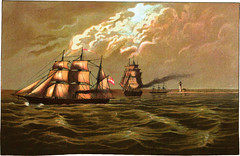
Sunday, June 30.—Dies memorabilis. At about 2 a.m. the steamer Empire Parish came alongside and put on board of us about 100 barrels of coal. At 10:30 a.m. this steamer having returned from Pass à l’Outre, a boatman pulled under our stern and informed us that the Brooklyn was no where to be seen and that the pass was all clear. We immediately got underway and steamed down the pass. The pilot, becoming alarmed, expressed his unwillingness to take us out, as he had not been out of the pass for three months and “would not run us ashore for anything.” This was really provoking. However, I hoisted my jack for a pilot, and as good luck would have it, as I ran by the pilot station a bold fellow jumped on board of me and his wife waved him on to his duty as we passed, and we continued on our course rapidly for the bar. In the meantime we had some time before discovered the Brooklyn some 7 or 8 miles to the southward of the bar under steam and hurrying up to prevent our escape. We dashed by the Bremen ship on the bar which considerately slacked a bow warp to let us pass more conveniently , and hauling close round her head spars to the northward, we were in a few moments outside of the bar. The Brooklyn had by this time approached us within about 4 miles, and was making every effort to overhaul us. A deeply exciting chase commenced, and I was for some time doubtful of my success. The Brooklyn had the reputation of being very fast both under sail and steam, and I was very doubtful whether my gallant little ship had the heels of her. The Brooklyn having made sail,we did the same, steering first N.N.E., then N.E. by N., then N. E., then N. E.by E., and so hauling in a gradual curve seaward . The Brooklyn having emerged from a squall in which she had been hid loomed up very large with her heavy battery and tall spars, her flag being plainly distinguishable at her peak. At length it began to be perceptible that we were dropping her by slow degrees, and my excited nervous system experienced a partial relaxation from the tension to which it had been strained for the last three hours. At 3:30 the Brooklyn, seeing that we had the heels of her, gave up the chase and bore up to the northward. Called on hands, sent them into the rigging and gave three cheers for the Confederate flag, after which, by invitation, I met the officers in the wardroom and drank a glass of wine with them in honor of the event. It was a positive luxury as the evening set in to breathe the pure air and look over the vast expanse of blue waters, with the feeling of a liberated prisoner. What an eventful career we have before us! May the Almighty smile upon us and our cause, and may we show ourselves worthy servants of Him and it. Night beautiful and starlight, with a light in the north throwing a pencil of rays to the northeast as if lighting us on our way.
0 comments

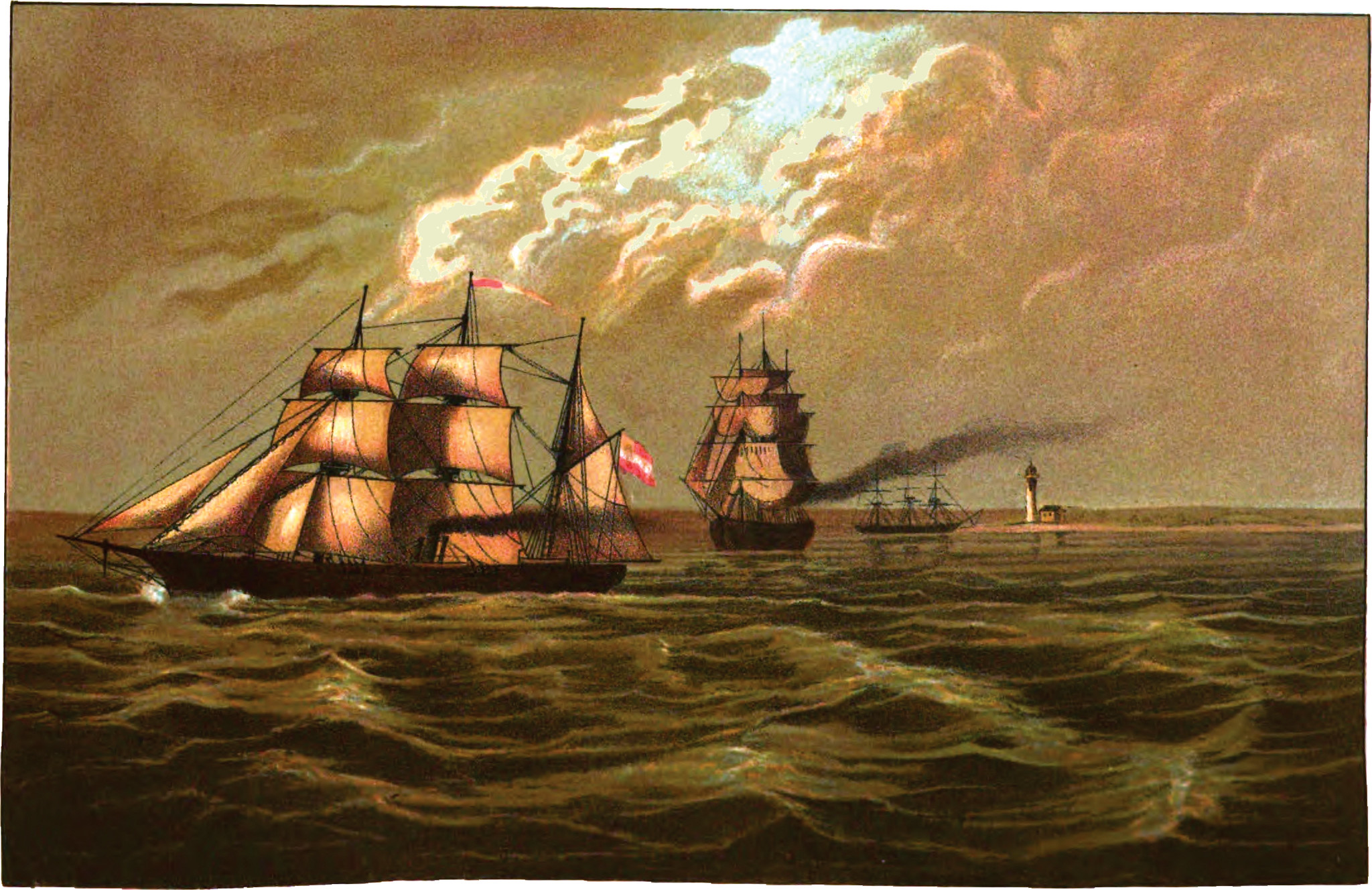
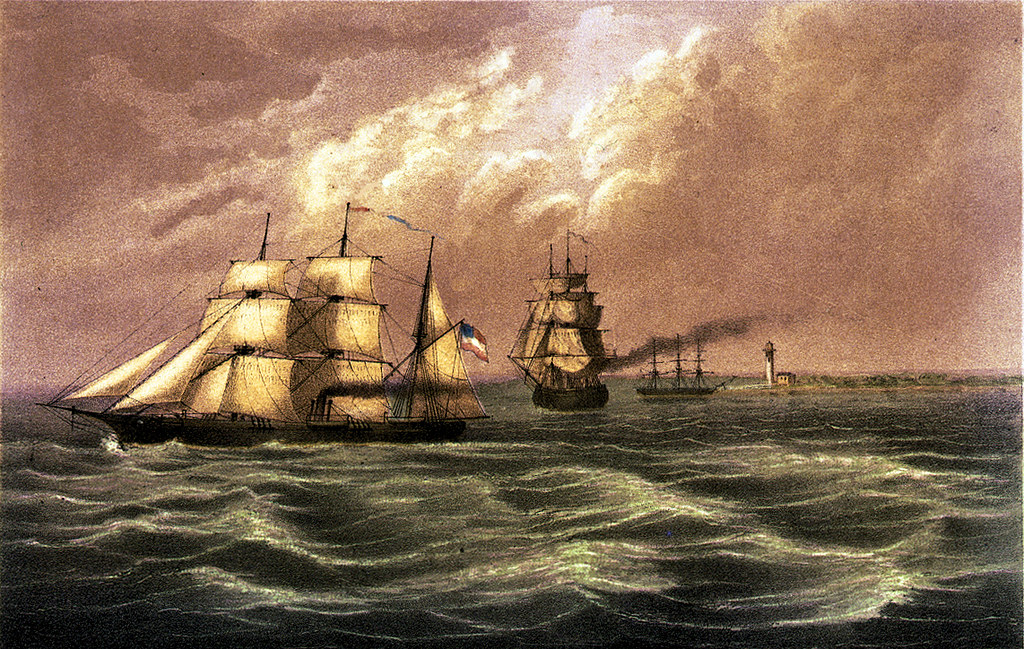
The Sumter running the blockade of Pass à l’Outre, by the enemy’s Ship Brooklyn, on the 30th June, 1861

Miscellaneous document sources

The Sumter running the blockade of Pass à l'Outre, by the enemy's Ship Brooklyn, on the 30th June, 1861
From Service Afloat: Or, The Remarkable Career of the Confederate Cruisers Sumter and Alabama, During the War Between the States, by Rafael Semmes

0 comments

Rebel War Clerk

Civil War Day-by-Day

JUNE 30th.—My family engaged packing trunks. They leave immediately.

0 comments

“A camp is a queer place;”—Rutherford B. Hayes

Diary and Letters of Rutherford Birchard Hayes

CAMP CHASE, June 30, 1861.

DEAREST:–Sunday morning, according to army regulations, there is to be a mustering and inspection of all men, visiting of sick quarters, etc., etc., on the last Sunday of each month. We have gone through with it, and have found, with a few exceptions, matters in good sort. Our colonel is fond of pleasantry, amiable and social. He enjoys the disposition of Matthews and myself to joke, and after duty, we get jolly. But he has not a happy way of hitting the humors of the men. Still, as we think him a kind-hearted, just man, we hope the men will learn to appreciate his good qualities, in spite of an unfortunate manner.

I have had some of the jolliest times the last week I have any recollection of. A camp is a queer place; you will enjoy being here. Matthews writes his wife not to come until the men are uniformed. This will be in about ten days we suppose. I don’t want you to wait on that account, but would like to have you stay until after we get on our good “duds.” Mother and Platt were out with Ruddy last night. He wanted to stay with us very much, but his father objected; he promised to let him stay out here with Birch.

I have heard nothing from Clendenin, but our colonel says he thinks Dr. Joe will be our physician, even if Clendenin concludes to accept the post he is offered in the Twenty-sixth. I hope he is right, and as he has had some talk with Governor Dennison on the subject, I am inclined to put faith in his conjecture.

Affectionately, your

B.

MRS. HAYES.

0 comments

CSS Sumter running the blockade

Library of Congress

CSS Sumter running the blockade
The Sumter running the blockade of Pass à l’Outre, by the enemy’s Ship Brooklyn, on the 30th June, 1861 (Library of Congress)

1869 Color lithograph by Kelly, Piet & Co., Baltimore

CSS Sumter, a 473-ton bark-rigged screw steam cruiser, was built as the merchant steamship Habana at Philadelphia in 1859 for McConnell’s New Orleans & Havana Line. She was later renamed Gibraltar or Gibraltar of Liverpool.

The merchant steamship Habana was purchased by the Confederate Government at New Orleans in April 1861; she was converted to a cruiser and placed under the command of Raphael Semmes. Renamed Sumter, she was commissioned in the Confederate Navy on 3 June 1861 and broke through the Federal blockade of the Mississippi River mouth late in that month.

Read much more about CSS Sumter. (Wikipedia)

0 comments

“We have had considerable excitement in our company lately in regard to the conduct of our officers.”–Army letters of Oliver Willcox Norton.

Civil War Day-by-Day

Camp Wright, Hulton, Penn.,

Sunday, June 30, 1861.

Dear Sister L.:–

Major General McCall was here on Friday and organized two new regiments for the war. There are now in this camp and Camp Wilkins about five thousand men. We had a review of all the troops in this camp Friday afternoon. The General expressed himself well pleased with our appearance.

Last night our regiment was drawn up in line of battle and we had a game of–charge bayonet. We are all armed now, you know, and, at the word, the bristling points came down and we started across the plain. We kept close together in good line till we almost reached the enemy (a crowd of spectators, unarmed women and children) when they fired a volley of screams at us and turned and fled. We broke ranks and pursued them, but as they seemed to get the better of us, we gave up the pursuit and fell into line. We received a lecture for breaking ranks and then faced about and charged again, this time in first-rate order. We tried it two or three times, succeeding very well, and then came the tug of war. A crowd of spectators had gathered on the back side of the field towards the river. Colonel Grant saw we wanted some fun and he drew us up in front of their terrible battery of laughter. We moved on steadily till the command, “Double quick;” “Clear the field.” Our Captain, who is not over nice in choice of words, sprang forward and sang out, “Forward boys, give ’em h–l.” Oh, what a scene! Every man did his best to outrun the rest, and with the wildest whoops we brought up at the fence in a cloud of dust and the field was cleared. The “Charge of the Light Brigade” was nothing in comparison to that. We had but few mishaps. – E. A. S. (the Reverend) lost one of his pearly false teeth and had to stop to find it, and Jack W. fell down and ran his bayonet into the ground.

We have got out of ball-cartridges and are practicing in skirmishing with blank-cartridges. You would laugh to see us fall flat on our faces and fire a volley and then roll over on our backs and load. We do this, however, and it is not so difficult as it might seem. Of course, we are not so liable to be hit by balls when lying on our backs. We just rise, so as to support the gun on our elbows, fire, and fall flat again, then tumble on the back and slide the gun down till the butt rests on the ground between the heels, and the muzzle is right over the face where a cartridge can be put in and sent home very easily. Company I is very expert in this. They will be running on double quick, and at the word, fall, fire and load in half a minute.

I have heard of no arrangements for the Fourth yet. Colonel McLane has gone to Erie, and some say he expects to have us there on the Fourth, but I think that’s all camp talk. The paymaster is to be here and pay off Colonel Hay’s and Colonel Jackson’s regiments this week. Some say he will pay us, but I guess all we will get won’t make us rich.

We have had considerable excitement in our company lately in regard to the conduct of our officers. It is ascertained that they are cheating us in a rascally manner. Each company is allowed seventy-seven rations per day for the privates and non-commissioned officers and musicians, and each commissioned officer is allowed four rations per day. Properly cooked and distributed one ration is all a man can eat and it almost always happens that some of the company are absent, and the law says, “That, if anything is saved from their rations the company may sell it and raise a company fund.” In this way Company B has now a fund of $200. Well, our three officers, instead of drawing their own rations, have boarded themselves and servant, all this time, out of ours, thus keeping us half the time without enough to eat, and depriving us of selling any extra allowance when we have it. A ration is valued at thirty cents, and by this course, each one of the officers saves $1.20 per day, besides a ration for his servant, making $1.50 per day, amounting to the nice little sum of $45 per month for each one. Not content with this they go a little deeper. A rich old farmer named Black sent nine dozen of eggs and several pounds of butter marked especially for the privates of Company G. Not a private in the company got an egg, and only a little of the butter. Now I call that decidedly mean. Officers who are making $150 to $200 a month must cabbage the $11 privates’ present. M. H. Goold gave the Captain a pretty good thrust about it yesterday. The Captain said he thought our talk about that had better stop, he was getting disgusted with it. Goold told him he thought the Captain was not more disgusted with it than the rest of us. or had more reason to be. The boys of Girard say they have not had a cent of the money that was put into the officers’ hands for them and cannot get postage stamps of them without paying ten cents for three. I can’t tell what has become of all the money for the Springfield boys. There are not more than thirty in the company and $150 would make $5 apiece, and I can’t find one who says he has had a dollar. I have had twenty-five cents and seven stamps. What has become of the money? Any talk like that makes the officers d–n us up hill and down. There will be some talk about it though, if we ever get back to Girard. I must close. I hope you will write soon.

0 comments

“As to the danger to myself, I am free to confess that I feel perhaps too indifferent.”–Letters from Elisha Franklin Paxton.

Elisha Franklin Paxton – Letters from camp and field while an officer in the Confederate Army

Camp Stephens, near Martinsburg, June 30, 1861.

I wrote to you last Monday, and immediately was ordered off on another expedition, in which I have been engaged the greater part of the past week. I was in charge of a small force engaged in destroying a bridge some ten miles from our camp on the railroad. It was a rather dangerous expedition, but I have become so much accustomed to the prospect of danger that it excites no alarm. I thought when we left Winchester that we certainly would have had a battle in a very few days; but two weeks have elapsed, and there is, I think, less reason to expect one now than there has been heretofore. The enemy is encamped on the opposite side of the Potomac some ten miles from here, but, I am satisfied, in less force than we have in this vicinity. Under such circumstances, if we get a fight we shall have to cross the river and make the attack. Our picket-guards occasionally come in contact, and the other day one of the Augusta Cavalry was severely wounded. I hope you are having good success as a farmer; so, if I should be left behind when the war is over, you may be able to take care of yourself. You think, Love, I write very indifferently about it. As to the danger to myself, I am free to confess that I feel perhaps too indifferent. Not so as to the separation from loved wife and little ones at home. I never knew what you were worth to me until this war began and the terrible feeling came upon me that I had pressed you to my bosom, perhaps, for the last time. I always keep upon my person the handkerchief which I took from your hand when we separated. It was bathed in tears which that sad moment brought to the eyes of my darling. I will continue to wear it. It may yet serve as a bandage to staunch a wound with. I keep one of your letters, which may serve to indicate who I am, where may be found the fond wife who mourns my death. May neither be ever needed to serve such a purpose! Enclosed I send a letter from James Edmonson to his grandmother. Say to Mrs. Chapin that she may rely upon my acting the part of comrade and friend to George. Kiss the children for me, and for yourself accept all that a fond lover and husband can offer.

0 comments

The Sumter runs the blockade at Pass à l’Outre, past USS Brooklyn

Miscellaneous document sources

From Service Afloat: Or, The Remarkable Career of the Confederate Cruisers Sumter and Alabama, During the War Between the States, by Rafael Semmes, beginning on page 116.

Here the conversation dropped, for an officer now came to report to me that a boat had just shoved off from the pilots’ station, evidently with a pilot in her. Casting my eyes in the given direction, I saw a whale-boat approaching us, pulled by four stout blacks, who were bending like good fellows to their long ashen oars, and in the stern-sheets was seated, sure enough, the welcome pilot, swaying his body to, and fro, as his boat leaped under the oft-repeated strokes of the oars, as though he would hasten her already great speed. But more beautiful still was another object which presented itself. In the balcony of the pilot’s house, which had been built in the very marsh, on the margin of the river, there stood a beautiful woman, the pilot’s young wife, waving him on to his duty, with her handkerchief. We could have tossed a biscuit from the Sumter to the shore, and I uncovered my head gallantly to my fair countrywoman. A few moments more, and a tow-line had been thrown to the boat, and the gallant young fellow stood on the horse-block beside me.

As we swept past the light-house wharf, almost close enough to touch it, there were other petticoats fluttering in the breeze, the owners of which were also waving handkerchiefs of encouragement to the Sumter. I could see my sailors’ eyes brighten at these spectacles, for the sailor’s heart is capacious enough to love the whole sex, and I now felt sure of their nerves, in case it should become necessary to tax them. Half a mile or so, from the light-house, and the bar is reached. There was a Bremen ship lying aground on the bar, and there was just room, and no more, for us to pass her. She had run out a kedge, and had a warp attached to it that was lying across the passage-way. The crew considerately slackened the line, as we approached, and in another bound the Sumter was outside the bar, and the Confederate flag was upon the high seas! We now slackened our speed, for an instant —only an instant, for my officers and men all had their wits about them, and worked like good fellows—to haul the pilot’s boat alongside, that he might return to the shore. As the gallant young fellow grasped my hand, and shook it warmly, as he descended from the horse-block, he said, “Now, Captain, you are all clear; give her h—ll, and let her go!”
We had now nothing to do, but turn our attention to the enemy. The Brooklyn, as we cleared the bar, was about three and a half, or four miles distant; we were therefore just out of reach of her guns, with nothing to spare. Thick volumes of smoke could be seen pouring from the chimneys of both ships; the firemen, and engineers of each evidently doing their best. I called a lieutenant, and directed him to heave the log. He reported our speed to be nine, and a half knots. Loth to believe that we could be making so little way, through the yet turbid waters, which were rushing past us with great apparent velocity, I directed the officer to repeat the experiment; but the same result followed, though he had paid out the line with a free hand. I now sent for the engineer, and, upon inquiry, found that he was doing his very best—“though,” said he, “there is a little drawback, just now, in the ‘foaming’ of our boilers, arising from the suddenness with which we got up steam; when this subsides, we may be able to add half a knot more.”

The Brooklyn soon loosed, and set her sails, bracing them sharp up on the starboard tack. I loosed and set mine, also. The enemy’s ship was a little on my weather quarter, say a couple of points, and had thus slightly the weather-gauge of me. As I knew I could lay nearer the wind than she, being able to brace my yards sharper, and had besides, the advantage of larger fore-and-aft sails, comparatively, stay-sails, try-sails, and a very large spanker, I resolved at once to hold my wind, so closely, as to compel her to furl her sails, though this would carry me a little athwart her bows, and bring me perhaps a little nearer to her, for the next half hour, or so. A rain squall now came up, and enveloped the two ships, hiding each from the other. As the rain blew off to leeward, and the Brooklyn reappeared, she seemed fearfully near to us, and I began to fear I should realize the foreboding of my lieutenant. I could not but admire the majesty of her appearance, with her broad flaring bows, and clean, and beautiful run, and her masts, and yards, as taunt and square, as those of an old time sailing frigate. The stars and stripes of a large ensign flew out from time to time, from under the lee of her spanker, and we could see an apparently anxious crowd of officers on her quarter-deck, many of them with telescopes directed toward us.  She had, evidently, I thought, gained upon us, and I expected every moment to hear the whiz of a shot; but still she did not fire.

I now ordered my paymaster to get his public chest, and papers ready for throwing overboard, if it should become necessary. At this crisis the engineer came up from below, bringing the welcome intelligence that the “foaming” of his boilers had ceased, and that his engine was “working beautifully,” giving the propeller several additional turns per minute. The breeze, too, favored me, for it had freshened considerably; and what was still more to the purpose, I began to perceive that I was “eating” the Brooklyn “out of the wind ”; in other words, that she was falling more and more to leeward. I knew, of course, that as soon as she fell into my wake, she would be compelled to furl her sails. This she did in half an hour or so afterward, and I at once began to breathe more freely, for I could still hold on to my own canvas. I have witnessed many beautiful sights at sea, but the most beautiful of them all was when the Brooklyn let fly all her sheets, and halliards, at once, and clewed up, and furled, in man-of-war style, all her sails, from courses to royals. We now began to gain quite perceptibly on our pursuer, and at half-past three, the chase was abandoned, the baffled Brooklyn retracing her steps to Pass à l’Outre, and the Sumter bounding away on her course seaward.

We fired no gun of triumph in the face of the enemy—my powder was too precious for that—but I sent the crew aloft, to man the rigging, and three such cheers were given for the Confederate flag, “that little bit of striped bunting,” that had waved from the Sumter’s peak during the exciting chase, as could proceed only from the throats of American seamen, in the act of defying a tyrant—those cheers were but a repetition of many such cheers that had been given, by our ancestors, to that other bit of “striped bunting ” which had defied the power of England in that olden war, of which our war was but the logical sequence.
0 comments

“Tramp, tramp, tramp, went the Sixteenth through Baltimore.”–Woolsey Family Letters, Joseph Howland to Eliza Woolsey Howland.

Woolsey family letters during the War for the Union

Washington, June 3o, 1861.

Our journey on was a hard one. We reached Harrisburg late Friday p. m., and Baltimore at sunrise Saturday. Our passage through Baltimore was unmolested, but was one of the most impressive scenes imaginable. We marched through about 8 o’clock without music and with colors furled, in perfect silence, marching in quick time, only pausing once to rest. The streets were full of people, but we did not get one word of welcome or a single smile except from two little girls in an upper window and half a dozen old darkies standing in doorways. At the head of the column of eight hundred stern-faced men walked the Colonel with his sword sheathed and a hickory stick in his hand. Once a rough fellow in the crowd (a city official) asked tauntingly, “Where’s your music?” and Colonel Davies, gritting his teeth, replied, “In our cartridge boxes!” We were all fully armed and supplied with ammunition, and had received full instructions how to act in case of an attack. Tramp, tramp, tramp, went the Sixteenth through Baltimore in the early morning, and the crowd looked cold and bitter at us, and we looked stern and ready at them. All the road from Harrisburg to Washington is guarded by strong bodies of federal troops, and they are needed.

We got here safely at noon yesterday, and, after a couple of hours’ delay under the shade of the trees of the Capitol grounds, we marched out to “Camp Woolsey,” for so this camp is named in your honor! There are 100,000 soldiers in Washington.

I hope to see you very soon. I don’t know what you will do with yourself here, but, if you want to come, your coming will make me very happy. God bless you!

0 comments

“If we find that we shall be allowed to march with the regiment, or rather ride, we could easily have grey flannel skirts and shirts made in Washington.”—Woolsey family letters, Georgeanna Muirson Woolsey to Eliza Woolsey Howland.

Woolsey family letters during the War for the Union

New York, Sunday.

My dear Eliza: In anticipation of a possible march on Tuesday I have got myself ready and hold myself under orders for any moment. As for some sort of a hospital costume, if we chance to need one, I have two grey cottonish cross-grained skirts, and a Zouave jacket giving free motion to the arms–so the skirts can be, one of them, always in the wash; and a white Zouave will take the place of the waist when that is in the tub. Four white aprons with waists and large pockets; two stick-out and washable petticoats to take the place of a hoop, and a nice long flannel dressing-gown, which one may put on in a hurry and fly out in, if the city is bombarded or “anything else.” Then for quiet and civil costume, I have only one dress made of black grenadine, like Mary’s, and a black Neapolitan straw with green ribbon will make it all very nice. I shall make up a trunk of towels and old scraps of linen and cotton, soap, cologne, oil-silk, sponges, etc., and have it stored away in the hotel in Washington for use, if necessary. Any towels or old sheets you may have to dispose of we shall probably find useful if we are able to do anything for the sick. I have also under consideration a small camp cooking affair, about two feet square, with lamp and all complete, which I shall probably get–cheap and very useful in an emergency–could cook up little things for ourselves at any rate. If we find that we shall be allowed to march with the regiment, or rather ride, we could easily have grey flannel skirts and shirts made in Washington. So I don’t see that we may not be very comfortable and useful, and consequently happy, even in following the war.

0 comments

Civil War Comet

Miscellaneous document sources
Civil War Comet - The Great Comet of 1861

The Great Comet of 1861 formally designated C/1861 J1 and 1861 II, is a long-period comet that was visible to the naked eye for approximately 3 months. It was categorized as a Great Comet, one of the eight greatest comets of the 19th century, according to Donald Yeomans.

On June 30, 1861, the comet made its closest approach to the Earth at a distance of 0.1326 AU (19,840,000 km; 12,330,000 mi). During the Earth close approach the comet was estimated to be between magnitude 0 and −2 with a tail of over 90 degrees. As a result of forward scattering C/1861 J1 even cast shadows at night (Schmidt 1863; Marcus 1997). During the night of 1861 June 30 — July 1, the famed comet observer J. F. Julius Schmidt watched in awe as the great comet C/1861 J1 cast shadows on the walls of the Athens Observatory. The comet may have interacted with the Earth in an almost unprecedented way. For two days, when the comet was at its closest, the Earth was actually within the comet’s tail, and streams of cometary material converging towards the distant nucleus could be seen.

https://en.wikipedia.org/wiki/C/1861_J1

0 comments

“Sixty thousand here now on this side of the River.”—Horatio Nelson Taft

Diary of US patent clerk Horatio Nelson Taft.

SUNDAY, JUNE 30, 1861.

Rained a little this morning but I went to church with wife in the morning. Took a walk up to the Depot in the evening, saw the arrival of the NY15 Regt (Col. McLeoud Murphy). Five Regts have arrived today. All the quarters (Buildings) on the Ave appear to be full, but they will go into camp by tomorrow and make room for more. Sixty thousand here now on this side of the River. Was in at Willards, Members of Congress are now coming in.

______

The three diary manuscript volumes, Washington during the Civil War: The Diary of Horatio Nelson Taft, 1861-1865, are available online at The Library of   Congress.

0 comments

“The President caught something of what I was saying, and asked me to repeat it, which I did, although I was scared to death.” Mary Chesnut’s Diary

Civil War Day-by-Day

June 29th.–Mrs. Preston, Mrs. Wigfall, Mary Hammy and I drove in a fine open carriage to see the Champ de Mars. It was a grand tableau out there. Mr. Davis rode a beautiful gray horse, the Arab Edwin de Leon brought him from Egypt. His worst enemy will allow that he is a consummate rider, graceful and easy in the saddle, and Mr. Chesnut, who has talked horse with his father ever since he was born, owns that Mr. Davis knows more about horses than any man he has met yet. General Lee was there with him; also Joe Davis and Wigfall acting as his aides.

Poor Mr. Lamar has been brought from his camp–paralysis or some sort of shock. Every woman in the house is ready to rush into the Florence Nightingale business. I think I will wait for a wounded man, to make my first effort as Sister of Charity. Mr. Lamar sent for me. As everybody went, Mr. Davis setting the example, so did I. Lamar will not die this time. Will men flatter and make eyes, until their eyes close in death, at the ministering angels? He was the same old Lamar of the drawing-room.

It is pleasant at the President’s table. My seat is next to Joe Davis, with Mr. Browne on the other side, and Mr. Mallory opposite. There is great constraint, however. As soon as I came I repeated what the North Carolina man said on the cars, that North Carolina had 20,000 men ready and they were kept back by Mr. Walker, etc. The President caught something of what I was saying, and asked me to repeat it, which I did, although I was scared to death. “Madame, when you see that person tell him his statement is false. We are too anxious here for troops to refuse a man who offers himself, not to speak of 20,000 men.” Silence ensued–of the most profound.

Uncle H. gave me three hundred dollars for his daughter Mary’s expenses, making four in all that I have of hers. He would pay me one hundred, which he said he owed my husband for a horse. I thought it an excuse to lend me money. I told him I had enough and to spare for all my needs until my Colonel came home from the wars.

Ben Allston, the Governor’s son, is here–came to see me; does not show much of the wit of the Petigrus; pleasant person, however. Mr. Brewster and Wigfall came at the same time. The former, chafing at Wigfall’s anomalous position here, gave him fiery advice. Mr. Wigfall was calm and full of common sense. A brave man, and without a thought of any necessity for displaying his temper, he said: “Brewster, at this time, before the country is strong and settled in her new career, it would be disastrous for us, the head men, to engage in a row among ourselves.”

As I was brushing flies away and fanning the prostrate Lamar, I reported Mr. Davis’s conversation of the night before. “He is all right,” said Mr. Lamar, “the fight had to come. We are men, not women. The quarrel had lasted long enough. We hate each other so, the fight had to come. Even Homer’s heroes, after they had stormed and scolded enough, fought like brave men, long and well. If the athlete, Sumner, had stood on his manhood and training and struck back when Preston Brooks assailed him, Preston Brooks’s blow need not have been the opening skirmish of the war. Sumner’s country took up the fight because he did not. Sumner chose his own battle-field, and it was the worse for us. What an awful blunder that Preston Brooks business was!” Lamar said Yankees did not fight for the fun of it; they always made it pay or let it alone.

Met Mr. Lyon with news, indeed–a man here in the midst of us, taken with Lincoln’s passports, etc., in his pocket–a palpable spy. Mr. Lyon said he would be hanged –in all human probability, that is.

A letter from my husband written at Camp Pickens, and saying: “If you and Mrs. Preston can make up your minds to leave Richmond, and can come up to a nice little country house near Orange Court House, we could come to see you frequently while the army is stationed here. It would be a safe place for the present, near the scene of action, and directly in the line of news from all sides.” So we go to Orange Court House.

Read the story of Soulouque, ¹ the Haytian man: he has wonderful interest just now. Slavery has to go, of course, and joy go with it. These Yankees may kill us and lay waste our land for a while, but conquer us–never!

______

¹Faustin Elie Soulouque, a negro slave of Hayti, who, having been freed, took part in the insurrection against the French in 1803, and rose by successive steps until in August, 1849, by the unanimous action of the parliament, he was proclaimed emperor.

0 comments

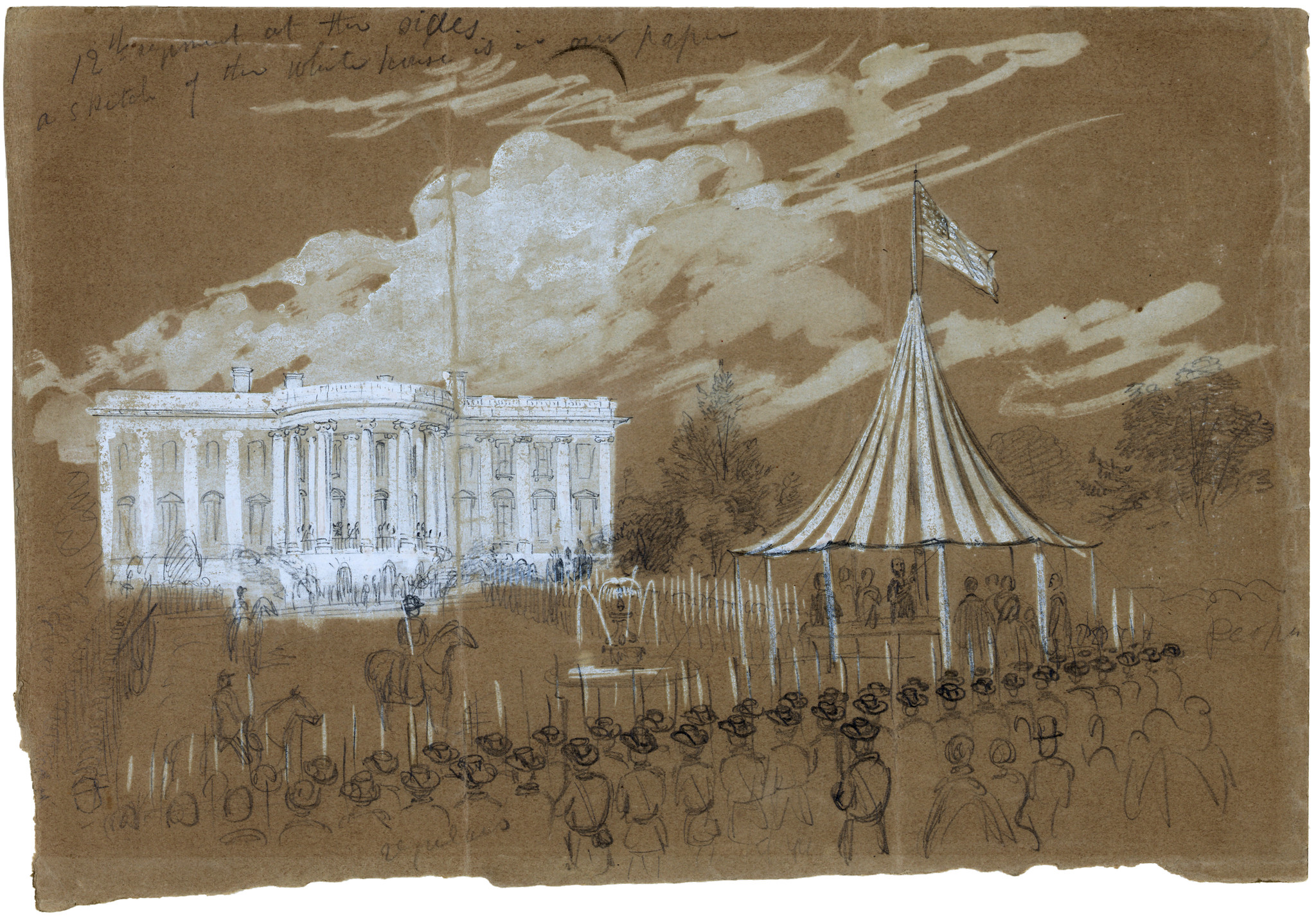
Flag raising at the White House

Library of Congress

Flag raising at the White House, June 29, 1861
Title: Flag raising at the White House
Creator(s): Waud, Alfred R. (Alfred Rudolph), 1828-1891, artist
Date Created/Published: [1861 June 29]
Medium: 1 drawing on olive paper : pencil and Chinese white ; 19.3 x 27.7 cm. (sheet).
Reproduction Number: LC-DIG-ppmsca-21165 (digital file from original item, recto) LC-DIG-ppmsca-21166 (digital file from original item, verso) LC-USZC4-5101 (color film copy transparency) LC-USZ62-4530 (b&w film copy neg.)
Rights Advisory: No known restrictions on publication.
Call Number: DRWG/US – Waud, no. 291 (A size) [P&P]
Repository: Library of Congress Prints and Photographs Division Washington, D.C. 20540 USA
Notes:
…..Title inscribed on verso.
…..Inscribed on verso: Flag raising at the White House – see daily papers-.
…..Reference print available in the Civil War Drawings file 1861.
…..Gift, J.P. Morgan, 1919 (DLC/PP-1919:R1.2.291)
…..Forms part of: Morgan collection of Civil War drawings.

Library of Congress file permalink

___________
Mike’s notes:

Note – This image has been digitally adjusted for one or more of the following:
– fade correction,
– color, contrast, and/or saturation enhancement
– selected spot and/or scratch removal
– cropped for composition and/or to accentuate subject

0 comments

Horatio Nelson Taft

Diary of US patent clerk Horatio Nelson Taft.

SATURDAY 29

It has been a pleasant comfortable day. Maj Genl John C. Fremont arrived last evening, and is at “Willards.” Much is expected of him in this contest. The Event of the day was the raising of the Stars & Stripes at tent on the Prests Grounds by the Prest. It caught in going up and was torn in among the Stars, which was taken by some superstitious persons as a bad omen. Our whole family was there, “Dr Pyne” officiated.

______

The three diary manuscript volumes, Washington during the Civil War: The Diary of Horatio Nelson Taft, 1861-1865, are available online at The Library of   Congress.

0 comments

Rebel War Clerk

Civil War Day-by-Day

JUNE 29th.—I cannot support my family here, on the salary I receive from the government; and so they leave me in a few days to accept the tendered hospitality of Dr. Custis, of Newbern, N. C., my wife’s cousin.

0 comments

The St. Paul’s Rifles have been ordered to the Coast

Journal of Meta Morris Grimball
Meta Morris Grimball

June 29

       Lewis writes very pleasantly about his campaign in Virginia, I rather think he likes the excitement. His Company have moved forward and form the advance guard of the Southern Army, and this he likes, he would prefer remaining in Virginia to keeping his Commission of Lieutenant.

       The St. Paul’s Rifles have been ordered to the Coast and are at Clarks Bay where they are not likely to see any service.—John is in Beaufort.—

0 comments