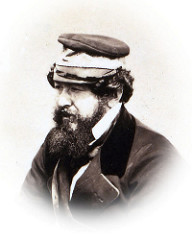
William Howard Russell’s Diary: “…what will Russell say?”

My Diary North and South – William Howard Russell

August 22nd.–

“The little dogs and all,
Tray, Blanche, and Sweetheart,
See they bark at me.”

The North have recovered their wind, and their pipers are blowing with might and main. The time given them to breathe after Bull Run has certainly been accompanied with a greater development of lung and power of blowing than could have been expected. The volunteer army which dispersed and returned home to receive the Io Pæans of the North, has been replaced by better and more numerous levies, which have the strong finger and thumb of General McClellan on their windpipe, and find it is not quite so easy as it was to do as they pleased. The North, besides, has received supplies of money, and is using its great resources, by land and sea, to some purpose, and as they wax fat they kick.

A general officer said to me, “Of course you will never remain, when once all the press are down upon you. I would not take a million dollars and be in your place.” “But is what I’ve written untrue?” “God bless you! do you know in this country if you can get enough of people to start a lie about any man, he would be ruined, if the Evangelists came forward to swear the story was false. There are thousands of people who this moment believe that McDowell, who never tasted anything stronger than a water melon in all his life, was helplessly drunk at Bull’s Run. Mind what I say; they’ll run you into a mud hole as sure as you live.” I was not much impressed with the danger of my position further than that I knew there would be a certain amount of risk from the rowdyism and vanity of what even the Americans admit to be the lower orders, for which I had been prepared from the moment I had despatched my letter; but I confess I was not by any means disposed to think that the leaders of public opinion would seek the small gratification of revenge, and the petty popularity of pandering to the passions of the mob, by creating a popular cry against me. I am not aware that any foreigner ever visited the United States who was injudicious enough to write one single word derogatory to their claims to be the first of created beings, who was not assailed with the most viperous malignity and rancour. The man who says he has detected a single spot on the face of their sun should prepare his winding sheet.

The New York Times, I find, states “that the terrible epistle has been read with quite as much avidity as an average President’s message. We scarcely exaggerate the fact when we say, the first and foremost thought on the minds of a very large portion of our people after the repulse at Bull’s Run was, what will Russell say?” and then they repeat some of the absurd sayings attributed to me, who declared openly from the very first that I had not seen the battle at all, to the effect “that I had never seen such fighting in all my life, and that nothing at Alma or Inkerman was equal to it.” An analysis of the letter follows, in which it is admitted that “with perfect candour I purported to give an account of what I saw, and not of the action which I did not see,” and the writer, who is, if I mistake not, the Hon. Mr. Raymond, of the New York Times, like myself a witness of the facts I describe, quotes a passage in which I say, “There was no flight of troops, no retreat of an army, no reason for all this precipitation,” and then declares “that my letter gives a very spirited and perfectly just description of the panic which impelled and accompanied the troops from Centreville to Washington. He does not, for he cannot, in the least exaggerate its horrible disorder, or the disgraceful behaviour of the incompetent officers by whom it was aided, instead of being checked. He saw nothing whatever of the fighting, and therefore says nothing whatever of its quality. He gives a clear, fair, perfectly just and accurate, as it is a spirited and graphic account of the extraordinary scenes which passed under his observation. Discreditable as those scenes were to our army, we have nothing in connection with them whereof to accuse the reporter; he has done justice alike to himself, his subject, and the country.”

Ne nobis blandiar, I may add, that at least I desired to do so, and I can prove from Northern papers that if their accounts were true, I certainly much “extenuated and nought set down in malice”–nevertheless, Philip drunk is very different from Philip sober, frightened, and running away, and the man who attempts to justify his version to the inebriated polycephalous monarch is sure to meet such treatment as inebriated despots generally award to their censors.
0 comments

“The Brazilian Minister wants to rent my House & furniture for one of his friends. I hardly know what to do.”—Horatio Nelson Taft

Diary of US patent clerk Horatio Nelson Taft.

WEDNESDAY 21

This has been a fine cool day but bright with a feeling of Autumn in the air. I saw the Comr this morning but could get nothing satisfactory from him in reference to my restoration to the Pat office. Came home about noon. The Brazilian Minister wants to rent my House & furniture for one of his friends. I hardly know what to do. I called upon Mr Connoly on M St this eve’g. He has a daughter at the Mount Holyok[e] School where I may send Julia.

______

The three diary manuscript volumes, Washington during the Civil War: The Diary of Horatio Nelson Taft, 1861-1865, are available online at The Library of   Congress.

0 comments

“Men are constantly arriving, showing the rapid concentration at this point of a large body of troops.”—Rutherford B. Hayes

Diary and Letters of Rutherford Birchard Hayes

August 21.–Changed camping place at Buckhannon to a fine spot one and one-half miles on road to Cheat Mountain. Got settled with McMullen’s Battery just as rain set in at night. Had letters from Jim and Will Scott and Uncle George.

_______

BUCKHANNON, VIRGINIA, August 21, 1861.

DEAR MOTHER:–You may send this letter, showing my whereabouts, to Lucy. I have no time to write much. On Sunday night, about 12 o’clock, we were ordered to quietly pack and march rapidly to this place. Some of our men had just returned from long scouting expeditions. They were weary with marching over the hills in rain and mud, and here was another march without sleeping. It was borne cheerfully–the men supposing it was to meet an enemy.

We find this a lovely spot, superior in some respects to the scenery about Weston. We have a beautiful camp about one and one-half miles from the village. There are here parts of five regiments–all but this from Cincinnati. Men are constantly arriving, showing the rapid concentration at this point of a large body of troops. We are ignorant of its purpose, but suppose it to be for service. We are all so healthy. I meet many Cincinnati friends and enjoy the greetings.

I received a letter from Uncle, directed to Clarksburg. I suppose that is still the best place to direct my letters. Write often. Let Uncle know where I am and how lately you have heard from me. Love to all.

Affectionately,

R. B. HAYES.

MRS. SOPHIA HAYES.

0 comments

Rebel War Clerk

Civil War Day-by-Day

AUGUST 21st.—Called in again by the Secretary to-day, I find the ominous communication to the President still there, although marked “immediate.” And there are no indications of Mr. Walker’s quitting office that I can see.

0 comments

Extracts from the journal of Commander Semmes, C.S. Navy, commanding C.S.S. Sumter

War of the Rebellion: from the Official Records of the Union and Confederate Armies and Navies
Wednesday, August 21.—Clear; temperature, pleasant. Returned the visit of the commander of the Abeille. He is a clever man, with pro-slavery sympathies, and seemed to understand well the cause of our quarrel with the North, but is a Frenchman all over and seemed to think we had not treated the pavillon Français with due respect in running down upon the Vulture with battery ready and men at quarters. I told him that both interest and inclination prompted us to conciliate the good will of the grand nation, and that we had only exercised one of the usual rights of war, both in using his ?ag and running down upon his ship at quarters.
0 comments

Two guns for their own use

Diary of Battery A, First Regiment, Rhode Island Light Artillery, by Theodore Reichardt

Wednesday, August 21.—The Twenty-eighth Pennsylvania received two guns for their own use. Signs of a demonstration show themselves this evening. All our baggage was sent off; the tents only left standing, ready to be burnt in case we had to leave.

0 comments

“The first day of camp life is past, and we had our first experience of a night in camp, sleeping on straw for a bed.”–Alexander G. Downing.

Diary of Alexander G. Downing; Company E, Eleventh Iowa Infantry

Wednesday, 21st—We drew our army cooking utensils this morning and one day’s rations, and then cleaned up our camp. Besides a part of the Eighth Iowa Infantry, there is a part of the Second Iowa Cavalry in camp. The first day of camp life is past, and we had our first experience of a night in camp, sleeping on straw for a bed.

0 comments

Journal of Surgeon Alfred L. Castleman.

Journal of Surgeon Alfred L Castleman.

21st.–I sit down to-night, journal on my knee, to write by the light of a tallow candle, stuck into the mouth of a whisky bottle, (whisky all out), that “I have nothing of importance to note to-day.”

0 comments

William Howard Russell’s Diary: American Vanity.—My own unpopularity for speaking the truth.

My Diary North and South – William Howard Russell

August 21st.–The echoes of Bull Run are coming back with a vengeance. This day month the miserable fragments of a beaten, washed out, demoralised army, were flooding in disorder and dismay the streets of the capital from which they had issued forth to repel the tide of invasion. This day month and all the editors and journalists in the States, weeping, wailing, and gnashing their teeth, infused extra gall into their ink, and poured out invective, abuse, and obloquy on their defeated general and their broken hosts. The President and his ministers, stunned by the tremendous calamity, sat listening in fear and trembling for the sound of the enemy’s cannon. The veteran soldier, on whom the boasted hopes of the nation rested, heartsick and beaten down, had neither counsel to give nor action to offer. At any moment the Confederate columns might be expected in Pennsylvania Avenue to receive the welcome of their friends and the submission of their helpless and disheartened enemies.

All this is forgotten–and much more, which need not now be repeated. Saved from a great peril, even the bitterness of death, they forget the danger that has passed, deny that they uttered cries of distress and appeals for help, and swagger in all the insolence of recovered strength. Not only that, but they turn and rend those whose writing has been dug up after thirty days, and comes back as a rebuke to their pride.

Conscious that they have insulted and irritated their own army, that they have earned the bitter hostility of men in power, and have for once inflicted a wound on the vanity to which they have given such offensive dimensions, if not life itself, they now seek to run a drag scent between the public nose and their own unpopularity, and to create such an amount of indignation and to cast so much odium upon one who has had greater facilities to know, and is more willing to tell the truth, than any of their organs, that he will be unable henceforth to perform his duties in a country where unpopularity means simply a political and moral atrophy or death. In the telegraphic summary some days ago a few phrases were picked out of my letters, which were but very faint paraphrases of some of the sentences which might be culled from Northern newspapers, but the storm has been gathering ever since, and I am no doubt to experience the truth of De Tocqueville’s remark, “that a stranger who injures American vanity, no matter how justly, may make up his mind to be a martyr.”

0 comments

Civil War Day-By-Day

Civil War Day-by-Day

August 21, 1861

  • Second Wheeling Convention adjourns.

A Chronological History of the Civil War in America1

  • Wheeling Convention adjourned sine die.
  • Skirmish at Cross Lanes, Va.

  1. A Chronological History of the Civil War in America by Richard Swainson Fisher, New York, Johnson and Ward, 1863
0 comments

A Rebel War Clerk’s Diary at the Confederate States Capital, By John Beauchamp Jones

Civil War Day-by-Day

AUGUST 20th.—Secretary Walker returned last night, having heard of the death of Col. Jones before reaching his destination. I doubt whether the Secretary would have thought a second time of what had been done in his absence, if some of his friends had not fixed his attention upon it. He shut himself up pretty closely, and none of us could see or hear whether he was angry. But calling me into his room in the afternoon to write a dispatch which he dictated, I saw, lying on his table, an envelope directed in his own hand to the President. Hints had been circulated by some that it was his purpose to resign. Could this communication be his resignation? It was placed so conspicuously before me where I sat that it was impossible not to see it. It was marked, too, “immediate.”

0 comments

Extracts from the journal of Commander Semmes, C.S. Navy, commanding C.S.S. Sumter

War of the Rebellion: from the Official Records of the Union and Confederate Armies and Navies
Tuesday, August 20.—Weather clear and temperature, out of the sun, quite cool and pleasant. Called on the governor and had an agreeable interview with him. Returned the calls also of the Dutch and French commanders. Received the visits of two Dutch commanders and several citizens. Made arrangements for receiving a supply of coal. The French steamer of war Abeille arrived from Cayenne. Sent an of?cer on board of her. Her commander called a few hours after.
0 comments

“It was our first meal in the army and consisted of boiled potatoes, fried bacon and baked beans.”–Alexander G. Downing.

Diary of Alexander G. Downing; Company E, Eleventh Iowa Infantry

Tuesday, 20th–I went early this morning to Inland, where all who enlisted were to meet and go to Davenport.[i] Several of the friends came in to see us off. There were forty-five of us and at 9 o’clock we left in wagons for Davenport. After a hot, dusty ride we arrived at Davenport at 4 o’clock in the afternoon, and marched out to Camp McClellan, where they received us very kindly. We had very fine barracks to go into and the boys of the Eighth Iowa had a good supper for us. It was our first meal in the army and consisted of boiled potatoes, fried bacon and baked beans. We have lots of straw to sleep on at night. We were to meet a part of a company from Le Claire under command of Captain Foster and together form one company in the Eighth Iowa Infantry. But Captain Foster did not come, and since there are only eight Le Claire boys here we have not enough to make a company.

[i] When I bade father good-by, he said: “Well, Alec, as you have made up your mind to go into the army, I want you to promise me that you will not enter into any of the vices that you will come in contact with while in the army, but try to conduct yourself just as if you were at home.” Of course I was not an angel while in the army, but I always remembered father’s advice and to that I attribute what little success I have had in life—and this is my seventy-second year. Father was in his forty-sixth year, but he told me that if it were not for leaving the family alone, he would go with me. He was a strong Union man, and his father had served all through the War of the Revolution, in the command of General Wayne.—A. G. D.

0 comments

“General Lyon killed and his troops routed.”—Diary of a Southern Refugee, Judith White McGuire.

Diary of a Southern Refugee During the War by Judith White McGuire

August 20.—We are rejoicing over a victory at Springfield, Missouri—General Lyon killed and his troops routed. Our loss represented large. I have only seen the Northern account.

No news from home, and nothing good from that quarter anticipated. We are among dear, kind friends, and have the home feeling which only such genuine and generous hospitality can give; but it sometimes overpowers me, when I allow myself to think of our uncertain future.

0 comments

“I was at home most of the day contriving what course to pursue for the time being.”—Horatio Nelson Taft

Diary of US patent clerk Horatio Nelson Taft.

TUESDAY, AUGUST 20, 1861.

Many people in the City were much alarmed last night at a report that “the rebels had crossed the River below and were marching on Washington.” Similar rumors are constantly afloat. Went to the Express Office and sent off (as requested) Lieut Martins trunk which was left with me. Called at the “National” and also a[t] Bradys Photograph Gallery. Saw Maj Anderson there. I was at home most of the day contriving what course to pursue for the time being.

______

The three diary manuscript volumes, Washington during the Civil War: The Diary of Horatio Nelson Taft, 1861-1865, are available online at The Library of   Congress.

0 comments

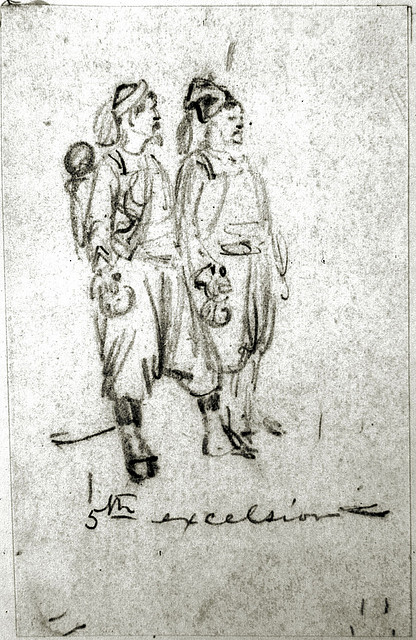
5th Excellsiors

Library of Congress

image

74th Infantry Regiment .
Civil War .
Fifth Excelsior Regiment; Fifth Regiment, Sickles’ Brigade.

This regiment was recruited under the special authority of the War Department, issued to Gen. D. E. Sickles; organized under Col. Charles K. Graham at Camp Scott, L. I., and mustered in the service of the United States for three years between June 30 and October 6, 1861.   (New York State Military Museum and Veterans Research Center)

__________

Alfred R. Waud Civil War Art

5th excelsiors

Sketch of two soldiers.

1 drawing on cream paper : pencil ; 9.9 x 6.4 cm. (sheet).

CREATED/PUBLISHED: [between 1860 and 1865]

Part of Library of Congress Civil War drawing collection

hdl.loc.gov/loc.pnp/cph.3a00529

0 comments

“…so sleepy; no rest or sleep the night before.”—Rutherford B. Hayes

Diary and Letters of Rutherford Birchard Hayes

August 20. Tuesday.–After marching three miles we stopped for water and to let the teams come up. One man reclining was accidentally shot by another hitting his foot against the hammer of a musket. Poor Carr received the ball in the heel of his shoe; it passed up his leg, grazing it merely, grazed his body and arm and shoulder, and left him without a serious wound! Fortunate. Reached Buckhannon about 3:30 P. M.–so sleepy; no rest or sleep the night before. Stopped at noon–got good bread and milk, honey and blackberry jam, and slept nearly an hour in a barn. Buckhannon a pretty place.

0 comments

William Howard Russell’s Diary: Harper’s Ferry.—John Brown.—Back by train to Washington.

My Diary North and South – William Howard Russell

Next day (20th)I took the train, at Ellicott’s Mills, and went to Harper’s Ferry. There is no one spot, in the history of this extraordinary war, which can be well more conspicuous. Had it nothing more to recommend it than the scenery, it might well command a visit from the tourist; but as the scene of old John Brown’s raid upon the Federal arsenal, of that first passage of arms between the abolitionists and the slave conservatives, which has developed this great contest; above all, as the spot where important military demonstrations have been made on both sides, and will necessarily occur hereafter, this place, which probably derives its name from some wretched old boatman, will be renowned for ever in the annals of the civil war of 1861. The Patapsco, by the bank of which the rail is carried for some miles, has all the character of a mountain torrent, rushing through gorges or carving out its way at the base of granite hills, or boldly cutting a path for itself through the softer slate. Bridges, viaducts, remarkable archways, and great spans of timber trestle work leaping from hill to hill, enable the rail to creep onwards and upwards by the mountain side to the Potomac at Point of Rocks, whence it winds its way over undulating ground, by stations with eccentric names to the river’s bank once more. We were carried on to the station next to Harper’s Ferry on a ledge of the precipitous mountain range which almost overhangs the stream. But few civilians were in the train. The greater number of passengers consisted of soldiers and sutlers, proceeding to their encampments along the river. A strict watch was kept over the passengers, whose passes were examined by officers at the various stations. At one place an officer who really looked like a soldier entered the train, and on seeing my pass told me in broken English that he had served in the Crimea, and was acquainted with me and many of my friends. The gentleman who accompanied me observed, “I do not know whether he was in the Crimea or not, but I do know that till very lately your friend the Major was a dancing master in New York.” A person of a very different type made his offers of service, Colonel Gordon of the 2nd Massachusetts Regiment, who caused the train to run on as far as Harper’s Ferry, in order to give me a sight of the place, although in consequence of the evil habit of firing on the carriages in which the Confederates across the river have been indulging, the locomotive generally halts at some distance below the bend of the river. [continue reading…]

0 comments

Civil War Day-By-Day

Civil War Day-by-Day

August 20, 1861

  • The pro-Union Second Wheeling Convention calls for the creation of the state of Kanawha

A Chronological History of the Civil War in America1

  • Skirmish at Hawk’s Nest, in the Kanawha Valley, Va.: 4,000 rebels attacked the barricades of the 11th Ohio Regiment, and were driven back with the loss of 50 killed.
  • Attack on Charleston, Mo., and rout of 1,200 rebels.
  • Wheeling Convention passed an ordinance, erecting a new State to be called “Kanawha,” by a vote of 50 to 28. The boundary as ?xed included the counties of—Logan, Wyoming, Raleigh, Fayette, Nicholas, Webster, Randolph, Tucker, Preston, Monongahela, Marion, Taylor, Barbour, Upshur, Harrison, Lewis, Braxton, Clay, Kanawha, Boone, Wayne, Cabell, Putnam, Mason, Jackson, Roan, Calhoun, Wirt, Gilmer, Ritchie, Wood, Pleasants, Tyler, Doddridge, Wetzel, Marshall, Ohio, Brooke, and Hancock. Other adjoining counties might be admitted, if acceded to by a majority of the voters.

  1. A Chronological History of the Civil War in America by Richard Swainson Fisher, New York, Johnson and Ward, 1863
0 comments

“Rumors of the “rebels” crossing the River into Maryland. Hard fighting expected soon near the City.”—Horatio Nelson Taft

Diary of US patent clerk Horatio Nelson Taft.

MONDAY 19

This will pass for a rainy day and a disagreable one. I was at Genl Porters office (Provost Marshall), a great crowd there after “passes” to Virginia. The Court Marshall was sitting in the same building. I saw four of the mutineers of the NY 79th who were awaiting their trial. They were hand cuffed. Went to the P.O. and was awhile at the Pat office. Rumors of the “rebels” crossing the River into Maryland. Hard fighting expected soon near the City. Called upon Mr Reynolds to sell him my furniture, think of sending the family north soon.

______

The three diary manuscript volumes, Washington during the Civil War: The Diary of Horatio Nelson Taft, 1861-1865, are available online at The Library of   Congress.

0 comments

The Southern forces have beaten the Union Army in the West.

Journal of Meta Morris Grimball
Meta Morris Grimball

19 August

       Things go on very successfully. The Southern forces have beaten the Union Army in the West. William was made one of the prize commissioners and went to North Carolina to see after a prize. He placed seals on it and took possession and returned home,—rather a fatiguing journey to Beaufort on the Coast. Since his return the Governor of N. C. has taken possession, too, so the matter has to be decided in Court. W. might get 1 or 2 hundred dollars for his work:—perhaps he will only have his expenses paid. There is much fever all over the Country now, and also in the City, Typhoid. The accounts from the Army are that 20 thousand troops are ill & wounded &c., and that the South Carolina troops are the worst provided & the North Carolina the best. The Counties are assessed in that State & the men provided in that way. There was a sad accident on Sulivan’s Island, Mr Tom Porcher trying to save his niece while bathing was drowned, also the young lady, Miss Ellen White, 14 years old.—

       Papa writes that he has been suffering from his gout.—

0 comments

“After a world of confusion…, we got off at daylight.”—Rutherford B. Hayes

Diary and Letters of Rutherford Birchard Hayes

August 19. Monday.–No more rumors. A tolerably pretty day. At 12 M. [midnight] got orders to quietly strike tents and with three days’ rations and the minimum amount of baggage move to Buckhannon. Two companies, Captain Drake’s and Captain Zimmerman’s, had just returned from a scouting expedition to Walkersville, etc. No rest yet. After a world of confusion, aggravated by an incompetent quartermaster, we got off at daylight.

0 comments

General Scott issues a comprehensive pass to Eliza and Georgy to give them access to outlying camps and hospitals.—Woolsey family letters.

Woolsey family letters during the War for the Union
Government hospitals were multiplying in Washington, Georgetown, and Alexandria. As regiments were ordered forward extemporized camp hospitals were broken up, and patients were sent back to these large general ones in the rear.
 
By this time J. H. had ordered his horses and carriage sent on from Fishkill for our use and we were constantly driving about, seeing where the need was in camps and hospitals and supplying wants. In order to make our way to the many outlying hospitals about Washington and also to visit Joe’s camp over the river, it was necessary for us to be provided with passes–not always an easy thing to procure. General Scott, however, came to the rescue and gave the following comprehensive one which was “good daily” during the rest of our stay in Washington:–
 

Headquarters of the Army,
Washington, Aug. 19, 1861.

Mrs. Joseph Howland (wife of the Adjutant of the New York 16th Regt.), sister Miss G. M. Woolsey, and man-servant (Stanislas Moritz) will be permitted to pass the Bridges to Alexandria (and return) and are commended to the courtesy of the troops.

Good daily.

Winfield Scott.

By command:

H. VAN RENSSELAER,

Col. and Aid de Camp.


Armed with this we constantly dashed over the Long-Bridge, the carriage filled with all sorts of supplies from the abundant and unfailing stores committed to us by the family and friends and societies at home. Warm woolen socks were always one item. Abby and many others never ceased knitting them during the war. Wherever we found a camp-hospital in need, there we thankfully left comforts from home, or arranged that the Sanitary Commission, whose general office was directly opposite to the Ebbitt House, should supply the want.
 
The Commission on its side was always glad to have our report and responded promptly to all our suggestions.
0 comments

Extracts from the journal of Commander Semmes, C.S. Navy, commanding C.S.S. Sumter

War of the Rebellion: from the Official Records of the Union and Confederate Armies and Navies
Monday, August 19.—Day broke clear, had all hands at quarters at 5:30 a.m., daylight. The strange steamer got up steam and ran toward us. Got our anchor and stood down for her. Hoisted the French colors. Soon afterwards the stranger hoisted French colors also. Hauled down the French colors and hoisted our own, and continued our course toward the stranger, and having come within speaking distance we hailed. A colloquy ensued, each of us asking the other if he had a pilot. The Frenchman ran in for the light vessel and we followed him. At the light vessel the Frenchman took a pilot. Soon after passing the light vessel we anchored to wait for the tide. At meridian got underway and proceeded up the river. The muddy waters of this stream and the low banks reminded us of the Mississippi. A dense, rich foliage covered the banks on either side and we passed several sugar estates with their tall chimneys and factories, and saw other in the distance, giving evidence of more prosperity in this slave state than we had seen either in Trinidad or Cayenne. Nothing can exceed the fertility of the soil, laden with rich crops of the sugar cane, beauti?ed and densi?ed with the charming tropical trees and plants, among which were the stately and graceful palm, the banana, the mango, etc. The negro population appeared well clothed and well fed, but the slave tenure is very precarious here, and the fear of their losing it has a sensible effeect upon the prosperity of the colony. Sent a lieutenant to call on the governor soon after anchoring and received a Visit from the French captain and from the senior Dutch ship. Some dealers in coal also came om board of us.
0 comments

John B. Jones goes to the presidential mansion and requests to see Jefferson Davis.—A Rebel War Clerk’s Diary at the Confederate States Capital.

Civil War Day-by-Day

AUGUST 19th.—The Secretary has gone to Orange C. H., to see Col. Jones, of the 4th Alabama, wounded at Manassas, and now in a dying condition.

Meeting with Mr. Benjamin this morning, near the Secretary’s door, I asked him if he did not think some one should act as Secretary during Mr. Walker’s absence. He replied quickly, and with interest, in the affirmative. There was much pressing business every hour; and it was uncertain when the Secretary would return. I asked him if he would not speak to the President on the subject. He assented; but, hesitating a moment, said he thought it would be better for me to see him. I reminded him of my uniform reluctance to approach the Chief Executive, and he smiled. He then urged me to go to the presidential mansion, and in his, Mr. B.’s name, request the President to appoint a Secretary ad interim. I did so, for the President was in the city that day, and fast recovering from his recent attack of ague.

Arrived at the mansion in Clay Street, I asked the servant if I could see the President. He did not know me, and asked my name, saying the President had not yet left his chamber. I wrote my business on a card with a pencil, not omitting to use the name of Mr. Benjamin, and sent it up. A moment after the President came down, shook hands with me, and, in his quick and rather pettish manner, said “send me the order.” I retired immediately, and finding Mr. Benjamin still in the hall of the department, informed him of my success. Then, in conformity with his suggestion, I repaired to Adjutant-General Cooper, who wrote the order that A. T. Bledsoe discharge the duties of Secretary of War during the absence of Mr. Walker. This I sent by a messenger to the President, who signed it.

Then I informed Col. Bledsoe of what had been done, and he proceeded without delay to the Secretary’s office. It was not long before I perceived the part Mr. Benjamin and I had acted was likely to breed a storm; for several of the employees, supposed to be in the confidence of Mr. Walker, designated the proceeding as an “outrage;” and some went so far as to intimate that Mr. Benjamin’s motive was to have some of his partisans appointed to lucrative places in the army during the absence of the Secretary. I know not how that was; but I am sure I had no thought but for the public service. The Secretary ad in. made but few appointments this time, and performed the functions quietly and with all the dignity of which he was capable.

0 comments