Visit to troops at Alexandria—Horatio Nelson Taft

Diary of US patent clerk Horatio Nelson Taft.

MONDAY, AUGUST 26, 1861.

Went to the Provost Marshalls with Julia this morning and after much trouble got a “Pass” to go on the Boat to Alexandria. Took the Boat with Julia at 1 o’clock. Went directly to the Camp of the NY 27th 3/4ths of a mile back of the City and near Fort Ellsworth East of “Shooters Hill.” Walked over to the Fort with Surgeon Barnes and Lieut Swan, found Lieut Link of Newark & Col Lansing and went through the Fort. Saw Brigade Drill afterwards and back to the Camp. Soldiers in good health.

______

The three diary manuscript volumes, Washington during the Civil War: The Diary of Horatio Nelson Taft, 1861-1865, are available online at The Library of   Congress.

0 comments

Downing’s Civil War Diary.–Alexander G. Downing.

Diary of Alexander G. Downing; Company E, Eleventh Iowa Infantry

Monday, 26th–There was a heavy rainstorm last night. I worked all day, picking onion seed, and in the evening went down to Inland to make arrangements to go back to Davenport in the morning to join the camp.

0 comments

“The jealousy existing in the military towards the medical department of the army astounds me.”–Journal of Surgeon Alfred L. Castleman.

Journal of Surgeon Alfred L Castleman.

26th.–I was visited by my Colonel to-day. He introduced the subject of reducing my hospital force. I was extra-polite, and replied that I had not the slightest objection, provided it was done with the understanding that it would shift the responsibility of the care of the sick from my shoulders to those of others. The subject was dropped, and will hardly be renewed. The jealousy existing in the military towards the medical department of the army astounds me. The military commanders claiming that the medical have no authority except through them, has driven the medical officers to assume the other extreme, and claim that they are the only officers in the army who are really independent of command. This quarrel is often bitter, and makes not only themselves uncomfortably captious, but subjects the sick and wounded to suffering whilst these settle their unnecessary quarrels.

0 comments

William Howard Russell’s Diary: A tour of inspection round the camp.—A troublesome horse.—McDowell and the President.—My description of Bull’s Run endorsed by American officers.—Influence of the Press.—Newspaper correspondents.—Dr. Bray.—My letters.—Capt. Meagher.—Military adventurers.

My Diary North and South – William Howard Russell

August 26th.–General Van Vliet called from General McClellan to say that the Commander-in-Chief would be happy to go round the camps with me when he next made an inspection, and would send round an orderly and charger in time to get ready before he started. These little excursions are not the most agreeable affairs in the world; for McClellan delights in working down staff and escort, dashing from the Chain Bridge to Alexandria, and visiting all the posts, riding as hard as he can, and not returning till past midnight, so that if one has a regard for his cuticle, or his mail days, he will not rashly venture on such excursions. To-day he is to inspect McDowell’s division.

I set out accordingly with Captain Johnson over the Long Bridge, which is now very strictly guarded. On exhibiting my pass to the sentry at the entrance, he called across to the sergeant and spoke to him aside, showing him the pass at the same time. “Are you Russell, of the London Times?” said the sergeant. I replied, “If you look at the pass, you will see who I am.” He turned it over, examined it most narrowly, and at last, with an expression of infinite dissatisfaction and anger upon his face, handed it back, saying to the sentry, “I suppose you must let him go.”

Meantime Captain Johnson was witching the world with feats of noble horsemanship, for I had lent him my celebrated horse Walker, so called because no earthly equestrian can induce him to do anything but trot violently, gallop at full speed, or stand on his hind legs. Captain Johnson laid the whole fault of the animal’s conduct to my mismanagement, affirming that all it required was a light hand and gentleness, and so, as he could display both, I promised to let him have a trial to-day. Walker on starting, however, insisted on having a dance to himself, which my friend attributed to the excitement produced by the presence of the other horse, and I rode quietly along whilst the captain proceeded to establish an acquaintance with his steed in some quiet bye-street. As I was crossing the Long Bridge, the forbidden clatter of a horse’s hoofs on the planks caused me to look round, and on, in a cloud of dust, through the midst of shouting sentries, came my friend of the gentle hand and unruffled temper, with his hat thumped down on the back of his head, his eyes gleaming, his teeth clenched, his fine features slightly flushed, to say the least of it, sawing violently at Walker’s head, and exclaiming, “You brute, I’ll teach you to walk,” till he brought up by the barrier midway on the bridge. The guard, en masse, called the captain’s attention to the order, “all horses to walk over the bridge.” “Why, that’s what I want him to do. I’ll give any man among you one hundred dollars who can make him walk along this bridge or anywhere else.” The redoubtable steed, being permitted to proceed upon its way, dashed swiftly through the tête de pont, or stood on his hind legs when imperatively arrested by a barrier or abattis, and on these occasions my excellent friend, as he displayed his pass in one hand and restrained Bucephalus with the other, reminded me of nothing so much as the statue of Peter the Great, in the square on the banks of the Neva, or the noble equestrian monument of General Jackson, which decorates the city of Washington. The troops of McDowell’s division were already drawn up on a rugged plain, close to the river’s margin, in happier days the scene of the city races. A pestilential odour rose from the slaughter-houses close at hand, but regardless of odour or marsh, Walker continued his violent exercise, evidently under the idea that he was assisting at a retreat of the grand army as before. [continue reading…]

0 comments

Red Legged Devil

Library of Congress

Civil War Era Photographic Portraiture No. 11

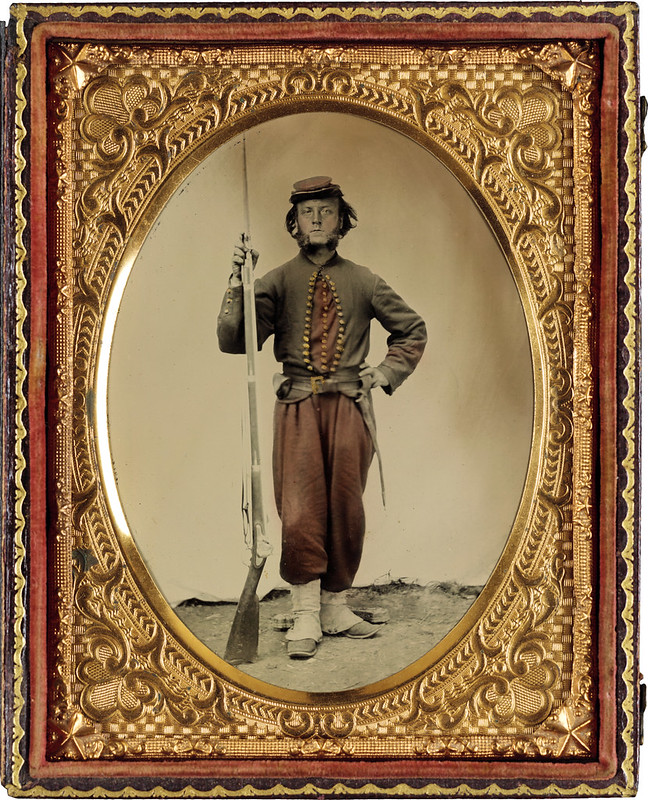
Red Legged Devil Zouave, 14th Brooklyn Regiment, very likely Alonzo S. Thompson

Almost 10 years ago, this tintype was the subject of a couple of involved NPR articles/podcasts on the image and identifying who the soldier in the Union Zuave uniform was.

In the first, Unknown No More: Identifying A Civil War Soldier1, he is identified as Thomas A. Ardies from the 14th Brooklyn Regiment2, also known as the “Red Legged Devils.” The identification was based on letters carved into the stock of his gun—A.T., thought to be his initials—, his distinctive uniform, and his height in comparison to the weapon.

A week later, in Photo Mystery Solved, Then Doubted, Then Deciphered, Thanks To Readers3, author Ramona Martinez revealed that their attempt to identify the subject in the photo had resulted in “a misidentification, a historical wild goose chase, and a lively, collaborative conversation online.”

It turns out that the letters carved into the stock weren’t A.T. but, rather, T.A..

The photo of the mystery soldier is a tintype, a direct positive of the scene, which produces laterally reversed images. The process produces mirror images of what they actually are — like belts, hats and, of course, initials. (The Library of Congress has a good explanation of this.)

Based on pension files from the 14th Brooklyn, there were eight soldiers with the initials A.T.. Six were eliminated as being too old or too tall.  A seventh, Albert C. Tibbals, was eliminated because one of the commenters actually owned a picture of Tibbals—and he wasn’t the man in the tintype.

The remaining soldier with the initials A.T. was a fellow named Alonzo S. Thompson.  He is very probably the soldier in the tintype, but the proof is not totally definitive as there are no other known photos of him to compare the tintype to.

Thompson was discharged for illness and died of chronic diarrhea on Long Island in 1863.


Title: [Unidentified soldier in Union zouave uniform with bayoneted musket with initials A.T. on stock]
Date Created/Published: [between 1861 and 1865]
Medium: 1 photograph : quarter-plate tintype, hand-colored ; 11.1 x 9.5 cm (case)
Reproduction Number: LC-DIG-ppmsca-32681 (digital file from original, tonality adjusted) LC-DIG-ppmsca-32126 (digital file from original item)
Rights Advisory: No known restrictions on publication.
Access Advisory: Use digital images. Original served only by appointment because material requires special handling.
Call Number: AMB/TIN no. 2805 [P&P]
Repository: Library of Congress Prints and Photographs Division Washington, D.C. 20540 USA http://hdl.loc.gov/loc.pnp/pp.print
Notes:
…..Possibly identified as Alonzo F. Thompson of Company C, 84th New York Infantry Regiment (earlier known as 14th Regiment New York State Militia). (Source: Martinez, Ramona. Photo Mystery Solved, Then Doubted, Then Deciphered, Thanks to Readers; http://www.npr.org/blogs/pictureshow/2012/04/17/150801239/ and American Civil War Database)
…..Title devised by Library staff.
…..Case: Rinhart, no. 108.
…..Gift; Tom Liljenquist; 2011; (DLC/PP-2012:127).
…..More information about this collection is available at http://hdl.loc.gov/loc.pnp/pp.lilj
…..Forms part of: Liljenquist Family Collection of Civil War Photographs (Library of Congress).
…..Published in: Civil War news. Tunbridge, Vt. : Historical Publications, June 2012 (XXVIII, 6), p. 5.
…..Published in: Civil War news / by Stephen W. Sylvia & Michael J. O’Donnell. Orange, Va. : Moss Publications, c1978.
…..Exhibited: “The Civil War in America” at the Library of Congress, Washington, D.C., 2013.

Library of Congress permarecord

Mike’s notes:

Image restoration note – This image has been digitally adjusted for one or more of the following:
– fade correction,
– color, contrast, and/or saturation enhancement
– selected spot and/or scratch removal
– cropped for composition and/or to accentuate subject matter
– straighten image

Image restoration is the process of using digital restoration tools to create new digital versions of the images while also improving their quality and repairing damage.


  1. Martinez, Ramona. “Unknown No More: Identifying a Civil War Soldier.” NPR. NPR, April 11, 2012. https://www.npr.org/2012/04/11/150288978/unknown-no-more-identifying-a-civil-war-soldier.
  2. On 7 December 1861, the State of New York officially changed the regiment’s designation to the 84th New York Volunteer Infantry (and its unit histories are sometimes found under this designation). But at the unit’s request and because of the fame attained by the unit at First Bull Run, the United States Army continued to refer to it as the 14th. (Wikipedia)
  3. Martinez, Ramona. “Photo Mystery Solved, Then Doubted, Then Deciphered, Thanks to Readers.” NPR. NPR, April 17, 2012. https://www.npr.org/sections/pictureshow/2012/04/17/150801239/photo-mystery-solved-then-doubted-then-resolved-thanks-to-readers.
0 comments

“Hurry up and send me my commission quick.”–Adams Family Letters, Henry Adams, private secretary of the US Minister to the UK, to his brother, Charles Francis Adams.

Civil War Day-by-Day
In the book, the following appears as a post script to a letter that was written on August 5.   However, Henry’s brother, Charles, replied on August 23 to a “letter of the 5th” from Henry.

P.S. August 26. After studying over the accounts of the battle and reading Russell’s letter to the Times, I hardly know whether to laugh or cry. Of all the ridiculous battles that ever were fought, this seems to me the most so. To a foreigner or to any one not interested in it, the account must be laughable in the extreme. But the disgrace is frightful. The expose of the condition of our army is not calculated to do us anything but the most unmixed harm here, though it may have the good effect at home of causing these evils to be corrected. If this happens again, farewell to our country for many a day. Bull’s Run will be a by-word of ridicule for all time. Our honor will be utterly gone. But yesterday we might have stood against the world. Now none so base to do us reverence. Let us stop our bragging now and hence-forward. Throw Bull’s Run in the teeth of any man who dares to talk large. In spite of my mortification, I could not help howling with laughter over a part of Russell’s letter. Such a battle of heels. Such a bloodless, ridiculous race for disgrace, history does not record. Unpursued, untouched, without once having even crossed bayonets with the enemy, we have run and saved our precious carcasses from a danger that did not exist. Our flag, what has become of it? Who will respect it? What can we ever say for it after this?


My determination to come home is only increased by this disgrace. I cannot stay here now to stand the taunts of every one without being able to say a word in defence. Unless I hear from you at once, I shall write myself to Governor Andrew and to Mr. Dana and to every one else I can think of, and raise Heaven and earth to get a commission. If we must be beaten, and it looks now as though that must ultimately be the case, I want to do all I can not to be included among those who ran away. Our accounts say nothing of the Massachusetts regiments. So far as we have learned, the Pennsylvania and foreign regiments are the only ones known to have disgraced themselves, and the Rhode Island ones stood well. Hurry up and send me my commission quick.

0 comments

“ ‘Burn it, bum it to the ground!’ She ran to the yard to know the cause; instantly this lonely woman was surrounded by a lawless, shouting soldiery, each with a burning torch, revealing, by its lurid and fitful light, a countenance almost demoniac.”—Diary of a Southern Refugee, Judith White McGuire.

Diary of a Southern Refugee During the War by Judith White McGuire

Norwood, Near Berryville, August 26.—On a visit of a few days to our relative, Dr. M. The people of this neighbourhood occupied as they are in the one I left. All hearts and hands seem open to our army. Four heavily laden wagons have left Berryville within a few days, for the hospitals below. We are all anxious about Western Virginia, of which we can hear so little. General Lee and General Floyd are there, and if they can only have men and ammunition enough we have nothing to fear.

The army in Fairfax seems quiet. Colonel Stuart, with his cavalry, has driven the enemy back, and taken possession of “Chestnut Hill” as head-quarters. There they are overlooking Washington, Georgetown, and our neighbourhood, all bristling with cannon, to prevent their nearer approach. Some of those young men can almost point from the hills on which they are encamped, to chimneys of their own firesides, the portals of their own homes. The woods are cleared away for miles; even the yard trees are gone, leaving the houses in bold relief, with nothing to shade, nothing to obscure them. I do pity those who were obliged to stay in Southern homes, with Southern hearts, surrounded by bitter and suspicious enemies. My old friend Mrs. D. is sometimes in their lines, sometimes in ours. When our men are near her, they are fed from her table, and receive all manner of kindness from her hands. Some of my nephews have been invited to her table, and treated as her relations. When they entered her house she [continue reading…]

0 comments

Tygart’s Valley, near Cheat Mountain Pass.—Rutherford B. Hayes

Diary and Letters of Rutherford Birchard Hayes

Monday evening, August 26.– Marched today up the beautiful valley, “Tygart’s Valley” I believe, to this pretty camp in the hills, eighteen miles. Saw our general. About forty-five, a middle-sized, good-looking man, educated at West Point. An army man, good sense, good talker–General Reynolds. Oh, what a lovely spot!

_______

August 26, 1861.

DEAR UNCLE:–We are camped somewhere near, I think, the head of Tygart’s Valley, near Cheat Mountain Pass. Several regiments are in sight, and the enemy under Lee so near that our outposts have fights with his daily. We are under a capital general, and are fast getting ready. I think we are safe; if not, we shall be within a very short time. We expect to stay here until we or the enemy are whipped, or back out for fear of a whipping–probably weeks.

We are in [a] lovely little valley on a fine clear trout stream, with high mountains on all sides and large trees over us. A perfect camp, perfectly protected by entrenchments for miles up the valley, pickets and scouts in all directions, etc., etc. A telegraph finished to headquarters of our general from General Rosecrans’ at Clarksburg, and rapid mail carriers daily to the same place. For instance, your letter of the 19th was handed to me at my tent by the courier within half an hour after our arrival here.

Glad Fanny is with you. Lee will not whip us unless we attack him with a force too small. If he attacks us, we are the best off. The postage stamps are all gone.

Sincerely,

R. B. HAYES.

I got four Fremont Journals. Much obliged.

S. BIRCHARD.

_______

SOMEWHERE IN TYGART’S VALLEY, NEAR CHEAT
MOUNTAIN PASS, VIRGINIA,
August 26, Monday evening, 8:30
P.M., after a march of eighteen miles, 1861.

DEAREST:–You will think me insane, writing so often and always with the same story: Delighted with scenery and pleasant excitement.

We are camped tonight in a valley surrounded by mountains on a lovely stream under great trees. With the Third Ohio, Thirteenth Indiana, one-half of McCook’s Ninth and the Michigan artillery, which Mother remembers passed our house one Sunday about the last of May, and McMullen’s Battery, all in sight. Our General Reynolds makes a good impression. We are [continue reading…]

0 comments

Civil War Day-By-Day

Civil War Day-by-Day

August 26, 1861

  • Battle of (Kessler’s) Cross Lanes. General John Floyd routs an Ohio regiment
  • General Benjamin Butler leads a successful amphibious landing on Cape Hatteras.
  • King Kamehameha IV proclaimed the neutrality of the Hawaiian Islands during the Civil War.

A Chronological History of the Civil War in America1

  • Seventh Ohio Regiment, while breakfasting at Summersville, Va., surprised and surrounded by a force of rebels under Floyd, but fought themselves through with a comparatively small loss.
  • Naval and military expedition sailed from Fortress Monroe against the forts at Hatteras Inlet.S

  1. A Chronological History of the Civil War in America by Richard Swainson Fisher, New York, Johnson and Ward, 1863
0 comments

“Captain Clark…, dined us yesterday at Widow What’s-her-name’s hotel”—Rutherford B. Hayes

Diary and Letters of Rutherford Birchard Hayes

Beverly, August 25. Sunday.–A cold night. Clear but foggy this A. M. No orders to march yet. Good! Provisions and provender, i. e. rations and forage, scarce and poor. Captain Clark, a spirited German (Prussian) officer of the “Greys,” dined us yesterday at Widow What’s-her-name’s hotel, Got letters here from Lute, Uncle, and Mother, with a Testament from Mother. Shall read it “in course”–through I mean; begin now.

_______

BEVERLY, VIRGINIA, August 25, 1861, Sunday A. M.

DEAREST:–Supposing I might have to go on towards Cheat Mountain this morning, I wrote you a very short note last night I now write so soon again to show you how much I love you and how much my thoughts are on the dear ones at home.

I never enjoyed any business or mode of life as much as I do this. I really feel badly when I think of several of my intimate friends who are compelled to stay at home. These marches and campaigns in the hills of western Virginia will always be among the pleasantest things I can remember. I know we are in frequent perils, that we may never return and all that, but the feeling that I am where I ought to be is a full compensation for all that is sinister, leaving me free to enjoy as if on a pleasure tour.

I am constantly reminded of our trip and happiness a year ago. I met a few days ago in the Fifth Regiment the young Moore we saw at Quebec, who went with me to see the animals at Montreal one Sunday. Do you remember the rattlesnakes?

Young Bradford goes to Cincinnati today.–We have our troubles in the Twenty-third of course, but it is happiness compared with the Guthries–fine fellows and many fine officers, but, etc., etc.

We saw nothing prettier [last year] than the view from my tent this morning. McCook’s men are half a mile to the right, McMullen’s Battery on the next hill in front of us. The Virginia Second a half mile in front, and the Guthries to the left. We on higher ground see them all; then mountains, meadow, and stream. Nothing wanting but you and the boys.

I want to say to you it will be impossible often, as we get further in the hills, to write, and when I do write it will be only a few lines. Don’t think I am getting weaned from you and home. It is merely the condition of things compels me. I saw young Culbertson, looking strong and healthy, Channing Richards, the Andersons, etc., etc., all ditto. Young Culbertson is now in a scouting party that is after guerrillas who murdered some of their men in an ambulance.

I have got a new boy–a yellow lad in Guthrie Gray uniform, aged about sixteen, named Theodore Wilson.

Sunday evening.–Just got orders to go to Huttonsville. Look on my map of Virginia and you will see it geography style, but the beautiful scenery you will not see there. We are to be for the present under General Reynolds, a good officer, and then General Benham or [continue reading…]

0 comments

Rebel War Clerk

Civil War Day-by-Day

AUGUST 25th.—I believe the Secretary will resign; but “immediate” still lies on his table.

News of a battle near Springfield, Mo. McCulloch and Price defeat the Federals, killing and wounding thousands. Gen. Lyon killed.

0 comments

Mary Chesnut’s Diary: “Now, cotton always means money, or did when there was an outlet for it and anybody to buy it. Where is money to come from now?”

Civil War Day-by-Day

August 25th.–Mr. Barnwell says democracies lead to untruthfulness. To be always electioneering is to be always false; so both we and the Yankees are unreliable as regards our own exploits. “How about empires? Were there ever more stupendous lies than the Emperor Napoleon’s?” Mr. Barnwell went on: “People dare not tell the truth in a canvass; they must conciliate their constituents. Now everybody in a democracy always wants an office; at least, everybody in Richmond just now seems to want one.” Never heeding interruptions, he went on: “As a nation, the English are the most truthful in the world.” “And so are our country gentlemen: they own their constituents–at least, in some of the parishes, where there are few whites; only immense estates peopled by negroes.” Thackeray speaks of the lies that were told on both sides in the British wars with France; England kept quite alongside of her rival in that fine art. England lied then as fluently as Russell lies about us now.

Went to see Agnes De Leon, my Columbia school friend. She is fresh from Egypt, and I wished to hear of the Nile, the crocodiles, the mummies, the Sphinx, and the Pyramids. But her head ran upon Washington life, such as we knew it, and her soul was here. No theme was possible but a discussion of the latest war news.

Mr. Clayton, Assistant Secretary of State, says we spend two millions a week. Where is all that money to come from? They don’t want us to plant cotton, but to make provisions. Now, cotton always means money, or did when there was an outlet for it and anybody to buy it. Where is money to come from now?

Mr. Barnwell’s new joke, I dare say, is a Joe Miller, but Mr. Barnwell laughed in telling it till he cried. A man was fined for contempt of court and then, his case coming on, the Judge talked such arrant nonsense and was so warped in his mind against the poor man, that the “fined one” walked up and handed the august Judge a five-dollar bill. “Why? What is that for?” said the Judge. “Oh, I feel such a contempt of this court coming on again!”

I came up tired to death; took down my hair; had it hanging over me in a Crazy Jane fashion; and sat still, hands over my head (half undressed, but too lazy and sleepy to move). I was sitting in a rocking-chair by an open window taking my ease and the cool night air, when suddenly the door opened and Captain walked in.

He was in the middle of the room before he saw his mistake; he stared and was transfixed, as the novels say. I dare say I looked an ancient Gorgon. Then, with a more frantic glare, he turned and fled without a word. I got up and bolted the door after him, and then looked in the glass and laughed myself into hysterics. I shall never forget to lock the door again. But it does not matter in this case. I looked totally unlike the person bearing my name, who, covered with lace cap, etc., frequents the drawing-room. I doubt if he would know me again.

0 comments

Supplies from the Sanitary Commission.

Woolsey family letters during the War for the Union

Sanitary Commission, Washington, D. C.
Treasury Building, Aug. 17th, 1861.

Miss Woolsey: In absence of Mr. Olmsted I answer your note in regard to supplies for the 25th N. Y. We will give immediate attention to this Regiment, and will gladly furnish them any supplies we have on hand for their comfort. There are now no beds or cases to fill with straw in the store-room of the Commission (but very few have ever been sent in). Mr. Olmsted, however, has sent for two hundred to be forwarded from New York as soon as possible, and when these arrive a supply shall be furnished to the 25th.

It has been the endeavor of the Secretary to send notice of the existence and objects of the Commission to the surgeon of each regiment: it may not have reached some, but the visits of the inspectors, now in progress, will ensure this notice to all.

Mr. Olmsted wishes to make the Regimental Hospital comfortable, but not to induce the regimental surgeons to retain patients who ought to be sent to the General Hospital.

I am glad to be able to add, that there is a reasonable prospect that a new General Hospital will be immediately established in or near Alexandria for the sick of the regiments in that vicinity.

Pardon haste,

With sincere regards,

Your obedient servant,

F. N. KNAPP, for

Fred’k Law Olmsted.

0 comments

Extracts from the journal of Commander Semmes, C.S. Navy, commanding C.S.S. Sumter

War of the Rebellion: from the Official Records of the Union and Confederate Armies and Navies
Sunday, August 25.— Cloudy in the morning. Went on shore to church at half past 8. The good old mother has her churches and clergymen , even in this remote Dutch colony. It is estimated that there [are] 10,000 Catholics in the colony. The church was a neat, well-arranged building, the congregation full and mixed, the colored names greatly preponderating. The sermon was fluent but in Dutch, and therefore sealed to me, but the Latin mass and the ceremonial—the same all over the world—impressed me strongly and touched many cords of reminiscence. The people were devout. A detachment of the government troops was present. A number received the communion. Mustered the crew at 11, and afterwards performed the agreeable duty of releasing a couple of prisoners; to release is always more pleasant than to confine. Some Dutch lieutenants visited the ship. On this day, in the quiet of the Sabbath sunlight, how strongly the thoughts revert to country, home, family, and friends, from all of whom, alas, we are separated under such painful circumstances.
We learn by late papers from Barbados that the U. S. S. Keystone State was in that island on the 21st of July, in search of us. She has not yet found us. There was quite a flutter in the dovecote at Key West, too, on the 8th of July , when the news of our arrival at Cienfuegos reached them . There was prompt coaling and steaming up on board the Niagara and Crusader, which vessels supposed they might overtake us at Cienfuegos or Trinidad, and blockade us anew, only in her Majesty’s dominions. Soft, Mr. Shufeldt, and soft, Captain McKean—we had anticipated all this display of black Republican zeal. We knew that the Yankee man at Cienfuegos would telegraph the Yankee man at Havana, and that the latter would send a fishing smack to Key West, and we knew that the enemy had ships at that point. Soft, Mr. Shufeldt. A long and steady rain during the night.
0 comments

Horatio Nelson Taft

Diary of US patent clerk Horatio Nelson Taft.

SUNDAY 25

Went to church this morning with Julia & Brownson. The day has been delightful, quite a show of soldiers up 14th St., Infantry, Cavalry & Artillery of the Regular Army with a fine Band and Drum Corps. A long train of Army wagons also passed the house. Mr B & wife [Mrs Taft] went to church in the afternoon. Walked down to Lafayette Square and was awhile at Willards with Brownson, not much of a crowd there tonight. Saw Col Clark and Col Chambers, Hon Ira Harris there. Came home 1/2 past nine.

______

The three diary manuscript volumes, Washington during the Civil War: The Diary of Horatio Nelson Taft, 1861-1865, are available online at The Library of   Congress.

0 comments

Downing’s Civil War Diary.–Alexander G. Downing.

Diary of Alexander G. Downing; Company E, Eleventh Iowa Infantry

Sunday, 25th–I stayed over night at Sparks’ and attended meeting at the grove again this morning. We had a basket dinner at noon. At the afternoon service the Lord’s Supper was observed. After the meeting we started for home, a distance of eleven miles.

0 comments

“I have the duties of Captain, 1st Lieutenant, and 2d Lieutenant, all combined, at present to perform..,”—War Letters of William Thompson Lusk.

War Letters of William Thompson Lusk.

Kosciusko Farm,

August 25th, 1861.

My dear Mother:

I am seated writing my usual Sunday letter, happy to state that my spirits are good and health excellent, as Uncle Charles will confirm. I was out drilling my men yesterday, when my attention was attracted by somebody nodding to me in a familiar style – a second glance told that it was Uncle Charley, and no other. I was much pleased at his kindness in looking me up, as well as to see him again. You will find he is looking well, and will learn from him that he entertains Republican sentiments of so decided a stripe that I, who was formerly a sort of an abolitionist, am obliged to confess myself a conservative in comparison. I received from Thomas a very pretty present, through the Express office, a few days ago. It consisted of a case containing knife, fork, spoon and cup – things which I shall find highly useful when on the march. When in Virginia before, provided with no such conveniences, fingers were obliged to adapt themselves to the performance of all the varied functions of “table services.” You ask for my address! I never can give you any fixed address, as no Regiment knows where it will be twenty-four hours in advance, but anything directed to the 79th Regiment, N. Y. S. M., Washington, will be forwarded without difficulty. I was in earnest in wishing that I was connected with some New England Regiment, but not in earnest as regards any intention of deserting my present post because of any difficulty attending it. As long as my friends stick by the 79th, I shall not surely be less faithful than are they. The wish to change arose from a desire to take part in the approaching battle to be conducted by McClellan, in which, it seemed probable, the 79th would be too much crippled to take any prominent part. Our Regiment is, however, now rapidly recovering from the effects of the battle and the intrigues of the old rum-selling officers now happily resigned. I have some responsibility resting upon me, as I am detailed to take sole charge of one of the Companies. I have the duties of Captain, 1st Lieutenant, and 2d Lieutenant, all combined, at present to perform, so I have little right to think of abandoning my post. In confidence I may add that possibly five or six of us may be transferred to a new Regiment by the Secretary of War. The Regiment would be under his patronage, and be called the “Cameron Highlanders.” In this new Regiment I most likely would be assigned the post of Captain. However neither say or think anything about this, as it is by no means determined yet. The letter from Fräulein Mathilde contained the kind wishes of the family, and an invitation to be present at her wedding which is to take place on the 1st of September. I find I have grown rusty in the German language, so that I had no little difficulty in deciphering the young lady’s epistle.

Have I written you that we are now encamped on Kosciusko’s farm? It is a pleasant spot, but damp. I hear we are to be marched off somewhere to-morrow. Report names Georgetown as our probable destination.

Uncle Charles is still in town I hear, but I cannot leave camp to visit him.

I will take the photograph question into consideration when we get paid off. Tell Lilly she must accept thanks and love for her kind letter, but I do not mean to answer it until after some success occurs.

Thank Mary for her kind intentions regarding writing me. Love to the little ones. Ask Will if he wants to be a soldier. Turly shall be made a Congressman, and get appointed Chairman of the Military Committee.

Love to all.

Believe me,

Very Affec’y.,

William T. Lusk.

0 comments

William Howard Russell’s Diary.—Navy Department.—A ride to camps on outskirts of Washington.

My Diary North and South – William Howard Russell

August 25th.–I visited the Navy Department, which is a small red-brick building two storeys high, very plain and even humble. The subordinate departments are conducted in rooms below stairs. The executive are lodged in the rooms which line both sides of the corridor above. The walls of the passage are lined with paintings in oil and water colours, engravings and paintings in the worst style of art. To the latter considerable interest attaches, as they are authentic likenesses of naval officers who gained celebrity in the wars with Great Britain–men like Perry, McDonough, Decatur, and Hull, who, as the Americans boast, was “the first man who compelled a British frigate of greater force than his own to strike her colours in fair fight.” Paul Jones was not to be seen, but a drawing is proudly pointed to of the attack of the American fleet on Algiers as a proof of hatred to piracy, and of the prominent part taken by the young States in putting an end to it in Europe. In one room are several swords, surrendered by English officers in the single frigate engagements, and the duplicates of medals, in gold and silver, voted by Congress to the victors. In Lieutenant Wise’s room, there are models of the projectiles, and a series of shot and shell used in the navy, or deposited by inventors. Among other relics was the flag of Captain Ward’s boat just brought in which was completely riddled by the bullet marks received in the ambuscade in which that officer was killed, with nearly all of his boat’s crew, as they incautiously approached the shore of the Potomac, to take off a small craft placed there to decoy them by the Confederates. My business was to pave the way for a passage on board a steamer, in case of any naval expedition starting before the army was ready to move, but all difficulties were at once removed by the promptitude and courtesy of Mr. Fox, the Assistant-Secretary, who promised to give me an order for a passage whenever I required it. The extreme civility and readiness to oblige of all American officials, high and low, from the gate-keepers and door porters up to the heads of departments, cannot be too highly praised, and it is ungenerous to accept the explanation offered by an English officer to whom I remarked the circumstance that it is due to the fact that each man is liable to be turned out at the end of four years, and therefore makes all the friends he can.

In the afternoon I rode out with Captain Johnson, through some charming woodland scenery on the outskirts of Washington, by a brawling stream, in a shady little ravine, that put me in mind of the Dargle. Our ride led us into the camps, formed on the west of Georgetown, to cover the city from the attacks of an enemy advancing along the left bank of the Potomac, and in support of several strong forts and earthworks placed on the heights. One regiment consists altogether of Frenchmen–another is of Germans–in a third I saw an officer with a Crimean and Indian medal on his breast, and several privates with similar decorations. Some of the regiments were on parade, and crowds of civilians from Washington were enjoying the novel scene, and partaking of the hospitality of their friends. One old lady, whom I have always seen about the camps, and who is a sort of ancient heroine of Saragossa, had an opportunity of being useful. The 15th Massachusetts, a fine-looking body of men, had broken up camp, and were marching off to the sound of their own voices chanting “Old John Brown,” when one of the enormous trains of baggage waggons attached to them was carried off by the frightened mules, which probably had belonged to Virginian farmers, and one of the soldiers, in trying to stop it, was dashed to the ground and severely injured. The old lady was by his side in a moment, and out came her flask of strong waters, bandages, and medical comforts and apparatus. “It’s well I’m here’ for this poor Union soldier; I’m sure I always have something to do in these camps.” On my return late, there was a letter on my table requesting me to visit General McClellan, but it was then too far advanced to avail myself of the invitation, which was only delivered after I left my lodgings.

0 comments

England and the cotton question.–Adams Family Letters; Charles Francis Adams, Jr., to his brother in London, Henry Adams

Civil War Day-by-Day


Quincy, Sunday, August 25, 1861

In my letter I begged you to go to work and try to make the two countries understand each other, for to my eye our foreign relations look very formidable. Why, when England and France are collecting fleets in our southern waters, do we all of a sudden hear rumors of a joint Mexican protectorate? It would be a blessing to mankind, but how will it complicate our relations? This cotton question is beginning to pinch and soon, if ever, if you have any desire to be useful to your country, backed by any energy, you can be useful where you are.

In my letter I asked you to touch England through her pocket. For some time past I have been turning over in my mind an elaborate article on this cotton supply question, but necessarily to be of any good to any one it must be directed more to English eyes than to ours. I touched on it in my last letter, and now I should like to hand it over to you, to see if you can do anything with it. I would write it for the Edinburgh or some really influential review or magazine, but to have effect it should appear in November, when the cotton-shoe will begin to pinch dreadfully, and I would force it into print by laying the plan of it before Mr. Motley or the Governor, or any other person likely to have influence on editors. That done throw your soul into your work and write as if you meant what you said. You always affect in writing too much calmness and quaint philosophy. That will come to you in time, but you do it now at the price of that fresh enthusiasm which is the charm of young writers. If you write now, write as if you were pleading a cause and too much interested to be affected. Throw your soul into your work and say what you feel. If you don’t check it, your mannerism will ruin your style in less than five years.


However now for the subject. The books you ought to review, or rather hang your subject on, are Mann’s Manual of Cotton, a book of about one hundred pages; the third annual report of the Manchester Cotton Supply Association and the numbers for May and June of the Cotton Supply Reporter of Manchester, and any new book dealing of the troubles in this country. If you accept the subject I have many curious facts collected, which I will send you at once. Start at once with the paradox that, instead of desiring to break this blockade, England should pray it might last for two years and if necessary assist in enforcing it, as if enforced its inevitable result must be, after one or at most two years of high prices, to forever break down the price of cotton to a reasonable profit over the cost of its cheapest possible production. This opens the whole question of supply. Two things are necessary to the production of cotton – an abundance of labor and a cotton soil. Look into the question of soil first. A semi-tropical heat, with a distribution of rain, are the only essentials. India has not the last and will not do; but Central and South America, all Africa (which is not desert), Australia and the Fiji Islands are better than our cotton states and need only organized labor. This with all the necessary material of ships, channels of trade, custom and experience, our planters have to such a degree that while they would furnish a fair supply of cotton on moderate terms, they could kill competition. Now is England’s chance to free herself from what has been her terror for years. In India, in Egypt in Abyssinia and in South Africa, there is an unlimited amount of cotton land of the finest quality and labor is abundant, costing almost nothing, but unorganized. Two years’ competition will organize it and once organized it can sell the South. In Australia, the South Sea islands and Central America, there is no labor and here the cooley question rises. Properly regulated the trade would be a blessing, for the Chinese amalgamates and California is in point as well as Dana’s reflections on Cuba. The books I have mentioned will give you all the information necessary on these points. This would bring cotton down to the cost, with a profit, of its production in cheap labor countries, say three pence a pound. But it would also lead to immense indirect advantages. As a missionary scheme Africa would be opened up and Livingstone’s discoveries made of use; slavery in America would be killed and the slave-trade closed for ever, as the African would be more useful at home than abroad. You will find in the first few pages of a new book called Social Statics more curious facts and reflections on England’s efforts at the suppression of the slavetrade, and this leads to the amount yearly expended in its suppression in this way, and which the consequent withdrawal of the fleet would save that government, and the amount England could thus afford to pay to promote the enterprise. Finally it would open the untold tropical fertility of Africa to the commerce of the world and these advantages cannot be estimated. Thus cotton would be produced on both sides of the equator all the year round in unlimited quantities, and England would have by two years’ suffering cut the meshes which she could never have broken.

On the other hand England breaks the blockade, or the South is victorious, England may then as well hug her chains, for she must wear them. The Southern confederacy will be aggressive and more slaves and more cotton will be the cry. In spite of England the slave-trade will flourish and their system will spread over Mexico and Central America. Then with the advantages of their organization, slave labor will win the day and England may look for competition in vain. The cotton monopoly will stifle her in the end. They will pretend in Parliament that the recognition of the Confederate States will not extend the area of slavery and all that humbug. Expose this, for it will be a victory of slavery. Recognition will mean war and the prostration at the feet of slavery of free society in America. England can do this if she chooses, but let her not deceive herself and let the results of her action be patent.

Finally the importance of this struggle cannot be overestimated. On the inviolability of the blockade and the consequent cotton pressure throughout the world hangs the destruction of American slavery, the eternal suppression of the slave-trade, the emancipation of England from a thraldom under which her great industrial interest has groaned for fifty years, and finally the civilization and awakening from Barbarism of the great continent of Africa. Even America, deprived of her monopoly, would reap advantage from the result, and this I tried to show in my article in the Atlantic of last April. Are not these results worth the agony of two years of half labor in Lancashire? Are they not worth fighting for? Can England hesitate as to which side her interest favors – as to what course she will adopt?

Here is a general sketch of my idea. I think it would be of service in England and if written as a man should write who is writing for his country at such a time as this, it would surely command attention. Any assistance I can give you I gladly will; but I earnestly beg you, even if this subject does not please you, to make yourself useful in your present position in some way of this kind. You can’t tell how much effect here a sympathetic word from England has now, and you can be of the greatest use if you only will. . . .
0 comments

Life of a private: “…it is the life of a Hound”

Journal of Meta Morris Grimball
Meta Morris Grimball

24 [August]

       Received a letter yesterday from Lewis he hopes to soon get home & accepts thankfully the Commission of Assistant Surgeon in the State Forces, and in reply to Arthur’s wish to go out to Virginia if in no other way as a private, says he had better not, for it is the life of a Hound, and now unless they enlist for the War, recieve no pay and have to support themselves. We hired a carriage the other afternoon and paid some visits. We paid $3 and fortunately got through 8 in the upper part of the Town, Miss Nowels, Miss Mazike, Mrs Hayne, Mrs Taber, Mrs Alice Heyward, Mrs Trenholm, Miss Turnbull, Miss Mitchel.—We shall after a while have to get it again.

       Lotty is learning to draw this summer and seems to like it better than Music. – Ella & herself have a nice set of friends.—

       There has been quite a flare up in Mrs Wilkinses’ family, the poor things do so want a ruling principle, every one does as he or she pleases, and they all are self indulgent, and indolent, in short badly brought up. Gov. has got himself into a miserable trouble, quareled with his father in law, his wife, an adopted child and has a large and increasing family. She, Adela, is one of the self indulgent ones, and must go to Greenville every summer, leave him to annoy his Mother & sisters.

       His little daughter died at Grahamville, little Eliza, from neglect. Adela was ill at the time. He rules at his Mother’s, is rude to his Sisters and induces Martin to be so, too, they all had a war talk and are now better friends. In my family, the Morises, they often quareled , but they always made up. The Wilkins’s are very rigid people and can’t forget they have through the ill management of Berkley Wilkins & Gov brought into non intercourse with the Taber concern & the T. Lowndes. I think people ought never to quarrel with any one.

0 comments

“There is one Co of the Zuaves who are Frenchmen, some of whom served in Africa.”—Horatio Nelson Taft

Diary of US patent clerk Horatio Nelson Taft.

SATURDAY 24

Saw the President this morning 1/2 past 8. Applied for a Pay Mastership in the Army. Too many already appointed, gave me a line to Mr Seward. Came home and found Mr Brownson of Lyons at the house. Went with him and Julia up to Camp Cameron to see the “Anderson Zuaves.” Col Riker conversed awhile with the Chaplin Rev Mr Harvey from N[ew] Y[ork] Mills, Oneida Co[unty], NY. There is one Co[mpany] of the Zuaves who are Frenchmen, some of whom served in Africa. Mr Seward was there and reviewed the Regt, 1000 strong.

______

The three diary manuscript volumes, Washington during the Civil War: The Diary of Horatio Nelson Taft, 1861-1865, are available online at The Library of   Congress.

0 comments

Rebel Cavalry—Turkeys and Chickens

Diary of Battery A, First Regiment, Rhode Island Light Artillery, by Theodore Reichardt
Thursday, August 22.—The right section left Berlin and went towards Frederick City.
Friday, August 23.—Rebel cavalry plainly to be seen on the other side of the Potomac.
Saturday, August 24, and Sunday, August 25.—Quiet. Great slaughter amongst turkeys and chickens!
0 comments

“Danger here; men killed and an enemy coming or near Cheat River.”—Rutherford B. Hayes

Diary and Letters of Rutherford Birchard Hayes

Saturday 24.–Doctor and I laughed at a soldier who said it was Saturday. We thought it was Thursday. The finest day’s march yet. Streams, mountain views, and invigorating air! Reached Buckhannon [Beverly] at 2 P. M.; greeted by friends in the Guthries warmly–Captain Erwin, Captain Bense, Captains Tinker, Clark. Saw Tatem, sick, Charles Richards, Tom Royse, and others. Danger here; men killed and an enemy coming or near Cheat River. Ambulance guide and men of “Guthries” killed. We camped on a pretty spot. Captain McMullen’s howitzers and one-half of McCook’s regiment with us on the march. Ours the only band here.

_______

BEVERLY, VIRGINIA, August, Saturday, 24 or 23, 1861.

DEAREST:–Your letters are all directed right–to Clarksburg, Virginia–got one from you, one from Uncle and one from Mother with a nice Testament today.

We marched from Buckhannon as I wrote you; but the rain stopped, the air was delicious, the mountain scenery beautiful. We camped at night in the hills without tents. I looked up at the stars and moon–nothing between me and sky–and thought of you all. Today had a lovely march in the mountains, was at the camp of the enemy on Rich Mountain and on the battlefield. Reached here today. Saw Captain Erwin and friends enough. It is pleasant. We had one-half of our regiment, one-half of McCook’s German regiment and McMullen’s Field Battery. Joe and I led the column. The Guthrie Greys greeted us hospitably. Men are needed here, and we were met by men who were very glad to see us for many reasons. We go to the seat of things in Cheat Mountain perhaps tomorrow.

I love you so much. Write about the dear boys and your kindred–that’s enough. Your letter about them is so good.

Affectionately,

[R.]

P.S.–My favorite horse has come out fine again (Webby first, I mean) and Webby second is coming out. Joe and I vote these two days the happiest of the war. Such air and streams and mountains and people glad to see us.

MRS. HAYES.

_______

BEVERLY, VIRGINIA, August 24, 1861.

DEAR UNCLE:–Thank you for the postage stamps. The traitors at home, you need not fear. . . We are needed here. Shall march towards the enemy tomorrow again. I am better pleased with this than with the main army at Washington. . . .

Affectionately,

R. B. HAYES.

S. BIRCHARD.

_______

BEVERLY, August 24, 1861.

DEAR MOTHER:–Fifty miles further in the mountains. Most lovely streams and mountains. My tent now looks out on a finer scene than any yet. Thank you for the Testament. I see war enough. I prefer to read something else. We expect to move on soon. We are at the jumping-off place. You will not hear often now.

Affectionately,

R. B. HAYES.

MRS. SOPHIA HAYES.

0 comments

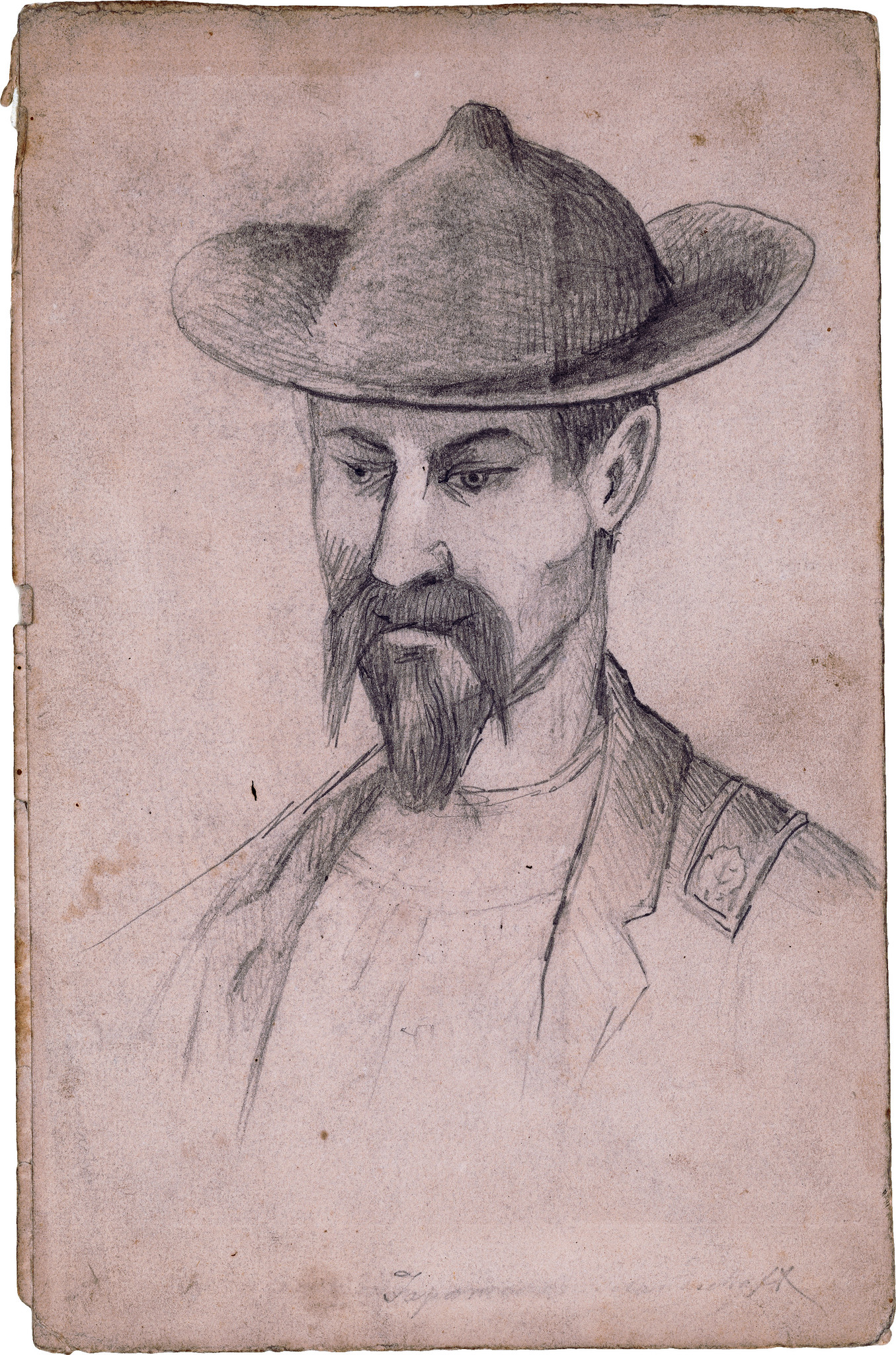
Major William Schnackenburg

Library of Congress
Major William Schnackenburg by Adolph G. Metzner

Title: [Major William Schnackenburg]
Creator(s): Metzner, Adolph, artist
Date Created/Published: [1861]
Medium: 1 drawing on front of sheet: graphite ; sheet 24 x 15 cm.
Reproduction Number: LC-DIG-ppmsca-51175 (digital file from front of original item)
Rights Advisory: No known restrictions on publication.
Call Number: DRWG/US – Metzner, no. 4 (front) (A size) [P&P]
Repository: Library of Congress Prints and Photographs Division Washington, D.C. 20540 USA
Major William Schnackenburg, Library of Congress Prints and Photographs DivisionNotes:
…..Title from Blood shed in this war by M. Peake.
…..With drawing (on back): Sargeant Paul Lamberg, 32 Regiment, Indiana Volunteers.
…..Forms part of the Adolph Metzner American Civil War Collection at the Library of Congress.
…..Forms part of the Documentary Drawing filing series (Library of Congress)
…..Purchase; E. Burns Apfeld; 2014; (DLC/PP-2014:188).
…..Publications: Blood shed in this war: Civil War illustrations by Captain Adolph Metzner, 32nd Indiana / Michael A. Peake. Indianapolis : Indiana Historical Society Press, 2010, p. 50.

https://www.loc.gov/pictures/item/2017646095/

___________
Mike’s notes:

Note – This image has been digitally adjusted for one or more of the following:
– fade correction,
– color, contrast, and/or saturation enhancement
– selected spot and/or scratch removal
– cropped for composition and/or to accentuate subject


0 comments

Rebel War Clerk

Civil War Day-by-Day

AUGUST 24th.—We are resting on our oars after the victory at Manassas, while the enemy is drilling and equipping 500,000 or 600,000 men. I hope we may not soon be floating down stream! We know the enemy is, besides, building iron-clad steamers—and yet we are not even erecting casemate batteries! We are losing precious time, and, perhaps, the government is saving money.

0 comments