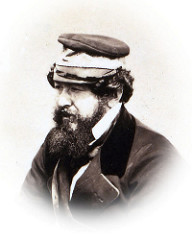
William Howard Russell’s Diary: The Prince de Joinville and his nephews.—American estimate of Louis Napoleon.—Arrest of members of the Maryland Legislature.—Life at Washington.

My Diary North and South – William Howard Russell

September 11th.–Captain Johnson, Queen’s messenger, started with despatches for England from the Legation to-day, to the regret of our little party. I observe by the papers certain wiseacres in Philadelphia have got up a petition against me to Mr. Seward, on the ground that I have been guilty of treasonable practices and misrepresentations in my letter dated August 10th. There is also to be a lecture on the 17th at Willard’s, by the Professor of Rhetoric, to a volunteer regiment, which the President is invited to attend–the subject being myself.

There is an absolute nullity of events, out of which the New York papers endeavour, in vain, to extract a caput mortuum of sensation headings. The Prince of Joinville and his two nephews, the Count of Paris and the Duke of Chartres, have been here for some days, and have been received with marked attention by the President, Cabinet, politicians and military. The Prince has come with the intention of placing his son at the United States Naval Academy, and his nephews with the head-quarters of the Federal army. The empressement exhibited at the White House towards the French princes is attributed by ill-natured rumours and persons to a little pique on the part of Mrs. Lincoln, because the Princess Clothilde did not receive her at New York, but considerable doubts are entertained of the Emperor’s “loyalty” towards the Union. Under the wild extravagance of professions of attachment to France are hidden suspicions that Louis Napoleon may be capable of treasonable practices and misrepresentations, which, in time, may lead the Philadelphians to get up a petition against M. Mercier.

The news that twenty-two members of the Maryland Legislature have been seized by the Federal authorities has not produced the smallest effect here: so easily do men in the midst of political troubles bend to arbitrary power, and so rapidly do all guarantees disappear in a revolution. I was speaking to one of General McClellan’s aides-de-camp this evening respecting these things, when he said– [continue reading…]
0 comments

“Three or four were wounded and our boys say that they killed several of the Rebels.”–Army Life of an Illinois Soldier, Charles Wright Wills.

Civil War Day-by-Day

Camp Norfolk, September 12, 1861.

Agreeable to our very short notice we packed our knapsacks, put three days rations in our haversacks, were carried across the river to Bird’s Point in two boats (our whole regiment), and just at dark started out through the woods. ‘Twas a confounded, dark, dirty, narrow road, and I was right glad when the word “halt” was given and preparations made for bunking in for the night. The next morning we started again along down the river, the gunboats, two of them, keeping a couple of miles ahead of us. We started with a couple of pieces of field artillery, but the road got so bad that we had to leave it after about three miles. We advanced about five miles when the gunboats, which were about a mile and one-half ahead of us, opened mouth, and thunder! what a rumpus they did keep up. We could not see them for the thick brush between us and the river, but we thought sure our little fight had come at last. We were drawn up in the front yard of some secesher’s deserted house (a fine one), and the colonel with a small party went ahead to reconnoiter. While they were gone we ate our dinners, and made ready for the expected march and fight. But the colonel on his return, scooted us back to our morning’s starting place. Whew, but that was a sweating old march. About an hour after we started back, 15 of our cavalry scouts were run in, through the place where we took dinner, by 60 or 70 secesh cavalry. Three or four were wounded and our boys say that they killed several of the Rebels. The gunboats came up in the p.m. reported fighting the “Yankee” and two land batteries, one of which was but three and one half miles below us (and some say but one and one half miles) and had 16 guns. They crippled the dam’d “Yankee” although the latter carries 84’s, while ours hadn’t but 64’s. Our boats were not touched. A deserter came up from Columbus yesterday afternoon and says that our boats killed 200 in the fight. (I believe he is a liar and a spy). We have had it sweet the last day and two nights. Rained like sixty and we have no tents. There is no shelter but a few trees and you know they amount to nothing in heavy rains. It is amusing to see the boys figure at night for dry beds. Every thing, gates, cordwood, rails, cornstalks, weeds and panels of fence and boards are confiscated, and genius is taxed its utmost to make the sleeping as comfortable as possible. Milo Farewell, Hy. Johnson and myself sleep on an armful of cornstalks thrown on a floor of rails. With nothing between us and the clouds. Sid., (Sidney Stockdale) and Theo. each had three sticks of four foot cord wood for a couch, with their feet resting in a mudpuddle. We are further out than any other regiment now. I tell you I like this, and feel like knocking down any man that I hear grumble. None of our boys do that I hear of. We will have our tents here this p.m. though I would rather be without them; they are so much trouble. I know we will have no dirtier time than we have had the last two days, and until it gets cold I would rather not have tents if it is the same all the time. I fell in love with Paducah while I was there, and I think I will settle there when the war is over. I never saw so many pretty women in my life. All fat, smooth-skinned small boned, highbred looking women. They hollered “Hurrah for Jeff” at us, some of them, but that’s all right. I could write until to-morrow morning about Paducah, but I must go and confiscate some corn for dinner.

0 comments

“I saw a young soldier the other day, who told me he could see the top of our house distinctly from ‘Munson’s Hill.’”—Diary of a Southern Refugee, Judith White McGuire.

Diary of a Southern Refugee During the War by Judith White McGuire

Sept. 12th.—Yesterday was the wedding of our dear _____.   The marriage of a child is always melancholy when it involves separation, but particularly so under such circumstances. But surely never were refugees so blessed with friends. Our plan was to have the ceremony in the church, and then to proceed to Winchester, where the bridal party would take the stage for Strasburg, and thence by the cars to Richmond; but we were overruled by Mr. P., who invited his and our friends for the evening, and a beautiful entertainment was prepared for them. We all exercised our taste in arranging the table, which, with its ices, jellies, and the usual etceteras of an elegant bridal supper, made us forget that we were in a blockaded country. A pyramid of the most luscious grapes, from Bishop Meade’s garden, graced the centre of the table. The bridesmaids were three, and groomsman one, and he, poor fellow, had to go off in the storm of last night, because his furlough lasted but forty-eight hours, and his station is Culpepper Court-House. The groom had a furlough of but three days, to come from and return to Richmond. The Bishop and Mrs. J. arrived in the morning. The party consisted of ladies, and gentlemen too old for the service. Bishop J. performed the ceremony. Bishop Meade professed to be too old for such occasions, and declined coming. We feel very lonely this morning, and turn to the newspapers more than we have done for some time.

I saw a young soldier the other day, who told me he could see the top of our house distinctly from “Munson’s Hill.” Oh, that I could know what is going on within those walls, all encompassed by armies as it is. With my mind’s eye I look into first one room and then another, with all the associations of the past; the old family Bible, the family pictures, the library, containing the collection of forty years, and so many things which seemed a part of ourselves. What will become of them? Who are now using or abusing them?

0 comments

A Diary of American Events.

The Rebellion Record – A Diary of American Events; by Frank Moore

September 12.–Captain Kid’s Cavalry company from New Creek, and a company of Infantry from Fort Pendleton, made a descent upon a camp of secessionists at Petersburg, Hardy County, Virginia. One shot from a twelve-pounder scattered the rebels like chaff. Several of them were killed and wounded and a number of prisoners taken. The camp and all its equipage destroyed. Three six-horse teams, twenty horses, six thousand bushels of corn, and a lot of guns and uniforms were captured. The expedition was entirely successful and gallantly conducted.

–A skirmish occurred at Black River, twelve or fifteen miles southwest of Ironton, Mo., between three companies of Indiana Cavalry under Major Gavitt, and a body of secessionists under the notorious Ben. Talbot, in which five of the rebels were killed and four taken prisoners, and thirty-five horses and a quantity of arms captured. The balance scattered in all directions, and being familiar with the county, eluded pursuit.

–The anniversary of the battle of Baltimore was celebrated in that city to-day with more than ordinary demonstrations on the part of the loyal citizens. The National flag was displayed from the public buildings, hotels, and all loyal newspaper offices, numerous private houses, shipping, etc., and the various camps. Gen. Dix issued an order for firing salutes and dress parades in honor of the day at the various camps at three o’clock. The New York Fifth regiment, Zouaves, made a grand dress parade from their fortified camps on Federal Hill through the city, passing around the different monuments. The Association of Old Defenders made their usual parade with their old flag, which they have not deserted as yet. The only demonstration of a character contrary to the patriotic spirit of the day was in the manner in which a few secession storekeepers arranged their goods to indicate their Southern principles, such as hanging out rolls of red and white flannel, or, as in one instance, displaying three flannel shirts–two red ones with a white one in the centre.–N. Y. Tribune, Sept. 13. [continue reading…]

0 comments

Civil War Day-By-Day

Civil War Day-by-Day

September 12, 1861

  • Siege of Lexington, Missouri begins
  • September 12 to 15—Battle of Cheat Mountain, Virginia (now West Virginia)
  • Lee, with 30,000 men under his command, expected to fight a force led by the Unionist General Rosecrans at Meadow Bridge, western Virginia. However, at the last moment Rosecans changed his direction of movement and engaged a Confederate force at Cheat Mountain, comprehensively defeating them. Union losses were 9 dead and 12 wounded while the Confederates lost nearly 100 men.

A Chronological History of the Civil War in America1

  • Col. John A. Washington (rebel), former proprietor of Mount Vernon, killed near Elk Water, Va., while reconnoitering.
  • Mayor Berrett, of Washington, took the oath and was released from Fort Lafayette.
  • The provost-marshal of St. Louis issued a proclamation manumitting two slaves, the property of a secessionist.
  • Battle of Cheat Mountain, Va.; rebels defeated.

  1. A Chronological History of the Civil War in America by Richard Swainson Fisher, New York, Johnson and Ward, 1863
0 comments

“The report tonight is that there has been a very smart skirmish near the chain Bridge which is three miles above Georgetown.”—Horatio Nelson Taft

Diary of US patent clerk Horatio Nelson Taft.

WEDNESDAY 11

Was at the Pat office this morning with Doct D, visited the Hospital there. Called upon Mr Seward, got letter of introduction from him to Mr Chase, could not see Mr C today. There has been heavy firing over the river all the afternoon. The report tonight is that there has been a very smart skirmish near the chain Bridge which is three miles above Georgetown. I was at Willards this evening but could hear no definite account, but large bodies of troops have gone up that way and we may have a battle tomorrow.

______

The three diary manuscript volumes, Washington during the Civil War: The Diary of Horatio Nelson Taft, 1861-1865, are available online at The Library of   Congress.

0 comments

Rebel War Clerk

Civil War Day-by-Day
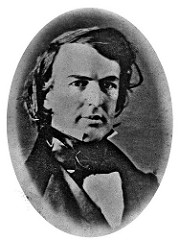
A likeness of Jones when he was editor and majority owner of the Daily Madisonian during President John Tyler’s administration.

SEPTEMBER 11th.—The colonel enjoys a joke. He whispered me today, as he beheld Major Tyler doing the honors of his office, that I might just hint at the possibility of his resumption soon of the functions of chief of the bureau. But he said he wanted a few days holiday.

0 comments

Texas Cavalry Private

Library of Congress

Civil War Era Photographic Portraiture No. 21


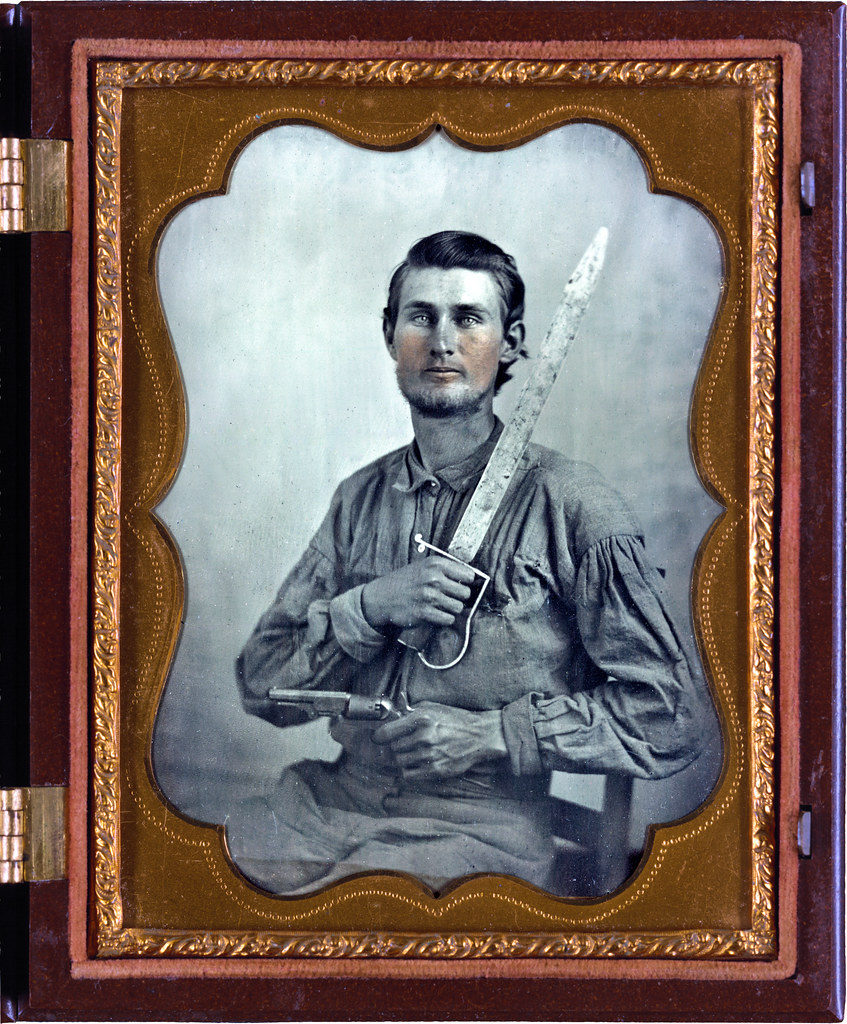
Title: [Private Simeon J. Crews of Co. F, 7th Texas Cavalry Regiment, with cut down saber and revolver]
Date Created/Published: [between 1861 and 1865]
Medium: 1 photograph : quarter-plate ambrotype, hand-colored ; 12.4 x 10.1 cm (case)
Summary: Photo shows identified soldier.
Reproduction Number: LC-DIG-ppmsca-34975 (digital file from original item)
Rights Advisory: No known restrictions on publication.
Access Advisory: Use digital images. Original served only by appointment because material requires special handling.
Call Number: AMB/TIN no. 3069 [P&P]
Repository: Library of Congress Prints and Photographs Division Washington, D.C. 20540 USA http://hdl.loc.gov/loc.pnp/pp.print
Notes:
…..Title devised by Library staff.
…..Case: Berg, no. 2-10.
…..Gift; Tom Liljenquist; 2012; (DLC/PP-2012:127).
…..More information about this collection is available at http://hdl.loc.gov/loc.pnp/pp.lilj
…..Purchased from: B.G. “Chip” Newman, Broker of Fine Antiquities, Madison, Mississippi, 2012.
…..Forms part of: Liljenquist Family Collection of Civil War Photographs (Library of Congress).
…..Forms part of: Ambrotype/Tintype photograph filing series (Library of Congress).
…..Published in: Serrano, Domenick A. Still more Confederate faces. Bayside, N.Y.: Metropolitan Co., 1994, p. 33.

Library of Congress item permalink.

Note: image may be reversed — image at Find A Grave shows image with pistol in right hand vice left.

_______________

Mike’s notes:

Image restoration note – This image has been digitally adjusted for one or more of the following:
– fade correction,
– color, contrast, and/or saturation enhancement
– selected spot and/or scratch removal
– cropped for composition and/or to accentuate subject matter
– straighten image

Image restoration is the process of using digital restoration tools to create new digital versions of the images while also improving their quality and repairing damage.

0 comments

William Howard Russell’s Diary: A Crimean acquaintance.—Personal abuse of myself.—Close firing.—A reconnaissance.—Major-General Bell.

My Diary North and South – William Howard Russell

September 11th.–A soft-voiced, round-faced, rather good-looking young man, with downy moustache, came to my room, and introduced himself this morning as Mr. H. H. Scott, formerly of Her Majesty’s 57th Regiment. “Don’t you remember me? I often met you at Cathcart’s Hill. I had a big dog, if you remember, which used to be about the store belonging to our camp.” And so he rattled on, talking of old Street and young Jones with immense volubility, and telling me how he had gone out to India with his regiment, had married, lost his wife, and was now travelling for the benefit of his health and to see the country. All the time I was trying to remember his face, but in vain. At last came the purport of his visit. He had been taken ill at Baltimore, and was obliged to stop at an hotel, which had cost him more than he had anticipated; he had just received a letter from his father, which required his immediate return, and he had telegraphed to New York to secure his place in the next steamer. Meantime, he was out of money, and required a small loan to enable him to go back and prepare for his journey, and of course he would send me the money the moment he arrived in New York. I wrote a cheque for the amount he named, with which Lieutenant or Captain Scott departed; and my suspicions were rather aroused by seeing him beckon a remarkably ill-favoured person at the other side of the way, who crossed over and inspected the little slip of paper held out for his approbation, and then, taking his friend under the arm, walked off rapidly towards the bank.

The papers still continue to abuse me fante de mieux; there are essays written about me; I am threatened with several farces; I have been lectured upon at Willard’s by a professor of rhetoric; and I am a stock subject with the leaden penny funny journals, for articles and caricatures. Yesterday I was abused on the ground that I spoke badly of those who treated me hospitably. The man who wrote the words knew they were false, because I have been most careful in my correspondence to avoid anything of the kind. A favourite accusation, indeed, which Americans make against foreigners is, “that they have abused our hospitality,” which oftentimes consists in permitting them to live in the country at all at their own expense, paying their way at hotels and elsewhere, without the smallest suspicion that they were receiving any hospitality whatever. [continue reading…]

0 comments

“I feel much encouraged about the war; things are every way looking better.”—Rutherford B. Hayes

Diary and Letters of Rutherford Birchard Hayes

Gauley River, 8 Miles South Of Summersville,

September 11, 1861.

Dear Lucy: – Well, darling, we have had our first battle, and the enemy have fled precipitately. I say “we,” although it is fair to say that our brigade, consisting of the Twenty-third, the Thirtieth (Colonel Ewing), and Mack’s Battery had little or nothing to do, except to stand as a reserve. The only exception to this was four companies of the Twenty-third, Captains Sperry, Howard, Zimmerman, and Woodward, under my command, who were detailed to make an independent movement. I had one man wounded and four others hit in their clothing and accoutrements. You will have full accounts of the general fight in the papers. My little detachment did as much real work – hard work – as anybody. We crept down and up a steep rocky mountain, on our hands and knees part of the time, through laurel thickets almost impenetrable, until dark. At one time I got so far ahead in the struggle that I had but three men. I finally gathered them by a halt, although a part were out all night. We were near half an hour listening to the cannon and musketry, waiting for our turn to come.

You have often heard of the feelings of men in the interval between the order of battle and the attack. Matthews, myself, and others were rather jocose in our talk, and my actual feeling was very similar to what I have when going into an important trial – not different nor more intense. I thought of you and the boys and the other loved ones, but there was no such painful feeling as is sometimes described. I doubted the success of the attack and with good reason and in good company. The truth is, our enemy is very industrious and ingenious in contriving ambuscades and surprises and entrenchments but they lack pluck. They expect to win, and too often do win, by superior strategy and cunning. Their entrenchments and works were of amazing extent. During the whole fight we rarely saw a man. Most of the firing was done at bushes and log and earth barricades. [continue reading…]

0 comments

“Money is getting scarce, gold having been out of circulation so long that people have forgotten how it looks, and merchants say that it will not be long until silver goes the same way.”–Alexander G. Downing.

Diary of Alexander G. Downing; Company E, Eleventh Iowa Infantry

Wednesday, 11th–I went up to the Fair Grounds and spent the day there. The attendance was good, there being about two thousand present.

Business is becoming quite dull. The war seems to put a stop to all improvements, and there is no demand for farm produce. Money is getting scarce, gold having been out of circulation so long that people have forgotten how it looks, and merchants say that it will not be long until silver goes the same way. For a long time now we have had wild-cat money, but everybody is afraid to go to sleep with any of it on hand for fear that it will be worthless in the morning.

0 comments

“These reports of victories are very unreliable affairs.”–Journal of Surgeon Alfred L. Castleman.

Journal of Surgeon Alfred L Castleman.

11th.–Had some skirmishing to-day. Took some prisoners, who state that within twelve miles of us is the center of operations of about one hundred thousand rebels, who are preparing to attack us and march on Washington. This, if true, falsifies all the predictions of this journal, that there is no considerable force of the enemy in front of us, and that we shall have no general engagement here. Nevertheless, my opinion is unchanged.

This morning quite a body of troops, infantry, cavalry and artillery, passed us, on the road going in the direction of where the enemy are supposed to be. By twelve o’clock artillery firing was distinctly heard some four miles in the direction which they took. In the afternoon we were hurriedly called to march to the support of our retreating men.

We met them about two miles this side of where the fight was. They claim to have gained a great victory, but they brought in no prisoners, no guns captured. Why was that. These reports of victories are very unreliable affairs. All kinds of stories are going through the camp, but I shall record none of them till they have assumed a shape worthy to be remembered.

0 comments

A Diary of American Events.

The Rebellion Record – A Diary of American Events; by Frank Moore

September 11.–Six rebels from Memphis, Mo., some of whom were identified as having served under Green, were arrested to-day near Salem, Iowa. They had with them a drove of one hundred and eighty cattle, which they said was for Chicago; the men were held as prisoners at Mount Pleasant.–N. Y. Herald, Sept. 13.

–A large party started out at seven o’clock this morning from the vicinity of the Chain Bridge, above Washington, under the command of Colonel Stevens, of the New York Highlanders. It consisted of several detached companies of infantry, a company of cavalry, and Captain Griffin’s battery. As the skirmishers advanced, the enemy’s pickets retired beyond Lewinsville, about seven miles from the Chain Bridge. The troops, having accomplished the object of their mission connected with the reconnoissance of the country, began to retrace their steps, when a large force of rebels, consisting of two regiments of infantry and Colonel Stuart’s regiment of Virginia cavalry, with a battery of four pieces, were seen approaching from the direction of Falls Church, evidently with a view of cutting them off and preventing their return to their camp; and line of battle was formed by the remainder of their forces. The rebel battery then opened with shell, which was replied to from Griffin’s battery. Several rounds were fired on each side, when the National troops ceased firing for about twenty minutes, in order to give the rebels an opportunity, which they would not embrace, of meeting them on the field–the rebels being for the greater part concealed in the woods. The National forces, on resuming operations, brought into action a thirty-two pounder, the shell from which soon silenced the rebel battery. The gun was then directed toward the cavalry, which appeared on the road leading to Fall’s Church, and soon sent them flying, a number reeling from their saddles and falling to the ground. The shells exploded in their midst. The command was then given to withdraw, and the Federal column fell back in good order to Chain Bridge, reaching there late in the afternoon.–(Doc. 42.)

–Thc Legislature of Kentucky adopted a resolution directing the Governor to issue a proclamation ordering the rebel troops encamped in that State to evacuate the soil of Kentucky. The resolution was passed by seventy-one yeas against twenty-six nays. A counter resolution, ordering both Union and rebel troops to leave the soil, was negatived under the rules of order. This action of the Legislature demonstrates the loyalty of Kentucky to the Union, without the slightest shadow of question or contradiction. [continue reading…]

0 comments

Civil War Day-By-Day

Civil War Day-by-Day

September 11, 1861

  • Lincoln ordered Frémont to withdraw his order regarding property and slave confiscation in Missouri for anyone who voiced their support for the Confederacy. Lincoln ordered Frémont to come into line with the Confiscation Act passed by Congress. To emphasize his order, Lincoln sent Judge Joseph Holt to St. Louis to push Frémont towards moderating his stance.
  • President Lincoln orders John C. Fremont to rescind his order freeing some slaves in Missouri and issue a new order conforming to the Confiscation Act passed by Congress

A Chronological History of the Civil War in America1

  • Kentucky Legislature passed a resolution ordering the C. S. troops to leave the State.
  • President Lincoln, in a letter to Gen. Fremont, directs him to modify the confiscation clause of his proclamation.
  • A number of fine vessels captured by the Union fleet at Hatteras Inlet.
  • Skirmish at Lewinsville, Va.; rebels defeated.
  • Skirmish at Elk Water, Va.; Union troops victorious.
  • Skirmish at Stewart’s Mill, Wa.

  1. A Chronological History of the Civil War in America by Richard Swainson Fisher, New York, Johnson and Ward, 1863
0 comments

“The ‘expected attack’ dwells upon our minds and hearts.”—Woolsey family letters; Mother to Georgeanna and Eliza.

Woolsey family letters during the War for the Union

Lenox, September.

My dear Girls: Abby, as usual, is writing away vigorously, and I am very sure her letters to you are better far than mine would be, therefore I always give place to her; but do not think me indifferent to you or to any little circumstance whatever connected with you in the most remote way, for I assure you every word relating to Washington has a deeper interest than I can express to you, and in all my reading of news I turn with indifference from other parts of the country and items of other regiments, to seek eagerly for some word of those immediately about Alexandria and Washington, and we look with more desire than ever for your letters. The “expected attack” dwells upon our minds and hearts, and our sympathies and fears are all alive. When will the end come? In God’s own time, and we must only wait in patience and faith, looking to God for strength to help us in this time of need. . . . Ask counsel of some of your wise friends in Washington as to the prudence of your remaining for the present there. Do you not think in case of an attack upon the city you would be better elsewhere? I scarcely know where either, south of Philadelphia. Had you not better take the chance, before communication is cut off, of coming north? I should fear your being in Baltimore more than staying in Washington. I hope you will call on Mrs. McClellan and her mother, if the latter is with her. I knew them both, you recollect, in North Conway, and I would like you to make their acquaintance. You might consult with your familiar, General Scott, as to the propriety and safety of your being in Washington in case of an attack. What a nice thing for you to have dined so socially with the General. It will come in as a pleasing little incident in that history which I hope you are writing for coming generations.

0 comments

Diary of Battery A, First Regiment, Rhode Island Light Artillery

Diary of Battery A, First Regiment, Rhode Island Light Artillery, by Theodore Reichardt

Tuesday, September 10.—Gov. Sprague, Col. Wheaton, Major Tompkins, and Capt. Reynolds, visited the section on picket. Quiet up to (Monday, September 16).

0 comments

“From the top of the Ship House we could see the secession flag at Munsons Hill, V.A., with a glass.”—Horatio Nelson Taft

Diary of US patent clerk Horatio Nelson Taft.

TUESDAY, SEPTEMBER 10, 1861.

Went to the Navy Yard today with Doct David and Julia. Chas & Sallie were also along. Quite lively times there but nothing doing excepting preparing war material, shot, cannon, &c. The Steamer Pensecola is nearly completed and was taking on her stores. 400 sailors for her were landed at the yard this morning. From the top of the Ship House we could see the secession flag at Munsons Hill, V.A., with a glass. Got Home to dinner and went down to see the Regulars Dress Parade & hear their music.

______

The three diary manuscript volumes, Washington during the Civil War: The Diary of Horatio Nelson Taft, 1861-1865, are available online at The Library of   Congress.

0 comments

First battle… such as it was.—Rutherford B. Hayes

Diary and Letters of Rutherford Birchard Hayes

Tuesday, 10.–Marched seventeen miles, drove enemies’ pickets out of Summersville, followed nine miles to Gauley river. Enemy entrenched on a hill, high, steep, and hidden by bushes, three to six thousand strong. We get ready to attack. We have been divided into three brigades: First, General Benham’s, consisting of Tenth (Colonel Lytle’s Irish), Twelfth (Colonel Lowe’s), and Thirteenth (Colonel Smith’s) regiments; Second, Colonel McCook’s–the Ninth, Twenty-eighth, and Forty-ninth; Third,–Twenty-third and Thirtieth and Mack’s Battery. McMullen’s Battery attached to McCook. Stewart’s Cavalry, West’s to headquarters, and Schaumbeck’s Cavalry to McCook’s.

First Brigade led the attack. We stood near half an hour listening to the heavy cannon and musketry, then were called to form in line of battle. My feelings were not different from what I have often felt before beginning an important lawsuit. As we waited for our turn to form, we joked a great deal. Colonel Matthews, Scammon, Captains Drake and Woodward, and privates–all were jolly and excited by turns.

Finally our turn came. I was told to take four companies and follow one of General Rosecrans’ staff. I promptly called off Seventh, Eighth, Ninth and Tenth companies. We marched over a hill and through a cornfield; the staff officer and myself leading on, until we reached the brow of a high hill overlooking the Gauley River and perhaps three-quarters of a mile from the entrenchments of the enemy. He [the officer] then said to me that I was to be on the extreme left of our line and to march forward guided by the enemy’s guns, that he had no special orders to give, that I was an officer and must use my own judgment. He never had been over the ground I was to pass over; thought the enemy might retreat that way. [continue reading…]

0 comments

From Camp Lyon

Miscellaneous document sources, News of the Day

Daily Times [Leavenworth, Ks], September 10, 1861

Camp Lyon, near Rolla, Mo.,}
September 1, 1860.}

Editor Times: — A few days ago, while on picket guard, I was informed by a reliable farmer’s wife, that the Secession women residing in the vicinity of camp, have put their heads together, and devised a plan to assist Ben. McCulloch & Co., in driving the abolition invaders from the “sacred soil” of Missouri, by putting poison into the pies they bring into camp for sale, of which a large number are daily consumed. Some one, a hidden listener, spread the news of the diabolical design thro’ the neighborhood, and thereby put us on the alert, and preventied them from putting their fiendish object into execution; as nothing unusual has yet occurred in camp, as regards the health of the troops.

The same day I was informed by a farmer residing three miles from where the picket was posted, that his house had been visited during the night by a party of about forty Secessionists, and plundered of nearly all its contents. While the Secesh were plundering the house, the farmer went to his stable, took his horse and hid him in the woods, and kept aloof until they departed. Not being satisfied with plundering the house and stable, they returned in two hours after, thinking to catch the farmer at home; but he was absent; they departed again, swearing that “we will have the d —— d Dutchman before to-morrow evening.”

The rebels here, are collecting in small squads, and going South to join McCulloch, who, it is rumored, is concentrating his forces 60,000 strong, at Lebanon, Mo., about sixty miles distant, preparatory to an attack upon Rolla.

The weather for the past few days has been very hot.

More anon,

Rover.

0 comments

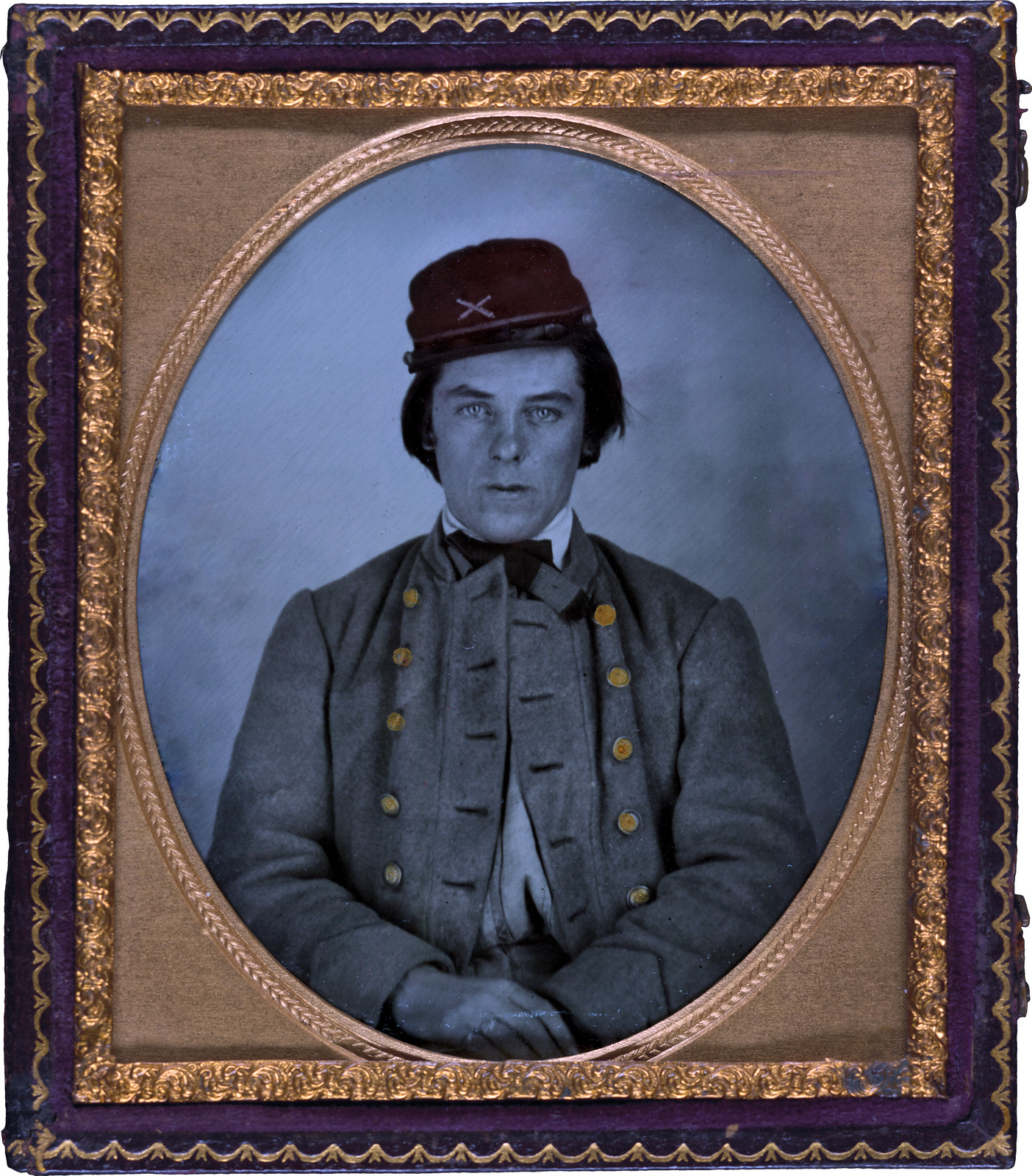
Unidentified artillery soldier in Confederate uniform and kepi hat.

Library of Congress

Civil War Era Photographic Portraiture No. 20

Unidentified artillery soldier in Confederate uniform and kepi hat.
Title: [Unidentified artillery soldier in Confederate uniform and kepi hat]
Date Created/Published: [between 1861 and 1865]
Medium: 1 photograph : sixth-plate ambrotype, hand-colored ; 9.2 x 8.0 cm (case)
Reproduction Number: LC-DIG-ppmsca-32058 (digital file from original item)
Rights Advisory: No known restrictions on publication.
Access Advisory: Use digital images. Original served only by appointment because material requires special handling.
Call Number: AMB/TIN no. 2766 [P&P]
Repository: Library of Congress Prints and Photographs Division Washington, D.C. 20540 USA http://hdl.loc.gov/loc.pnp/pp.print
Notes:
…..Title devised by Library staff.
…..Case: Leather, plain with gilt border.
…..Additional information in collections file.
…..Gift; Tom Liljenquist; 2011; (DLC/PP-2012:127).
…..More information about this collection is available at http://hdl.loc.gov/loc.pnp/pp.lilj
…..Purchased from: The Union Drummer Boy, Gettysburg, Pa., 2011.
…..Forms part of: Liljenquist Family Collection of Civil War Photographs (Library of Congress).
…..Published in: Civil War times. Leesburg, Va. : Weider History Group, Inc., August 2012 (LI, 4), p. 18 (left).

Library of Congress item permalink

_______________

Mike’s notes:

Image restoration note – This image has been digitally adjusted for one or more of the following:
– fade correction,
– color, contrast, and/or saturation enhancement
– selected spot and/or scratch removal
– cropped for composition and/or to accentuate subject matter
– straighten image

Image restoration is the process of using digital restoration tools to create new digital versions of the images while also improving their quality and repairing damage.

0 comments

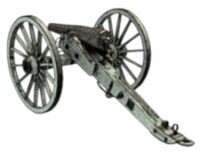
Decided not to enlist in company intended for a battery of heavy cannon–Alexander G. Downing.

Diary of Alexander G. Downing; Company E, Eleventh Iowa Infantry

Tuesday, 10th–I went down town this morning to see about enlisting in a battery which Mr. Little, a business man of Davenport, is trying to raise. He was planning to raise a company of two hundred men to command a battery of heavy cannon. But before night I made up my mind that he would not succeed, and I did not enlist in it. I bunked with some others in vacant store buildings, lying on gunny sacks. It rained hard all day.

0 comments

“…got audience of the Secretary of the Treasury; told a story of our penury (and such a story). I got the money which the paymaster had failed to procure.”–Journal of Surgeon Alfred L. Castleman.

Journal of Surgeon Alfred L Castleman.

10th.–Our regiment has received two months pay to-day, and to-night all are boisterously happy. We had been notified to have our muster-rolls ready, and we should be paid off on the first day of this month. The rolls were ready but the pay was not. We had received no pay since we entered Uncle Sam’s service. We had had to use all our little private means to buy uniforms and .outfit for the war, and there was not money enough in the whole regiment to pay for washing one shirt. We were all in debt, and momentarily expecting orders to march into the deserted parts of Virginia. What were we to do? We could not think of leaving so. Day before yesterday we had intimations from our commanding officers that we should remain a day or two longer where we are, and our troops who heretofore had been constantly impatient to advance, were now overjoyed at the delay, not doubting but that it was to receive our pay, and oh how many dreams of little presents to be sent home before we should be plunged into the wilderness. Perhaps some thought of photographs for sweethearts and wives. But scarcely had the joyous echoes from the rocky hills around us died away, when we were officially informed that there was no money in the treasury. It was a damper. I at once made business to the city; saw the paymaster; through him and my friends got audience of the Secretary of the Treasury; told a story of our penury (and such a story). I got the money which the paymaster had failed to procure. To-day we have been paid off, and to-night I ride a high horse in the affections of the regiment. If they do not dismount me before their money is all expended, their constancy will be greater than my knowledge of human nature generally warrants me in expecting. We are all joyous to-night.

0 comments

Bledsoe confides that Secretary of War Walker is on his way out. Rebel War Clerk

Civil War Day-by-Day

SEPTEMBER 10th.—Col. Bledsoe is back again! He says the President refuses to accept his resignation; and tells me in confidence, not to be revealed for a few days, that Mr. Walker has tendered his resignation, and that it will be accepted.

0 comments

William Howard Russell’s Diary: Discussion on Slavery.

My Diary North and South – William Howard Russell

September 10th.–A party of American officers passed the evening where I dined–all, of course, Federals, but holding very different views. A Massachusetts Colonel, named Gordon, asserted that slavery was at the root of every evil which afflicted the Republic; that it was not necessary in the South or anywhere else, and that the South maintained the institution for political as well as private ends. A Virginian Captain, on the contrary, declared that slavery was in itself good; that it could not be dangerous, as it was essentially conservative, and desired nothing better than to be left alone; but that the Northern fanatics, jealous of the superior political influence and ability of Southern statesmen, and sordid Protectionists who wished to bind the South to take their goods exclusively, perpetrated all the mischief. An officer of the district of Columbia assigned all the misfortunes of the country to universal suffrage, to foreign immigration, and to these alone. Mob-law revolts well-educated men, and people who pride themselves because their fathers lived in the country before them, will not be content to see a foreigner who has been but a short time on the soil exercising as great influence over the fate of the country as himself. A contest will, therefore, always be going on between those representing the oligarchical principle and the pollarchy; and the result must be disruption, sooner or later, because there is no power in a republic to restrain the struggling factions which the weight of the crown compresses in monarchical countries. [continue reading…]

0 comments

A Diary of American Events.

The Rebellion Record – A Diary of American Events; by Frank Moore

September 10.–President Lincoln, Secretary Cameron, Governor Curtin and suite visited the Pennsylvania regiments to-day. The President introduced the Governor and Mrs. Curtin, Secretary Cameron and General McClellan, who were received with enthusiastic cheering. A hand-shaking then took place, General McClellan cordially greeting officers and men. Each man had something cheering to say to the General. One man said, “General, we are anxious to wipe out Bull Run; hope you will allow us to do it soon?” “Very soon, if the enemy does not run,” was the prompt response.

At last Captain Barker, of the Chicago cavalry corps, composing the escort, appealed to the troops not to crowd the General too hard, or shake his hand too much, as before he slept he had a long way to travel, and much writing to do with the hand they were shaking. He promised if they would fall back the General would say a few words to them. They instantly complied, when the General, removing his hat, spoke as follows:–

Soldiers: We have had our last retreat. We have seen our last defeat. You stand by me, and I will stand by you, and henceforth victory will crown our efforts.

– The Eighth regiment of Maine Volunteers, under the command of Colonel Leo Strickland of Livermore, passed through Boston, Mass., on their way to the seat of war. The regiment musters about eight hundred men, recruited from all parts of Maine. They are uniformed in the regular army uniform, a dark blue coat, light blue pantaloons, and a black felt hat. They marched in excellent order, although they have had but little opportunity to drill, as yet. They were without arms, but will receive them at the camp. – Boston Advertiser, September 11.

– The gunboats Conestoga and Lexington left Cairo and reconnoitred down the Mississippi River to-day. They encountered a battery of sixteen guns at Lucas Bend, on the Missouri shore, and two rebel gunboats. They silenced the rebel batteries and disabled the rebel gunboat Yankee, and would have captured her had she not been supported near Columbus. One of the Conestoga’s men was slightly injured. The loss of the rebels is not known. [continue reading…]

0 comments