A Diary of American Events.

The Rebellion Record – A Diary of American Events; by Frank Moore

September 27.–To-day Major-General Dix and staff, Brig.-General Duryea and Major Belger proceeded to the Relay House, Md., for the purpose of reviewing and presenting the Fourth Wisconsin regiment, Col. Paine, with a stand of colors. The regiment was drawn up in line and presented a truly martial appearance. When the presentation was about to take place, the divisions on each flank of the battalion were wheeled to the left and right, forming a three-sided square. The color guard was marched forward from the line, the colors then brought forward, when Gen. Dix addressed the regiment in the most patriotic and impassioned language. Col Paine replied in the same lofty sentiments and with burning eloquence, which spontaneously drew from his regiment acclamations of eternal fidelity to the emblem of our country’s glory–after which the colors took their place in line.–Baltimore American, Sept. 28.

——-

Late addition to Volume 3:

September 27.–A battle was fought near Shanghai, in Benton County, Missouri, between a body of Kansas troops, under Montgomery and Jamison, and the advance guard of Ben. McCulloch’s army and some of the State Guard, under Judge Cheneault. The rebels were driven back with considerable loss, and pursued forty miles, when Montgomery fell back on Greenfield. Great alarm was felt by the rebels in Springfield lest Montgomery should attack that place, and the troops there rested on their arms for several nights.–(Doc. 75.)

0 comments

Civil War Day-By-Day

Civil War Day-by-Day

September 27, 1861

  • McClellan responded to the public’s overwhelming desire for him to launch an offensive against Confederate forces near Washington. McClellan discussed his strategy with President Lincoln. McClellan based his future strategy on highly inflated figures regarding the strength of Confederate forces near the capital. He told Lincoln that there were 150,000 Confederate troops near Washington DC. In fact, there were probably no more than 50,000. The president was told that 35,000 men were needed to guard the city with a further 23,000 needed to guard the Potomac River. This left him with about 75,000 men to launch his campaign against Confederate forces. McClellan demanded a force of 150,000 men to give him parity with the perceived strength of the Confederates.

A Chronological History of the Civil War in America1

  • Gen. Fremont takes the ?eld against the rebels left St. Louis with 13,000 men.

  1. A Chronological History of the Civil War in America by Richard Swainson Fisher, New York, Johnson and Ward, 1863
0 comments

“Policy of sending Union men out of the Confederacy…”—Diary of John Beauchamp Jones.

Civil War Day-by-Day

SEPTEMBER 26th.—Had a conversation with the Secretary to-day, on the policy of sending Union men out of the Confederacy. I told him we had 15,000 sick in the hospitals at Manassas, and this intelligence might embolden the enemy to advance, capture the hospitals, and make our sick men prisoners. He said such prisoners would be a burden to them, and a relief to us. I remarked that they would count as prisoners in making exchanges; and to abandon them in that manner, would have a discouraging effect on our troops. He said that sending unfriendly persons out of the country was in conformity with the spirit of the act of Congress, and recommended me to reperuse it and make explanations to the people, who were becoming clamorous for some restriction on the egress of spies.

0 comments

“Today have nearly finished packing up.”—Horatio Nelson Taft

Diary of US patent clerk Horatio Nelson Taft.

THURSDAY 26

We have thought considerably today of taking another house and remaining in the City. But decent houses for rent are extremely scarce now. Two months ago half the houses (almost) were empty and for rent. I was at the “White House” last evening. Saw Maj Watt and called at the residence of Gov Chase. He was not at home. Today have nearly finished packing up. It has been the National Fast day, business suspended all over the City & stores closed. Julia has gone to stay with Matty Hartly. Chas & Sallie called just at Dusk.

______

The three diary manuscript volumes, Washington during the Civil War: The Diary of Horatio Nelson Taft, 1861-1865, are available online at The Library of   Congress.

0 comments

Fremont’s Hundred Days in Missouri

The Atlantic Monthly

THE narrative1 we propose to give of events in Missouri is not intended to be a defence of General Fremont, nor in any respect an answer to the charges which have been made against him. Our purpose is the more humble one of presenting a hasty sketch of the expedition to Springfield, confining ourselves almost entirely to the incidents which came under the observation of an officer of the General’s staff.

General Fremont was in command of the Western Department precisely One Hundred Days. He assumed the command at the time when the army with which Lyon had captured Camp Jackson and won the Battle of Booneville was on the point of dissolution. The enemy, knowing that the term for which our soldiers had been enlisted was near its close, began offensive movements along their whole line. Cairo, Bird’s Point, Ironton, and Springfield were simultaneously threatened. Jeff Thompson wrote to his friends in St. Louis, promising to be in that city in a month. The sad, but glorious day upon Wilson’s Creek defeated the Rebel designs, and compelled McCulloch, Pillow, Hardee, and Thompson to retire.

Relieved from immediate danger, General Fremont found an opportunity to organize the expedition down the Mississippi. Won by the magic of his name and the ceaseless energy of his action, the hardy youth of the Northwest flocked into St. Louis, eager to share his labors and his glory. There was little time for organization and discipline. They were armed with such weapons as could be procured against the competition of the General Government, and at once forwarded to the exposed points. History can furnish few parallels to the hasty levy and organization of the Army of the West. When suddenly required to defend Washington, the Government was able to summon the equipped and disciplined militia of the East, and could call upon the inexhaustible resources of a wealthy and skilful people. But in the West there was neither a disciplined militia nor trained mechanics. Men, indeed, brave, earnest, patriotic men, were plenty, –men who appreciated the magnitude and importance of the task before them, and who were confident of their ability to accomplish it. But to introduce order into their tumultuous ranks, to place arms in their eager hands, to clothe and feed them, to provide them with transportation and equipage for the march, and inspire them with confidence for the siege and the battle, –this labor the General, almost unaided, was called upon to perform. Like all the rest of our generals, he was without experience in military affairs of such magnitude and urgency, and he was compelled to rely chiefly upon the assistance of men entirely without military training and knowledge. The general staff and the division and brigade staffs were, from the necessity of the case, made up mainly of civilians. A small number of foreign officers brought to his aid their learning and experience, and a still smaller number of West Point officers gave him their invaluable assistance. In spite of all difficulties the work proceeded. In six weeks the strategic positions were placed in a state of defence, and an army of sixty thousand men, with a greater than common proportion of cavalry and artillery, stood ready to clear Missouri of the invader and to open the valley of the Mississippi. At this time the sudden appearance of Price in the West, and the fall of Lexington, compelled the General to take the field. We will now confine ourselves to the narrative of the incidents of the march to Springfield, as it is given in the journal which has been placed in our hands.


1. Fremont’s Hundred Days in Missouri was published in three installments in The Atlantic Monthly. The anonymous author appears to have been a member of Fremont’s staff with a disdainful bias towards Missourians, even those who were pro-Union.
0 comments

Relief of the Families of Volunteers

Miscellaneous document sources, News of the Day

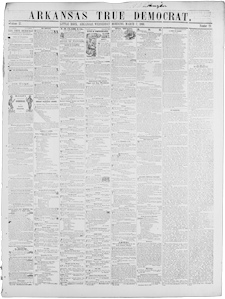
Arkansas True Democrat [Little Rock], September 26, 1861

We respectfully suggest to the county court of Pulaski county, the propriety, if not the necessity, of levying a tax, under the provisions of the ordinance, of the convention of May 11th and 30th; and to issue county scrip, based upon and anticipating the tax. The families of volunteers must not be permitted to suffer or want. If the matter is left to voluntary contributions, a few will do it all, while the niggardly will stand aloof. It is a melancholy truth that we have wealthy men in our county who have done nothing, or next to nothing, for the great southern cause. Perhaps one has given a horse, another a gun, or some such small matter, and taken good care to let everybody know of their liberality! they are able to give thousands, and if they had any patriotism, would give it. We can reach these men by a tax, and in no other way. For this reason it has been strongly urged that such a tax should be levied. We submit the matter to the county court.

0 comments

Military Companies

Miscellaneous document sources, News of the Day

Arkansas True Democrat [Little Rock], September 26, 1861

Some of the military companies raised during the present war have assumed queer names.—We have “avengers,” “invincibles,” “fencibles,” and “rangers,” without number. In our State we have, or had, a company of “yellow jackets,” another of “hornets” and one called the “sassafras invincibles.” In Texas they have one called “the Yankee hunters.” In Alabama one is styled “the rosin heels.” Wild cats, tigers, rattlesnakes, and bears, have furnished names for other companies.

0 comments

Thede and I had our pictures taken—War Diary of Luman Harris Tenney.

War Diary of Luman Harris Tenney.

26th. Fast day. In the morning Thede and I had our pictures taken for Aunt Rhodilla and one of Thede alone for Lizzie Cobb. Went to camp. Worked in the Quartermaster’s barracks. Services at two. Aunt and Uncle were over.

0 comments

Sleeping on a hard pine board was new business to most of us

David L Day – My diary of rambles with the 25th Mass

Sept. 26.   Being the first company on the ground, and not having tents, we bivouacked last night in Agricultural Hall. Sleeping on a hard pine board was new business to most of us, and Morpheus was courted in vain. The boys, however, made a frolic of the night, and more unearthly noises and sounds never greeted my ears. I think the rebels would never need hear the sound of our guns to frighten them, if they could hear sounds like those. Several other companies arrived on the ground this morning, and this afternoon all hands are busy pitching tents.

0 comments

Day of Fasting and Prayer.–Alexander G. Downing.

Diary of Alexander G. Downing; Company E, Eleventh Iowa Infantry

Thursday, 26th–We had no drill today. Instead of drilling all went to meeting. President Lincoln issued a proclamation asking that the day be observed as a day of fasting and prayer, and our company attended service twice today, in a body. The war has cast a gloom over the whole country; people are beginning to believe that it will be a long siege before it is over with.

0 comments

A Diary of American Events.

The Rebellion Record – A Diary of American Events; by Frank Moore

September 26.–Capt. Stewart’s cavalry, numbering seventy-five men, to-day encountered forty rebel cavalry at Lucas Bend, Ky., whom they pursued into Jeff. Thompson’s camp at Belmont. Four rebels were killed, five captured, and many wounded. The remainder escaped to the woods. The Federal troops captured all the guns and pistols they could bring away with them. No Federal troops were injured.

–the Thirty-fifth regiment of Ohio Volunteers took possession of Cynthiana, Kentucky.

–at Louisville, Ky., W. G. Querton, formerly one of the editors and proprietors of the Courier, was arrested for aiding the Southern rebellion.

–The turnpike bridge over Green river, near Mumfordville, was burned by rebels.

–J. B. Archer, Captain of the steamboat Commercial, was arrested, but bailed in ten thousand dollars. The beat was also seized, but released on security being given to surrender her on demand to the Federal Government.– Louisville Journal, September 28.

–The Twenty-first regiment of Ohio Volunteers, left Findlay for Camp Dennison.–Ohio Statesman, October 2.

–In accordance with the recommendation of the President of the United States, published August 12th, this day was observed as a day of fasting and prayer.

0 comments

Wanted

Miscellaneous document sources

Richmond Daily Dispatch,
September 25, 1861

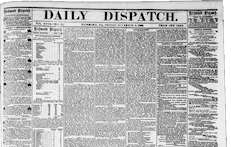
Forty Negroes wanted immediately — good hands — to aid in saving of Louisiana, above Baton Rouge. Men preferred at $1 per day and found; women in proportion. An excellent opportunity is offered for force, permanently, on shares, on the place, operation. I refer to the members of the old house of Dunlop , Moncure & Co., Richmond.

0 comments

Ninth Maine

New York Times

BOSTON, Tuesday, Sept. 24.

The Ninth Maine regiment passed through here this afternoon, en route for Washington.

0 comments

Lincoln to Seward on Tahiti Consulship

Uncollected Letters of Abraham Lincoln—1917
To William H. Seward1
September 25, 1861
Tahiti is vacant; and if the Secretary of State knows no objection, I know none, to Mr. Clark’s having the appointment.
A. LINCOLN
Sep. 25. 1861

  1. Lincoln’s endorsement appears on a letter from A.H. Clark, Washington, September 25, 1861:“ In March last I was recommended for the Consulship of Acapulco.“Of the number of those who recommended me are gentlemen now holding important federal positions in California and elsewhere. I am fully endorsed in the State Department by Senators Harlan, McDougall and Latham.“My application for Acapulco was unsuccessful, and I respectfully ask the Consulship for Tahiti, made vacant by the death of Mr [Visesimus] Turner who was appointed from California.”No record of Clark’s appointment has been found.
0 comments

Civil War Day-By-Day

Civil War Day-by-Day

September 26, 1861

  • Skirmish near Fort Thorn, New Mexico Territory

A Chronological History of the Civil War in America1

  • National Fast, observed in accordance with President Lincoln’s recommendation.
  • Second action at Lucas Bend, Ky.; rebel loss four
    killed and ?ve prisoners.

  1. A Chronological History of the Civil War in America by Richard Swainson Fisher, New York, Johnson and Ward, 1863
0 comments

Mrs. Lincoln “gave my wife a very strong letter in our favor (with a Boquet) to Mr Chase, Sec’y of the Treasury.”—Horatio Nelson Taft

Diary of US patent clerk Horatio Nelson Taft.

WEDNESDAY, SEPTEMBER 25, 1861.

Busy packing boxes most of the day. We expected [to] give up the house on Friday morning but have concluded not to do so until Monday. My wife went today to pay her respects to Mrs Lincoln before leaving the City. Was very graciously received by Mrs L. and assured that if she could do anything to keep our Family here she would do it as she was anxious to have our boys come there as companions & playmates for hers. She gave my wife a very strong letter in our favor (with a Boquet) to Mr Chase, Sec’y of the Treasury.

______

The three diary manuscript volumes, Washington during the Civil War: The Diary of Horatio Nelson Taft, 1861-1865, are available online at The Library of   Congress.

0 comments

We drilled in the barn on the “double quick.”–Alexander G. Downing.

Diary of Alexander G. Downing; Company E, Eleventh Iowa Infantry

Wednesday, 25th–It rained all day and we had to drill in a big barn on the edge of town. We drilled in the barn on the “double quick.” On account of the rain, business of all kinds is almost at a standstill.

0 comments

This may be a fatal policy, or it may be a trap.—Rebel War Clerk

Civil War Day-by-Day

SEPTEMBER 25th.—Mr. Benjamin and Gen. Winder, after granting a special interview to Messrs. G. and R., have concluded to let them depart for Pennsylvania and New York! Nor is this all. I have an order from Mr. Benjamin to give passports, until farther orders, to leave the country to all persons who avow them-selves alien enemies, whether in person or by letter, provided they take no wealth with them. This may be a fatal policy, or it may be a trap.

0 comments

I am here as J. A. [judge-advocate].—Letters of Rutherford B. Hayes.

Diary and Letters of Rutherford Birchard Hayes

Mt. Sewell on Pike from Lewisburg
down Gauley And Kanawha Rivers,
Thirty Miles From Lewisburg,
Camp Sewell, September 25, 1861.

Dear L–: – I am now in General Cox’s camp, twenty-five miles from the Carnifax Ferry. The regiment is back about twenty miles. I am here as J. A. [judge-advocate]. Came over yesterday. This camp is on the summit of a high hill or mountain which affords a most extensive view of mountain scenery. The enemy is on a hill about one or two miles from us under Wise. Their strength is not known. Firing continued between the pickets yesterday a good part of the day. Many cannon shot and shell also were let off without much result. One man (Major Hise) slightly wounded on our side. We are ordered not to fight the enemy, not to attack, I mean, until General Rosecrans arrives with our regiment and other forces. McCook is here. If the enemy does not retire, I think there will be a battle in a few days, but I think they will retreat again. They left a strongly fortified position day before yesterday. I found it yesterday. Well, all these matters you read in the papers.

Tell uncle I would write him, but I don’t know where he is, and I suppose he sees my letters often enough. I am in the best possible health and spirits. I trust you are also. It seems to me we are gradually getting better off in the war. It may, and will last some time, but the prospect improves steadily.

I merely write this morning to tell you of my present whereabouts, and that I love you dearly. Kisses and love for the boys and all.

Affectionately,

R.

Mrs. Hayes.

0 comments

War Diary of Luman Harris Tenney.

War Diary of Luman Harris Tenney.

25th. In the morning went over to camp. Commenced work. Thede went over to Uncle’s after dinner. Went to tea. Called on Lizzie Cobb. Had a fine time.

0 comments

We now began to realize some of the discomforts of a soldier’s life.

David L Day – My diary of rambles with the 25th Mass

Sept. 25. Under escort of the Milford Brass Band, we marched through a few of the principal streets to the depot. Here a large concourse of citizens had collected to give us their best wishes, and see us off. We now began to realize some of the discomforts of a soldier’s life. There not being passenger cars enough to accommodate us, we were crowded into two box freight cars for South Framingham, where we changed to passenger cars for Worcester. Arriving there, we marched to the city hall, where we took dinner. From there we marched to the agricultural grounds’ west of the city, where we are to encamp. This camp is named Camp Lincoln, in honor of Ex-Governor Lincoln of Worcester.

0 comments

A foraging expedition returns.–Journal of Surgeon Alfred L. Castleman.

Journal of Surgeon Alfred L Castleman.

25th.–We had a great time to-day, having sent out this morning some six thousand troops, with about one hundred wagons, on a foraging expedition. This evening they returned, loaded with hay, oats, corn, cows, sheep, hogs, and one Irishman–all captured from the enemy. In this deserted and desolated country, where we have for weeks been enjoying (?) rural life without a sign of pig or poultry, without even those indispensable concomitants of civil life–the cries of babies, or the flapping in the wind of confidential garments from clothes lines in the back yard[1]–the sight of the woolly bleaters called back reminiscences of savory mutton and warm under-dresses, with whispered wishes for the time when we may return to the pleasures of civil life.


[1] A something whispers to me that if this should ever be read by housekeepers, it may call up unpleasant reminiscences of “ironing days.” I hope not.

0 comments

Busy for the soldiers.—Diary of a Southern Refugee, Judith White McGuire.

Diary of a Southern Refugee During the War by Judith White McGuire

25th.—The last two days spent with pleasant friends, one day with Miss M. M., and the other with my old acquaintance, Mrs. Dr. F., of the “White Post.” These ladies, like all others, are busy for the soldiers. To-day I received a copy of ” Headley Vicars,” abridged for the camp, by my friend J. J. Mr. M. will take it to-morrow to the camp, when he goes with the wagon. To-day we have been helping the Bishop to pack a barrel of grapes, and another with tomatoes and other fresh vegetables; and yet another Mrs. M. has packed with bread, biscuit, and a variety of things for the sick.

0 comments

Coats for Jeff Thompson’s men.—”The most bewildering combination of brilliant, intense reds, greens, yellows, and blues in big flowers” from flannel-lined oilcloth table-covers.

War Diary of a Union Woman in the South

Sept. 25, 1861. (Home again from “The Pines.”)—When I opened the door of Mrs. F.’s room on my return, the rattle of two sewing-machines and a blaze of color met me.

“Ah! G., you are just in time to help us; these are coats for Jeff Thompson’s men. All the cloth in the city is exhausted; these flannel-lined oilcloth table-covers are all we could obtain to make overcoats for Thompson’s poor boys. They will be very warm and serviceable.”

“Serviceable, yes! The Federal army will fly when they see those coats! I only wish I could be with the regiment when these are shared around.” Yet I helped make them.

Seriously, I wonder if any soldiers will ever wear these remarkable coats. The most bewildering combination of brilliant, intense reds, greens, yellows, and blues in big flowers meandering over as vivid grounds; and as no table-cover was large enough to make a coat, the sleeves of each were of a different color and pattern. However, the coats were duly finished. Then we set to work on gray pantaloons, and I have just carried a bundle to an ardent young lady who wishes to assist. A slight gloom is settling down, and the inmates here are not quite so cheerfully confident as in July.


Note: To protect Mrs. Miller’s job as a teacher in post-civil war New Orleans, her diary was published anonymously, edited by G. W. Cable, names were changed and initials were generally used instead of full namesand even the initials differed from the real person’s initials. (Read Dora Richards Miller’s biographical sketch.)

0 comments

A Diary of American Events.

The Rebellion Record – A Diary of American Events; by Frank Moore

September 25.–At Trenton, New Jersey, the Grand Jury came into the United States Court, and made a lengthy presentment “that complaints have been made before this Grand Inquest concerning certain newspapers published in this State, and copies of the following papers issued during the last few months have been submitted, and carefully examined, namely: The Newark Evening Journal, The Warren Journal, The Hunterdon Democrat, The New Brunswick Times, and The Plainfield Gazette; that during the most critical period, while the capital of the nation has been besieged by armed insurgents, while eleven States in actual rebellion have been striving, by invasion and treachery, to plunge other States still remaining loyal into open opposition to the National Government, these newspapers have been, up to a very recent period, persistently denouncing and libelling these to whom the great duty of National defence is necessarily intrusted; in thwarting their efforts for self-preservation, and fomenting rebellion by discouraging and opposing the only means by which it can be put down. While they cherish a due regard for freedom of speech they feel it their duty to repudiate and denounce the conduct of these journals; that while the Press may freely criticize public men and measures in the peaceful contests of party, yet in a war for the life of a nation, the Press, as well as individuals, should uphold the existing Government or be treated as its enemies. They consider their duty fully discharged in reference to these newspapers by this presentment, leaving them to the wholesome action of public opinion. They recommend all loyal citizens, all public officers, all municipal corporations, vigorously to withhold all patronage from such newspapers as do not hereafter give their unqualified support to the National Government.”

–Smithland, Kentucky, was occupied by the National troops to-day.–Stocking-knitting associations were organized by the ladies of Lebanon County, Pennsylvania,

–This day General William F. Smith, with a force of several thousand men from the camps in the vicinity of the Chain Bridge, on the Potomac, proceeded to Lewinsville, Va., for the purpose of reconnoitring and obtaining forage. Upon arriving at that place his troops were permitted to rest from about half-past nine o’clock A. M., till three o’clock P. M., when there came in sight a large force of Confederate troops, consisting of four or five regiments of infantry, one of cavalry, and six pieces of artillery. They came from Fall’s Church, and in a few minutes opened a fire of shot and shell upon the National troops, without, however, doing any other harm than slightly wounding one man. Their fire was returned by the batteries of Captains Griffin and Mott, who had thrown only Twenty-six shot and shell when the secessionists deemed it prudent to retire from the field. Their loss is not known. The object of the expedition having been accomplished, Gen. Smith, at about five o’clock, returned to his camp. He brought with him ninety-two loads of hay and corn, twenty sheep and twenty beef cattle– the sheep and cattle being the property of Quartermaster Means, of the Confederate service–and one prisoner, who mistook the National pickets for his own. He represents himself as an aid of Gen. Stuart. The Union troops of the expedition consisted of the New York Seventy-ninth, Third Vt., Nineteenth Indiana, and a portion of a Wisconsin regiment, with eighty regular cavalry, Griffin’s West Point battery, and a section, two guns, of Mott’s New York battery. [continue reading…]


0 comments