 October 2, 1861
A Chronological History of the Civil War in America1
- Rebels defeated at Chapmansville, Va.
- A Chronological History of the Civil War in America by Richard Swainson Fisher, New York, Johnson and Ward, 1863
October 2, 1861
A Chronological History of the Civil War in America1
Tuesday, October 1.—One o’clock A. M. Orders arrived to return immediately to Seneca Mills. The left section marched at once, arriving towards day-break. At sunrise, the fifth gun went on picket duty once more. Lieut. Newton, Sergeants Hammond and Read, were with the left section. Commenced to throw up intrenchments during the night.
OCTOBER 1st.—I find that only a few hundred alien enemies departed from the country under the President’s proclamation, allowing them forty days, from the 16th of August, to make their arrangements; but under the recent order of Mr. Benjamin, if I may judge from the daily applications, there will be a large emigration. The persons now going belong to a different class of people: half of them avowing themselves friendly to our cause, and desiring egress through our lines on the Potomac, or in the West, to avoid being published as alien enemies going under flag of truce via Norfolk and Fortress Monroe. Many of them declare a purpose to return.
TUESDAY, OCTOBER 1, 1861.
Have had a hard days work moveing down our Furniture. Had six wagon loads left after our sale but I take back some articles from Mr Peck which he bid off having concluded [to] remain in the City awhile longer. We are in a very pleasant neighborhood and pleasant part of the City. Our troops have advanced somewhat within a day or two on the other side of the River but no fighting yet of any account.
______
The three diary manuscript volumes, Washington during the Civil War: The Diary of Horatio Nelson Taft, 1861-1865, are available online at The Library of Congress.
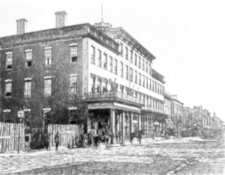
Rev. Henry Hopkins to Eliza Woolsey Howland.
City Hotel Hospital, ……………
Alexandria, Oct, 1861.
My dear Mrs. Howland: I want to tell you how I am coming on here in my new field, for at Washington I received the impression, which it will take a long time to wear away, that you and Miss Woolsey are cordially interested in all that concerns me in this work.
Dr. Sheldon is entirely propitious thus far. . . . Those who are religious women among the nurses hail my coming with real joy. The very first one whom I encountered was such a woman, and as I sat down in her cheerful ward before the bright fire on the hearth, talking with the men, a poor emaciated creature who was sitting wrapped in blankets, with his feet upon a pillow, asked me–“Are you a physician?” “No,” I told him, “I am a clergyman.” He stretched out his lean hand to me, and said–“Oh, sir, I am so glad to see you. I have been very sick, so that they gave me up, and now I am getting well, and I am not a Christian, and I must be.” Could the most trembling faith ask more than this?
I have just come from attending the funeral of a soldier of the 27th N. Y. regiment, who died last evening of typhoid fever. It was severely simple in all its accompaniments, only a little gathering in the hospital dining room, and a simple exercise; while a corporal’s guard were the only ones to attend the body to the grave, to hear the last sad words spoken. But in the very simplicity of it, and in the peculiar circumstances of those concerned, and especially from being the first time that I had ever officiated on such an occasion, it was to me very impressive. Had I not been here it is unlikely that he would have received a Christian burial.
. . . . Dr. Sheldon called me Mr. Woolsey this morning, and as long as that association of ideas continues I am sure of most excellent treatment.
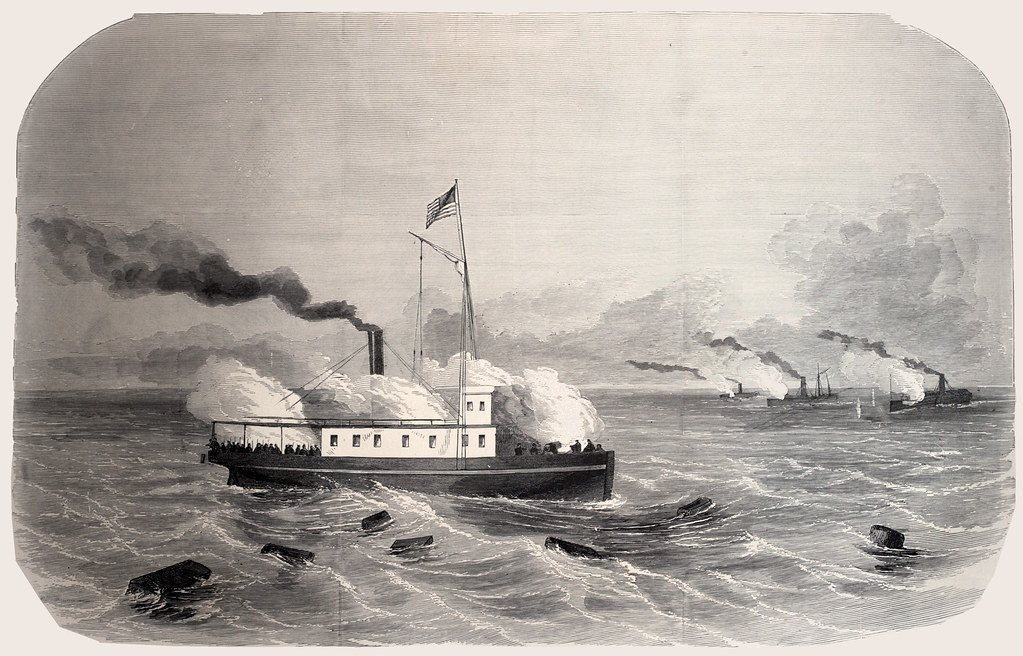
Capture of the Propeller ‘Fanny’ In Pamlico Sound by Three Confederate Steamers while Conveying Men and Stores to the Twentieth Indiana Regiment
(from Frank Leslie’s Illustrated History of the Civil War…, edited by Louis Shepheard Moat, Published by Mrs. Frank Leslie, New York, 1895)
“0n the 1st of October, 1861, Colonel Hawkins dispatched the propeller Fanny, with two cannon, ammunition, supplies and provisions, to the camp of the Twentieth Indiana Regiment, then stationed at Chicamacomico. While they were landing their stores into boats they were attacked, about five o’clock in the afternoon, by the Confederate steamer, Northampton, and two tugs, which came from the direction of Roanoke Island, and after a brief engagement the Fanny was surrendered to the enemy.”
1st. My birthday (twenty)–what a contrast between this one and that of the year before. Spent the day about as usual.
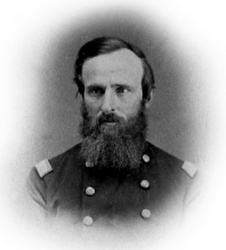
Camp Sewell, October 1, 1861. – About a week ago I left Camp Scott, or Cross Lanes, and came over to General Cox’s camp on the top of Sewell Mountain. Our Secesh friends are fortifying in sight. I staid with McCook. General Cox is an even-tempered man of sound judgment, much loved by his men. McCook and he both wanted to occupy Buster’s Knob on the left of our enemy’s camp, but a dispatch from General Rosecrans prevented. The next day the enemy were fortifying it. General Schenck takes command of our brigade. I have tried five cases the last two days. We had a rain-storm, cold, windy, and awful. Must go to winter quarters. The enemy still fortifying. Our pickets killed a colonel or lieutenant-colonel of the enemy who rode among them. All wrong and cruel. This is too like murder. Shooting pickets, etc., etc., ought to be put down. Another cold night. Jolly times we have in camp.
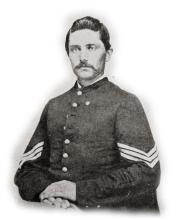
Tuesday, 1st–We drew our cooking utensils and rations for five days. John Batderf, Joseph Tomlinson and I were put in as cooks for the company. We have company drill four hours a day. It seems that we are in camp this time for business. My bunk-mate is James M. Fossett, a brother of Thomas Fossett. James enlisted this time instead of his brother. He’s a fine fellow for a bunk-mate.
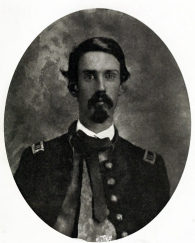
Headquarters 79th Regt.
Camp Advance, Co. K.
Virginia, 1861.
Dear Mother:
A most delightful moonlight forbids my retiring at the usual hour to rest, so I will write and let you know that all is well – that we have had a dull week, that there has been naught to stir the sluggish blood since last week save once, when it was thought that the Army of Beauregard was marching in heavy columns upon us, but it didn’t come, so we all said: “Pooh, pooh! We knew it wouldn’t. They are too wise to attack us.” Alas, that we should have to tell that sorry tale of Bull Run! Walter has written me, and is full of our defeat. He does not feel flattered by the cheap lithographs in the shop windows representing “Yankees Running,” which are thrust upon his sight all over England. He is delighted though to think that the 79th did well, and that I was a member of the Highland Regiment. As we file out of our camp, full equipped, the soldiers of other Regiments are wont to say, “There go the Highlanders. There will be fighting to-day.” We are now formidably intrenched, and I think can make a tolerable defence against the foe. The Richmond Examiner says: “We” (the Southerners) “flaunt our flag defiantly in the face of the cowed and craven-hearted foe, but they tamely endure the insults we heap upon them, and refuse to accept our challenge to a fair and open fight.” Well I think we can afford to endure the flaunting of the “stars and bars” until McClellan is ready, when we hope to march forward, seeking winter quarters in the pleasant mansions of the South. Just this same thing the Southerners are hoping to gain in the North. Beauregard thinks Philadelphia, Baltimore and New-York gay places in the season, where the Southern youth may join in the festivities of winter. Nous verrons.
We have a little parson in our regiment who has a due regard for his personal safety. We love to get him into our tents, and describe with graphic truthfulness the horrid nature of shell wounds. The worst of shells too, we add, is, that they can be thrown to such a distance that even the Doctor and Chaplain are exposed to their death-bearing explosions. Our parson grows uneasy, and. when an alarm is given, starts off, carpet-bag in hand, to our intense amusement, for the nearest place of safety. He is like that worthy chaplain who, on the eve of battle, told the soldiers, “Fear not, for those of you who fall will this night sup in Paradise.” The battle commenced and the chaplain began to display most entertaining signs of terror. He was reminded of the consoling language he had himself used in the morning. “No thank ye,” he answered quickly, “I never did like suppers.” To such an extent are we obliged to resort to everything to amuse ourselves. Our darkeys give us some amusement and much more trouble. Ours we have dubbed the “Pongo,” who knows how not to do it. in a manner to excite our unbounded admiration. In the evening these Africans have a way of getting around the fire and singing real “nigger melodies,” which are somewhat monotonous as regards the music, and totally idiotic as regards the words. A favorite of theirs goes thus – viz:
My little boat is on de ocean
Where de wild bird makes de music
………..All de day.
This will sometimes be repeated for a couple of hours by the indefatigable nigger – indefatigable in this alone.
October 1.–The Eighth regiment of New Jersey Volunteers, commanded by Col. ____ Johnston, left Trenton for Washington.–The Fifteenth regiment of Pennsylvania Volunteers, Colonel Christ, left Harrisburg for the seat of war. Previous to the regiment’s leaving, the regimental colors were presented by Governor Curtin, with an effective and patriotic address. Colonel Christ responded in an appropriate manner, and the affair passed off very enthusiastically.
–Melancthon S. Wade of Ohio, Lovell S. Rosseau of Kentucky, and Alvin Schoepf were appointed Brigadier-Generals in the Army of the United States.–General McClellan made a balloon reconnoissance, in the afternoon, from Munson’s Hill, in Virginia.
–Three Lieutenants attached to the United States ship Constellation, which recently arrived at the Portsmouth navy-yard, were sent to Fort Lafayette, they having refused to take the oath of allegiance. Their names are Benjamin P. Loyal, W. R. Butts, and Henry K. Stevens–the first two natives of Virginia.
–The United States gunboat Itaska was launched at Philadelphia, Pa.–Colonel Taylor, in command of the rebels at Springfield, Mo., issued a proclamation ordering all Union men who have borne arms in the Home Guard, to leave the country, or go into the Southern army for the same length of time as they had served against it. The proclamation also prohibits the carrying any more slaves South, as such a course is calculated to lessen the confidence of the people in the ability of the rebels to maintain themselves in Missouri.– (Doc. 62 ½.)
–This afternoon, a mile and a half beyond Edsall’s Hill, in Virginia, a slight skirmish occurred, in which a private of the New Jersey Third was killed and three were wounded. Surgeon Cox and eleven men had been out scouting, and encountered a rebel advance picket of one hundred men. Cox instantly cried, “Battalion, halt!” The rebels, thinking they were met by a superior force, broke and ran. Our small force, in returning, were suddenly confronted by another rebel guard, about eighty strong, and fired on with the result as above stated. The fire was returned with good effect, and each party then fell back.–N. Y. Tribune, Oct. 3.
–The gunboat Conestoga went down the Mississippi River within three miles of Columbus, Ky. She chased the rebel gunboat Jeff. Davis, obliging her to take shelter under cover of the rebel batteries on shore. It was ascertained that the Jeff. Davis had an armament of four six-pounders. The Conestoga found the rebel signal fires burning several miles above Columbus.
–Ai Warrenton, Virginia, died Col. Barlow Mason, late aid to Gen. Johnston, wounded at the battle of Manassas. He was brother to the Hon. James M. Mason, Captain Murray Mason, and others.
–Application having been made to the Government by R. B. Forbes, to have ” letters of marque” issued to the propeller Pembroke, about to sail for China, Secretary Welles, in a letter of this date, writes that Congress has not authorized the issue of such papers against the Confederate States, and that if it had done so it would have been an admission of what the Confederates assume–namely, that they are an independent nationality. But the Secretary also thinks that, under the second clause of the Act of Augusts, 1861, “letters permissive, under proper restrictions and guards against abuse, might be granted.”–(Doc. 63.)
–The Rev. Mr. Robinson, a Missionary teacher in the Cherokee nation, arrived at St. Louis, Mo., and reported that the Chief of that Nation finally succumbed to the secession pressure, and on August 21st called the Council together at Telequah and sent in a message recommending the severance of their connection with the United States and an alliance with the Southern Confederacy. The Council approved of the recommendation, and appointed Commissioners to make a treaty of alliance with the Southern Government. The Confederate Commissioner had assumed the payment of the annuities hitherto received by the. Cherokees from the National Government. The Creeks had raised one thousand men for service in the Confederate army, and the Cherokees formed a Home Guard of twelve hundred strong.– (Doc. 63 ½.)
–Col. St. George Cooke, of the Utah forces, arrived at St. Louis to-day. His regulars, six hundred strong, will reach Fort Leavenworth in three or four days.–St. Louis Republican, Oct. 2.
–At Hatteras Inlet the steamer Fanny, with stores for the United States Volunteers on the north coast, was captured by a party of Confederates in their armed steam-tugs. The Fanny was armed with two rifled brass guns, and had on board thirty-five men of the Ninth New York Volunteer regiment. Her crew were mostly civilians, and upon the appearance of the enemy, abandoned the vessel, and escaped in a small tout. The soldiers were taken prisoners by the rebels.–(Doc. 64.)
October 1, 1861
A Chronological History of the Civil War in America1
Monday, September 30 .—The section returned to Darnestown, and the battery was once more together.
SEPTEMBER 30th.—A pretty general jail delivery is now taking place. Gen. Winder, acting I suppose, of course, under the instructions of the Secretary of War—and Mr. Benjamin is now Secretary indeed—is discharging from the prisons the disloyal prisoners sent hither during the last month by Gens. Johnston, Floyd, and Wise. Not only liberating them, but giving them transportation to their homes, mostly within the enemy’s lines. Surely if the enemy reciprocates such magnanimous courtesy, the war will be merely child’s play, and we shall be spared the usual horrors of civil war. We shall see how the Yankees will appreciate this kindness.
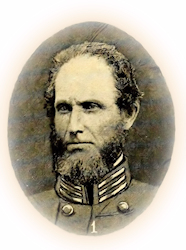
Sept. 1—Meet Chaplains. Dr. Pendleton there. Rev. Dr. Schon and Rosser come on train. (Rev. Thos. Murphy, of Wilmington, and David Sykes, of Bladen died Aug. 18.) Two converts during the week. Much interest in 2nd and 3rd. Several penitents and some converts.
Sept. 4—The Lord’s work goes on. Ten quiet clear conversions at night. Bro. Howard preaches. Ten days furlough comes.
Sept. 5—Self-denial. Furlough in my pocket, but feel it my duty to remain at my work. Much encouraged by frequent conversions.
(Sixteen years from that day I was to see my wife die in Greensboro. She has been seventeen years in Heaven, as I review my little diary of the trials and toils of war.)
Sept. 6—Preach for Doles’ Brigade. In p. m., Bro. Howard, Lawry and I immerse about thirty men. Bro. Powledge, of Georgia, preaches for me at night.
Sept. 7—Bro. Howard preaches for men at night.
Sept. 8—Meet Chaplains. Glorious work in the army, thank God!
Sept. 9—Start home.
Sept. 10—Get to Raleigh at midnight.
Sept. 11—Reach home to breakfast.
Sept. 12—Ride to Orange Church.
Sept. 13—Preach in M. E. Church in Chapel Hill.
Sept. 16—Rev. J. W. Jenkins baptizes my fourth son, James Russell.
Sept. 17—Start to Virginia at 4 p. m. God bless wife and children!
Sept. 19—Get to Orange Courthouse weak and sick. Walk six or eight miles to Dr. Terryll’s.
Sept. 20—Walk to wagon yard. Ride to Palmyra Church. Preach to Ordinance officers.
Sept. 21—Get to Regiment near Morton’s Ford. Bro. Marshall went with me and preached at Palmyra Church. Sleep in stable at Buckner’s.
Sept. 22—Go in camp near Morton’s Ford. Willie’s birthday.
Sept. 23—Preach to Regiment on picket line. Prayers at night.
Sept. 25—Revs. Rumple and Kilpatrick arrive. Bro. Rumple preaches at night.
Sept. 26—Bro. Kilpatrick preaches this p. m. Regiments go on picket. Prayer at night.
Sept. 27—Preach twice on picket. Relieved late. Bro. Rumple preaches at night.
Sept. 28—Two converts.
Sept. 29—Write to Prof. Hepburn.
Sept. 30—Go on picket.
MONDAY 30
We have been all day hard at work getting ready to leave our residence on L St. I have rented a house on 9th St next door to Comodore Smith, No. 346, having 9 rooms and back buildings, rent $200.00 pr year. House in tolerable repair and convenient, shall move in tomorrow. The House belongs to the old “Douty Estate” and is one belonging to “Douty Row” betwen Mass Ave and L St, West. Weather is delightful.
______
The three diary manuscript volumes, Washington during the Civil War: The Diary of Horatio Nelson Taft, 1861-1865, are available online at The Library of Congress.
30th. Thede returned in the morning. I felt rather ill from a hard cold.
Monday, 30th–I left home early this morning for Tipton, where at 10 o’clock about one hundred of us, with a band, left Tipton in farm wagons for Wilton, which place we reached at 4 o’clock, all covered with mud. At 5 o’clock we took the train for Davenport and arrived there at 8 o’clock. We formed in double line at the station and marched through town past the Burtis Hotel, on up to Camp McClellan, where we went into the barracks. As we passed the hotel every other man was handed a good wool blanket.
Company B of the Eleventh Iowa had supper prepared for us, consisting of boiled potatoes, fried bacon, boiled beef, baker’s bread and coffee. On the way down from Wilton, Governor Kirkwood passed through the train and shook each man by the hand.
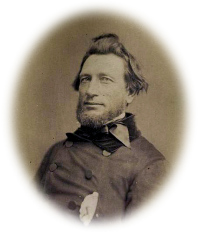
30 h.–During the past week I have been much shocked by the growing tendency to drunkenness amongst the officers of the army. I do not doubt but that if the soldiers could procure spirituous liquors, they would follow the example set them by their much loved officers.
I have been somwhat amused for a few days by the antics of an officer of high rank, who has been shut up by sickness in his tent, and under my supervision. He entered the army about the time I did, and had for some time been a much esteemed member in good standing of the Good Templars. He had been from camp a few days–I think to Washington–and returned sick. He had been with me but a short time when his vivid imagination began to convert the stains on his tent into “all manner of artistic beauties– figures of beasts and men, and of women walking on the walls of his tent, feet upwards.” Fie, fie! Colonel; if I did not know that you were a Good Templar and a married man, I should think such fancies were unbecoming. ‘Tis a good thing to be a Templar and a married man, but still ” All is not gold that glitters.”
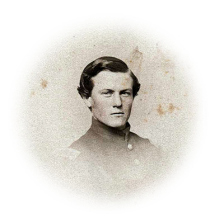
Camp Corcoran, Arlington Heights, Va.,
Monday, Sept. 30, 1861.
Dear Sister L. :–
My soldiering now is not play, it is work. The last time I wrote you we were in Camp Casey, above Washington. Last Saturday afternoon we received orders to strike tents and be ready to march. We were ready in half an hour, and at sunset we started, no one knew where. We went down through the city, past the Capitol, and across the Long Bridge, and set our feet on the sacred soil of the “Mother of Presidents.” After marching about eight miles, we halted on a piece of rough ground, evidently a pasture, stacked our guns and lay down to rest. We were hungry, but we had nothing to eat. D., H. and I had each a blanket. We spread one down and the other to cover us and tried to sleep, but it was so cold we could not sleep much. The dew wetted our blankets both through, and H. was almost sick, so we had rather a sorry night. I rose about 4 o’clock and stood by the guard fire till reveille, drying our blankets. Half an hour after sunrise we marched about half a mile to our present camp. We pitched our tents and had our dinner of bread and raw pork at noon. I could not eat raw pork and dry bread at home, but a fast of twenty-four hours, a ten-mile march, and a bivouac at night sharpens the appetite wonderfully. At night we got things arranged, and had a good supper. Our rations are of the best quality, except our salt beef, which is not sweet.
Now for our camp. We are on Arlington Heights, about four miles southwest of the Capitol. The Heights are ranges of hills running parallel with the river and overlooking the city. Fort Corcoran is about twenty rods from our camp, and another fort on the other side. As far as I can see in every direction, the white tents of our enemy dot every hilltop. The rebel camps are within two miles of us, their pickets and ours shooting each other every night.
Our whole regiment has been changed from light infantry to a rifle regiment. We are to have the short Minie rifle with sword bayonet. Our drill is changed entirely, but I am learning it very fast. The whole regiment is doing its best with the hope of soon meeting the enemy. We are drilling with old altered flintlocks.
As I came out of my tent yesterday morning, what was my astonishment to see the Reverend Mr. Reed of Pittsburgh standing before me in uniform. I looked at him and could hardly recognize him, but there was no mistake. He is the chaplain of Governor Black’s regiment, twelve hundred strong. He said his regiment had gone to make a reconnoissance beyond Munson’s Hill–that great fortification was taken without firing a gun, and a lot of wooden guns ingeniously painted showed how they were armed.
Regiments are moving every night, and though we are ignorant of what is to be done, the universal impression is that a great battle is on the tapis.
2 P. M. We have orders to be in readiness to march at a moment’s notice. Forty rounds of cartridges are distributed. Lowe’s balloon is in our camp. I would write more but must stop for want of time.
Address O. W. N., care Captain T. M. Austin, McLane’s Regiment, Camp Corcoran, Washington, D. C.
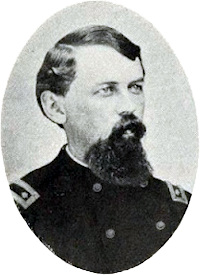
Norfolk, September 30, 1861.
You think I’m doing pretty well in the number of my letters, don’t you? I can afford to for you are the only correspondent I have. You musn’t be surprised if you don’t get letters from me so regularly after this, for if we start back in the country, as I expect we will, to intercept Price’s retreat if Fremont whips him, we may be away from mails and such like for some time. If anything happens to me you will hear it just as quick as the news can be taken to you.
Since my last we have had some more fun here. Our company was out a few miles the other day to capture an old cuss we thought was peddling news from our camp down to Columbus. He had skedaddled though before we got to his house. We gobbled up all the loose plunder we could find lying around, it wasn’t much, and marched back. We had a mighty good time on picket a few nights ago. It was confounded cold, bushwhackers or no bushwackers we concluded to have a fire. A couple of the boys volunteered to go back to camp for kettles and coffee, and we found lots of nice roasting ears in the field we were camped in, and a kind of pumpkin that ate very well after a little roast before the fire. Then there were splendid pawpaws, lots of nuts of all kinds which a little fire made ripe, and we sat and cooked and ale all night. I can eat, if necessary, 36 hours without intermission except for an occasional drink, and I drink nearly a half gallon of coffee per day.
Last night the Pekin company in our regiment were on picket and at 3 this morning they were attacked. Ten of them held their ground against 150 half-mounted and half-foot and finally made them scoot. It was a devilish brave thing. The Rebels left one dead and one so badly wounded that he’ll die to-night, and carried off two others dead and four badly wounded. A lot more were scratched. But one of our men was wounded, and that a flesh wound in the arm, that will hardly take him off duty. The firing roused us here in the camp and we thought from the noise that the longed fight had come at last for certain. I tell you it was funny when the long roll (we would not get out of bed without the long roll for a thousand cannons these cold nights) to see the boys scramble for shoes and accoutrements. There was some profanity. I have just been to see a poor devil that has blown half of his head off this afternoon to get rid of his troubles. A soldier. Don’t know what he suicided for. We are messed off now, 15 in a tent, each tent’s inmates cooking and eating by themselves.
September 30.–Early this morning Colonel Geary marched from Point of Rocks to Berlin, Md., with three companies of infantry and two pieces of artillery. Immediately upon his arrival there he opened upon the rebel works with shell, and in a half hour dislodged the rebels effectually from every position they occupied.– Baltimore American.
September 30, 1861
SUNDAY 29
Went to church in the morning with the boys. Dr Smith preached “Unless the Lord keep the City the watchman wait in vain.” From the way he handled the Text it was to be infered that the Army now here was of little account. He does not believe that the Lord is usualy on the side of the “heaviest Battalions” as old Napoleon did. The Sunday[s] are very quiet here even now, but the long wagon trains keep moving. We too expect to move tomorrow.
______
The three diary manuscript volumes, Washington during the Civil War: The Diary of Horatio Nelson Taft, 1861-1865, are available online at The Library of Congress.
SEPTEMBER 29th.—To-day Mr. Benjamin issued several passports himself, and sent several others to me with peremptory orders for granting them.