0

Civil War Day-by-Day

February 12, 1863, The Charleston Mercury

All information points to an early attack upon Charleston by the water approach and by land. There are grounds to expect a fleet of some eight or ten iron-clad gunboats to try the harbor, while a formidable force will march on us from some landing place to the southward or northward of the city. The signs of activity and preparation on our coast, and the appearance of the iron-plated steam batteries, mean work. We may rest assured that great efforts will be put forth for the reduction of this place.

Charleston is bitterly hated, because of her early prominence in secession, and because of the victory of Fort Sumter, when the stars and stripes were first lowered to the Confederate arms. Into this port have been imported nine-tenths of the arms and ordnance and munitions of war, clothing for the soldiers, and shoes and medicines which have been brought in for the Confederate armies. These reasons of moral and practical expediency for an effort to reduce the city, have received additional stimulus from the repeated and severe failures in their inland expeditions in Carolina, and from the disasters recently suffered in their naval arm. But stronger and more imperative than aught else is the threatened complication with neutral nations, through the recent rout and dispersion of the blockading fleet by the Palmetto State and Chicora.

The attack on Charleston, we are informed through Northern sources, has been determined on some time since. The last reason for making it, is peremptory, and forbids a much longer delay. If the blockade is raised at the port of Charleston for neutral vessels choosing to enter it, there is but one way for the United States to mend the matter – by taking Charleston. This is what they are now vigorously intent upon attempting. It is our business to see that the attempt shall fail, and to be fully ready to meet it. The fight in the harbor between our batteries and the iron- clad gunboats is going to be an experiment, concerning which we and the world have no experience from the past. Although very hopeful of the result, we should prepare to fight the city itself in defence. How are our commissary stores and army supplies? We have powerful works, able and devoted Generals and admirable soldiers. Have we enough? Let us dismiss as idle the notion that Charleston is not to be attacked, and at once address ourselves heartily and with energy to the task before us. Stern work is near and not remote. Let us put away self delusion and flattery, and take the common sense of strong probability doe our guide.

0 comments

0

Civil War Day-by-Day

February 12, 1863, The New York Herald

A reconnoitering party from Stafford Court House, under Col. Percy Wyndham, which started on the 9th instant and proceeded to Warrenton Junction, cut the telegraph wires at that point leading to the Rappahannock. At Elk Run they fell in with the enemy’s pickets, and captured two of them. The result of the reconnoissance is that no rebel forces are on this side of the Rappahannock, and that all the streams are flooded and the roads in such a condition that the enemy cannot move no more than ourselves.

The absurd story concerning the destruction of the United States sloop-of-war Brooklyn, by the rebel vessels Alabama, Florida and Harriet Lane, which was in circulation yesterday, has no foundation in fact. It is manifestly untrue, as the Alabama could not have been in the locality laid down as the scene of the alleged disaster.

The bark Springbok, which sailed from London for Nassau with a general cargo, part of which proved to be of a suspicious character, was brought into this port yesterday, having been captured by the United States steamer Sonoma, off the Bahamas, on the 3d inst. She was put in charge of Acting Master Willis and a prize crew, who brought her safely to New York. The cargo was composed of leather, salt and boots and shoes. The Sonoma came across the rebel vessel Florida, when off the Bahamas, on the 1st instant; but the latter avoided her, and cleared off, though the Sonoma chased her for thirty-six hours.

The intelligence which we give today relative to the splendid run of the Union ram Queen of the West down the Mississippi will be read with great interest. The bold dash which this vessel made past the batteries of the enemy shows what valor and pluck can accomplish, as manifested by Colonel Ellett. She destroyed three steamers loaded with provisions for the rebels at Vicksburg, and took fifty-six prisoners. She ran under the batteries at Port Hudson, and drew their fire without being damaged. She attacked the rebel gunboat City of Vicksburg with splendid daring, and was only [continue reading…]

0 comments

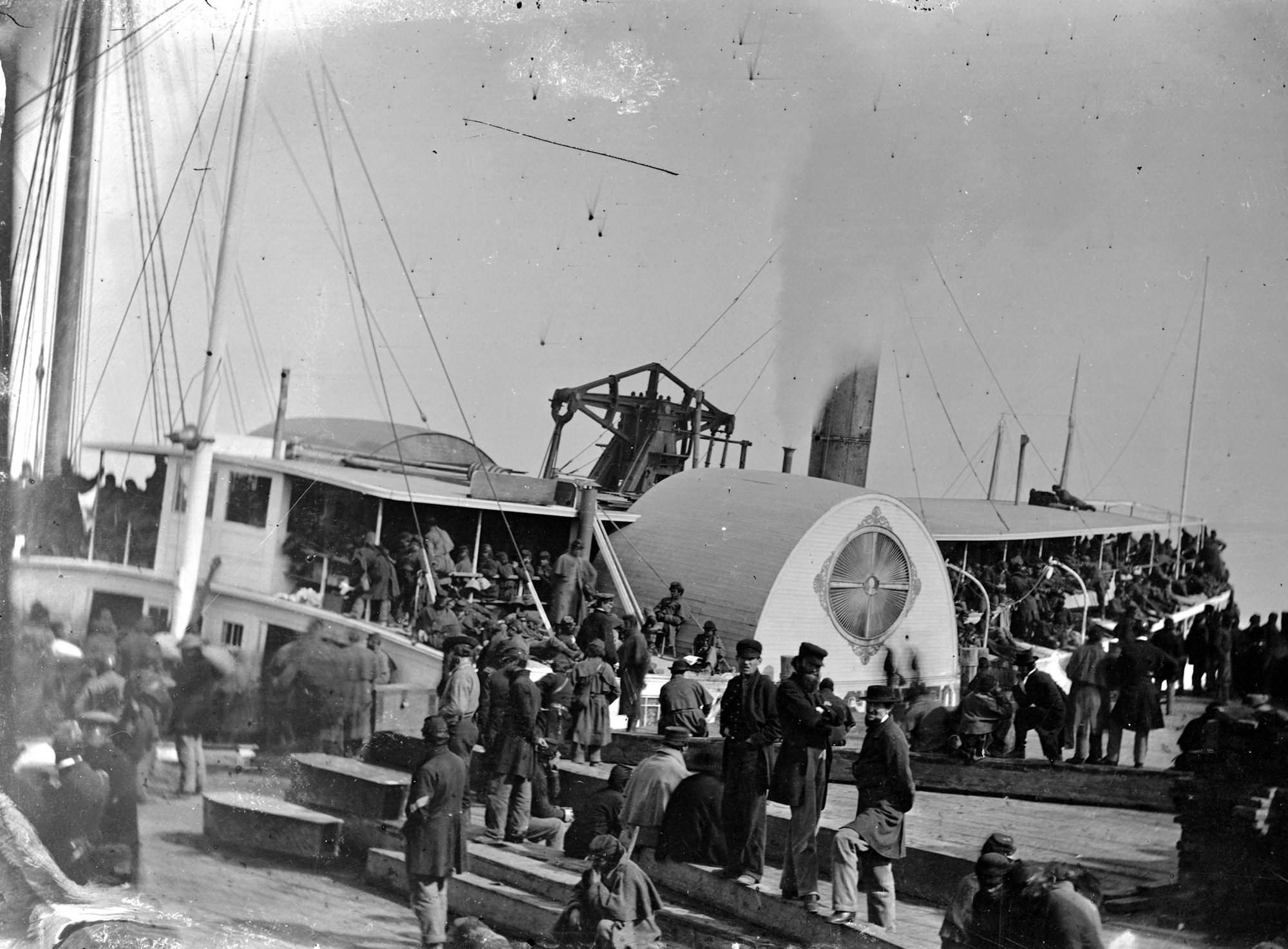
Embarkation

Library of Congress, Miscellaneous document sources
Aquia Creek Landing, Va. Embarkation of 9th Army Corps for Fort Monroe; another view 00315a

Aquia Creek Landing, Va. Embarkation of 9th Army Corps for Fort Monroe; photograph is by Alexander Gardner. “On February 5, 1863, Sedgwick was succeeded by Maj. Gen. William F. “Baldy” Smith, and on February 12 the corps was ordered to Newport News, where it encamped for a month.” [IX Corps (Union Army) — Wikipedia]

Library of Congress image.

0 comments

0

Civil War Day-by-Day

February 12, 1863, The Charleston Mercury

(CORRESPONDENCE OF THE MERCURY.)

RICHMOND, Saturday, February 7.

We were exceedingly anxious to hear from Charleston yesterday, for we thought fighting had nearly commenced. But not a word has come up to 10 o’clock today, though the lines are up – no, not even a newspaper came. But it was always a struggle for the Charleston mail to get through.

Fredericksburg dispatches last night indicated movements on the part of the enemy, which the late snow and rain frustrated. Evidently ‘Fighting Joe’ intends to imitate Napoleon crossing the Alps. A friend just from the army gives me an item about ‘Fighting Joe,’ was in the same class at West Point with Major General Jubal Early, of Lee’s army, and one day Jubal got mad with Joe and kicked him out of his room whereat ‘Fighting Joe’ exclaimed, ‘What in the world are you doing that for? ‘and went his way in the most lamb-like manner. If he is this sort of man, he will be a brief morsel in the omnivorous mouth of R.E. Lee. Yankee papers say ‘Fighting Joe’ is going to take an entirely new route, but they neglect to mention that that route, like the one Burnside chose, is a rebel suggestion. Lee’s spy system is marvellous. By April we hear from Joe army something real.

Our papers talk about Yankee deserters coming in by squads to our lines in the Valley of Virginia. A letter from Suray, Page county, says: ‘Twenty or thirty of them passed our house yesterday and as many today. Two of them looked so forlorn that brother consented to let them stay all night. He repented it, for while they told us that 20,000 had deserted since the battle of Fredericksburg, and the rest were ready to desert as soon as they got their pay, many tampered with our negros, and told them the North was determined to conquer the South, and was able to do it.’ This is the substance, [continue reading…]

0 comments

0

Cruise of the U.S. Flag-Ship Hartford -Wm. C. Holton

Feb. 11th, nine thirty A. M. Arrived off the city and brought the ship to anchor.

0 comments

War Diary of Luman Harris Tenney.

War Diary of Luman Harris Tenney.

11th. After breakfast B. went with me to commissary and then to town. Drew and issued rations for ten days. Rained in the afternoon. Did the work alone. Thede went to town and brought me back Irving’s “Life of Washington.” Commenced it. Case inquired about Thede enlisting in his company.

0 comments

Diary of a Southern Refugee, Judith White McGuire.

Diary of a Southern Refugee During the War by Judith White McGuire

February 11.For ten days past I have been at the bedside of my patient in Richmond. The physicians for the third time despaired of his life; by the goodness of God he is again convalescent. Our wounded are suffering excessively for tonics, and I believe that many valuable lives are lost for the want of a few bottles of porter. One day a surgeon standing by B’s bedside said to me, “He must sink in a day or two; he retains neither brandy nor milk, and his life is passing away for want of nourishment.” In a state bordering on despair, I went out to houses and stores, to beg or buy porter; not a bottle was in town. At last a lady told me that a blockade-runner, it was said, had brought ale, and it was at the medical purveyor’s. I went back to Mr. P’s instantly, and told my brother (B’s father) of the rumour. To get a surgeon’s requisition and go off to the purveyor’s was the work of a moment. In a short time he returned, with a dozen bottles of India ale. It was administered cautiously at first, and when I found that he retained it, and feebly asked for more, tears of joy and thankfulness ran down my cheeks. “Give him as much as he will take during the night,” was the order of the physician. The order was obeyed, and life seemed to return to his system; in twenty-four hours he had drank four bottles; he began then to take milk, and I never witnessed any thing like the reanimation of the whole man, physical and mental. The hospitals are now supplied with this life-giving beverage, and all have it who “absolutely require it,” though great care is taken of it, for the supply is limited. Oh, how cruel it is that the Northern Government should have made medicines, and the necessaries of life to the sick and wounded, contraband articles!

0 comments

Diary of Horatio Nelson Taft.

Diary of US patent clerk Horatio Nelson Taft.

Washington Wednesday Feby 11. 1863

Fears are now frequently expressed that we are to have trouble in the free states. There seems to exist a great number of peace men, men who are willing to make peace on any terms “only stop the war.” The “Knights of the Golden Circle” (K.G.C.) a secret Society are said to have become numerous and are ready to overthrow the Govt if necessary to make Peace. “Union Leage” Secret Societies are now forming all over the Country to counteract the K.G.Cs. I intend to Join the U.L. tomorrow night. It is intended to have the unconditional Union Men in this City and all over the Country ready (at a moments warning, “armed to the teeth”) for any emergency. The action of some of the State Legislatures, and conventions of the People, and the tone of some of the Interior Papers is somewhat alarming. There is as this State of things prove a great lack of confidence in those at the head of the Govt and who manage the War. But a Victory or two will put things “all right.” No Separation. “No peace” for ten years to come, unless those in rebellion are willing to lay down their arms and return to their duty as Loyal Citizens, so say I.

There is no particular news today. Some skirmishing in Tennessee, the papers say 600 rebels taken prisoners. Important news expected from Charleston & Savannah, our “Iron Clads” are there. Recd letter from home, no important news in it. The question is do we want the House we occupy another year? from 1st May? I think we will have to say yes.

0 comments

Downing’s Civil War Diary.–Alexander G. Downing.

Diary of Alexander G. Downing; Company E, Eleventh Iowa Infantry

Wednesday,11th–A large detail from our brigade began work on the canal from the Mississippi river to Lake Providence. About three hundred negroes are working on it. The canal is being cut twenty rods wide and when completed will be three-quarters of a mile long with a fall of twenty feet. I paid out thirty cents for some necessary articles, and also loaned thirty cents to Clark.

0 comments

A Rebel War Clerk’s Diary

Civil War Day-by-Day
A likeness of Jones when he was editor and majority owner of the Daily Madisonian during President John Tyler’s administration.

FEBRUARY 11th.—There is a rumor that Major-Gen. Gustavus W. Smith has tendered his resignation.

Some idea may be formed of the scarcity of food in this city from the fact that, while my youngest daughter was in the kitchen to-day, a young rat came out of its hole and seemed to beg for something to eat; she held out some bread, which it ate from her hand, and seemed grateful. Several others soon appeared, and were as tame as kittens. Perhaps we shall have to eat them!

0 comments

0

Civil War Day-by-Day

February 11, 1863, The Charleston Mercury

MOBILE, February 10. – The New Orleans Delta, of January 28th, has been received here. It contains, under the head of general orders, a Proclamation of the President of the United States, dated January 1st, 1861, for the information and government of the officers and soldiers of the officers and soldiers of the command, and all persons acting under their authority. The proclamation is intended to carry into effect the emancipation scheme, and provides that [illegible] who leave their employers will be compelled to support themselves and families by labor upon the public works. To secure the objects both of capital and labor, the Sequestration Commissioner is authorized and directed, upon conference with planters and other parties, to propose and establish a yearly system of negro labor, and when accepted by the planter or other parties, faithful service and subordination shall be enforced on the part of the negro by the officers of the Government. The Quartermaster’s Department is charged with the duty of harvesting the corn on deserted fields, and cultivating abandoned estates. Unemployed negros will be engaged in this service. By order of Major-General BANKS.

0 comments

0

Civil War Day-by-Day

February 11, 1863, The New York Herald

Our Ogeechee River Correspondence.

OGEECHEE RIVER, Ga., Jan. 27, 1863.

The events of today have doubtless made the presence of an iron-clad in Southern waters so well known to the rebels that it will not be deemed contraband for me to state the fact of the Monitor iron-clad Montauk’s arrival in the Ogeechee river, Georgia, and the additional fact that she has, in a measure, thoroughly tested her offensive powers, as well as her armor, under the guns of Fort McAllister, Genesis Point, not many miles from the city of Savannah.

A sharp fight of nearly eight hours, during which time the Montauk was repeatedly struck by shot and shell of the largest calibre, a portion of which were rifled projectiles, has clearly demonstrated the fact that, at what may be called short range, the iron clads (by which I refer to the Monitor style – the New Ironsides not having been tested), are completely invulnerable as against the heaviest ordnance in the rebel service, or perhaps of any nation. The turret, and the plan of working the heavy guns within, were proved to be all that could be desired. But to the affair itself.

The blockading squadron in Ossabaw Sound, reinforced by the Montauk, proceeded on Tuesday, the 20th, up the Big Ogeechee river, and came to anchor for the night at a point about four miles below Fort McAlister, on Genesis Point, in sight of the work and in view of the steamer Nashville, lying a few miles above the fort, towards Montgomery.

As one of the main objects of this reconnoissance in force was to test the Montauk, as well as to ascertain the strength and character of the work and the calibre of the guns mounted upon it, the Montauk assumed the lead. This morning at daylight the fleet up anchor and steamed towards the battery, the Montauk a quarter of a mile ahead, in the following order: Montauk, Capt. Worden; Wissahickon, Seneca, Dawn, mortar schooner C. P. Williams and tug Daffodil. The Montauk approached to within a mile and a quarter of the battery. Then her further progress was interrupted by two [continue reading…]

0 comments

0

Civil War Day-by-Day

February 11, 1863, The Charleston Mercury

March is near at hand, and throughout the Confederate States the practical question of what is to be planted for the season of [illegible] must be decided concerning every field. The country, it may be said, will be richer. The temptation to plant cotton is great, and the world would undoubtedly benefit by having a large amount of cotton at the close of the year at very low prices. And, on the whole, our resources might be greater. But as a present weapon of defence in a gigantic and terrible struggle for independence, a scant production of cotton may be used to teach an ignorant and inimical world the importance of these Confederate States to its prosperity and happiness, and to compel their unwilling justice. It is not a mere question of money-making and moneyed resource for the country. The present amount of cotton on hand may bring in the markets of the world just as much as if another crop were added to the supply; yet even if it greatly increased the future means of the country, which we deem doubtful, it does not at all follow that another crop will aid us in the achievement of our independence or shorten the struggle. That is the great object. All else is insignificant. Cotton is a great political engine, and upon the supply or withholding of it depend the prosperity or misery of millions in the quasi neutral nations of Europe. Their one-sided and criminal neutrality against us is redounding to their great detriment. The screw is tightening, and it is our policy to stand still as regards cotton, and let the screw run down to the lowest turn endurable by the Abolition Governments of Europe. They are interested in our planting as much as we. Who can do without cotton the longest? It is only a question of endurance, in which the people of the Confederate States at least will not starve.

We, therefore, trust that large crops of corn will be everywhere planted, not only because it is not wise to plant too much cotton, but because with our large armies in the field, there is need of producing much food. Most of our troops are farmers, who cannot this year plant. Others must plant a double quantity. The question of food is now important, and every care should be taken to put it above and beyond doubt for the coming year. It is the duty of patriotism, and is a vital matter.

0 comments

0

Civil War Day-by-Day

February 11, 1863, The New York Herald

Our Key West Correspondence.

KEY WEST, Jan. 29, 1863.

Warning

The following article contains wording that is offensive to many in the world of today.
However, the article is provided unedited for its historical content and context.

[continue reading…]

0 comments

0

Civil War Day-by-Day

February 11, 1863, The New York Herald

There has been no movement in the Army of the Potomac since our last accounts.

A rash attempt to force the picket lines of the enemy, six miles from Yorktown, last Saturday, was made by Captain Faith, of the Fifth Pennsylvania cavalry, which resulted in his men being drawn into an ambuscade, near the “Nine Mile Ordinary,” and thirty of them being killed. He was himself mortally wounded. His second in command, Capt. Hagerston, was taken prisoner, as were the two Lieutenants – Williams and Little – who were serving as volunteers.

The account which we publish today from our correspondent on the Ogeechee river, detailing the events of the late contest between the iron-clad Montauk and the rebel battery, proves satisfactorily the invulnerability of the gunboat. She came out unscathed from a terrific fire, notwithstanding the rebel boast that she had suffered severely. She dismounted two of the guns on the battery, and although the range was short and the aim perfect, the heavy shots from the enemy failed to damage her. The battery opened on our wooden vessels at long range; but their aim was bad and they did no harm.

The pirate steamer Alabama is reported to have turned up at Kingston, Jamaica, on the 20th ult., where she landed the crew and officers of the United States steamer Hatteras, numbering over one hundred. It was reported that the Alabama had suffered severely in her fight with the Hatteras; that she had five shot in her hull, one of which – through her stern post – was a very bad one. She put into Kingston to repair damages, and expected to be ready for sea in four days. Immediately upon this news being received in Havana, the United States steamers Wachusett and Oneida sailed direct for Kingston, and the Santiago de Cuba and R.R. Cuyler, then on the south side of Cuba, were ordered at once to the same port, and the Tioga and Sonoma were also steering in the same direction. It is quite likely, then, that the Alabama is now hemmed in by a squadron of not less than six ships, which, if they are active enough in their movements, may place Captain Semmes in an awkward position.

The news from the Southwest is not very important. Our troops entered Lebanon, Tenn., on the 8th inst., and captured [continue reading…]

0 comments

0

Cruise of the U.S. Flag-Ship Hartford -Wm. C. Holton

Feb. 10th. Still aground; at two P. M., succeeded in getting off by the assistance of two river tugboats which had been sent to our assistance; in the meantime the steamer Che Kiang had been sent down the river with despatches for the Admiral to return to the city. Just as we got nicely over the bar, the despatches were brought on board; the ship was immediately turned around, and back we started again, and in attempting to cross the bar the second time we grounded; the tugboats fastened to us again the Che Kiang hitched on, and with considerable difficulty we succeeded in getting over. If we had not been so unfortunate as to run our ship’s nose into the mud in our first attempt at crossing the bar, the Che Kiang, in my opinion, would have had a fine time in overhauling us, and at the same time we might have enjoyed a fine sea breeze.

0 comments

War Diary of Luman Harris Tenney.

War Diary of Luman Harris Tenney.

10th. After breakfast we four started out to visit the penitentiary. Called at Mr. Rice’s. Got Mary and Mrs. Hickox and went to the Asylum instead. Was deeply interested and affected. So many pretty and talented little creatures among the sufferers. Saw Fanny H. off at 1 P. M. Uncle dead. Went with Brougham to Penitentiary, then to camp for the night. Answered a good letter from Fannie.

0 comments

Downing’s Civil War Diary.–Alexander G. Downing.

Diary of Alexander G. Downing; Company E, Eleventh Iowa Infantry

Tuesday, 10th–This is a clear, warm day. We disembarked early this morning and marching out about one mile from the river to Sparrow’s plantation, we pitched our tents on the large lawn of the plantation house, bordering the lake. Mr. Sparrow, the owner, is a congressman in the rebel congress, and he and his family having gone away, left their negroes in charge of the plantation. Our colonel has established his headquarters in the plantation house. The First Kansas out on scout duty today got into a skirmish with the rebels and lost two men killed and eight wounded.

0 comments

Diary of Horatio Nelson Taft.

Diary of US patent clerk Horatio Nelson Taft.

Washington Tuesday Feb 10th 1863

The weather continues pleasant, and everything quiet as far as the War is concerned. The scene seems just now to be shifting to the South, and we are expecting every day to hear that Savannah or Charleston has been attacked, perhaps both. Genl Fosters N.C. Army has gone to S.C. The “Army of the Potomac” seems to be dropping to pieces, a large portion having gone down the Potomac and and [sic] another portion have come up this way. Today I have been engaged in examining copies of the Report of the Indian Agent for the Sioux Tribes on the borders of Minnesota, the Scene of the late Indian Murders. The Report is quite interesting. I went from the office on to the Ave and staid at the Book Stores till near dinner time, bought Thos Buchanan ReadsWagoner of the Alleghanies” and some Photographs for Julia. I read a good deal at the Book Stores and buy a little. But is usual for gentlemen of anything of a studious turn to frequent the Book Stores here and sit and read any book they choose for hours. I have not been out since dinner but reading the evening papers and the new Book. Capt Thornett came in and sat an hour in my room and smoked his segar. I take care of Maj Austins NY paper during his absence from the house and also “take care” to read it. Rcd letter from wife today, all well.

0 comments

A Rebel War Clerk’s Diary

Civil War Day-by-Day
A likeness of Jones when he was editor and majority owner of the Daily Madisonian during President John Tyler’s administration.

FEBRUARY 10th.—No stirring news yet. The enemy’s fleet is at Port Royal, S. C. Everywhere we are menaced with overwhelming odds. Upon God, and our own right arms, we must rely, and we do rely.

To-day, in cabinet council, it is believed it was decided to call out all conscripts under forty-five years of age. The President might have done it without consulting the cabinet.

Yesterday Mrs. Goddin, the owner or wife of the owner of the house I occupy, failing to get board in the country, and we having failed to get another house, took possession of one room of the little cottage. We have temporarily the rest: parlor, dining-room, and two chambers—one of them 8 by 11—at the rate of $800 per annum. This is low, now; for ordinary dwellings, without furniture, rent for $1800. Mr. G. has an hereditary (I believe) infirmity of the mind, and is confined by his father in an asylum. Mrs. G. has four little children, the youngest only a few weeks old. She has a white nurse, who lost her only child (died of scarlet fever) six days ago; her husband being in the army. It is a sad spectacle.

To-day beef was selling in market at one dollar per pound. And yet one might walk for hours in vain, in quest of a beggar. Did such a people ever exist before?

0 comments

0

Civil War Day-by-Day

February 10, 1863, The New York Herald

We give today the official reports of Admiral DuPont, Captain Stellwagen and other officers relating the details of the attack on our blockading fleet at Charleston. They indorse the statements made in these columns yesterday. The loss on the Mercedita was four killed and three wounded. On the Keystone State twenty killed and twenty wounded. The surprise of the rebel rams was undertaken during a heavy fog, which prevented our vessels from defending themselves in time to prevent some serious damage. The blockade, however, appears to be as perfect as ever.

Our news from Hilton Head brings us the facts of the late attack of the Montauk on Fort McAllister. It is said that the Montauk fired in all seventy-six shots, and was struck forty-five times, forty striking the turret, making no further impression than an indentation in the iron from three eighths to five-eighths of an inch deep, and shaped like a saucer. The enemy’s shells were filled with sand to render them more effective, and when they struck burst like a percussion cap, scattering the iron and sand around. It is said that one shell entered the smoke stack of the Montauk, shattering it to pieces. No further injury to the fort was done than the dismounting of one or two guns.

There is nothing from the Army of the Potomac, except the vague statement that a reconnoissance was completed on Sunday on the right wing of the army, which accomplished all the purposes for which it was intended in the most successful manner.

There is no intelligence from Vicksburg or the West. We have four days later from New Orleans, by the steamer Marion, which arrived at this port yesterday afternoon. It will be seen that some active, and it may be important, movements are being made on the west of the Mississippi, and it may be that there will be some fighting soon in that direction. One of our correspondents sends us some further particulars concerning the organization of the new negro regiments in New Orleans. The news is altogether of great interest. [continue reading…]

0 comments

0

Civil War Day-by-Day

February 10, 1863, The Charleston Mercury

OFFICE NAVAL STATION,

Charleston, February 3, 1863.

SIR: I have the honor to inform you that upon the night of the 30th ultimo I left the wharf at this place, in company with the steam ram Chicory, Commander John R. Tucker, at a quarter past 11 o’clock, and steamed slowly down the bar, as, from our draft, we could not cross until high water. At half-past 4 we crossed the bar, with about a foot and a half to spare, and soon after made a steamer at anchor – stood directly for her, and directed Lieut. Commanding Rutledge to strike her with our prow. When quite near we were hailed – ‘What steamer is that – drop your anchor or you will be into us.’ He was informed that it was the Confederate steamer ‘Palmetto State.’ At this moment we struck her and fired the seven-inch gun into her, as he gave an order to fire. I then inquired if he surrendered, and was answered in the affirmative. I then directed him to send a boat on board, which was done. After some delay Lieutenant Commanding Abbott came on board and informed me that the vessel was the U.S. steamer Mercedita, Commander Stellwager, and that she was in a sinking condition, and had a crew of one hundred and fifty-eight, all told, and wished to be relieved; that all his boats were lowered without the plugs being in, and were full of water. At this time the Chicora was engaged with the enemy, and the alarm was given. I knew our only opportunity was to take the enemy unawares, as the moment he was under way, from his superior speed we could not close with him. I then directed Lieutenant Commanding Rutledge to require from Lieutenant Commanding Abbott his word of honor for his commander, officers and crew that they would not serve against the Confederate States until regularly exchanged, when he was directed to return with his boat to his vessel to render what assistance he could. I then stood to the northward and eastward and soon after made another steamer getting under way. We stood for her and fired several shots at her; but as we had to fight the vessel in a circle to bring the different guns to bear, she was soon out of range. In this way we engaged several vessels, they keeping at long [continue reading…]

0 comments

0

Civil War Day-by-Day

February 10, 1863, The Charleston Mercury

(CORRESPONDENCE OF THE MERCURY.)

RICHMOND, Thursday, February 5.

Charleston’s hour is at hand. The enemy is about to wreak his utmost malice upon you. Be of good cheer. The foe has lost heart. PRYOR’S fight – 1800 – shows that ABE’S infernal Proclamation has done its work, and that the Irish, the best fighters the North have, are sick of the war. The constant desertions to us at Vicksburg show what the men of the West feel in view of Lincoln’s abolition crusade. Moreover, you have Beauregard with you – a tower of strength – a General equal to our very best. Our only fear here is on account of the iron clads; but a late Port Royal letter to the N.Y. Times lets the cat out of the bag, and admits that the Monitors can’t stand a heavy sea. Keep them out of the bar for a few days, and they will be thumped to pieces. But the Yankees have two reasons for destroying you: first, because they hate you; second, because they desire to deprive the Confederacy of its chief port. Charleston would be an irreparable loss to the cause. Defend it bravely, and may God be with you in the hour of trial. Besides the harbor works and the gunboats, we take it for granted the defences of the city itself are well mounted with guns. With an open harbor all else may fail to stop the iron-clads. Drewry’s Bluff and Genesis Point greatly encourage.

Another lady – not the plenipotentiary from Illinois, mentioned in yesterday’s letter – is here, and declares that Wall street has shut down upon Chase, and refuses peremptorily to lend him another dollar. We hope it may be true.

One of our papers takes the ground that England’s hostility to slavery is undying, and that her Government is secretly on the side of the North, in order to destroy the institution in the Southern States. People are troubled, too, lest someone of the Northwestern States shall creep into the Confederacy, and so ensure ultimately a complete reconstruction.

Hugh Pleasants, the Polybius of the age, shows from history that Wellington did not for three years achieve any greater victory than our Generals, and proves that Lee, in six months, accomplished more, in the way of killing, wounding and capturing the enemy, than Wellington did in his whole career. Thus London Times Russell’s slur in the Army and Navy Gazette, upon our warlike deeds, is set at naught.

Some two inches of snow fell last night on ground frozen as hard as iron. It will stick, provided the weather don soften, which seems probable, now the snow has ceased to fall. More vexation for ‘Fighting Joe Hooker.’

HERMES.

0 comments

“I have advised my men to whip any enlisted man they hear talking copperheadism..,”–Army Life of an Illinois Soldier, Charles Wright Wills.

Civil War Day-by-Day

Ninth.—Papers of the 6th give me much pleasure. The dashing move of the ram “Queen of the West,” the gallant fight of our soldiers at Corinth, are certainly enough good news for one day. At noon roll call to-day, I spoke to my men of the resolutions passed by the officers at Corinth and approved by the soldiers, and told them that a chance would be offered them in a few days to vote on similar ones. They received the latter statement with a cheer that plainly showed their mind on the subject. I believe that the whole regiment with a proper action of the officers for a few days, will denounce copperheadism, even in terms strong enough to suit the Chicago Tribune. ‘Twill be the officers fault if we don’t. If we were only officered properly throughout there would never have been a word of dissatisfaction in the regiment. That is rather a solemn subject. I have advised my men to whip any enlisted man they hear talking copperheadism, if they are able, and at all hazards to try it, and if I hear any officer talking it that I think I can’t whale, I’m going to prefer charges against him. Doing plenty of duty now; on picket every other day. Last night I had command of a guard at General Hospital No. 1, or rather we guarded it in the day time, relieved at 9 p.m. and went on again at daylight. I had some friends in the hospital, steward, warden and clerks, and they made it very pleasant for me. That is they fed me on sanitary cake, butter, etc., induced me to drink some sanitary wine, beer, etc., and also to sleep between sanitary sheets, with my head on a sanitary pillow, etc., and again this morning to accept a bottle of sanitary brandy and a couple of bottles of sanitary porter. All of which I did, knowing that I was sinning. I write you this that you may feel you are doing your country some good in forwarding the above articles for the benefit of the soldiers. You will of course, give these encouraging items to your coworkers.

0 comments

0

Civil War Day-by-Day

February 9, 1863, The New York Herald

PHILADELPHIA, Feb. 8, 1863.

The iron steamer Princess Royal, in charge of Acting Master Edward Van Sice, arrived off the Navy Yard today. She brings highly important intelligence, both as relates to her capture and the rebel attack on our blockading squadron at Charleston, showing conclusively that there is no foundation for the assumption of the rebels departure of the United States fleet, only two vessels out of the eight or ten having been disabled or obliged to leave.

It appears from the statement of an intelligent eye witness that the cause of this attack of the rebel rams on our squadron was owing to the capture of the Princess Royal – the captain and pilot of that vessel having escaped ashore during the darkness of the night and communicated intelligence to the enemy.

The Princess Royal endeavored to run the blockade by way of Beach Inlet on the 29th ult., but was discovered by the pilotboat Blunt. On signal being given the Unadilla proceeded towards her and captured the prize without other assistance. It was then discovered that the captain and pilot had succeeded in getting ashore by a small boat, carrying important despatches to the rebel government. The Unadilla carried her to the side of the Housatonic, and laid there till daylight, when a thunder of guns was heard, accompanied by sharp flashes of fire. It was supposed that our fleet was engaged in making, or the Alabama or Florida were endeavoring to force, an entrance. At daybreak two rebel iron clads were seen coming down from the direction of Stono Inlet towards our fleet.

They attacked the Mercedita first. One ram struck her on the water ridge, keeling her over, and at the same time firing a shot, which entered one of her boilers, causing the death of three persons, including a gunner, by a shot and steam. The ram then hailed the Mercedita, and Captain Stellwagen lowered one of his small boats, after leaving one of the plugs out; allowing the water to enter it. The ram answered our hail by replying, “Confederate ram Palmetto State. Do you surrender?” This was repeated three times, Captain Stellwagen replying at such inquiry “I am in a sinking condition.” The rebels answered, “God damn you to hell, if you don’t surrender we will blow you out of the water. Send your boat aboard.”

The boat which Captain Stellwagon lowered then conveyed his lieutenant (executive officer) to the side of the rebel ram, [continue reading…]

0 comments