0

News of the Day

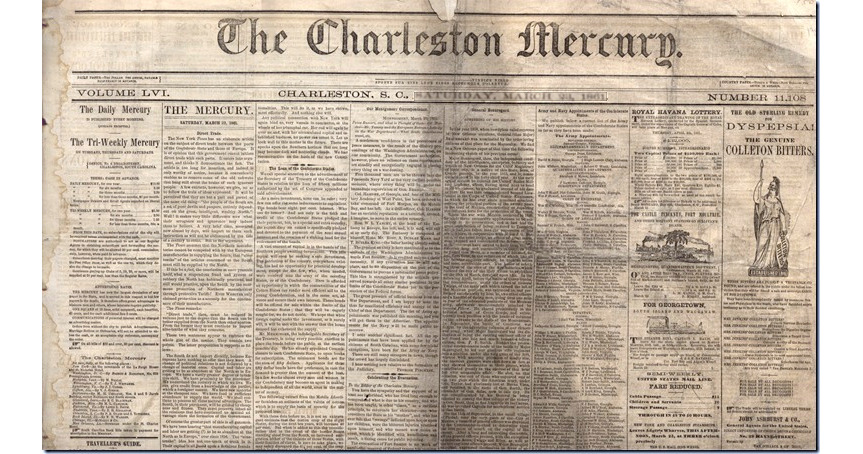
March 14, 1863, The Charleston Mercury

The Northern papers publish the report of Commodore DUPONT in relation to the attack of our gunboats upon the blockading fleet. He mentions that our iron-clads went out of Charleston, unperceived by the blockaders, and attacked the blockaders; that the Mercedita was first attacked, and a heavy rifle shell passed through her condenser and the steam drum of her port boiler, and exploded, blowing a hole four or five feet square, killing the gunner and scalding a number of men. He says Captain STELLWAGEN surrendered – crew and officers were paroled, though nothing was said of the ship, the executive officer, Lieutenant Commanding ABBOTT, having gone on board the enemy’s gunboat and made the […..] arrangement. He states that only casualties were on the Mercedita and the Keystone State. On the Keystone State they were very large – about one-fourth of her crew were killed and wounded, and among the former the medical officer of the ship, Surgeon GOTWALD.

The Commodore states that the Mercedita had arrived at Hilton Head, but the whole story though is so lamely told as to leave little or no doubt but that the Mercedita went down, and never got to Hilton Head or anywhere else, except to Davey Jones’ locker.

0 comments

0

Cruise of the U.S. Flag-Ship Hartford -Wm. C. Holton

March 13th. To-day the gunboat Sachem started up the river, also two transports loaded with troops. The day has been spent in getting the ship ready for action. This afternoon, army signal officers came on board to accompany us up the river. Mortar vessels are moving up to take their positions for bombarding; at four P. M. we got under way, and started up the river, followed by the Richmond, Mississippi, Monongahela, and gunboat Kineo. As soon as the ships were got under way we beat to quarters.

The Admiral, Fleet Captain and Captain Palmer commanding, also Mr. Kimberly, executive officer, inspected the ship fore and aft, to see that all things were in readiness; at seven thirty P. M. came to anchor for the night, it being so very dark it was deemed necessary, as every precaution is required under the circumstances.


0 comments

Downing’s Civil War Diary.–Alexander G. Downing.

Diary of Alexander G. Downing; Company E, Eleventh Iowa Infantry

Friday, 13th–The weather is quite pleasant and all is quiet. There is nothing of importance.

0 comments

War Diary of Luman Harris Tenney.

War Diary of Luman Harris Tenney.

13th. The Capt. called and asked me to join his school. Got a book and went over in the evening. Then had some maple sugar. Washwoman came in. Pity the poor woman. Her husband has returned and I fear will cause her trouble.

0 comments

Diary of Horatio Nelson Taft.

Diary of US patent clerk Horatio Nelson Taft.

Washington Friday March 13th 1863.

It has been quite a cold day with Snow in the middle of it and freezing hard tonight. News by the papers that there has been a battle at Yazoo City Miss and that we have taken 7000 Rebels prisoners. I think the Report needs confirmation. No other news of any particular importance today. Most of my time in the office has been occupied with my friends who have called, among whom were Col Sol Bulkley, [L or S?] Short of Buffalo (formerly) now of Phila and Seelye, formerly of [Sodus?], now Syracuse. I have been down to the “National” this evening writing a Specification for Short for a Patent for his “Greek fire.” He seems to be making something out of it by furnishing it for filling “Shells” for the Govt. Called today to see Mrs Burch, the owner of the House I am in. She is one of the F.F.Vs and of course “secesh” and was somewhat frightened when I enquired about the property thinking no doubt of the awful “confiscation” act and other penalties which the disloyal have to fear. She did not “let out” any of her rebel Sentiments to me. I called at Charleys also a few minutes. Met Col Close of Fort McDowell at the National. He invited me over to see him at the Fort. I should think him a pretty wide awake officer.

0 comments

Fate

Diaries and Letters of Belle Edmondson

March FRIDAY 13, 1863

Battle at Greenwood,1 had a long walk with Dr Moses to listen to the echoes of the distant cannons. Fate—how strange, and yet how blessed and happy. “Oh! who, in the course of his life, has not telt some joy without security and without the certainty of a morrow”—


  1. Battle of Fort Pemberton
0 comments

A Rebel War Clerk’s Diary

Civil War Day-by-Day
A likeness of Jones when he was editor and majority owner of the Daily Madisonian during President John Tyler’s administration.

MARCH 13th.—To-day a great calamity occurred in this city. In a large room of one of the government laboratories an explosion took place, killing instantly five or six persons, and wounding, it is feared fatally, some thirty others. Most of them were little indigent girls!

0 comments

0

News of the Day

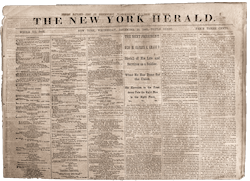
March 13, 1863, The New York Herald

The news from the army on the Rappahannock today is unimportant. The pickets of the enemy along certain portions of the line on the opposite side of the Rappahannock are one half negroes and one half white men. The negroes are armed and uniformed the same as the whites. Only one hundred to one hundred and fifty yards intervenes between our pickets and the enemy, and they are plainly to be distinguished without the aid of a glass.

A despatch from Rutherford’s creek, Tennessee, states that the whole rebel force of Van Dorn retreated towards Shelbyville on Wednesday night, that the country between Nashville and Columbia is now cleared of marauders, and that the means of crossing Duck river are destroyed. This postpones for a time the expected engagement in that quarter.

The account of our special correspondent on board the gunboat Montauk of the late fight of our iron-clads at Fort McAllister, on the Ogeechee, will be found intensely interesting. The Montauk was struck with solid shot seventy-one times, and was lifted clear out of the water at the bow by the explosion of a torpedo, but she was not injured. The action was a terrific one, no less than three hundred and one shells having been thrown by our vessels, and two hundred and seventy-seven solid shot and shell by the enemy. Our firing upon the fort was magnificently directed, and, notwithstanding the statements in the Southern journals that Fort McAllister was uninjured, it proves that it was very seriously damaged. We give a very fine map today showing the scene of action and the position of all our vessel during the engagement. The impregnability of our iron-clads under the heaviest fire is pretty well established by the result of this conflict.

An arrival of three steamers from Port Royal yesterday furnishes us with the latest news from that quarter. The attack on Charleston has not yet commenced. The papers of that city say that neither the Indianola nor Queen of the West have been destroyed, but are still in good condition. An officer of the rebel army who was taken prisoner in the vicinity of Charleston states that negotiations for peace have been under consideration for the past three weeks at Richmond, but that the fact had not been permitted to go before the public. The British steamer Queen of the Wave ran ashore near Charleston and Admiral DuPont was using every exertion to save her. The British steamship, the Douro, which was captured off Cape Fear, on the 9th instant, by the United States gunboat Quaker City, was brought into this port yesterday by the latter vessel as a prize. Her cargo consisted of four hundred and twenty bales of cotton and some turpentine and tobacco. She ran the blockade at Wilmington, North Carolina, and was making for Nassau when intercepted by the Quaker City.

The difficulties existing between General Hunter and the officers of General Foster’s command appear to be yet unsettled. General Naglee has been ordered to New York by General Hunter, and has issued a farewell address to his division, in which he predicts that […..] is mighty and will prevail.”

Several valuable prizes are now on their way to this city. The prize steamer Adela, has arrived at Fortress Monroe from Key West, bound to New York. The prize steamer Virginia, bark Mohlen Williamson and brig J.W. Sawyer, with prize cargoes f twenty seven vessels, left Key West for this port on the same day. The steamship Peter Hoff, Captain Jamran, R.N., with a valuable cargo, was captured on the 25th of February off St. Thomas by the United States gunboat Vanderbilt, and arrive at Key West, where she was sent for adjudication. The Hoff was bound from London to Matamoras via St. Thomas. The prize schooners Avon, Alligator and Anne Hortenz have also arrived at the same place.

The whereabouts of the pirate Florida remains a mystery. She is reported as having been seen at so many different places, and under so many various circumstances. She was reported, for instance, as being seen off Abaco on the 24th ult., lying a helpless wreck upon the waters. On the same day she is said to have been taking in coal and provisions at Barbados, whereas a bark which arrived here and sailed from that port on the 24th reports that no privateers were there at that time.

By the Anglo-Saxon, which arrived here yesterday, we have the latest features of the European view of the American question. The London Times, commenting upon the recent action of the conservative states, says that they are taking steps which prove that their object is peace, and finding a federal government unwilling to give effect to their desire, have superseded its action, and thus commenced […..] second stage of this tremendous American revolution for themselves.”

Discussing the conflict between the statements of Mr. Seward and M. Mercier relative to the mission of the latter to Richmond, the Times regrets that Mr. Seward finds it necessary to deny the humane act imputed to him by Mercier, which would reflect credit on him, and at the expense of Mr. Seward veracity. It expresses its belief, at the same time, that Mr. Seward did listen to M. Mercier’s counsels.

The London Globe thinks that it is the duty of either the government of France or the United States to demand an apology for the contradiction existing between Messers. Seward and Mercier.

The British steamship Kangaroo, from Liverpool, which arrived at this port on Wednesday evening, brought on freight eight hundred and twenty-five bales of cotton. The City of Baltimore brought three hundred and sixty- nine bales.

0 comments

0

News of the Day

March 13, 1863, The Charleston Mercury

There is a general prejudice against the Stars and Bars; though in itself a handsome banner. It is said to be too like the old Yankee concern, which has become so hateful. Fortunately, it is not the Flag under which our armies have won their most signal successes; and many believe that it will be hard now to supersede the crimson battle flag with its starred St. Andrew’s Cross of Blue. It has claims upon us now; for was not this the banner that waved along the lines of the Confederates when they pressed so fiercely upon McClellan hosts through the woods and marshes of the Peninsula, until its crimson flutter was a vision of terror and vengeance to the flying foe? Was not this the glorious rag that struck panic into the legions of Pope when they saw it flash upon their rear like a crimson star? It has waved defiance from the heights of Fredericksburg; and Potomac, from the mountains to the sea, has fondly reflected the blood-red gleam. Under its shadow great soldiers have died with one last look upon its dear cross; and in the hour of victory, it has seemed transfigured into something God-like, when the rapturous shouts of our Southern soldiery shook its folds like a storm. It will be hard to supersede this battle flag, and many will sympathize with the sentiments of our correspondent ‘Alabama.’

RICHMOND ENQUIRER.

0 comments

0

News of the Day

March 13, 1863, The New York Herald

We publish in another column, from our special correspondent, a full account of the bombardment of Fort McAllister, on the Ogeechee river, and of the destruction of the Nashville by the United States gunboat Montauk, commanded by Lieutenant Worden, who has covered himself with glory. It is true that Fort McAllister has not been captured, and a silly shout of exultation has been raised by the rebels; but that was not the object of the expedition. The fort would be of no advantage to us, situated, as it is, on the mainland, where it could be recaptured. The object was to test the strength and capacity of the Monitors, and to train the gunners to actual service in battle; and this has been fully attained. The result has proved that the iron-clads are invulnerable to any guns of the calibre possessed by the rebels – the Montauk having been struck over seventy times without injury – and that even their torpedoes fail to injure those vessels, though raising them a foot out of the water. The practice of the gunners has been admirable, as was evinced by their fire against the Nashville. The fifth shell (an ordinary one) set her on fire and insured her destruction. The coolness, courage and heroism of the commander of the Montauk, who had the honor of commanding the Monitor when she repulsed and baffled the Merrimac, are deserving of all praise; and the success of the new experiment in naval warfare is due as much to Worden as to the qualities of the Monitors. Nothing can be more satisfactory than the results obtained, and the time is not far distant when our iron-clads will give such a report of themselves as will be heard at the ends of the earth.

0 comments

0

Cruise of the U.S. Flag-Ship Hartford -Wm. C. Holton

March 12th. The Genesee went up the river to-day with two mortar schooners in tow.

0 comments

Downing’s Civil War Diary.–Alexander G. Downing.

Diary of Alexander G. Downing; Company E, Eleventh Iowa Infantry

Thursday, 12th–The Eleventh Iowa received two months’ pay, I receiving $26.00. We commenced to cut the levee today, but shortly after we got started the order was countermanded.

0 comments

War Diary of Luman Harris Tenney.

War Diary of Luman Harris Tenney.

12th. Capt. Nettleton called and gave me a line from home and told me about his visit. Read two or three good lectures in “Currents and Countercurrents.” Went down to Co. H in the evening. Visited with the boys.

0 comments

Diary of Horatio Nelson Taft.

Diary of US patent clerk Horatio Nelson Taft.

Thursday March 12th 1863

A bright pleasant morning but followed by snow and wind, quite cold tonight. Capt Swan came up from the Army and called on me today. Maj E. P. Taft got a furlough to go home and was in one of the Govt offices this morning haveing his papers approved when he fell down in a fit in the office and was insensible for some time. He recovered however after an hour or two and started for home on the 6½ train. The attack was occasioned no doubt by mental excitement on account of dispatch which he had read relating to his little boys sickness together with considerable physical debility. Met Norton Spencer, son of A.O.S., formerly of Lyons. I have not seen him for some years. He was one of McClellans aids on the Peninsula last summer. Also met at the National my old friend A B Dickerson, U.S. Minister to Nicaragua, just returned, had a long conversation with him in reference to that country. He has just been appointed US Marshall of the Northern District of NY. No news of any great importance today. The N.H. Election came off on the 10th, result uncertain. I fear there will be trouble in some of the Northern States on account of the Conscription. It is thought by many that a Draft will be resisted with arms. I think that those who go into that will get into bad business and come to grief.

0 comments

A Rebel War Clerk’s Diary

Civil War Day-by-Day
A likeness of Jones when he was editor and majority owner of the Daily Madisonian during President John Tyler’s administration.


MARCH 12th.—To-day we have no army news.

Mr. Richard Smith issued the first number of The Sentinel yesterday morning. Thus we have five daily morning papers, all on half sheets. The Sentinel has a biography of the President, and may aspire to be the “organ.”

John Mitchel, the Irishman, who was sentenced to a penal colony for disturbances in Ireland, some years ago, is now the leading editor of the Enquirer. He came hither from the North recently. His “compatriot,” Meagher, once lived in the South and advocated our “institutions.” He now commands a Federal brigade. What Mitchel will do finally, who knows? My friend R. Tyler, probably, had something to do with bringing him here. As a politician, however, he must know there is no Irish element in the Confederate States. I am sorry this Irish editor has been imported.

The resignation of Gen. Toombs is making some sensation in certain circles. He was among the foremost leaders of the rebellion. He was Secretary of State, and voluntarily resigned to enter the army. I know not precisely what his grievance is, unless it be the failure of the President to promote him to a higher position, which he may have deemed himself entitled to, from his genius, antecedents, wealth, etc. But it is probable he will cause some disturbance. Duff Green, who is everywhere in stormy times, told me to-day that Gen. Toombs would be elected Governor of Georgia this fall, and said there were intimations that Georgia might make peace with the United States! This would be death to the government—and destruction to Toombs. It must be a mistake. He cannot have any such design. If he had, it would be defeated by the people of Georgia, though they sighed for peace. Peace is what all most desire—but not without independence. Some there are, in all the States, who would go back into the Union, for the sake of repose and security. But a majority would not have peace on such terms.

Still, it behooves the President to be on his guard. He has enemies in the South, who hate him much.

0 comments

Through Some Eventful Years

Through Some Eventful Years by Susan Bradford Eppes
Susa Bradford Eppes

March 12th, 1863.–More bad news to write in my diary. Sweet little Susie died before day this morning. She was so pretty. Except cousin Rich, she was the best looking one of the family. She loved him devotedly and ever since he was killed she seemed to be thinking of him all the time. When she was dying she asked to be buried beside him. Our “God’s Acre,” is filling fast. Aunt Nancy is so frail we fear she cannot stand this fresh blow.


Susan Bradford is 17 years old when this entry was made.

0 comments

0

News of the Day

March 12, 1863, The Charleston Mercury

The shrewd correspondent of the Savannah Republican, ‘P.W.A.’ writing from this city on the 10th instant, says:

It is not probable that the enemy will abandon the Southern coast without making an attack upon Charleston of Savannah. Their expenditures of money have been too heavy, and their preparations too elaborate, to admit of such a supposition. Public opinion in the United States – […..] power behind the throne,’ which has had much to do in the conduct of the war on the other side – calls for the sacrifice of one or both of these cities, and a formidable effort will be made – probably within the next two weeks – to satisfy the demand.

There is a good reason, doubtless, for the hesitation which has characterized the movements of Gen. Hunter. First, his differences with General Foster as to the command of the Federal army, and next, the reports of spies and deserters as to the strength and character of our defences, have almost certainly operated to produce the delay. It is understood that there are five iron-clad vessels of the Monitor class now on the coast. These, it was feared, would not be sufficient to effect the reduction of either city, and three others – some say four – were sent for. It is for the arrival of the additional iron monsters that the enemy are waiting. One or two of them are reported to be now on the way to Port Royal.

Five of these Monitors – the number understood to be now on the coast – would be quite sufficient to protect the water base of any movement by land. Indeed, the wooden gunboats and other vessels of war now blockading this harbor, would be equal to that service. Why, then, should the enemy be waiting for additional iron-clads? There can be but one answer to this question? Their purpose is to operate by water. If Charleston is the point at which they are aiming, then they will enter the harbor and engaged the ports and batteries by which it is defended. They may even hope that the iron armor with which their vessels are protected, will enable them to run the gauntlet of the forts, and reach the city, as they did at New Orleans, and with like results. If Savannah is the goal of their ambition, then you may expect to see them steam up [continue reading…]

0 comments

0

News of the Day

March 12, 1863, The New York Herald

RUTHERFORD’S CREEK, FOUR MILES NORTH OF COLUMBIA, March 11, 1863.

General Granger came up with the enemy at this place yesterday afternoon. The advance guard were skirmishing yesterday, and lost two killed and several wounded, but captured several rebels. One of them reports that Col. Coburn, with two thousand men, escaped, and were making their way to our lines.

The Position of Rutherford’s Creek.

Rutherford’s creek is one of the many small tributaries of the Duck river, which river flows westerly through the State of Tennessee and falls into the Tennessee river in Humphrey county, at a point about ten miles north of Columbia, and flows southerly until it falls into Duck river at about a mile north of the county capital. About three miles from the mouth of that creek the engagement reported in the above telegram took place.

The Importance of the Movement.

As we have had so many skirmishes during the present war, and battles even of a gigantic nature, a skirmish like the present one, with but two killed and several wounded, is now looked upon as a very trifling affair. But in this skirmish there is something more than appears at the first glance. The rebel General Van Dorn is reported to be stationed along the line of the Duck river, in Maury county, with a force reported as varying from ten to eighteen thousand men. Their object is, doubtless, to flank Rosecrans and capture Nashville. But the plan has been foreseen by the commander of the Department of the Cumberland, and he has sent General Granger with a sufficient force to counteract the movement. There is but little doubt that if the rebels will only stand to fight a serious battle may grow out of this simple skirmish. The Union troops wish to, and will dearly repay the debt they owe Van Dorn for the capture of Coburn on the 7th instant, providing he will give them a chance. [continue reading…]

0 comments

0

Civil War Day-by-Day

March 12, 1863, The Charleston Mercury

(CORRESPONDENCE OF THE MERCURY.)

RICHMOND, Friday, March 7.

It was a relief to us to hear that the Indianola had not been blown up. One of our papers recommends that the parties connected with the disgraceful affair (if such it was) be branded with the letters T. M., and formed into a detached company, to be known by the name of Turreted Monsters.

A recent order from the War Department directs all officers dropped from the rolls, cashiered by courts martial, or whose resignations are accepted, be at once enrolled. Said officer may select in his former command any company from his own State in which to be enrolled.

Fulton, of the Baltimore American, has been writing letters from Port Royal, in one of which he says the humbling of Charleston, the taking of Sumter and Moultrie, and the raising of the old flag, are undertakings of magnificent importance and doubtful results. Very! In this connection I may mention an on dit to the effect that General G. W. Smith has written to General Beauregard, offering his services in any capacity during the coming siege.

Twelve surgeons, who remained in charge of our wounded after the battle of Murfreesboro’, have addressed a letter to the Secretary of War detailing the gross indignities heaped upon them while at the North, in direct contravention of the rules of the cartel. They were imprisoned with convicts and deserters, marched through the streets like prisoners of war, hooted and jeered at by the mob, and robbed of their money, clothes and surgical instruments. They ask for redress and [continue reading…]

0 comments

0

News of the Day

March 12, 1863, The New York Herald

General Hooker had a long conference in Washington yesterday with the President, Gen. Halleck, Mr. Stanton and the Committee on the Conduct of the War, and returned to the Rappahannock last night. A reconnoitering party sent out a few days ago, consisting of a detachment of the First Maine cavalry, to scour the neck of land between the Rappahannock and Mattapony rivers, returned on Sunday to Falmouth and made a good report of itself, to the effect that all the court houses on the neck, and all the ferries on the Rappahannock for eighty miles below our lines, were visited, and that another smuggling nest was broken up and the smugglers captured, together with several rebel officers. a valuable lot of medical stores, contraband goods, such as boots, shoes, caps and blankets, and a number of horses and mules, were taken. Several boats engaged in carrying goods across the Rappahannock were destroyed, and a large warehouse filled with wheat and corn, ready for transportation, was burned. This is doing very well in that infested region.

It is said that before many days elapse the President will issue a call for more troops. The rumors that Major General Butler had been appointed Provost Marshal of the eastern district are not true.

The news from the Southwest today is important. It was believed in Memphis yesterday that an engagement at Port Hudson was progressing. A report reached Cincinnati from Jackson, Tennessee, that a portion of General Sullivan’s division, composed of two hundred men and two pieces of artillery, had been surrounded by the rebels and captured.

A movement took place on Monday afternoon at Rutherford creek, one of the tributaries of the Duck river, Tennessee, which may eventuate before many days in a serious battle between the Union troops and Van Dorn’s large rebel force of some 18,000 men, now on the line of the Duck river. General Granger, sent forward by General Rosecrans, arrived at the creek on that evening, and his advance guard immediately commenced skirmishing with the enemy, capturing several of them, who report that Colonel Coburn and two thousand of his men – who, it will be remembered, were [continue reading…]

0 comments

0

Cruise of the U.S. Flag-Ship Hartford -Wm. C. Holton

March 11th. At five-thirty A. M. got under way, and continued on up the river. At nine A. M. brought ship to anchor off the city of Baton Rouge, La. The crew have been employed to-day coaling ship.

0 comments

Downing’s Civil War Diary.–Alexander G. Downing.

Diary of Alexander G. Downing; Company E, Eleventh Iowa Infantry

Wednesday, 11th–All is quiet. The commissioned officers of our brigade had a meeting at brigade headquarters for the purpose of considering ways and means for arming the colored men, since they have been declared free. The plan is to put them under good officers for garrison service, thus relieving that number of men for the more important places in the front. They also passed resolutions calling upon the loyal people of the North to put down those at home who are opposing the prosecution of the war; if need be they would use force by calling for soldiers from the front. The men at the front feel that this opposition to war at home is helping to prolong the war, by encouraging the rebels.

0 comments

War Diary of Luman Harris Tenney.

War Diary of Luman Harris Tenney.

11th. After getting up beef and bread, issued rations for 10 days. Drove round in wagon and distributed the potatoes. Through in good season. In the evening played checkers and finished my letter to Fannie. Received a good letter from her, also one from Frederick.

0 comments

Diary of Horatio Nelson Taft.

Diary of US patent clerk Horatio Nelson Taft.

Washington Wednesday March 11th 1863

When I looked out of the window this morning everything was covered with Snow. But it has all disapeared tonight leaving a due quantity of mud in its place. No important events are chronicled in the papers today. In looking ahead a month ago I thought it impossible that a month could pass away without something of great importance taking place. The Capture of Charleston, Savannah, or Vicksburgh seemed among the probabilities or attempts that way at least. I suppose our forces are doing what they can and will at least make an attempt direct to Capture Savannah or Charleston soon. I think it is intended to Starve them out at Vicksburgh by cutting off their Supplies and surrounding the City with water. Great crowds still frequent the Ave afternoons and “Shoulder Straps” were quite plenty. The army orders in the morning papers is stirring them up. The sweet delicate looking lads, the ma mas pets who have got on “Straps” through and draw their pay through pa pas influence cannot air their nice uniforms much longer in the streets or parlors of Washington. March into “line” Gentlemen, or a disgraceful dismissal from the army. Called at Charleys and at Doct Munsons this evening. Got to my room at 9. Got letter from Home & from W T Tinsley of Lyons, wants Seeds.

0 comments

A Rebel War Clerk’s Diary

Civil War Day-by-Day
A likeness of Jones when he was editor and majority owner of the Daily Madisonian during President John Tyler’s administration.

MARCH 11th.—Gen. Fitzhugh Lee has made a dash into Fairfax (near Washington) a day or two ago, and captured the Federal Gen. Slaughter and other officers, in their beds.

Last night one of the government warehouses in this city was burnt. It is supposed to have been the work of an incendiary traitor; perhaps in retaliation for the recent impressment of flour. Yesterday the lower house of Congress passed a resolution restricting impressments. This has a bad aspect.

The Bureau of Conscription, to-day, under the direction of Col. Lay, decided that all clerks in the departments, appointed subsequent to the eleventh of October last, are liable to be en-rolled for service. Yet the colonel himself has a clerk appointed in January last.

Gold sells at $5 in Confederate States notes for one; U. S. Treasury notes are at a premium here of $2.50. Even the notes of our State banks are at 60 per cent. premium over Confederate notes. This is bad for Mr. Memminger. An abler financier would have worked out a different result.

All the patriotism is in the army; out of it the demon avarice rages supreme. Every one seems mad with speculation; and the extortioners prey upon every victim that falls within their power. Nearly all who sell are extortioners. We have at the same time, and in the same community, spectacles of the most exalted virtue and of the most degrading vice.

Col. Mattel, the former commandant of conscripts for North Carolina, who was wounded at Kinston, and yet was superseded by Col. Lay’s friend, Col. August, is now to be restored, and Col. A. relieved. Upon this Col. L. has fallen sick.

Mr. Duffield, whom Col. Lay and Mr. Jacques had appointed A. A. G. over me, has not yet, for some cause, got his commission. The Secretary or some one else may have “intervened.”

0 comments