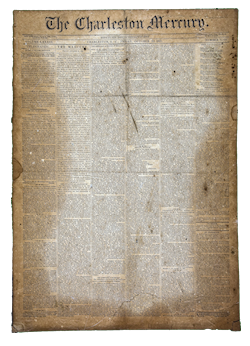
March 16, 1863, The Charleston Mercury
We take pleasure in recording the particulars of what is considered one of the boldest and most successful feats of the war. We allude to the brilliant foray of Captain JOHN H. MICKLER, and a detachment of his Company (11th Regiment, S. C. V.), on last Thursday night, which resulted in surprising and capturing a detachment of pickets and signal corps men, at the Spanish Wells Observatory, on Hilton Head Island, a few hundred yards from a regiment of infantry, and within sound of the long roll at General HUNTER’S headquarters. By examining a map of the locality, it will be observed that Hilton Head Island is separated from the main land by wide water courses, navigable for gunboats of all classes, which renders all approach to it difficult, if not dangerous, except to men who can pull an oar lustily as well as handle the rifle with deadly precision. Washed by the Atlantic ocean on the front, and the rear so guarded naturally, Hilton Head was in every respect what might have been thought a safe place for ‘Department Headquarters;’ but it seems that our salt water boys have found a way to get there.
On Thursday evening, all proper arrangements having been previously made, the […..] started in their canoes, and followed May River down to its junction with Mackay’s Creek, where the union of the two streams forms Calibogue Sound. Learning from close observation the picket stations, they effected a safe landing. The night was dark, and the wind high enough to send the tide to the shore with a heavy murmur. After making all necessary dispositions to ensure success, the scouts moved cautiously to the high ground, and thence towards the house, which is used as a picket and signal station. Their plan was to approach the place in the rear, and, if possible, capture or bayonet every one there without firing a gun; but they found that a sentinel guarded the approach from this quarter, and another was posted on the front. Under these circumstances, there was no alternative but to shoot down the sentinel at the back door, and then do their work with dispatch. Bang went a musket, and, as target practice is not certain in the dark, away scampered the sentinel, followed by the attacking party, who rushed close upon his heels into the house. Before the sleeping guards could throw off their blankets, they found themselves in the grasp of a band of stern rebels. Rather than take the twenty odd [continue reading…]


 Camp Winder, March 15,1863.