0

News of the Day

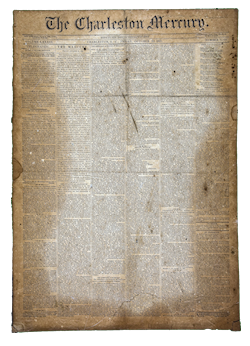
March 23, 1863, The Charleston Mercury

On Tuesday last the Yankees, with from 1000 to 1200 men, advanced some two or three miles from Jacksonville. The object was to burn down some buildings behind which the Confederates were stationed. Major BREVARD’S battalion attacked them, and the fight lasted about an hour, during which we had five men wounded, but none killed. During the skirmish the enemy’s wagons could be seen carrying off their dead and wounded. The enemy being in superior force, came near surrounding the Confederates, who were compelled to retire to a more favorable position. The centre of the Yankee forces was composed of white troops, and their right and left wings of negros, officered by whites. In a few days we look for more important information from that quarter. The Confederate troops have been reinforced, and are anxious to meet the enemy.

0 comments

0

News of the Day

March 23, 1863, The Charleston Mercury

The long silence at Fredericksburg has at last been broken by the clash of arms. The enemy has begun his […..] movement,’ and made his first step by attempting to cross the river at Kelly’s Ford, above Fredericksburg. On last Tuesday morning, about 9 o’clock, a.m., the advance of the enemy, some 3000 strong, as estimated in the official despatch to General Lee, and supposed to be Averill’s division, appeared on the north bank of the Rappahannock, and succeeded in effecting a crossing. Accounts brought down by passengers put the enemy force a little higher – say some four or five thousand. They were here met by a portion of General Fitzhugh Lee’s command, about 1200 strong, according to the reports we get. A severe engagement ensued. The fighting is said to have been terrific, and the enemy are reported to have fought with great stubbornness. The battle wavered a long time, and the great bravery of our men alone won the victory. Our men dashed on the enemy with all the force of an avalanche, and for a long time the fight raged – hand to hand. The Yankees contested every inch of the ground, but finding the fire of our men too much they fell back in great disorder, and retired to the other side of the river. As soon as the retreat was ordered the Yankees fled in great dismay and confusion, leaving behind them their dead and wounded on the field, and a number of supplies. So rapid was the enemy’s flight across the river that his hospital, established in the rear for his wounded was abandoned, and his dead lay strewn over the ground – everything left behind in his panic.

Of the loss in the action we can get very little information. It is quite certain, however, that the enemy suffered severely. We can get no actual estimate of his loss, but from the accounts brought down by passengers last night, as well as from the official despatches, it is very plain that the fight was a hard and desperate one, and the loss severe. The Yankees would scarcely have been thrown into such confusion and disorder had not they have been terribly cut up.

So far as regards our own loss, we are without any definite information. It is to be hoped from the accounts we get that our men suffered not seriously. The despatches we have convey no idea as to the extent of our loss, beyond the mere fact [continue reading…]

0 comments

0

Cruise of the U.S. Flag-Ship Hartford -Wm. C. Holton

March 22d. At ten A. M., the Albatross got under way and dropped down the river a short distance, and shelled the batteries at Warrenton, receiving in return a brisk fire from musketry and field pieces; after engaging the batteries a short time, came up and anchored ahead of us. Last night a very large coal lighter was floated down to us from the fleet above Vicksburg, the enemy not discovering it until it had got some distance below their batteries, at which time they fired a few shots at it, but doing it no damage. We are not altogether out of coal, but as it is believed that we are in rather a tight fix, it has been deemed necessary to take in a good supply of this precious article. To-day the ship’s company have been engaged coaling ship from lighter. The Albatross is also taking in coal from the same lighter.

0 comments

Downing’s Civil War Diary.–Alexander G. Downing.

Diary of Alexander G. Downing; Company E, Eleventh Iowa Infantry

Sunday, 22d–I worked all day setting up our tent, my two tent mates being on duty. General Logan’s Division started for Vicksburg today. It commenced to rain this evening.

0 comments

War Diary of Luman Harris Tenney.

War Diary of Luman Harris Tenney.

22nd. After morning work, Sergts. Drake and Arnold and Capt. Tod and I rode down to Alton. Very pleasant. Drake is a good boy. Seems to have a heart. After dinner saw Col. Ratliff and got permission to go home three days. Oh what a happy boy. How good it will seem to see Ma and girls and F. Thede has a pass, too. C. G. and Tully (Norton) rode to town with us. Stayed at the National.

0 comments

Diary of David L. Day.

David L Day – My diary of rambles with the 25th Mass

March 22. The garrison here consists of companies G, Capt. Swift, and II, Capt. Sanford, of the 27th Massachusetts; company D, Capt. Howard, of the 5th Massachusetts; company C, Capt. Cliffton, of the 1st North Carolina Union volunteers, and part of a company of North Carolina cavalry. Several gunboats lying in the river. The fellows here are telling us bear stories about one rebel General Garnett (whoever he is) and his brigade which is hovering around here. I think he must be quite a harmless character to let so small a garrison as this go undisturbed, but it is possible he has a wholesome fear of Capt. Flusser and his gunboats. This town has undergone quite a change since we were here last fall. During the winter the enemy made a dash in here, setting the town on fire, burning up the central and business portion of it. These people have singular ideas; they seem to think that by destroying their property, they are in some way damaging us, but if we destroy any property it is a great piece of vandalism. I reckon they will sometime see their mistake and repent of it in dust and ashes.

0 comments

A Rebel War Clerk’s Diary

Civil War Day-by-Day
A likeness of Jones when he was editor and majority owner of the Daily Madisonian during President John Tyler’s administration.

MARCH 22d.—It was thawing all night, and there is a heavy fog this morning. The snow will disappear in a few days.

A very large number of slaves, said to be nearly 40,000, have been collected by the enemy on the Peninsula and at adjacent points, for the purpose, it is supposed, of cooperating with Hooker’s army in the next attempt to capture Richmond.

The snow has laid an embargo on the usual slight supplies brought to market, and all who had made no provision for such a contingency are subsisting on very short-commons. Corn-meal is selling at from $6 to $8 per bushel. Chickens $5 each. Turkeys $20. Turnip greens $8 per bushel. Bad bacon $1.50 per pound. Bread 20 cts. per loaf. Flour $38 per barrel,—and other things in proportion. There are some pale faces seen in the streets from deficiency of food; but no beggars, no complaints. We are all in rags, especially our underclothes. This for liberty!

The Northern journals say we have negro regiments on the Rappahannock and in the West. This is utterly untrue. We have no armed slaves to fight for us, nor do we fear a servile insurrection. We are at no loss, however, to interpret the meaning of such demoniac misrepresentations. It is to be seen of what value the negro regiments employed against us will be to the invader.

0 comments

0

News of the Day

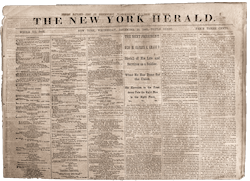
March 22, 1863, The New York Herald

In a Richmond paper of the 17th instant we find sixteen advertisements for substitutes, with the condition generally attached that he must be over forty-five years of age, which shows that the population of the regular military age, between eighteen and forty-five, must be exhausted, and that the rebellion is on its last legs, when it must resort to old men to fight its battles. To show the pressure that exists, we may state that in nearly all the advertisements “a liberal price” is offered, while in one the specific sum of $1,000 is held out, with the remark that “a bugler is preferred,” and the man must be of […..] and industrious habits.” In another advertisement the sum of $400 is offered as a reward for the arrest of a substitute who deserted after getting his pay. We are told he is “Canadian by birth.” All these are indications of the terrible straits to which the chiefs of the Southern insurrection are now reduced. Their men are exhausted. Their money has become almost worthless, being four or five hundred per cent below the par standard of gold. One vigorous effort now, and the rebellion is forever laid low.

0 comments

0

News of the Day

March 22, 1863, The New York Herald

CONDITION OF THE SOUTH – HOW UNION PRISONERS ARE TREATED BY THE REBELS.

WASHINGTON, March 21, 1863.

The Union prisoners who have been released, and arrived here last night from Richmond, on the steamer State of Maine, make some interesting statements in regard to the condition of affairs in the rebel confederacy. They represent that they were most cruelly treated, and suffered everything but death. The rebels treat citizen prisoners much worse than they do the prisoners of war. They were supplied with barely sufficient food to sustain life, and that of the worst possible quality. Latterly, those in Richmond have not been allowed to purchase anything – not even a loaf of bread. Provisions are very scarce and held at fabulous prices. Prices are systematically understated by the rebel papers. Flour is now selling in Richmond at forty to fifty dollars per barrel, although quoted in the Richmond papers at twenty- \eight dollars and a half; sweet potatoes, eight dollars per peck; eggs, two dollars per dozen, and other articles in proportion. In Mobile flour is selling at seventy-five to eighty dollars per barrel.

The poorer classes in Richmond are in a starving condition, and there have been a number of cases of actual starvation among them from inability to obtain the necessaries of life. Society throughout the confederacy is fearfully demoralized, women hitherto respectable being actually compelled to resort to prostitution to obtain the means of existence.

The utmost rigor and cruelty is exercised to keep the soldiers in the army. Soldiers absenting themselves from camps without leave are tried by court martial and punished by from twenty to one hundred lashes, according to the number of days they are gone. Deserters are frequently shot as examples to deter the soldiers from desertion. Many Union soldiers who have deserted to the enemy refuse to take the oath of allegiance and enter the rebel service after ascertaining the actual condition of things and learning what they must undergo, preferring to be returned as deserters and take their [continue reading…]

0 comments

0

News of the Day

March 22, 1863, The New York Herald

The official report of the late conflict near Milton, Tenn., between General Hall’s brigade and the rebels, on the Liberty road, reached the War Department yesterday from General Rosecrans. We have before published the leading facts. Gen. Rosecrans says that the rebels numbered about eight or ten regiments of Morgan’s and Breckinridge’s cavalry, and that Gen. Hall, after four hours’ fighting, whipped and drove them with a loss on our side of seven killed and thirty-one wounded, including one captain. The rebel loss, he says, was thirty or forty killed, including three commissioned officers, one hundred and forty wounded and twelve prisoners, among which were three commissioned officers.

The snow storm at Fortress Monroe ended yesterday in a heavy gale and severe fall of rain. The snow was over a foot deep, and there is but little chance of the roads in that vicinity being available for some days to come.

The intelligence from Gen. Hooker’s army also represents the roads in an impassable condition from the recent snow fall. The mud is rapidly increasing. There are no movements to report from that quarter. General Hooker is about to have a grand review of the First Army Corps.

The army of the United States and the cause of loyalty against rebellion have sustained a serious loss in the death of Major General Edwin V. Sumner, who died at Syracuse yesterday morning, rather suddenly, of congestion of the lungs.

We have later news of the rebel privateer Florida by the arrival at this port yesterday of the bark N.H. Gaston, from Trinidad, which reports that the privateer was at Barbadoes taking in coal on the 23d ult., and left there on the 25th. Since her capture of the Jacob Bell she is not reported to have taken any more prizes.

By the arrival of the steamship British Queen at this port yesterday we have news from the Bahamas dated at Nassau, N.P., on the 16th of March. The blockade runners were doing an active and most profitable trade between the rebel ports and the port of Nassau. The arrivals at and departures from Charleston, Wilmington and Nassau are reported as of daily occurrence. The vessels were mostly owned in England; but many hailed from other European countries. The Legislature of the Bahamas was opened in session on the 5th instant. Governor Bayley delivered an important speech on the occasion, in which he reviewed the position of neutrals trading from the islands to the rebel ports, as well as the question of the right of search as asserted by the federal Congress….

0 comments

“Those upon whom we all looked as distinguished for purity of character as men, and for gallantry as soldiers, seem to have been the first victims.”–Letters from Elisha Franklin Paxton.

Elisha Franklin Paxton – Letters from camp and field while an officer in the Confederate Army

Camp Winder, March 22, 1863.

I am grateful to you for the tender interest in my health manifested in your last letter, received some days since. For the last week I have felt better than I have before this winter. I have gotten a half-bushel of dried peaches from Richmond, and, living upon these for the most part, I have improved very much. I am so much pleased with the medicine that I think I shall send to Richmond and get another bushel. So, I think, you may give up your idea of a furlough.

It commenced snowing again on Thursday evening, and snowed or rained all day Friday and Saturday. To-day the sun is shining brightly, the birds chirping, and some signs of spring again. I hope now we may have good weather, and that you may be able to make some speed with your farm work.

I had an unexpected visitor at my tent yesterday evening–Mr. Junkin of Falling Spring Church. I divided my bed with him, and did what I could to make him comfortable. He has special claims upon my hospitality as the pastor of my old church. It is associated in my mind with many loved friends who have now gone to their long homes, and from it I derived my earliest impressions of the church and the pastor. Twenty long years have passed since I used to go there to church. I have grown that much older, but I fear not much wiser or better. I remember and reverence the teachings of my venerable pastor, but have not made them the guide of my life as I ought to have done.

I laid aside my pencil and paper just here to go over and hear a sermon from Mr. Junkin. It was impressive and eloquent. When he alluded to our missing comrades of the past campaign, there was a solemn stillness, and many eyes moistened with tears. It is sad, indeed, to think now how many good men we have lost. Those upon whom we all looked as distinguished for purity of character as men, and for gallantry as soldiers, seem to have been the first victims. I never saw an audience more attentive than our soldiers are at church. The great mass of them are good men, who have not lost in the army the habits which they learned in their churches at home. I like to see those whose lives may be spared to return home without being contaminated with the vices of the army.

0 comments

0

Cruise of the U.S. Flag-Ship Hartford -Wm. C. Holton

March 21st. At nine A. M., got under way, went to quarters, and steamed up the river a short distance, but owing to the dense fog returned back to our anchorage. To-day we buried one of our men, Robert King, Quartermaster, who had been lying ill for some days. From our anchorage we could see a range of high cliffs, and a small village known as Warrenton. Thinking that there might be batteries erected there, it was decided upon to go up and introduce ourselves by way of informing Mr. Secesh that we are still on the lookout for them. At five P. M., got under way again in company of the Albatross. Steamed up, and when in good range opened fire; continued on up until we had passed by the cliffs, where we expected to find guns mounted, but there were none to be found or at least no response was made to our firing. At six thirty, P. M., came to anchor about three miles above Warrenton. We are now lying about six or seven miles below Vicksburg, and can see the city quite distinctly. This has been quite an adventurous week to us.

0 comments

Downing’s Civil War Diary.–Alexander G. Downing.

Diary of Alexander G. Downing; Company E, Eleventh Iowa Infantry

Saturday, 21st–The Eleventh Iowa received new guns, the Enfield rifle, and everyone is pleased with the exchange. Receiving orders to move camp, we struck our tents at 3 o’clock p. m. and moved two miles and went into camp in a cotton field close by the levee just above the town of Lake Providence. On account of the flooding waters we had to travel a distance of four miles to reach the point. General Logan’s Division moved up the river about four miles.

0 comments

War Diary of Luman Harris Tenney.

War Diary of Luman Harris Tenney.

21st. John Devlin went down to Oberlin without a pass. Will probably be punished. Took a letter for C. G. and brought another from Fred which C. G. showed to me. Both good. Issued rations for 11 days. After going round with potatoes, felt rather tired. A sore toe, miserable corn.

0 comments

A Rebel War Clerk’s Diary

Civil War Day-by-Day
A likeness of Jones when he was editor and majority owner of the Daily Madisonian during President John Tyler’s administration.

MARCH 21st.—The snow is nearly a foot deep this morning, as it continued to fall all night, and is falling still. It grows warmer, however.

But we now learn that the Indianola was destroyed in the Mississippi by the officers, upon the appearance of a simulated gun-boat sent down, without a crew! This was disgraceful, and some one should answer for it.

Col. Godwin writes from King and Queen County, that many of the people there are deserting to the enemy, leaving their stock, provisions, grain, etc., and he asks permission to seize their abandoned property for the use of the government. Mr. Secretary Seddon demands more specific information before that step be taken. He intimates that they may have withdrawn to avoid conscription.

0 comments

0

News of the Day

March 21, 1863, The New York Herald

Exploits of the Black Brigade in Florida.

HILTON HEAD, S.C., March 16, 1863.

The latest intelligence from the Black brigade, which is now marching into Florida, is that they have taken several important points, with many prisoners, and captured large quantities of munitions and supplies, and are still driving the enemy before them.

The expected arrival here of another army corps, said to be Burnside’s, the departure of which is noticed by the Richmond papers, has created fresh hopes and additional enthusiasm among our troops.

A Charleston paper speaks of the expected arrival in that city of some distinguished military characters to witness the expected battle at that point.

The Eighty-fifth Pennsylvania held a great indignation meeting on the 12th, denouncing the proceedings of a peace meeting, recently held at their home in Fayette county. Similar meetings are being held in other regiments.

A memorial to the President is being prepared by the soldiers, asking the appointment of Union orators to visit the army occasionally, and also that an administration journal may be furnished gratuitously to the troops in the field.

A movement is on foot here among the various regiments to raise a fund for the suffering poor of England.

The charges preferred against Colonel Osborne, of the Twenty-fourth Massachusetts, have been withdrawn, it appearing that they were all groundless, which restores this popular and accomplished officer to his command. [continue reading…]

0 comments

0

News of the Day

March 21, 1863, The Charleston Mercury.

FROM THE RAPPAHANNOCK.

The Fredericksburg correspondent of the Richmond Examiner writer from Fredericksburg, March 17:

The military situation here is unchanged, save in the increased animation apparent in the enemy’s camp, and their adoption of certain precautionary measures which indicate a purpose to prevent all communication between the pickets. Last night the performance was varied by the banging of drums and blowing of bugles, and shooting of sky rockets. These demonstrations were so numerous and marked as to excite considerable attention, and much speculation as to their meaning. Your correspondent was along the lines throughout the night, but discovered no unusual indications in the immediate front. It is his confirmed opinion that a large part of Hooker’s army is on the march for some point higher up the Rappahannock. Quite a body of his cavalry took that direction yesterday morning, and the light of the enemy’s camp fires evidently tends Northwestward. This opinion is given in the face of the fact that also on yesterday a brigade of their infantry marched down the river, and that there is not the least sign of relaxation of their hold on the opposite heights. It seems to be the settled opinion that when the curtain does rise for another act in the bloody drama of this war, Fredericksburg will be the scene of a second conflict.

FROM VICKSBURG.

The Vicksburg Whig of March 14 says:

The Federals are evidently on the move. Yesterday morning the number of transports across the river was only six. In the forenoon a large train could be seen moving up, and upon examining the camp in White’s Field, it was discovered that many of the tents had disappeared. The dredge boats, however, were still at work, but do not seem to have advanced a [continue reading…]

0 comments

0

News of the Day

March 21, 1863, The New York Herald

Nothing of importance occurred in the Army of the Rappahannock yesterday. A heavy snow storm was falling during the day and previous night, and the weather was very cold.

By an arrival from Hilton Head we have an account of the exploits of the Black Brigade in Florida, by which they have obtained possession of many important points and a large quantity of munitions and supplies. Large reinforcements, supposed to be Burnside’s army corps, were expected at Hilton Head.

Rumors were circulated in the city yesterday that some of our gunboats had passed Fort Sumter on Monday and Tuesday, and that Charleston was being bombarded. We need hardly say that this report is without confirmation, as we have had despatches from Charleston dated Monday saying that all was quiet in that vicinity; nor do our reports from Hilton Head of the same date make any mention of a fight going on near Charleston.

We have some very interesting news from the Southwest today. The Union forces made a brilliant dash into Northern Alabama, in company with a number of gunboats, reaching as far as Tuscumbia, on the 22d ult. The advance drove the rebel cavalry from the town into the mountains, and occupied the place. Advancing farther into the interior our troops, who were commanded by Colonel Corwin, carried away considerable plunder. This account of the raid comes from a rebel source – the Confederacy, published in Atlanta, Ga.

The only news from Vicksburg is to the effect that the cut-off is likely to prove a success, and that our troops are improving in health. The movements of transports and gunboats up the Yazoo Pass continue very active.

Large bodies of rebel troops are said to be concentrating at Knoxville, and that a number of them, amounting to four [continue reading…]

0 comments

0

Cruise of the U.S. Flag-Ship Hartford -Wm. C. Holton

March 20th. Nothing has occurred to-day worthy of note. Rebel pickets have been seen all day on the opposite shore. Last night the mortar vessels above Vicksburg opened fire and shelled the city for about three hours.

0 comments

Downing’s Civil War Diary.–Alexander G. Downing.

Diary of Alexander G. Downing; Company E, Eleventh Iowa Infantry

Friday, 20th–Nothing of importance today. We have drill twice a day. I received a pass and went to Lake Providence. The water is already in the streets and the army sutlers occupying vacant buildings will have to move out tomorrow. I purchased a tin plate and spoon for thirty cents.

0 comments

War Diary of Luman Harris Tenney.

War Diary of Luman Harris Tenney.

20th. Issued bread and beef after breakfast. Then got up rations to issue for the remainder of the month. No lesson again. Read some and played checkers. C. G. slept with me last night and did not wake up, so has had to work all day. He received a letter from Fred.

0 comments

Diary of David L. Day.

David L Day – My diary of rambles with the 25th Mass

March 20. This morning finds the storm unabated. The boat starts at daylight, passing Roanoke island, and enters the Albemarle, arriving at Plymouth late in the afternoon, where we make our quarters in a large warehouse on the wharf.

0 comments

Diary of a Southern Refugee, Judith White McGuire.

Diary of a Southern Refugee During the War by Judith White McGuire

March 20th.—Severe snow-storm. This will retard the attack upon Fredericksburg, if the enemy designed it. We spent the morning in the parlour. N. P. read aloud the old-fashioned but amusing novel, “Pride and Prejudice,” in very spirited style. The event of the day was the arrival from Alexandria of a bundle, filled with useful articles for a lady, who, not wanting them all herself, allowed us to help ourselves at the price which they cost her in Alexandria. It was amusing to see with what avidity the girls seized on a calico dress at only seventy-five cents per yard (Confederate money); every thing was in such demand, that I only got a tooth-brush, at one dollar; they are two dollars and fifty cents in Richmond.

0 comments

Through Some Eventful Years

Through Some Eventful Years by Susan Bradford Eppes
Susa Bradford Eppes

March 20th, 1863.—Mattie and I have the whooping cough very bad. She cannot retain her food, though I do not suffer in that way, it is extremely painful. When the spells of coughing take me the blood oozes from my eyes, nose and ears. Three doctors have been called in and they say they never saw such a case. It is well I am not going to school this winter for I do not believe I could study.

Sam Donelson went back to the army of the West today. Mother is with Aunt Nancy.


Susan Bradford is 17 years old when this entry was made.

0 comments

A Rebel War Clerk’s Diary

Civil War Day-by-Day
A likeness of Jones when he was editor and majority owner of the Daily Madisonian during President John Tyler’s administration.

MARCH 20th.—The snow is eight inches deep this morning, and it is still falling fast.

Not a beggar is yet to be seen in this city of 100,000 inhabitants!

Hood’s division, mostly Texans, whose march to the Rappahannock was countermanded when it was ascertained that the enemy had been beaten back across the river, were all the morning defiling through Main Street, in high spirits, and merrily snow-balling each other. And these men slept last night out in the snow without tents! Can such soldiers be vanquished?

Yesterday Floyd’s division of State troops were turned over to the Confederacy—only about 200!

We have no further particulars of the fight on the Rappahannock; we know, however, that the enemy were beaten, and that this snow-storm must prevent further operations for many days. Several Eastern Shore families, I learn, are about to return to their homes. This is no place for women and children, who have homes elsewhere. We are all on quarter-rations of meat, and but few can afford to buy clothing at the present prices.

0 comments