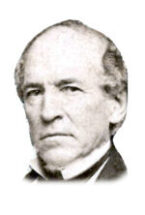
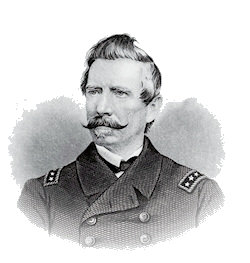
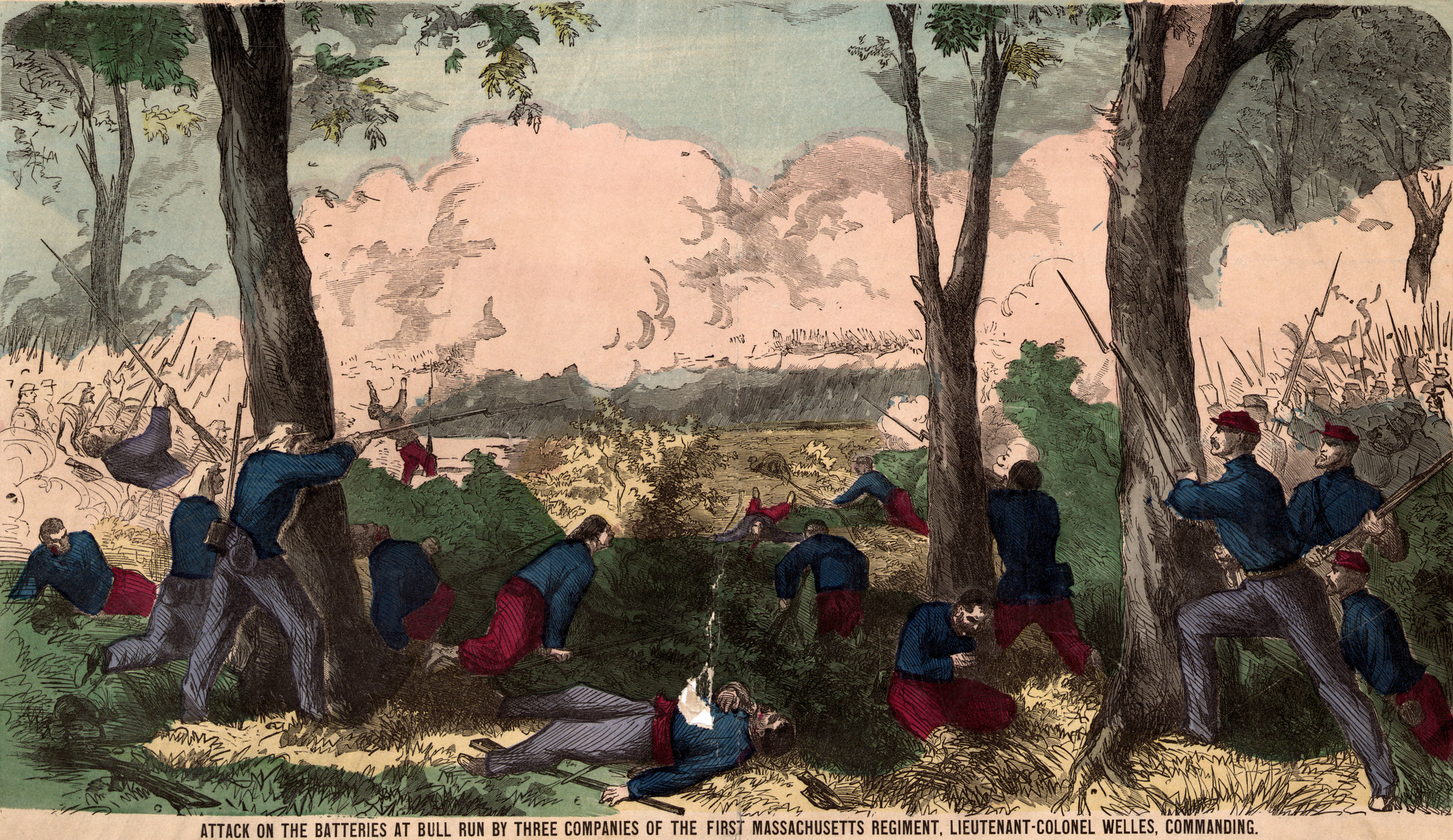
John T. Hughes

Civil War Era Photographic Portraiture

Civil War Era Photographic Portraiture #007

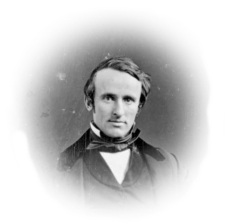
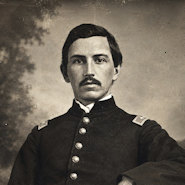
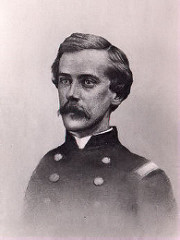
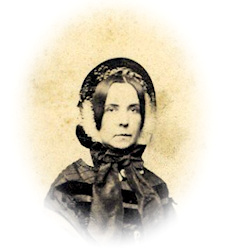
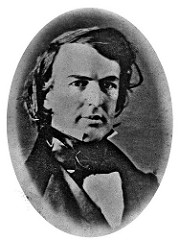
John T. Hughes (July 25, 1817 — August 11, 1862) was a colonel in the Missouri State Guard and Confederate Army during the American Civil War. He might also have been a brigadier general at the time of his death but documentation of the appointment is lacking.

Hughes returned to Missouri in the summer of 1862 to recruit for the Confederacy. At this time he may have been appointed as either an acting Confederate or Missouri State Guard brigadier general. No record of the appointment has been found but he was known as “general.”

He, his recruits, and several other recruiting or partisan bands united to attack the garrison of Independence, Missouri on August 11, 1862, with Hughes in overall command. During this battle (the First Battle of Independence), he was killed instantly by a shot to the head while leading a charge, but the city was captured. He is interred at Woodlawn Cemetery in Independence. He left behind a wife, Mary, and five young sons. (Wikipedia)


0 comments

William Howard Russell’s Diary: A runaway crowd at Washington.—The army of the Potomac in retreat.

My Diary North and South – William Howard Russell

July 22nd.–I awoke from a deep sleep this morning, about six o’clock. The rain was falling in torrents and beat with a dull, thudding sound on the leads outside my window; but, louder than all, came a strange sound, as if of the tread of men, a confused tramp and splashing, and a murmuring of voices. I got up and ran to the front room, the windows of which looked on the street, and there, to my intense surprise, I saw a steady stream of men covered with mud, soaked through with rain, who were pouring irregularly, without any semblance of order, up Pennsylvania Avenue towards the Capitol. A dense stream of vapour rose from the multitude; but looking closely at the men, I perceived they belonged to different regiments, New Yorkers, Michiganders, Rhode Islanders, Massachusetters, Minnesotians, mingled pellmell together. Many of them were without knapsacks, crossbelts, and firelocks. Some had neither great-coats nor shoes, others were covered with blankets. Hastily putting on my clothes, I ran down stairs and asked an “officer,” who was passing by, a pale young man, who looked exhausted to death, and who had lost his sword, for the empty sheath dangled at his side, where the men were coming from. “Where from? Well, sir, I guess we’re all coming out of Verginny as far as we can, and pretty well whipped too.” “What! the whole army, sir?” “That’s more than I know. They may stay that like. I know I’m going home. I’ve had enough of fighting to last my lifetime.”

The news seemed incredible. But there, before my eyes, were the jaded, dispirited, broken remnants of regiments passing onwards, where and for what I knew not, and it was evident enough that the mass of the grand army of the Potomac was placing that river between it and the enemy as rapidly as possible. “Is there any pursuit?” I asked of several men. Some were too surly to reply; others said, “They’re coming as fast as they can after us.” Others, “I guess they’ve stopped it now–the rain is too much for them.” A few said they did not know, and looked as if they did not care. And here came one of these small crises in which a special correspondent would give a good deal for the least portion of duality in mind or body. A few sheets of blotted paper and writing materials lying on the table beside the burnt-out candles, reminded me that the imperious post-day was running on. “The mail for Europe, viâ Boston, closes at one o’clock, Monday, July 22nd,” stuck up in large characters, warned me I had not a moment to lose. I knew the event would be of the utmost interest in England, and that it would be important to tell the truth as far as I knew it, leaving the American papers to state their own case, that the public might form their own conclusions.

But then, I felt, how interesting it would be to ride out and watch the evacuation of the sacred soil of Virginia, to see what the enemy were doing, to examine the situation of affairs, to hear what the men said, and, above all, find out the cause of this retreat and headlong confusion, investigate the extent of the Federal losses and the condition of the wounded; in fact, to find materials for a dozen of letters. I would fain, too, have seen General Scott, and heard his opinions, and have visited the leading senators, to get a notion of the way in which they looked on this catastrophe.–”I do perceive here a divided duty.”–But the more I reflected on the matter the more strongly I became convinced that it would not be advisable to postpone the letter, and that the events of the 21st ought to have precedence of those of the 22nd, and so I stuck up my usual notice on the door outside of “Mr. Russell is out,” and resumed my letter.

Whilst the rain fell, the tramp of feet went steadily on. As I lifted my eyes now and then from the paper, I saw the beaten, foot-sore, spongy-looking soldiers, officers, and all the debris of the army filing through mud and rain, and forming in crowds in front of the spirit stores. Underneath my room is the magazine of Jost, negociant en vins, and he drives a roaring trade this morning, interrupted occasionally by loud disputes as to the score. When the lad came in with my breakfast he seemed a degree or two lighter in colour than usual. “What’s the matter with you?” “I ‘spects, massa, the Seceshers soon be in here. I’m a free nigger; I must go, sar, afore de come cotch me.” It is rather pleasant to be neutral under such circumstances.

I speedily satisfied myself I could not finish my letter in time for post, and I therefore sent for my respectable Englishman to go direct to Boston by the train which leaves this at four o’clock to-morrow morning, so as to catch the mail steamer on Wednesday, and telegraphed to the agents there to inform them of my intention of doing so. Visitors came knocking at the door, and insisted on getting in– military friends who wanted to give me their versions of the battle–the attaches of legations and others who desired to hear the news and have a little gossip; but I turned a deaf ear doorwards, and they went off into the outer rain again.

More draggled, more muddy, and down-hearted, and foot-weary and vapid, the great army of the Potomac still straggled by. Towards evening I seized my hat and made off to the stable to inquire how the poor horse was. There he stood, nearly as fresh as ever, a little tucked up in the ribs, but eating heartily, and perfectly sound. A change had come over Mr. Wroe’s dream of horseflesh. “They’ll be going cheap now,” thought he, and so he said aloud, “If you’d like to buy that horse, I’d let you have him a little under what I said. Dear! dear! it must a’ been a sight sure-ly to see them Yankees running; you can scarce get through the Avenue with them.”

And what Mr. W. says is quite true. The rain has abated a little, and the pavements are densely packed with men in uniform, some with, others without, arms, on whom the shopkeepers are looking with evident alarm. They seem to be in possession of all the spirit-houses. Now and then shots are heard down the street or in the distance, and cries and shouting, as if a scuffle or a difficulty were occurring. Willard’s is turned into a barrack for officers, and presents such a scene in the hall as could only be witnessed in a city occupied by a demoralised army. There is no provost guard, no patrol, no authority visible in the streets. General Scott is quite overwhelmed by the affair, and is unable to stir. General M’Dowell has not yet arrived. The Secretary of War knows not what to do, Mr. Lincoln is equally helpless, and Mr. Seward, who retains some calmness, is, notwithstanding his military rank and militia experience, without resource or expedient. There are a good many troops hanging on about the camps and forts on the other side of the river, it is said; but they are thoroughly disorganised, and will run away if the enemy comes in sight without a shot, and then the capital must fall at once. Why Beauregard does not come I know not, nor can I well guess. I have been expecting every hour since noon to hear his cannon. Here is a golden opportunity. If the Confederates do not grasp that which will never come again on such terms, it stamps them with mediocrity.

The morning papers are quite ignorant of the defeat, or affect to be unaware of it, and declare yesterday’s battle to have been in favour of the Federals generally, the least arrogant stating that M’Dowell will resume his march from Centreville immediately. The evening papers, however, seem to be more sensible of the real nature of the crisis: it is scarcely within the reach of any amount of impertinence or audacious assertion to deny what is passing before their very eyes. The grand army of the Potomac is in the streets of Washington, instead of being on its way to Richmond. One paper contains a statement which would make me uneasy about myself if I had any confidence in these stories, for it is asserted “that Mr. Russell was last seen in the thick of the fight, and has not yet returned. Fears are entertained for his safety.”

Towards dark the rain moderated and the noise in the streets waxed louder; all kinds of rumours respecting the advance of the enemy, the annihilation of Federal regiments, the tremendous losses on both sides, charges of cavalry, stormings of great intrenchments and stupendous masked batteries, and elaborate reports of unparalleled feats of personal valour, were circulated under the genial influence of excitement, and by the quantities of alcohol necessary to keep out the influence of the external moisture. I did not hear one expression of confidence, or see one cheerful face in all that vast crowd which but a few days before constituted an army, and was now nothing better than a semi-armed mob. I could see no cannon returning, and to my inquiries after them, I got generally the answer, “I suppose the Seceshers have got hold of them.”

Whilst I was at table several gentlemen who have entrée called on me, who confirmed my impressions respecting the magnitude of the disaster that is so rapidly developing its proportions. They agree in describing the army as disorganised. Washington is rendered almost untenable, in consequence of the conduct of the army, which was not only to have defended it, but to have captured the rival capital. Some of my visitors declared it was dangerous to move abroad in the streets. Many think the contest is now over; but the gentlemen of Washington have Southern sympathies, and I, on the contrary, am persuaded this prick in the great Northern balloon will let out a quantity of poisonous gas, and rouse the people to a sense of the nature of the conflict on which they have entered. The inmates of the White House are in a state of the utmost trepidation, and Mr. Lincoln, who sat in the telegraph operator’s room with General Scott and Mr. Seward, listening to the dispatches as they arrived from the scene of action, left it in despair when the fatal words tripped from the needle and the defeat was clearly revealed to him.

Having finally cleared my room of visitors and locked the door, I sat down once more to my desk, and continued my narrative. The night wore on, and the tumult still reigned in the city. Once, indeed, if not twice, my attention was aroused by sounds like distant cannon and outbursts of musketry, but on reflection I was satisfied the Confederate general would never be rash enough to attack the place by night, and that, after all the rain which had fallen, he in all probability would give horses and men a day’s rest, marching them through the night, so as to appear before the city in the course of to-morrow. Again and again I was interrupted by soldiers clamouring for drink and for money, attracted by the light in my windows; one or two irrepressible and irresistible friends actually succeeded in making their way into my room–just as on the night when I was engaged in writing an account of the last attack on the Redan my hut was stormed by visitors, and much of my letter was penned under the apprehension of a sharp pair of spurs fixed in the heels of a jolly little adjutant, who, overcome by fatigue and rum-and-water, fell asleep in my chair, with his legs cocked up on my writing-table–but I saw the last of them about mid-night, and so continued writing till the morning light began to steal through the casement. Then came the trusty messenger, and, at 3 A.M., when I had handed him the parcel and looked round to see all my things were in readiness, lest a rapid toilet might be necessary in the morning, with a sigh of relief I plunged into bed, and slept.
0 comments

“The news-boys are still shouting with their extras, ‘Battle of Bull’s Run! List of the killed! Battle of Manassas! List of the wounded!’ ”—War Diary of a Union Woman in the South by Dora Richards Miller

War Diary of a Union Woman in the South

July 22.—What a day! I feel like one who has been out in a high wind, and cannot get my breath. The news-boys are still shouting with their extras, “Battle of Bull’s Run! List of the killed! Battle of Manassas! List of the wounded!” Tender-hearted Mrs. F. was sobbing so she could not serve the tea; but nobody cared for tea. “O G.!” she said, “three thousand of our own, dear Southern boys are lying out there.” “My dear Fannie,” spoke Mr. F., “they are heroes now. They died in a glorious cause, and it is not in vain. This will end it. The sacrifice had to be made, but those killed have gained immortal names.” Then Rob rushed in with a new extra, reading of the spoils captured, and grief was forgotten. Words cannot paint the excitement. Rob capered about and cheered; Edith danced around ringing the dinner bell and shouting, “Victory!” Mrs. F. waved a small Confederate flag, while she wiped her eyes, and Mr. D. hastened to the piano and in his most brilliant style struck up “Dixie,” followed by “My Maryland” and the “Bonnie Blue Flag.”

“Do not look so gloomy, G.,” whispered Mr. S. “You should be happy to-night; for, as Mr. F. says, now we shall have peace.”

“And is that the way you think of the men of your own blood and race?” I replied. But an utter scorn choked me, and I walked out of the room. What proof is there in this dark hour that they are not right? Only the emphatic answer of my own soul. To-morrow I will pack my trunk and accept the invitation to visit at Uncle Ralph’s country-house.


Note: To protect Mrs. Miller’s job as a teacher in post-civil war New Orleans, her diary was published anonymously, edited by G. W. Cable, names were changed and initials were generally used instead of full names—and even the initials differed from the real person’s initials. (Read Dora Richards Miller’s biographical sketch.)

0 comments

A Diary of American Events – July 22, 1861

The Rebellion Record – A Diary of American Events; by Frank Moore

–The Confederate States Congress appointed a day of thanksgiving for the victory at Manassas, and “deeply deplored the necessity which has washed the soil of our country with the blood of so many of her sons.”–(Doc. 113.)

–General Sweeney’s command dispersed a band of one hundred and fifty rebels stationed at Forsythe, Mo., and took possession of the town. Five of the rebels were killed and several wounded. Three of the Federal troops were slightly wounded, but none killed. The first and second stories of the court-house were filled with blankets, provisions, camp equipage, etc., which, together with two tons of lead found in a well, and other articles secreted in different parts of the town, in all valued between eighteen and twenty thousand dollars, fell into the hands of General Sweeney.–N. Y. Times, July 80.–(Doc. 133.)

–Quartermaster-Sergeant Whitney of the Vermont Regiment, was shot this morning by the rebels at Newport News, only a short distance from the camp, while searching for a strayed bullock. The body was pierced with half a dozen bullets.–An infernal machine, intended to blow up some of the ships of war in Hampton Roads, washed ashore this morning within a few rods of Floyd’s house in Virginia. It is of an ingenious construction, and is the second attempt of the kind.–The Roanoke arrived at Fortress Monroe this morning. She has been as far south as St. Augustine, Fla. During her cruise she burnt a rebel privateer whose crew escaped to the shore.– Boston Transcript, July 23.

–The correspondence between the Chief of the Cherokee Nation and various rebel authorities and citizens of Arkansas, was published today. It exhibits the attitude that tribe intends to assume in reference to the present war.– (Doc. 114.)

–Colonel William D. Kennedy, commander of the Jackson Guard, Tammany Regiment N. Y. S. V., died at Washington of congestion of the brain.–Boston Post, July 23.

–At Louisville, Ky., John W. Tompkins, formerly Clerk of the Board of Aldermen, recently a violent secessionist and recruiting officer of the Southern Confederacy, was shot dead this afternoon by Henry Green, city watchman. Tompkins was hallooing for Jeff. Davis, and was requested to desist by Green, when he drew a knife on Green, but was retreating when Green shot him. Tompkins had been endeavoring to send contraband articles southward by the Louisville and Nashville Railroad during the past week, and has been the main cause of the midnight disturbances at the depot of that road. –Louisville Courier, July 23.

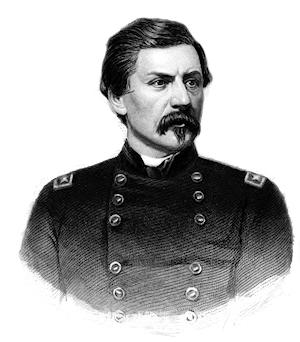
General George B. McClellan–Major-General McClellan has been summoned by the Government from Western Virginia to repair to Washington and take command of the Army of the Potomac. General Rosecrans takes his place in command of the Army of Western Virginia. The Corps d’ Armee at Washington is to be instantly re-organized and increased by the addition of 100,000 men. The necessary orders have already been given. –Offers of regiments already raised are being made and accepted with such rapidity as to ensure that this will be accomplished within a few days. Large reinforcements from various directions are already on their way to Washington, orders having been telegraphed for them yesterday while the battle was in progress. The Government entertains no apprehensions whatever for the safety of the Capital. Preparations not only for defensive but also for the speedy renewal of offensive operations are going on vigorously. General McDowell has returned to his head-quarters at Arlington Heights. The regiments composing his army are resuming their positions. Most of them have already done so.–Baltimore American, July 23.
0 comments

Civil War Day-By-Day

Civil War Day-by-Day

July 22, 1861

  • George B. McClellan [US] ordered to Washington to take command of the Army of the Potomac following the defeat at Bull Run
  • In a proclamation, Jefferson Davis accepts Tennessee as a member of the Confederacy

A Chronological History of the Civil War in America1

  • Gens. McDowell and Mansfield superseded in command of the Army of the Potomac by Gen. McClellan. Army disorganized, and the three months’ men return home.
  • State Convention of Missouri met at Jefferson City.

  1. A Chronological History of the Civil War in America by Richard Swainson Fisher, New York, Johnson and Ward, 1863
0 comments

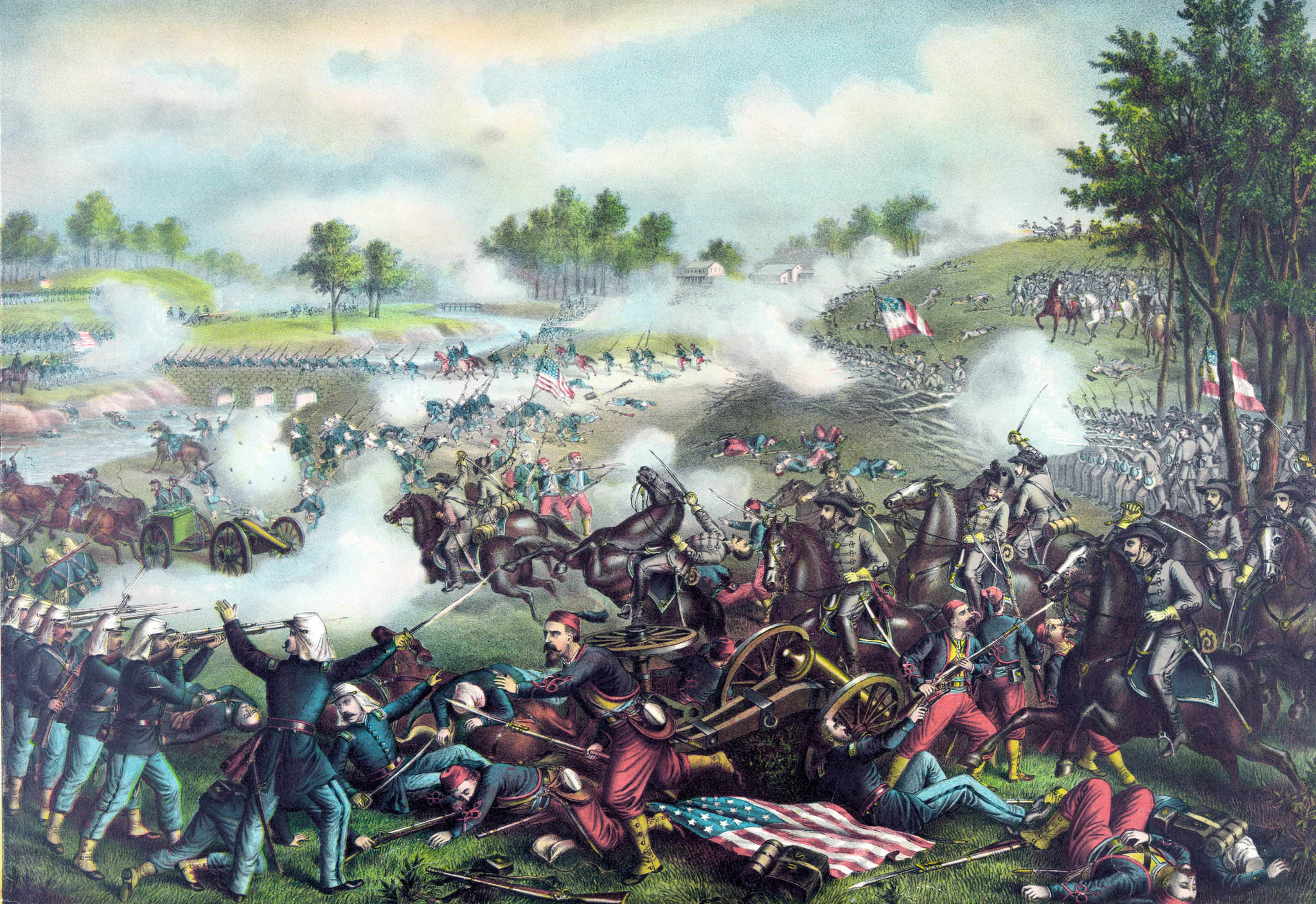
Battle of Bull Run Va July 21st, 1861

Miscellaneous document sources

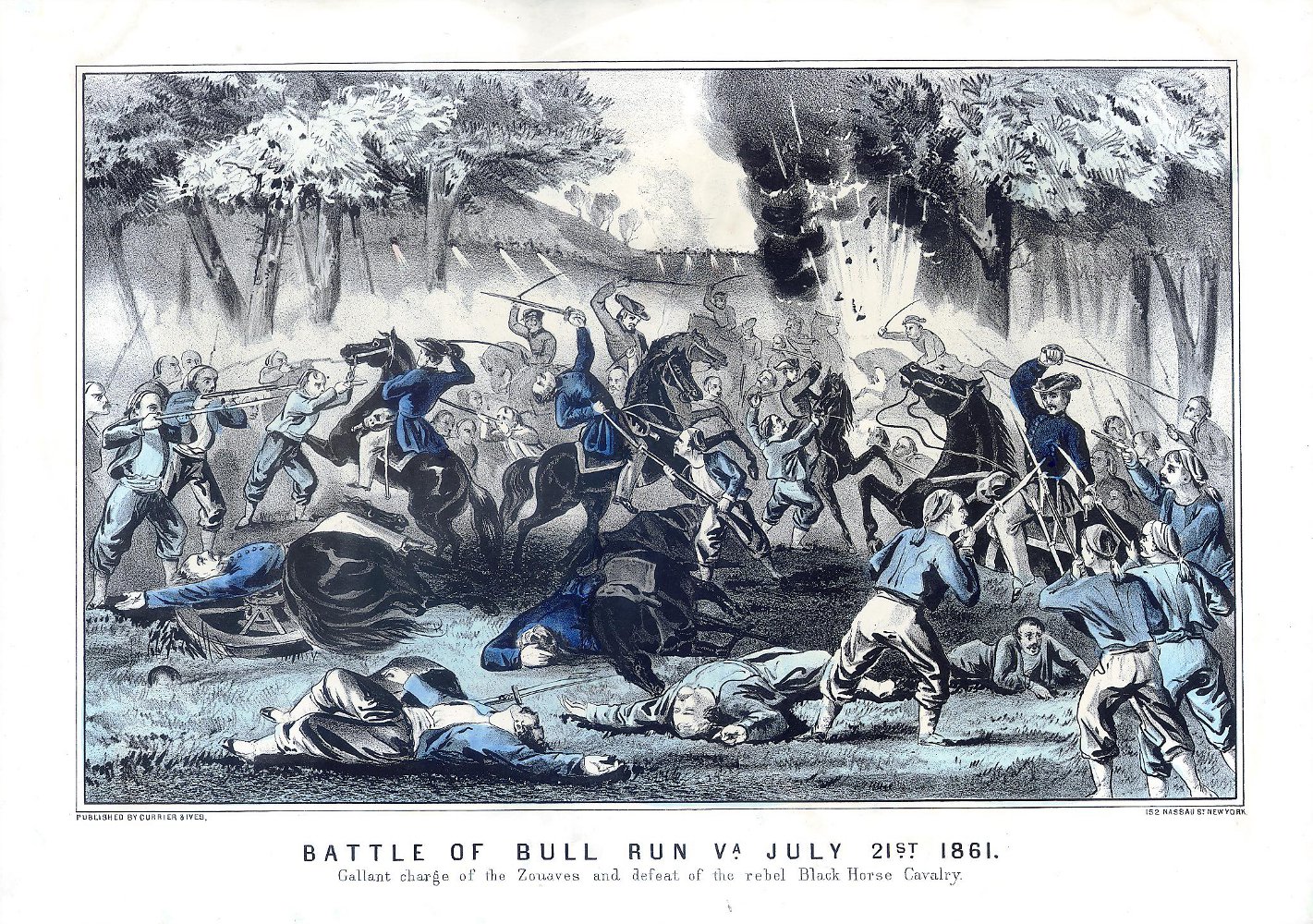
Battle of Bull Run Va July 21st 1861, Gallant Charge of the Zouaves and Defeat of the Rebel Black Horse CavalryGallant Charge of the Zouaves and Defeat of the Rebel Black Horse Cavalry

Currier and Ives, c. 1861

0 comments

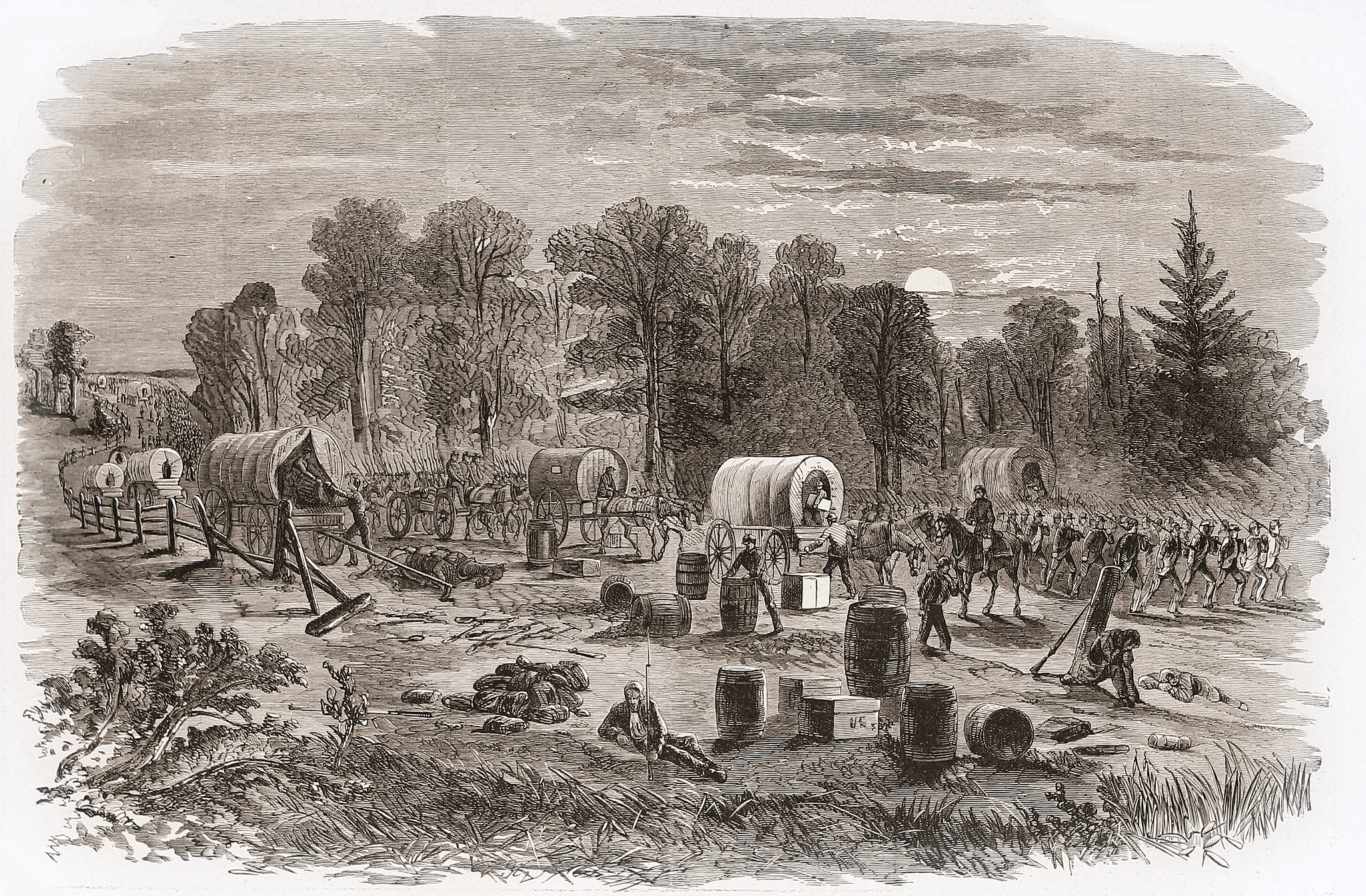
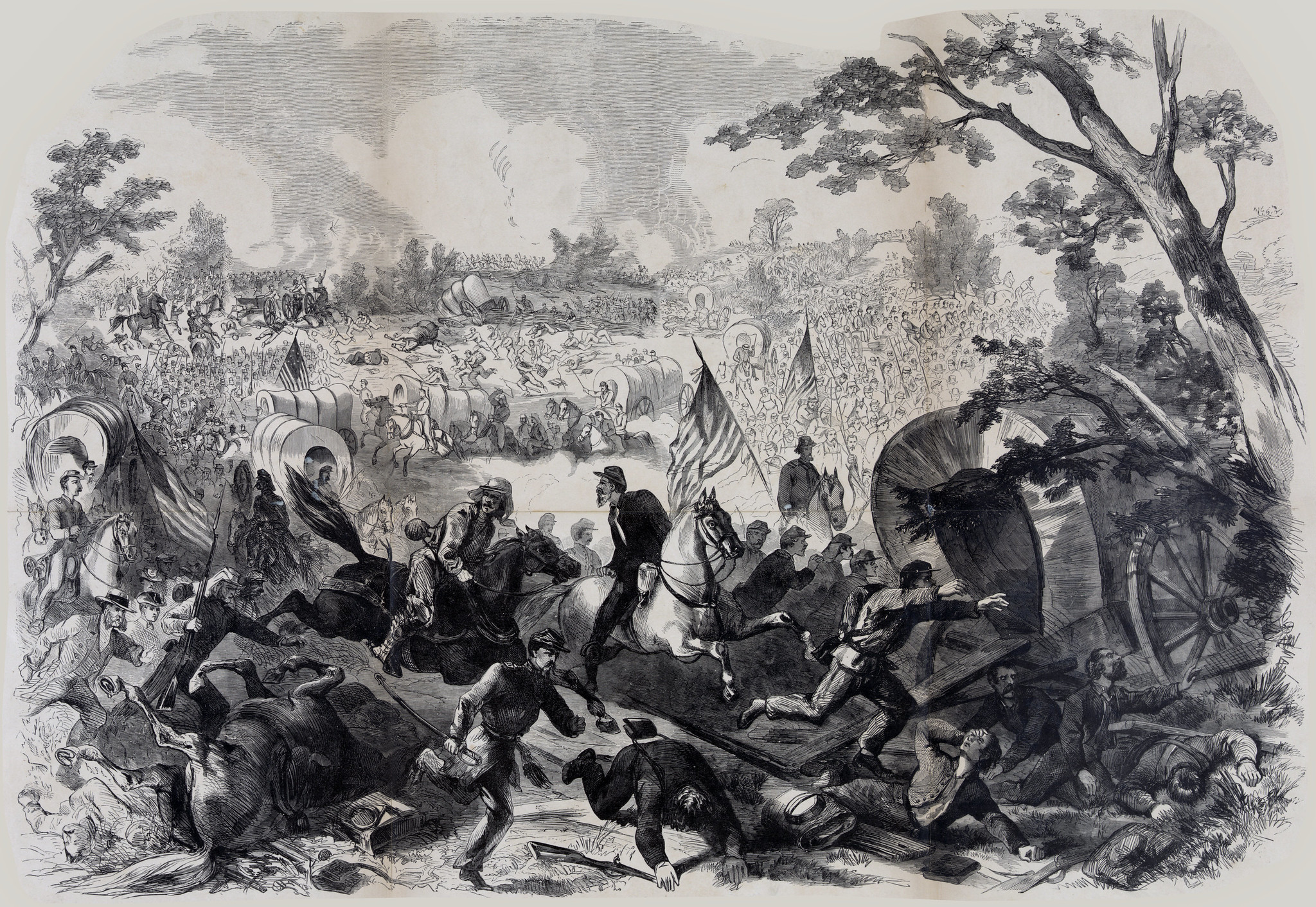
Retreat of the Federal Army under Gen. McDowell upon Centreville.

Miscellaneous document sources

The First Battle of Bull Run, Va., Sunday afternoon, July 21, 1861The First Battle of Bull Run, Va., Sunday afternoon, July 21, 1861

Retreat of the Federal Army under Gen. McDowell upon Centreville. — The Reserve Division of Col. Miles Covering the Retreat and Repelling the Confederate Cavalry. Panic Among the Teamsters and Civilians and General Stampede Toward Arlington Heights.

The J. Howard Brown Company, Publishers, 45 Centre Street, New York

0 comments

Bull Run

Miscellaneous document sources

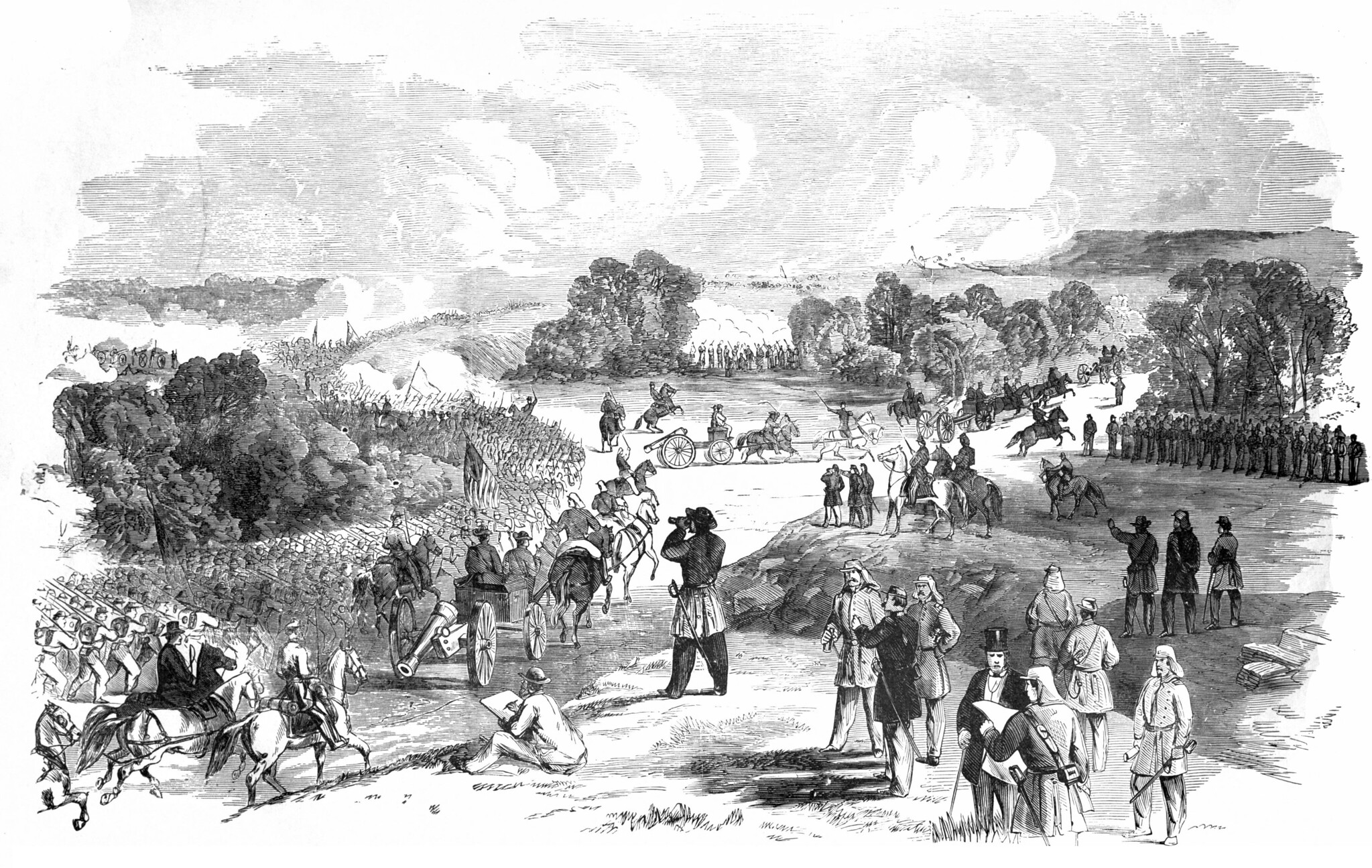
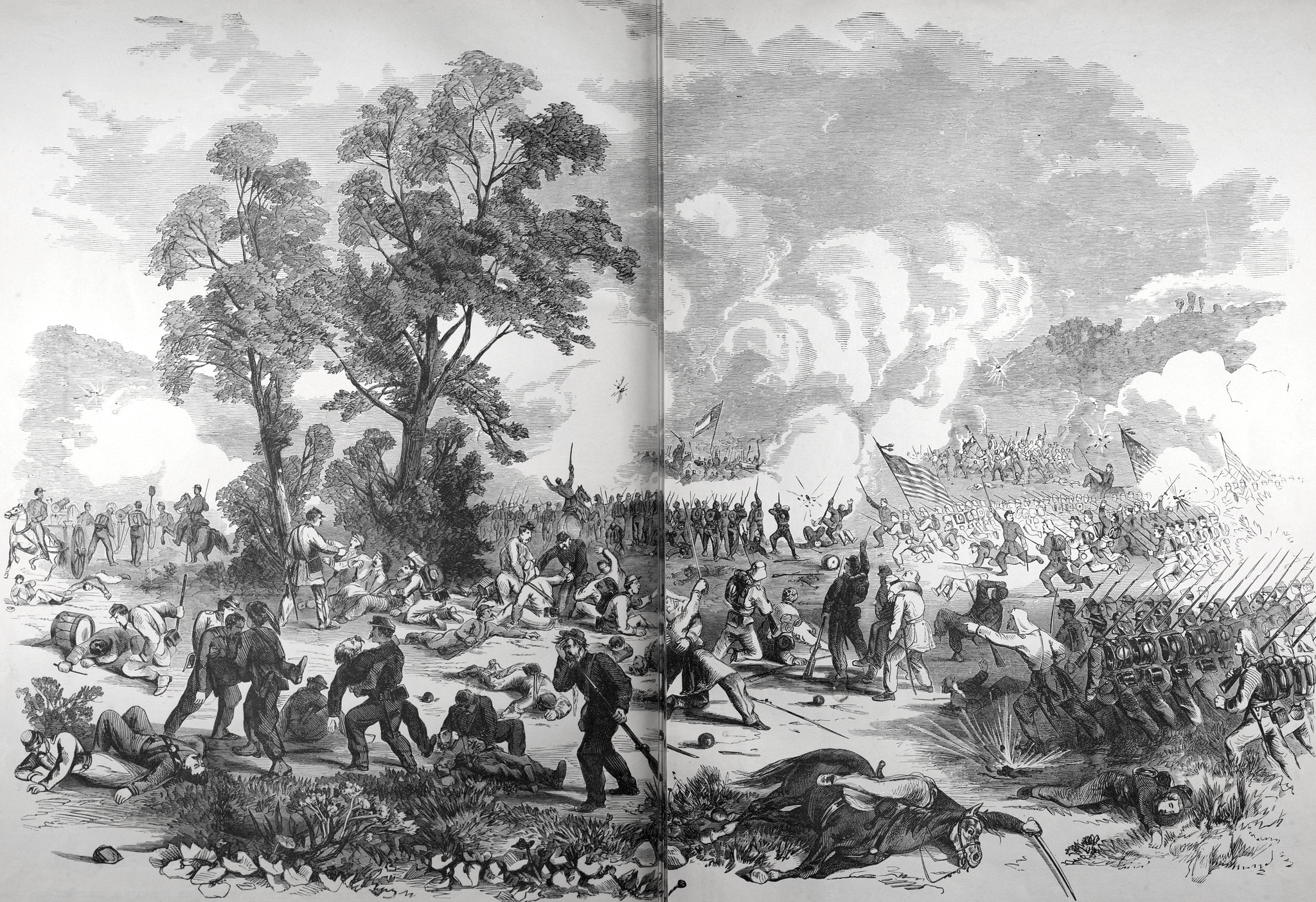
The Battle Of Bull Run, between the Federal Army, Commanded by Major General McDowell, and the Confederate Army, under Generals Johnston and Beauregard, on July 21st, 1861—Advance of the Federal TroopsThe Battle Of Bull Run, between the Federal Army, Commanded by Major General McDowell, and the Confederate Army, under Generals Johnston and Beauregard, on July 21st, 1861—Advance of the Federal Troops.

(from Frank Leslie’s Illustrated History of the Civil War…, edited by Louis Shepheard Moat, Published by Mrs. Frank Leslie,New York, 1895)

“The first battle of Bull Run was fought on July 21st, 1861. It resulted in a loss on the Federal side of 481 killed, 1,011 wounded and 1,460 missing. The Confederate loss was estimated at nearly 2,000. The latter army in action and reserve, numbered over 40,000 men, while the Federal force in action was about 35,000. Although the Confederates won a great victory, they were in no condition to pursue the advantage they bad gained; had they done so they might have converted a repulse into a disastrous and total defeat. Our illustration shows the Federal troops advancing on the enemy’s lines.”

0 comments

“But in this war I could not feel contented if I were not in some way taking part in it.”—Rutherford B. Hayes

Diary and Letters of Rutherford Birchard Hayes

COLUMBUS, Sunday morning, July 21, 1861.

DEAR UNCLE:–I came in last evening to attend a little tea gathering at Mr. Andrews’; shall return this morning. We are now in condition to move on a few days’ notice, and expect to go soon–say a week or two. I constantly at camp am reminded of you. You would enjoy the company we have and the amusing incidents which are occurring. The colonel [Jacob Ammen] of the Twenty-fourth next us is a character. He has been an army officer (West Pointer) many years, a teacher of mathematics, etc., in different colleges, and has seen all sorts of life. He is a capital instructor in military things, and finding Matthews and myself fond of his talk, he takes to us warmly. Dr. Joe is now settled with us, and we are made up. We have had good visits from Mr. Giddings, David Tod, and other State celebrities. . . .

It would have been a great happiness to have spent the summer and fall fixing up around Spiegel Grove. But in this war I could not feel contented if I were not in some way taking part in it. I should feel about myself as I do about people who lived through the Revolution, seeing their neighbors leaving home, but doing nothing themselves–a position not pleasant to occupy. I hope you will be well enough to come down. If not, I do not doubt we shall be together again one of these days. All well here.

Sincerely,

R. B. HAYES.

S. BIRCHARD.

0 comments

The Battle of Bull Run in Which We Fight and Win and Run Away.–Diary of Josiah Marshall Favill.

Diary of a Young Officer – Josiah Marshall Favill (57th New York Infantry)

(July 21 & 22)

IN the order prescribed by the regulations, for a force feeling the enemy preparatory to an attack, we marched forward, passing over the open field and into a piece of full grown timber, apparently the slope of a considerable hill. As we slowly ascended the rising ground, suddenly a loud screeching noise overhead sent more than half the regiment pell mell the other side of a fence that ran along the road side. Here we crouched down flat on our bellies, our hearts in our mouths, just as a shell exploded a little beyond us. It was from the rebel batteries in front, and the first any of us had ever heard, and it certainly did seem a terrible thing, rushing through the air like an immense sky rocket, then bursting into a thousand pieces, carrying death and destruction to everything in its course. The stampede was only momentary, but very funny; the boys jumped back again; in fact, almost as quickly as they had dispersed, and then stood steady in the ranks, watching the advance of the Rhode Islanders. When the latter had emerged into the clearing, beyond the woods, our regiment wheeled to the right, into line of battle, and followed the advancing line. In the meantime, several shells came over the woods, generally passing far to the rear before bursting, doing no harm other than making us a little nervous. Just as we emerged from the woods, the Rhode Islanders reached the crest of the hill and immediately opened fire, and the rattle of musketry became so heavy we could hear no commands, and the smoke so thick, we could see nothing at all in front; away off to the right, however, we saw little white puffs of smoke, indicating the position of the rebel batteries, which began to drop their shells about us, much to our confusion; while we were peering into the dense smoke in front, wondering how the enemy looked, an order came directing us to move forward and go into action. We marched immediately, reached the crest of the hill, and amid the rattle of musketry, the booming of guns, and screeching of shells, lay down and commenced firing. Before we had time to get well at work, along came Griffith’s light battery at full gallop, scattering the right of our regiment badly; we got together again as quickly as possible, but were five and six files deep, narrowing the front of the regiment, and rendering about half of us useless. I was in this struggling crowd, and with many others, tried hard to get the line straightened out, but the objection many of the fellows had to take the front rank prevented our doing much of anything, so I crept up to the front, determined at least to get a sight of the enemy, and a shot if possible. I soon reached a position where I could look over the hill, and there sure enough, nearly at the bottom, just in front of a clump of trees, stood a long line of rebel infantry firing away at our men. I took a shot immediately, and then loaded and fired as quickly as I could, very much excited, but now not at all afraid, except of the men in rear who persisted in firing over our heads, although they could see nothing to fire at, and stood no possible chance of hitting anything, except the back of our heads, which was not comfortable to think of. The musket balls whistled around us, and every now and then, one of our fellows dropped his gun and rolled over, shot; however, the noise of the musketry, and booming of the cannon, drowned all cries, and kept up the excitement, so that we thought only of firing and trying to hit somebody. We lay in this position a good while, keeping up a rattling fire, when the order was passed along the line to stand up and fire; the regiment jumped to its feet, just as a wild unearthly yell rung out below, and the rebel line dashed forward, [continue reading…]

0 comments

On the extreme left at Blackburn’s Ford.

Woolsey family letters during the War for the Union
Joseph Howland

On The Battle-Field Near Bull Run,

Sunday, 21, 12.45 p. m.

Our brigade is making a demonstration in the face of the enemy and a fight is going on on the right of the line five or six miles off. The enemy’s batteries do not return our fire. We see immense masses of troops moving, and the supposition is that the enemy is trying to outflank us on the left. We started (from Centreville) at half-past two this morning.

– – – – – – –

The following little note, hardly legible now, written in pencil on a scrap of soiled and crumpled paper, made its way to us at Washington and told the rest of the story:

Evening. Half-past seven.

A complete rout. The Sixteenth safe. We are making a final stand.                       J. H.

0 comments

Charge of the Sixty-Ninth

Harper’s Weekly

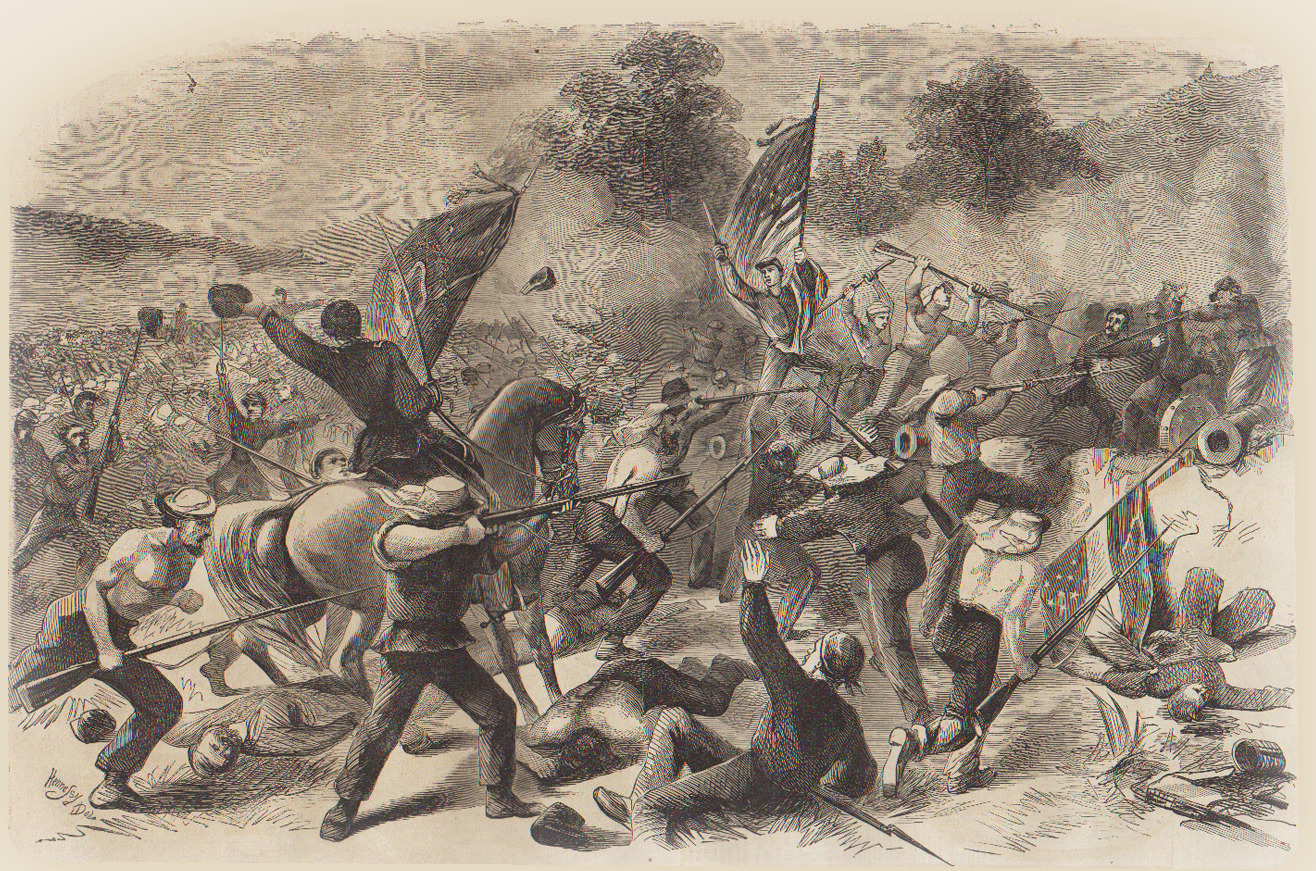
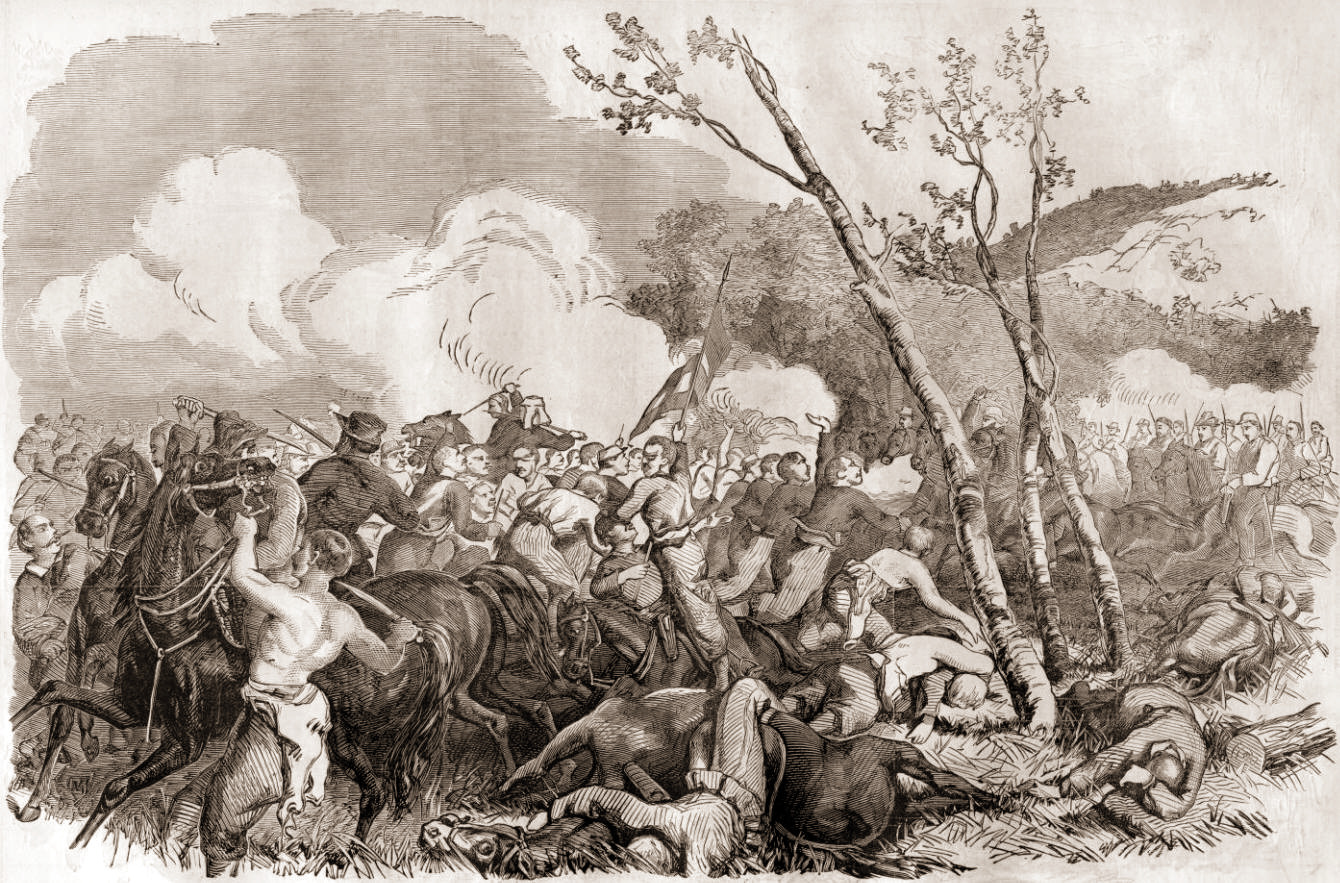
Gallant Charge of the Sixty-Ninth Regiment, New York State Militia, Upon a Rebel Battery at the Battle of Bull RunGallant Charge of the Sixty-Ninth Regiment, New York State Militia, Upon a Rebel Battery at the Battle of Bull Run

Harper’s Weekly, August 10, 1861:

CHARGE OF THE SIXTY-NINTH.

ON page 508 we illustrate one of the GALLANT CHARGES OF THE SIXTY-NINTH REGIMENT, NEW YORK STATE MILITIA, AT THE BATTLE OF BULL RUN.

This gallant regiment performed prodigies of valor that day. An officer of the Second thus speaks of their performance :

The Sixty-ninth Regiment, New York State Militia performed prodigies of valor. They stripped themselves, and dashed into the enemy with the utmost fury. The difficulty was to keep them quiet. While the Second was engaging a regiment of rebels they retreated into a thick hay-field to draw the Northerners into a trap. The Second continued firing into them, while the Sixty-ninth, by a flank movement, took them in the rear, and pouring a deadly fire into their ranks, afterward charged them with the bayonet. The slaughter was terrible and the defeat complete, for not a man stirred of the whole five or six hundred. In this attack there were very few of the Sixty-ninth wounded.

0 comments

Letter from Charlotte Cross Wigfall

Louise Wigfall Wright — A Southern Girl in ’61

(excerpts)

From Richmond, July 21st my mother writes:

“No news except that Gen. Johnston has joined Beauregard with a large force. A part of his troops are left still at Winchester, but the greater part are with him. The President went down to-day, but I don’t know exactly in what capacity, whether he will command or not. . . . The troops are pouring in, and a general battle at Manassas is expected very soon. We brought up by one train, upwards of 50 prisoners brought from Winchester, and crowds gathered on the way, at every roadside station, to see ‘the Yankees.’ I was almost sorry for them.”

“9 o’clock. You will have heard that we have gained a second victory, and a ‘glorious though a dear bought one,’ Mr. Davis telegraphs, at Manassas. Only some of the deaths are known as yet; Lieut. Colonel Johnson of the Hampton Legion and poor Col. Bartow they say are killed; Wade Hampton slightly wounded. All Beauregard’s staff are safe. Poor Mrs. Bartow is here, but does not yet know the sad tidings. The enemy they say were in full retreat. All is excitement here and the people seem almost wild.

0 comments

Charge of the Black Horse Cavalry upon the Fire Zouaves at the Battle of Bull Run

Harper’s Weekly
Charge of the Black Horse Cavalry upon the Fire Zouaves at the Battle of Bull Run

Harper’s Weekly, August 10, 1861

“WE publish on page 501 an illustration of the terrible conflict which took place at the battle of Bull Run between the Fire Zouaves and the Black Horse Cavalry. One of the lieutenants of the Zouaves thus tells the tale:”

“The Zouaves rushed out of the woods only to find themselves the target for another body of infantry beyond, while the Black Horse Cavalry were seen charging full upon them. Things looked badly, when, fortunately, the infantry were engaged by another regiment, thus giving the Zouaves time to prepare for the charge from the horsemen. They formed hastily in line, kneeling, semi-kneeling, and standing, that, Ellsworth fashion, they might receive their enemies with successive volleys. On came the Horse—a full regiment of brave men, splendidly mounted, and as ready for mischief as those on whom they hoped to fall. To an early discharge from the cavalry the Zouaves made no response, although several of the men were killed, but waited patiently until the enemy was almost upon them, when, in quick succession, the three ranks fired, each man doing his best for the good cause. The shock to the rebels was great; but they rallied, behaving splendidly, and attempted a renewal of the charge, for which, however, the excited firemen were prepared, and for which the Black Horse Cavalry paid most dearly. They were completely shattered, broken up, and swept away. Not more than a hundred of them rode off, and as they went their rebellious ears were saluted with “One, two, three, four, five, six, seven, tigah, Zouave!” and such a “tiger repeat” as one can only appreciate when he has heard it.”

“The following account is from a private letter:”

“The New York Zouaves received the first charge of the famous Black Horse Guard, about which Governor Wise has so often spoken. It was a splendid corps of cavalry, all the horses of which were coal black. They came upon the Zouave regiment at a gallop, and were received by the brave firemen upon their poised bayonets, followed instantly by a volley, from which they broke and fled, though several of the Zouaves were cut down in the assault. They quickly returned, with their forces doubled—perhaps six or seven hundred—and again they dashed with fearful yells upon the excited Zouaves. This time they bore an American flag, and a part of the Zouaves supposed for an instant that they were fiends, whom they had originally mistaken. The flag was quickly thrown down, however, the horses dashed upon the regiment, the ruse was discovered, and the slaughter commenced. No quarter, no halting, no flinching now, marked the rapid and death-dealing blows of our men as they closed in upon the foe, in their madness and desperation. Our brave fellows fell, the ranks filled up, the sabres, bowie-knives, and bayonets glistened in the sunlight, horse after horse went down, platoon after platoon disappeared—the rattle of musketry, the screams of the rebels, the shout of ‘Remember Ellsworth!'”

0 comments

Manassas Plains

Diary of Battery A, First Regiment, Rhode Island Light Artillery, by Theodore Reichardt
Sunday, July 21.-Battle of Manassas Plains. This battle will always occupy a prominent place in the memory of every man of the battery. They all expected to ?nd a disorganized mob, that would disperse at our mere appearance; while, to the general surprise, they not only were better disciplined, but also better of?cered than our troops. We started by two o’clock in the morning, but proceeded very slowly. Passed Centreville before break-of-day. When the sun rose in all its glory, illuminating the splendid scenery of the Blue Ridge mountains, though no sun of Austerlitz to us, we crossed the bridge over the Cub Run. By this time, the report of the 30-pounder Parrott gun belonging to Schenck’s command, who had met the enemy, was heard. Our division turned off to the right, and marched some miles through dense woodland, to the Warrenton road. Towards ten o’clock, nothing could be seen of the enemy yet, and the belief found circulation that the enemy had fallen back. Experience proved that, had we remained at Centreville, the rebel army would undoubtedly have attacked us; but hearing of our advance they only had to lay in ambush, ready to receive us. At the aforesaid time, the Second Rhode Island infantry deployed as skirmishers. We advanced steadily, till arriving at the Bull Run and Sudley’s church, a halt was ordered to rest the men and the horses. But it should not be; the brave Second R. I. Regiment, coming up to the enemy, who was concealed in the woods, their situation was getting critical. The report of cannon and musketry followed in rapid succession. Our battery, after passing Sudley’s church, commenced to trot in great haste to the place of combat. At this moment Gen. McDowell rode up in great excitement, shouting to Capt. Reynolds: “Forward with your light battery.” This was entirely needless, as we were going at high speed, for all were anxious to come to the rescue of our Second regiment. In quick time we arrived in the open space where the con?ict was raging already in its greatest fury. The guns were unlimbered, with or without command; no matter, it was done, and never did better music sound to the ears of the Second Regiment, than the quick reports of our guns, driving back the advancing foe. For nearly forty minutes our battery and the Second Regiment, [continue reading…]
0 comments

Battle of Bull Run, Va., July 21st, 1861

Frank Leslie’s Illustrated Newspaper

Battle of Bull Run, Va., July 21st, 1861, Between the Federal Army, Commanded By General McDowell, and the Confederate Army, Commanded by Generals Beauregard and Johnston.Battle of Bull Run, Va., July 21st, 1861, Between the Federal Army, Commanded By General McDowell, and the Confederate Army, Commanded by Generals Beauregard and Johnston.

(from Frank Leslie’s Illustrated History of the Civil War…, edited by Louis Shepheard Moat, Published by Mrs. Frank Leslie, New York, 1895)

“The battle of Bull Run, which the Confederates called the battle of Manassas, was the first really important action of the Civil War. The scene lay a few miles northwest of Manassas Junction, on the banks of Bull Run. It resulted, as everyone knows, in the complete routing of the Federals. The repeated efforts to rally the troops were fruitless. In a short time the entire Federal line seemed to have broken in disorder, the force under General Sykes apparent[ly alone?] in making an effort to withstand the tide. But it was finally compelled to yield to the masses against it. The Federals then on all sides retreated in confusion toward the passages leading to Centreville. By nine o’clock that evening the last of the fugitives had reached Centreville. The Confederate loss was reported to be 378 killed, 1,489 wounded and 20 missing—total 1,887; that of the Federals, 481 killed, 1,011 wounded and 1,460 missing—total 2,952.”

0 comments

“Reinforcements have been going over all day and last night. 12000 have left the City.”—Horatio Nelson Taft

Diary of US patent clerk Horatio Nelson Taft.

SUNDAY, JULY 21, 1861.

This has been the most exciting day yet. We have heard the guns all day from the battle which has been raging at or near Mannasses Junction. There is no news that can be relied on public tonight, only that a terrible fight has been going on all day. Reinforcements have been going over all day and last night. 12000 have left the City. A Regt passed the church during services this morning and a train of Artillery dashed by. A most excited crowd at Willards and all sorts of rumors afloat.

______

The three diary manuscript volumes, Washington during the Civil War: The Diary of Horatio Nelson Taft, 1861-1865, are available online at The Library of   Congress.

0 comments

Battle of Bull Run—July 21st 1861

Library of Congress

Title: Battle of Bull Run—July 21st 1861—Federal (Gen. McDowell) ... Confederate (Gen. Beauregard) ... Lithograph by Kurz & AllisonTitle: Battle of Bull Run—July 21st 1861—Federal (Gen. McDowell) … Confederate (Gen. Beauregard) …
Creator(s): Kurz & Allison.,
Date Created/Published: c1889, c1890.
Medium: 1 print : lithograph, color.
Reproduction Number: LC-DIG-pga-01843 (digital file from original print) LC-USZC4-1796 (color film copy transparency) LC-USZ62-5454 (b&w film copy neg.)
Rights Advisory: No known restrictions on publication.
Call Number: PGA – Kurz & Allison–Battle of Bull Run … (D size) [P&P]
Repository: Library of Congress Prints and Photographs Division Washington, D.C. 20540
Notes:
….4515V(?) U.S. Copyright Office.
….Copyright by Kurz & Allison, Art Publishers, Chicago, U.S.A.
….Exhibited: “With Malice Toward None : The Abraham Lincoln Bicentennial Exhibition” at the Library of Congress, Washington, D.C., 2009.

Library of Congress permalink

0 comments

Rebel War Clerk

Civil War Day-by-Day

JULY 21st.—The President left the city this morning for Manassas, and we look for a battle immediately. I have always thought he would avail himself of his prerogative as commander-in-chief, and direct in person the most important operations in the field; and, indeed, I have always supposed he was selected to be the Chief of the Confederacy, mainly with a view to this object, as it was generally believed he possessed military genius of a high order. In revolutions like the present, the chief executive occupies a most perilous and precarious position, if he be not a military chieftain, and present on every battle-field of great magnitude. I have faith in President Davis, and believe he will gain great glory in this first mighty conflict.

Early in the evening Secretary Walker returned from tea in great excitement. He strode to and fro in the room where we were sitting, d——g his office. He said a great battle was then going on, and he wished himself present participating in its perils. Again he denounced the office he filled—and seemed, for a time, almost frantic with anxiety. He said all young men ought to be in the field, and this was understood by those present, who had merely shouldered their pens.

Before long the hall of the department was filled with people eager to hear the news; and as successive dispatches were received, the excitement increased. All the cabinet were in our office; and Hon. Howell Cobb, President of Congress, making deductions from the dispatches, announced his belief that it was a drawn battle. This moved the wrath of Col. Bledsoe, and he denounced Cobb. Mr. Hunter did nothing but listen. It was night, now. Finally, Mr. Benjamin, who had gone to the Spottswood Hotel, where Mrs. Davis resided, returned with news that stopped every detracting tongue. Mrs. D. had just got a dispatch from the President announcing a dearly-bought but glorious victory. Some of the editors of the papers being present, and applying to me for a copy of the dispatch, Mr. Benjamin said he could repeat it from memory, which he did, and I wrote it down for the press. Then joy ruled the hour! The city seemed lifted up, and every one appeared to walk on air. Mr. Hunter’s face grew shorter; Mr. Reagan’s eyes subsided into their natural size; and Mr. Benjamin’s glowed something like Daniel Webster’s after taking a pint of brandy. The men in place felt that now they held their offices for life, as the permanent government would soon be ratified by the people, and that the Rubicon had been passed in earnest. We had gained a great victory; and no doubt existed that it would be followed up the next day. If so, the Federal city would inevitably fall into our hands; and this would soon be followed by the expulsion of the enemy from Southern soil. All men seemed to think that the tide of war would roll from that day northward into the enemy’s country, until we should win a glorious peace.

0 comments

Covering the Retreat

Miscellaneous document sources

Blenker's Brigade Covering the Retreat near Centreville after the battle at Bull RunBlenker’s Brigade Covering the Retreat near Centreville.

Harper’s Pictorial History of the Civil War by Alfred H. Guernsey and Henry W. Alden; copyrighted 1866 by Harper and Brothers; 1894 by Alfred H. Guernsey and Henry W. Alden; 1894 by McDonnell Bros; pub. The Puritan Press Co.; Chicago, Illinois

0 comments

Extracts from the journal of Commander Semmes, C.S. Navy, commanding C.S.S. Sumter

War of the Rebellion: from the Official Records of the Union and Confederate Armies and Navies
Sunday, July 21.—Fresh trade wind with passing clouds. Atmosphere highly charged with moisture. Mustered the crew and read the articles of war and a general order announcing the decision of a court-martial; permitted the crew to go on liberty in detachments.
0 comments

Capture of Ricketts’ Battery

Miscellaneous document sources

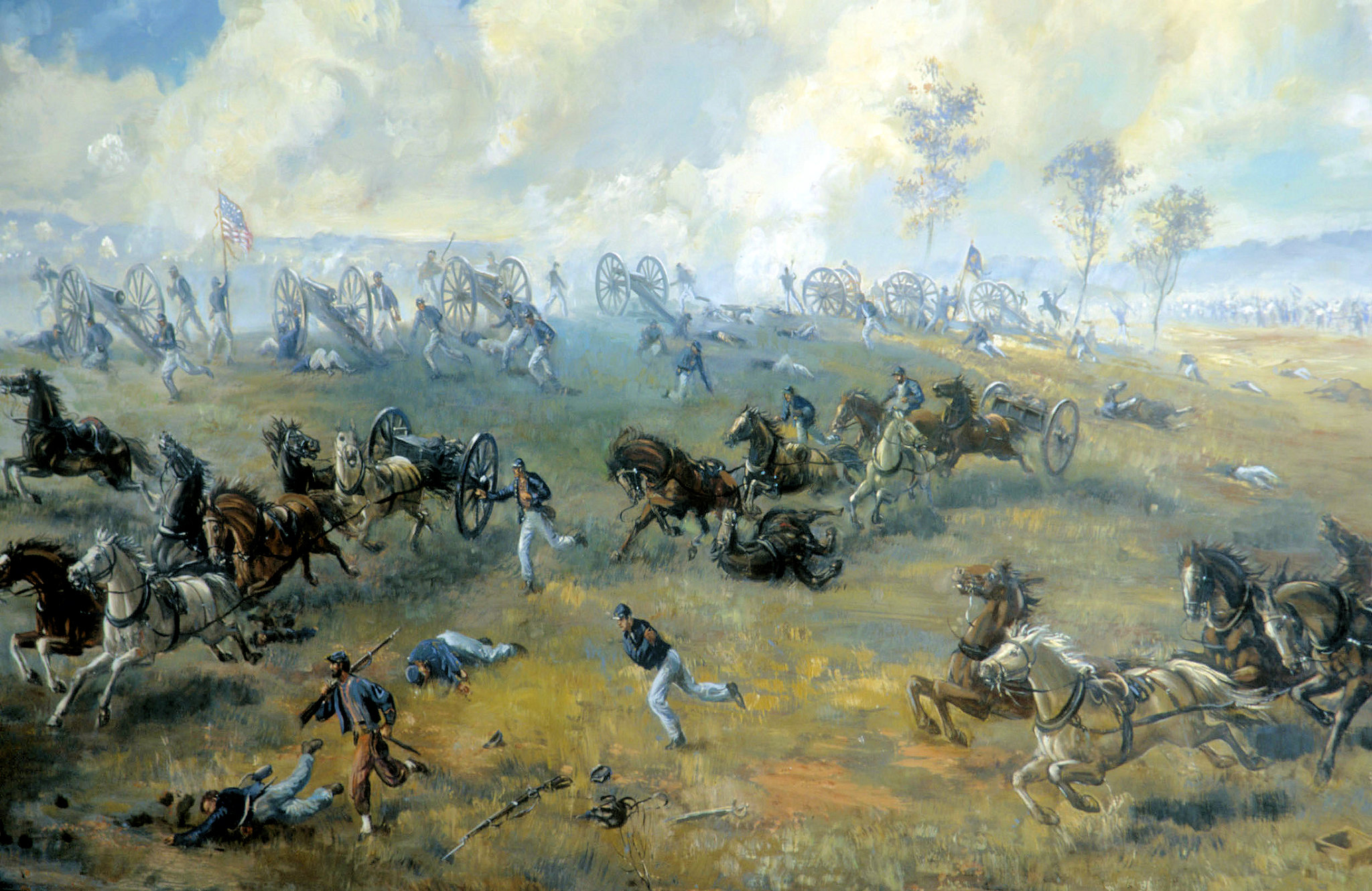
The painting Capture of Ricketts' Battery, depicting action during the First Battle of Bull Run, one of the early battles in the American Civil War. The painting is oil on plywood, and is displayed in the Henry Hill Visitor Center at Manassas National Battlefield Park.The painting Capture of Ricketts’ Battery, depicting action during the First Battle of Bull Run, one of the early battles in the American Civil War. The painting is oil on plywood, and is displayed in the Henry Hill Visitor Center at Manassas National Battlefield Park.

1964

Author: Sidney E. King (1906-2002), National Park Service painter

0 comments

Stonewall Jackson at Bull Run

Library of Congress

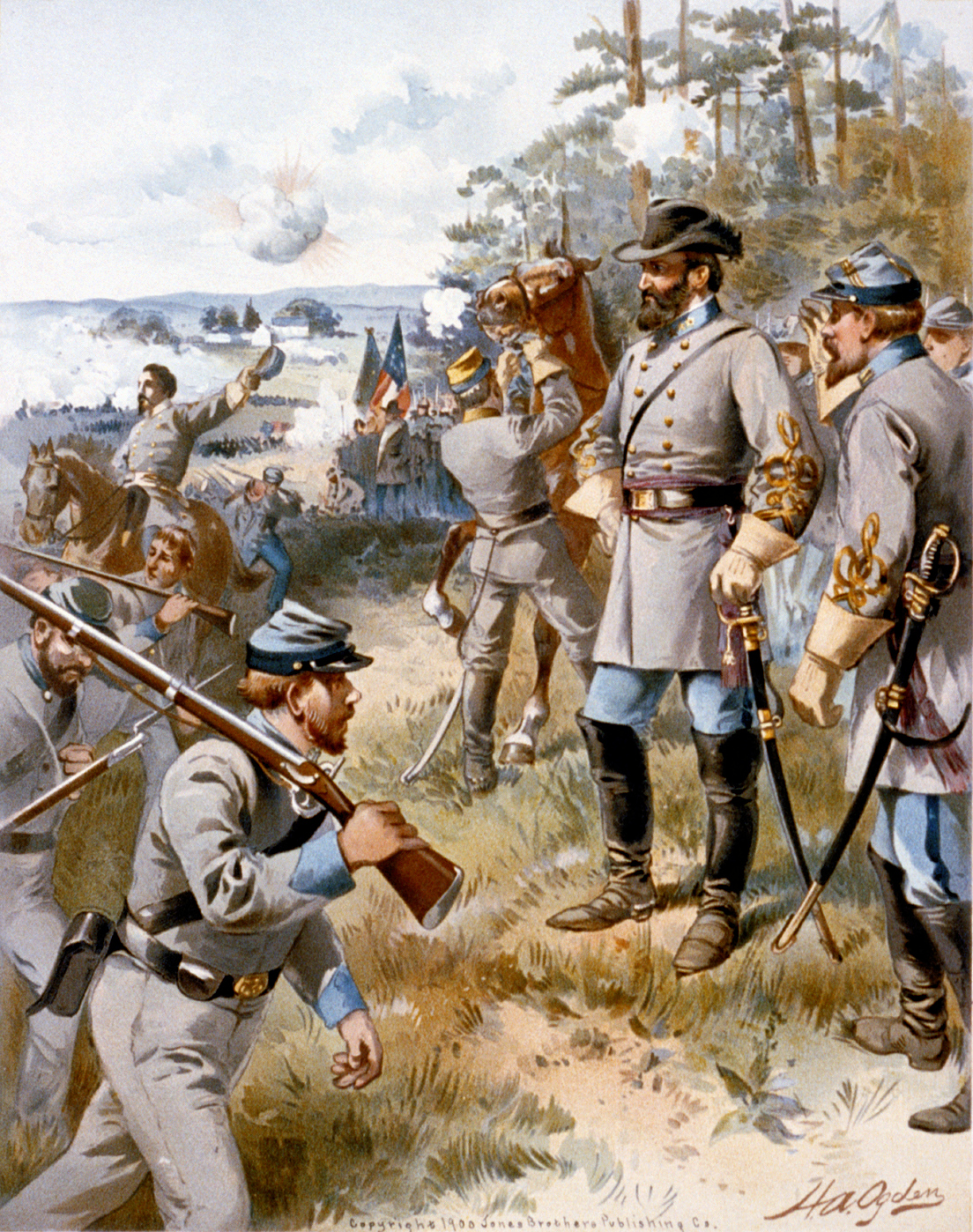
Stonewall Jackson at Bull Run - Print shows General Stonewall Jackson standing on a ridge with soldiers, one holding Jackson's horse, monitoring the action of the battle at Bull Run, Virginia. Print by Henry Alexander Ogden. Title: Stonewall Jackson, Bull Run, Aug. 17, 1861 / H.A. Ogden.
Creator(s): Ogden, Henry Alexander, 1856-1936, artist
Related Names:
Jones Brothers & Company, publishers
Jones Brothers & Company, copyright claimant
Date Created/Published: c1900 March 1.
Medium: 1 print : chromolithograph with paste-on ; 33.2 x 24.7 cm (sheet)
Summary: Print shows General Stonewall Jackson standing on a ridge with soldiers, one holding Jackson’s horse, monitoring the action of the battle at Bull Run, Virginia, August 17, 1861.
Reproduction Number: LC-DIG-pga-11168 (digital file from original item) LC-USZC2-1784 (color film copy slide) LC-USZ62-3922 (b&w film copy neg.)
Rights Advisory: No known restrictions on publication.
Call Number: PGA – Jones Bros.–Stonewall Jackson … (A size) [P&P]
Repository: Library of Congress Prints and Photographs Division Washington, D.C. 20540 USA
Notes:
….D4747 U.S. Copyright Office.
….Title from item.
….Signed on stone on lower right: H.A. Odgen.
….Inscribed in ink at bottom: Copyright 1900 by Jones Brothers Publishing Co.
….Copyright number inscribed in ink on back.
….Date of copyright deposit stamped on back.
….Incluldes print-registration marks on sides and top.

Library of Congress permalink

___________
Mike’s notes:

Note – This image has been digitally adjusted for one or more of the following:
– fade correction,
– color, contrast, and/or saturation enhancement
– selected spot and/or scratch removal
– cropped for composition and/or to accentuate subject

0 comments

The Battle of Bull’s Run

Library of Congress

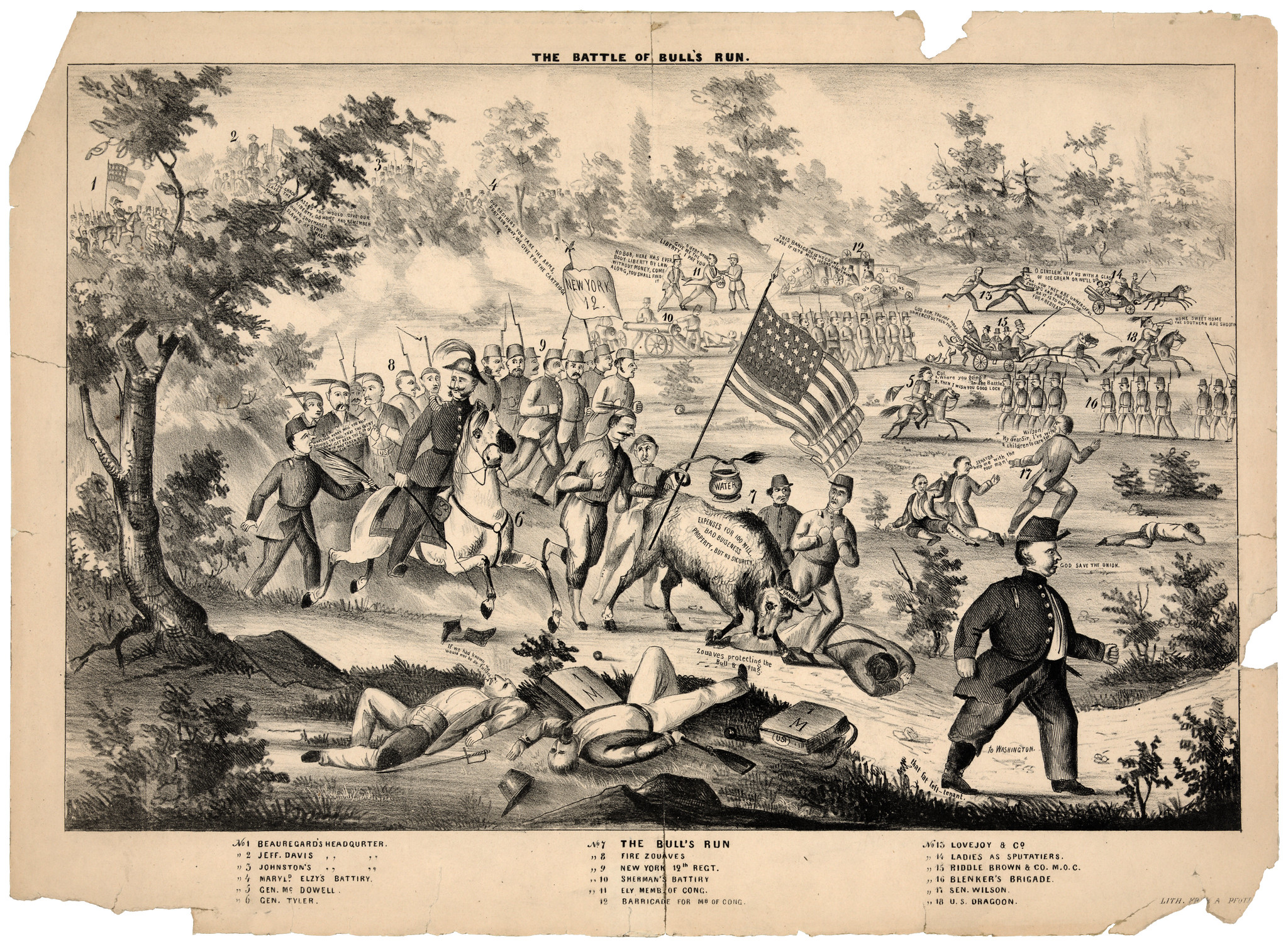
The Battle of Bull's Run - Cartoon print shows Union troops after the Battle of Bull Run during the Civil War from the point of view of a copperhead, that is, a northern Democrat supporting Confederate troops.
Title: The Battle of Bull’s Run / lith. Fr[…] A. Pfott.
Creator(s): Pfott, A., lithographer
Date Created/Published: 1861.
Medium: 1 print : lithograph ; 35.6 x 48.9 cm (sheet)

Summary:
Cartoon print shows Union troops after the Battle of Bull Run during the Civil War from the point of view of a copperhead, that is, a northern Democrat supporting Confederate troops. The image is keyed to eighteen points in the image: Beauregard’s headquarters, Jefferson Davis’ headquarters, Johnston’s headquarters, Elzy’s Maryland battery, General McDowell, General Tyler, The Bull’s Run, Fire Zouaves, New York 19th Regiment, Sherman’s battery, Ely member of Congress, barricade for member of Congress, Lovejoy & Company, Ladies as spectators, Riddle Brown & Company, Blenker’s Brigade, Senator Wilson, and the U.S. Dragoon. Includes numbered key.

Reproduction Number:
LC-DIG-ppmsca-19521 (digital file from original print) LC-USZ62-90666 (b&w film copy neg.)
Rights Advisory: No known restrictions on publication.
Call Number: PC/US – 1861.P468, no. 1 (B size) [P&P]
Repository: Library of Congress Prints and Photographs Division Washington, D.C. 20540 USA http://hdl.loc.gov/loc.pnp/pp.print
Notes:
….Lith. fr[?] A. Pfott.
….Title appears as it is written on the item.
….Forms part of: American cartoon print filing series (Library of Congress)
….Exhibited: “With Malice Toward None : The Abraham Lincoln Bicentennial Exhibition” at the Library of Congress, Washington, D.C., 2009.

Library of Congress permalink

___________
Mike’s notes:

Note – This image has been digitally adjusted for one or more of the following:
– fade correction,
– color, contrast, and/or saturation enhancement
– selected spot and/or scratch removal
– cropped for composition and/or to accentuate subject

0 comments

Three companies of the First Massachusetts Regiment at Bull Run

Library of Congress

 Attack on the batteries at Bull Run by three companies of the First Massachusetts Regiment, Lieutenant-Coloner Welles, CommandingAccompanying text:

Attack on the batteries at Bull Run by three companies of the First Massachusetts Regiment, Lieutenant-Coloner Welles, Commanding

The daring charge of these three companies of the First Massachusetts Regiment, upon one of the enemy’s batteries at Bull Run, is deserving of commemoration. This regiment was attached to Gen. Tyler’s Division, and a battery of four guns having, after long cannonading on our part, suddenly opened fire upon our troops, was sent, with three or four others, to endeavor to dislodge it. The three companies named led the attack, the Massachusetts Regiment being in the van. The Rebels reserved their fire till our men were within a few yards of them, and then poured in volley after volley, with terrible effect. Capt. Brackett, of the regular Cavalry, an officer in the fiercest battles of the Mexican War, said he had never witnessed such a tempest of balls. Many of the members of these companies were killed or wounded, but, though subjected to a fire from three different points, they showed no signs of flinching. They were at one time exposed also to the cross-fire of the Michigan Regiment. Company IH lost eleven men in the fight, and Company G twelve. Lieut.-Colonel Welles, of this regiment, noticing that private Grover, of Company H, was retiring from the ranks in the fiercest of conflict, approached him to learn the reason; and finding that he had been wounded in the left arm, so that he could not steady his musket, took the weapon, and taking the most exposed position, fired steadily and with great execution upon the enemy. Col. Cowdin, the commander of the regiment, also took a musket, and marched at the head of his men, loading and firing with them. One of the members of Company G had a hand-to-hand fight with one of the rebels, and was getting worsted, when one of Ellsworth’s Fire Zouaves came up, and killed the rebel.

Battle Scenes, no. 1

published at H.H. Lloyd & Co., c1861

handcolored lithograph

Library of Congress image .

0 comments