Diary of a Southern Refugee, Judith White McGuire.

Diary of a Southern Refugee During the War by Judith White McGuire

9th.On Monday saw B. removed from the bed of suffering, on which he had been lying four months, put on a stretcher, and carried to the canal-boat. His countenance was full of joyful anticipations of home. His arm, which should have been amputated on the field, hangs lifeless by his side; and yet fit expects to return to his post, that of Major of artillery, as soon as he is strong enough. Poor fellow, it is well for him to amuse himself with the idea, but he will never again be fit for any duty but that at a post. He has been the recipient of kindnesses from Mr. and Mrs. P. and others, which could only be experienced in this dear, warm-hearted Southern country of ours, and which he can never forget to his dying day. That night I spent with my kind friend Mrs. R., and next morning made such purchases as were absolutely necessary for our; comfort. I gave for bleached cotton, which used to be sold for 12 ½ cents, $3.50 per yard; towelling $1.25 per yard: cotton 50 cents a spool, etc. Nothing reconciled me to this extravagance but that I had sold my soap for $1 per pound!!

The enemy has retired from Vicksburg, their canal having proved a failure. Where they will reappear nobody knows. Another ineffectual attempt upon Charleston on the 7th and 8th.

0 comments

Stonewall & Lee disapprove application for leave of absence.

Experience of a Confederate Chaplain—Rev. A. D. Betts, 30th N. C. Regiment

April 9—My application for leave of absence, to be with my wife during “an important crisis” returns “disapproved!” It was approved by regiment, brigade and division commanders but “disapproved” by corps commander, T. J. Jackson. I felt no bitterness toward him, as he was conscientious. I think he had never seen his only child, Julia. He set great store on the presence and services of chaplains among the soldiers. He knew the campaign would soon open, and he wanted chaplains to be on hand to care for the wounded and dying. He and others must trust their wives in God’s hands and he thought chaplains ought.

“Respectfully forwarded disapproved, T. J. Jackson.”

Whatever “Stonewall” disapproved we might expect Gen. Lee to disapprove. My heart sank within me when I read the short, last entry: “Respectfully returned disapproved by order of Gen. R. E. Lee.” My diary gives some of the cries of my heart in that sad hour.

0 comments

A Rebel War Clerk’s Diary

A Rebel War Clerk’s Diary at the Confederate States Capital, By John Beauchamp Jones
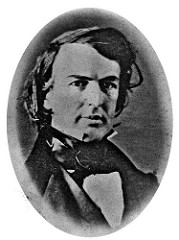
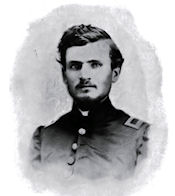
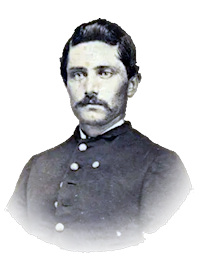
A likeness of Jones when he was editor and majority owner of the Daily Madisonian during President John Tyler’s administration.

APRIL 9th.—Nothing additional has occurred at Charleston, the enemy not having renewed the attack. At Vicksburg all was quiet, and the enemy abandoning their canal. Such news must have a depressing effect upon the North. They will see that their monitors and iron-clads have lost their terrors. They have lost some twenty war steamers within the last few months; and how many of their merchantmen have been destroyed on the ocean, we have no means of knowing.

British and French capitalists have taken a cotton loan of $15,000,000, which is now selling at a premium of four per cent. in those countries. Our government can, if it will, soon have a navy of Alabamas and Floridas.

But we are in danger of being sold to the enemy by the blockade-runners in this city. High officers, civil and military, are said, perhaps maliciously, to be engaged in the unlawful trade hitherto carried on by the Jews. It is said that the flag of truce boats serve as a medium of negotiations between official dignitaries here and those at Washington; and I have no doubt many of the Federal officers at Washington, for the sake of lucre, make no scruple to participate in the profits of this treasonable traffic. They can beat us at this game: cheat us in bargaining, and excel us in obtaining information as to the number and position of troops, fortifications, etc.

0 comments

0

News of the Day
1860s newsprint

April 9, 1863, Savannah Republican (Georgia)

 Passports are now issued in Augusta at 25 cents each–the proceeds to be handed over to the Augusta Purveying Association for the benefit of the city poor. This is a good idea. No one will refuse to pay the amount where so much good can be accomplished by it. We hope to see the same rule adopted here.


0 comments

0

News of the Day
1860s newsprint

April 9, 1863, Clarke County Journal (Alabama)

 Is there no remedy for the […..] prices of the essentials of life? Yes, there is a remedy, and it is in the hands of the men who are not in the army, and if they do not remedy it, and that right speedily–well, every sensible man knows the inevitable disaster which awaits us as a people.–In the name of God, how can the poor live at the present prices! Go to the free market, and you will there see squalid poverty and misery in the persons of old men, women and children who never knew distress until the spirit of extortion got abroad in the land.–With what the poor can earn, added to that they receive through charity, many of them are on the verge of starvation, if we may judge from their emaciated faces. Men who were worth a few thousands of dollars a year or two ago, are now reduced to beggary by this curse of the country, Extortion. The extortioners are doing for Lincoln more than his army and navy combined. Take heed, rich men!–you may have been rich before the war began, or may have made a fortune since–we say to you beware! If you do your duty, all may yet be well. But if you do it not, you and your children will most assuredly be beggars, yes, slaves, at the close of this unrighteous war. Our gallant soldiers can avail nothing if the people at home fight against them. Your disposition to make money while your countrymen are bleeding and starving, cannot benefit you in the end, unless your course is changed. And the pulpit and the press throughout the country cannot too often tell you so.–Mont. Mail.


0 comments

0

News of the Day

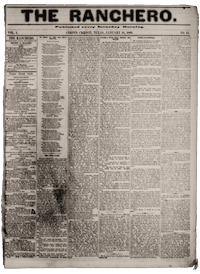
April 9, 1863, The Ranchero (Corpus Christi, Texas)

First Letter from Trimmer.

Agua Poquito, Tex.,}
April 4, 1863.   }

 Editor Maltby:– . . . The capture and release of one E. J. Davis and hanging of one Montgomery and his release, constituted the all-absorbing topic of conversation at Roma when I left there, a couple of days since. A thousand vile rumors were afloat, but none of them bore the impress of truth. A war with Mexico was upon every tongue. The invasion of Mexican soil, the hanging of Montgomery could only be atoned for by the shedding of Texan blood, was the general feeling. My impression is that the financial link at present binding Brownsville and H. Matamoros together will be found hard to break, even though the military on both sides of the brave old river should resolve themselves into a community of blunderbusses; a thing not at all unlikely. Whether or not the Fort Brown military concocted the grand scheme of trying to make of Judge Davis what the Almighty never designed him to be; viz. a man in any respect troubled with greatness, or whether they simply approved the undertaking, or only gave it a quasi-recognition, I know not and care less. Of one thing, however, I am well satisfied, that “it was worse than a crime, it was a blunder.” . . .

Trimmer.


0 comments

0

News of the Day

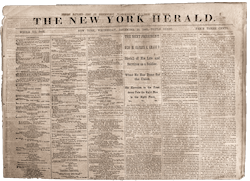
April 9, 1863, The New York Herald

Our Pamlico Correspondence.

ON BOARD STEAMER JNO. FARON, PAMLICO RIVER,

TWELVE MILES BELOW WASHINGTON, N.C., WITH REBELS ON ALL SIDES OF US, April 1, 1863.

I attempt to write you, though I am inclined to think that the chances of this letter ever reaching you are slim indeed. We are decidedly in a tight place, and, if it was not for the fact that people expect to see all the details of this and every other matter in HERALD, I should wish I was home. Who would be a correspondent in the field, with such a prospect of fun ahead – if the booming of heavy guns, the bustling of steamers to and fro, and the anxiety and tumult arising from hearing and knowing that our friends – a mere handful – only twelve miles off, are invested and threatened by an overpowering force, and we […..] to succor them, and even ourselves on the eve of a battle, which must, from the nature of things, be one of the most sanguinary of the war – may be called fun.

I have to jumble my reports together somewhat, owing to the […..] and confusion,” but will try to make the whole matter intelligible, […..]far as we’ve got.”

On Sunday morning last General Foster received information from the commanding officer at Washington that General Hill, with a large rebel force, had driven in our pickets in front of that town and was menacing the place on all sides. General Foster immediately took the steamer Faron, Captain Agnew, and arrived on Monday morning, to find that the danger was even greater than he had anticipated. The Faron was despatched back to Newbern immediately, with orders to Lieut. Col. Hoffman to send a brigade of infantry and some light field pieces as soon as possible, and General Spinola’s legion was fixed upon for the service. General Spinola received his orders to get his brigade ready at half-past four o’clock [continue reading…]

0 comments

0

News of the Day
1860s newsprint

April 9, 1863, Clarke County Journal (Alabama)

 On yesterday (says the Atlanta Intelligencer of the 19th) a scene occurred in our streets which moved the sympathies of our soul. A number of ladies, perhaps a dozen, composed of the wives and daughters of soldier’s families, who represented themselves and their families to have been deprived of anything to eat in the last few days, save a small portion of corn bread, were seen perambulating our streets until they came up to a provision store on White Hall street. They all entered it, being preceded by a tall lady on whose brown rested care and determination. She asked the merchant the price of bacon. He replied that it was $1.10 per lb. She remonstrated with him, as to the impossibility of females in their condition paying such prices for this necessity of life. He remaining inexorable in his demand, this tall lady proceeded to draw from her besom a long navy repeater, and at the same time ordered the others in the crowd to help themselves to what they liked, which they did accordingly, giving preference to the bacon, until they had taken, as we learn, something like $200 worth.–They went out, and on being questioned by some gentlemen as to what they meant, they related their suffering condition, of which we have already spoken.


0 comments

0

News of the Day

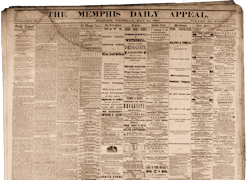
April 9, 1863, Memphis Daily Appeal (Jackson, Mississippi)

The Bath paper mills in South Carolina, a short distance from Augusta, Georgia, were destroyed on the 2d inst. These were the largest mills in the Confederacy, and the loss is a serious one to the proprietors, as well as to the papers of the South.


0 comments

0

News of the Day

April 9, 1863, The New York Herald

The government is not officially informed of any events occurring at Charleston; but that an attack most decisive in its results is imminent, it would be idle to deny. The feeling among both officers and men comprising the expedition is hopeful, and argues success. It is said that the city of Charleston is prepared for the worst, and that the women and children have already been removed.

The Richmond papers of Tuesday contain Charleston despatches of the 5th instant stating that important military movements are taking place there, which are not permitted to be made public. The Sentinel, of Richmond, on the 7th instant says that eight monitors and iron-clads were then off the bar at Charleston, and that some significant telegrams from there indicate that the long expected collision has actually occurred, and that the storm has burst upon Charleston at last.

The distress and want of food and army supplies at Richmond is seriously embarrassing to the rebels. A rebel cavalryman, who deserted from the rebel army on the Blackwater and came into Norfolk yesterday, says the Confederates are making arrangements to remove their capital from Richmond to Chattanooga, and that the scarcity of provisions and forage is the principal cause.

Our news from the Southwest is interesting. The rebels are building batteries on the Yazoo Pass, three miles from Greenwood. The ram Switzerland has been repaired of the injuries she received in passing the rebel batteries at Vicksburg, and has been sent up the Red river. The rebels are constructing a fleet of cotton-protected gunboats at Shreveport. An expedition of gunboats went up the Yazoo on the 1st inst. Twenty-two hundred bales of government cotton arrived at Cairo on Tuesday. [continue reading…]

0 comments

0

News of the Day
1860s newsprint

April 9, 1863, Semi-Weekly News (San Antonio, Texas)

Five cents per pound will be paid for cotton or linen rags, delivered to the undersigned in Austin, or to Dr. Theo. Koester, in New Braunfels.

These rags are wanted to make paper with, and as this is a new enterprise in Texas, it is hoped every family will provide themselves with a rag bag. Agents to collect rags will be appointed in each county, of which due notice will be given.

D. Richardson, Austin.


0 comments

0

News of the Day

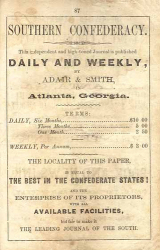
April 9, 1863, Southern Confederacy (Atlanta, Georgia)

 The following is applicable in other sections besides New Jersey.

 I am a farmer, and so was my father before me. I have not followed in his footsteps in the way of managing the farm, because I have taken agricultural papers and have learned much that was not his to know; and what’s more, the railroad has come within three miles of me, so that the old farm upon which my father toiled many years is worth five times what it was in his day. I am not one of the kind of men who croak and grumble about old times. I enjoy modern times, and would not give up my machines, and go back to the old way of doing things by hand for any money. I often wonder if my father can look down from Heaven, and see the mowers and reapers fly over the old places where he toiled and sweated. I cannot help chuckling to myself, as I sit in my sulky, and ride over the old familiar places, cutting down the grass, and raking it up again, like a half-a-dozen men; to think my boys can go to school all the year round, and never suffer from the want of learning, as I do even to this day.

 My wife is up to the times, too, and likes to give her family a good chance in the world. She is a good manager, rising early, and rising to some purpose. I owe half of my prosperity to her help and counsel. My boys are growing up healthy, sensible young fellows. The two oldest harness up the old mare and go to the academy, three miles off, and except a little while during hay and harvest, they do not lose a day all the year round. The only thing that troubles me is my daughters.–Nancy, the oldest, is a fine, handsome, smart girl of nineteen. She went to the district school till she was sixteen, and then she had learned all there was to learn there. So we concluded to send her to Mr. Drake’s Seminary, about fifty miles off. She did get along there amazingly. In two years she had learned a pile, and besides, had painted beautiful pictures enough to cover our walls, (though I must confess, I suspect her teacher gave her a lift at that now and then.) She could sing equal to our parson’s wife, and can start the tunes in meeting when the Squire’s away. She knew the French for everything around the house, and understood botany, chemistry, natural philosophy, and more than I could mention.

 While she was at Mrs. Drake’s she only came home at fall and spring vacations, and then was so busy sewing and getting ready to go back again, that her mother did not think it worth while to set her to work. Well last spring she came home for good, and a joyful day it was for me. I felt happy to think I had a daughter who had a good education in her head, and spry and healthy hands to work. But, Mr. Editor, she is a spoiled girl, for aught I can see, but her mother thinks she will come to after a while.

 She can’t bear to see me in my shirt sleeves, no matter how clean and white, but insists upon my wearing a linen duster, for she has learned that “it is disgusting to eat with a man in his shirt-sleeves.” She is right down ashamed of her mother’s hands because they show that she has been a hard-working woman all her life.–Our home-made striped carpets that have always been my pride, are “not fit to be seen.”–She won’t let Bob or Dick run about barefooted, for she says they look like beggars.–She has written their names in the spelling books Bobbie and Dickie, and written her’s Nancie Smythe. She says she would rather not eat with servants–that is our hired man and woman, who have lived with us six years, and were born and raised on the next farm. It makes her sick to smell pork and cabbage. She has not forgotten how to milk, but if any body rides by when she is milking, she gets behind the cow and hides her head, as if she was stealing the milk. I have stood these things without saying much until last Sunday; when she insisted upon our hired people sitting up in the gallery, because we needed all our pew room.

 I hired two pews, to have room for all. I knew she expected two boarding school misses to make a visit, and was planning to get our men-folks out of sight. I bolted out at this, and had a regular blow-up, and told Nancy she was getting too big feeling entirely for a farmer’s daughter. She staid at home from church and cried all day. I hate crying women more than a long drought, so I shan’t scold her again. I don’t want to be hard on the girl, but what am I to do? I am willing to let her feed the chickens in gloves, and spell all our names wrong, and I’d just as lief have the boys wear shoes; but when it comes to overturning everything, and being ashamed of her father, mother, and home, I am discouraged. I have bought her a piano, and let her learn music for two years, for she is naturally musical. She came near fainting one night when the Squire’s son, just out of college, and a whiskered chap from the city was here, because I said: “Come, Nance, give us a tune on the piany.” I saw something was wrong, but could not guess what, for I had on my duster, and wasn’t tippling my chair back, (a “vulgar trick,” Nancy calls it.) The next day my wife told me what was to pay. I must say I like my old fashioned way of pronouncing as well as her new fashioned way of spelling. And only this morning, after breakfast, when her ma told her to shake the table-cloth, what does she do, but take it away through the long hall and out the back door, for fear some one would see her shake it in the same place where she had for ten years. I’ve got a new boughten carpet for the parlor, and now she wants the front windows cut down to the floor.

 Yesterday she came to me to know if she might “teach district school?” “No,” said I, “why do you want to teach? I am able to keep six girls like you, if I had them. No, I can’t think of you teaching.” Upon this she began to cry again, and I can’t stand woman’s tears, so I said, “teach,” and she is going to teach all Winter and Summer, in a little bit of a school house, not as good as my pig house, for fear she will get tanned and freckled, and spoil her hands helping her mother.

 Now, Mr. Editor, I have given up Nancy, but I have three fine girls growing up. I am able and willing to give them all a good education, for I believe in it, in spite of the dreadful blunder I have made. I would like to know if you can tell us of any place where a farmer’s daughter can get a good education and not lose her senses. I can’t stand it; to have our other girls get too big for our old fashioned farm house; I want them sensible, well-informed women, but I set down my foot against having them all turn school teachers,.–John Smith in Newark Advertiser.
 

0 comments

0

News of the Day

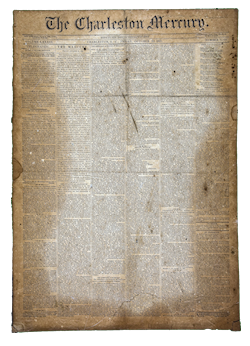
April 9, 1863, Charleston Mercury

 The Richmond papers have all been compelled to advance their prices. The Enquirer and Examiner have gone up to $15 for twelve months, and $8 for six months. The Whig has advanced to $12, and the Dispatch to $10. The Sentinel, a new paper, is mailed at $10 a year. These rates are high, but do not begin to correspond with the advance in everything else.


0 comments

0

Cruise of the U.S. Flag-Ship Hartford -Wm. C. Holton

April 8th. At five A. M., got under way and steamed up the river; at eight forty came to anchor three miles above Bayou Sara, opposite a large plantation; among other objects a saw-mill was here seen in operation; sent a boat on shore in charge of an officer and an armed crew for the purpose of foraging; after capturing a quantity of sheep they returned on board; at four thirty P. M., got under way again, and continued on our way up the river; at seven P. M., brought ship to anchor for the night near Texas landing.

0 comments

A Confederate Girl’s Diary

A Confederate Girl’s Diary by Sarah Morgan Dawson

Wednesday, Clinton, April 8th, 1863.

Our last adieux are said, and Linwood is left behind, “it may be for years, and it may be forever.” My last hours were spent lying on the sofa on the gallery, with Lydia at my feet, Helen Carter sitting on the floor at my side, while all the rest were gathered around me as I played for the last time “the centre of attraction.” I grew almost lachrymose as I bid a last adieu to the bed where I have spent so many months, as they carried me downstairs. Wonder if it will not miss me? It must have been at least five before the cars returned. Mrs. Carter grew quite pathetic as they approached, while poor little Lydia, with streaming eyes and choking sobs, clung first to Miriam and then to me, as though we parted to meet only in eternity. All except her mother started in a run for the big gate, while I was carried to the buggy through the group of servants gathered to say good-bye, when the General drove me off rapidly.

What a delightful sensation is motion, after five months’ inaction! The last time I was in a vehicle was the night General Beale’s ambulance brought me to Linwood a helpless bundle, last November. It seemed to me yesterday that I could again feel the kind gentleman’s arm supporting me, and his wondering, sympathetic tone as he repeated every half-mile, “Really, Miss Morgan, you are very patient and uncomplaining!” Good, kind President Miller! As though all the trouble was not his, just then! But stopping at the gate roused me from my short reverie, and I opened my eyes to find myself stationary, and in full view of a train of cars loaded with soldiers, literally covered with them; for they covered the roof, as well as filled the interior, while half a dozen open cars held them, seated one above the other in miniature pyramids, and even the engine was graced by their presence. Abashed with finding myself confronted with so many people, my sensation became decidedly alarming as a dozen rude voices cried, “Go on! [continue reading…]

0 comments

War Diary of Luman Harris Tenney.

War Diary of Luman Harris Tenney.

(Ohio River)

8th. Had a very pleasant morning ride up the smooth, glassy water in the sunshine. Reached Maysville at nine. The people received us with open arms. All seemed very hospitable. Waved handkerchiefs and flags and invited the boys to breakfast. Never were treated so well before. Took dinner at hotel with Thede and Burt. Horse at stable. Marched at two. Rode with Drake. Had a very pleasant visit with him. Beautiful rolling country, grass green. Encamped at Lewiston, 7 miles from Maysville. Slept out with Drake. Cooked ham and made tea for supper. Many boys and officers drunk.

0 comments

Downing’s Civil War Diary.–Alexander G. Downing.

Diary of Alexander G. Downing; Company E, Eleventh Iowa Infantry

Wednesday, 8th–General Townsend, of General Halleck’s staff, from Washington, D. C., made a speech to the Sixth Division of the Seventeenth Army Corps today, on the question of arming the colored men. He urged loyal men to accept commissions as officers in colored regiments. General McArthur, commander of our division, spoke also, and the boys cheered them a great deal. Steps were taken to raise two regiments of colored troops at this place and give them arms. The Fifteenth Iowa received their pay today.

0 comments

April 3 to 8, 1863

Experience of a Confederate Chaplain—Rev. A. D. Betts, 30th N. C. Regiment

April 3—Prayer meeting every night.

April 4—Fierce wind all day. Hard on soldiers. Dr. Grissom gets to camp. Hear from Rev. Mr. Sherwood. Snow all night.

April 5—Snow all a. m. Sore throat.

April 6—Visit G. T. Swain, Co. C., near camp, quite sick.

April 7—Meet chaplains of this corps. Preach to them and many others. Good meeting. All day with them. Such meetings warm the heart and encourage us.

April 8—In camp busy writing to the officers of thirteen regiments asking them if they wish our next conference to send them chaplains. Lieut. Ellis goes to work to raise money to buy a horse for his chaplain. Col. P. gives twenty dollars, others smaller sums.

0 comments

A Rebel War Clerk’s Diary

A Rebel War Clerk’s Diary at the Confederate States Capital, By John Beauchamp Jones
A likeness of Jones when he was editor and majority owner of the Daily Madisonian during President John Tyler’s administration.

APRIL 8th.—We learn to-day that the enemy bombarded our forts at Charleston, yesterday, two hours and a half. But few of our men were injured, and the forts sustained no damage of consequence. On the other hand, several of the iron-clads and monitors of the enemy were badly crippled; one of the latter, supposed to be the Keokuk, was sunk. Since then the bombardment has not been renewed. But no doubt the enemy will make other efforts to reduce a city which is the particular object of their vengeance.

Every one is on the qui vive for further news from Charleston. Success there will make Beauregard the most popular man in the Confederacy, Lee excepted.

Speculation is running wild in this city; and the highest civil and military officers are said to be engaged, directly or indirectly, in the disgraceful business of smuggling. Mr. Memminger cannot be ignorant of this; and yet these men are allowed to retain their places.

0 comments

0

News of the Day

April 8, 1863, The Charleston Mercury

CHATTANOOGA, April 6. – MORGAN was attacked by the enemy at Liberty, on Friday, and driven back to Snow Hill, where he held his position, and the enemy retired. Our troops, under Colonel SMITH, were repulsed at Woodbury on Saturday, and fell back to within twelve miles of McMinnville, with the loss of one killed and eight made prisoners.

KNOXVILLE, April 6 – Parties from Kentucky report that PEGRAM’S command was attacked two miles beyond Somerset on Monday, March 24, by an overwhelming force of the enemy infantry and cavalry. After a desperate hand to hand fight, PEGRAM fell back six miles, the enemy making no pursuit. The loss was heavy on both sides. The Confederate Government agents brought out with them a large lot of cattle.

OKALONA, April 6 – The Yankees at Corinth are preparing for some movement – either a raid or an evacuation. Their suttlers are selling out their entire stock to Southern men, and are then leaving.

JACKSON, MISS., April 6. – General CHALMERS on Friday drove the enemy’s pickets within five miles of Memphis, killing two and capturing one.

We have intelligence from Fort Pemberton to the 5th to the following effect: The enemy began to embark last night, and this morning he is in rapid retreat. We shelled their camps and transports, and succeeded in disabling a boat laden with troops. We also made a reconnoissance in force from our left flank, creating great alarm amongst the Yankees.

We have reports from New Orleans that BANKS, with 10,000 men, had crossed to Donaldsonville, and had gone thence down the Bayou Plaquemine, with a view to reinforce WEITZEL, and enable him to attack the Teche country.

COLUMBIA, TENN., APRIL 6 – The following despatch has just been received:

‘To Gen. Bragg: A report received from Col. WOODWARD says: ‘With a section of KING’S Missouri Battery we sunk one gunboat and one transport and disabled others, on the night of the 23rd  instant, near Palmyra, on the Cumberland river.’

(Signed)EARL VAN DORN, ‘Major General.’

On the 4th, in a skirmish near Franklin, we captured seven Yankees.

0 comments

0

News of the Day
1860s newsprint

April 8, 1863, Montgomery Weekly Advertiser

 Gen. Liddel’s command, stationed near Wartrace, Tenn., are having a good deal of sport in catching a large number of rabbits daily. An old friend of ours says that on last Friday the boys captured about four hundred of the “molly cottontails.” They manage the thing well. Two or three regiments march out and surround a thicket, then cavalry men with dogs enter the thicket and put the rabbits to flight, when our boys close in with clubs, sticks, etc., making a clean sweep of the varments. Quite a Luxury, and a great saving in a commissary point of view.–Chat. Rebel.


0 comments

0

News of the Day

April 8, 1863, Arkansas True Democrat (Little Rock)

Some six or eight weeks ago, handbills and circulars were sent all over the State, notifying country dealers and merchants that the subscriber thereto was prepared to furnish some 50,000 pairs of cotton cards, calicoes, and other things, on terms that would enable them to supply families at low rates. A lively correspondence was soon opened with parties from every section of the State, and a large number of dealers, speculators, and some few who were desirous of benefiting their neighborhoods, visited the city to purchase cards and other things. They were referred to George W. Curtis, a shrewd fellow, who was book-keeper in a well known commercial house in the West for many years, and known to a great many persons in the city. The dealers were taken to a building on the river bank, and let to a cellar where boxes marked in the usual manner, with the numbers of pairs and the number of the size of the cotton cards were snugly stowed. Curtis, it appears, made no secret that these cards were smuggled, and liable to confiscation, but that was the reason why he was enabled to sell them so cheaply, some heavy sales being effected at twelve hundred and fifty dollars for each one hundred pairs. An open box or two of the cards were shown as samples. Secrecy was enjoined, as it was desirable not to let the law officers get on the scent, and as the building was near the river, it was very easy for purchasers to quietly move their boxes on a boat and carry them off.–As the demand was so great, purchasers were advised to pay for their cargo and secure their boxes, which were to be delivered early in April. Others engaged to take large quantities, one contract being to the tune of $30,000. About the first of April, Curtis told a number of his patrons that he expected every hour a large lot of dry goods and needed money, and the parties might take the cards, or take part in cotton cards and part in dry-goods when the latter came. Curtis, it appears, had a partner, whose name we did not learn and two or three others were in some way connected with the concern. The whole party boarded at the Hayne’s Hotel, and it appeared that the money received for the cards, or a good part of it was deposited with Haynes for safe keeping. A few nights since the partner of Curtis, accompanied by another of the parties, presented an order to Mr. Haynes, from Curtis, for the money. The paper money was in a box and some $1,000 in specie, in a bag. Haynes took the money from the safe and delivered it to them, but the lateness of the hour excited his suspicions and he told them they had better leave the money and call for it in the morning. They drew their pistols and prevented him from locking up the money again, took it up stairs to a room; but returned in a few minutes, handed him the box, said they were joking and went off. As they had not returned the specie, Haynes followed them, overtook the one who had the gold, took his arm and walked with him down the street expostulating, until they came in sight of two or three soldiers on guard, when the fellow got scared, dropped the bag of gold and ran off. Upon his return to the hotel, Mr. Haynes examined the box, and found the money had been abstracted and old newspapers put in its place. The next morning, the buyers of cotton cards became uneasy and proceeded to examine their purchases, when, to their dismay, they found that each box had in it nothing but a few sticks of wood so arranged that they sounded like the handles of the cards rattling, and weighing about the same as a box of cards would weigh.–Curtis & Co., have vamosed the ranche, and the buyers of the cotton cards may be seen looking very blue, each with a small stick of wood under his arm.

 Our lawyers are all busy discussing the question as to whom the $1,000 in gold belongs. One says to Haynes, for the fellow dropped it at his feet, and Haynes is bound to retain it until called for. Others say that it must be returned to those who paid the specie for cotton cards which they never received. Still others, contend that it should be divided, prorata, among all the victims, those who paid paper as well as those who paid gold. No decision has been arrived at, up to the time of our going to press, but the occurrence has given rise to any amount of witticisms and puns. It was a well planned scheme, boldly carried out, and the victims have learned the force of the old adage “never buy a pig in a poke,” which they alter to “never buy cotton cards in boxes.”


0 comments

0

Civil War

April 8, 1863, The Charleston Mercury

(CORRESPONDENCE OF THE MERCURY.)

RICHMOND, Saturday, April 4.

The cold March wind blowing this morning is fast drying the roads and paving the way to army operations, which the light April showers will hardly put a stop to. HOOKER’S army must be demoralized, if the half we hear from private sources be true. An attack on his part is not expected. Some sentences in a late order of Gen. Lee have been construed to mean offensive intentions on our side, but that cautious General will see to it that neither Yankees or Confederates get any clue to his designs.

Stonewall Jackson still grows in favor with the army. Lee inspires confidence, Jackson enthusiasm; and many who have been bitterly prejudiced against the latter, are now his most ardent admirers. A friend who called on Stonewall not long ago found him playing with two little girls, and learned that he sends some miles for them every evening to come and cheer him with their artless gaiety.

General Tochman’s case is still unsettled. In the course of its investigation before the Special Committee appointed for that purpose, some rather odd incidents have transpired, which induce the opinion that the powers that be are given to devious ways.

It is stated here that General G.W. Smith has received the appointment of State Geologist in Georgia. Another report is that he will take charge of important iron works. [continue reading…]

0 comments

0

News of the Day

April 8, 1863, The New York Herald

IMPORTANT NEWS.

Three Thousand Armed Women Attack the Government and Private Stores.

BALTIMORE, April 7, 1863.

Col. Stewart, of the Second Indiana regiment, one of the fourteen United States officers just released by the rebels, and who has just arrived here, makes the following statement: –

On Thursday last he saw from his prison window to Richmond a great bread riot, composed of about three thousand women, who were armed with clubs and guns and stones.

They broke open the government and private stores, and took bread, clothing and whatever else they wanted.

The militia were ordered out to check the riot, but failed to do so.

Jeff. Davis and other high officials made speeches to the infuriated women, and told them they should have whatever they needed.

They then became calm, and order was once more restored.

All the other released Union officers confirm this statement.

0 comments

0

News of the Day
1860s newsprint

April 8, 1863, Montgomery Weekly Advertiser

 When we see a man advertising for a wife or a woman advertising for a husband, we conclude that it was either intended for a joke or that it is bona fide. If it is intended for wit, where is the wit? If there is anything peculiarly funny in reviving a practice which had its origin in the brothels of New York, we cannot see it. If the advertiser be acting in good faith, we take it that he or she is a person of dubious character, and that there is some “take in” or Yankee speculation contemplated. We would not trust the morals of such a person out of sight, and should avoid their society as we would a moral pestilence. Generally, such persons will be found to be either Yankee denizens or hopeless idiots. One is an object of loathing, the other an object of pity.–Columbus Sun.


0 comments