0

News of the Day
1860s newsprint

April 11, 1863, Peoria Morning Mail (Illinois)

St. Louis, April 9.

The Democrat’s special from Young’s Point 3d, says several transports with troops and Ellets Marine Brigade and one iron-clad started up stream this morning.There is no prospect of active operations before Vicksburg for some time.A new canal has been cut three miles above here to be eight miles long and empty in the Mississippi below Warrenton; three dredges and the African brigade are at work night and day.Farragut holds the river between Vicksburg and Port Hudson, Porter and Grant are reconnoitering up the Yazoo with a considerable force.

0 comments

0

News of the Day

April 11, 1863, The New York Herald

The report from Charleston is that the Keokuk was disabled on Tuesday, and on the following day was sunk on the beach off Morris Island.

Subjoined is a sketch of her: – […..]

The Keokuk was designed by Mr. C. W. Whitney, of this city, and was built at the yard of J. S. Underhill & Co., Dry Dock Iron Works. She was launched in the early part of last winter, and sailed from New York on the 11th of March, arriving at Port Royal on the 26th. The following is a description of the vessel: –

The Keokuk was not only a two turreted vessel, but was also a ram. She was smaller than the Ericsson Monitors, being one hundred and fifty-nine feet six inches over all, including the ram, which was five feet long. She had a beam of thirty-six feet, with a depth of hold of thirteen feet six inches, and drew nine feet of water. Her sides sloped inward at an angle of thirty-seven degrees, to shed the enemy’s shot.

She was built of iron, and her armor extended nearly four feet below the water line. The horizontal deck was five feet above the water line. Her propulsive power was furnished by two propellers and two engines of five hundred horse power. The hull of the vessel was constructed of half-inch rolled iron. She had three keelsons running the whole length of the vessel, and two fore and aft bulkheads, leaving on each side a space and forming an inner skin, which would probably keep out the water in the event of the outer skin being pierced by shot. In addition to these she had two bulkheads – one forward and one aft – which could be filled with water, so as to settle the vessel down while in action. These could be filled in fifteen minutes and pumped out in forty minutes. In using the ram, should the vessel be wrenched so as to cause leakage, the compartment alluded to was to preserve the vessel from sinking. The vessel was submerged one foot by the appliance of these water tanks. [continue reading…]

0 comments

0

News of the Day

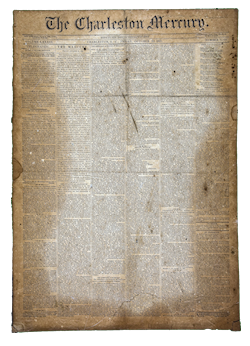
April 11, 1863, The Charleston Mercury

On the 23d instant all the Confederate Treasury notes, dated prior to December 2d, 1862, will cease to be fundable in eight per cent. bonds, but will be fundable until the 1st of August in seven per cent. bonds. To facilitate the funding of these notes, the Secretary of the Treasury has established depositaries in the principal cities and towns of each State in the Confederacy. The inducement to fund in eight per cent. bonds before the 22d of this month, when the privilege ceases, is that the holder of Confederate bonds will be exempt from taxation to the amount of the bonds so held. A bond which yields eight per cent. interest is, of course, better than one which yields only seven per cent., and those who now invest in eight per cents. will, doubtless, have any opportunity, ere long, of selling their bonds at a premium. Eight per cent. bonds of the hundred million loan, long dates, are already selling at a premium of five per cent., and when this premium advances to eight or ten per cent. the bonds now issued, bearing eight per cent., will also command a premium.

0 comments

0

News of the Day

April 11, 1863, The Charleston Mercury

On Wednesday evening our watchful pickets reported a gunboat of the enemy in Coosa Rover, near Chisolm’s Island. It was first believed that the vessel was aground, but subsequent events proved that she was anchored there. During the night another gunboat also took position in the same neighborhood. Upon the first intimation of the presence of one of the enemy vessels in a position which offered an opportunity for punishment, Gen. WALKER ordered sections of the Beaufort Volunteer Artillery, Virginia, North Carolina and Georgia batteries to move forward, with a view to attack, and, if possible, destroy the vessels. These, with a proper infantry support, consisting of a regiment from Gen. COOK’S brigade, reaching the scene of action during the night, and waited for daybreak to open the ball. Before morning one of the gunboats moved down towards Port Royal Ferry, and a force was detached and sent in that direction to operate should opportunity offer.

At dawn, Capt. LUMPKIN, of the Virginia Battery, and Lieutenant HAL STUART, of the Beaufort Artillery, brought their guns in position in splendid style, having to manoeuvre, under great disadvantages, in an old cotton field. Before the Abolitionists had time to rub their eyes and turn over in their bunks, the 6 pound shot and 12 pound shell were crashing through the sides of the gunboat jolly style. Lieutenant STUART’S second shot knocked off the rudder, and the ship became unmanageable. In a few minutes, after firing their heavy guns in return the Yankees displayed the white flag, and our guns ceased their terrible fire. The vessel was discovered to be on fire from our shells, and hence the surrender. As usual, the rascals used the flag only for their personal safety; for, by this time, the gunboat had drifted over to the other shore, and the valiant crew jumped into the marsh, and, regardless of the mud and water, they struggled for the island shore. Seeing this, our guns were elevated a little, and a perfect hail of grape and canister fell among the fugitives, killing and wounding several. [continue reading…]

0 comments

0

News of the Day

April 11, 1863, The Charleston Mercury

At two o’clock p.m., just as the officers had seated themselves for dinner, the first advance of the iron-clad fleet was announced to the commandant of the post. Their anchorage had been within the bar of Ship Channel, off the southern end of Morris Island, some four miles from Sumter. Upon inspection, it was judged that good time would be allowed for the conclusion of the meal, and, after communicating the movement by telegraph to Headquarters in Charleston, dinner was comfortably dispatched. At half past two o’clock, after examination of the approaching armament from the terreplein, the order for the […..] roll’ was issued. The whole garrison knew that the hour of trial was at hand, and the greatest enthusiasm and alacrity prevailed. The men rushed to their guns with shouting and yells of exultation. The regimental band was ordered to the rampart. The garrison flag (the Confederate States) was already flying defiantly from the staff at the northern apex of the pentagonal fortress. The blue and white banned of the Palmetto State was given to the wind on the southwest corner of the work, and the elegant black and white color, of the First Regiment South Carolina Artillery (Regulars) was run up at the southeast angle, in the face of the coming foe. A salute of thirteen unshotted guns was fired, and the band broke forth with the stirring strains of ‘Dixie.’

It was determined to permit the fleet to come well within range before opening fire. Lieutenant Colonel JOSEPH A. YATES, who that morning reported for duty, was assigned to the special command of the barbette batteries. Major ORMSBY BLANDING was assigned the special command of the casemate batteries. They were both at their posts, with officers, men and guns ready, and awaiting the order to begin the engagement. Colonel ALFRED RHETT, the commandant of the post, stood on the parapet watching the progress of the doughty iron-clad dogs of war. Every heart beat high. Every face was flushed with calm excitement, properly incident to such a moment. On they came, steaming slowly northeastward – seven Monitors, their hulls sunk down to the water level, showing only a black line on the surface and a projecting turret and smoke stack each – the Ironsides, looming up from the sea a formidable looking monster, and the Keokuk, her hull more distinctly visible than the Monitors, and with two turrets, the most dreaded of [continue reading…]

0 comments

0

News of the Day

April 11, 1863, The Charleston Mercury

LATEST FROM VICKSBURG.

VICKSBURG, April 8. – Everything quiet here. Two more transports left this afternoon, bound up the river. A number of transports are still in sight.

LATEST FROM PORT HUDSON.

PORT HUDSON, April 9. – All quiet here. The enemy fleets, above and below, have disappeared. The former is above Bayou Sara. Forty exchanged and paroled prisoners from New Orleans arrived here yesterday. Our troops at this point are in excellent spirits, and are vigilantly watching the Yankee vessels.

We have trustworthy information from St. Joseph, La., to the effect that HARRISON’S pickets are skirmishing with the enemy. Three flats, loaded with Yankees, came down the Tensas a few days ago.

THE LATEST FROM TENNESSEE.

CHATTANOOGA, April 9. – The enemy occupies Lebanon with a division, under Gen. REYNOLDS. The Yankees are also in force at Carthage. The news we get from Kentucky is cheering. The Louisville Democrat spurns the tyranny of the Union Democratic Convention and its platform. All is quiet at Columbia. Twenty more prisoners reached here yesterday. We have advices from Memphis that the enemy is preparing more empty boats as […..] clad,’ for the purpose of landing troops at Vicksburg. The Yankee boats had returned from Steele’s Bayou, badly damaged. More families have been exiled from Memphis on account of raids on the railroad.

VAN DORN’S cavalry has succeeded in capturing one gunboat and two transports on the Cumberland River, near Palmyra, which were burned. A grand review took place yesterday at Tullahoma.

THE FOOD QUESTION AND THE SPECULATORS.

RICHMOND, April 10. – The President will issue his Proclamation tomorrow morning, urging the people to direct their agricultural labor mainly to the production of food crops. He takes an encouraging view of the present position of affairs, and urges the raising of food for man and beast, as the means of averting the only danger that the Government regards with apprehension. He administers a rebuke to the speculators.

REPULSE OF THE ENEMY IN FLORIDA.

PALATKA, FLA., March 31. – On Friday, the 27th inst., the large transport steamer Ben DeFord landed at this place for the purpose of occupying the town. A fine cavalry corps stationed here, under command of Capt. J. J. Dickison, met them very handsomely. We fired upon them with Enfield rifles, at a distance of about one hundred yards, killing and wounding a great many, the notorious Colonel MONTGOMERY, the Kansas […..]’ and outlaw, among the number. They immediately fled to their boat, and did not return the fire until they were out in the stream. It is almost a miracle that we had only one man wounded from the amount of shell and grape thrown. They retreated across the river, and took on board two companies of negros whom they had there engaged plundering and stealing. They then steamed off down the river, and we have not heard from them since. We have just received a despatch which states that they have burnt Jacksonville and left the river. – Savannah News.
0 comments

0

News of the Day

April 11, 1863, The New York Herald

Our Headquarters Correspondence.

HEADQUARTERS, ARMY OF THE POTOMAC.

April 9, 1863.

The event of the season came off yesterday. The grand review, which the army has for days been looking forward to, and in which rival regiments were to vie with each other for distinction, has passed, and with it the “[…..] of war. The circumstance” awaits us, in our weary marches and days of toil yet to come; in the future apparently uninviting, but anticipated with dazzling visions. Great preparations had been made for the display, and for several days a large force was employed, with axes, picks and shovels, leveling the fields. Ditches were filled, stumps and bushes removed, ridges cut down, and quagmires drained, until the Fitzhugh estate wore the appearance of a race track. Tall stakes, bearing the designs of the badges of the several corps, were planted in the positions to be occupied by the respective commands, and as the troops marched out upon the field the divisions wheeled into line as if by instinct, with no confusion, no noise, save the music of the bands, the tramp of the regiments and the few brief orders of the officers.

Hours slipped by, and the dark blue masses on the plateau grew larger, the banners more numerous, the rattle of drums more bewildering. The artillery came out, and the great guns that thundered at the heights of Fredericksburg pointed their muzzels over towards the white tents in the hollows, and the little rifle cannon drew up by them briskly, as if proud of the work they did before Richmond, at Antietam and over the pontoons down by the river. The columns were all in line, the men waited and grew impatient, and the battery horses, to amuse themselves in the cold, kicked each others shins, and fiercely switched imaginary flies, and still the cortege did not appear. The wind swept across the open country, [continue reading…]

0 comments

0

News of the Day

April 11, 1863, The New York Herald

The long expected attack upon Charleston commenced on Tuesday last. In the early part of the day only four of our iron-clads were engaged – probably three fitted with submarine devils and one other. According to the rebels the firing from both parties was very heavy and during the action the Ironsides grounded, but got off and dropped out of range.

About two o’clock in the afternoon seven Monitor batteries, the Keokuk and Ironsides again renewed the contest at about one mile and three quarters distant, as in all probability no obstructions were found, and for three hours the firing was rapid and heavy. Fort Sumter seems to have been the object and aim of the operations at that time. At four o’clock the Ironsides and Keokuk withdrew, leaving the other vessels to continue the work for an hour longer. It is possible that the signals from the flagship were not readily seen on account of the dense smoke from the guns, and it was not until sometime afterwards they noticed she had left. This may account for their remaining an hour later. It is apparent that the rebels have but little confidence in their iron- clads, as they did not attempt to engage until our vessels withdrew. The casualties in Fort Sumter were one killed and five badly wounded, showing that some good gunnery was exhibited either at their barbette or through the embrasures. No reports had been received from the other rebel batteries at the time of sending the despatch to Richmond, and it is fair to presume that our wooden vessels, with their long range rifles, had been engaging some of the rebel earth works.

On Wednesday there seemed to have been no signs of a renewal of the attack; but of course the rebels had no means of knowing the intentions of Admiral Dupont, and therefore they are not justified in feeling very joyous over the fact that no signs were visible of a movement. Twenty-two Union vessels were reported off the bar. These comprise the wooden gunboats, the ordnance vessels and storeships. The Keokuk was evidently injured – she is reported sunk off Morris [continue reading…]

0 comments

0

News of the Day
1860s newsprint

April 11, 1863, San Antonio Herald

 We cannot help believe that Gen. Bee has but performed his duty, in delivering up the traitor Davis, to the demand of the Mexican authorities. Davis, it is true, is a scoundrel whom any Texan would be justified in shooting down like a dog, should he be found voluntarily upon our soil. There was very naturally a general clamor for his death–but from important public considerations, Gen. Bee exercised the judgment and the firmness to return him. There is no computing the value of the Mexican trade to our Government and people during the war. It is worth the lives of a thousand such […..] Davis. A war with Mexico, at the present juncture would be a severe misfortune to our cause. It would not only cut off our supplies from the only portion of the Confederacy that the enemy has not been able to blockade, but would enable him to recruit the thousands of renegade desperadoes who infest that portion of Mexico by which our Southern frontier is bounded, and to keep a large army near our borders, sufficient to break up all the settlement between this city and the Rio Grande. Ever since the war began, it has been the policy of the Yankees to engender such ill feeling on the part of Mexico against the Confederate Government, as would lead to war. Had Davis not been given up, their schemes would have been successful. But thanks to the prudence of Gen. Bee, they have thus far been defeated.


0 comments

0

Cruise of the U.S. Flag-Ship Hartford -Wm. C. Holton

April 10th. This morning we got under way and steamed down the river a short distance, where we came to an anchor, and sent boats with boatswain and armed crews on shore to procure logs for ships’ side. They returned with several large ones for that purpose, and also some hogs they had shot in the bushes for their own consumption.

While at anchor here, according to orders previously given two of our engineers, with a working party composed of firemen and coal heavers, after removing boilers and machinery and all articles of value, went to work with hammers, axes, &c., demolishing our fairy boat and prize J. D. Clarke and sending her hull to the bottom of the Mississippi by means of scuttling. Weather exceedingly warm and calm. Returned during this P. M. to our anchorage off mouth of Red River.

0 comments

War Diary of Luman Harris Tenney.

War Diary of Luman Harris Tenney.

10th. Renewed our march soon after sunrise. Got some biscuit for lunch. Drake and I rode together some again. Got into Sharpsburg a little after noon. We of the commissary put our horses in a shed and slept in a hayloft. Issued one day’s rations. Such a green Com., never saw. Ate supper at a sound Union family’s Hart’s. Sarah very pretty little girl. Saw quite a scene at the hotel about a slave. Four or five girls crying.

0 comments

Downing’s Civil War Diary.–Alexander G. Downing.

Diary of Alexander G. Downing; Company E, Eleventh Iowa Infantry

Friday, 10th–William Mills, secretary to the president of the Sanitary Commission of Iowa, visited our regiment today. He is down here among the different Iowa regiments distributing the sanitary goods donated by the loyal people of the State. The health of the Eleventh Iowa is very good, and the boys are feeling fine. Our regiment reports five hundred and twenty men for duty.

0 comments

Diary of David L. Day.

David L Day – My diary of rambles with the 25th Mass

News From Along the Line.

April 10. The siege of Washington on the Pamlico river continues, and heavy firing is heard from there every day. We learn they have got Gen. Foster shut up there and he is in danger of being made prisoner. That may be, but I will bet ten to one he holds the keys and will never take off his cap to any general in the Confederate service.

0 comments

A Rebel War Clerk’s Diary

A Rebel War Clerk’s Diary at the Confederate States Capital, By John Beauchamp Jones
A likeness of Jones when he was editor and majority owner of the Daily Madisonian during President John Tyler’s administration.

APRIL 10th.—We are not informed of a renewal of the attack on Charleston. It is said our shot penetrated the turret of the Keokuk, sunk.

In New York they have been exulting over the capture of Charleston, and gold declined heavily. This report was circulated by some of the government officials, at Washington, for purposes of speculation.

Col. Lay announced, to-day, that he had authority (oral) from Gen. Cooper, A. and I. G., to accept Marylanders as substitutes. Soon after he ordered in two, in place of Louisianian sutlers, whom he accompanied subsequently—I know not whither. But this verbal authority is in the teeth of published orders.

0 comments

0

News of the Day

April 10, 1863, The New York Herald

From all the information in our possession we are warranted in stating that the attack on Charleston has fairly commenced, and it may be, ere this time, that the great rebel stronghold has been reduced. Fort Sumter is again the object of attack – this time the Union gunboats being the aggressors. The arrival of the United States transport Fairhaven at this port yesterday brings us news from Port Royal to the 4th inst. The cannonade on Fort Sumter opened on Monday from nine of the iron-clads. A tremendous explosion took place in the harbor of Charleston a few days since, causing a jarring sensation to the whole blockading squadron six miles off. It is supposed to have been a premature explosion of some submarine machines, probably the rebel torpedoes; and if this be so the obstructions most dangerous to our fleet may have been removed by some unlooked for disaster.

The Richmond papers generally are silent upon the state of affairs at Charleston. So are the rebels on the Rappahannock. All these things indicate that success is not on the side of the enemy, whatever may be the fortunes of our attacking forces so far. We have information from rebel sources as late as the 8th inst.

The Richmond Sentinel of Wednesday says:– “It is understood that official information was received at a late hour in Monday evening to the effect that the enemy (our forces) had been attempting to cross the bar off Charleston harbor; but had not up to that time succeeded in getting over. It was believed yesterday that several federal iron-clads, eight in number, together with many transports had crossed.” “It was also believed”– says the Sentinel – a despatch was received by the Secretary of War (Randolph) on Tuesday evening, to the effect that the long expected attack had commenced, and that the enemy were bombarding Fort Sumter.” The Richmond Whig says that late on the same day our iron-clads had crossed the bar, and were then at anchor. This was officially announced.

At any moment, then, we may receive important intelligence from Charleston. [continue reading…]

0 comments

0

News of the Day

April 10, 1863, The Charleston Mercury

HEADQUARTERS,
DEPARTMENT OF SO. CA., GA. AND FLA.,
CHARLESTON, S. C., April 10, 1863

(General Orders No. 55)

The Commanding General is gratified to have to announce to the troops the following joint resolutions unanimously adopted by the Legislature of the State of South Carolina:

‘Resolved, That the General Assembly reposes unbounded confidence in the ability and skill of the Commanding General of this Department and the courage and patriotism of his brave soldiers, with the blessing of God, to defend our beloved city, and to beat back our vindictive foes.

Resolved, That his Excellency the Governor be instructed to communicate this resolution to Gen. Beauregard.’

Soldiers! the eyes of your countrymen are now turned upon you on the eve of the second anniversary of the 13th of April, 1861, when the sovereignty of the State of South Carolina was triumphantly vindicated within the harbor which we are now to defend. The happy issue of the action on the 7th instant – the stranded, riddled wreck of the iron-mailed Keokuk – her baffled coadjutors, forced to retire beyond the range of our guns, have inspired confidence in the country that our ultimate success will be complete. An inestimably precious charge has been confided to your keeping, with every reliance on your manhood and enduring patriotism.

By command of Gen. BEAUREGARD.

(Signed) THOMAS JORDAN,
Chief of Staff.
(Official:)JNO. M. OTEY, A. A. G.

0 comments

0

News of the Day

April 10, 1863, The Charleston Mercury

The dress parade of the Charleston Battalion on Union Wharf, at half-past five o’clock, p.m., are daily witnessed by a large number of spectators. The parade ground is not as favorably located as that of the Battery, but the number of persons immediately interested makes up the aggregate. The battalion has also, within the past few weeks, selected men from the ranks, who, under the tuition of Mr. BRESSENDEN, are becoming great favorites not only with the battalion, but with its well-wishers. The manoeuvres of the battalion are most complete and expert, and visit to Union Wharf in the afternoon will be amply repaid.

0 comments

0

News of the Day

April 10, 1863, The Charleston Mercury

We deem our City and State fortunate in the Generals now in command for our defence, whatever may have been the causes which cast their services amongst us. Our readers are fully aware of the labors and services of General BEAUREGARD preparatory to the reduction of Fort Sumter. They know how General RIPLEY worked in repairing the fort after its fall and in improving Fort Moultrie. Also his erection of Fort Ripley on the eligible site of Middle Ground Shoal. The new works constructed for the defence of Charleston since the return of General BEAUREGARD were, of course, ordered by him. They were planned by Major HARRIS and Captain ECHOLS, Chief Engineers respectively of the Department and State, and executed under their direction. The special arrangement of the guns in each work (especially in Sumter and Moultrie) was left to the experience of General RIPLEY as an artillerist, after consulting, however, with the General Commanding.

0 comments

0

News of the Day

April 10, 1863, The Charleston Mercury

Since our last issue the enemy has made no movement of importance in this vicinity. On the Stono his operations seem to progress very slowly, as if he were awaiting the issue of the final contest between the iron fleet and the batteries of our harbor. The Monitors, six in number, with the Ironsides, still lie at anchor within the bar, and at a distance of about three miles southwest from Fort Sumter. Whatever the motives for their delay may be, there are good reasons for believing that they will not depart until they have made one more effort for the reduction of Charleston.

During Wednesday afternoon many pieces of the Keokuk furniture, with the spy glasses and other effects of her officers, were washed ashore on the Morris Island beach. Most of these articles, when found, were covered with clotted blood. That our readers may have correct information of the strength and character of the iron vessel we have sunk, we append a minute description of the Keokuk, taken from a New York paper of December last:

The Keokuk, the invention of Mr. C.W. Whitney, an iron merchant of this city, is of an entirely novel construction. Her dimensions are as follows: Length over all, including the ram of five feet; 159 feet 6 inches; breadth of beam, 36 feet; depth of hold, 13 feet 6 inches; draft of water 9 feet. Her sides present a very peculiar appearance, being constructed at an angle of 37 degrees, so as to cause the shot to roll off. With the exception of a few inches of wood on deck, which is locked so as to keep it tight, some minor pieces between decks, and the necessary joiner work, the vessel is exclusively built of iron, with an armor extending some four feet below the water line, while her flush deck is about five feet above the water line. The hull of the vessel, including frame and beams, are exclusively of iron. It is constructed of half-inch rolled iron plates. Three keelson run the whole length, while two bulwarks, fore and aft, form an inner vessel, which enables the structure to float, should the outside be riddled with shot. Two bulwarks – one fore and one aft – can be filled with water in fifteen minutes, and emptied in forty minutes, so as to settle or raise the vessel as wanted [continue reading…]

0 comments

0

News of the Day
1860s newsprint

April 10, 1863, Peoria Morning Mail (Illinois)

 The Chicago Tribune says, “the latest private advices from our army at Vicksburg are all of the same tenor, and all amount to this: Have patience.” The patience of the people is well nigh exhausted. “Hope long deferred maketh the heart sick.” The people have been waiting on the promises of the Administration for a long time, and yet the prospect of putting down the rebellion grows darker and darker every day. Have patience, indeed! If the Administration could have infused into its composition a little of the spirit of a Jackson, no matter how small, the people would have patience. As it is, both patience and confidence are out of the question.


0 comments

0

News of the Day
1860s newsprint

April 10, 1863, Southern Banner (Athens, Georgia)

The Bath Paper Mill, situated on the S. Carolina Railroad, six miles from Augusta, was destroyed by fire, about 2 o’clock, P.M. on the 2d inst. The Augusta Chronicle says, the loss of this paper mill at this time, is a great public calamity. A large amount of work was done there for the Confederate Government, besides supplying a number of newspapers with paper for their regular supplies. The mill was entirely destroyed, with paper and stock in process of being worked up. About fifty hands were employed in the mill. The fire originated from a spark upon the roof. The high wind prevailing, and the length of time elapsing before the fire was discovered, and it wholly impossible to save the building.

This was the largest mill in the Confederacy. The Constitutionalist is apprehensive of having to suspend, at least for a time, its publication, until supplies can be procured from other mills.


0 comments

0

News of the Day

April 10, 1863, The New York Herald

Our Bayou Boeuf Correspondence.

HEADQUARTERS, GEN. WEITZEL’S COMMAND,

BAYOU BOEUF, La., March 30, 1863.

Although the main body of this division of the Nineteenth army corps has fallen back to this point, still a strong force occupies Brashear City, seven miles in front, from which point the enemy’s pickets can be frequently seen and information often had of their movements. Their attempts to get into our rear with small parties, and annoy us by burning bridges, tearing up track, &c., were effectively checkmated by the movements of our ever watchful commander, and we now hold a position from which we can observe all they do, and where it is impossible for them to annoy us by raids. Venture upon an attack they dare not. Nothing would please us better if they would; but they prefer to burrow in their intrenchments, never coming out except in small parties on foraging, or rather stealing excursions, and in hopes of picking up an occasional venturesome picket or obtaining a few conscripts.

I regret, however, to have to record an affair that occurred on Saturday last, which has caused us the loss of a valuable boat, with her armament, several valuable lives, and a number of our best troops taken prisoners. This disaster was caused by failing to carry out the instructions of the Commanding General, who knew the danger and directed the expedition in a manner to accomplish all he desired without incurring any risk. Nothing proves more certainly that bravery without prudence and discrimination is valueless than the result of this expedition. The facts of the case are as follows: – General Weitzel received information last week that a steamer had succeeded in running out of the Teche into Atchafalaya river, and escaped into the upper rivers through Grand Lake; also that a force of the enemy were in position across the narrow neck of land between the Atchafalaya river and Grand Lake. Wishing to learn if it were true, and [continue reading…]

0 comments

0

Cruise of the U.S. Flag-Ship Hartford -Wm. C. Holton

April 9th. At six A. M., got up anchor and steamed up the river; at eleven A. M., two rebel steamers were discovered ahead of us near the mouth of Red River (one of which was of large proportions), and approaching same with the intention of entering it. They no doubt had in our absence come out of Red River and transported a mail and provisions to the Confederate army at Vicksburg, and were now returning, having accomplished their work; as soon as we were discovered by them, they everlastingly did get up and keep putting on a full head of steam to escape capture by the “infernal Yanks,” as they called us. The larger steamer of the two was successful in her effort to escape, but the other was bagged by us, a shot from our Sawyer rifle hitting her, or passing so near to the heads of those on board that they brought up with their craft among the bushes, and commenced blowing the steam whistle of same for assistance from the other, which was by this time well up Red River, her smoke only being visible to us from outside. Some of her crew made their escape, I believe, by taking to the bushes, when they saw that their cry for help was of no avail. Since we had come to an anchor off the mouth of Red River, in the Mississippi, and this steamer was just a few yards up first-mentioned stream, around a point of land. We sent the Albatross, our tender ( a light draught gunboat), after our prize; she was successful in her mission, and soon returned with a miniature paddle-wheel boat, by name the J. D. Clarke, and brought her alongside of us.

The Albatross brought also three prisoners on board of us from off the rebel steamer,—one a secesh major, another an engineer, and the third party a fireman of the boat. This afternoon the Admiral paroled two of the above-mentioned parties, the engineer and fireman, and retained the major.

We are at anchor off the mouth of Red River, with logs on the ship’s side, about where the boilers and machinery are situated, as a protection against injury from rebel rams, should they be so pugnacious as to come out of Red River some dark night and try their butting powers.

0 comments

War Diary of Luman Harris Tenney.

War Diary of Luman Harris Tenney.

9th. A little after sunrise, went to breakfast at a private house. So many slaves about here, more than white folks by far. Started on at 8 P. M. After nine miles passed through Flemingsburg. Men, women and children were out with flags and handkerchiefs. It did our hearts good. Passed through Tilton. Drake and I stopped at a house and got dinner. Went on to Sherburne and camped. Chamberlain got thrown and hurt badly. Got wagon for the boys.

0 comments

Downing’s Civil War Diary.–Alexander G. Downing.

Diary of Alexander G. Downing; Company E, Eleventh Iowa Infantry

Thursday, 9th–The Eleventh Iowa received four months’ pay today, I receiving $3.00 a month here and father drawing $10.00 a month at home. The boys of our regiment send a large amount of their money home every pay day.

0 comments