0

News of the Day

April 8, 1863, The Charleston Mercury

A correspondent of the Jackson Appeal, writing from Port Hudson, La., under date of March 15, gives the annexed account of the Yankee attack on that place:

The long expected contest between the Yankee fleet took place before daylight this morning, the first shot being fired at ten minutes past twelve o’clock, and the last one at twenty minutes past two. It was short, sharp and decisive.

Six vessels were to complete the expedition, divided into two divisions. The vanguard was to consist of the flag ship Hartford, a first class steam sloop-of-war, carrying twenty-six 8 and 9 inch Paixhan guns, leading, followed by the Monongahela, as second class steam sloop, mounting sixteen heavy guns, and the Richmond, a first class steam sloop-of-war, of twenty-six guns, principally 8 and 9 inch Columbiads. The rear guard was composed of the first class steam sloop Mississippi, twenty-two guns, 8 and 9 inch, and the gunboats Kinnes and Genesee, each carrying three Columbiads and two rifled 32 pounders. The Mississippi was a side wheel steamer. All the others were screw propellers. The vanguard was commanded by Admiral Farragut in person, on board the Hartford. The rear guard was under the command of Captain Melancthon Smith, flying his pennant from the Mississippi. They were to proceed up stream in single file, the prow of one following close upon the stern of another, and keeping their fires and lights well concealed, until they should be discovered by our batteries, when they were to get by the best way they could, fighting their passage, and once above, they believed they would have the rebel stronghold on both sides – their guns covering every part of the encampment. Besides this, the Essex and mortar boats anchored at the Point, and supposed to have already acquired our range, were expected to play no mean part in the affair.

Shortly before midnight the boats, having formed the line of battle as described, their decks cleared for action, and the men at their quarters, the Hartford led the way, and the others promptly followed her direction. At the moment of their [continue reading…]

0 comments

0

News of the Day

April 8, 1863, Charleston Mercury

The Augusta Constitutionalist, of Saturday last, appears in a half sheet. The editor says:

The destruction of the Bath Paper Mills, from which was derived our supplies of printing paper, may entail on us the necessity of suspending the issue of the Constitutionalist. At this time it seems impossible to obtain paper from any other sources. All the paper mills of the Confederacy are now monopolized to their fullest capacity by press engagements. Under these circumstances, we prefer not to receive any more subscriptions. We request all persons contemplating remittances by mail or express, to withhold them, at least until we can announce definitely whether we will be able to continue the issue of this paper. Should we be compelled to suspend, we will resume our publication as soon thereafter as practicable. It is wholly impossible, however, now to make any calculation as to when that can be.

The remarks apply equally to the publication of The Southern Field and Fireside.

It would be vain for us to attempt to express the depth of our regret at this great calamity. It is one of those terrible providences to which we must bow, and we feel our subscribers will do so likewise, without any other sentiment towards us than that of regret at a common misfortune.

Under these circumstances, we will be compelled, for the present, to publish our daily on a half sheet, and to condense, or perhaps leave out, our contract advertisements.

The Macon Telegraph, of Monday, also appears on a half sheet. The editor says:

What we have for a long time foreseen and dreaded as inevitable, has come upon us. We are obliged to take to a fragment of a sheet and even then can only promise that it shall be as large as possible.For the reasons which impel this step we refer the reader to an article copied elsewhere from the Charleston Courier of the 3d instant–and so stringent are they as to force that old, wealthy, and influential sheet to a suspension for a few days. Nothing remains for us and all other Confederate newspapers, but to diminish our consumption to the lowest possible limit consistent with keeping our readers advised of current events, and this must be done by throwing out all standing advertisements, and restricting that branch of our business to the smallest possible limit.

0 comments

0

News of the Day

April 8, 1863, The Charleston Mercury

About two weeks since, a force of about four hundred men of the Seventh New Hampshire Volunteers, stationed at St. Augustine, Fla., were out in the woods near that place, either on a foraging expedition or making an attempt to capture the company of Capt. DICKERSON, of the Second Florida Cavalry. Upon their retiring into St. Augustine, Capt. DICKERSON cut off from the main body of the Yankees a Sergeant and four men. They were sent to Lake City, the headquarters of General FINEGAN. Last evening a guard brought to this city the Sergeant and his comrades, and a deserter from the Sixth Connecticut Volunteers, recently stationed at Jacksonville.

0 comments

0

News of the Day
1860s newsprint

April 8, 1863, Daily Mississippian (Jackson, Mississippi)

 A letter bearing the following direction reached the post office of our neighboring village of Clinton, where it was copied, and the letter bearing it again started for its proper destination in Louisiana:

 Go wing thy flight where e’er thou may,
 I’d have thee do so, without delay,
 Yet stay; go not too far, I’d have thee stop,
 And in the Clinton Post Office drop.
 But of Clintons there are many,
 To stop at Clinton, Louisiana.
 Tell the P.M. to keep you in his stalls,
 Until for you Miss Sallie Ripley calls.
 Go straight ahead–don’t be delayed,
 For don’t you se you’re postage paid?
 If on the road you should be left,
 I’ll make complaint to “Uncle Jeff.”


0 comments

0

News of the Day

April 8, 1863, Arkansas True Democrat (Little Rock)

For the True Democrat.

Mr. Editor:

 Through the kindness of Dr. Headley, the head surgeon of Gen. McRae’s brigade, I had the pleasure a few days since of visiting the regimental hospitals of that brigade. For temporary encampments I regard these hospitals as models of the best kind. They are substantial log cabins, containing two rooms about 18 feet square, divided by a passage, with a good fire place to each. These rooms have closely chinked walls, good plank floors and are well ventilated above. The roofing is such as to most effectually exclude the rain. Not more than six patients are allowed to occupy the same room. Each regiment has its own hospital located at a distance from the others upon the best site near the camps. In a separate cabin there is a kitchen attached to each hospital, cooks are detailed to prepare, under the direction of a physician, such articles of diet as are suitable for the sick. So neat and well ventilated were the sick apartments, that on entering them I could not discover the presence of any vitiated air.–These hospitals have more than realized the results anticipated. The per cent. of mortality is far less than that reported under any of the various plans hitherto adopted.

 These gratifying results are chiefly due to the good sense and humanity of Gen. McRae, and the unretiring skill and energy of Dr. Headley, his brigade surgeon.

 I have sent you this meager sketch for publication, to assure loved ones at home who have friends in the service under command of General McRae, that they have better medical advice, more skillful nursing, and as many of the comforts of the sick as these hard times would furnish them at home.

 A Citizen.

 Little Rock, March 18th, 1863.


0 comments

0

News of the Day

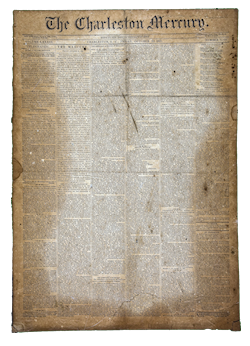
April 8, 1863, The Charleston Mercury

HEADQUARTERS, DEPARTMENT OF SOUTH CAROLINA, GEORGIA AND FLORIDA,

GENERAL ORDERS No. 58.

CHARLESTON, S.C. April 5, 1863.

I. FIELD AND COMPANY OFFICERS ARE SPECIALLY enjoined to instruct their men under all circumstances to fire with deliberation at the feet of the enemy; they will thus avoid over-shooting, and, besides, wounded men give more trouble to our adversary than his dead, as they have to be taken from the field.

II. Officers in command must be cool and collected in action, hold their men in hand, and caution them against useless, aimless firing. The men must be instructed and required each one to single out his mark. It was the deliberate sharp-shooting of our forefathers in the Revolution of 1776, and at New Orleans in 1815, which made them so formidable against the odds with which they were engaged.

III. In the beginning of a battle, except by troops deployed as skirmishers, the fire by file will be avoided: It excites the men, and renders their subsequent control difficult; fire by wing or company should be resorted to instead. During the battle, the officers and non-commissioned officers must keep the men in the ranks, enforce obedience, and encourage and stimulate them if necessary.

IV. Soldiers must not be permitted to quit the ranks to strip or rob the dead, nor even to assist in removing our own dead, unless by special permission, which shall only be given when the action has been decided. The surest way to protect our wounded is to drive the enemy from the field; the most pressing, highest duty is to win the victory.

V. Before the battle, the Quartermaster of the Division will make all the necessary arrangements for the immediate transportation of the wounded from the field. After consulting with the Medical Officers, he will establish the Ambulance Depot in the rear, and give his Assistants the necessary instructions for the efficient service of the Ambulance Wagons and other means of transportation.

VI. The Ambulance Depot, to which the wounded are to be conveyed or directed for immediate treatment, should be established at the most convenient building nearest the field of battle. A red flag marks the place and way to it.

VII. Before and immediately after battle the roll of each Company will be called, and absentees must strictly account for their absence from the ranks. To quit their standard on the battle field, under fire, under the pretence of removing or aiding the wounded, will not be permitted. Any one persisting in it will be shot on the spot; and whoever shall be found to have quit the field, or his Regiment or Company, without authority, will be regarded and proclaimed as a coward and dealt with accordingly.

VIII. The active ambulances will follow the troops to succor the wounded, and to remove them to the depots. Before the engagement INFIRMARY Detachments will also be detailed and organized, of three men (the least effective under arms) from each Company, whose duties will be hereinafter prescribed. These men must not loiter about the Depots, but will return promptly to the field as soon as possible.

IX. The Infirmary Detachments will be under the immediate orders of the Medical Officers on the field. This Corps is to go upon the field unarmed, except the non-commissioned officers, who are to protect the Corps against stragglers and marauders. The members will be provided with one litter to every two men, and each with a badge by which he can be easily distinguished from the rest of the command, also with leather shoulder straps, a canteen of water, a tin cup, a haversack, containing a half pound of line, twenty-four bandages, two long and two short splints of wood, sponges and tourniquets, and a pint bottle of alcoholic stimulant.

X. It shall be the duty of this corps, under the immediate direction of the Assistant-Surgeon of the regiment, accompanied by the ambulances or wagons, to follow up promptly the action, administering to the immediate wants of the wounded, by giving stimulus, checking hemorrhage and the temporary splinting of fractures.

XI. Those who are too much disabled to walk, will be removed to some ambulance depot, previously agreed upon, where they will be left in charge of the Surgeon of the regiment. The removal of the wounded from the field will devolve upon the Infirmary Corps, and all men straggling from the ranks under pretext of aiding this corps will be summarily dealt with, to which end, the medical officers in charge and the non-commissioned officers are specially required to report to the regimental commanders of the stragglers, their names, and the company to which they may belong.

XII. The Assistant Surgeon in charge of the Infirmary Corps should provide himself with a pocket case, ligatures, needles, pins, chloroform, napkins, brandy or whisky, tourniquets, bandages, lint and splints. To obviate the shock of the nervous system, to suppress hemorrhage, to put fractures in some temporary apparatus, so as to facilitate the removal of the wounded, should be his first care. This last is best accomplished by placing under the fractured limb a piece of old linen or cotton, of the form of a pocket handkerchief; on the opposite and outer edges of this are placed the splints, which are rolled up in it, toward the lint, on each side; until the fracture is snugly supported in the intervening space; the whole to be secured by two or three bands of tape or of bandage.

XIII. The Regimental Surgeon should, before an action, satisfy himself by personal inspection, that all the means and appliances for carrying the wounded are at hand; give instructions to the Infirmary Corps as to the application of a tourniquet to restrain dangerous hemorrhage; establish depots for the wounded, under the supervision of the Medical Director; and render to the men of his regiment all necessary surgical aid; performing there all operations that are required; and he will be held responsible that he has at his disposition all the means, supplies and appliances, for the proper performance of the service enjoined, or has taken all proper measures to secure them. He will instruct all detailed to assist him, not to allow ambulances to be monopolised by wounded officers, to the exclusion of others. He will forbid any of the Infirmary Corps to hold officers’ horses on the field, or to do anything but what strictly appertains to their duty. The Surgeon should not devote himself exclusively to a wounded officer, nor leave his post to accompany his to the rear.

XIV. Wounds will be dressed and operations performed as far as practicable on the field, and patients made as comfortable as circumstances will admit for transportation to hospitals in the interior.

XV. Surgeons will supply themselves with Hospital Flags, and will have them attached to the Ambulances and placed conspicuously over the Field Infirmaries and Hospitals.

XVI. As soon as possible after an action, Surgeons will transmit to the Medical Director a return of casualties according to the following form: RETURN OF KILLED AND WOUNDED in the ———-Regiment, in the action of———–.

XVII. The material for the Badges and for the Ambulance Flags prescribed in VI. paragraph of this Order will be provided by the Quartermaster’s Department.

By command of General BEAUREGARD.
(Signed) THOMAS JORDAN,
Official: Chief of Staff.
JNO. M. OTEY, A.A.G. April 6
HEADQUARTERS,

DEPARTMENT OF SOUTH CAROLINA, GEORGIA AND FLA.,
CHARLESTON, April 5, 1863

(SPECIAL ORDERS No. 77)

I. IN CASE OF A BOMBARDMENT OF THE CITY OF Charleston, should any Hospital become untenable, Medical Officers in charge, and those unattached to Regiments, unless otherwise specially ordered, will repair forthwith to the temporary Hospital established four miles from the city, next adjoining the building known as the ‘Four Mile House,’ where they will convey all hospital property that can be removed, and with them attendants and nurses will report to the Surgeon in charge for duty.

II. Wounds will be dressed and operations will be performed, as far as possible, on the field, and patients will be made as comfortable as circumstances will admit for transportation to Hospitals in the interior.

III. Medical Inspectors are charged with the general supervision of the removal of the wounded by railroad to the Hospitals at Summerville and Columbia.

By command of General BEAUREGARD.
April 6 JNO. M. OTEY. A.A., Gen.
0 comments

0

News of the Day
1860s newsprint

April 8, 1863, Daily Mississippian (Jackson, Mississippi)

The Richmond correspondent of the Knoxville Register says:

 The evils incident to revolution are in this city developed in their worst aspect. Citizens of Richmond are not affected by them, but the crowds which congregate in the Capital, of both sexes, give abundant evidence of the rapid progress of social demoralization growing out of the unhappy condition of our country. I cannot say more, without saying too much, and can give you no adequate conception of the looseness of morals that is becoming prevalent among those whose necessities open the gateway to all vices. Gambling, such as would startle habitues of European watering places, is not the worst of the moral calamities that has befallen Richmond.

 Not only do the Faro banks attract “despositors” from civil and military classes of society, but men who stand high, at least officially, above Congressmen and Major Generals, nightly resort to the magnificent gambling hells of Richmond. I have visited such establishments in Eastern and Southern cities, but have entered none in which the spirit of utter recklessness was so strongly betrayed as in those of this city. The vice of gaming contracted in the army over an “innocent game of old sledge,” becomes the absorbing passion of the gamester in the Faro banks of Richmond. The hope of sudden wealth, the insatiable love of excitement, the desperation resulting from the loss of fortune by the calamities of war, and the absence of those which wives and children throw about men, have all combined to fill this city with reckless gamblers.

 Women from all the States and cities of the South visit Richmond. They would reach the army, and often find it impossible. They have not anticipated the vastness of the expenditures to which they would be subjected. Their very necessities suggest a course of conduct which it is needless to portray. Penniless, helpless, unadvised, unrestrained by the presence of those to whom they are known, they resort to means of securing assistance of which at home they would never have dreamed. Religion is a stranger among the floating population of Richmond. Sunday, in this city, is the day of high carnival for all vices. Patriotism might well weep.


0 comments

0

News of the Day

April 8, 1863, The Charleston Mercury

At last, the long period of doubt and delay is at an end; and this goodly city, girdled with the fiery circle of its batteries, stands confronted with the most formidable Armada that the hands of man have ever put afloat.

The first scene in the novel drama of the war, which, we trust, is to add new lustre to the fame of Charleston, has closed. Let us render thanks to the Lord of Hosts that the result, thus far, has been one of proud triumph to our country. As yet, however, we have but entered upon the ordeal. It will be for the next few days to tell the tale of our sad disaster, or complete success.

In view of the reticence which (for reasons of military policy) has heretofore marked our allusions to the presence of the iron clad fleet, a brief review of the events of the week will not be out of place. About noon on Sunday last the first intelligence was flashed to the city from Fort Sumter, that the turrets of the far-famed Monitor gunboats were looming up against the southeastern horizon. During the afternoon the entire fleet hove in sight. Eight Monitors, besides the frigate Ironsides and twenty-seven wooden war vessels, took up their position just beyond the bar. As the news became bruited about the city, very many of our non-combatant population (previously incredulous of danger) made hasty preparations to depart; and every train that has left the city since has gone heavily laden with the eleventh-hour refugees and their effects.

Sunday night passed quietly by. Monday morning brought us reports of the movements of transports up the Stono River, and the debarkation of a considerable force of Yankee troops on Cole’s Island. But throughout Monday and Monday night, the armored fleet held its position beyond the bar. On Tuesday morning it was observed that another Monitor had arrived, making a force of no less than ten iron clad vessels, including the Ironsides. [continue reading…]

0 comments

0

News of the Day
1860s newsprint

April 8, 1863, Savannah Republican (Georgia)

 A correspondent of the Mobile Advertiser, writing from the camp of the Thirty-eighth Alabama Regiment, relates the following:

 Some weeks ago, a young man came to camp and proposed to volunteer. He was accepted, there being nothing in his physical appearance to indicate the singular denouement which followed six weeks afterwards. While on drill he was recognized and claimed as a runaway slave. He enlisted by the name of Solomon Vernoy; but after his arrest owned up to be nick named Pieg, and being a runaway. He says that he has a boss, but that “by right” he is free. He says that his mother was a domesticated Indian, who was unlawfully sold into slavery, and run off from Kentucky. His looks do not indicate the African, and if he gets a good lawyer and sues for his “by rights,” there will be a pretty law suit, since the master will have to rebut the presumption of color by proof. He must, at least, admire the patriotism of Vernoy, or Pieg, as the case may be.


0 comments

0

News of the Day
1860s newsprint

April 8, 1863, Daily Mississippian (Jackson, Mississippi)

There is no country in the civilized world where quite the same devotion is paid to woman as in our own sunny domain. There is no land where woman, occupying in society her own appropriate place, deserves and receives a more unqualified homage, or exerts a more general and potent influence. Our present struggle for civil liberty and the heroism of Southern women were not necessary to our high appreciation of the sex. We were taught to love and to honor glorious womanhood as one of the attributes, and one of the evidences of true nobility in man. But never did woman furnish such illustrious proofs of worth, goodness and greatness, to demonstrate how much she merited our devotion, as in this glorious struggle for home and country the women of the South have shown!

 As if to inspire us with a new creation of virtue–as if to exhibit new phases of loveliness–to enthrone the sex in the holy laces of our affections–to impress the public mind with a new sense of their worth–to exhibit to the world the highest attributes of character–to cheer the brave–to soothe the sick–to minister to the wounded–to endure labor–to incur danger–to despise ease and luxury–to make unwonted sacrifices–to surrender, at the altar of liberty, those dearer than life–still to utter the words sacred to patriotism, “let us defend the country, or perish!”–to ply all human agencies, and to call on God for help–to astonish our enemies, and interest the gazing world with a devotion as holy, a courage as sublime, as ever marked the great characters of history, the women of the South have gone forth to cheer, to save, to comfort, and to bless!

 It is not affirming more than simple truth to say, without their aid, our struggle could not have been maintained! Their influence and their ministrations have saved the country! By their efforts, in large part, the troops have been clothed and warmed. They have blessed the sick, and restored the sinking in the hospitals. They have nerved the arm and inspired the courage of the soldier in the shock of battle. For them, we feel, we are enacting the deeds of glorious manhood. To them the dust-stained, toil-worn veteran looks for the laurel wreath when the battle is won. To the sanctity of home, and the purity of the domestic circle, the patriot looks for the safety, glory and strength of his country. With the help of God, they must save the country, if it is saved; they must purify it, if it is pure; they must elevate the standard of virtue; they must frown vice into the hidden recesses of its own shame; they must banish the extortioner, or mark him for infamy; they must, and they will improve and bless the world. They are heaven’s messengers. Ever true, kind, merciful, pitying, sympathizing women! Last to leave the victim on the cross; first at the tomb of the risen God-man; last to give over the offices of compassion and mercy; first to crown triumphant virtue, and to hail the conquering heroes who dre4w the sword for truth. Next to our worship and our supreme reverence for God, is our worship and our devotion for noble, self-sacrificing woman!

 With the aid of such a power, and God’s approval, we shall triumph gloriously, and our country shall yet be free as the eagle that cleaves the sky. These reflections have been suggested by reading the proceedings of a convention of some of the matrons of Mississippi, held at Meridian on the 4th of March, 1863, to organize a “Confederate soldiers’ Aid Society,” for the better accomplishment of the objects suggested by the style of the association. They army will bless these ladies, and all those associated with them; and the country will record their names, and preserve their memory, as among the treasurers of its inheritance.


0 comments

0

News of the Day

April 8, 1863, The New York Herald

There is nothing new from the Army of the Potomac. The snow has disappeared, but the roads are in a frightful condition.

By an arrival from Hilton Head we learn that the town of Jacksonville, Florida, was burned by the Union forces under Colonel Rust, in return for the attempt of the rebels to shell it and murder all the Union inhabitants.

The bread riot which took place in Richmond on Thursday is very significant of the condition to which rebeldom is reduced. If the people of that city are compelled to break open the public stores to obtain bread, what must be the state of the inhabitants of those districts which produce but little food and raise mainly cotton or tobacco? Virginia is the most fruitful grain raising State in the South, and is the Eastern portion of what Tennessee and Kentucky are to the West, and if the want of food manifests itself in such a demonstrative fashion as to bring out a hungry mob of three thousand women into the streets of the capital, we can readily imagine how dire must be the distress existing in the other States.

We learn by despatches from Nashville, dated yesterday, that General Mitchell, with three hundred and fifty cavalry, went out on the Lebanon poke to Green Hill, and dashing into a rebel camp, where there was a large number of conscripts, on the sabre charge, he took fifteen prisoners, killed five and captured all their arms, horses and equipments.

General Rosecrans’ despatches to the War Department, under date of Monday, state that General Stanley completely whipped the rebel guerillas of Morgan at Snow Hill, capturing about fifty prisoners and three hundred horses.

0 comments

0

News of the Day

April 8, 1863, Arkansas True Democrat (Little Rock)

Warren, Texas, March 23d, 1863.

Mr. Editor:

 Having seen several pieces in your paper in regard to the war, our facilities for sustenance and defence, I take the liberty of requesting you to insert my opinion, if it is only the opinion of a native Texan girl. I live about a mile from the Indian Nation, on the west side of Red river, where I have the opportunity of seeing persons, not only from the Nation, but from every portion of Texas. And I am sure at this time, there is more unanimity of feeling respecting the war than ever before in Texas and the Nation. Last year there were some in Texas who were desirous of a reconstruction of the old connection. My parents were from the North–but now all, all are for prosecuting the war with vigor. The people here are far more able to bear the burden of the war now than at any time prior to this. Cotton cards have been procured, the loom and wheel have been brought into use, and nearly every family makes cloth enough for its own use, and some to spare. My mother, whose family is small, has had upwards of two hundred yards of cloth woven within the last six months. As to clothes, there will be no more trouble. The ladies are quite independent. As to the wheat crop, there never has been perhaps a more flattering prospect in Texas. More land has been planted in grain, and every appearance indicates a larger yield.

 Great preparation is making for a large maize or corn crop. It is true we all deplore the war; we are sorry it had to come; but it was a disease in the body politic which had to run its course. It has come and we trust it is in last stages. The fever is subsiding, and ere long we think the trumpet of peace will be sounded from the Great Lakes to the Rio Grande; from the Atlantic to the Pacific.

 It is strange, that our brethren of the North should have conceived an idea so erroneous as that of subjugating so many millions of their own race, armed in the holy cause of the Bible and the constitution. In the North we have friends, friends of right, and to them we look for a speedy terminus of this, the most atrocious war of modern times. But if the fanatics are bent upon piratical destruction let them come, we will welcome them to bloody graves. We would rather that our homes be burnt, our stock and grain be stolen, our brothers and lovers press the gory sod of a patriot’s grave, than live as conquered slaves.

Katrina.


0 comments

0

News of the Day
1860s newsprint

April 8, 1863, Montgomery Weekly Advertiser

 We regret to learn that the Bath Paper Mill, situated a short distance from Augusta, Georgia, was destroyed by fire on Thursday last. This mill supplied a number of the most prominent papers of the country, and its loss at the present time is a public calamity.


0 comments

0

News of the Day
1860s newsprint

April 8, 1863, Galveston Weekly News

 The Brownsville correspondent of the San Antonio Herald says Judge Davis was accompanied by a Major who was formerly a preacher in Austin, and by a Lieut. who was also a renegade from the same city, and by three subaltern officers, two of whom were from this State. One of these three is said to be Braubock, once the Sheriff of Gillespie county, and who escaped from the guard house in Austin last Summer. Some 10 or 12 men of the 3d Regiment had deserted by their influence, one of whom is Lieut. Holtse from New Braunfels. Pearce, the United States consul at Matamoras, keeps a recruiting office and clothes and feeds all the recruits among whom are the deserters and some traitors from San Antonio and other parts of Texas, some of whom are said to have very soon found out their mistake. The Herald says Montgomery, late of Lockhart, “went up a tree,” as soon as captured, and that Davis ought to have gone up at the same time, but that he was surrendered to the Mexican Authorities.


0 comments

0

News of the Day
1860s newsprint

April 8, 1863, Galveston Weekly News

Brownsville, Texas, March 22, 1863.

Editor Galveston News:

 It is reported that Col. (late Judge) Davis, after his surrender to Gov. Lopez Wednesday last, behaved himself prudently, not joining in the noisy demonstrations gotten up by the Consul and adherents among the rabble, and that he has left Matamoras for the mouth of the river with the design of embarking as speedily as possible. “Let the devil have his due.” He has real sins enough to atone for, without imputation of others not his own. It is said that his wife had expressed a wish that he might be kept a prisoner during the war, to prevent him from serving the enemy. She is a firm Southerner, and although, as a true wife should, she goes with her husband where he wishes her to go, she does not hesitate to condemn the part he has taken against his country. He has other very near relatives in Texas, it is said, whose loyalty is true, and who are much pained by his defection.

 The steam transport, Honduras, in which colonel Davis came over, has had a run up the coast since his capture, and has returned to the mouth, ready, it is supposed, to take on these refugees, whose departure will be quite a relief from continual apprehension of unpleasant collisions. It is said that the barque “Arthur,” U. S. ship of war, so long lying off Aransas bar, is also now off this port, where a British steamer is also watching events.

. . . Sabre.


0 comments

0

Cruise of the U.S. Flag-Ship Hartford -Wm. C. Holton

April 7th. This afternoon some men were seen on shore making signals with a flag. Thinking it to be some parties from the lower fleet wishing to communicate with us, we ordered our army signal officer to exchange signals with them, but he found that it was impossible to do so, as they used different signals from ours. The gunboat Albatross then got under way, and found them to be some of the enemy, and shelled them off.

Between eight and nine o’clock, P. M., as near as I can recollect, we fired three guns at intervals of three minutes each, and sent up three rockets with same intervals intervening, to attract the attention of lower fleet, but received no answer to same. Mr. Gabaudan, the Admiral’s Secretary, with despatches, left the ship in a skiff to run the gauntlet of the rebel batteries, taking with him a contraband for oarsman, to communicate with the vessels below. Another skiff with two contrabands in it was sent away from the ship about the same time as the one first mentioned, for the purpose of distracting the attention of the emeny’s pickets from the other boat, or in case either were discovered, to give one a chance to escape. About ten o’clock P. M., a rocket was observed sent up from below, as a signal from the lower fleet that the experiment had proved a success.

0 comments

A Confederate Girl’s Diary

A Confederate Girl’s Diary by Sarah Morgan Dawson

Tuesday, April 7th.

I believe that it is for true that we are to leave for New Orleans, via Clinton and Ponchatoula, this evening. Clinton, at least, I am sure of. Lilly came down for me yesterday, and according to the present programme, though I will not answer for it in an hour from now, we leave Linwood this evening, and Clinton on Thursday. I am almost indifferent about our destination; my chief anxiety is to have some definite plans decided on, which seems perfectly impossible from the number of times they are changed a day. The uncertainty is really affecting my spine, and causing me to grow alarmingly thin. . . .

0 comments

War Diary of Luman Harris Tenney.

War Diary of Luman Harris Tenney.

7th. After doing stable duty, went up to Co. H and got some ham, bread and coffee. Read the morning paper and wrote to Delos. A little after noon received orders to march. Fed, packed up and marched down to the boat. Saw Al Bushnell. Other battalion along. Took supper with Capt. Stewart on the boat. Had a berth with A. B. Good sleep.

0 comments

Downing’s Civil War Diary.–Alexander G. Downing.

Diary of Alexander G. Downing; Company E, Eleventh Iowa Infantry

Tuesday, 7th–The sanitary goods were issued to the different companies of the regiment today; the boys are pleased with the many good things that came from Iowa. Received orders to clean up for inspection.

0 comments

A Rebel War Clerk’s Diary

A Rebel War Clerk’s Diary at the Confederate States Capital, By John Beauchamp Jones
A likeness of Jones when he was editor and majority owner of the Daily Madisonian during President John Tyler’s administration.

APRIL 7th.—Nothing definite has transpired at Charleston, or if so, we have not received information of it yet.

From the West, we have accounts, from Northern papers, of the failure of the Yankee Yazoo expedition. That must have its effect.

Judge Campbell, Assistant Secretary of War, has decided in one instance (page 125, E. B. Conscript Bureau), that a paroled political prisoner, returning to the South, is not subject to conscription. This is in violation of an act of Congress, and general orders. It appears that grave judges are not all inflexibly just, and immaculately legal in their decisions. Col. Lay ordered the commandant of conscripts (Col. Shields) to give the man a protection, without any reason therefor.

It is now said large depots of provisions are being formed on the Rappahannock. This does not look like an indication of a retrograde movement on the part of Gen. Lee. Perhaps he will advance.

This afternoon dispatches were received from Charleston. Notwithstanding all the rumors relative to the hostile fleet being elsewhere, it is now certain that all the monitors, iron-clads, and transports have succeeded in passing the bar, and at the last accounts were in readiness to begin the attack. And Beauregard was prepared to receive it. To-morrow we shall have exciting intelligence. If we are to believe what we hear from South Carolinians, recently from Charleston (I do believe it), Charleston will not be taken. If the ground be taken, it will not be Charleston. If the forts fall, and our two rams be taken or destroyed, the defenders will still resist. Rifle-pits have been dug in the streets; and if driven from these, there are batteries beyond to sweep the streets, thus involving the enemy and the city in one common ruin.

0 comments

0

News of the Day
1860s newsprint

April 7, 1863, Peoria Morning Mail (Illinois)

 Democrats, go early to the polls this morning. The abolitionists, alias the dark lantern Union Leaguers, though apparently inactive are secretly hard at work, and hence extra vigilance is needed on the part of the Democracy. Again we repeat, go early to the polls, and look sharp for fraudulent voting. This will be attempted, for in no other way can the abolitionists succeed.

0 comments

0

News of the Day

April 7, 1863, The Charleston Mercury

The Richmond Enquirer very properly denounces the Government of the United States as a Despotism. Well – what constitutes it a Despotism? One thing, and one thing alone – the suspension of this writ of Habeas Corpus. By the suspension of this writ, President LINCOLN can arrest and cast into prison any citizen he pleases, and there is no power by which the citizen can be released, but his arbitrary will. This power makes President LINCOLN a Despot, and his Government a Despotism. Yet, strange to say, the Enquirer supports the proposition that the Congress of the Confederate States – President DAVIS to be empowered to suspend the Habeas Corpus Act: and, like President LINCOLN, to arrest and imprison whom he pleases, in the Confederate States, without any amenability or restraint from the Courts of the land. Does not the Enquirer support the establishment of a despotism in the Confederate States, exactly similar to that it denounces in the United States?

But the Enquirer alleges that President DAVIS will not abuse the power, if conferred upon him, by a law making him a Despot. This is exactly the plea of the Abolitionists of the United States, in making LINCOLN a Despot. It is ever the plea used in the establishment of all Despotisms. Admit the statement, however, to be true – the Government is nevertheless a Despotism. The right of personal liberty is gone. We have no right to be out of prison, if the President chooses we shall be in it. Suppose the Confederate States are conquered by the United States, will there be any worse form of Government over us? Can there be any worse, in its principles? It is to avoid just such a Government, with all its inevitable results of political ruin, slavery and death, that we are now fighting.

But the Enquirer argues that there are districts of disaffected country where the suspension of the writ of Habeas Corpus ought to prevail. Admit this to be true, for argument sake – what then? Shall the Writ be suspended throughout the Confederacy where disaffection does not prevail? To give any effect to the argument, let the suspension be limited by law to the districts disaffected. To go further, is using the disaffection in a small part of the Confederacy to extend a [continue reading…]

0 comments

0

News of the Day

April 7, 1863, The Charleston Mercury

HEADQUARTERS, DEPARTMENT OF SOUTH CAROLINA, GEORGIA AND FLA.,

I. IN CASE OF A BOMBARDMENT OF THE CITY OF Charleston, should any Hospital become untenable, Medical Officers in charge, and those unattached to Regiments, unless otherwise specially ordered, will repair forthwith to the temporary Hospital established four miles from the city, next adjoining the building known as the ‘Four Mile House,’ where they will convey all hospital property that can be removed, and with them attendants and nurses will report to the Surgeon in charge for duty.

II. Wounds will be dressed and operations will be performed, as far as possible, on the field, and patients will be made as comfortable as circumstances will admit for transportation to Hospitals in the interior.

III. Medical Inspectors are charged with the general supervision of the removal of the wounded by railroad to the Hospitals at Summerville and Columbia.

By command of General BEAUREGARD. April 63

0 comments

0

News of the Day
1860s newsprint

April 7, 1863, Weekly Columbus Enquirer (Georgia)

 We learn that fourteen bacon hams were sold in this city on yesterday, and brought the small sum of nine hundred and eighteen dollars and seventy-five cents. These hams, we learn, were raised by one of the oldest and best farmers, and were none of your little boney pieces of meat like that which you find scattered around some places in town, and better worth one dollar and twenty-five cents per pound than common meat is worth fifty cents. But that is a big pile of money these hard times for fourteen hams of bacon. Why it is almost the price of a number one negro.

Selma Sentinel.


0 comments

0

News of the Day

April 7, 1863, The Charleston Mercury

FROM DIVISION No. 1.

I. IN PURSUANCE OF THE REQUISITION OF THE General Commanding, the orders of his Excellency Governor Bonham, and the terms of the Acts of the General Assembly in relation to this subject, I hereby call upon Division No. 1, comprising the Judicial Districts of Pickens, Greenville, Spartanburg, Anderson, Union, York, Chester, Laurens, Abbeville and Newberry, to supply its proportion of slaves labor under the present requisition.

II. The Commissioners of Roads of the several Districts, and the authorities of the incorporated towns and villages having jurisdiction of the road hands within their boundaries, will at once summon all persons in the possession of slaves within the limits of their authority to have their slaves subject to this call at the nearest Railroad Depot to the owner’s residence, on WEDNESDAY, the 6th day of May next, at 10 o’clock a.m., ready for transportation to Charleston.

III. All owners of slaves who have not hitherto furnished any labor in this connection will be required to furnish one-half their hands subject to road duty for thirty days, and those who have furnished less than one-half, will be required by the Commissioners and the town authorities as aforesaid to furnish enough to make up one-half. Persons owning single road hands or a number not divisible by one-half will be required to send such single negros, or two in such condition may unite and send one.

IV. The Act requires the attendance of one of the Commissioners at each Depot. He will be met by an Agent of the State and of the Confederate States, and the negros will be there receipted for.

V. Assessment of the negros are made in duplicate upon their arrival in Charleston and before they are put to work, one copy is kept by me for the owner, the other turned over to the Confederated authorities. I am authorized to say the [continue reading…]

0 comments