0

News of the Day

May 8, 1863, The New York Herald

WASHINGTON, May 6, 1863.

THE FAILURE OF THE CAMPAIGN.

Hooker’s campaign is a failure, just when it was supposed to be on the very eve of a brilliant success. It is understood that he was outgeneralled by Lee and his army outnumbered by the rebels. Still a retreat was not looked for; but Hooker himself seems to have lost confidence in success, particularly as Sedgwick’s corps had not joined him, and thus was induced to give the order to retreat. The army retired over the United States Ford and Banks’ ford. The backward movement commenced at ten o’clock last (Tuesday) night, and before daylight this (Wednesday) morning the artillery and mule trains had all crossed, and the infantry was still crossing, Couch’s corps in the advance. The enemy were not able to harass our army in its retreat very materially. Their sharpshooters tried to pick off the artillery horses and mounted officers, and wherever they could bring guns to bear upon us they did so; but our artillery usually dislodged them before they could inflict much damage. The army is now supposed to be on its way back to its old camping ground. There is no apprehension that the enemy will cross the river in pursuit, except, perhaps, some of its cavalry.

THE FAILURE OF SEDGWICK TO JOIN HOOKER.

The failure of Sedgwick’s corps to effect a junction with the main army, as had been designed, had a considerable effect in causing the backward movement. That was no fault of either Sedgwick or his army. They were sandwiched in between Lee and Longstreet, and crushed by overpowering numbers in the direction of Banks’ ford. Here they managed to effect a crossing, but not without fearful loss. Their killed and wounded are set down as between five and six thousand. The enemy’s loss, it is said, is still larger. [continue reading…]

0 comments

0

News of the Day
1860s newsprint

May 8, 1863, American Citizen (Canton, Mississippi)

            Among the returned Confederate prisoners, to whom we alluded in our paper of yesterday morning, was a Georgian, who had had his leg shot off in the battle, in which he was taken prisoner by the abolitionists.  While in New York city, awaiting his recovery, he states that he was visited by a Georgia lady, resident in that city, who purchased for him an artificial leg, of the best description, and which he now wears.

            He refused to give us the lady’s name; but some day, when this “horrid war” shall have been brought to a close, and our bloodsprinkled land is again blessed with peace, the names of the Southern heroines, who, by the force of circumstances, are compelled to live among the enemies of their country, but who avail themselves of that residence to succor and provide for their wounded and suffering countrymen, should, by all means, be made public, that they may be cherished in the memories of the Southern people along with the other heroes who are battling for Southern independence.

            It may be well to suppress the names of these heroines, these devoted daughters of the South in a foreign land, for the present, but they should be preserved, and, at the proper time, be given to the public, and cherished as they so justly deserve.

            The Georgian who had the artificial leg alluded to, was offering to bet that he could out run, outjump, or out walk any other one leg man–so proud was he of the excellence of the leg which the Georgia lady had furnished him.

Augusta Constitutionalist.

0 comments

0

News of the Day

May 8, 1863, The New York Herald

THE CORRESPONDENCE OF MR. T.M. COOK.

HEADQUARTERS, ARMY OF THE POTOMAC,

NEAR UNITED STATES FORD, May 5, 1863.

In my last communication I was compelled, owing to the length to which it grew on my hands, to make merely a mention of the operations of the army yesterday. I improve the opportunity of a quiet morning to write more in detail of the events of that day.

Operations on Monday.

The fierce struggle of Sunday had crowded our brave forces back several miles, causing the entire relinquishment of the plank road and the general headquarters, and leaving us at night, wearied and exhausted, at the White House, situated at the intersection of the Wilderness and United States Ford roads, and about five miles from the United States Ford. The whole of the fighting ground of that terrible Sunday had fallen into the enemy’s possession, and with it the greater part of the wounded who had been too severely hurt to drag themselves from the battle field. The whole plain at and about Chancellorsville was strewn over with those wretched ones, for whom the rebels had no word of sympathy or pity. Their own fearfully swollen list of wounded demanded all the attention they were able to bestow upon those who had fallen; and those unfortunates of our army who fell into their possession were left to endure the tortures they were suffering until it should be convenient for their captors to give them a little attention. Fortunate were those, under such circumstances, who fell in the woods, and to whom the devouring flames brought a termination of torture in a horrid death.

Our own hospitals – temporary affairs, in most instances, pitched beneath the shade of the trees – were crowded with sufferers, and all night long the attending surgeons had been industriously engaged, given relief to some, and making the wounds of others a mutilation for life. The Third corps hospital, under the care of Drs. Sims and Dexter, had been removed, during the progress of the battle, no less than five times, owing to the disrespect of the enemy for the flag that, by all nations, is considered a safeguard against attack. At first this hospital was located on the plank road about a mile west of the Chancellorsville house, and in the rear of the operations of Birney and Whipple. Here the enemy fired upon it, [continue reading…]

0 comments

0

News of the Day
1860s newsprint

May 8, 1863, Savannah Republican (Georgia)

            A young woman, apparently about 17 years of age, attired in military apparel, was arrested in this city, Tuesday, and lodged in jail, until some satisfactory information in regard to her can be obtained.  She says that she is a married woman, that she is from Mississippi, and was with a company stationed near Charleston; and that, having lost her dresses, she was unable to procure any other clothing than that in which she was attired.  She probably pants for glory, but “seeking the bubble reputation at the cannon’s mouth” doesn’t accord with woman’s sphere–doesn’t suit her at all.  But if girls do take to britches and guns, woe betide old Uncle Abraham.  He will soon find use for that inevitable Scotch cloak and cap.

0 comments

0

News of the Day

May 8, 1863, The New York Herald

The news of General Hooker’s retrograde movement to the north side of the Rappahannock, after sustaining a loss of ten thousand men or more during a contest of three days, created an intense excitement in the city yesterday. Our latest news report the army safe at Falmouth. The artillery, ammunition and trains were brought over without loss. The river had risen ten feet, rendering a pursuit by General Lee next to impossible. The failure of General Sedgwick to support General Hooker, owing to the overwhelming force brought against him by the rebels at Fredericksburg; the absence of Gen. Stoneman’s splendid cavalry force, which was employed on an expedition that now proves to have been quite successful, and the reinforcement of Lee by Longstreet, and the delay in bringing up Heintzelman’s reserves, all combined to render Gen. Hooker position on the other side of the Rappahannock no longer tenable, and his withdrawal became a painful necessity. He crossed by the United States and Banks’ fords in a terrific rain storm, the sudden rising of the waters rendering the use of the pontoon bridges exceedingly precarious.

The success of General Stoneman’s expedition is admitted by the rebels themselves. His forces were divided into three squadrons – one commanded by himself and the others by Generals Averill and Buford. All performed their work gallantly by cutting the railroad communications between Lee’s army and Richmond and destroying all the bridges to within five miles of the rebel capital.

One party of the cavalry went to Louisa Court House, cutting up the railroad there. Another pushed on to Columbia and Goochland, on the James river, breaking the canal at the former point and capturing rebel stores at the latter. A portion of the force are said to have actually got to within a mile and a quarter of Richmond. General Stoneman then pushed on for the peninsula, and it was reported in Washington yesterday that he had got as far as Williamsburg.

The loss of the enemy in the three days’ fights is estimated at fully twenty thousand men, so that their loss is double that of our side. [continue reading…]

0 comments

0

News of the Day

May 8, 1863, The New York Herald

THE CORRESPONDENCE OF MR. S.M. CARPENTER.

UNITED STATES FORD, May 6 – 8 A.M.

Yesterday morning the trains were all ordered back to camp, and by dark the wagons, extra caissons, pack mules, &c., were at Falmouth. The wounded were hastily removed from the hospitals and sent to Washington, leaving nothing on the other side except our infantry and artillery.

About five o’clock it commenced raining. The water fell in torrents for over an hour, deluging the roads, tearing up the corduroys, sweeping away bridges and threatening the destruction of the pontoons. The river rose with great rapidity and soon overflowed the ends of the pontoons, rendering crossing impracticable. The upper pontoon was taken up and used in lengthening out the others, and after several hours of very hard labor the bridges were once more ready.

Pine boughs were spread upon the pontoons to prevent the noise of crossing, and about mid-night the troops commenced falling back. The First corps was the first to cross, and is now nearly all over. The Third corps remains in the intrenchments to cover the retreat. It is hoped that the army will reach this side before the enemy discovers the retreat; but cannonading has commenced quite fiercely at the front, and a desperate battle is not an improbable event.

We can doubtless retire across the river without serious loss; but if discovered in our attempt the struggle will be fierce. Unmolested the troops can get over by noon.

The roads are in a horrible condition – almost as bad as when General Burnside foundered here last winter. Our sick are lying in the woods, but ambulances are coming up to remove them. [continue reading…]

0 comments

0

News of the Day

May 8, 1863, The New York Herald

OUR RICHMOND, VA., DESPATCH.

I am able to give you a few items of intelligence which may be of interest, in advance of a detailed history of my experiences in the confederacy.

THE ADVANCE OF GENERAL STONEMAN HEARD OF.

We received an alarm here on Sunday about Stoneman’s cavalry raid, and there is no doubt that had three hundred of his cavalry made the attempt when so near Richmond on Sunday night they could easily have entered the town, capturing Jeff. Davis and his Cabinet, a majority of the members of the rebel Congress, with other officials, burning the bridges across the James and cutting off communications southward, destroying all the army supplies in town and doing other mischief of incalculable importance.

THE REBELS WERE BADLY SCARED,
and the inmates of Libby prison delightfully hopeful when the intelligence of Stoneman’s advance was received.

I do not believe that any regular force was left to defend the town. The city battalion, which was employed to guard the prisons, and the City Guards had all been withdrawn and sent as reinforcements to Lee. The prisons were guarded by discharged and disabled soldiers and citizens, some of whom appeared never to have attempted to handle a musket before.

THE PRISONERS IN LIBBY
had been paroled on Sunday, otherwise it was believed that we could have overpowered the guards and taken the town and Jeff. Davis ourselves.

THE STORE CLOSED AND THE CITIZENS PLACED UNDER ARMS.

On Monday places of business were closed and the citizens formed themselves into companies and battalions to resist the expected advance of the “Yankee cavalry,” Several of our cavalry were captured in the outskirts of the town. Two were brought in on their own horses, and dismounted at the door of Libby prison. They had become separated from their command and had lost their way. [continue reading…]

0 comments

0

News of the Day

May 8, 1863, Tri-Weekly Telegraph (Houston, Texas)

            We paid over $2000 a day or two since for a lot of printing ink that before the war would have cost $125.

0 comments

0

News of the Day
1860s newsprint

May 8, 1863, Savannah Republican (Georgia)
            The war upon women–waged only here and there two years ago–is becoming universal.  The stubborn fealty, lofty patriotism, and fiery spirit of the women of the South, which ought rather to excite a noble admiration and would do so in a generous foe, only begets persecution from the cowards, which composed the Yankee army.  There is hardly a gentleman now holding rank in the army of Rosecrans.  A consummate scoundrel himself, his officers take pattern after him, and mostly resemble him.  Let our troops remember, when they go into battle, that they are fighting the cowards who have persecuted their wives and daughters, robbed, pillaged and burnt.–Rebel.

0 comments

0

News of the Day
1860s newsprint

May 8, 1863, Natchez Daily Courier,

            The following very pertinent remarks, from the Little Rock Democrat of a late date, are equally applicable to the doings of “General Starvation” and his piratical invaders further South.

                                    The Starvation Policy.

            “It has been known, for weeks, that the Federals in this State, as well as others, were destroying all farming implements, seizing all provisions and preventing the planting of crops, with the avowed determination to starve the people into submission.  We supposed it might be possible that this was the vindictive cruelty of some cowardly commander, who vented his spite on women and children.  But it is now certain that orders to that effect have issued from Lincoln’s war department.  In Phillips, Chicot, and other counties, where the Federals have a foothold they have and are burning all the fences, plows and farming utensils they find.  They destroy the property of widows as well as of male citizens.  They are sending thousands of women and children within our lines, destroying all the provisions they find, and preventing the people from planting.  Out of many cases reported to us, is one of a widowed lady, at whose house a number of officers and men called and demanded their dinners.  After having eaten, they told her that they had orders to seize all her provisions, destroy all the farming implements and fences and prevent her from having a crop raised.  They left her a week’s supply of provisions only.  In Phillips county they killed every milch cow, shot down every hog and cut down fruit trees.  In Chicot county, they have made a clean sweep.

            “This is not civilized warfare.  It is a war upon women and children.  It is a wholesale robbery and national murder.  Yet so timid has been our policy that we have let these villains navigate our waters, because they protested against the barbarity of firing into boats.  We have paroled jayhawkers whose hands and garments were covered with the blood of murdered patriots.  We have forborne until forbearance has ceased to be a virtue, until it has ceased to be manly.”

0 comments

0

Civil War

May 8, 1863, Southern Confederacy (Atlanta, Georgia)

            The Fort Brown Flag of March 20th gives a detailed account of the capture and release of the renegade Judge Davis.  A party of Texas Rangers crossed the Rio Grand, surrounded the house in which Davis and Montgomery were lodged in company with a number of renegades, which at first showed fight, but they soon ran over the sandhills losing three men killed and some wounded.  Montgomery and Davis were brought over to the Texas side.  Montgomery is said to have been hung immediately after he was landed.  The Mexican authorities acted very promptly and very calmly.  Governor Lopez simply made a demand for the surrender of the captured individuals, and as soon as General Bee could obtain possession of  Davis he returned him to the Mexican authorities.

0 comments

0

Civil War

May 8, 1863, Tri-Weekly Telegraph (Houston, Texas)

            In distributing the cotton cards lately bought by the State, the Military Board have fixed their prices at $10 per pair.  As they have enough to go very far towards supplying the demand, it is to be presumed that the price of cotton cards will speedily come down to that figure.  This operation alone will save the people hundreds of thousands of dollars.

0 comments

0

Civil War

May 8, 1863, The Charleston Mercury

FROM THE RAPPAHANNOCK –

FURTHER DETAILS OF THE LATE BATTLES.

RICHMOND, May 7. – The correspondent of the Richmond Whig gives some further details of the battles of Chancellorsville and Fredericksburg.

HOOKER accomplished the capture of Marye’s Heights by a ruse. On Saturday evening he moved several heavy columns of troops towards the right of his line. During the night, however, he recalled them, and threw them rapidly across the river on pontoons.

The battle began at daylight. BARKSDALE’S brigade of Mississippians, by desperate fighting, held the enemy in check for some time. The fight opened with volleys of musketry, but the combatants soon closed with the bayonet, many of our men encountering the enemy with clubbed muskets. Finally, the Mississippians were compelled to fall back before overwhelming numbers, but not until the ground had been piled with the slain Yankees. Our loss was about one hundred. All of the 10th Mississippi, excepting two companies, were captured. Colonel GRIFFIN and Adjutant STUART were killed, and Major CAMPBELL was wounded. All but seven of Company A, Washington Artillery, were made prisoners, including Captain SQUIRES. The Yankees showed ‘no quarters’ to the rebels. The guns of the Washington Artillery were not retaken.

Most of our casualties in the battles around Chancellorsville, consisted of slight wounds in the hand or arm. Few, comparatively, were killed. [continue reading…]

0 comments

0

Civil War
1860s newsprint

May 8, 1863, Daily Mississippian (Jackson, Mississippi)

            We infer that something of a panic exists south of us.  Droves of negroes, mules &c., have been pressing through our village, northward and eastward bound, for some days.  The stampede seems to have frightened many of our own citizens, and we hear of a number who have already started for distant parts with their slave property and every thing else they could carry.  Georgia and East Mississippi appears to be favorite regions at present.–Raymond Gazette, 6th.

0 comments

0

Civil War

May 16, 1863, The New York Herald

Our Murfreesboro Correspondence.

MURFREESBORO, Tenn., May 10, 1863.

My despatches of last night will have intimated to you the loss of the forces under Colonel A.D. Streight, sent to destroy the military machine shops and arsenals at Rome, Georgia. The rebel papers received stated the capture positively; but it was thought advisable to suppress the news until we should have something definite in regard to the capture either from Gen. Hurlbut or Gen. Dodge. Little doubt is entertained at headquarters that Streight has been taken: Indeed, I imagine that when the expedition was planned the probability of Streight’s capture was freely discussed and admitted. The proposed end would have justified the expensive means. Had Streight succeeded in his efforts the capture of seventeen hundred men, as now reported, would have been a cheap price to pay for that success.

The unfavorable reports, it must be remembered, are those of the Chattanooga Rebel of May 7. Our reports from Dodge, at Tuscumbia, are only to April 27. On that day Streight, with a portion of his force, had penetrated as far east from Tuscumbia as Blountsville, the enemy, who is under Brigadier General N. B. Forrest, following him rapidly. Both forces were mounted. Being pressed rather hard by Forrest, Streight turned at Blountsville and fought him. He succeeded in drawing Forrest into an ambuscade; and opened upon him a heavy fire. Forrest was badly whipped, and gave no more trouble that day, keeping at a respectful distance. Further we do not hear from Streight except through the Chattanooga Rebel.

Streight’s force consisted of the Third Ohio infantry Lieutenant Colonel Lawson commanding; Fifty-first Indiana, Eighteenth Illinois and Seventy-third Indiana. [continue reading…]

0 comments

0

Cruise of the U.S. Flag-Ship Hartford -Wm. C. Holton

May 7th. Commences with pleasant weather; at six forty-five A. M., sent the Albatross down the river in search of the Sachem; at 9 A. M., inspected crew at quarters; at two P. M., the Albatross came up the river and made fast inshore ahead of us; at two forty P. M., the Sachem came up the river and anchored.

0 comments

Robert M. McGill

Robert M. Magill – Personal Reminiscences of a Confederate Soldier Boy, 39th Georgia Regiment of Infantry

Thursday, 7th.—Reported Federals just across the river, and that General Beauregard had arrived at Vicksburg.


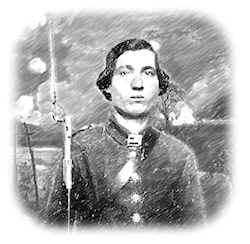
(Note: picture is of an unidentified Confederate soldier.)

0 comments

Downing’s Civil War Diary.–Alexander G. Downing.

Diary of Alexander G. Downing; Company E, Eleventh Iowa Infantry

Thursday, 7th–One hundred and fifty prisoners captured at Grand Gulf were taken past here this morning; they all looked quite downhearted. A large train of provisions passed here for the army below. The roads are drying fast, which is making the hauling and marching better. The boys are all anxious to leave this place and move to the front. This is a low, unhealthy locality. An old negro here has picked up more than a thousand overcoats and blankets and is storing them away in his hut. These are thrown aside by the men marching out from the landing. On becoming warm and getting tired of their loads, they begin to unload about the first day’s march.

0 comments

War Diary of Luman Harris Tenney.

War Diary of Luman Harris Tenney.

7th. Weather still bad. After breakfast ordered to the river. No chance for us today to cross. By orders of Col. Kautz, I went to the Div. train and helped myself to one day’s rations. Lt. crossed over. Robinson, Drake and I got permission to swim our horses and cross. Saddled and went round by the river road to avoid pickets. Glad to get back into a dry bed again.

0 comments

“I’m on a General Court Martial now. Confound the Court Martials.”–Army Life of an Illinois Soldier, Charles Wright Wills.

Army Life of an Illinois Soldier, Charles Wright Wills, (8th Illinois Infantry)

Camp 103d Illinois Infantry, Lagrange, Tenn.,
May 7, 1863.

Isn’t the Grierson “raid” glorious? Two other expeditions started from this point and were gone respectively five and ten days each. Although they made good long marches and took about 40 prisoners and 500 animals, still we forget them in looking after Grierson. We have the Rebels well scared in this country. Five thousand men could sweep everything north of Jackson, if they could only hold it. Papers to-day give us the news on the Rappahannock up to the 4th of May, which includes the route of Siegel’s Dutchmen and leaves Hooker in what seems to me a close place. Well, he can at worst but fail. What a consolation. General Oglesby wrote to Hurlbut to detail me on his staff. General Hurlbut referred the letter through division and brigade headquarters for the letter of my company and on its return to Hurlbut, General Smith objected to my being detailed out of his command. He thought Oglesby might find his staff in his own command. All right! I would like to have been with Old Dick though. I’m on a General Court Martial now. Confound the Court Martials.

0 comments

0

News of the Day

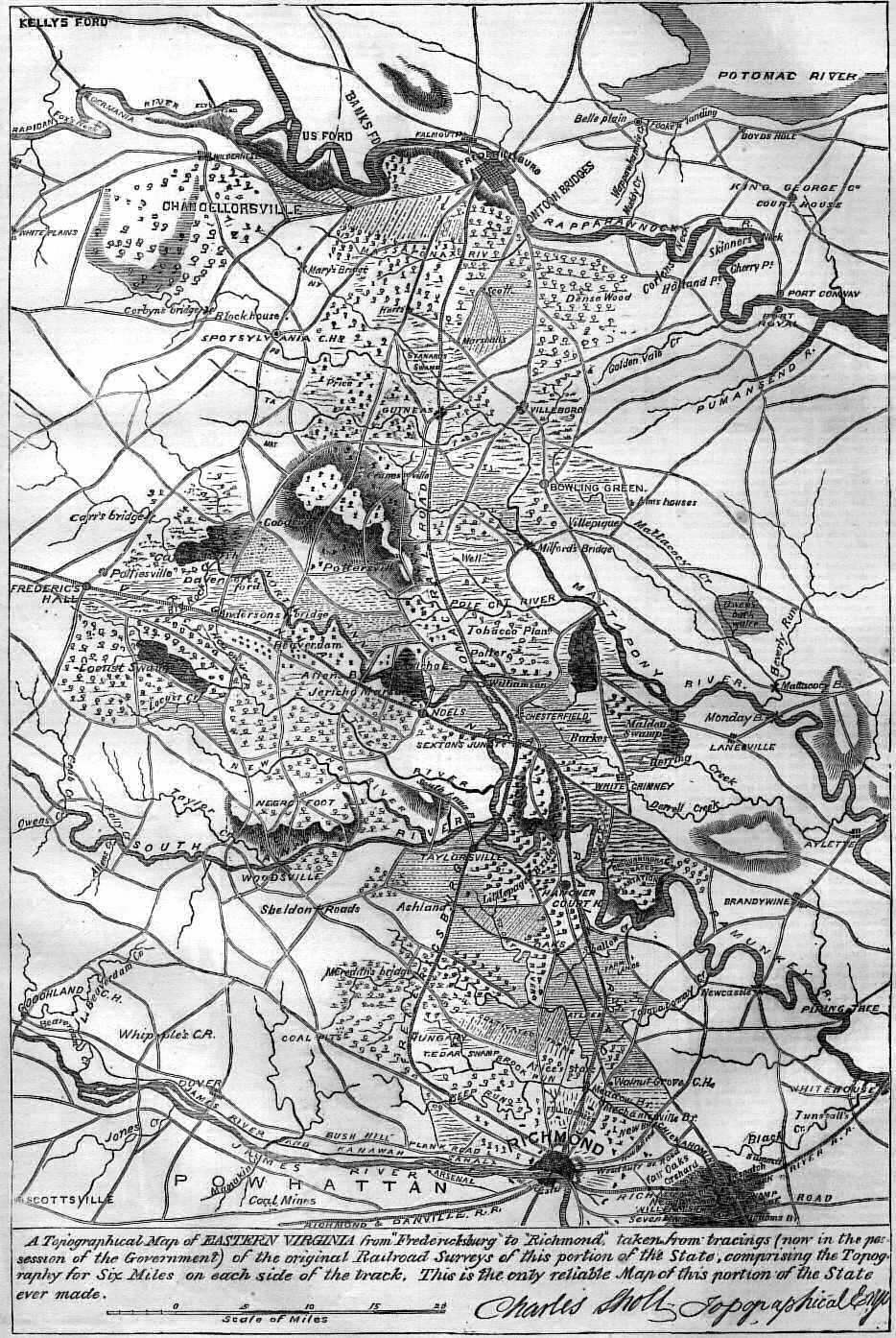
From May 16, 1863, Harper’s Weekly

2007-00686.jpg

Click on map for larger image (300 kbytes)

0 comments

A Rebel War Clerk’s Diary

A Rebel War Clerk’s Diary at the Confederate States Capital, By John Beauchamp Jones
A likeness of Jones when he was editor and majority owner of the Daily Madisonian during President John Tyler’s administration.

MAY 7th.—A scout came in to-day with the vexatious intelligence that a body of hostile cavalry is still in Louisa County. And later in the day we have information that the Mattapony bridge was burned last night! Thus again is communication interrupted between Gen. Lee and the city! Our wounded cannot be brought to the hospitals here, nor supplies sent to them! It really does seem as if an organization of Union men here were co-operating with the enemy, else they never could disappear and reappear so often with impunity. Every one is asking what Gens. Elzey and Winder are doing—and echo answers, WHAT?

There is a great pressure for passports to leave the country. Mr. Benjamin writes an indignant letter to the Secretary against Gen. Whiting, at Wilmington, for detaining a Mr. Planner’s steamer, laden with cotton for some of the nationalities—Mr. B. intimates a foreign or neutral power. But when once away from our shore, many of these vessels steer for New York, depositing large sums “for those whom it may concern.”

Mr. J. B. Campbell, attorney for J. E. Hertz (Jew), writes a long letter to “J. A. Campbell, Assistant Secretary of War,” urging the payment of the slight sum of $25,200 for ninety kegs of bicarbonate of soda seized by the agent of the department! The true value is about $250!

At two o’clock this afternoon a note was received by the Secretary of War from Lieut.-Gen. Longstreet (still in the city), stating that the President last night desired him to go to Gen. Lee immediately; but the general, during the day, has become convinced that he should not leave the city until communications are reestablished with Gen. Lee, and the city in a condition of defense against the sudden dash of one or two columns of the enemy–an event, he thinks, meditated by the Yankees! And the persistency of the Federal cavalry in hanging round the city in spite of all the generals here, and the many companies, battalions, and regiments vainly sent out in quest of them, would seem to indicate such purpose.

But the raids in the West don’t seem to flourish so well. We have an official dispatch from Gen. Bragg, stating that Gen. Forrest has captured 1600 of the enemy’s cavalry in a body, near Rome, Georgia.

There are amusing scenes among the horrors of war, as the following, taken from a paper to-day, shows :

Taking the Oath under Protest.—A few weeks ago a laughable incident occurred in the neighborhood of Nashville, which is worthy of record. A saucy, dashing young girl, of the Southern persuasion, was, with a number of other ladies, brought into the presence of Gen. Rosecrans, in order that their Southern ardor might be checked by the administration of the oath of loyalty. The bold, bright-eyed Juno in question, objected to take the oath, saying that her mother had taught her that it was unlady-like to swear; her sense of morality forbid her to swear, and swear she could and would not. The officer insisted that the lady must take an oath before she left his presence.

“Well, general,'” said bright eyes, ‘if I must swear, I will; but all sins of the oath must rest on your shoulders, for I swear on your compulsion: “G–d d–m every Yankee to h__l’ “

“And the defiant beauty tossed her dark curls and swept out of the presence unmolested.”—Nashville Union.

7 O’CLOCK P.M. The report that the bridge over the Mattapony had been burned by the enemy was false—invented probably by a spy or emissary, who, has enjoyed the freedom of the city under the Dogberrys and Vergises imported hither to preserve the government. A number of trains containing our wounded men, guarded by a detachment of troops, have arrived at the Fredericksburg depot. An officer just arrived from the army says we have taken 15,000 prisoners. If this be so, the loss of the enemy during the week in Virginia will not be less than 40,000. Our loss in killed and wounded is estimated at from 8 to 10,000—we lost a few hundred prisoners. We have taken, it is said, 53 guns, and lost 14.

I think the reports to-day of squadrons of the enemy’s cavalry seen in the surrounding counties are not reliable—they were probably our own men in quest of the enemy.
0 comments

0

A Soldier’s Story of the Siege of Vicksburg

From the diary of Osborn H. Oldroyd

MAY 7TH.–Our company detailed and reported this morning at headquarters for picket duty, but not being needed, returned to camp. Were somewhat disappointed, for we preferred a day on picket by way of change.

Pickets are the eyes of the army and the terror of those who live in close proximity to their line. Twenty-four hours on picket is hardly ever passed without some good foraging.

We broke camp at ten o’clock A. M., and very glad of it. After a pleasant tramp of ten miles we reached Rocky Springs. Here we have good, cold spring water, fresh from the bosom of the hills.

We have met several of the men of this section who have expressed surprise at the great number of troops passing. They think there must be a million of “you’ns” coming down here. We have assured them they have not seen half of our army. To our faces these citizens seem good Union men, but behind our backs, no doubt their sentiments undergo a change. Probably they were among those who fired at us, and will do it again as soon as they dare. I have not seen a regular acknowledged rebel since we crossed the river, except those we have seen in their army. They may well be surprised at the size of our force, for this Vicksburg expedition is indeed a big thing, and I am afraid the people who were instrumental in plunging this country headlong into this war have not yet realized what evils they have waked up. They are just beginning to open their eyes to war’s career of devastation. They must not complain when they go out to the barnyard in the morning and find a hog or two missing at roll-call, or a few chickens less to pick corn and be picked in turn for the pot. I think these southern people will be benefited by the general diffusion of information which our army is introducing; and after the war new enterprise and better arts will follow–the steel plow, for instance, in place of the bull-tongue or old root that has been in use here so long to scratch the soil. The South must suffer, but out of that suffering will come wisdom.

0 comments

0

News of the Day

May 7, 1863, The New York Herald

Our couriers from Hooker’s army bring the details of movements on the Rappahannock down to Monday night as relates to the main army, and to Tuesday morning at two o’clock in relation to the detachment under General Sedgwick.

The news from General Sedgwick’s detachment is less encouraging at first glance, but the result of his movement was a success. It would appear that, after the struggle of Sunday, General Lee detached a large body of his main army to go down and meet General Sedgwick. It is also known that General Longstreet was rapidly getting into his rear at that time. Early Monday morning large masses of rebels appeared on the heights to the east of Fredericksburg, which had been partially evacuated by our forces in order to strengthen Sedgwick’s column. Those remaining made but a brief resistance and relinquished the position to the enemy, having first removed all their guns.

Some fighting occurred above Fredericksburg, the particulars of which have not been received; but it is supposed to have been an effort to hold the rebels from moving up to reinforce the body engaged against Sedgwick. In this, however, we were unsuccessful. It is generally understood that their force was Longstreet’s column, just arrived from Suffolk. They interposed no objections to our holding the possession of the city of Fredericksburg, which we still retain.

On Monday General Sedgwick was hotly engaged throughout the entire day, the enemy pressing him at all points and cutting him up badly. His men were obliged to give way before the overwhelming masses of the enemy constantly, and his discomfiture seemed certain when the gallant Vermont Brigade made a noble charge, repulsing the rebels in fine style and securing the safety of that portion of the army.

The slaughter of the enemy in this action, which occurred in close proximity to Banks’ ford, is without parallel in the history of warfare, considering the number of men engaged. Whole brigades of the rebels were wiped out; but their force was so many times greater than that at the command of General Sedgwick that it was impossible that he could hold his [continue reading…]

0 comments

0

News of the Day
1860s newsprint

May 7, 1863, Mobile Register And Advertiser

            At Brownsville, Texas, molasses is selling at fifty cents per gallon.  Shoes, of good make, eighteen dollars per dozen.  Hats, at the same prices.  Domestics, twenty cents per yard.  Two hundred barrels of flour sold at auction at ten dollars and fifty cents per barrel.

0 comments