0

News of the Day

May 7, 1863, The New York Herald

Army of the West.

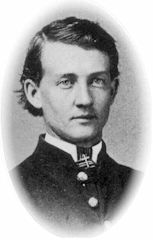
General Hartsuff has received an appointment under General Burnside, and has left Washington for his new seat of military labors. He has to some extent recovered from the wounds he received at Antietam – enough to enable him to resume active duties – therefore he has been relieved from duty on the D’Utassy Court Martial.

As it will be interesting to our readers to know more of this famous general, we this day present them with a
SKETCH OF GENERAL HARTSUFF.

Major General George L. Hartsuff was born in the town of Tyne, Seneca county, N. Y., on the 28th of May, 1830. His father’s family removing to the West, he entered the West Point Military Academy from Michigan, in 1848, and graduated in 1852 as brevet second lieutenant of the Fourth artillery. He was promoted to second lieutenant of the Second artillery on the 12th of June, 1853, and first lieutenant the 8th of March, 1853. He was made captain in the Adjutant General’s Department on the 22d of March, 1861, and on the 17th of July, 1862 he was promoted to a majority in the same department. On the 15th of April, 1862, he received the appointment of brigadier general of volunteers. On the 29th of November, 1862, he received the appointment of major general of volunteers. As lieutenant, he served first in Texas from November, 1852, to June, 1854, being most of the time in the field. At Fort Brown, in the fall of 1853, he suffered from an attack of yellow fever, surviving the almost constantly fatal symptom of black vomit. After recovering from the attack he served in Florida of two years. In this campaign with the Indians he was wounded several times. This inaugurated the last war with the Seminoles. A bullet received in the chest, and which wounded the lung, in this Indian fight, remains in the body. His escape on that occasion was almost miraculous. Bleeding from several wounds received from the rifles of the savages, his […..] place of the water and surrounded by aquatic plants, where he remained several [continue reading…]
0 comments

0

News of the Day

May 7, 1863, The New York Herald

Our Special Reports from the Battle Field.

OPERATIONS ON SUNDAY.

After the disaster to our right wing on Saturday and the manifestation the rebels made of their position and intentions, Gen. Hooker determined upon a radical change of front. Hitherto, as the reader has seen, his line faced east, south and west. It was now certain that the main body of the enemy had got around to our right, or on the west of us, and that but small bodies of them remained between us and Fredericksburg. Acting upon this supposition, and with the full confidence that he would be powerfully assailed the next morning on his right, the commanding general determined at midnight of Saturday to form a powerful line of battle, facing directly to the right.

INTENDED LINE OF BATTLE SUNDAY MORNING.

The organization of this line gave Reynolds the extreme right, with his right flank resting on the river, Slocum the centre, and Sickles the left, his left flank resting at Scott creek. Couch and Meade were left to look after the front towards Fredericksburg, while the remnant of the Eleventh was to be used, if it could be reorganized, wherever it could be made the most effective. In the formation of this line I have given particular attention to those forces that were most actively engaged. On the previous night, during the confusion of the stampede, Gen. Berry, of Sickles’ corps, had moved up the plank road and taken a position just at the edge of the woods, where he met the enemy as they were advancing to complete the discomfiture of the right wing, and had hurled them back most effectually. He was then ordered to retain the ground he had thus defended, which was on either side of the plank road, as indicated in the above diagram, which would give him the left of our right wing.

During the night of Saturday, Birney, having been annoyed by the sharpshooters of the enemy lying in the woods about the cleared field in which he bivouacked for the night, ordered out his division, and charged bayonets through the woods to the plank road, effectually clearing it of all bodies of rebels. He then fell back again into the field with Whipple. [continue reading…]

0 comments

0

News of the Day

May 7, 1863, The New York Herald

Our Special Reports from the Battle Field.

CORRESPONDENCE OF MR. L.W. BUCKINGHAM.

May 3, 1863.

I shall not attempt to chronicle the disgraceful affair of a part of the Eleventh corps (formerly Sigel), till I am able to learn full particulars and send you a diagram of the positions then held by our troops.

GENERAL WILLIAMS’ DIVISION ORDERED TO SUPPORT GENERAL GEARY.

The following is correct as far as it goes: –

At six o’clock P. M., on the 2d of May, the First division, Under General Williams, of the Twelfth Army corps (Slocum), was ordered to leave its intrenchments, which fronted Howard to support General Geary, one half of whose line was then actually engaged with the enemy. The division moved promptly, and in less than ten minutes were both engaged.

JACKSON’S ATTACK UPON THE ELEVENTH CORPS.

General Howard’s right, commanded by Carl Schurz, was attacked by Stonewall Jackson, and held its ground for about an hour, when his corps broke in the greatest confusion dashing to Williams’ rear and over his intrenchments.

AN ATTEMPT TO CHECK THE RETREAT.

A small regiment from each brigade of Williams’ division had been left to support a section of Lieutenant Crosby’s battery, F (Fourth United States), and hold the works. These troops formed across the woods and endeavored to check the flying columns of Howard’s corp, but were unequal to the task. The Twenty-eighth New York infantry, Lieut. Col. Cook, held their ground till after the flight of Howard’s command, and kept the enemy engaged. Colonel Cook, Lieutenants Chaffer and Kenyon, and about 100 men were flanked and taken prisoners. [continue reading…]

0 comments

0

News of the Day

May 8, 1863, The Charleston Mercury

We make up from our Richmond exchanges of Tuesday a summary of such additional intelligence of the recent movements of the campaign in Virginia as had been received up to Monday night:

THE BATTLE.

The scene of the battle is in Spotsylvania county, between the Wilderness and Chancellorsville. The latter is a place with only one dwelling, a large brick house, formerly a tavern, and latterly a boarding school. It is about ten miles west of Fredericksburg. The Wilderness we suppose to be indicated by ‘Wilderness Creek,’ a small stream running into the Rappahannock, about four or five miles from Chancellorsville; the country adjacent and widening out towards Chancellorsville is the Wilderness, out of which the enemy came at the bidding of Jackson. The United States Ford is on the Rappahannock, eight miles above Fredericksburg, and two miles below the mouth of the Rapidan. Ely’s Ford is on the Rapidan, four miles above its mouth. The enemy having crossed into Spotsylvania, presented himself on the left of our line in front of Fredericksburg. But our sagacious Commander had taken proper measures, it may be inferred by the result. Longstreet and his command were recalled in good time, and by the best routes for an opportune junction with our main line, while the strategy for getting in rear of the enemy was matured. This decisive movement was conducted by that warrior who never fails, and on Saturday (as we understand) the enemy, in his dismay, found Jackson thundering upon his rear. Driven from his position towards Chancellorsville, he got out of the frying pan into the fire by encountering Longstreet. His rout was complete, as we are officially informed by General Lee.

Brigadier General E.F. Paxton, of Rockbridge county, Va., whose fall in battle is announced, was formerly Gen. Jackson’s Adjutant General. He commanded a brigade in Jackson’s corps, and it is sufficient praise to say of him, that he commanded Jackson’s affectionate confidence. – Green grow the turf over his grave, and undying be his fame! [continue reading…]

0 comments

0

News of the Day
1860s newsprint

May 7, 1863, Semi-Weekly News (San Antonio, Texas)

(Communicated.)

            Why is it, while our attention is so often called to our hospitals in Galveston, in Arkansas and in Virginia, that nothing is said or done for our own sick and suffering soldiers here at home?  Why should they be kept in “durance vile,” in a hot, close, unhealthy place, in one of the noisiest, dustiest, and most public streets in the city, a miserable situation and a badly ventilated house, while at the same time the fine building, containing 18 rooms, situated on the Arsenal grounds, which are so well adapted for hospital purposes, where the fevered brow of the sufferer could be fanned by the cool invigorating breezes and his appetite tempted by the fresh fruits and vegetables which are cultivated on the place at the expense of the Government, is occupied as a private residence by an officer, with the rank of Major, and therefore entitled to but three rooms?  Why it should be so is a mystery, and looks very much as if “there is something rotten in Denmark.”  The matter should be investigated.

0 comments

0

News of the Day
1860s newsprint

May 7, 1863, Semi-Weekly News (San Antonio, Texas)

            The Knoxville Register learns, through a letter from a lady living near Murfreesboro‘, that the vandals are committing terrible excesses in Tennessee.  They are turning women and children out of their houses without food or shelter.  They had ravished four girls of good respectability in society, two of whom had become deranged.

0 comments

0

News of the Day

May 7, 1863, The Charleston Mercury

(From the Richmond Examiner of Monday.)

On Saturday morning the belief became general in the city that Hooker had succeeded in throwing the main body of his army across the upper waters of the Rappahannock and had established himself on a line running from Chancellorsville, on the Orange plank road, ten miles west of Fredericksburg, to Spotsylvania Court House, a point twelve miles southwest of the latter place. Though it was clear that our position had been turned by this movement, and our army deprived of the immense advantages it enjoyed in the famous battle of the 13th December, 1862, the admission gave rise to no uneasiness. The morning, however, wore away without anything transpiring.

But about 12 o’clock the city was electrified by the report that the Yankees, in immense force, had taken possession of the Central Railroad at Louisa Court House, fourteen miles southwest of Spotsylvania Court House, and sixty miles from the city, and, being uninterrupted by our troops, were tearing up the track for miles. This statement being made on the authority of the telegraph operator at Louisa Court House, who had only escaped capture after performing prodigies of pedestrianism, was currently believed, and gave rise to vague but grave apprehensions. On every hand the questions were asked, ‘Where is Gen. Lee?’– ‘Where is our army?’ In the course of an hour the above story received an addition in the shape of a report that a heavy detachment of the enemy had appeared at Columbia, and, after cutting the canal at that place, were making their way to the high bridge on the South Side Railroad. At four o’clock p.m., a city paper issued an extra containing the following:

‘The telegraph operator from Louisa Court House arrived at Frederick’s Hall Station, twelve miles this side of the Court House, at 11:45 today (Saturday). He walked from Louisa Court House to Frederick’s Hall, bareheaded and without a coat. He reports that the enemy, about one thousand strong, came into Louisa Court House at three o’clock this morning, [continue reading…]

0 comments

0

News of the Day

May 7, 1863, The New York Herald

The intelligence from General Hooker’s army brings us to the sanguinary conflict in Virginia up to Tuesday morning, at which time affairs looked more favorable for our forces than at any previous time since the movement commenced. On Monday the rebels in large force pressed hotly on General Sedgwick, who then occupied the heights of Fredericksburg. After a severe contest – in which he inflicted terrible slaughter upon the enemy – he withdrew his corps across the river, and moved on to  assist General Hooker about two o’clock on Tuesday morning. In conducting this movement he was exposed to a raking fire from the rebel batteries and the attacks of the enemy on his rear, causing considerable loss of life. The movement, however, was made in good order across the pontoon bridges, and may be regarded as a success under the circumstances, and will, no doubt, greatly strengthen General Hooker’s position.

The action of Gen. Stoneman with his splendid cavalry force is not yet satisfactorily accounted for, although all the indications show the probability of his having succeeded in his principal object – as time may prove – notwithstanding that Longstreet got up to Lee’s aid with his reinforcements from Suffolk. To counterbalance this additional increase of the rebel forces, however, we have the fact that thirty thousand Union troops, under Gen. Heintzelman, is hastening from Washington to support Gen. Hooker. Thus the contending armies present an enormous opposing force, and the contest must prove of a terrific and sanguinary character.

Our army correspondents furnish another brilliant chapter today in the history of this grand conflict, describing in detail the battles from Friday to Tuesday morning; and to their graphic stories we refer our readers. We also publish today four maps of the scene of action, showing the position of our forces on Friday; the battle field of Saturday, with the disposition of the Union lines during the day; the battle ground of Sunday, and a comprehensive map comprising the theatre of the entire conflict as it raged on Saturday, Sunday and Monday. [continue reading…]

0 comments

0

News of the Day

May 7, 1863, The Charleston Mercury

Our readers read yesterday a synopsis of the debate in the Senate on the bill which passed the House of Representatives, repealing the Naturalization Laws, in view of the influx of Yankees after the war. This bill is similar to that introduced by Mr. THOMAS COBB, of Georgia, into the Provisional Congress, passed by that body, and vetoed by President DAVIS. The effort to perpetuate the Yankee Naturalization Laws over the Confederate States may, in effect, be nothing but a form of reconstruction of our Union with them – for every one must know, that after the war is over, ten Yankees will enter the Confederated States for one European. It is a matter of congratulation that this debate was in open session, and that we have the vote upon the measure, although not the names of the Senators. By degrees the people may be let into a knowledge of the course of their Representatives.

The Richmond Enquirer commends President DAVIS. In one column it heaps upon him praises, and in the next denounces his notorious policy. It likens him to BRONDAS, of Sparta, who was a great General in the field; and in the next column it strongly assails two measures of his policy. The Enquirer discourseth as follows upon these two measures:

One is, the conscription of persons pretending to be foreigners, but whom their own Governments do not think it worth their while to claim as subjects; the other is the repeal of all naturalization laws. The first has been defeated; the second postponed by a vote of 9 to 8. We shall hear more of them both.

The opponents of both these measures have acted under the vague and confused idea that certain foreign Governments, which do not know us, and which we do not know, might possibly be irritated against us. They say, if we pretend to put ourselves on an equality with foreign nations, and venture to say that we will admit their Consuls when they admit ours; that we will respect the rights of their nationality so soon as they respect ours; that we will acknowledge their citizens to be their citizens just when they acknowledge us to be citizens of the Confederate States, and not till then; perhaps they may grow angry – who knows? [continue reading…]

0 comments

0

News of the Day

May 7, 1863, The New York Herald

Our Special Reports from the Battle Field.

OUR DESPATCHES.

THE CORRESPONDENCE OF T.M. COOK.

HEADQUARTERS, ARMY OF THE POTOMAC,

NEAR UNITED STATES FORD,

MONDAY EVENING, May 4, 1863.

I write you in the midst of a lull in operations in this vicinity – perhaps the lull that precedes a storm more violent, if that be possible, than that which has raged with us for the past three days. General Hooker congratulated his army that they had obtained a position that would compel the enemy to come out of his intrenchments and give us battle. The enemy has come out of his intrenchments, and has given us battle. From fifteen to twenty thousand slain and mangled rebels attest the ferocity of that battle. They attacked us first on Friday, though more as if feeling of us than really to fight us. On Saturday we pushed our lines a couple of miles beyond where they had been originally established, when an overwhelming body of the enemy, under the rebel General Hill, fell upon our right flank with a violence that we were unable to withstand. The Eleventh corps, having the extreme right, broke in confusion under this attack and fled from the field in a panic, nearly effecting the total demoralization of the entire army. But for the unsurpassed bravery and coolness of General Sickles, the history of the Army of the Potomac would have terminated with this disaster. On Sunday morning, at daylight, they came upon our left flank as we were changing front, and a battle ensued that has not been [continue reading…]

0 comments

0

News of the Day
1860s newsprint

May 7, 1863, Mobile Register And Advertiser

            The factory at Bankston has suspended operations, and the place is being fortified.  Col. Wesson has despatched a messenger asking for troops to defend and protect the factory.–[Greensboro (Miss.) Motive, 25th.

0 comments

0

News of the Day

May 7, 1863, The New York Herald

Our Special Reports from the Battle Field.

OPERATIONS ON SATURDAY.

CHANGE OF POSITION.

During the night of Friday the position of our forces was very materially changed. The Second corps was thrown down the Blanks Ford road, holding the extreme left of our line, and, with a portion of the Fifth, completed the line on the east up to the plank road, supported by the Second division of the Third corps, which was resting on the direct road to the United States Ford. The Second division, Gen. Geary, of the Twelfth, held the left of our centre, its left resting on the plank road in front of the general headquarters, and extending along the entire front of the field. Gen. Williams’ division of the same corps was formed on the right of this line, facing to the southwest, its extreme right, resting in the edge of the woods facing the little cleared field indicated in the general map I send you, situated about two miles south of west from headquarters. The Eleventh corps was originally directed to take position on the right of Gen. Williams, with its right extending as far down towards the Wilderness road as consistent with a proper strengthening of the position. Birney’s division of the Third corps was ordered to take position on the plank road as a reserve both to the Eleventh and Twelfth; but General Sickles, discovering an advantageous opening in a cleared, field about a quarter of a mile south of the plank road, and a mile and a half west of general headquarters, obtained permission to advance Birney to this place, which brought him between the Eleventh and Twelfth corps. At this place he deployed off to the right around the field, General Williams, of the Twelfth, occupying the other side of the opening. This field is shown in the diagram above. It is a small farm, half of which (the portion occupied by our forces) is elevated to the general level of the land about Chancellorsville, the back half falling off rather precipitously into the valley of Scott’s creek, and forming a low piece of cultivated bottom [continue reading…]

0 comments

0

News of the Day

May 7, 1863, The Charleston Mercury

FROM THE SEAT OF WAR IN VIRGINIA–THE LATEST NEWS.

RICHMOND, May 5. – The following despatch was received this evening:

GUINEA STATION, NEAR FREDERICKSBURG,

Tuesday, May 5.

To his Excellency President Davis:

At the close of the battle of Chancellorsville, on Sunday, the enemy was reported advancing from Fredericksburg on our rear. General McLAWS was sent back to arrest his progress, and repulsed him handsomely that afternoon. Learning that his force consisted of two corps under General SEDGWICK, I determined to attack, and marched back yesterday, with General ANDERSON, and uniting with McLAWS and EARLY in the afternoon, succeeded, with the blessing of Heaven, in driving General SEDGWICK across the river. We have reoccupied Fredericksburg, and no enemy remains south of the Rappahannock, or in its vicinity.

ROBT. E. LEE,

General Commanding.

WEDNESDAY, May 6. Direct communication with the army being again established, authentic details of the battle may soon be expected. A packet boat arrived this morning from Lynchburg. The passengers report that very little damage has been done to the canal by the Yankees. Several farm bridges over the canal were destroyed and one lock gate damaged.

Two trains, laden with wounded, arrived this morning on the Fredericksburg Railroad. [continue reading…]

0 comments

0

News of the Day

May 7, 1863, The New York Herald

Our Special Reports from the Battle Field.

OPERATIONS ON FRIDAY.

DISPOSITION OF THE FORCES.

These forces all reached their destination on Thursday, and were promptly thrown into position to repel any attack that might be made upon them. On the same evening the Second corps followed across at the United States Ford, and moved promptly up the road, and on the following morning the Third, which had been aiding in the demonstration on the left, crossed by the same route. Thus by noon of Friday there were in position at and about Chancellorsville the whole of the Second, Third, Fifth, Eleventh and Twelfth corps. This was a most formidable army to contend against, and, occupying the commanding position that had been selected for it, there seemed no chance that it could ever be repulsed. The disposition of these forces on Friday evening I have shown in the sectional diagram which accompanies this.

Up to this time there had been no fighting save the slight skirmishing which took place at the seizure of the fords. The enemy had not deigned to show himself in any direction, and it was a perplexing question where and how soon he would come upon us.

RECONNOITERING.

In this dilemma the Commanding General despatched reconnoitering parties of cavalry, supported by suitable bodies of infantry, on all the roads to scour the country round about, and ascertain if the rebels were in force and position anywhere in our vicinity. General Hooker himself accompanied and advanced party down the main Fredericksburg road [continue reading…]

0 comments

0

News of the Day

May 7, 1863, The New York Herald

Our Special Reports from the Battle Field.

CORRESPONDENCE OF MR. L.A. HENDRICK.

FIFTH ARMY CORPS HEADQUARTERS,

IN THE WOODS, REAR OF CHANCELLORSVILLE, Va.,

May 4, 1863.

THE “ESPIRIT DU CORPS” OF THE TROOPS.

About nine o’clock last evening I visited the Ninth Massachusetts regiment, supporting a battery in the rear of the house where General Meade’s headquarters was yesterday, in the rear of where stood, but now stands no more, the Chancellorsville mansion, and the Fourth Michigan, Fourteenth New York, Thirty-second Massachusetts and Sixty-second Pennsylvania regiments – Second brigade, General Griffin division – lying in close proximity to one another and to several batteries massed in the vicinity. I found all quiet, and the boys in excellent spirits, heightened, no doubt, by the fact, notwithstanding the want of sleep for the past few nights, that they had been only slight sufferers in our desperate actions thus far.

A QUIET NIGHT EXPECTED.

It was the general impression that we should have a quiet night of it; hence my temerity in visiting the trenches, which, in case of renewed attack, would be an unpleasantly dangerous locality for a non-combatant. The only news I gather here was the absence of Maj. Lowry, Sixty-second Pennsylvania regiment, with five companies, on a scouting expedition, and some apprehension was felt for his safety, as he had been away several hours. If the rebels get the Major they will [continue reading…]

0 comments

0

News of the Day

May 7, 1863, The New York Herald

Long live the Union! The news of Monday’s warlike operations on the Rappahannock, received in this city yesterday, has lifted a heavy weight of anxiety from the public mind. Our heroic Army of the Potomac is still intact, and in a strong position for offensive or defensive purposes – a position which its fearless and active commander appears to entertain no though of abandoning except to advance.

In order that our readers may fully understand the general situation of affairs, we give this morning several illustrated maps and the interesting detailed reports from our special correspondents on the field of the military operations around them since Friday morning last, and the results down to Tuesday morning. It will thus be seen that General Hooker’s position remains substantially the same as at the beginning. We esteem it, too, a matter of congratulation that the detached army corps of General Sedgwick, on the Heights of Fredericksburg, hemmed in between two overwhelming divisions of the rebel army, was successful in cutting its way out, and in recrossing the river on its pontoon bridges under the enemy’s fire. It seems almost a miracle that in this daring and difficult enterprise, the corps was not captured en masse or utterly destroyed. It was, no doubt, materially assisted by Gen. Hooker’s attack upon the right on Monday afternoon, which, for the purpose of feeling and disarranging the movements of the enemy, was a brilliant success.

The reoccupation of the Heights of Fredericksburg by the rebels is no serious loss to us. General Hooker’s base of operations and his depots of supplies are on this side of the river, and are properly protected. The object of Lee and Jackson in their attack upon the heights was not the recovery of those intrenchments, which have ceased to be of any value to them, but the capture or destruction of a detached body of some twelve or fifteen thousand Union troops, with their small arms, equipments and artillery. Failing in this object, the recapture of their old defensive position is a barren victory to the enemy, and very dearly purchased, while the brilliant movement of Sedgwick from Fredericksburg greatly strengthens Gen. Hooker’s operations. [continue reading…]

0 comments

0

Cruise of the U.S. Flag-Ship Hartford -Wm. C. Holton

May 6th. Commences with clear and pleasant weather, and light breezes from the northward and westward; at six thirty-five A. M., the steamer Sachem got under way and steamed up the river, exchanging signals with lower fleet from mast-head; at eight forty-five called all hands up anchor, got under way, and proceeded up the river; at eleven thirty came to anchor off Point Coupée; sent forth cutter, in charge of an officer, and with six marines and an armed boat’s crew, to destroy some Confederate property; at one thirty P. M., under way steaming up the Mississippi; at 3 o’clock passed the Sachem; at seven o’clock came to anchor off the mouth of Red river; Albatross also came up and anchored.

0 comments

Robert M. McGill

Robert M. Magill – Personal Reminiscences of a Confederate Soldier Boy, 39th Georgia Regiment of Infantry

Wednesday, 6th.—All quiet to-day. Have very good place to camp; plenty of mulberries.


(Note: picture is of an unidentified Confederate soldier.)

0 comments

Downing’s Civil War Diary.–Alexander G. Downing.

Diary of Alexander G. Downing; Company E, Eleventh Iowa Infantry

Wednesday, 6th–The Sixth Division trains all went to the landing this morning for ammunition. Wagon trains are passing back and forth all the time, hauling provisions and ammunition for the army at Grand Gulf. We had battalion drill this afternoon.

0 comments

War Diary of Luman Harris Tenney.

War Diary of Luman Harris Tenney.

Kentucky

6th. Reached the ford at Waitsboro at noon. Troops were crossing. One boatload of 27th N. J. drowned, 32 persons, Capt. Alexander. Pitiful sight. Camped on the hill. Rainy and chilly. Issued about half rations. Saw an old lady, “Aunt Betsy,” 115 years old, good mind and good heart. Enjoyed hearing her talk. Rheumatism, ready to die when God calls.

0 comments

A Rebel War Clerk’s Diary

A Rebel War Clerk’s Diary at the Confederate States Capital, By John Beauchamp Jones
A likeness of Jones when he was editor and majority owner of the Daily Madisonian during President John Tyler’s administration.

MAY 6th.—The excitement has subsided, as troops come pouring in, and many improvised cavalry companies go out in quest of the fox—who has vanished we know not exactly whither.

It is believed we have taken 15,000 or 20,000 prisoners, and that the enemy’s killed, wounded, and prisoners must reach the appalling number of 40,000.

On Sunday, the enemy opposite Fredericksburg sent over a flag, asking permission to bury their dead. This was granted. But when they came—two corps under Gen. Sedgwick came over and fell upon our few regiments in the vicinity. So goes the story. Then, it is said, when Gen. Lee ordered two of our divisions to drive Sedgwick back, the men, learning the enemy with the flag of truce had given no quarter to their comrades, refused to fight unless permitted to retaliate in kind. This was promised them; and then their charge was irresistible, never pausing until the Yankees were hurled back across the river. No prisoners were taken. However this may be, Gen. Lee sends the following to the President:

[Received by telegraph from Guiney’s Depot.]

“HEADQUARTERS, 10 o’clock A M.,
“May 5, 1863.

“To HIS EXCELLENCY, PRESIDENT DAVIS.

“At the close of the battle of Chancellorville, on Sunday, the enemy was reported advancing from Fredericksburg in our rear.

“Gen. McLaws was sent back to arrest his progress, and repulsed him handsomely that afternoon. Learning that this force consisted of two corps, under Gen. Sedgwick, I determined to attack it, and marched back yesterday with Gen. Anderson, and uniting with Gens. McLaws and Early in the afternoon, succeeded by the blessing of Heaven in driving Gen. Sedgwick over the river. We have reoccupied Fredericksburg, and no enemy remains south of the Rappahannock in its vicinity.

“(Signed)…………………………………………… R. E. LEE, General.”

Another dispatch from Gen. Lee says Hooker is still on this side of the river, at United States Ford, fortifying.

Gen. Longstreet is now closeted with the Secretary of War. No doubt his entire corps will immediately rejoin Lee.

Jackson was wounded (his arm has been amputated) before the great battle was fought, by our own men, in the gloom of the evening, supposing him a Federal officer. He was reconnoitering in front of the line.

S. S. H______ writes to the department, proposing to send an emissary to the North, to organize secret societies to destroy the enemy’s stores, ships, railroad bridges, etc. by an unexplained process.

Tillman, Griffin & Co. write to Judge Campbell to obtain them permission to trade with Mexico. Does this mean trading cotton with the enemy? I know not whether the request was granted.

Mr. Benjamin, Secretary of State, writes to the Secretary to-day for permission for some of his Louisiana friends to leave the country in a government steamer.

It is said that the government at Washington is ordering their troops from North Carolina and other places on the Southern seaboard towards Washington, and to reinforce Hooker—or Hooker’s army. I think Hooker himself will go the way of all general flesh that fails.

The President sent to the War Department fifty-five letters to-day, written to him on various subjects, but mostly asking appointments. He had read them, and several had indorsed on them, in his own hand, what he wished done in the premises. So he has not lost his sight. He still attends to business at his dwelling, and has not been in his office for more than a month.

Secretary Seddon is gaunt and emaciated, with long straggling hair, mingled gray and black. He looks like a dead man galvanized into muscular animation. His eyes are sunken, and his features have the hue of a man who had been in his grave a full month. But he is an orator, and a man of fine education—but in bad health, being much afflicted with neuralgia. His administrative capacity will be taxed by the results.

0 comments

0

A Soldier’s Story of the Siege of Vicksburg

From the diary of Osborn H. Oldroyd

MAY 6TH.–This day has been a hot one, but as our duties have not been of an arduous nature we have sought the shade and kept quiet. While in camp, the boys very freely comment upon our destination, and give every detail of progress a general overhauling. The ranks of our volunteer regiments were filled at the first call for troops. That call opened the doors of both rich and poor, and out sprang merchant, farmer, lawyer, physician and mechanics of every calling, whose true and loyal hearts all beat in unison for their country. The first shot that struck Sumpter’s wall sent an electric shot to every loyal breast, and to ­day we have in our ranks material for future captains, colonels and generals, who before this war is ended will be sought out and honored.

It can not be possible that we are to be kept at this place much longer, for it is not very desirable as a permanent location. Of course we are here for some purpose, and I suppose that to be to prevent the enemy from assailing our line of supplies. As they are familiar with the country they can annoy us exceedingly without much loss to themselves. But after we have captured Vicksburg, and the history of Grant’s movements is known, we shall then understand why we guarded Hankinson’s Ferry so long. One of the boys said he thought Mr. Hankinson owed us something nice for taking such good care of his ferry for him. The variety of comments and opinions expressed in camp by the men is very curious. Some say we are going to surround Vicksburg, others think Grant is feeling for the enemy’s weakest point there to strike him, and one cool head remarked that it was all right wherever we went while Grant was leading, for he had never known defeat. Confidence in a good general stiffens a soldier–a rule that ought to work both ways. Surely no leader ever had more of the confidence of those he led than General Grant. He is not as social as McPherson, Sherman, Logan and some others, but seems all the while careful of the comfort of his men, with an eye single to success. Great responsibilities, perhaps, suppress his social qualities, for the present; for each day presents new obstacles to be met and overcome without delay. The enemy are doing all they can to hinder us, but let Grant say for ­ward, and we obey.

Unable to sleep last night, I strolled about the camp awhile. Cause of my wakefulness, probably too much chicken yesterday. I appeared to be the only one in such a state, for the rest were

                        “Lost in heavy slumbers,
                                    Free from toil and strife,
                        Dreaming of their dear ones,
                                    Home and child and wife:
                        Tentless they are lying.
                                    While the moon shines bright.
                        Sleeping in their blankets,
                                    Beneath the summer’s night.”

0 comments

0

News of the Day

May 6, 1863, The Charleston Mercury

(From the Atlanta Confederacy, May 5.)

Yesterday morning before 10 o’clock, Col. Lee received a despatch from Major Rowland stating that the Yankee cavalry were at Gadsden, Ala., (on the Coosa river, at the corner of the four counties of Cherokee, DeKalb, St. Clair, and Benton, say 50 or 60 miles below Rome). The despatch of Maj. R. was from Marietta, the nearest telegraph station – whither he had come on an engine to send it. It stated that a messenger had come from Gadsden to Rome, and from Rome on the railroad down to Kingston, and that it was expected the enemy would proceed at once to Rome to destroy Noble’s Iron Works, on the river below, and the valuable work shops at Rome. Later in the day a despatch was received that they had passed by Rome, and were to the south, between that point and Kingston. We also heard it reported that a body of the enemy were approaching via Cedartown, but we saw no despatch to that effect, and suppose it was not correct. It was then supposed they were aiming at the bridge and Iron Works at Etowah. Col. Lee, with all that remained of the Provost Guard and some others, taking two pieces of artillery, took the train at 7 p.m., intending to go to the defence of the bridge and the Iron Works, or to any other point where his presence might be needed. At this writing, we have received nothing from the movements of him and his command since leaving here.

This raid has created a good deal of excitement in the city. Many supposed it was intended to make a descent upon this place, for the purpose of destroying Government supplies, of which the Yankees know we have a considerable amount stored in the city. Various speculations were indulged, and reports canvassed as to their number, and the point from which they came. Some supposed it to be a small force cut off by Forrest in his fight with them at Courtland (Lawrence County, on the Memphis and Charleston Railroad, twenty miles west of Decatur). Others supposed it to be a separate expeditions from Corinth, having come entirely to the south of Forrest’s command – say through Marion, Hancock and Blount counties. When the news came that they had passed by Rome, it was supposed that they were in small force, [continue reading…]

0 comments

0

News of the Day
1860s newsprint

May 6, 1863, Southern Banner (Athens, Georgia)

    We are compelled once more to issue only a half-sheet.  The necessary supply of paper could not be obtained.  We trust we shall not have to ask the indulgence of our patrons in this respect again.  By omitting advertising matter, we are enabled to present nearly as much reading matter as usual.

0 comments

0

News of the Day

May 6, 1863, Arkansas True Democrat (Little Rock)

            A friend in north-western Arkansas writes to us the particulars of some of the atrocious acts committed by the federals there.  Two of them seized two young girls and outraged them.  Afterwards, two negroes, after severe struggling committed rapes on two respectable ladies, while their white comrades in arms stood by laughing at the shrieks and prayers of the poor women.  May God nerve the arm of Gen. Cabell, and give strength to the brave men under him, to avenge the foul deeds of these dastardly ruffians.

0 comments