May 6 to May 9, 1863

Experience of a Confederate Chaplain—Rev. A. D. Betts, 30th N. C. Regiment

May 6—Damp and cool. Rain all day.

May 7—Pass 11th and 62nd Regiments going to Hamilton’s Crossing. Write to wife from Ashland, in the home of Rev. D. T. Wills.

May 8—Ride over the worst roads I ever saw to old camp and find my Regiment there. Some are gone forever!

May 9—Prayers with my men. Hear from family. Doing well, thank God!

Saturday, May 9, 1863—Spend day among wounded. Most of the wounded of our Regiment get off on train to hospitals. Many poor strangers suffer for attention, though surgeons and nurses do all they can.

0 comments

A Rebel War Clerk’s Diary

A Rebel War Clerk’s Diary at the Confederate States Capital, By John Beauchamp Jones
A likeness of Jones when he was editor and majority owner of the Daily Madisonian during President John Tyler’s administration.

MAY 9th.—The papers contain the following order from Gen. Lee :

“HEADQUARTERS ARMY NORTHERN VIRGINIA,
“May 7th, 1863.

“GENERAL ORDERS No. 59.

“With heartfelt gratification, the General Commanding expresses to the army his sense of the heroic conduct displayed by officers and men, during the arduous operations in which they have just been engaged.

“Under trying vicissitudes of heat and storm, you attacked the enemy, strongly intrenched in the depths of a tangled wilderness, and again on the hills of Fredericksburg, fifteen miles distant, and by the valor that has triumphed on so many fields, forced him once more to seek safety beyond the Rappahannock. While this glorious victory entitles you to the praise and gratitude of the nation, we are especially called upon to return our grateful thanks to the only Giver of victory for the signal deliverance He has wrought.

“It is, therefore, earnestly recommended that the troops unite on Sunday next in ascribing to the Lord of hosts the glory due unto His name.

“Let us not forget in our rejoicing the brave soldiers who have fallen in defense of their country; and while we mourn their loss, let us resolve to emulate their noble example.

“The army and the country alike lament the absence for a time of one to whose bravery, energy, and skill they are so much indebted for success.

“The following letter from the President of the Confederate States is communicated to the army as an expression of his appreciation of its success:

“’I have received your dispatch, and reverently unite with you in giving praise to God for the success with which He has crowned our arms.

“‘In the name of the people, I offer my cordial thanks to yourself and the troops under your command for this addition to the unprecedented series of great victories which your army has achieved.

“’The universal rejoicing produced by this happy result will be mingled with a general regret for the good and the brave who are numbered among the killed and wounded.’

“R. E. LEE, General.”

The losses on either side are not yet relatively ascertained. Ours, in killed, wounded, and prisoners, will probably reach 10,000. We have taken about 10,000 prisoners; the enemy’s killed and wounded is thought to be 15,000 to 20,000. We have taken about fifty guns—and it is said 40,000 small arms, in good order. They did not have leisure to destroy them as on former occasions. It was a complete and stunning defeat.

Gen. Jackson remains near Fredericksburg, and is doing well since the amputation of his (left) arm. The wound was received, during the battle by moonlight, from his own men, who did not recognize their beloved general.

A letter was received to-day from Gen. Whiting at Wilmington, who refuses to permit the “Lizzie” to leave the port, unless ordered to do so. He intimates that she trades with the enemy. And yet Mr. Benjamin urges the Secretary to allow her to depart! Commodore Lynch also writes that the detention of the “Lizzie” is a prudential measure, as it is the only steamer in port that could conduct our unfinished gun-boat to a place of safety, should the enemy’s fleet make a sudden attack on the city.

The President (who still absents himself from the Executive Office, his health being precarious) writes the Secretary to consult Gen. Lee before detaching Gen. Jenkins’s cavalry brigade from the West. It would have been better if Gen. Lee’s advice had been taken in regard to Gen. Longstreet.

The men from the garrison at Drewry’s Bluff, and the crew from the steamer Richmond, were taken away to man the batteries around the city. The President requests the Secretary to order them back at the earliest moment practicable. It would be an ugly picture if our defenses at Drewry’s Bluff were surprised and taken by a sudden dash of the enemy up James River.

The raid of the enemy’s cavalry, after all, did little or no permanent injury to the roads or canal. They are all in operation again.

It is said Lincoln has called for 500,000 more men. Numbers have now no terror for the Southern people. They are willing to wage the war against quadruple their number.

0 comments

0

A Soldier’s Story of the Siege of Vicksburg

From the diary of Osborn H. Oldroyd

MAY 9TH.–Orders this morning to draw two days’ rations, pack up and be ready to move at a moment’s warning. We drew hard-tack, coffee, bacon, salt and sugar, and stored them in our haversacks. Some take great care so to pack the hard-tack that it will not dig into the side while marching, for if a corner sticks out too much anywhere, it is only too apt to leave its mark on the soldier. Bacon, too, must be so placed as not to grease the blouse or pants. I see many a bacon badge about me–generally in the region of the left hip. In filling canteens, if the covers get wet the moisture soaks through and scalds the skin. The tin cup or coffee-can is generally tied to the canteen or else to the blanket or haversack, and it rattles along the road, reminding one of the sound of the old cow coming home. All trifling troubles like these on the march may be easily forestalled by a little care, but care is something a soldier is not apt to take, and he too often packs his “grub” as hurriedly as he “bolts” it. We were soon ready to move, and filled our canteens with the best water we have had for months. We did not actually get our marching order, however, until near three o’clock P. M., so that being anxious to take fresh water with us, we had to empty and refill canteens several times. As we waited for the order, a good view was afforded us of the passing troops, and the bristling lines really looked as if there was war ahead.

O, what a grand army this is, and what a sight to fire the heart of a spectator with a speck of patriotism in his bosom. I shall never forget the scene of to-day, while looking back upon a mile of solid columns, marching with their old tattered flags streaming in the summer breeze, and hearkening to the firm tramp of their broad brogans keeping step to the pealing fife and drum, or the regimental bands discoursing “Yankee Doodle” or “The Girl I Left Behind Me.” I say it was a grand spectacle–but how different the scene when we meet the foe advancing to the strains of “Dixie” and “The Bonny Blue Flag.” True, I have no fears for the result of such a meeting, for we are marching full of the prestige of victory, while our foes have had little but defeat for the last two years. There is an inspiration in the memory of victory. Marching through this hostile country with large odds against us, we have crossed the great river and will cut our way through to Vicksburg, let what dangers may confront us. To turn back we should be overwhelmed with hosts exulting on their own native soil. These people can and will fight desperately, but they cannot put a barrier in our way that we cannot pass. Camped a little after dark.

0 comments

0

News of the Day

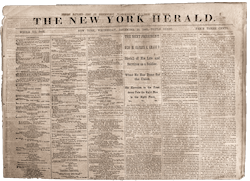
May 9, 1863, The New York Herald

The President and General-in-Chief in Consultation with General Hooker.

THE CORRESPONDENCE OF MR. G.H. OSBORNE.

FALMOUTH, Va., May 7, 1863.

At about ten o’clock this morning a special train, consisting of a locomotive and a single box car, arrived from Aquia creek, bringing to the station two distinguished visitors. President Lincoln and Major General Halleck were the solo occupants of the car, having left Washington at a very early hour this morning by steamer, and riding through Aquia creek upon a couple of camp stools.

Immediately upon their arrival the President and the General-in-Chief were conducted to a carriage which had been for some time in waiting, and with a solitary cavalryman on either side of the vehicle were escorted to the headquarters of Major General Hooker. No demonstration was made by the few groups of officers and soldiers who were lounging about the depot, save an occasional touch of the vizor by those who recognized in the tall, stooping form and thin, careworn features the presence of the Commander-in-Chief of the army and navy of the United States. His coming, although known at headquarters, seemed to take everybody at the station by surprise.

After reaching the old headquarters camp, the President and General Halleck at once repaired to General Hooker’s tent, and entered into a conference, it is supposed, upon the result and the impending movements of the Army of the Potomac. They are now together, in deep consultation.

The President’s countenance seemed to bear traces of pure disappointment. His appearance was in every way that of an overtasked and overworked man. General Halleck, on the other hand, seemed, to a casual observer like myself, to be in the best of health and spirits.

0 comments

0

News of the Day

May 9, 1863, The New York Herald

OUR DESPATCHES.

THE CORRESPONDENCE OF MR. S.M. CARPENTER.

HEADQUARTERS, ARMY OF THE POTOMAC.

May 7, 1863.

The Grand Army of the Potomac is once more in its camps, safe from danger. The second experiment for the overthrow of the rebellion has been attempted on the bluffs of the Rappahannock, and failed. In our shattered columns, our decimated batteries, our scattered trains, and the wards of our crowded hospitals we read the painful history of this disaster – a history unprecedented in its character and humiliating to the nation.

A REVIEW OF THE CAMPAIGN.

A brief sketch of the principal features connected with this remarkable campaign, although necessarily meagre, cannot at this time prove uninteresting. I shall attempt the narration, however, conscious of my inability to do the subject justice.

THE ADVANCE was commenced on the morning of the 27th of April. The troops were elated. Every countenance beamed with enthusiasm and confidence, and the army streamed out from its camps among the hills, glorious in the pride of its power, flushed with the prospect of victory. The Eleventh and Twelfth corps went first, and crossed Kelly’s ford without opposition. The Fifth followed immediately after, crossed at the same place, wheeled to the left, and marching down along the narrow strip of land between the Rapidan and the Rappahannock, crossed the former at Ely’s Ford and joined the Eleventh and Twelfth at Chancellorsville, nine miles from Fredericksburg. Every one was astonished at the rapidity of the movement, and the failure of the enemy to resist us. It is true they gave us a little fight at Germania Mills, but a volley from our infantry was answered by the white flag of surrender, and one of the strongest positions upon our line of march fell into our hands, with the loss of but a single man. General Hooker, with his staff, had followed and was soon at the front. The advance of the Fifth corps pushed on down the turnpike towards the city, but was repulsed from a strong position held by the enemy at the junction of the turnpike with the plank road, six miles from Fredericksburg, and fell back upon the main column, while the Second and Third corps hurried up from the United [continue reading…]

0 comments

0

News of the Day

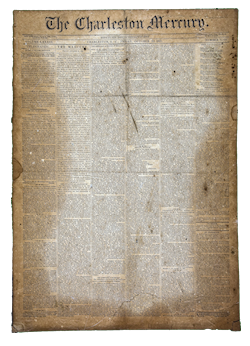
May 9, 1863, The Charleston Mercury

The smoke of battle is slowly lifting from the famous banks of the Rappahannock, and the scene reveals another signal triumph, to be added to the long list of victories, which have illustrated the prowess of the Southern troops. Scanty as are the accounts that reach us of the movements and details of the conflict, we know enough to convince us of the gratifying character of the general results. The […..] army on the planet,’ with Fighting Joe HOOKER at it head, has once more been hurled back by the invincible veterans of LEE. The fields of Spotsylvania have again been reddened with the blood and strewn with the bones of the invaders, and ten thousand of the insolent Northern host will go, captives, to the Richmond they had hoped to enter, as conquerors. Let us thank God that, heavy as has been the cost, a great victory has been won, which will heighten the fame of our cause, at home and abroad, and send new dismay to the hearts of our enemies everywhere.

0 comments

0

News of the Day

May 9, 1863, The New York Herald

PROCLAMATION BY PRESIDENT LINCOLN.

WASHINGTON, May 8, 1863.

BY THE PRESIDENT OF THE UNITED STATES OF AMERICA:– A PROCLAMATION.

Whereas, the Congress of the United States, at its last session, enacted a law entitled, “An act for enrolling and calling out the national forces, and for other […..] purposes,” which was approved on the third day of March last; and

Whereas, it is recited in the said act that there now exists in the United States an insurrection and rebellion against the authority thereof, and it is, under the constitution of the United States, the duty of the government to suppress insurrection and rebellion, to guarantee to each State a republican form of government, and to preserve the public tranquillity; and,

Whereas, for these high purposes a military force is indispensable, to raise and support which all persons ought willingly to contribute, and

Whereas, no service can be more praiseworthy and honorable than that which is rendered for the maintenance of the constitution and the Union, and the consequent preservation of free government; and

Whereas, for the reason thus recited, it was enacted by the said statute that all able bodied male citizens of the United States, and persons of foreign birth who shall have declared on oath their intentions to become citizens under and in pursuance of the laws thereof, between the ages of twenty and forty-five years, with certain exceptions not necessary to [continue reading…]

0 comments

0

News of the Day

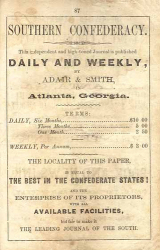
May 9, 1863, Southern Confederacy (Atlanta, Georgia)

 (Author Unknown.)

Air–Bonnie Blue Flag.

Oh!  yes, I am a Southern girl,
           
And glory in the name,
And boast it with far greater pride
           
Than glittering wealth or fame.
I envy not the Northern girl
           
Her robes of beauty rare;
Though diamonds grace her snowy neck,
           
And pearls bedeck her hair.
Chorus.

           
                Hurrah!  hurrah!  for the sunny South so dear;
           
                Three cheers for the homespun dress             
           
                The Southern ladies wear.

This homespun dress is plain, I know–
           
My hat’s Palmetto, too–
But then it shows what Southern girls
           
For Southern rights will do.
We’ve sent the bravest of our land
           
To battle with the foe,
And we would lend a helping hand;
           
We love the South, you know.
Now, Northern goods are out of date,
           
And since Old Abe’s blockade, [continue reading…]

0 comments

0

News of the Day

May 9, 1863, The New York Herald

OUR DESPATCHES.

THE CORRESPONDENCE OF MR. L.A. HENDRICKS.

FIFTH ARMY CORPS HEADQUARTERS.

IN OLD CAMP, NEAR FALMOUTH, Va., May 6, 1863.

The recent movement and its result may be set down as a nine days wonder. Just nine days absence, and we are back to our old camps again. I essay no criticism upon the recent movement, but I will essay the allegation that no one anticipated the reoccupying so soon our old camping grounds. Any ratiocination only ends in the inexplicable if not philosophic conclusion that

            There is a divinity that shapes our ends,

            Rough ——

Our army, to say the least, have had a rough time of it. They had a rough time on the march, a rough time in the fights, a rough time in the sleepless nights and coffeeless meals and a rough time in the march back again. Whether the result will tell roughly upon any of our commanding generals, or the military sagacity of the war powers at Washington, the future will develop. As the case stands the facts resolve themselves into three propositions and three conclusions.

First – We started to find the enemy, and we found him.

Second – We started to whip the enemy, and we did not whip him.

Third – We started to remain away and we have come back again.

How these propositions come to be followed by these conclusions future war investigating committees may determine. For the present I confess myself under a cloud, and I have the consciousness of knowing – although this consciousness, I confess, is not attended with any high degree of satisfaction – that officers of all grades with whom I have conversed confess themselves similarly beclouded. If there is any true philosophy in the principal that is “might is right” then the [continue reading…]

0 comments

0

News of the Day

May 9, 1863, The New York Herald

OUR DESPATCHES.

THE CORRESPONDENCE OF MR. GALEN H. OSBORNE.

BANKS’ FORD ON THE RAPPAHANNOCK, May 7, 1863.

SALEM HEIGHTS.

The battle of Salem Heights, fought on Sunday evening, was one of the most sanguinary contests of the war. The forces of General Sedgwick were marching to join General Hooker’s column at Chancellorsville, when they came upon the reinforcements which Longstreet had collected, and, after an engagement almost without a parallel in severity during the rebellion, were compelled to withdraw.

THE ADVANCE

In the advance from the heights of Fredericksburg the division of General Brooks led the way, with Newton’s column upon the right, and that of General Howe upon the left. Skirmishers from the Sixty-first Pennsylvania, Forty-third New York, Eighty-second Pennsylvania and Seventh Massachusetts were thrown out in front and on both flanks, and the march for the first two miles was unopposed by the retiring foe, toward whom our resolutely advancing troops occasionally directed a volley of their musketry. At this distance, however, the rebel General Early rallied his men, and posted a battery of flying artillery in such a position as for a time to annoy us, but nevertheless inflicting slight damage. An order to charge upon the battery was obeyed with the greatest alacrity, but before our infantry, who went up on the double quick, could reach it, the rebels limbered up and hurried away. [continue reading…]

0 comments

0

News of the Day

May 9, 1863, The New York Herald

His Adventures in the Rebel Confederacy.

The Experiences of Mr. J.H. Vosburg, One of Our Special Army Correspondents.

It has been remarked that the HERALD had correspondents in every place where it is possible that anything interesting may occur, but I believe that I have the distinction of being the first representative of that press in Libby prison.

On my way from Stafford Court House to Kelly’s Ford, just previous to the late advances of our army, I was induced by illness and the lateness of the hour to take up quarters for the night at a comfortable farmhouse, instead of proceeding to camp. This was on Sunday evening, April […]. The house where I stopped was a hospitable one on a road where troops were passing almost hourly, and I had no reason to apprehend an encounter with the subjects of Jeff. Davis. About eight o’clock the next morning, when starting out for a walk after breakfast, accompanied by my host, and having passed the gate and into the road, I was suddenly confronted by two men in the unmistakable gray uniform of the Confederate service, with guns […..]a ready.” They had been concealed behind an embankment, and when I first perceived them were not six paces from me. Bidding me a courteous “Good morning,” they told me that I was a prisoner. Under the circumstances to surrender was valorous discretion, and I yielded, as my captors afterwards remarked, […..] dignifiedly.” The remainder of the party, making in all six, immediately appeared.

The rest of this article is published at

Chronicles >> Prisons and Prisoners >> Libby >>> Our Captured Corrspondent

0 comments

0

News of the Day

May 9, 1863, The New York Herald

The official report of Admiral Porter, recording his great success in the capture of Grand Gulf, Miss., was received at the Navy Department yesterday, and created much excitement in Washington. The possession of this point places the formidable rebel strongholds at Vicksburg and Port Hudson at our mercy. Admiral Porter says that he now holds the door to Vicksburg. The fight lasted five hours and a half. The forts were literally torn to pieces by the fire of our vessels, but all the guns captured by our forces were in good condition. The works at Grand Gulf were the most formidable ones the rebels possessed in the vicinity of Vicksburg. Admiral Porter and General Grant now hold them, and are remounting the guns. General Grant is reported by despatches from Cairo to have reached Port Gibson. Many of the rebels who fled from Grand Gulf were captured by our pursuing forces.

We have the authority of the Secretary of War, in his despatch to Governor Curtin, of Pennsylvania, yesterday, that the Army of the Potomac will speedily resume offensive operations; that, although the principal operations of General Hooker failed, there has been no serious disaster to the organization and efficiency of the army, and that not more than one-third of General Hooker’s force was engaged,

The movements of General Stoneman’s cavalry force, which formed the most brilliant episode in the nine days’ fight of Hooker’s army, are finely illustrated in the map which we publish today. It shows the different routes taken by the several divisions of the cavalry corps under Generals Stoneman, Averill and Buford, and Colonels Kilpatrick, Davis, and Wyndham. Starting from Kelly’s Ford on the northwest, the lines of march are faithfully portrayed, (marked with the design of arrows) to all the points touched at the portions of the track torn up, the bridges destroyed, and the spot where the canal was cut, near Columbia. The latest news reports Colonel Kilpatrick as having reached Gloucester Point, through Tunstal’s Station, near Yorktown, where he joined General King. Of the brilliant movement of Colonel Kilpatrick’s command, General King says in his official notice of his arrival at Gloucester Point: – ‘They burned the bridges over the [continue reading…]

0 comments

0

News of the Day

May 9, 1863, The Charleston Mercury

HIGHLY IMPORTANT FROM RICHMOND.

OUR VICTORY ON THE RAPPHANNOCK COMPLETE.

TEN THOUSAND PRISONERS TAKEN, &C., &C., &C.

RICHMOND, May 7 – 10 p.m. – The following official despatch was received here tonight:

CHANCELLORSVILLE, MAY 7.

To his Excellency President Davis: After driving SEDGWICK across the Rappahannock on the night of the 4th, I returned on the 5th to Chancellorsville. The march was delayed by a storm which continued during the whole of the night following. In placing our troops in position on the morning of the 6th to attack HOOKER, I ascertained that he had abandoned his fortified position. A line of skirmishes pressed forward until they came within range of the enemy’s batteries planted north of the Rappahannock, which, from the configuration of the ground, completely commanded this side. His army therefore escaped with the loss of a few additional prisoners.

(Signed) R.E. LEE.

(The Latest)

RICHMOND, May 8. – All accounts from the lines of the Rappahannock represent our victory to have been a very decided one.

We have captured about ten thousand prisoners, many valuable horses and wagons, and a large quantity of ammunition and small arms.

The number of our wounded is large; but they are well cared for. Colonel GRIFFIN was not killed, but captured. It is reported that DANIEL E. SICKLES, the Yankee General, was killed.

The trains have resumed their regular trips between this city and Fredericksburg. Five trains arrived here last night, laden with the wounded. All is quiet at Fredericksburg. BARKSDALE is reoccupying the place, and the enemy is opposite, as before.

The storm in Spotsylvania county on Wednesday was the severest that has been felt there for twelve months past.

0 comments

0

News of the Day

May 9, 1863, The New York Herald

The Secretary of War, in his despatch of yesterday to the Governor of Pennsylvania, says that although principal operations of General Hooker failed, there has been no serious disaster to the organization and efficiency of the army;”that more than one-third of General Hookerforce was engaged;” that “General Stoneman’s operations have been a brilliant success,” and that Army of the Potomac will speedily resume offensive operations.”

These official statements are encouraging if we may accept them as involving a new commander to the army; but otherwise they amount to nothing. Under the circumstances, it may be something to boast of that the army has suffered no serious disaster, and is still strong, compact and efficient; but no more damaging confession could be made in regard to General Hooker than that […..] more than one-third” of his army was engaged in all his three days’ battles around Fredericksburg and Chancellorsville. In this fact alone it is evident that his army was two-thirds larger than his abilities to manage it. We would not be cruel towards General Hooker. He is sufficiently punished by his deplorable failure where he had promised and had the means and the opportunity for a glorious success. We may say, however, that in the division of his forces when he should had massed them against the enemy; in his movements to avoid a general engagement where he should have tried it; in fighting upon the defensive with only one-third of his forces, when he should have acted upon the offensive with his whole army; that in his delay to bring out the enemy after crossing the river, and in permitting them, en masse, to operate first upon one flank and then upon the other; and that, finally, in recrossing the river, when by the concentration of his columns the enemy dared not attack him, it is abundantly proved that General Hooker has neither the skill, the grasp of mind, nor the steadiness or self-possession which ought to belong to the commander of the Army of the Potomac.

So conclusively do we regard the facts against him that we take it for granted that General Hooker is to be set aside. He has had a fair trail, a splendid opportunity; he has signally failed, and simple justice to the brave army which he has so [continue reading…]

0 comments

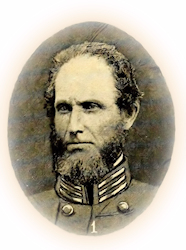
Where Dora Miller resists the attempt of a flunky officer to requisition the house she lives in for Pemberton’s headquarters. .

War Diary of a Union Woman in the South

May 9th, 1863.—This morning the door-bell rang a startling peal. Martha being busy; I answered it. An orderly in gray stood with an official envelope in his hand.

“Who lives here?”

“Mr. L.”

Very imperiously—”Which Mr. L.?”

“Mr. H. L.”

“Is he here?”

“No.”

“Where can he be found?”

“At the office of Deputy ______.”

“I’m not going there. This is an order from General Pemberton for you to move out of this house in two hours. He has selected it for headquarters. He will furnish you with wagons.”

“Will he furnish another house also?”

“Of course not.”

“Has the owner been consulted?”

“He has not; that is of no consequence; it has been taken. Take this order.”

“I shall not take it, and I shall not move, as there is no place to move to but the street.”

“Then I’ll take it to Mr. L.”

“Very well, do so.”

As soon as Mr. Impertine walked off I locked, bolted, and barred every door and window. In ten minutes H. came home.

“Hold the fort till I’ve seen the owner and the general,” he said, as I locked him out.

Then Dr. B.’s remark in New Orleans about the effect of Dr. C.’s fine presence on the Confederate officials there came to my mind. They are influenced in that way, I thought; I look rather shabby now, I will dress. I made an elaborate toilet, put on the best and most becoming dress I had, the richest lace, the handsomest ornaments, taking care that all should be appropriate to a morning visit; dressed my hair in the stateliest braids, and took a seat in the parlor ready for the fray. H. came to the window and said:

“Landlord says, ‘Keep them out. Wouldn’t let them have his house at any price.’ He is just riding off to the country and can’t help us now. Now I’m going to see Major C, who sent the order.”

Next came an officer, banged at the door till tired, and walked away. Then the orderly came again and beat the door—same result. Next, four officers with bundles and lunch-baskets, followed by a wagon-load of furniture. They went round the house, tried every door, peeped in the windows, pounded and rapped, while I watched them through the blind-slats. Presently the fattest one, a real Falstaffian man, came back to the front door and rung a thundering peal. I saw the chance for fun and for putting on their own grandiloquent style. Stealing on tiptoe to the door, I turned the key and bolt noiselessly, and suddenly threw wide back the door, and appeared behind it. He had been leaning on it, and nearly pitched forward with an “Oh! what’s this?” Then seeing me as he straightened up, “Ah, madam!” almost stuttering from surprise and anger, “are you aware I had the right to break down this door if you hadn’t opened it?”

“That would make no difference to me. I’m not the owner. You or the landlord would pay the bill for the repairs.”

“Why didn’t you open the door?”

“Have I not done so as soon as you rung? A lady does not open the door to men who beat on it. Gentlemen usually ring; I thought it might be stragglers pounding.”

“Well,” growing much blander, “we are going to send you some wagons to move; you must get ready.”

“With pleasure, if you have selected a house for me. This is too large; it does not suit me.”

“No, I didn’t find a house for you.”

“You surely don’t expect me to run about in the dust and shelling to look for it, and Mr. L. is too busy.”

“Well, madam, then we must share the house. We will take the lower floor.”

“I prefer to keep the lower floor myself; you surely don’t expect me to go up and down stairs when you are so light and more able to do it.”

“He walked through the hall, trying the doors. “What room is that?”—”The parlor.” “And this?”—”My bedroom.” “And this?”—”The dining-room.”

“Well, madam, we’ll find you a house and then come and take this.”

“Thank you, colonel. I shall be ready when you find the house. Good morning, sir.”

I heard him say as he ran down the steps, “We must go back, captain; you see I didn’t know they were this kind of people.”

Of course the orderly had lied in the beginning to scare me, for General Pemberton is too far away from Vicksburg to send such an order. He is looking about for General Grant. We are told he has gone out to meet Johnston; and together they expect to annihilate Grant’s army and free Vicksburg forever. There is now a general hospital opposite this house and a small-pox hospital next door. War, famine, pestilence, and fire surround us. Every day the band plays in front of the small-pox hospital. I wonder if it is to keep up their spirits? One would suppose quiet would be more cheering.


Note: To protect Mrs. Miller’s job as a teacher in post-civil war New Orleans, her diary was published anonymously, edited by G. W. Cable, names were changed and initials were generally used instead of full namesand even the initials differed from the real person’s initials. (Read Dora Richards Miller’s biographical sketch.)
0 comments

0

Cruise of the U.S. Flag-Ship Hartford -Wm. C. Holton

May 8th. Lying to an anchor in the Mississippi off the mouth of Red river; all quiet on the “Father of Waters,” up to four A. M., when a scene of great excitement occurred on board of the Flag-ship Hartford. The reader may ask what was the cause of it? Was the enemy near? No; but our friends were, and about bidding us, maybe, a long adieu, and leaving the good old ship for other parts; and they were our best of friends,—those who had left their wives and children, homes, relations, all that tends to make home dear, to be with us, and by their presence, kind words, and noble example, encourage us to deeds of noble daring; and well, dear reader, have they performed this duty, as the preceding pages of this book will testify, having been under their command in nine general engagements with the enemy, and have come out of all victorious, with little loss of life or limb, and the least damage to ship, while other vessels of the fleet had to succumb to the destructiveness of the enemy’s shot and shell, losing many valuable lives. This will appear more wonderful when it is taken into consideration that we always took the lead; we never asked others to go where we were afraid to go ourselves, and by this course of proceeding the Hartford has earned herself and brave Commander a name and fame at home and abroad. The rebels upon the banks of the Mississippi call her the black devil, and honorably acknowledge him who flies his broad blue pennant in defiance to them from her masthead, to be a bold, brave, and daring old warrior. I think it is a well-deserved compliment to the old naval hero, who never knew what fear or defeat was, and also to the staunch and noble old vessel whose decks he has trod with such a courageous tread and quiet mien, while guiding her movements when engaged with the enemy at close quarters, and running the gauntlet of their terrible batteries under a storm of iron hail. Success to him and his brave companions in all their future operations is the wish of the writer of these few lines, and may he be spared many years yet to brighten the rage of history with an account of his glorious deeds in the service of his country. Although rumored the day previous, the ship’s company could not be made to believe that we were going to lose one who held such a place in the hearts of all, and had become so dear—whose name was a household one; but alas! the dawn of this day proved the rumor too true, and many a countenance of these tars, tried by fire and water, every one a hero and able to relate an account of his hair-breath escapes from the enemy, was darkened and clouded over from the effect of this sad news; others’ eyes were wet with the tears they would fain conceal, but could not; their grief would find vent through this channel. All things being in readiness, at four, forty this morning, precisely, the following officers left the ship, viz . Rear-Admiral D. G. Farragut, Fleet Captain T. A. Jenkins, Fleet Surgeon J. M. Foltz, Rear-Admiral’s Secretary, E. C. Gabaudan, Fleet Captain’s Clerk, E. A. Palmer; also Lieut. Eaton of U. S. A. Signal Corps, and two soldiers of same; at five A. M., the Sachem got under way with them on board, when the lads manned the rigging, and gave three times three with a will; such cheers were seldom given by our noble sailors to any person or persons, and the honored recipients of same will long remember the event.


0 comments

Downing’s Civil War Diary.–Alexander G. Downing.

Diary of Alexander G. Downing; Company E, Eleventh Iowa Infantry

Friday, 8th–General Blair’s Division, composed of Ohio and Illinois troops, went by today on their way to Grand Gulf. All day teams were returning to the river landing for provisions for the army at Grand Gulf. We received orders to send all the sick back to the hospital at Memphis, and prepare to march. Our regiment has battalion drill twice a day now.

0 comments

War Diary of Luman Harris Tenney.

War Diary of Luman Harris Tenney.

Friday, 8th. Clear but uncomfortably warm. The regt. came in during the day. Issued four days’ rations in the morning. Conflicting reports about a battle on the Potomac. Hooker whipped! Richmond taken! etc. All very anxious to get reliable news. Col. Miner in camp. Received no letters from home and Fannie. Wrote in the evening.

0 comments

A Rebel War Clerk’s Diary

A Rebel War Clerk’s Diary at the Confederate States Capital, By John Beauchamp Jones
A likeness of Jones when he was editor and majority owner of the Daily Madisonian during President John Tyler’s administration.

MAY 8th.—To-day the city is in fine spirits. Hooker had merely thrown up defenses to protect his flight across the river. The following dispatch was received last night from Gen. Lee:

“CHANCELLORVILLE, May 7th, 1863.

“TO HIS EXCELLENCY, PRESIDENT DAVIS.

“After driving Gen. Sedgwick across the Rappahannock, on the night of the 4th inst., I returned on the 5th to Chancellorville. The march was delayed by a storm, which continued all night and the following day. In placing the troops in position on the morning of the 6th, to attack Gen. Hooker, it was ascertained he had abandoned his fortified position. The line of skirmishers was pressed forward until they came within range of the enemy’s batteries, planted north of the Rappahannock, which, from the configuration of the ground, completely commanded this side. His army, therefore, escaped with the loss of a few additional prisoners.

“(Signed)……………………………………………….R. E. LEE, General.”

Thus ends the career of Gen. Hooker, who, a week ago, was at the head of an army of 150,000 men, perfect in drill, discipline, and all the muniments of war. He came a confident invader against Gen. Lee at the head of 65,000 “butternuts,” as our honest poor-clad defenders were called, and we see the result! An active campaign of less than a week, and Hooker is hurled back in disgrace and irreparable disaster! Tens of thousands of his men will never live to “fight another day”—and although the survivors did “run away,” it is doubtful whether they can be put in fighting trim again for many a month.

And the raiding cavalry have not been heard from today. If they be not back on the north side of the Rappahannock by this time, it is probable they will reach Richmond in a few days without arms, and on foot.

Gens. Hood’s and Pickett’s divisions (Longstreet’s corps) are now passing through the city—perhaps 15,000 of the best fighting men in the South. Oh, what wisdom and foresight were evinced by Gen. Lee, when, some ten days ago, he telegraphed the President to send him Longstreet’s corps, via Gordonsville! It was referred to the Secretary of War, who consulted with Gen. Cooper—and of course it was not done. This corps was not in the battle. If it had been on the field, Hooker’s destruction would have been speedy and complete; and his routed regiments would have been followed to the very gates of the Federal capital. As it was, Lee lost a day in driving Sedgwick back—and then Hooker “escaped,” as Lee expresses it.

I do not understand the Assistant Secretary of War’s official correspondence. He sent in the other day a letter addressed to him two years ago to be filed—and to-day an envelope addressed to him as Assistant Secretary by Mr. Benjamin, Secretary of State, merely covering a letter (sealed) for R. S. Bunkee, Mobile, Alabama. Well, it is filed.

The pressure for permits to leave the Confederacy is not renewed to-day. Judge Campbell will not have so many passports to “approve,” and I trust confidence in the permanency of the Confederacy will be unshaken. How must they feel who, in anticipation of Lee’s defeat, had received, in advance, a pardon from the powers at Washington!

Col. Lay was in to-day; he thinks the North will be cheered a little by their capture of GrandGulf, in the West. But that is not Vicksburg, or Charleston, or Richmond.

We have had short allowance of food yesterday and to-day; the country people being afraid to come to market, lest their horses should be seized to go in quest of the enemy’s cavalry. My family dined to-day on eight fresh herrings, which cost two dollars.

The trains from Fredericksburg brought down several hundred Federal officers; among them was a general, a large number of colonels, lieutenant-colonels, majors, captains, etc. These, when exchanged, as I suppose they will be—for victory makes our government magnanimous—may, if they choose, deny the report that the raiding cavalry destroyed the railroad.

Now what will the Tribune say? It did say, a few months ago, that if the effort to crush the rebellion failed this spring, it would be useless to prolong the war—and that peace should be made on the best practicable terms. Since the beginning of the war, I doubt not 500,000 men have been precipitated upon Virginia. Where are they now? In the third year of the war, we see “the finest army the world ever saw,” overthrown by about half its numbers, and in full retreat toward its own frontier. Perhaps 100,000 invaders have found bloody graves in Virginia—and an equal number have died of their wounds, or from disease contracted in this State. The number of maimed and disabled must also be 100,000—and yet Richmond is not taken, or likely to be. To invade and subjugate a vast territory, inhabited by millions of warlike people, the assailants must always have four times as many men as the assailed; therefore we stand on an equal footing with the United States in this war, and they may, if they be insane enough, protract it indefinitely, and in the end reap no substantial benefit. On the contrary, the fortune of war may shift the scene of devastation to their own homes. Perhaps Lee may follow up this blow until he enters Pennsylvania.

0 comments

0

A Soldier’s Story of the Siege of Vicksburg

From the diary of Osborn H. Oldroyd

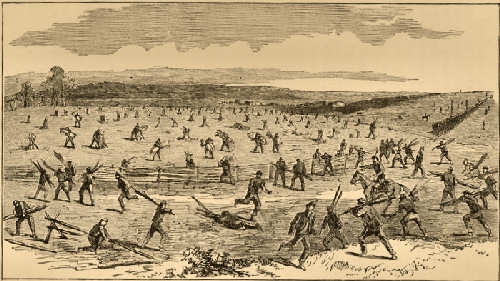
MAY 8TH–We were ready to continue our march, but were not ordered out. Some white citizens came into camp to see the “Yankees,” as they call us. Of course they do not know the meaning of the term, but apply it to all Union soldiers. They will think there are plenty of Yankees on this road if they watch it. The country here looks desolate. The owners of the plantations are “dun gone,” and the fortunes of war have cleared away the fences. One of the boys foraged to-day and brought into camp, in his blanket, a variety of vegetables–and nothing is so palatable to us now as a vegetable meal, for we have been living a little too long on nothing but bacon. Pickles taste first-rate. I always write home for pickles, and I’ve a lady friend who makes and sends me, when she can, the best kind of “ketchup.” There is nothing else I eat that makes me catch up so quick. There is another article we learn to appreciate in camp, and that is newspapers–something fresh to read. The boys frequently bring in reading matter with their forage. Almost anything in print is better than nothing. A novel was brought in to-day, and as soon as it was caught sight of a score or more had engaged in turn the reading of it. It will soon be read to pieces, though handled as carefully as possible, under the circumstances. We can not get reading supplies from home down here. I know papers have been sent to me, but I never got them. The health of our boys is good, and they are brimful of spirits (not “commissary”). We are generally better on the march than in camp, where we are too apt to get lazy, and grumble; but when moving we digest almost anything. When soldiers get bilious, they can not be satisfied until they are set in motion.

2007-00604a.jpg

The raid on the fence before going into camp

0 comments

0

News of the Day
1860s newsprint

May 8, 1863, Mobile Register And Advertiser

            The Shreveport Gazette recently published a card signed by about a hundred foreigners, who, fearing they might be drafted in the militia, adopted that course to notify the people that they were French subjects, and owned no allegiance to Louisiana.  The News says that Mr. B. Courtade, one of the signers of the card, was taken out of his bed and “tarred and cottoned” the same night, and the rogue’s march was played before the business houses of the balance.

0 comments

0

News of the Day

May 8, 1863, Tri-Weekly Telegraph (Houston, Texas)

            We are informed that Col. Pyron’s regiment, which is now on the march to the field to meet the enemy, are in need of haversacks.  This article is very necessary to a soldier in the field, and it being such a cheap article, we think we have only to call the attention of our readers to their want of them.  Our citizens have been very liberal to all our soldiers, and this noble regiment has been always entirely overlooked, save by the ladies of Washington county.  Capt. Wm. Edwards, of the regiment, is detained on business in this city for a short time, and will forward the articles direct to the men of the regiment.  Who will be first to respond to the appeal?  Here is a chance for our patriotic ladies to do good, and gain honor by the outlay of a small capital.

0 comments

0

News of the Day

May 8, 1863, Tri-Weekly Telegraph (Houston, Texas)

            Waxahachie, Texas, April 30.–The Waxahachie powder mill blew up yesterday.  Mr. Rown, the proprietor, and Mr. Phillips one of the hands, were both killed, and Mr. Nance was badly bruised.  There were about 2000 lbs. of powder in the mill at the time.

0 comments

0

News of the Day

May 8, 1863, The New York Herald

The news of General Hooker’s retrograde movement across the Rappahannock without a general battle, and with the enemy en masse in his rear, created throughout this city yesterday a profound sensation of disappointment and despondency. Confident hopes of great victories were changed again to painful anxieties for the safety of the army; for the news of the morning left our forces crossing the swollen river on two narrow pontoon bridges, in broad daylight and in view of the enemy.

We experience no small sense of relief in being able to announce to our readers that the army is safe in its old camp at Falmouth. That it was permitted to recross the river without a determined effort of the enemy to cut it to pieces satisfies us that General Lee was not disposed to risk the experiment; for he has shown from the beginning a remarkable knowledge of every movement of our forces. It is said that General Hooker was in a measure compelled to recross the river, because, with its flooded condition, and the almost impassable roads between it and his depots, he was in danger of being cut off from his supplies of provisions and ammunition.

After the events of the last ten days it is easy to see that General Hooker might have done better. For instance, had he avoided any signs of an advance until General Stoneman had cut the rebel railway communications with Richmond and returned to the army, the reinforcements and supplies to Lee from below might have been cut off until too late to be of any service to him. Or had General Hooker retained the powerful body of Stoneman’s cavalry to guard his flanks, that disastrous rebel flank movement of Friday and Saturday could have easily been prevented. We apprehend, however, that General Hooker greatest mistake was an underestimate of the strength of the rebels, or he surely would not have advanced beyond the river to draw them out without the support of Stoneman’s cavalry. From the moment he touched the south side of the river that formidable body of horsemen would have been invaluable in scouring the country and in keeping General Hooker apprised of every movement of the enemy in season to meet it. As the matters stand, [continue reading…]

0 comments

0

News of the Day
1860s newsprint

May 8, 1863, American Citizen (Canton, Mississippi)

            The Raleigh State Journal, alluding to the high price of newspaper, and the difficulty of procuring it at almost any price, says:

            What remedy is there for this state of things?  We see but two:  either an enormous increase in the price of subscription, or a suspension of the press.  With paper at fifty cents per pound a weekly sheet cannot be issued for less than five dollars.  This calculation excludes any profit.  To preserve the profits of ordinary times, the price would be at least seven dollars.  The dailies at that rate must go to fifteen dollars.  To pay, outside of the large cities, a daily must go to twenty dollars.

            There are a certain class of readers who will take a paper at any price.  But these would take papers which were published nearest the sources of news.  They would not take country papers at all, at the prices.

            We can suggest one measure which might afford relief.  The Government we understand has large quantities of cotton on hand, which was bought at a comparatively small price.  If the paper mills could buy this cotton from the government at a price to cover all expenses and pay a small advance, they could afford paper at present rates and thus save the press.

            But this plan we know would be objected to on the ground of affording Government aid to special private enterprises, a principle which has been repudiated in our politics for years, at least in theory.

            This failing, we see nothing before us but the suspension of a large majority of the papers of the Confederacy. [continue reading…]

0 comments