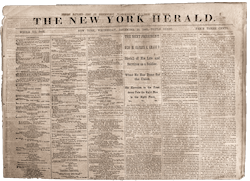
June 17, 1863, The New York Herald
The sudden and rapid invasion of Maryland and Pennsylvania by General Lee’s army, from Culpepper and the upper Rappahannock, after outgeneralling Hooker by turning his right flank, is to be traced directly to the removal of General McClellan from the command of the army last fall, when he was within two days’ easy march of Culpepper and the enemy. This has been the fertile source of all our troubles and failures and disasters on this side of the Alleghany Mountains since that unhappy 5th of November. McClellan, in the moment of panic last September, when the Cabinet and General-in-Chief at Washington were bewildered and knew not what to do or what orders to give, had taken hold of our army, beaten and demoralized under Pope, and with it saved the federal capital, Maryland and Pennsylvania, and, by the battles of South Mountain and Antietam, had forced Lee to take the back track into Virginia. After recruiting and refitting the shattered Army of the Potomac he followed the rebel general in his retreat towards Richmond, and would have compelled him to fight at a disadvantage, and perhaps defeated him in a decisive battle, or forced him to abandon the Confederate capital and evacuate Northern Virginia. But in the midst of this successful and brilliant career he was cut short, without cause, by the influence of Wade and the Satanic committee of which he was chairman – a committee which misrepresented everything, and deceived alike the Chief Magistrate and the country.
What was the first consequence of this step, following rapidly upon its heels? Burnside, unfit for the command of an army of 100,000 men, broke one side of his head against Fredericksburg, from which he recoiled and staggered back by the force of the shock. He has since fractured the other side of his skull against Vallandigham and [continue reading…]