Fremont’s Hundred Days in Missouri.

The Atlantic Monthly

THE FORCED MARCH TO SPRINGFIELD.

Bolivar, October 26th. Zagonyi’s success has roused the enthusiasm of the army. The old stagers took it coolly, but the green hands revealed their excitement by preparing for instant battle. Pistols were oiled and reloaded, and swords sharpened. We did all this a month ago, before leaving St. Louis. We then expected a battle, and went forth with the shadow and the sunshine of that expectation upon our hearts; but up to this time we have not seen a shot fired in earnest. Now the blast of war blows in our ears, and we instinctively “stiffen the sinews and summon up the blood.”

Captain H., the young chevalier of the staff, whom we have named Le Beau Capitaine, went this morning to St. Louis with intelligence of the victory. He has ninety miles to ride before midnight, to catch to-morrow’s train.

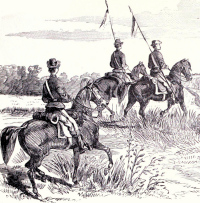
Under the influence of the excitement which prevailed, we were on horseback this morning long before it was necessary, when the General sent us word that the staff might go forward, and he would over-take us. The gay and brilliant cavalcade which marched out of Jefferson City is destroyed, –the maimed and bleeding Guard is reposing a few miles south of Bolivar,–the detachment which was left at head-quarters has gone on to join the main body,–and the staff broken into small parties, straggles along the road. A more beautiful day never delighted the earth. The atmosphere is warm, the sky cloudless, and the distance is filled with a soft dreamy haze, which veils, but does not conceal, the purple hills and golden forests.

A few miles south of our last night’s camp we came out upon a large prairie, called the Twenty-Five Mile Prairie. It is an undulating plain, seven miles wide and twenty-five long. It was the intention to concentrate the army here. A more favorable position for reviewing and manoeuvring a large force cannot be found. But the plan has been changed. We must hasten to Springfield, lest the Rebels seize the place, capture White and our wounded, and throw a cloud over Zagonyi’s brilliant victory.

Passing from the prairie, we entered a broad belt of timber, and soon reached a fine stream. We drew rein at a farm-house on the top of the river-bank, where we found a pleasant Union family. The farmer came out, and, thinking Colonel Eaton was the General, offered him two superb apples, large enough for foot-balls. He was disappointed to find his mistake, and to be compelled to withdraw the proffered gift. Sigel encamped here last night, and the debris of his camp-fires checker the hill-side and the flats along the margin of the creek. After waiting an hour, the General not coming up, Colonel Eaton and myself set out alone over a road which was crowded with Sigel’s wagons. Everything bears witness to the extraordinary energy and efficiency of that officer. This morning he started before day, and he will be in Springfield by noon to-morrow. His train is made up of materials which would drive most generals to despair. There are mule-teams, and ox-teams, and in some cases horses, mules, and oxen hitched together. There are army-wagons, box-wagons, lumber-wagons, hay-racks, buggies, carriages, –in fact, every kind of animal and every description of vehicle which could be found in the country. Most of our division-commanders would have refused to leave camp with such a train; but Sigel has made it answer his purpose, and here he is, fifty miles in advance of any other officer, tearing after Price.

We were jogging painfully over the incumbered road, and through clouds of dust, when an officer rode up in great haste, and asked for Dr. C., who was needed at the camp of the Guards. By reason of the broken order in which the staff rode to-day, he could not be found. For two mortal hours unlucky aides-de-camp dashed to the front and the rear, and scoured the country for five miles upon the flanks, visiting the farm-houses in search of the missing surgeon. At last he was found, and hurried on to the relief of the Guard. At this moment the General came up, and, to our astonishment, Zagonyi was riding beside him, bearing upon his trim person no mark of yesterday’s fatigue and danger. The Major fell behind, and rode into Bolivar with me. On the way we met Lieutenant Maythenyi of the Guard.

Our camp is on the farm of a member of the State legislature who is now serving under Price. His white cottage and well-ordered farm-buildings are surrounded by rich meadows, bearing frequent groups of noble trees; the fences are in good condition, and the whole place wears an air of thrift and prosperity which must be foreign to Missouri even in her best estate.


Fremont’s Hundred Days in Missouri was published in three installments in The Atlantic Monthly. The anonymous author appears to have been a member of Fremont’s staff with a disdainful bias towards Missourians, even those who were pro-Union.
0 comments

Fremont’s Hundred Days in Missouri.

The Atlantic Monthly

October 26th. This morning I was awakened by loud cheers from the camp of the Benton Cadets. My servant came at my call.

“What are those cheers for, Dan?”

“The Body-Guard has won a great victory, Sir! They have beaten the Rebels, driven them out of Springfield, and killed over a hundred of them. The news came late last night, and the General has issued an order which has just been read to the Cadets.”

The joyful words had hardly reached my eager ears when shouts were heard from the sharp-shooters. They have got the news. In an instant the camp is astir. Half-dressed, the officers rush from their tents, – servants leave their work, cooks forget breakfast, – they gather together, and breathless drink in the delicious story. We hear how the brave Guard, finding the foe three times as strong as had been reported, resolved to go on, in spite of odds, for their own honor and the honor of our General,– how Zagonyi led the onset, –how with cheers and shouts of “Union and Fremont,” the noble fellows rushed upon the foe as gayly as boys at play,–what deeds of daring were done, – that Zagonyi, Foley, Maythenyi, Newhall, Treikel, Goff and Kennedy shone heroes in the fray, – how gallantly the Guards had fought, and how gloriously they had died. These things we heard, feasting upon every word, and interrupting the fervid recital with involuntary exclamations of sympathy and joy.

It did not fall to the fortune of the writer to take part with the Body-Guard in their memorable attack, but, as the Judge-Advocate of a Court of Inquiry into that affair, which was held at Springfield immediately after our arrival there, I became familiar with the field and the incidents of the battle. I trust it will not be regarded as an inexcusable digression, if I recite the facts connected with the engagement, which, as respects the odds encountered, the heroism displayed, and the importance of its results, is still the most remarkable encounter of the war.


Fremont’s Hundred Days in Missouri was published in three installments in The Atlantic Monthly. The anonymous author appears to have been a member of Fremont’s staff with a disdainful bias towards Missourians, even those who were pro-Union.
0 comments

Gardner Sacked

Civil War Day-by-Day

Daily Times [Leavenworth, Ks],
October 26, 1861

Our South-Eastern Border.

Every day the necessity becomes more apparent for sending troops along the line between our State and Missouri. Marauding parties are almost constantly scouting along the border, sacking and burning our infant towns, and committing depredations among the inhabitants. The Kansas Brigade, which has so many times “saved Kansas,” is not now in the State, and a force should be sent without delay to repel any advances the rebels may make in southern Kansas. Our latest advices are that the town of Gardner, in Johnson County, has been sacked. A special messenger to Lawrence says the town was attacked by about one hundred rebels1, and fully $10,000 worth of goods taken. It was feared that Olathe would meet with the same fate.

The Governor should instantly despatch a few companies in that direction, with orders to pursue the marauders, and give them no quarter. We had as well advise leniency towards a mad dog, preparing to bite, or leniency toward a Camanche, in waiting for a scalp.


1The raid was 14 men of Dick Yeager’s gang.

0 comments

I feel the effects of severe drill some.—Army letters of Oliver Willcox Norton.

Civil War Day-by-Day

Camp Leslie, Hall’s Hill,

Fairfax County, Va., Oct. 26, 1861.

Friend P——s.:—

To-day has been a great day with us. General McClellan and staff reviewed General Porter’s Division, of which we form a part. Five brigades were reviewed. We are attached to General Butterfield’s Brigade. Our regiment was very highly complimented by the General, as one of the best, if not the best, on the field. We had a sham battle, an exciting time.

My health is still good. I feel the effects of severe drill some. It is as much as I can stand, but, while many are getting sick, I am all right yet. One poor fellow in our regiment died last night. The first one that has died since we left home.

Many seem to think that this war is soon to close. I am fully satisfied, however, that it cannot be ended without the emancipation proclamation, and I think that will be made next winter. I am in for thorough work while we’re at it, but I shudder for the results of the continuance of the war.

To-morrow we do guard duty. It is tiresome work. No sleep nights. Almost every time some fun occurs to relieve the monotony. An Irishman challenged a party the other night with, “Halt! Who goes there?” Ans.–”Grand rounds.” “Och, to the divil wid yez grand rounds; I thought it was the relafe guard.”

0 comments

Manual of arms with our new weapons.–Alexander G. Downing.

Diary of Alexander G. Downing; Company E, Eleventh Iowa Infantry

Saturday, 26th–We drilled with our new arms this morning for the first time. Some of the men are awfully awkward in shouldering arms and using the ramrod and returning it to its place. It is also quite amusing to hear some of the officers give orders when we are going through the manual of arms.

0 comments

Disorderly troops and officers.—Official fibs.—William Howard Russell’s Diary.

My Diary North and South – William Howard Russell

October 26th.–More reviews. To-day rather a pretty sight–12 regiments, 16 guns, and a few squads of men with swords and pistols on horseback, called cavalry, comprising Fitz-John Porter’s division. McClellan seemed to my eyes crest-fallen and moody to-day. Bright eyes looked on him; he is getting up something like a staff, among which are the young French princes, under the tutelage of their uncle, the Prince of Joinville. Whilst McClellan is reviewing, our Romans in Washington are shivering; for the blockade of the Potomac by the Confederate batteries stops the fuel boats. Little care these enthusiastic young American patriots in crinoline, who have come to see McClellan and the soldiers, what a cord of wood costs. The lower orders are very angry about it however. The nuisance and disorder arising from soldiers, drunk and sober, riding full gallop down the streets, and as fast as they can round the corners, has been stopped, by placing mounted sentries at the principal points in all the thoroughfares. The “officers” were worse than the men; the papers this week contain the account of two accidents, in one of which a colonel, in another a major, was killed by falls from horseback, in furious riding in the city.

Forgetting all about this fact, and spurring home pretty fast along an unfrequented road, leading from the ferry at Georgetown into the city, I was nearly spitted by a “dragoon,” who rode at me from under cover of a house, and shouted “stop ” just as his sabre was within a foot of my head. Fortunately his horse, being aware that if it ran against mine it might be injured, shied, and over went dragoon, sabre and all, and off went his horse, but as the trooper was able to run after it, I presume he was not the worse; and I went on my way rejoicing.

McClellan has fallen very much in my opinion since the Leesburg disaster. He went to the spot, and with a little–nay, the least–promptitude and ability could have turned the check into a successful advance, in the blaze of which the earlier repulse would have been forgotten. It is whispered that General Stone, who ordered the movement, is guilty of treason–a common crime of unlucky generals–at all events he is to be displaced, and will be put under surveillance. The orders he gave are certainly very strange. [continue reading…]

0 comments

A Diary of American Events.

The Rebellion Record – A Diary of American Events; by Frank Moore

October 26. – At Mill Creek, five miles from Romney, Gen. Kelley’s force came upon the rebel’s outposts, which they drove in, and advanced to the Indian Mound Cemetery, to the west of the town, where the rebels made a stand and opened fire with a twelve-pound rifled gun, placed in a very commanding position in the cemetery, and with a mountain howitzer from the high grounds on the east bank of the river, which point commanded our approach for a distance of over a mile. At the east end of the bridge the enemy had also thrown up intrenchments, from which they kept up a constant fire of musketry upon the head of the column. One twelve-pounder and two six-pounders responded to the artillery on Kelley’s post until the General was enabled to fully comprehend the enemy’s position, when he soon gave the command to charge upon their batteries and intrenchments. The cavalry under the lead of Capts. Keys and McGhee, dashed across the river, (which was fordable at this point,) while the infantry, under Cols. Mason and De Puy, Lieut.-Col. Kelley, and Major Swearingen, rushed over the bridge to encounter the foe, at the very muzzles of his guns. No sooner did the rebels perceive this movement, than they immediately abandoned their positions, and commenced a precipitate retreat, rushing “pell-mell” through the town, and directing their flight toward Winchester.

General Kelley captured some four hundred or five hundred prisoners, among whom was Colonel E. M. Armstrong, late a member of the Richmond Convention, two hundred horses, three wagon loads of new rifles, three cannon, a large quantity of corn, tents, and, in fact, every thing they had. The loss on the Federal aide was but one man killed and five wounded. When about one and a half miles from Springfield the rear of Col. Johns’ column (ordered to make the feint from the north) was attacked from the heights by the enemy, severely wounding two men and detaining the column about an hour. The march was then resumed through Springfield, and on arriving within half a mile of the bridge crossing the south branch of the Potomac, Col. Johns discovered the enemy on the opposite bank, when a brisk firing commenced. An attempt to force the passage of the bridge was ineffectual, the rebels having destroyed a portion of it. Captain Shaw marched his company upon the bridge with a view to carry the position, but lost one killed and six wounded. At this time, hearing nothing further of the firing at Romney, and concluding that Gen. Kelley had carried the place, and that the object desired had been accomplished, Col. Johns withdrew his force to Oldtown, Md., after a march of twenty-five miles.–(Doc. 107.)

–A large meeting was held at Elkton, Cecil County, Maryland, by the Union men. Speeches were made by Henry Winter Davis, Edwin U. Webster, Alexander Evans, S. S. Maditt, Esq., and others. There were several hundred ladies on the ground, and the display was grand.–N. Y. Tribune, October 30.

–Parson Brownlow has been forced to suspend the publication of his paper, the Knoxville (Tenn.) Whig. He gives his readers a farewell address, in which he says that he will neither give a bend to keep the peace, nor will he take an oath to support the Jeff. Davis Confederacy, and he informs the authorities that he is ready to go to jail. He has been indicted by the Grand Jury for treason, because, as he says, he has refused to publish garbled accounts of skirmishes in Kentucky, and other articles, the insertion of which in his sheet was insisted upon by the rebels.–(Doc. 108.)

–A wagon train was established between Baltimore, Md., and Washington, D. C. Fifty wagons were employed in the service. This was rendered necessary by the closing of the Potomac and the great amount of freight thus thrown upon the railroad.–Baltimore American, October 26.

–Generals Fremont and Sigel arrived at Springfield, Missouri, and were received with a display of National flags and every demonstration of joy.–National Intelligencer, Nov. 1.

–The Charleston Mercury, of this date, declares that the Northern army “has broken its ranks forever;” that “no trumpet will call them to battle again;” and that “however new forces may be mustered, and new generals commissioned, the decree of Manassas cannot be reversed;” that therefore Southern “independence is assured,” and it accordingly gives some space to the consideration of what the relations of the new Government “with the world are to be.” It describes the late prosperous and happy condition of the United States, and its present condition, and fears that Europe will not understand the South when it looks upon it as the active agent in the destruction of so much good. (Doc. 110.)

–Three companies of the Ninth Illinois regiment went to Saratoga, Ky., on the Cumberland River, and attacked a body of rebels, whom they routed, killing thirteen, taking twenty-four prisoners, and capturing fifty-two horses. They had two wounded on their side. These affairs, though not important in their results, in one sense, do nevertheless show in a clear light the spirit and bravery of the National troops, and add new proof to the evidence already gathered that the rebels are sure to be defeated in a fair fight with equal numbers, or with numbers not greatly inferior to theirs.– (Doc. 111.)

–This day a scouting party of thirty men of the Eighth Illinois regiment, under the command of their colonel, Johnson, left for Fort Holt, near Cairo, Ill., and proceeded several miles in the direction of Columbus, Ky. An advance guard was sent out to keep their way clear. They returned to their command and reported to Col. Johnson that a large force of the enemy’s cavalry was advancing upon them; whereupon Col. Johnson ordered his men to a turn in the road, and directed them to lie in ambush for the enemy, who, upon coming up, were confronted by Col. Johnson and ordered to surrender, to which they replied by opening a fire upon him, which he escaped. At this moment the men of his command fired a volley into the midst of the rebels, from the brush, killing their captain and lieutenant, and several others, which so astounded and surprised the rebels that they broke and ran in a promiscuous retreat, leaving their lieutenant dead in the road.–Louisville Journal, November 1.

0 comments

Civil War Day-By-Day

Civil War Day-by-Day

October 26, 1861

A Chronological History of the Civil War in America1

  • Rebels routed by the Union troops at Romney, Va., retreated to Winchester.
  • Gallant charge of Major Zagonyi, of Fremont’s Body Guard, with 160 men, through a rebel force 2,000 strong, at Springfield, Mo.; rebels signally defeated and many of them killed.

  1. A Chronological History of the Civil War in America by Richard Swainson Fisher, New York, Johnson and Ward, 1863
0 comments

Still trying to get a position.—Horatio Nelson Taft

Diary of US patent clerk Horatio Nelson Taft.

FRIDAY, OCTOBER 25, 1861.

A cool, fine October day just right for outdoor business and Military parades. Went down to the Pat office and read the papers in Vansantvoords room. Called at the Sec’ys office, sent in my card but did not see him. Went up to the Presidents in the evening and saw Maj Watt, gave him a new start in the matter of my appointment. He will see the Sec’y tomorrow and Mrs Lincoln in the morning. Caught a little more cold.

______

The three diary manuscript volumes, Washington during the Civil War: The Diary of Horatio Nelson Taft, 1861-1865, are available online at The Library of   Congress.

0 comments

Rebel War Clerk

Civil War Day-by-Day

OCTOBER 25th.—Gen. Price, of Missouri, is too popular, and there is a determination on the part of the West Pointers to “kill him off.” I fear he will gain no more victories.

0 comments

Rhode Island Light Artillery

Diary of Battery A, First Regiment, Rhode Island Light Artillery, by Theodore Reichardt

Friday, October 25. — Remained the same, at Edwards Ferry.

0 comments

Fremont’s Hundred Days in Missouri.

The Atlantic Monthly

THE BODY-GUARD AT SPRINGFIELD.

It may not be out of place to say a few words as to the character and organization of the Guard. Among the foreign officers whom the fame of General Fremont drew around him was Charles Zagonyi, –an Hungarian refugee, but long a resident of this country. In his boyhood, Zagonyi had plunged into the passionate, but unavailing, struggle which Hungary made for her liberty. He at once attracted the attention of General Bem, and was by him placed in command of a picked company of cavalry. In one of the desperate engagements of the war, Zagonyi led a charge upon a large artillery force. More than half of his men were slain. He was wounded and taken prisoner. Two years passed before he could exchange an Austrian dungeon for American exile.

General Fremont welcomed Zagonyi cordially, and authorized him to recruit a company of horse, to act as his body-guard. Zagonyi was most scrupulous in his selection; but so ardent was the desire to serve under the eye and near the person of the General, that in five days after the lists were opened two full companies were enlisted. Soon after a whole company, composed of the very flower of the youth of Kentucky, tendered its services, and requested to be added to the Guard. Zagonyi was still overwhelmed with applications, and he obtained permission to recruit a fourth company. The fourth company, however, did not go with us into the field. The men were clad in blue jackets, trousers, and caps. They were armed with light German sabres, the best that at that time could be procured, and revolvers; besides which, the first company carried carbines. They were mounted upon bay horses, carefully chosen from the Government stables. Zagonyi had but little time to instruct his recruits, but in less than a month from the commencement of the enlistments the Body-Guard was a well-disciplined and most efficient corps of cavalry. The officers were all Americans except three, –one Hollander, and two Hungarians, Zagonyi and Lieutenant Maythenyi, who came to the United States during his boyhood.

Zagonyi left our camp at eight o’clock on the evening of the twenty-fourth, with about a hundred and sixty men, the remainder of the Guard being left at head-quarters under the command of a non-commissioned officer.

Major White was already on his way to Springfield with his squadron. This young officer, hardly twenty-one years old, had won great reputation for energy and zeal while a captain of infantry in a New York regiment stationed at Fort Monroe. He there saw much hazardous scouting-service, and had been in a number of small engagements. In the West he held a position upon General Fremont’s staff, with the rank of Major. While at Jefferson City, by permission of the General he had organized a battalion to act as scouts and rangers, composed of two companies of the Third Illinois Cavalry, under Captains Fairbanks and Kehoe, and a company of Irish dragoons, Captain Naughton, which had been recruited for Mulligan’s brigade, but had not joined Mulligan in time to be at Lexington. [continue reading…]

0 comments

Fremont’s Hundred Days in Missouri.

The Atlantic Monthly

October 25th. We moved only seven miles to-day. It is understood that the General will gather the whole army upon a large prairie a few miles north of Bolivar, and devote a few days to reviewing the troops, and to field-maneuvers. This will have an excellent effect. The men will be encouraged when they see how large the column is, for the army has never been concentrated.

This morning we received news of the brilliant affair at Fredericktown.

Just before the General left camp to-day, I received orders to report myself to General Asboth, for duty as Judge-Advocate of a Court-Martial to be held in his division. General Asboth was several miles behind us, and I set out to ride back and join him. After a gallop of half an hour across the prairie, I discovered that I had lost my way. I vainly tried to find some landmark of yesterday’s march, but was at last compelled to trust to the sagacity of my horse, – the redoubtable Spitfire, so named by reason of his utter contempt for gunpowder, whether sputtered out of muskets or belched forth by cannon. I gave him his head. He snuffed the air for a moment, deliberately swept the horizon with his eyes, and then turned short around and carried me back to the farm-house from which I had started. I arrived just in time for dinner. Two officers of Lane’s brigade, which had marched from Kansas, came in while we were at the table. They seasoned our food with spicy incidents of Kansas life.

After dinner I started with Captain H., of Springfield, to find Asboth. As we left the house, we were joined by the most extraordinary character I have seen. He was a man of medium height. His chest was enormous in length and breadth; his arms long, muscular, and very large; his legs short. He had the body of a giant upon the legs of a dwarf. This curious figure was surmounted by a huge head, covered with coarse brown hair, which grew very nearly down to his eyes, while his beard grew almost up to his eyes. It seemed as if the hair and beard had had a struggle for the possession of his face, and were kept apart by the deep chasm in which his small gray eyes were set. He was armed with a huge bowie-knife, which he carried slung like a sword. It was at least two feet long, heavy as a butcher’s cleaver, and was thrust into a sheath of undressed hide. He called this pleasant instrument an Arkansas toothpick. He bestrode, as well as his diminutive legs would let him, an Indian pony as shaggy as himself. This person proved to be a bearer of despatches, and offered to guide us to the main road, along which Asboth was marching. [continue reading…]

0 comments

Second Charge

Frank Leslie’s Illustrated Newspaper
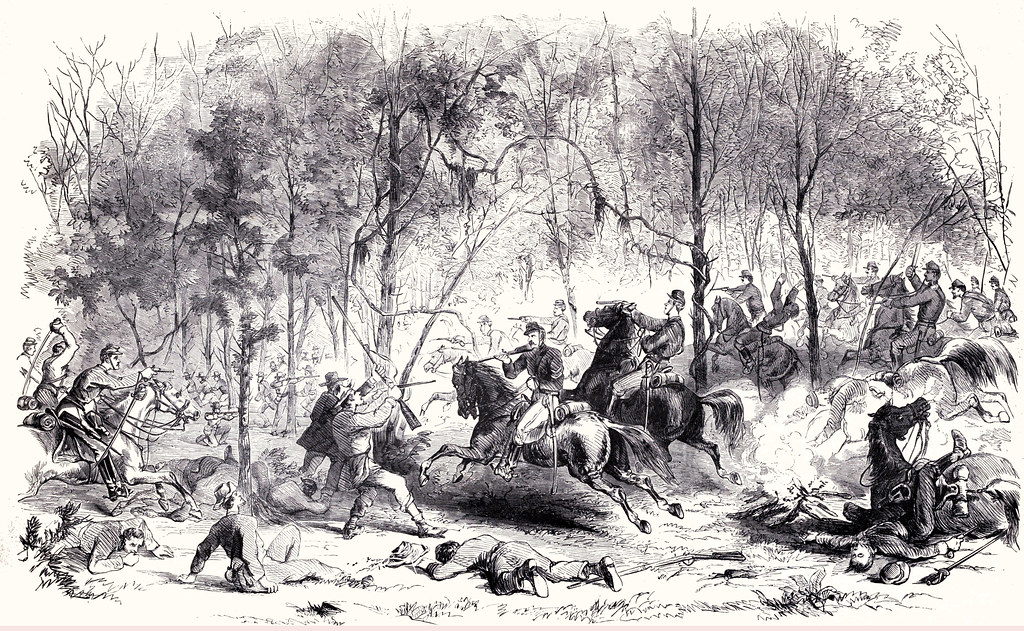
Second Charge upon the Confederates by General Fremont's Bodyguard, under Major Zagonyi, near Springfield, Mo., On October 25th, 1861

Second Charge upon the Confederates by General Fremont’s Bodyguard, under Major Zagonyi, near Springfield, Mo., On October 25th, 1861

(from Frank Leslie’s Illustrated History of the Civil War…, edited by Louis Shepheard Moat, Published by Mrs. Frank Leslie, New York, 1895)

“After the first charge of Major Zagonyi, described on another page, Captain McNaughton reached the scene with fifty men. The order to follow the retreating Confederates was given, and all dashed ahead for a second charge through the woods. Many of the fugitives were overtaken there, as well as in the streets of Springfield and in the forest beyond the city. Only when further pursuit seemed useless did the Federals return. Zagony’s brave followers suffered a loss of eighty-four dead and wounded in this engagement, which, for the boldness of its undertaking and the rapidity of its execution under the great disparity of numbers, certainly has but few parallels in any history.”

0 comments

First Charge

Frank Leslie’s Illustrated Newspaper

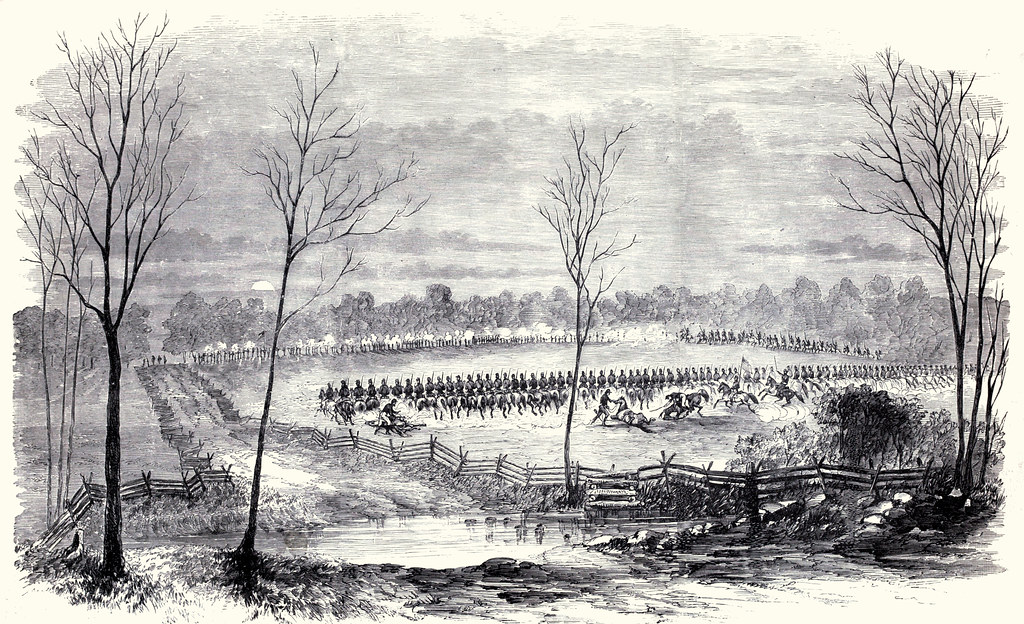
First Charge of Fremont’s Bodyguard, Led by Major Zagonyi, on the Confederate Garrison at Springfield, Mo., October 25th, 1861

(from Frank Leslie’s Illustrated History of the Civil War…, edited by Louis Shepheard Moat, Published by Mrs. Frank Leslie, New York, 1895)

“While encamped at Pomme de Terre, Mo., Fremont learned that a Confederate force had just been established at Springfield. He at once ordered Major Zagonyi to take his cavalry on a reconnoissance, and to capture the camp if deemed practicable. When Zagonyi arrived near Springfield he learned that the Confederate force was nearly 2,000 strong, while he had but 150 men. ‘Notwithstanding this disparity he made a gallant charge into the enemy’s ranks in the face of a hailstorm of bullets. He succeeded in, forcing the Confederates to break away in wild disorder, thus making the first charge of the bodyguard a great success.”

0 comments

“Our guns are the old-fashioned muskets made by working over the old flintlock gun..,”–Alexander G. Downing.

Diary of Alexander G. Downing; Company E, Eleventh Iowa Infantry

Friday, 25th–We got our equipments today. Our guns are the old-fashioned muskets made by working over the old flintlock gun, so as to use a cap in place of the flint. The musket is loaded with a cartridge containing powder, ball, and three buckshot in front of the ball. Each man is to carry forty rounds or more of ammunition all the time.

0 comments

A out of the mud onto high, dry ground.–Journal of Surgeon Alfred L. Castleman.

Journal of Surgeon Alfred L Castleman.

25th.–We have moved our camp about one hundred rods, are out of the mud, on high dry ground, where the tents can be ventilated and the streets kept clean. I look for a great improvement in the health of the regiment from this.

0 comments

Missouri: “The roar of artillery, the rattling of musketry, and the sight of wounded and dead men was very solemn.”—Reminiscences of the Civil War by William and Adelia Lyon.

Reminiscences of the Civil War, William and Adelia Lyon

Letter from Captain Lyon to Mrs. Lyon.

“Pilot Knob, Mo., Oct. 25, 1861.–Were ordered to Frederickstown (25 miles southeast of here). Marched all night through a mountainous country. We were after Jeff Thompson, who had a large force. Our force was nearly 5,000 strong. When we got there we found that Jeff had left the day before and gone south. We were joined here by 1,500 Illinois troops from Cape Girardeau. Our regiment was on the left flank, the second post of honor, so on the march would, of course, be in the rear. The head of the column met the rebels about three-quarters of a mile from town, and just as our regiment was starting. The rebels had gone on ten miles south, were reinforced and returned, and took a position at that point to fight us. They were 5,000 to 7,000 strong.

“The fight opened immediately at the head of the column and we started on a double quick for the battle field. When about half way to the scene of action we were ordered to act as a reserve. The firing continued about half an hour where the battle commenced, then gradually receded, showing that the rebels were retreating. The battle was fought mostly by artillery and cavalry, but one regiment of infantry being under fire, the 21st Illinois. Our forces pursued the rebels several miles. The grand result of the fight is that we killed at least 300 of them. Our forces found and buried 242, and large numbers were carried off by them. A great many were wounded and taken prisoners. Two pieces of artillery were also taken. Our loss is eight killed and thirty-three wounded. The defeat was total, breaking up their army and cleaning out this whole section of the state. One of their principal officers, Col. Lowe, was killed.

“We moved south 10 miles on Tuesday, but we ascertained that there was nobody in this section to fight us, so on Wednesday we returned to Frederickstown, and yesterday returned here. We have slept in tents but two nights since we left St. Louis, yet I never slept better in my life than I have some of these nights in the open air. The days are hot and the nights are cold, yet we do not take cold.

“Our regiment is No. 1. The men started for the battle with the utmost enthusiasm and were terribly disappointed when they found the rebels were retreating without giving us a chance at them. Our position was such that had the force first engaged met a reverse, we should have had the brunt of the fight. The rebels were poorly armed, which accounts for the great difference of loss on our side and theirs. We found a great many bodies on our march on Tuesday, one badly eaten by hogs. Another was shot just as he was getting over a fence, and his body was stiffened in that condition. We buried them.

“Our march was through a rugged country, hilly, rocky, and almost mountainous. We have returned here, but don’t know how long we shall stay. Our men are footsore, but otherwise well. Today received your first letter. Was overjoyed to get it.

“You ask me how I felt when going into battle. It is hard to analyze my feelings. I did not forget the danger to myself, but I was cool and self-possessed. The predominant thought was that probably many of the brave men who followed me would never return, and I wondered–if I came out alive–over which of them the scalding tears would fall ere the sun should set. The roar of artillery, the rattling of musketry, and the sight of wounded and dead men was very solemn. It was necessary, however, and I take my full share of responsibility; although, of course, none fell by my hand.”

0 comments

“Mr. Lusk, I wish to have a few words with you.”—War Letters of William Thompson Lusk.

War Letters of William Thompson Lusk.

October 25th, 1861.

My dear Mother:

It is with extreme pleasure I write you to-day. We are still at Fort Monroe, and of course I do not know how long we are to remain here, but Old Point Comfort has proved itself such to me. I think few up to the present time have served under greater disadvantages in the army than I. A member of a Scotch Regiment strong in its foreign prejudices, introduced as I was by _____, a man greatly unpopular among the men, I have enjoyed little prestige or favor. We have had hard work to do, and for four months I have suffered from extremes of heat and cold, from hunger and wet, and sleepless nights – from all the hardships of outpost life – have had the credit which I felt was due denied, and have waited patiently, though sometimes against hope. After Col. Stevens became Brig.-Gen., our Regiment fell to the command of . . . Morrison, who sought to exhibit his authority by all sorts of petty and irritating acts of insolence toward myself. The life became intolerable, and I sent in my resignation. I have written you how kindly Gen. Stevens acted in the matter. I withdrew the resignation temporarily, however, on learning from Gen. Stevens the probability of a speedy action.

When Gen. Stevens was detached from our Brigade to command one stationed at Annapolis, I was left almost without appeal from the insults of . . . Morrison. I found my rights taken away, and favors bestowed on low, ignorant rowdies. I then obtained a furlough, meaning to arrange some plan of honorable escape while on a visit home.

Suddenly a despatch came ordering our Regiment to meet Gen. Stevens at Annapolis, and it was whispered our destination was to be some place on the Southern coast. I thereupon pocketed all affronts, gave up all thoughts of a leave of absence, and resolved to be resigned to the painfulness of my position, and to perform any duties that might be allotted me. A few days ago I was appointed officer of the day. The duties of the day were arduous, and for twenty-four hours I had no sleep. It was about 7 ½ in the morning and my duties had nearly expired, when Gen. Stevens desired to see the officer of the day. I supposed it was to perform some business in connection with my position. On reporting myself he said, “Mr. Lusk, I wish to have a few words with you.” “Yes,” said I, “but be quick, as my time has nearly expired.” “Oh!” said he, “I only wish to tell you that you are appointed my Aide-de-camp. You know my peculiarities, and if we are satisfied with each other I think you will have no reason to repent of your appointment.” I thanked him, told him I was proud to accept the appointment. So now, Mother, with best love to all the dear ones at home, I subscribe myself,

Your affectionate son,
Capt. W. T. Lusk,
Aide-de-camp to Gen. Stevens,
Sherman’s Division.
0 comments

“How do you suppose we can overcome the effects of the New York press?”–Adams Family Letters, Henry Adams, private secretary of the US Minister to the UK, to his brother, Charles.

Civil War Day-by-Day

London, October 25, 1861

You complain of the manner in which England has been allowed to wheel round. I mean to write a letter to the Times on that matter some day. Do you know the reason why it is so? How do you suppose we can make a stand here when our own friends fail to support us? Look at the Southerners here. Every man is inspired by the idea of independence and liberty while we are in a false position. They are active, you say. So they are, every man of them. There are no traitors among them. They have an object and they act together. Their merchants and friends in Liverpool have been warm and vigorous in their support from the beginning. Ours have been lukewarm, never uttering a hearty word on our side, and the best of them, such as Peabody and the house of Baring’s invariably playing directly into the hands of our opponents. They have allowed the game to go by default. Their talk has been desponding, hesitating, an infernal weight round our necks. How can you suppose that we should gain ground with such allies.

But we might nevertheless have carried the day if the news from home had been such as to encourage our party, which was once strong and willing. You know how much encouragement we have had from your side. Every post has taken away on one hand what it brought of good on the other. It has by regular steps sapped the foundations of all confidence in us, in our institutions, our rulers and our honor. How do you suppose we can overcome the effects of the New York press? How do you suppose we can conciliate men whom our tariff is ruining? How do you suppose we can shut people’s eyes to the incompetence of Lincoln or the disgusting behavior of many of our volunteers and officers.

I tell you we are in a false position and I am sick of it. My one hope is now on McClellan and if he fails us, then as I say I give it up. Here we are dying by inches. Every day our authority, prestige and influence sink lower in this country, and we have the mournful task of trying to bolster up a failing cause. Do you suppose I can go among the newspapers here and maintain our cause with any face, with such backing? Can I pretend to a faith which I did once feel, but feel no longer? I feel not seldom sorry in these days that I did n’t follow my first impulse, and go into the army with the other fellows. Our side wants spirit. It does n’t ring as it ought.

These little ups and downs, this guerilla war in Missouri and Kentucky, amount to nothing but vexation. Oh, for one spark of genius! I have hopes of McClellan for he does n’t seem to have made any great blunders, but I don’t know.

We are all in a lull here. The English Government is perfectly passive and likely to remain so. . . .

0 comments

Adams Family Letters, Charles Francis Adams, U.S. Minister to the U.K., to his son, Charles.

Civil War Day-by-Day

London, October 25, 1861

Our American news comes much in the old way, always of a chequered character. First, we are compelled to blow away a great deal of froth on the top of the cup, and then we find the liquor more or less muddled beneath. The impression is that “some one has blundered.” Our Navy does not look as it did in the last war. Then the land expeditions indicated as much incapacity as they do now. Now our ships do nothing but catch fishing schooners. The Alliance, the Goudar, the Thomas Watson, the Bermuda, the Fingal, the Amelia, have all taken quantities of clothing, and military equipment of every description from here, of which we have had notice beforehand. But I do not see a sign of their capture in any quarter. Yet to my mind this is a greater triumph than twenty such results as that at Bull’s Run. The latter at least had the effect of seriously crippling the victor. The former supplies the material for carrying on the war indefinitely and gives to all Europe the idea of an ineffective blockade – the most dangerous thing of all to our ultimate success… I cannot sympathise with Mr. Sumner’s speech, because the tone is purely vindictive and impracticable. But I do not the less feel that we must ultimately embrace the military necessity as a basis for the reconstruction of a stable government.

0 comments

A Diary of American Events.

The Rebellion Record – A Diary of American Events; by Frank Moore

October 25.–General Fremont’s body guard, numbering three hundred men, under command of Major Zagonyi, charged against two thousand rebels, drawn up in line of battle at their camp, near Springfield, Missouri, routed them, cleared Springfield of rebels, and retired.–(Doc. 106.)

–At Pilot Knob, Missouri, Col. Boyd, of the Twenty-fourth Missouri regiment, commandant of the post, announced the modification of the proclamation of Gen. Fremont by the President, and declared that martial law would be rigidly enforced in the counties of Jefferson, St. Francois, Washington, and Ironton, and that all persons taken in arms against the Government of the United States, in an irregular warfare, or who might be found to have participated in any manner in the burning or otherwise injuring railroad or other bridges, or cutting telegraph wire, or injuring any public property, would be summarily shot. Also, that the sympathizers with the rebellion, who were constantly visiting the stations on the Iron Mountain Railroad, and giving information to the rebels, would hereafter be arrested and dealt with as spies.–N. Y. World, Oct. 26.

–The Ulster Guard, Twentieth regiment of New York Volunteers, under the command of Col. George W. Pratt, left Kingston for the seat of war. The regiment numbers nine hundred and seventy-five men.–Idem.

Gen Franklin extended his picket lines a mile beyond Annandale, on the Little River turnpike, which leads direct to Fairfax Court House, Va,–Walter W. Smith, one of the crew of the privateer Jeff Davis, captured on board the Enchantress, was convicted of the crime of piracy.–Col. Marshall, of the Seventh Maine regiment, died in Baltimore, of typhoid fever. He had been sick two weeks. His regiment started for Washington.–N. Y. Times, Oct. 26.

–An artillery duel was fought across the Potomac River, at Edwards’ Ferry. Firing was kept up by rifled cannon from nine o’clock in the morning until two in the afternoon. A large number of shots were thrown from both parties. Several balls fell in a portion of Gen. Banks’ encampment, killing two and wounding two or three. A few tents were struck and injured, rendering it prudent to move the encampment some distance back. Shot and shell were thrown rapidly into the Confederate encampments, doing, as is believed, serious damage. The rebels were also obliged to move their quarters/–Cincinnati Gazette, October 30.

–Yesterday, at Charleston, S. C., Judge A. G. Magrath, in the “Confederate” court, delivered an opinion with regard to questions raised by J. L. Pettigru, Nelson Mitchell, and William Whaley, as to the constitutionality of the rebel sequestration act.–(Doc. 109.)

–At a banquet given at Inverary, Scotland, the Duke of Argyle declared that “no more tremendous issues were ever submitted to the dread arbitrament of war, than these which are now submitted to it upon the American continent;” that it is “the absolute duty of Great Britain to remain entirely neutral;” and that “we ought to admit, in fairness to the Americans, that there are some things worth fighting for, and that National existence is one of them.” – London Times, October 29.

–The Fifteenth Mass, regiment, in Maryland, had to-day their first parade since the battle at Ball’s Bluff, on the 21st. After the parade the regiment was formed in a square and the gallant Colonel Devens made them an address. No description could produce the tender subdued fervor with which the colonel first spoke, the electric sympathy by which his men were affected, or the earnest determination with which the question was asked and answered:

“Soldiers of Massachusetts, men of Worcester County, with these fearful gaps in your lines, with the recollection of the terrible struggle of Monday fresh upon your thoughts, with the knowledge of the bereaved and soul-stricken ones at home, weeping for these whom they will see no more on earth, – with that hospital before your eyes, filled with wounded and maimed comrades, – I ask you now whether you are ready again to meet the traitorous foe who are endeavoring to subvert our Government, and who are crushing under the iron heel of despotism the liberties of a part of our country? would you go next week? would you go to-morrow? would you go this moment?” One hearty “Yes!” burst from every lip.

Brigadier General Kelley with Twenty-five hundred men, of Virginia and Ohio Volunteers, left New Creek, Virginia, at night, on an expedition against the rebels in Romney. Nearly at the same time, Thomas Johns, of Second regiment Potomac brigade, marched from the mouth of Patterson’s Creek, with seven hundred men, to favor Gen. Kelley’s attack on Romney, by a feint or diversion toward the north of the town. – Wheeling Intelligencer, Nov. 2.

0 comments

…drawn up in one line.—Rhode Island Light Artillery

Diary of Battery A, First Regiment, Rhode Island Light Artillery, by Theodore Reichardt

Thursday, October 24.—After all the troops had been withdrawn, the rebel pickets held the line close to the river, and fired a shot once in a while. Rickett’s, ours, and Captain Bess’ batteries, were drawn up in one line. Our battery is detached to General Williams’ brigade.

0 comments

There were 544 prisoners brought in here yesterday morning from Leesburg.

Civil War Day-by-Day

MANASSAS JUNCTION, VA., October 24, 1861.

Dear Mother:
I received your letter this morning and was very glad to hear from you all, but was very sorry to hear that sister was sick. There were 544 prisoners brought in here yesterday morning from Leesburg, an account of which you have seen in the paper ere now. They were sent off last night to Richmond. Blake and Jack Robinson was detailed from our company to go as guard. Leesburg has since been taken by the enemy. Our forces retreated seven miles. The enemy are about to flank us and I think that we shall have to fight soon for I guess it is very galling to them to have so many of their men taken prisoners. We have had frost for several nights and it is already beginning to turn very cold, but we have not suffered any yet. I wear two pair of socks in my boots and they do very well, for it keeps the cold wind off my legs.

You were speaking of your hogs being fat. You ought to see these up here, they are so fat that they can hardly get along. The beeves that we have here are the fattest and prettiest I ever saw. They are generally large young cows, nearly twice as large as ours at home. I have often wished that you could have such at home. We have got thick overcoats from the government, with capes reaching below our elbows. They are of great service to us in standing guard. If we had a good dog and was allowed to shoot, we could live on rabbits, for I never saw so many in my life, the woods are full of them. If I only had Leo here now, I could get along very well. I don’t want him to be an unruly dog, for he comes of such good breed that I would not like to hear of his being killed.

I should like to be at home in hog killing time, and wish I could see Tasso now, for I know he is a fine looking dog. I hope Walter’s puppy will not turn out. I should like to be at home with you on Christmas, but the way affairs are going on now I do not think there is any likelihood of it, as for winter quarters, I do not expect that we will go into any at all, for the enemy pride themselves on standing the cold weather and I expect they will attack us in the dead of winter. We learned from the prisoners that the enemy intended to attack us in two or three days, but let them come when they will. I will insure them a very warm reception. Before this reaches you will have heard of L. Barnes’ death and also of Bowden’s discharge from the army on account of being a minor, etc. Lafayette’s death has cast a deep gloom over the company, for he was a very much beloved member. I will be very glad to get those blankets but I would wait and send them by some one, as they might get lost by themselves. All send their love to you.

Give my love to all. Goodbye.

Your loving son,
GEORGE.


Letters from two brothers who served in the 4th North Carolina Infantry during the Civil War are available in a number of sources online.  Unfortunately, the brothers are misidentified in some places as Walter Lee and George Lee when their names were actually Walter Battle and George Battle. See The Battle Brothers for more information on the misidentification.

0 comments

J.B. Jones reflects, “the enemy will fight better every successive year; and this should not be lost sight of. They, too, are Anglo-Saxons.”

Civil War Day-by-Day

OCTOBER 24th.—We made a narrow escape; at least, we have a respite. If the Yankee army had advanced with its 200,000 men, they would not have encountered more than 70,000 fighting Confederate soldiers between the Potomac and Richmond. It was our soldiers (neither the officers nor the government) that saved us; and they fought contrary to rule, and even in opposition to orders. Of course our officers at Leesburg did their duty manfully; nevertheless, the soldiers had determined to fight, officers or no officers.

But as the man in the play said, “it will suffice.” The Yankees are a calculating people: and if 1500 Mississippians and Virginians at Leesburg were too many for 8000 Yankees, what could 200,000 Yankees do against 70,000 Southern soldiers? It made them pause, and give up the idea of taking Richmond this year. But the enemy will fight better every successive year; and this should not be lost sight of. They, too, are Anglo-Saxons.

0 comments