Diary of Horatio Nelson Taft.

Diary of US patent clerk Horatio Nelson Taft.

Friday 11th

Fine pleasant day. The Event here has been the passage of the Bill by the House abolishing Slavery in the District of Columbia. It had passed the Senate. No particular War news today. I was down to the Hotels. They are all full and quite a crowd at Willards. Went to the “Festival” to call for Julia about 10, staid an hour, it is the last night. We got home about 111/2 o’clock. The nights are now bright and beautiful.


The three diary manuscript volumes, Washington during the Civil War: The Diary of Horatio Nelson Taft, 1861-1865, are available online at The Library of Congress.

0 comments

Rebel War Clerk

Civil War Day-by-Day
A likeness of Jones when he was editor and majority owner of the Daily Madisonian during President John Tyler’s administration.

APRIL 11th.—The enemy are at Fredericksburg, and the Yankee papers say it will be all over with us by the 15th of June. I doubt that.

0 comments

Downing’s Civil War Diary.–Alexander G. Downing.

Diary of Alexander G. Downing; Company E, Eleventh Iowa Infantry

Friday, 11th–It rained all day. Troops have been arriving by the thousands every day since Sunday.

0 comments

War Diary of Luman Harris Tenney.

War Diary of Luman Harris Tenney.

11th. Day chilly with slow rain falling. In the evening Oakie McDowell and I kept a light in the commissary. Commenced a letter to Fannie. Came near being reported for having light. Captain Seward is under arrest!

0 comments

Sitting down before Yorktown, as yet untaken.

Woolsey family letters during the War for the Union
William Winthrop to Georgeanna.

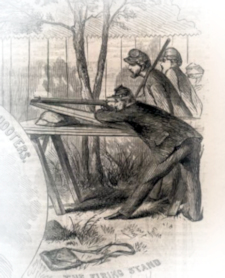
Berdan’s Sharpshooters,………………..
Camp before Yorktown, April 11, 1862.

Dear Cousin: Your welcome and full letter brought joy and facts. . As for us, we are sitting down before Yorktown, as yet untaken. The enemy retreated before us, first from Great Bethel, then from the extensive entrenchments at Smithville, two miles beyond. Yorktown is their stronghold; the works are understood to extend pretty much all the way across the Peninsula to the James. They have some forty guns on the works now facing us.

On the 5th, we saw something like war. As the head of Porter’s Column–we are that head–emerged from the wood and rose upon the open land which forms a gradual natural glacis to the batteries, we were saluted with shell after shell, and all day the shell and round shot and rifle bullets cracked and boomed and whizzed about us. We, as usual, skimmed the crême de la crême, being posted as skirmishers, as well under cover as we could get, about three-fourths of a mile in advance of the main army, and one-half mile in advance of our own artillery. We lost two and had four wounded during the day, and it is most unaccountable that our loss was not twenty times as great; for the horrid, detestable music of shot and shell and ball was almost continually tingling our ears. One of the killed was in my own company–Phelps. I had him buried next day–a sweet Sunday–and laid the green turf neatly over the mound. . . . By the way, I think of you and Eliza as I see the little hospital flags hung out from all the more respectable farmhouses. . . . General Porter said in a note of commendation on our regiment, read on parade, that the enemy “by their own admissions had begun to fear us and provide against us as far as possible.” This praise has rather turned the head of our Colonel. Moi, I have been too cold, too weary, too wet, too unslept, too unwashed, to feel conceited or proud. Further, our teams have not yet come up with the officer’s baggage, so I am without mutations of raiment, or have to depend on strangers for the same; also am only one-half blanketed. But these are minor ills, for which, no doubt, our lovers are pitying us more than we deserve as they sit in their boudoirs far away.

The brandy and things which you sent me, just before going off, were very valuable. I had a few swallows of the liquor left in my flask a few nights since on picket, and it proved worth more than so much liquid gold. A soldier of the 2nd Maine, on picket with my men, was struck by a ball which broke his leg. He crawled through the rain and cold of that miserable night, half a mile, on his hands and knees, to the reserve picket, and was just fainting when I came in with your brandy, treasured up for just such a moment.

The weather is now fair and warm and delicious. I walked through the woods this A. M. before reveille, to the sandy beach of York River, and saw the sun come up out of the sea; and watched our gunboats, which are ready to cooperate when the right moment comes. I hope we shall not be cheated out of a good battle.
0 comments

Journal of Surgeon Alfred L. Castleman.

Journal of Surgeon Alfred L Castleman.

11th.A mail to-day. One, only one little letter from my home, and that thirteen days old! The bearing of General ― towards me for a few days has been greatly changed? What is it to mean. * * *

Last night Prof. Lowe, the aeronaut, staid with us. He went up in his balloon, and took drawings of the enemy’s fortifications. Says they are the most formidable he has seen during the war. Nothing doing by the army to-day. Gen’l. McC. visits us. He has had a council of war. Result of it of course not known.

0 comments

The Jacket of Gray—Diary of a Southern Refugee, Judith White McGuire.

Diary of a Southern Refugee During the War by Judith White McGuire

10th.—Spent yesterday in the hospital by the bedside of Nathan Newton, our little Alabamian. I closed his eyes last night at ten o’clock, after an illness of six weeks. His body, by his own request, will be sent to his mother. Poor little boy! He was but fifteen, and should never have left his home. It was sad to pack his knapsack, with his little gray suit, and coloured shirts, so neatly stitched by his poor mother, of whom he so often spoke, calling to us in delirium, “Mother, mother,” or, “Mother, come here.” He so often called me mother, that I said to him one day, when his mind was clear, “Nathan, do I look like your mother?” “No, ma’am, not a bit; nobody is like my mother.” The packing of his little knapsack reminds me of

THE JACKET OF GRAY.

“Fold it up carefully, lay it aside,
Tenderly touch it, look on it with pride,
For dear must it be to our hearts evermore,
The jacket of gray, our loved soldier-boy wore.
 
“Can we ever forget when he joined the brave band
Who rose in defence of our dear Southern land,
And in his bright youth hurried on to the fray–
How proudly he donned it, the jacket of gray?
 
“His fond mother blessed him, and looked up above,
Commending to Heaven the child of her love;
What anguish was hers, mortal tongue may not say,
When he passed from her sight in his jacket of gray.
 
“But his country had called him, she would not repine,
Though costly the sacrifice placed on its shrine;
Her heart’s dearest hopes on the altar she lay,
When she sent out her boy in his jacket of gray.
 
“Months passed, and war’s thunders rolled over the land,
Unsheathed was the sword, and lighted the brand;
We heard in the distance the sound of the fray,
And prayed for our boy in the jacket of gray.
 
“Ah, vain, all in vain, were our prayers and our tears;
The glad shout of victory rang in our ears;
But our treasured one on the battle-field lay,
While the life-blood oozed out on the jacket of gray.
 
“Fold it up carefully, lay it aside,
Tenderly touch it, look on it with pride,
For dear must it be to our hearts evermore,
The jacket of gray our loved soldier-boy wore.
 
“His young comrades found him, and tenderly bore
The cold lifeless form to his home by the shore:
Oh, dark were our hearts on that terrible day
When we saw our dead boy in the jacket of gray.
 
“Ah, spotted and tattered, and stained now with gore,
Was the garment which once he so proudly wore;
We bitterly wept as we took it away,
And replaced with death’s white robes the jacket of gray.
 
“We laid him to rest in his cold, narrow bed,
And ‘graved on the marble we placed o’er his head,
As the proudest of tributes our sad hearts could pay,
He never disgraced the poor jacket of gray.
 
“Fold it up carefully, lay it aside,
Tenderly touch it, look on it with pride,
For dear must it be to our hearts evermore,
The jacket of gray our loved soldier-boy wore.
0 comments

Army Life of an Illinois Soldier, Charles Wright Wills.

Civil War Day-by-Day

April 10.—The Rebels have run and left Island 10, and our boys have taken some 2,000 of them prisoners below here. They passed up on a boat this morning. We will be paid off to-day or to-morrow.

0 comments

Diary of Horatio Nelson Taft.

Diary of US patent clerk Horatio Nelson Taft.

Thursday 10th

The weather is more settled today. Nothing in particular has occured. We are getting more of the particulars of the great Battle at Pittsburgh Landing, it was the most desperate fight of the War so far. There is nothing from Yorktown, to which all eyes are now turned. Both parties are in great force there. There must be another desperate encounter there. Our troops are flushed with Victory. The rebels are desperate.


The three diary manuscript volumes, Washington during the Civil War: The Diary of Horatio Nelson Taft, 1861-1865, are available online at The Library of Congress.

0 comments

Rebel War Clerk

Civil War Day-by-Day
A likeness of Jones when he was editor and majority owner of the Daily Madisonian during President John Tyler’s administration.

APRIL 10th.—The condemned spies have implicated Webster, the letter-carrier, who has had so many passports. He will hang, probably. Gen. Winder himself, and his policemen, wrote home by him. I don’t believe him any more guilty than many who used to write by him; and I mean to tell the Judge Advocate so, if they give me an opportunity.

0 comments

Shiloh – A. G. Downing; still burying the dead; wounded still dying.

Diary of Alexander G. Downing; Company E, Eleventh Iowa Infantry

Thursday, 10th–We are still burying the dead. The lieutenant of Company F was buried today. Nearly all of the dead have been buried now, but there are some of the wounded still dying. I was detailed with two others to bury three of the rebels’ dead. We went out about a half mile north of the camp to a stony knoll where one body lay, and worked all forenoon, the ground being so hard and stony, to dig even a shallow grave into which we rolled the body and covered it the best we could. In the afternoon we dug a double grave for two who had died of mortal wounds.

0 comments

War Diary of Luman Harris Tenney.

War Diary of Luman Harris Tenney.

10th. Thursday. The First Battalion of the Second Cavalry (four companies) left at ten A. M. for Carthage, Mo. Issued to them ten days’ rations. Reported that we shall leave in a few days for some point forty or fifty miles east.

0 comments

Nicely prepared for 300 men.

Woolsey family letters during the War for the Union
Sarah Woolsey to Georgeanna.

New Haven, April.

I spent one delightful day in New York with Jane at the New England rooms, where everything is nicely prepared for 300 men. The superintendent has time during intervals to rush down stairs and compose puffs on Jane, which he publishes in the newspapers next morning! The day we went down, we had the luck to fall upon the first wounded soldier of the season, and, though he was not very sick, Jane went to work in the most approved way, and you should have seen her with her bonnet off, her camel’s-hair shawl swung gracefully from her shoulders and a great pocketed white apron on, making tea over a spirit-lamp and enjoying it all so thoroughly. The Newbern hero was fed with sardines and oysters and all sorts of good things, and face and hands washed by Jane’s little paws so nicely. . . . Don’t say anything when you write home, for Jane is rather huffy when we talk too much about it, since her appearance in the public prints. Did you see the letter from a soldier in the hospital, describing Jane, and using the celebrated sentence which, as she says, leaves no doubt as to the identity: “I dare not mention her name, but she is beautiful.”

0 comments

Journal of Surgeon Alfred L. Castleman.

Journal of Surgeon Alfred L Castleman.

10th.–Fell back to-day about a mile and a half out of reach of enemy’s shells. Patience and endurance of everything, without expression of thought, can scarcely be considered a virtue, even in a military subordinate. The Western Army is all activity and execution. No. 10 taken, Beauregard whipped on his own ground, all our armies accomplishing glorious deeds, except this poor old thing of the Potomac, called an army: Nearly a year has been spent by us in squatting around in sight of the enemy, rushing forward to-day, till within fighting distance, to-morrow falling back, as if afraid that some one might get shot. Here we have been for five days in sight of the enemy we came to capture or destroy, and this morning, because they threw a few shells into our camp, we are falling back! We are within twenty miles of one of our principal military stores and depots, with our men and animals starving. My ambulance horses-have not had a mouthful of any thing to eat for nearly three days, and to-day they are expected to draw the heavy ambulances over the worst roads I ever saw. Yes, here we are, in a “cul de sac,” the rivers on either side of us held by the enemy, the ground in front blockaded by them, and their pickets jeeringly calling across the little creek to know whether we are not most ready to fight. Who is to blame? Many of us begin to question the ability of General McClellan.

If we can get forage and rations here, I think we must make some kind of a fight before we get away. How much of a fight, I cannot tell. It is surprising how man is modified by habit. During the late skirmishes, we who are not engaged, sat in our tents, smoking, singing, jesting with as much indifference as we would sit by our fires at home and listen to the falling of the axeman’s blows. True, we sometimes notice the sounds of a report heavier than usual, and “wonder how many that shell did for.” Would such indifference have overtaken us, if we had been kept engaged in the ordinary duties of an army? I verily believe not. It is the offspring of a kind of desperation. We came to effect something. We have been disappointed, and are growing careless of consequences. Nor are the moral habits of the men less changed. Stealing is becoming a pastime with them, and is scarcely looked on as a crime.

General McClellan’s command has dwindled down to three corps d’armee, and I regret to say that the opinion is beginning to be held by many, that he is not competent to the command of even this force.

No mail now for ten days. This is very hard; harder even than to sleep out and go hungry. Even now our families may be suffering, dying, and we have no means of knowing it. Well, in time of war this is necessary, and perhaps it is all for the best. God controls and directs.

0 comments

Shiloh.—Diary of a Southern Refugee, Judith White McGuire.

Diary of a Southern Refugee During the War by Judith White McGuire

9th.—Our victory at Shiloh complete, but General Albert Sydney Johnston was killed. The nation mourns him as one of our most accomplished officers. He fell while commanding in the thickest of the fight. It is an overwhelming loss to the Western army, and to the whole country. Beauregard pursued the enemy, but their General (Grant) having been reinforced very largely, our army had to retreat to Corinth, which they did in good order. This was done by order of General Johnston, should Buell reinforce Grant. They are now at Corinth, awaiting an attack from the combined forces. Van Dorn reinforced Beauregard. We are anxiously awaiting the result.

0 comments

Diary of Horatio Nelson Taft.

Diary of US patent clerk Horatio Nelson Taft.

Wednesday April 9th 1862

It has stormed all day, rain, sleet and snow falling incessantly. News today of a great Battle West. Beauregard defeated and Island No 10 taken with all the land Batteries. Our armies everywhere victorious, more prisoners, guns, and munitions than our troops know what to do with. The City is in wild excitement over the news. A Salute of 100 guns ordered by the Sec’y of War. The great “Anaconda” is drawing in his coils tighter and tighter around the rebels. They have behaved most cowardly in every instance where they did not have the advantage in numbers or position. The proud “Southerners” had better strike the word chivalry from their vocabulary. I think they are a race of bombaster cowards and events are proveing it every day. We have had one Bull Run. They have a “Bully Run” every time they meet our troops.


The three diary manuscript volumes, Washington during the Civil War: The Diary of Horatio Nelson Taft, 1861-1865, are available online at The Library of Congress.

0 comments

Rebel War Clerk

Civil War Day-by-Day
A likeness of Jones when he was editor and majority owner of the Daily Madisonian during President John Tyler’s administration.

APRIL 9th.—There are several young officers who have sheathed the sword, and propose to draw the pen in the civil service.

To-day I asked of the department a month’s respite from labor, and obtained it. But I remained in the city, and watched closely, still hoping I might serve the cause, or at least prevent more injury to it, from the wicked facility hitherto enjoyed by spies to leave the country.

0 comments

War Diary of Luman Harris Tenney.

War Diary of Luman Harris Tenney.

9th. Went out with a detail of woodchoppers. Had a good time. Boys caught a rabbit and cooked it–all ate a morsel. Went and saw squad of Indians–savage looking enough.

0 comments

Shiloh – A. G. Downing; burying the dead by companies.

Diary of Alexander G. Downing; Company E, Eleventh Iowa Infantry

Wednesday, 9th–Fifteen hundred more of our troops arrived. We are still burying the dead. It rained again today. The ground is so thoroughly soaked that it is difficult to dig the graves deep enough and keep out the water. We bury our dead by companies, all of one company in one grave, and if only one of a company is killed, the body is placed in a grave by itself. The bodies of the rebels’ dead are placed side by side in long graves. The carcasses of horses are removed by burning them.

0 comments

Shut up and desolate.

Woolsey family letters during the War for the Union
Eliza’s lovely home at Fishkill was all this time shut up and desolate, but the grounds were in the hands of their neighbor, Mr. Henry W. Sargent, who kindly undertook the work Joe had to give up for the war. He planted the place, selecting trees and superintending the work day after day. The little rise in the lawn north of the house he named Mars Hill, and there Mr. Thomson, the farmer-in-charge, set up a flag-pole and kept the colors flying, though the house stood empty.


Caroline Carson Woolsey to Eliza.

April 9th.

Dear Eliza: We have made our little visit to the W’s at Fishkill, and the first thing after dinner drove over to your place. . . . Every one says it is very much improved, and the trees that are being set out are very fine ones and add to the general air of elegance.. . . I must tell you how beautiful too your greenhouses looked, lots of flowers and very beautiful ones, and two large boxes have come down this week for Mother, and been arranged in rustic baskets, etc., and make us look very popular to the seven usual evening callers; last night they were admired by Messrs. Beekman, Shepherd, Goddard, Denny, Bronson, Frothingham and Dorus W., and each gentleman tried to look conscious to the others, while I looked so to all. . . . Returning from Fishkill we found Sarah Woolsey here, and she is now sitting on the sofa reading the news. Uncle Edward has just gone, and Jane and Hatty are off at the hospital. Abby is very down in her mind about the Merrimac, and thanks fortune (secretly) there is always something to be melancholy over. . . .

Sarah drove out one morning to see Aunt E., who entertained her with abusing Abby for her political opinions! She said the Tribune was not a paper for Christian people, particularly females, to take, and that as long ago as Rutgers Place times Uncle E. had warned us against it. “I read it myself, it is true,” she said, “but then the curious eye and ear must be satisfied!” Capital reason for doing what a Christian “female” should not do!

0 comments

Journal of Surgeon Alfred L. Castleman.

Journal of Surgeon Alfred L Castleman.

9th.–Rained hard all day. But little done to-day. 6th Maine regiment went out in afternoon, got one man mortally wounded in a little skirmish. Roads so bad that I fear we shall have to fall back to-morrow.

0 comments

Diary of Horatio Nelson Taft.

Diary of US patent clerk Horatio Nelson Taft.

Tuesday 8th

This has been a most dismal day, rain or Sleet has been falling all the time. I am all the time thinking of the Thousands of Soldiers who are now out in the storm without tents or shelter. Such must be the condition of Genl McDowells Division, which has advanced into Virginia on their way to Richmond leaving their tents behind, and also those who are now besieging Yorktown. The news tonight is that Island No 10 and the Shore Batteries have been surrendered to our troops. We shall get particulars tomorrow, probably. Genl McClellan is having a desperate time of it at Yorktown. The Rebels under McGruder are, it is said, Thirty thousand strong, but they must capitulate or run and run they cannot very easily. We are expecting news of a great battle at or near Corinth every day betwen Halleck and Beauregard. Each have over a hundred thousand men. It will be the great Battle of the war I think. Nothing has been heard from the Merrimac as yet.


The three diary manuscript volumes, Washington during the Civil War: The Diary of Horatio Nelson Taft, 1861-1865, are available online at The Library of Congress.

0 comments

Rebel War Clerk

Civil War Day-by-Day
A likeness of Jones when he was editor and majority owner of the Daily Madisonian during President John Tyler’s administration.

APRIL 8th.—Col. Bledsoe has been appointed Assistant Secretary of War by the President. Now he is in his glory, and has forgotten me.

0 comments

0

Civil War Day-by-Day

April 8th. Was signalized by the mortar fleet, twenty-two in number, arriving from Pilot Town, where they had gone to be stripped of their rigging. They looked very pretty as they ranged along the shore in line of battle, with their flagship, the Harriet Lane, at their head. We look for a great noise from them before long.

0 comments

Shiloh – A. G. Downing writes of the aftermath.

Diary of Alexander G. Downing; Company E, Eleventh Iowa Infantry

Tuesday, 8th–We formed a line of battle early this morning and remained in line about two hours.[1] So many men throughout the camp were firing off their loaded rifles, preparing to clean them, that the officers thought a battle was in progress out in front. About 9 o’clock word came in from the front that there was no rebel in sight, and we were ordered back to our quarters. We spent the day in burying the dead, both our own and those of the rebels.

Our battle line had been at the south end of Jones’ Field, where a few days before we had cleared the timber for a review ground. This place was fought over so often by both armies and the dead lay so close that one could walk on dead bodies for some distance without touching the ground. There were over three thousand five hundred dead on the battlefield, and something like five hundred dead horses. Seven hundred bodies of the rebels were put into one grave. It is an awful sight to see the dead lying all about. It rained this forenoon, but cleared off this afternoon. The heavy rains have soaked the ground, making it very muddy. About five thousand of our forces arrived today.


[1] It has been said by some that from General Grant down to the commonest private in the ranks of the entire Army of the Tennessee, all the men cared for on Monday afternoon, the second day of the battle of Shiloh, was to get back to their camps. I cannot believe the statement, for on Tuesday, the 8th, when we were ordered into line of battle, on that gloomy, rainy morning, and a cold wind blowing from the northwest, I know by the sentiment of the boys in my own company, that they would have gone to the front then if ordered to do so. We felt that the loss in our company was too great not to follow up the victory.—A. G. D.

0 comments