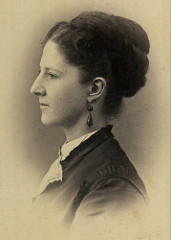
Frights and Perils in Steele’s Bayou

War Diary of a Union Woman in the South

Thursday, July 17, 1862. (On a raft in Steele’s Bayou.)—Yesterday we went on nicely awhile and at afternoon came to a strange region of rafts, extending about three miles, on which persons were living. Many saluted us, saying they had run away from Vicksburg at the first attempt of the fleet to shell it. On one of these rafts, about twelve feet square, (more likely 12 yards—G.W.C) bagging had been hung up to form three sides of a tent. A bed was in one corner, and on a low chair, with her provisions in jars and boxes grouped round her, sat an old woman feeding a lot of chickens. They were strutting about oblivious to the inconveniences of war, and she looked serenely at ease.

Having moonlight, we had intended to travel till late. But about ten o’clock, the boat beginning to go with great speed, H., who was steering; called to Max:

“Don’t row so fast; we may run against something.”

“I’m hardly pulling at all.”

“Then we’re in what she called the rapids!”

The stream seemed indeed to slope downward, and in a minute a dark line was visible ahead. Max tried to turn, but could not, and in a second more we dashed against this immense raft, only saved from breaking up by the men’s quickness. We got out upon it and ate supper. Then, as the boat was leaking and the current swinging it against the raft, H. and Max thought it safer to watch all night, but told us to go to sleep. It was a strange spot to sleep in—a raft in the middle of a boiling stream, with a wilderness stretching on either side. The moon made ghostly shadows and showed H., sitting still as a ghost, in the stern of the boat, while mingled with the gurgle of the water round the raft beneath was the boom of cannon in the air, solemnly breaking the silence of night. It drizzled now and then, and the mosquitoes swarmed over us. My fan and umbrella had been knocked overboard, so I had no weapon against them. Fatigue, however, overcomes everything, and I contrived to sleep.

H. roused us at dawn. Reeney found light-wood enough on the raft to make a good fire for coffee, which never tasted better. Then all hands assisted in unloading; a rope was fastened to the boat, Max got in, H. held the rope on the raft, and, by much pulling and pushing, it was forced through a narrow passage to the farther side. Here it had to be calked, and while that was being done we improvised a dressing-room in the shadow of our big trunks. (During the trip I had to keep the time, therefore properly to secure belt and watch was always an anxious part of my toilet.) The boat is now repacked, and while Annie and Reeney are washing cups I have scribbled, wishing much that mine were the hand of an artist.


Note: To protect Mrs. Miller’s job as a teacher in post-civil war New Orleans, her diary was published anonymously, edited by G. W. Cable, names were changed and initials were generally used instead of full namesand even the initials differed from the real person’s initials. (Read Dora Richards Miller’s biographical sketch.)

0 comments

Downing’s Civil War Diary.–Alexander G. Downing.

Diary of Alexander G. Downing; Company E, Eleventh Iowa Infantry

Wednesday, 16th–Our regiment went out on picket. I went on camp guard.

0 comments

War Diary of Luman Harris Tenney.

War Diary of Luman Harris Tenney.

16th. Wednesday. Boys returned from Fort Gibson, no enemy there. Enemy four miles below on the south side of the Arkansas, at Fort Davis. Expecting artillery. Boys rested.

0 comments

Rebel War Clerk

Civil War Day-by-Day
A likeness of Jones when he was editor and majority owner of the Daily Madisonian during President John Tyler’s administration.

JULY 16th.—Gen. Lee is hurrying up reinforcements from the South, old regiments and conscripts, and pays very little attention to McClellan on the Peninsula, knowing no further enterprises will be attempted by the enemy in that quarter for some time to come.

0 comments

July 9 to 16, 1862

Experience of a Confederate Chaplain—Rev. A. D. Betts, 30th N. C. Regiment

July 9th—Willie is doing well. McDugald about to die. Lieut. Shaw very low. Swift Galloway doing well. Visit D. H. Neal, Piper, and Horace Morrison.

July 11th—Rain all the morning. Walkout through mud to camp, and find regiment returned after seven days in fighting and suffering. Glad to see Col. Parker once more. Return weary to Pa’s, having walked nine and rode three miles.

Sunday, July 13th—In camp. Overtax my strength.

July 14th—Feeble. Visit a few wounded.

July 15th—Ride to camp and visit my sick. Daniel McDugald, my school-mate three years at Summerville and my class-mate three years at Chapel Hill, has died of wounds.

July 16th—Keep close. Suffer with cough. Married Thos. E. Amos and Sarah G. Davis, in Clay St. Church, Richmond.

0 comments

Frights and Perils in Steele’s Bayou

War Diary of a Union Woman in the South

Wednesday, July 16, 1862. (Under a tree on the bank of Steele’s Bayou.)—Early this morning our boat was taken out of the Mississippi and put on Mr. Fetler’s ox-cart. After breakfast we followed on foot. The walk in the woods was so delightful that all were disappointed when a silvery gleam through the trees showed the bayou sweeping along, full to the banks, with dense forest trees almost meeting over it. The boat was launched, calked, and reloaded, and we were off again. Towards noon the sound of distant cannon began to echo around, probably from Vicksburg again. About the same time we began to encounter rafts. To get around them required us to push through brush so thick that we had to lie down in the boat. The banks were steep and the land on each side a bog. About 1 o’clock we reached this clear space with dry shelving banks and disembarked to eat lunch. To our surprise a neatly dressed woman came tripping down the declivity bringing a basket. She said she lived above and had seen our boat. Her husband was in the army, and we were the first white people she had talked to for a long while. She offered some corn-meal pound-cake and beer, and as she climbed back told us to “look out for the rapids.” H. is putting the boat in order for our start and says she is waving good-bye from the bluff above.


Note: To protect Mrs. Miller’s job as a teacher in post-civil war New Orleans, her diary was published anonymously, edited by G. W. Cable, names were changed and initials were generally used instead of full namesand even the initials differed from the real person’s initials. (Read Dora Richards Miller’s biographical sketch.)

0 comments

“The gun-boats are rushing up and down the river, shelling the trees on the banks, afraid to approach Drury’s Bluff.”—Diary of a Southern Refugee, Judith White McGuire.

Diary of a Southern Refugee During the War by Judith White McGuire

Mecklenburg County, July 15.—Mr. _____ and myself summoned here a short time ago to see our daughter, who was very ill. Found her better—she is still improving.

Richmond is disenthralled—the only Yankees there are in the “Libby” and other prisons. McClellan and his “Grand Army,” on James River, near Westover, enjoying mosquitoes and bilious fevers. The weather is excessively hot. I dare say the Yankees find the “Sunny South” all that their most fervid imaginations ever depicted it, particularly on the marshes. So may it be, until the whole army melts with fervent heat. The gun-boats are rushing up and down the river, shelling the trees on the banks, afraid to approach Drury’s Bluff. The Northern papers and Congress are making every effort to find out to whom the fault of their late reverses is to be traced. Our people think that their whole army might have been captured but for the dilatoriness of some of our generals. General Magruder is relieved, and sent to take command in the West.

0 comments

Rebel War Clerk

Civil War Day-by-Day
A likeness of Jones when he was editor and majority owner of the Daily Madisonian during President John Tyler’s administration.

July 15th.—Gen. Pendleton has given McClellan a, scare, and might have hurt him if he had fired lower. He planted a number of batteries (concealed) on the south side of the river, just opposite the enemy’s camp. The river was filled with gun-boats and transports. At a signal, all the guns were fired, at short range, too, for some minutes with great rapidity, and then the batteries were withdrawn. I happened to be awake, and could not conjecture what the rumpus meant. But we fired too high in the dark, and did but little execution. Our shells fell beyond the enemy’s camp on the opposite side of the river. We lost a few men, by accident, mostly. But hereafter in “each bush they fear an officer.”

0 comments

Downing’s Civil War Diary.–Alexander G. Downing.

Diary of Alexander G. Downing; Company E, Eleventh Iowa Infantry

Tuesday, 15th–No news from Richmond.

0 comments

0

Civil War Day-by-Day

July 15th. Has changed the affairs of the fleet materially. Before daylight a firing of cannon had been heard up the river, and a gunboat had been dispatched to reconnoitre. As time passed, the firing neared us, and soon cannon balls could be seen dropping into the river below a-bend which hid objects from our view. The enemy proved to be the rebel ram Arkansas, which had chased our gunboat down the Yazoo river, and now came booming along, firing at our ships as she came. As no danger was apprehended, our ships were all lying without steam, and so near together that for one to fire endangered the rest.

All hands were called to quarters, and the ram came on and passed us, while each vessel which could fire upon her, did so, but we were not able to sink or disable her. Preparations were immediately made to follow her, and on the same evening our ships got under way, resolved to run down by the batteries and destroy the ram if possible. We commenced firing about dark, the ball being opened by Commodore Davis’s iron-clads, and in twenty minutes from the time of opening fire, we were in full blast. We passed slowly by the city, receiving fewer shots than formerly and being unable to discover the ram, which had been secreted behind a huge wharf-boat, and consequently we were unable in the darkness to harm her. We came to anchor below the city, and found our casualties to be, in killed three, and Captain Broome and Mr. Hoffman severely, and four of the crew slightly, wounded.

0 comments

War Diary of Luman Harris Tenney.

War Diary of Luman Harris Tenney.

15th. Stayed in camp and read “Guy Mannering,” good story. Pastured my horse and Brownell’s.

0 comments

Homeless and Shelterless

War Diary of a Union Woman in the South

Tuesday, July 15, 1862.—Sunday night about ten we reached the place where, according to our map, Steele’s Bayou comes nearest to the Mississippi, and where the landing should be, but when we climbed the steep bank there was no sign, of habitation. Max walked off into the woods on a search, and was gone so long we feared he had lost his way. He could find no road. H. suggested shouting and both began. At last a distant halloo replied, and by cries the answerer was guided to us. A negro said “Who are you? What do you want?” “Travelers seeking shelter for the night.” He came forward and said that was the right place, his master kept the landing, and he would watch the boat for five dollars. He showed the road, and said his master’s house was one mile off and another house two miles. We mistook and went to the one two miles off. There a legion of dogs rushed at us, and several great, tall, black fellows surrounded us till the master was roused. He put his head through the window and said,—”I’ll let nobody in. The Yankees have been here and took twenty-five of my negroes to work on their fortifications, and I’ve no beds nor anything for anybody.” At 1 o’clock we reached Mr. Fetler’s, who was pleasant, and said we should have the best he had. The bed into whose grateful softness I sank was piled with mattresses to within two or three feet of the ceiling, and, with no step-ladder, getting in and out was a problem. This morning we noticed the high-water mark, four feet above the lower floor. Mrs. Fetler said they had lived up-stairs several weeks.


Note: To protect Mrs. Miller’s job as a teacher in post-civil war New Orleans, her diary was published anonymously, edited by G. W. Cable, names were changed and initials were generally used instead of full namesand even the initials differed from the real person’s initials. (Read Dora Richards Miller’s biographical sketch.)

0 comments

Rebel War Clerk

Civil War Day-by-Day
A likeness of Jones when he was editor and majority owner of the Daily Madisonian during President John Tyler’s administration.

July 14th.—Jackson and Ewell and Stuart are after Pope, but I learn they are not allowed to attempt any enterprise for some weeks yet. Fatal error, I fear. For we have advices at the department that Pope has not now exceeding 20,000 men, but that all the rolling stock of the Baltimore and Ohio Railroad is ordered West to bring reinforcements. Besides, the United States Government is calling for 600,000 additional men. Then again, McClellan and Burnside will form a junction with Pope, and we will be outnumbered. But the President and Gen. Lee know best what is to be done. We have lost many of the flower of Southern chivalry in the late conflicts.

0 comments

A Confederate Girl’s Diary

Civil War Day-by-Day

July 14th, 3 P.M.

Another pleasant excitement. News has just arrived that Scott’s cavalry was having a hard fight with the Yankees eight miles from town. Everybody immediately commenced to pick up stray articles, and get ready to fly, in spite of the intense heat. I am resigned, as I hardly expect a shelling. Another report places the fight fourteen miles from here. A man on horseback came in for reinforcements. Heaven help poor Howell, if it is true. I am beginning to doubt half I hear. People tell me the most extravagant things, and if I am fool enough to believe them and repeat them, I suddenly discover that it is not half so true as it might be, and as they themselves frequently deny having told it, all the odium of “manufacturing” rests on my shoulders, which have not been accustomed to bear lies of any kind. I mean to cease believing anything, unless it rests on the word of some responsible person. By the way –the order I so confidently believed, concerning the proclamation, turns out not quite so bad. I was told women were included, and it extended to houses as well as public ones, though I fortunately omitted that when I recorded it. When I read it, it said, “All discussions concerning the war are prohibited in bar-rooms, public assemblies, and street corners.” As women do not frequent such places, and private houses are not mentioned, I cannot imagine how my informant made the mistake, unless, like me, it was through hearing it repeated. Odious as I thought it then, I think it wise now; for more than one man has lost his life through discussions of the kind.

0 comments

Downing’s Civil War Diary.–Alexander G. Downing.

Diary of Alexander G. Downing; Company E, Eleventh Iowa Infantry

Monday, 14th–The weather is very warm; it is sweltering. I was detailed with a squad of men from our regiment under command of the quartermaster to go out with the trains to get some corn and fodder for the mules and horses. The Government has adopted the policy of paying for all material taken on a foraging expedition. But this is upon one condition only, viz.; the quartermaster issues a requisition on the Secretary of War for all material taken, and then if the owner of the property can prove his loyalty to the Government, he will get his pay for the same; if he cannot prove it, he will be classed as a rebel and will get nothing.

0 comments

War Diary of Luman Harris Tenney.

War Diary of Luman Harris Tenney.

14th. Monday. Read in “Guy Mannering.” Rained very heavily most all day. Thunder. Got wet in tent. An alarm. Large detachment sent out. 1st and 2nd Battalions went, Archie and Thayer too. Major was angry that they went. Major, field officer of the day.

0 comments

“Rights and duties of citizens of the States in which we may be stationed.”–Army Life of an Illinois Soldier, Charles Wright Wills.

Civil War Day-by-Day

Headquarters, Army of the Mississippi,
July 14, 1862.

General Orders No. 92:

For the information of all in the command, the following explanations are given, in reference to the rights and duties of citizens of the States in which we may be stationed.

1. All citizens of the States claiming the rights, and holding themselves bound to the duties of citizens of the United States are entitled to the same protection of person and property, which we claim for ourselves.

2. We hold citizens to the performance of active duties, only when they receive protection; if left without protection, they are bound only to good will and abstinence from all acts of hostility to the Government.

3. Persons denying that they are citizens of the United States, repudiating the duties of citizens, by words or actions, are entitled to no rights, save those which the laws of war and humanity accord to their characters.

If they claim to belong to a hostile government, they have the rights of belligerents, and can neither justly claim, nor have anything more from the army. If they are found making war, without lawful organization or commission, they are enemies of mankind, and have the rights due to pirates and robbers, which it will be a duty to accord them.

It is not our purpose to admit the slaves of loyal masters within our lines, or use them without compensation, or prevent their recovery, when consistent with the interest of the service.

The slaves of our enemies may come or go wherever they please, provided they do not interfere with the rules and orders of camp and discipline. They deserve more at our hands than their masters.

By order of General Rosecrans,

(Signed) W. L. Elliott,

Brig. Gen’l. and Chief of Staff.

(Official, R. O. Selfridge, Asst. Adjt. Gen’l.)

0 comments

Rebel War Clerk

Civil War Day-by-Day
A likeness of Jones when he was editor and majority owner of the Daily Madisonian during President John Tyler’s administration.

July 13th.—We have some of Gen. Pope’s proclamations and orders. He is simply a braggart, and will meet a braggart’s fate. He announces his purpose to subsist his army in our country, and moreover, he intends to shoot or hang our non-combating citizens that may fall into his hands, in retaliation for the killing of any of his thieving and murdering soldiers by our avenging guerrillas. He says his headquarters will be on his horse, and that he will make no provision for retreat. That he has been accustomed to see the backs of his enemies! Well, we shall see how he will face a Stonewall!

0 comments

A Confederate Girl’s Diary

Civil War Day-by-Day

July 13th, Sunday.

A profitable way to spend such a day! Being forced to dispense with church-going, I have occupied myself in reading a great deal, and writing a little, which latter duty is a favorite task of mine after church on Sundays. But this evening, the mosquitoes are so savage that writing became impossible, until Miriam and I instituted a grand extermination process, which we partly accomplished by extraordinary efforts. She lay on the bed with the bar half-drawn over her, and half-looped up, while I was commissioned to fan the wretches from all corners into the pen. It was rather fatiguing, and in spite of the numbers slain, hardly recompensed me for the trouble of hunting them around the room; but still, Miriam says exercise is good for me, and she ought to know.

I have been reading that old disguster, Boswell. Bah! I have no patience with the toady! I suppose “my mind is not yet thoroughly impregnated with the Johnsonian ether,” and that is the reason why I cannot appreciate him, or his work. I admire him for his patience and minuteness in compiling such trivial details. He must have been an amiable man, to bear Johnson’s brutal, ill-humored remarks; but seems to me if I had not spirit enough to resent the indignity, I would at least not publish it to the world! Briefly, my opinion, which this book has only tended to confirm, is that Boswell was a vain, conceited prig, a fool of a jackanape, an insupportable sycophant, a – whatever mean thing you please; there is no word small enough to suit him. As to Johnson, he is a surly old bear; in short, an old brute of a tyrant. All his knowledge and attainments could not have made me tolerate him, I am sure. I could have no respect for a man who was so coarse in speech and manners, and who eat like an animal. Fact is, I am not a Boswellian, or a Johnsonian, either. I do not think him such an extraordinary man. I have heard many conversations as worthy of being recorded as nineteen-twentieths of his. In spite of his learning, he was narrow-minded and bigoted, which I despise above all earthly failings. Witness his tirades against Americans, calling us Rascals, Robbers, Pirates, and saying he would like to burn us! Now I have railed at many of these ordinary women here, for using like epithets for the Yankees, and have felt the greatest contempt for their absurd abuse. These poor women do not aspire to Johnsonian wisdom, and their ignorance may serve as an excuse for their narrow-mindedness; but the wondrous Johnson to rave and bellow like any Billingsgate nymph! Bah! He is an old disguster!

0 comments

Downing’s Civil War Diary.–Alexander G. Downing.

Diary of Alexander G. Downing; Company E, Eleventh Iowa Infantry

Sunday, 13th–No news of importance. Some of the men occasionally get into religious discussions. There are two of them rather strong in the Universalist doctrine. One of them who reads the Bible a good bit got into a discussion today with some of the men. While some of the boys are church members in their homes, there are a good many who are not.

0 comments

War Diary of Luman Harris Tenney.

War Diary of Luman Harris Tenney.

13th. Awoke early and found my horse. Took him out to graze. Issued rations to the whole command. Tired at night. Slept out with the pickets, with Charlie Fairchild.

0 comments

“For a chicken!”–A Diary From Dixie

Civil War Day-by-Day

July 13th.–Halcott Green came to see us. Bragg is a stern disciplinarian, according to Halcott. He did not in the least understand citizen soldiers. In the retreat from Shiloh he ordered that not a gun should be fired. A soldier shot a chicken, and then the soldier was shot. “For a chicken!” said Halcott. “A Confederate soldier for a chicken!”

Mrs. McCord says a nurse, who is also a beauty, had better leave her beauty with her cloak and hat at the door. One lovely lady nurse said to a rough old soldier, whose wound could not have been dangerous, “Well, my good soul, what can I do for you?” “Kiss me!” said he. Mrs. McCord’s fury was “at the woman’s telling it,” for it brought her hospital into disrepute, and very properly. She knew there were women who would boast of an insult if it ministered to their vanity. She wanted nurses to come dressed as nurses, as Sisters of Charity, and not as fine ladies. Then there would be no trouble. When she saw them coming in angel sleeves, displaying all their white arms and in their muslin, showing all their beautiful white shoulders and throats, she felt disposed to order them off the premises. That was no proper costume for a nurse. Mrs. Bartow goes in her widow’s weeds, which is after Mrs. McCord’s own heart. But Mrs. Bartow has her stories, too. A surgeon said to her, “I give you no detailed instructions: a mother necessarily is a nurse.” She then passed on quietly, “as smilingly acquiescent, my dear, as if I had ever been a mother.”

Mrs. Greenhow has enlightened Rachel Lyons as to Mr. Chesnut’s character in Washington. He was “one of the very few men of whom there was not a word of scandal spoken. I do not believe, my dear, that he ever spoke to a woman there.” He did know Mrs. John R. Thompson, however.

Walked up and down the college campus with Mrs. McCord. The buildings all lit up with gas, the soldiers seated under the elms in every direction, and in every stage of convalescence. Through the open windows, could see the nurses flitting about. It was a strange, weird scene. Walked home with Mrs. Bartow. We stopped at Judge Carroll’s. Mrs. Carroll gave us a cup of tea. When we got home, found the Prestons had called for me to dine at their house to meet General Magruder.

Last night the Edgefield Band serenaded Governor Pickens. Mrs. Harris stepped on the porch and sang the Marseillaise for them. It has been more than twenty years since I first heard her voice; it was a very fine one then, but there is nothing which the tooth of time lacerates more cruelly than the singing voice of women. There is an incongruous metaphor for you.

The negroes on the coast received the Rutledge’s Mounted Rifles apparently with great rejoicings. The troops were gratified to find the negroes in such a friendly state of mind. One servant whispered to his master, “Don’t you mind ’em, don’t trust ’em” –meaning the negroes. The master then dressed himself as a Federal officer and went down to a negro quarter. The very first greeting was, “Ki! massa, you come fuh ketch rebels? We kin show you way you kin ketch thirty to-night.” They took him to the Confederate camp, or pointed it out, and then added for his edification, “We kin ketch officer fuh you whenever you want em.”

Bad news. Gunboats have passed Vicksburg. The Yankees are spreading themselves over our fair Southern land like red ants.

0 comments

Journal of Surgeon Alfred L. Castleman.

Journal of Surgeon Alfred L Castleman.

13th.–One year ago this day, the –– Regiment of –– Volunteers entered the service of the United States. It then numbered between ten and eleven hundred of the finest troops that ever went to battle. Its history in that brief period, though sad, is briefly summed up. On the 19th of June, 1861, the regiment was organized. On the 24th of July following, it took up its hurried march, to aid in arresting the tide of retreat which was rushing from Bull Run on Washington, and was, I am told, the first Western regiment which passed through Pennsylvania to support our beaten friends. Early in August it reached Washington, was shortly after brigaded under command of General R–– K–– , a Commander in all respects worthy of the position he held. The measles, in its very worst form, had broken out in camp, before the regiment left the State of ––, and from severe exposure on a most hurried journey, much sickness prevailed for a time after its arrival at Washington. General K ––, being endowed with feelings which could never witness suffering without sympathy, fully realized the fact that sick and feeble men were an encumbrance to the army. He was constantly on the watch, and every means in his power was employed to preserve the health and energy of his men; nor did he permit either vanity or vindictiveness to interpose between his Surgeons and their proper duties. The restored health and vigor of his men responded beautifully to his care and his efforts.

Some time in September the regiment was transferred to the brigade of Gen. –– S–– , and although after this transfer their position subjected them to more labor and exposure, their health and comfort whilst under his command were looked after with such care and solicitude that their efficiency continued to improve, and on the 1st of October, not a man had died in camp, or had been killed or wounded in battle. About that time they were transferred to the brigade of Gen. ––. This General showed himself possessed of one very Napoleonic trait of character, that when an object is to be attained the lives of men are not to be estimated. The men were exposed and hard worked. The efforts of the surgeons were not seconded. Their advice was disregarded. Sickness increased. The men became jaded and dejected, and the frequent passing of a squad to the solemn tread of the dead march, and with arms reversed, told sadly that another foe was at work. The cool days of November brought hopes of restored health and vigor, but continued severity of discipline and disregard of sanitary demands, blasted the hopes and brought even more frequent processions to the grave.

The New Year came without a death on the battle-field, but with greatly thinned ranks. The winter passed with constant work and constant exposure, without an enemy in our field. The men sickened of the work of the menial, and panted for that of the soldier. The battle of Drainesville was fought in our hearing, but we were not permitted to participate. Their spirits were buoyed up by promises that soon we should have the enemy at Manassas “in a bag,” and then we should have only to go forward and capture them. But notwithstanding these promises we were compelled to chop, to dig, to do picket duty, and to see them going away before our very faces without being permitted to prevent it. So great had been our losses that recruiting officers had been sent off, and men were added to the regiment sufficient to swell its original number to between eleven and twelve hundred.

On the 23d March, 1863, the regiment (in the same brigade) embarked at Alexandria, for the Peninsula between the James and York Rivers. On its arrival, hard work, hard marches and exposure seemed the order of every day. Numbers were discharged from service daily, on account of constitutions broken by excessive demands on the nervous energy of the men. They were anxious, whilst able, to be led to battle, but for them only drudgery was reserved; and although for weeks our regiment has been within sight of the enemy, or within hearing of his guns, never to this day has it been permitted to attack.

At Williamsburg it fought on the defensive, and scarcely had it engaged till it was ordered to fall back. By declining to obey that order it at last found an opportunity of its long wished for ambition, to distinguish itself in fight. In that fight, despite the order of its General, it saved the battle of Williamsburg–the Army of the Potomac. The regiment lost in the fight nine killed, and seventy-one wounded. It fought that day under Gen. Hancock, and this is the battle in which Gen. McClellan telegraphed that “Hancock’s success was won with a loss of less than twenty in killed and wounded!” Was the Commander-in-Chief ignorant of the facts about which he telegraphed? Or did Gen. Hancock need some “setting up?” However this may be, the Commander-in-Chief publicly declared to this regiment that to it he owed the victory, and promised that it should have “Williamsburg inscribed on its banner.” Notwithstanding this promise, “Williamsburg” got on to other banners, but never found its place on that to which it was promised. Why?

Experience seemed to have taught no good lessons. Large demands continued to be made on the energies of the men. They sank under the efforts, and on the retreat before Richmond, when at the battle of White Oak Swamp, and Malvern Hills, all the force of active and robust men were needed. This regiment which had brought to the field eleven hundred of as good men as ever went to war,[1] which had not lost thirty men in battle, now tottered feebly into line with only two hundred and twenty-seven muskets, borne by men feeble, emaciated, and as nearly spiritless as it is possible for ambitious and energetic men to be.

I omitted to record, in the proper place, that though the regiment was in the fight on the night of the 27th of June, doing great execution, not a man was killed, and only twelve wounded.

This is an epitomized history of one regiment for a year.

The signs of the times portend that we have done “playing war.” Our Generals have now been taught a lesson of realities, which it is to be hoped will be heeded. Our muskets will hardly be seen guarding the property of rebels, whilst these are shooting down our men in the battle. Contratrabands are being taken into the employment of the government, and are relieving the soldiers of much hard and depressing labor. As matter of economy, the regimental brass bands are being discharged. This is pretty hard, but as economy is necessary to a proper and successful prosecution of the war, we submit cheerfully. Our good band then will no more carry us forward in pleasing imagination to the land of “Dixie,” nor ‘backward to the melancholy ” days of Auld Lang Syne,” the “Star Spangled Banner,” will not again wake our drowsy energies “At the Twilight’s Last Gleaming;” nor shall we be awoke in the “Stilly Night,” by the romping, rolicking music of “The Girl I Left Behind Me.” We shall part with regret, not only the band, but with particular members, whose conduct has on all occasions been courteous and gentlemanly. Their leader has also made himself useful by his peculiar talent for scouting, often learning almost instinctively the position and strength of the enemy.


[1] The physical superiority of the Western over the Eastern regiments was illustrated in the athletic exercises on first of January, at Camp Griffin. [See journal of that date.]
0 comments

Woolsey Family during the War.

Woolsey family letters during the War for the Union

Eliza Woolsey Howland to her sister, Georgeanna.

Fishkill, July 13.

Except for seeing how much good the rest and the home scenes are doing Joe, I would much rather be at Harrison’s Point. He is improving nicely. His wound is not healed yet, but the inflammation has all gone and it looks better every day, . . . and but for a good deal of debility and shakiness of leg and hand, he would be quite himself. . . . Did they tell you of the demonstration the village people had prepared, and how we had to change our time of coming and telegraph secretly to Mr. Masters at Newburgh in order to escape it? They had actually arranged to take the horses out of the carriage and drag Joe home themselves. Fancy the struggle we should have had, to maintain an expression of mingled gratification and humility all through the three miles!

Joe received the other day the company reports of the 16th’s part in Friday’s battle, and their simple story is exceedingly touching–all of them speaking particularly of the coolness and cheerfulness of the men. Lieutenant Corbin, who wrote the little poem, makes out the report of Company C, which in its quaintness and simplicity reminds one of the old days of knight errantry. “Four of my men,” he says, “fell dead fighting bravely and pleasantly.” Company C, you know, is the color company, and of them he says, “The colors, which my company had the honor to guard, were safely kept, though they bear many an evidence of the hot fire in which they stood.” The reports are nearly all equally simple, and one captain says, speaking of the order to cross and reinforce Porter, “This seemed highly pleasing to the boys, and with elastic step we took up our march for Gaines’ Mill.” Joe says they came out of the fight, too, with equal bravery and cheerfulness, and he got a smile from every man he looked at that day. They all seem to want him back again, and his great anxiety is to be with them.

0 comments

Homeless and Shelterless

War Diary of a Union Woman in the South

Sunday, July 13, 1862. (Under a tree on the east bank of the Mississippi.)—Late on Saturday evening we reached a plantation whose owner invited us to spend the night at his house. What a delightful thing is courtesy! The first tone of our host’s welcome indicated the true gentleman. We never leave the oars with the watchman; Max takes those, Annie and I each take a band-box, H. takes my carpet-sack, and Reeney brings up the rear with Annie’s. It is a funny procession. Mr. B.’s family were absent, and as we sat on the gallery talking it needed only a few minutes to show this was a “Union man.” His home was elegant and tasteful, but even here there was neither tea nor coffee.

About eleven we stopped here in this shady place. While eating lunch the negroes again came imploring for tobacco. Soon an invitation came from the house for us to come and rest. We gratefully accepted, but found the idea of rest for warm, tired travelers was for us to sit in the parlor on stiff chairs while the whole family trooped in, cool and clean in fresh toilets, to stare and question. We soon returned to the trees; however, they kindly offered corn-meal pound-cake and beer, which were excellent. If we reach Fetler’s Landing to-night, the Mississippi-River part of the journey is concluded. Eight gunboats and one transport have passed us. Getting out of their way has been troublesome. Our gentlemen’s hands are badly blistered.


Note: To protect Mrs. Miller’s job as a teacher in post-civil war New Orleans, her diary was published anonymously, edited by G. W. Cable, names were changed and initials were generally used instead of full namesand even the initials differed from the real person’s initials. (Read Dora Richards Miller’s biographical sketch.)

0 comments