0

Civil War Day-by-Day

October 10, 1862, The Charleston Mercury

(CORRESPONDENCE OF THE MERCURY.)

RICHMOND, Monday, October 6.

At last we hear something from the West, BUELL has advanced 21 miles from Louisville, 500 Confederate prisoners have been taken, and a great battle was daily expected. This we learn from the Philadelphia Inquirer of the 3d. The same paper gives a list of 19 vessels of the ‘Ohio Navy.’ Had Bragg taken Nashville, the Cumberland and Tennessee Rivers might have been fortified against this Navy. The Inquirer also gives the reply of the Altoona Governors to Lincoln. They sustain his emancipation act on the ground that the war separates father and son, husband and wife in the free States, ergo it ought to separate master and slave in the rebellious States. Fiddle-faddle.

Major Peyton is the bearer of a handsome present from Gen. Beauregard to Stonewall Jackson. It is a splendid silver-mounted pistol, of a new pattern, made in Paris expressly for Jackson. It is a revolver, navy size, constructed to throw balls as a cannon throws grape-shot. With this formidable weapon, an officer hard pressed in action might destroy half a dozen enemies at a single discharge. An appropriate inscription is engraved on the silver plating.

Trouble has broken out between Loring and Floyd. A captain in Loring’s command claims a company in Floyd’s army, and asserts that four fifths of Floyd’s men are within the conscript age. Loring endorses his captain. Randolph forwards the correspondence to Gov. Letcher, who transmits it to the Legislature, and it is published in this morning’s Examiner, together with a rebutting letter from Gen. Floyd. It is unfortunate the Examiner has taken the matter in hand, for the devil does not hate holy water half as bad as the Government hates the Examiner. Nor does Mr. Davis dote on Floyd. If it [continue reading…]

0 comments

0

Civil War Day-by-Day

October 10, 1862, Tri-Weekly Telegraph (Houston)

I have been appointed chief agent of the Army in Arkansas, to procure clothing, blankets, shoes, socks, and hats for our suffering soldiers. I appeal to the patriotic citizens of Southern Texas, particularly the ladies, for these articles. Your own husbands, fathers, brothers and sons are in this army. It is clothing for them I am after. There is not a family, much as they have given, but can spare a blanket, shirt, pants or coat. Even little girls can knit socks, and of these we want not less than fifty thousand pair.

While you are in your comfortable homes, many a soldier is lying on the ground without covering. While thousands of you are treading upon carpets, your brethren in the field are freezing, and the ladies of Little Rock have stripped their houses of carpets to make blankets for them. Will you be behind your sisters in Arkansas?

Our soldiers will winter in Missouri. How much they will suffer I know, for I was there last winter in the swamp with Gen. Jeff. Thompson. Our men are unused to such climate. Already are the cold blasts upon them. They must be supplied, and that soon.

All contributions will be gladly received, and everything paid for if desired. Mr. H. D. Taylor will act as agent at Houston, and agents will be appointed at Austin, San Antonio, Hallettsville, Huntsville and Jasper, as soon as I can visit them. Let contributions be forwarded at once.

0 comments

0

Civil War Day-by-Day

October 10, 1862, The New York Herald

Our Louisville Correspondence.

LOUISVILLE, Ky., Oct. 6, 1862.

The news from the front today, while it is of an extremely interesting nature, yet has a smack of disappointment in it. At all points the rebels fly as our forces advance, without giving us a chance to fight them; and so rapidly is Buell pushing his columns forward that the retirement of the rebels partakes very much of the nature of a complete rout. The news is of the same character both from the left, right and centre. Buell’s movements seem to prevent the rebels effecting a concentration of their forces, and they are rapidly becoming demoralized from their frequent and hasty retreats. Our right occupied Bardstown yesterday (Sunday), and so rapidly were they moving that last evening three divisions of Crittenden’s corps were in Lebanon, twenty-seven miles distant. This is the fastest army travelling on record, and is conclusive evidence that when the occasion demands it, Buell can make as rapid strides as any commander we have.

General Hardee had commanded the rebel forces at Bardstown and in that vicinity, and his force is estimated by citizens of Bardstown at not less than thirty thousand men, some accounts putting the number as high as thirty-five thousand. Hardee himself was ill at the time of the evacuation of that place, and this will probably be an excuse for his not fighting. Everything in the vicinity of Bardstown that could move on wheels, or could drag the wheels, was pressed into the rebel service and taken away in their flight. The country was thoroughly stripped of all kinds of produce, and the goods in the stores adapted to military purposes was all taken away. Their flight from that place was very precipitate, yet they took good care off their sick with them. They took the Lebanon [continue reading…]

0 comments

Diary of a Southern Refugee, Judith White McGuire.

Diary of a Southern Refugee During the War by Judith White McGuire

9th.—A very pleasant day at S. H. The ladies all busily knitting for our soldiers—oh, that we could make them comfortable for the winter!

0 comments

A Confederate Girl’s Diary

Civil War Day-by-Day

October 9th, Thursday.

It is astonishing what a quantity of fresh air has been consumed by me since I formed that wise resolution. The supply must be largely increased, to keep up with the demand; perhaps that is the cause of all these clouds and showers; I must be making a severe drain on the economy of heaven. From breakfast to dinner I remain on the balcony, and read aloud several chapters of the “Mémoires” of Dumas, by way of practice. A dictionary lies by me, and I suffer no word to pass without a perfect definition. Then comes my French grammar, which I study while knitting or sewing, which takes very nearly until dinner-time. After that, I do as I please, either reading or talking, until sunset when we can ride or walk; the walk being always sweetened with sugarcane. The evening we always spend on the balcony. Is that grand air enough? O mon teint! je serai joliment brume!

We three girls occupy the same room, since Gibbes’s arrival, and have ever so much fun and not half enough sleep. I believe the other two complain of me as the cause; but I plead not guilty. I never was known to laugh aloud, no matter how intense might have been my mirth; “it won’t come,” as Gibbes murmured last night while reading aloud Artemus Ward’s last letter, when we discovered it was suppressed laughter, rather than suppressed pain, that caused him to writhe so. On the other hand, Anna and Miriam laugh as loud and lustily as daughters of the Titans – if the respectable gentlemen had daughters. I confess to doing more than half the talking, but as to the laugh that follows, not a bit. Last night I thought they would go wild, and I too laughed myself into silent convulsions, when I recited an early effusion of my poetic muse for their edification. Miriam made the bedstead prance, fairly, while Anna’s laugh sounded like a bull of Bashan with his head in a bolster case.

0 comments

Downing’s Civil War Diary.–Alexander G. Downing.

Diary of Alexander G. Downing; Company E, Eleventh Iowa Infantry

Thursday, 9th–We have received no rations today and the boys have been pitching pretty freely into the cattle and hogs in this locality. The rebels are reported to be at Holly Springs, Mississippi. We moved on nearer Ripley and are three miles east of town. It is very warm and dusty; water is scarce along the way.

0 comments

War Diary of Luman Harris Tenney.

War Diary of Luman Harris Tenney.

Thursday, 9th. Orders came to be ready to march at 7 A. M., we to draw our pay before starting. Hastened breakfast and we were paid during the day. Awful wet and muddy, cold and chilly. Wore overcoats and shivered. Delayed the march. In the evening a Kansas officer of the day became frightened and alarmed the camp. Got saddled and sat two hours in the rain. Boys mad. Some of the boys started for the fort with the sick.

0 comments

Robert M. McGill

Robert M. Magill – Personal Reminiscences of a Confederate Soldier Boy, 39th Georgia Regiment of Infantry

Thursday, 9th.—Passed Lawrenceburg at 8 A. M.; saw seventy-five Yankee prisoners; prisoners continued to come in; some cannonading ahead, but seems to be retreating as we advance. Hungry set; no rations; halted at Salt River until J. H. Morgan passed with 2,000 or 3,000 cavalry; filed left; turned in the direction of Salvisa; crossed Salt River again at 3 P. M.; saw 400 prisoners; reported Morgan has taken 4,000 more. Camped five miles from Salvisa; no rations yet, except fresh beef without salt, and nothing to cook in. Marched twenty-five miles since 10 A. M.


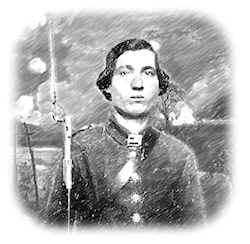
(Note: picture is of an unidentified Confederate soldier.)

0 comments

Rebel War Clerk

Civil War Day-by-Day
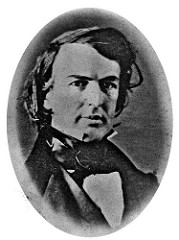
A likeness of Jones when he was editor and majority owner of the Daily Madisonian during President John Tyler’s administration.

OCTOBER 9th.—Early this morning I was at the depot. The superintendent suggested that I should send some one to Weldon in search of the trunk. He proffered to pass him free. This was kind; but I desired first to look among the baggage at the depot, and the baggage-master was called in. Only two were unclaimed last night; but he said a gentleman had been there early in the morning looking for his trunk, who stated that by some mistake he had got the wrong one last night. He said he stopped at the Exchange, and I repaired thither without delay, where I found my trunk, to the mutual joy of the traveler and myself. It was sent to the cottage, and the stranger’s taken to the hotel. Had it not been for my lucky discovery, we should have had no spoons, forks, etc.

My wife has obviated one of the difficulties of the blockade, by a substitute for coffee, which I like very well. It is simply corn meal, toasted like coffee, and served in the same manner. It costs five or six cents per pound-coffee, $2.50.

I heard a foolish North Carolinian abusing the administration to-day. He said, among other things, that the President himself, and his family, had Northern proclivities. That the President’s family, when they fled from Richmond, in May, took refuge at St. Mary’s Hall, Raleigh, the establishment of the Rev. Dr. Smedes, a Northern man of open and avowed partiality for the Union; and that the Rev. Dr. Mason of the same place, with whom they were in intimate association, was a Northern man, and an open Unionist. That the President’s aid, and late Assistant Secretary of State, was an Englishman, imported from the North; Gen. Cooper, the highest in rank of any military officer, was a Northern man; Col. Gorgas, Chief of Ordnance, was also a Northern man; Gen. Lovell, who was in the defeat at Corinth, and who had surrendered New Orleans, was from Pennsylvania; Gen. Smith, in command of Virginia and North Carolina, from New York; and Gen. Winder, commanding this metropolis, a Marylander, and his detectives strangers and aliens, who sold passports to Lincoln’s spies for $100 each. He was furious, and swore all the distresses of the people were owing to a Nero like despotism, originating in the brain of Benjamin, the Jew, whose wife lived in Paris.

The .Senate, yesterday, passed the following resolutions, almost unanimously:

1st. Resolved by the Congress of the Confederate States of America, That no officer of the Confederate Government is by law empowered to vest Provost, Marshals with any authority whatever over citizens of the Confederate States not belonging to the land or naval forces thereof or with general police powers and duties for the preservation of the peace and good order of any city, town, or municipal district in any State of this Confederacy, and any such exercise of authority is illegal and void.

2d. Resolved, That no officer of the Confederate Government has constitutional or other lawful authority to limit or restrict, or in any manner to control the exercise of the jurisdiction of the civil judicial tribunals of the States of this Confederacy, vested in them by the constitutions and laws of the States respectively, and all orders of any such officer, tending to restrict or control or interfere with the full and normal exercise of the jurisdiction of such civil judicial tribunals are illegal and void.

3d. Resolved, That the military law of the Confederate States is, by the courts and the enactments of Congress, limited to the land and naval forces and the militia when in actual service, and to such other persons as are within the lines of any army, navy, corps, division or brigade of the army of the Confederate States.

Yesterday, the Dispatch contained an article, copied from the Philadelphia Inquirer, stating that a certain person who had been in prison here, arrested by order of Gen. Winder, for disloyalty, and for attempting to convey information to the enemy, had succeeded in obtaining his release; and, for a bribe of $100, a passport to leave the Confederacy had been procured from Gen. Winder’s alien detectives. The passport is printed in the Philadelphia paper, and the bearer, the narrative says, has entered the United States service.

This must have been brought to the attention of the President; for a lady, seeking a passport to go to her son, sick and in prison in the North, told me that when she applied to Gen. Winder to-day, he said the President had ordered him to issue no more passports. And subsequently several parties, government agents and others, came to me with orders from the Secretary (which I retain on file), to issue passports for them. I hope this may be the end of Winder’s reign.

A letter from Gen. Lee states that, in view of certain movements, he had, without waiting for instructions, delivered the sword, horse, etc. of Gen. Kearney, lately killed, to his wife, who had made application for them. The movements referred to we shall know more about in a few days.

Gen. Van Dorn dispatches the department that his army is safe; that he took thirteen guns and 700 prisoners. So it was not so disastrous a defeat. But the idea of charging five times his number!
0 comments

Diary of a Southern Refugee, Judith White McGuire.

Diary of a Southern Refugee During the War by Judith White McGuire

8th.—Mr. N. joined us this morning,, and we all gathered here for the day. It seemed so much like old times, that C. broke a war rule, and gave us pound-cake for supper.

0 comments

Downing’s Civil War Diary.–Alexander G. Downing.

Diary of Alexander G. Downing; Company E, Eleventh Iowa Infantry

Wednesday, 8th–We did not get into bivouac until late last night, and again started on our march early this morning. We marched until 3 p. m., when we halted to rest, going into bivouac for the night in a large field of cow-peas, near the town of Ripley, Mississippi. We ran out of rations and foraging parties were sent out. They brought in sweet potatoes and fresh pork, which is all we have to eat. I picked some cow-peas and cooked them; they are rather strong, yet better than nothing to eat. The report is that the rebels have scattered out and escaped, and that we shall not follow them any longer. We are so far from our base of supplies that we are in danger of being captured.

0 comments

War Diary of Luman Harris Tenney.

War Diary of Luman Harris Tenney.

Wednesday, 8th. Commenced drizzling in the morning and kept it up all day. I was detailed to act as Sergt. Major, which pleased me much. Went with picket detail and reported to Stewart at Salomon’s headquarters. Went down and saw Battery boys, and Archie, Reeve, Brooks, and Mason. Good time. In the P. M. Major Burnett with detail started back to Fort Scott. Major sick. Our cook among the detail, so we boys had to commence cooking ourselves. Kept raining all night. Battery paid off and very noisy.

0 comments

Robert M. McGill

Robert M. Magill – Personal Reminiscences of a Confederate Soldier Boy, 39th Georgia Regiment of Infantry

Wednesday, 8th.—Left camp at 5 A. M. Marched to Versailes and rested awhile; again ordered forward. Various rumors to-day; some say there is from 10,000 to 20,000 Yankees near. Crossed Kentucky River at 7 P. M.; halted at 8; rested until 1 A. M.; ordered forward at 5 A. M.; pickets fighting; look for hard fighting to-day.


(Note: picture is of an unidentified Confederate soldier.)

0 comments

Rebel War Clerk

Civil War Day-by-Day
A likeness of Jones when he was editor and majority owner of the Daily Madisonian during President John Tyler’s administration.

OCTOBER 8th.—At last we have definite accounts of the battle of Corinth, on Friday, Saturday, and Sunday last. We have been defeated, and fearful has been the slaughter on both sides. The enemy had overwhelming numbers. We have no particulars, further than that our army retreated This is bad for Van Dorn and Price.

My family arrived last night, well, and pleased with the cottage, which they call Robin’s Nest. But we were saddened by the loss of a trunk—the most valuable one—containing some heavy spoons, forks, and other plate, saved from the wreck at Burlington; my wife’s velvet cloak, satin dress (bought in Paris), my daughter’s gold watch, and many other things of value. Twelve trunks, the right number, were delivered; but one did not belong to us.

0 comments

North Carolina Legislator—Senator J. W. Ellis

Experience of a Confederate Chaplain—Rev. A. D. Betts, 30th N. C. Regiment

Oct. 8—Walk five miles with J. W. Ellis as he starts to North Carolina as Senator. This Christian gentleman, a lawyer of Columbus county, enlisted in Co. E as a private, August 28, 1861. His friends elected him to the North Carolina Senate in 1862. He had a walk of about ninety miles to Staunton, the railroad track having been torn up. I put his knapsack on my horse and claimed the pleasure of walking a few miles with him.

Oct. 12—Preach in morning. Captain Atwell died at Shepardstown.

0 comments

0

Civil War Day-by-Day

October 8, 1862, The New York Herald

The main body of the rebel army of Virginia, at least one hundred thousand strong, under General Lee, was, at the date of our last advices, encamped between Charlestown and Winchester, apparently awaiting and expecting an attack from General McClellan. The next rebel column in importance was that of General Jo. Johnston, at Culpeper Court House, consisting of three divisions, equal, probably, to forty thousand men. There was also a considerable supporting detachment at Gordonsville; but in all that region of country east of the Blue Ridge, from Culpeper Court House to Leesburg, there appear to be no rebel troops beyond a few squads of scouting cavalry.

From this distribution of the rebel forces it would appear that General Lee has abandoned all hopes of every other line of communication with Richmond except that up the Shenandoah valley and across the Blue Ridge by way of Culpeper Court House, or by way of Gordonsville. Had he been able to hold on to Harper’s Ferry he might have commanded the more direct route to the rebel capital by way of Leesburg and Manassas; but with Harper’s Ferry in our possession General McClellan holds this route, whereby, should Lee attempt a retreat up the valley without a fight, he may be headed off or left far behind in the race for Richmond. Hence the necessity to Lee of drawing General McClellan up the Shenandoah valley, and hence the probability of very soon of a tremendous battle in the neighborhood of Winchester. From the tone of the Richmond journals it appears that Lee is not averse to this engagement, but is prepared for it, and does not absolutely despair of turning the tables against General McClellan and driving him back into Maryland.

Our only apprehension in the matter, however, is that Lee may possibly deceive our scouts by a thin line of troops, so disposed in front as to present the appearance of a great army, while the bulk of his forces, horse, foot, artillery and trains, are hurried up the valley and across the mountains to Culpeper Court House and Gordonsville. Once at [continue reading…]

0 comments

0

Civil War Day-by-Day

October 8, 1862, The Charleston Mercury

(Correspondence of the Mobile Advertiser.)

TUPELO, September 29.

There are many inquiries as to the object and result of General Price’s late march to and retreat from Iuka, and a great desire to know whether it resulted in any advantage, or proved a failure or reverse. The palpable evidence of his having been obliged to retire from his position at Iuka is accepted by some as a proof that he was unsuccessful. Nothing could be further from the fact. Early in August, as soon as General Hardee had moved his forces and placed the railroad at General Price’s disposal, the latter made preparations for an advance, and communicated with Major General Earl Van Dorn, stating his intentions and desiring co-operation, assuring him that so soon as the armies formed a junction he would cheerfully turn over the command to him. The proposition was favorably accepted, but circumstances at the time forbade Gen. Van Dorn’s leaving his position, menaced as he was by a superior and exasperated foe. Meantime Gen. Bragg had accomplished the great task of concentrating his forces at Chattanooga and confronted the enemy with an army that not only stayed their further progress into our fair land, but threatened their destruction. Soon the Yankees turned their cowering front towards Nashville, and were rapidly followed by the Army of Mississippi. Bragg felt confident that he could ruin the fleeing army in his front, but had some misgiving should they be reinforced by the 25 or 30,000 under Grant and Rosencranz, then extended from Columbus and Memphis to Tuscumbia. All the information that he could gain of the enemy tended to their leaving West Tennessee and reinforcing Buell. This he informed Price of and desired him, at any sacrifice, to hold the Federal army in West Tennessee in check and prevent their escape, at the same time ordering Van Dorn to act in concert with Price. Price sent an aid to Van Dorn with his plan of operations, desiring his approval and co-operation, and again assuring him that [continue reading…]

0 comments

0

Civil War Day-by-Day

October 8, 1862, Nashville Daily Union (Tennessee)

A merchant at Independence Hill fourteen miles from Murfreesboro’, was robbed recently of $1,400 worth of goods and $4,000 in money by the guerrillas. His store was completely stripped. And these are the soldiers who protect our rights!

0 comments

0

Civil War Day-by-Day

October 8, 1862, Montgomery Weekly Advertiser

“Personne,” the correspondent of the Charleston Courier, recording some incidents of the late battles on Manassas Plains, mentions the following of an Alabama boy:

It is related of a soldier belonging to the Eighth Alabama Regiment, that he found a Yankee in the woods, that being separated from his regiment he did not know what to do with him. While soliloquizing, the officer who gave me the incident rode by, and his advice being asked, he told the soldier he had better let the prisoner go. “Well” said the Alabamian, “I reckon I will; but look here, Yankee, you can’t leave till you’ve given me some of them good clothes. Strip! I want your boots and breeches.” The Yankee protested against any such indignity, and appealed to the officer to protect him. The Alabamian also plead his cause. “Here’s this fellow,” said he, “come down here a robbing of our people, and he’s stayed so long it’s no mor’n right he should pay for his board. I don’t want him to go round in his bar legs any mor’n he wants to; and I mean to give him my old clothes.” “A fair exchange is no robbery,” replied the officer, “and as you have no shoes and a mighty poor pair of pants, I reckon you had better help yourself.” “Now Yankee, you hear what the ‘boss’ says, do yer; off with your traps and let’s trade.” The last thing my friend saw as he rode away, was the two worthies in their “bar legs,” stripping for an exchange.

0 comments

0

Civil War Day-by-Day

October 8, 1862, The New York Herald

General Orders No. 163.

CAMP NEAR SHARPSBURG, Md., Oct. 7, 1862.

The attention of the officers and soldiers of the Army of the Potomac is called to General Orders No. 139, War Department, Sept. 24, 1862, publishing to the army the President’s proclamation of Sept. 22.

A proclamation of such grave moment to the nation, officially communicated to the army, affords to the general commanding an opportunity of defining specifically to the officers and soldiers under his command the relation borne by all persons in the military service of the United States towards the civil authorities of the government. The constitution confides to the civil authorities, legislative, judicial and executive, the power and duty of making, expounding and executing the federal laws. Armed forces are raised and supported simply to sustain the civil authorities, and are to be held in strict subordination thereto in all respects. This fundamental rule of our political system is essential to the security of our republican institutions, and should be thoroughly understood and observed by every soldier. The principle upon which, and the objects for which, armies shall be employed in suppressing the rebellion, must be determined and declared by the civil authorities, and the chief Executive, who is charged with the administration of the national affairs, is the proper and only source through which the views and orders of the government can be made known to the armies of the nation.

Discussion by officers and soldiers concerning public measures determined upon and declared by the government, when carried at all beyond the ordinary temperate and respectful expression of opinion, tend greatly to impair and destroy the discipline and efficiency of troops by substituting the spirit of political faction for that firm, steady and [continue reading…]

0 comments

0

Civil War Day-by-Day

October 8, 1862, Nashville Daily Union (Tennessee)

General Anderson’s Camp at Lavergne Broken up and Routed!
Rebel LossThirty Killed and Eighty wounded.
Three Hundred Prisoners Taken!
The Enemy’s Entire Camp: Equipage, Stores, Arms and Ammunition Captured and Brought to this City.

Our arms at this point have been crowned with another brilliant success over the foes of our peace and happiness. The rebel camp, under Gen. Anderson at Lavergne, fifteen miles from this place, of which so much has been said for the last week, and which the secessionists firmly believed would in a few days drive the army from this city, has been utterly scattered and annihilated by our industrious, fearless and resolute officers and soldiers, whose skill and valor are worthy of the loftiest praise.

For days past we could hear of nothing but Lavergne, LavergneLavergne and Anderson and fifty pieces of cannon, and ten thousand rebels, with any number of reinforcements from divers places. It was the current talk of the rebels. General Negley, finally, concluded that this scare-crow had been flourished before us quite long enough, and determined to give it a quietus, similar to that administered to Col. Bennett’s camp near Goodlettsville. Officers and privates alike were eager for the conflict, and never did troops more heartily second the plans of their commander. It was resolved to place Lavergne and its accompaniments among the things that were, and due preparations were made. The following were the orders from Headquarters:

Headquarters U. S. Forces,
Nashville, Tenn., Oct. 6, 1862. [continue reading…]

0 comments

0

Civil War Day-by-Day

October 8, 1862 , Montgomery Weekly Advertiser

The people of Lynchburg, Va., have recently been thrown into a fever of excitement by the appearance of a ghost in their midst. It has very appropriately selected a deserted hospital as the scene of its nocturnal visitations.

0 comments

0

Civil War Day-by-Day

Washington Telegraph (Arkansas), October 8, 1862

At the residence of Mr. B. McDonald, in Washington, Ark., on the 26th ult., Lieut. James F. Walker, in the 30th year of his age. He was the son of Dr. W. S. Walker, of Tyler, Texas.a member of Col. Speight’s regiment and first lieutenant of Capt. Mayse’s company. Commanding in person and deportment, firm and energetic as a drill officer, united with great urbanity of manners, which endeared him to the entire company, he may justly claim the title of their idol. The tears that bedewed the cheeks of the weather-beaten soldiers as they stood around his dying bed, gave ample proof of their love for their favorite officer. But alas! tears and prayers were alike unavailing. The stern mandate had gone, and despite the unremitting watchfulness of his physicians and the tender care of friends endeared to him by long association, he went down to an early grave in the flower of his manhood, and at a time when his brave and manly services were most needed.

“But the night dew that falls, tough in silence it weeps,
Shall brighten with verdure the grave where he sleeps,
And the tear that we shed though in Secret it rolls,
Shall long keep his memory green in our souls.”

M.S.D.

0 comments

0

Civil War Day-by-Day

October 8, 1862, Galveston Weekly News

We hear that the scarcity of medicines some time since so much complained of, is now obviated. We learn on good authority that there is now an unusual large supply of medicines in the State, in the hands of merchants.

0 comments

0

Civil War Day-by-Day

October 8, 1862, The Charleston Mercury

Savannah is up and doing in behalf of our suffering soldiers in Virginia. A public meeting has been held, and prompt measures taken to secure at once clothing for the army. Messrs. W.H. WILTBERGER & CO., proprietors of the Pulaski House, have offered the entire stock of carpets of their establishment to be converted into covering for the soldiers. Some idea of the munificence of the donation may be formed, when we state that it comprises the carpeting of one hundred and twenty rooms, and when cut up, will make over five hundred comfortable and good sized blankets.

0 comments