0

Civil War Day-by-Day

February 5, 1863, The Charleston Mercury

For fifteen months, or since the MUIR business, the esequatur of Mr. ROBERT BUNCH from the United States Government has been withdrawn. HE has been the Consular Agent of her Britannic Majesty at this port, and is now permanently withdrawn by his Government. We learn that, both from the British Minister to the United States, Lord LYONS, and from his Government itself, he has assurances that his course in Charleston is approved, with the promise of promotion to a more important diplomatic post. It is said that under the prospect of a formidable attack on Charleston, it would not be proper to expose the obnoxious Mr. BUNCH, deprived of his official position, to the hostility of the Yankee forces, should they succeed; therefore, the Cadmus has been sent to remove him out of the way of any such unpleasantness. It seems more probable, however, that the real motive of his withdrawal is a desire on the part of Lord LYONS and of the British Administration to gratify the United States Government in the removal of Mr. BUNCH, whose views and course has been more unprejudiced and just to the Confederate States than their own. Yet, while proceeding to do so, it accords with British custom to avoid sacrificing an officer who has done his best for his county, and, at the same time, also to avoid, as far as practicable, the appearance to the Confederate States of removing an officer because of his fairness and supposed friendly bias. The danger to Mr. BUNCH of remaining longer in Charleston, may be a mere diplomatic reason on the part of Lord LYONS for his immediate transfer to London.

We throw out these views which occur to us for whatever they may be worth. Every one must judge for himself.
0 comments

War Diary of Luman Harris Tenney.

War Diary of Luman Harris Tenney.

Tuesday, 4th. Let Thede go to town on my mare. Read “Tom Brown.” Became quite interested. There seems so much reality in all the sports and tricks. In the evening went to tactic school at Co. K’s quarters. Like it well.

0 comments

Downing’s Civil War Diary.–Alexander G. Downing.

Diary of Alexander G. Downing; Company E, Eleventh Iowa Infantry

Wednesday, 4th–Rain all day, and the whole country is being flooded over. General Grant has sent five or six expeditions along the river to find some way to move the army on to higher ground in the rear of Vicksburg, and also to solve the problem of getting our fleet and gunboats past the rebels’ batteries with out running the risk of having them destroyed. I wrote a letter to John D. Moore, Inland, Iowa.

0 comments

Diary of Horatio Nelson Taft.

Diary of US patent clerk Horatio Nelson Taft.

Washington Wednesday. Feb’y 4th 1863

It has been the coldest day of the Season with a sharp cutting wind. The “Grand Concert” came off this evening. I had tickets rather more than I sold but did not see or hear much of the Concert. I think the audience (which was a large one) were not very well satisfied and rather felt “sold.” I was spending most of the evening more pleasantly with Genl Havelock at his room on F Street by invitation. The Genl is an open hearted honest old Soldier. The President invited him over here from England to take charge of the Cavalry as it arrived from the country and fit it for Service. He thinks he has not been very handsomely treated by the Sec’y of War as his Views and plans have not met with much favor at the War office. He holds a Cols Commission, was Genl in the British Army. We sat and talked and drank sherry near two hours. He is a fine specimen of the English Gentleman and brother of the celebrated Genl Havelock of India fame. My Stove “goes off” tonight and the wood melts away in it like wax as it is a very cold night for this City. Mercury is 10 above zero. No war news of any importance, everything must be frozen up. The Potomac was frozen over this morning. There are indications in congress that Mr Chases Banking system will be adopted. Gold droped yesterday five per cent, but is up again today to 159 under the influence of some “Secesh” news to the effect that some of our Blockading Squadron at Charlston had been destroyed by two rebel “iron Clads.” We will wait and see.

0 comments

A Rebel War Clerk’s Diary

Civil War Day-by-Day
A likeness of Jones when he was editor and majority owner of the Daily Madisonian during President John Tyler’s administration.

FEBRUARY 4th_–One of the enemy’s iron-clad gunboats has got past our batteries at Vicksburg. Gem Pemberton says it was struck “three times.” But it is through.

The enemy’s presses reiterate the assertion that Gen. Longstreet is in Tennessee with his corps; and that the detachments from Gen. Lee’s army amount to 75,000 men. This is evidently for the purpose to encourage Hooker’s army to cross the Rappahannock. These presses must know that Gen. Lee’s whole army was less than 75,000 men; that Longstreet is still with him, and that only one small brigade has been sent away to North Carolina. Well, let them come! They will be annihilated. But is it not diabolical in the New York Post, Times, etc. to urge their own people on to certain destruction? If Hooker had 300,000, he could not now come to Richmond!

We have extremely cold weather now; and, probably, the rivers in Virginia will be frozen over to-night.

0 comments

0

Civil War Day-by-Day

February 4, 1863, The New York Herald

We have unexpected news and rather startling in intelligence from Charleston for the entertainment of our readers this morning. We derive the news from a late number of the Richmond Dispatch, and the substance of it is, that on Saturday morning last the improvised rebel fleet of Charleston, consisting of two little patched up iron-clads and three small attending steamboats, made a sortie upon our blockading squadron, sunk two of the ships, set fire and crippled several others, and cleared the roadstead of every vestige of a blockade. We refer the reader to the details in our news columns.

But there is another feature in this disgraceful affair which is suggestive of more serious mischief to follow. We allude to the proclamation by Gen. Beauregard and Capt. Ingraham, commander of the petty rebel attacking squadron, declaring the blockade of Charleston raised and the port legally open to foreign trade, which proclamation is seconded by the foreign consuls accredited to Charleston in their proceedings to the same effect. A similar pronunciamiento was issued by General Magruder after his successful cutting up and dispersion of our blockading fleet in Galveston harbor. We are not aware that there is anything in the recognized international law upon the subject which puts an end to a blockade thus temporarily raised by a successful sortie; but there may be some special understanding in the matter between the government of Jeff. Davis and the governments of England and France. At all events, from the rejoicings of the rebels at Charleston, it is evident that they attach much greater importance to this successful raid of their contemptible fleet than the mere sinking of a federal ship or two and the dispersion of the remainder of our squadron for one short day would warrant. We shall probably be enlightened upon this question in the course of the day from Washington.

But this melancholy affair at Charleston, superadded to the late Galveston disaster, and the Merrimac affair in Hampton Roads, and the escape of the Nashville from Beaufort, and of the Oreto from Mobile, ought to be sufficient to satisfy President Lincoln that old Mr. Welles is not the man for the Navy Department at this crisis. Had any one of our new iron-clads been on the ground those two rebel gunboats from Charleston might have been destroyed or captured. But it [continue reading…]

0 comments

0

Civil War Day-by-Day

February 4, 1863, The Charleston Mercury

It is our sad office, today, to chronicle the death of the founder of this journal  one who, for fourteen or fifteen years, was its editor and proprietor, and whose learning, talents and stainless character have adorned many positions of honor and usefulness, and wrought much good in this community.

The Hon. HENRY L. PINCKNEY was born September 24, 1794. He was the son of the Hon CHARLES PINCKNEY, and his wife, MARY ELEANOR LAURENS. His father was Father of the Constitution of the United States, having submitted to the Convention of 1787 the scheme of government, which was adopted in may parts literally, and throughout substantially, by that high body. His mother was the daughter of the Hon. HENRY LAURENS, who was President of the Continental Congress. The scion of these illustrious stocks showed great aptitude at school, and was graduated at the South Carolina college in 1812, with the first honors of his class, and a reputation for talent. He studied law under his brother-in-law, the distinguished ROBERT Y. HAYNE, but never practiced the profession.

In 1816 he was elected to the popular branch of the State Legislature, and was re-elected, serving for sixteen successive years; and again, after an interval, for two years more. During this time he was appointed Chairman of the leading Committee of Ways and Means, acting in that capacity for eight years. In 1830, and for four years, he was elected Speaker of the House. This was during the most exciting period of the Nullification controversy. THE CHARLESTON MERCURY was, throughout, the exponent of the State Rights, Free Trade Party of South Carolina. From the establishment of the paper until 1833, when Mr. PINCKNEY went to Congress, and it was bought for JOHN A. STUART, Esq., Mr. PINCKNEY was its owner and conductor. In the editorial columns, and in speeches, he consistently, boldly and ably opposed the protection of manufacturers by duties laid by Congress, not for revenue, but for the unconstitutional and illegal object of benefiting one class and section of the Confederacy at the expense of others. He advocated nullification of the oppressive and unlawful Tariff of 1828. The party and policy succeeded in the State in 1833, when Mr. [continue reading…]

0 comments

0

Civil War Day-by-Day

February 4, 1863, The Charleston Mercury

We understand, from some of the officers of the captured gunboat Isaac P. Smith, that the fire of our sharpshooters during the engagement was so deadly as seriously to retard the working of their heavy guns, and that at one time they found no little difficulty inducing their crew to man the guns at all. Our brave sharpshooters were posted, without the slightest cover of any kind, upon the river bank, within 150 yards of the muzzles of the enemy guns. Their weapons were Enfield rifles, with which they poured an incessant fire into the ports of the gunboat. The force of sharpshooters consisted of Company H, Captain ROOF, and Company I, Lieut. GUNTER, of the 20th S.C.V.; a detachment of twenty men from Capt. HARLESTON’S Company D, 1st Regiment (regular) S.C.A., and Company I, 1st Regiment (regular) S.C.A., Captain MITCHEL, the last named officer being in command of the force. The skill, courage and coolness of the sharpshooters largely contributed to the success of the attack.

We have been presented with the twenty-four pounder rifle shell, somewhat broken, which struck the machinery and stopped the gunboat. It was found lodged in the steam pipe, after passing through the side of the boat and through the steam chest. No other shot penetrated the machinery, and the size and shape of the shell in question, as we are informed, shows that the retreating steamer was halted by one of Capt. GARY’S batteries, of the LUCAS Battalion of S.C. Heavy Artillery, on James’ Island. The shell can be seen at our office.

0 comments

0

Civil War Day-by-Day

February 4, 1863, The New York Herald

Our news today is of more than usual importance. Telegrams from Charleston to the Richmond papers give accounts of a disaster to the blockading gunboats in Charleston harbor on Saturday, which is said to have resulted in the loss of two vessels sunk and four set on fire. The Mercedita was sunk in five fathoms of water. The rebel authorities, General Beauregard and Captain Ingraham (the latter being in command of the enemy’s squadron), have declared the blockade of Charleston raised in a proclamation stating that they hereby formally declare the blockade by the United States of the said city of Charleston, S.C., to be raised by a superior force of the Confederate States from and after the 31st day of January, A.D., 1863.

The loss to our men is claimed to be heavy, while the enemy boast that they did not lose a man. The foreign Consuls gave it as their opinion that the blockade was fairly raised by the dispersion of our fleet. We give a map of the locality today.

Charleston despatches also repeat the report of the capture of the J.P. Smith in Stono river.

The Richmond Dispatch says that another attack was made on Fort McAllister, on the Ogeechee, on Monday, and that our boats were again driven away.

There is little of importance from the Army of the Potomac. The roads are improving under the change of weather. General Hooker has decided to give a limited number of furloughs to the men, to enable them to visit their homes. Colonel Percy Wyndham has just returned from an expedition to Warrenton. He surprised the town on Monday night, and while there sent strong patrols to the Rappahannock, at Sulphur Springs and Waterloo, who found no enemy at either place. He captured in Warrenton eighty stand of arms, which he was obligated to destroy, having no facilities for bringing them away.

We learn from Tennessee that General Wheeler’s cavalry attacked a fleet of twenty-five federal transports on the Cumberland river, and destroyed five on last Friday. The fleet was accompanied by two gunboats. On coming down from Nashville on Saturday General Wheeler’s cavalry destroyed a locomotive and five cars at Lavergne, and captured the guard of fifty-two men.

The report from Paducah, Ky., is that Fort Donelson was attacked early yesterday morning, and that the fight was still going on at four o’clock P.M. Reinforcements were arriving. The gunboat New Era was attacked on Sunday night near Island No. 10 by 3,000 rebel guerillas from a battery of three guns. The firing continues till daylight, when the rebels retired.

The opening of the canal near Vicksburg is progressing; but the enemy have planted a battery opposite its lower end, which commands it. General Grant has arrived there. The rebel Longstreet is said to have gone to Tennessee with thirteen brigades.

0 comments

0

Civil War Day-by-Day

February 4, 1863, The New York Herald

Warning

The following article contains wording that is offensive to many in the world of today.
However, the article is provided unedited for its historical content and context.

The bill for the formation of a negro army, which passed the United States House of Representatives on Monday last, has created considerable discussion and excitement, and Mr. Stevens, of Pennsylvania, the Mephistopheles of Congress, seems to be particularly worried about it. He thinks that negro soldiers should be employed under any circumstances, and fears that unless [continue reading…]

0 comments

War Diary of Luman Harris Tenney.

War Diary of Luman Harris Tenney.

3rd. Tuesday. Commenced taking care of my cream mare. Thede tried her gait. We cleaned her off nicely. Was kept quite busy all day straightening accounts in commissary. A cold, chilly, piercing day. Suffered considerably. Seems good to have Thede with me.

0 comments

Downing’s Civil War Diary.–Alexander G. Downing.

Diary of Alexander G. Downing; Company E, Eleventh Iowa Infantry

Tuesday, 3d–Cloudy and cold. The levee is the only thing of interest and importance. We are still at work on the levee, but the water is almost to the top now, and it is breaking at so many points that the land on both sides of the river is being flooded. Our camps will have to be moved to higher ground farther from the river. Some of the camps are already being moved. I bought a supply of bread today for a dollar.

0 comments

Diary of Horatio Nelson Taft.

Diary of US patent clerk Horatio Nelson Taft.

Washington Tuesday Febru’y 3rd 1863

It was quite warm and pleasant this morning. But tonight it is cold with a kee[n] north wind which quite upsets all my calculations for comfort in my room for the chimney and my stove do not work together at all, the draft being decidedly down instead of up. I have consequently been obliged to surrender the premises and have spent the evening with my Artist friend Mr Mulviny whose room is below stairs. He has fine Stereoscopic Views and a good Instrument and many fine pictures. He himself is half Irish & half Italian. The concert for the NY soldiers goes off tomorrow night. I have got ten tickets to Sell. I am afraid the whole thing will be a “Sell” with P.H. Ostrander as manager. I think the House will be full as great efforts are making to sell tickets. If the audience are not “Sold,” I shall be glad. Called this morning at Charleys to say to him that some of the Patients at the Ascension Hospital were complaining of Doct Dorr, and want of attention. Some of the Soldiers are given to complaining and are never Satisfied whatever their treatment may be. Such men can make a great deal of trouble if they try as there is always plenty of anxious listeners visiting the Hospitals and take it for granted that a sick or wounded soldier would always tell the truth. It is bitter cold tonight for the poor soldiers in the field and it is freezing hard.

0 comments

A Rebel War Clerk’s Diary

Civil War Day-by-Day
A likeness of Jones when he was editor and majority owner of the Daily Madisonian during President John Tyler’s administration.

FEBRUARY 3d.—It appears that Gen. Pryor’s force, 1500 strong, was attacked by the enemy, said to be 5000 in number, on the Blackwater. After some shelling and infantry firing, Gen. P. retired some eight miles, and was not pursued. Our loss was only fifty; it is said the enemy had 500 killed and wounded; but I know not how this was ascertained.

Gold in the North now brings 58 1/2cents premium. Exchange sells at $1.75. Cotton at 96 cents per pound!

They are getting up a fine rumpus in the North over the imprisonment of an editor.

To-day, when conversing with Judge Perkins in relation to having a passport system established by law, he admitted the necessity, but despaired of its accomplishment. “For,” said he, “nothing can be done in Congress which has not the sanction of the Executive.” He meant, I thought, from his manner and tone, that the Executive branch of the government was omnipotent, having swallowed up the functions of the other co-ordinate branches. I cannot understand this, for the Executive has but little appointing patronage, the army being completely organized, having supplementary generals, and all officers, under the grade of brigadiers, being promoted as vacancies occur.

0 comments

0

Civil War Day-by-Day

February 3, 1863, The Charleston Mercury

We agree with every word ‘Historicus’ has said against the intervention of France and England to end the war between Confederate and the United States, on the principles which governed their intervention in the case of Greece and Belgium. The readers of THE MERCURY will remember that, from the first suggestion of the intervention of European Powers, we opposed it, as necessarily injurious to the Confederate States. The great European nations did not sympathize with us in our struggle for Free Government. They are all, including Great Britain, Consolidationists. They do not understand that Free Government consists, first, in the limitations of the powers of government – and, second, in their partition, by which one set of functionaries can check another, and all great interests, by representation, can protect themselves. Hence, they naturally leaned to the United States in their effort to subjugate us; and have perverted the laws of nations to strengthen their power against us. To give such nations the power of settling our relations towards the United States, would be fatal to our liberties. Reconstruction, in the form desired by the United States, would doubtless follow; and we would be taxed, ruled and oppressed, as heretofore, by the majorities of the Free States. Nor would we be any better off on the subject of slavery. With such Abolitionists as Lord PALMERSTON and Earl RUSSEL on the part of Great Britain, and Ministers from France entirely indifferent to the institution (to say the least of it) on the part of France, it would be a miracle if the Confederate States escaped utter ruin by their intervention. And what chance would the Confederate States have of any of the Border States in the adjustment of boundaries, under the auspices of such mediators? Might they not be zealots in making these States, like their own, Free States? Cotton is all that their interests require; and these States do not grow cotton. The region where cotton is produced, if left to slave labor, will be enough for them, and may be supposed enough for us. The Confederate States would, of course, be dissatisfied with such an adjustment; and if they resisted, there stands the precedent of Greece and Belgium – they would be coerced. Holland and Turkey were forced to submit to the intervention dictated by Great Britain and France, by the force of arms. No! the Confederate States want no such intervention; and the astonishing part of the matter is, that any statesman of Great Britain, so able and well informed as ‘Historicus’ clearly is, should deem it necessary to combat at such length, a policy which no considerate statesman of the Confederate States has ever, that we know of, proposed or supported. That it has been proposed and supported in England, by those who profess to be favorable to our cause, we cannot doubt. We are deeply indebted to ‘Historicus’ for exposing their folly; but we could not be at all surprised, if, failing to conquer us, our Yankee foes should [continue reading…]

0 comments

0

Civil War Day-by-Day

February 3, 1863, The New York Herald

The latest news from Suffolk represents that the enemy was last night in force between sixteen and seventeen miles from there this side of the Blackwater. Our troops had taken every precaution to attack him again should he advance farther towards Suffolk. There is now no evidence that an engagement will ensue immediately.

Our correspondence from that quarter today gives a full detail of Gen. Corcoran’s plan of operations in the recent battle, and gives credit to the skill of the commander and the valor of the men.

With regard to the reported disabling of the Union iron-clad Montauk, in the Ogeechee, off Fort McAllister, there are two very different versions abroad. The Richmond and Savannah papers say that the Montauk came up to the fort in fine style, and that she was the only boat engaged. Their shell and shot were broken to pieces as they struck her sides, but her turret was so badly injured that she had to haul off. The others in the meantime remained below the bend of the river, entirely out the action. On the other hand, the Navy Department received a despatch last night from Fortress Monroe, stating that there is no truth in the report that the Montauk was disabled; that Commander Worden lay under the enemy’s guns for four hours, and that their shot had no more effect upon his vessel than hail stones.

Nothing had been heard at Port Royal of the capture of the gunboats Isaac Smith in Stono river.

In addition to the news we gave yesterday relative to the reported destruction of the Oreto or Florida, we have since learned that a leading mercantile house of Havana sent word off to the Columbia, as she was about leaving that port, that the rebel vessel had been destroyed.

It is stated, upon the authority of the Richmond Whig, that the British steamer Princess Royal was surrounded and captured by a fleet of Union gunboats while attempting to run the blockade into Charleston on Thursday, with a valuable [continue reading…]

0 comments

0

Civil War Day-by-Day

February 3, 1863, The Charleston Mercury

Yesterday forenoon passed in the city and harbor without any stirring news or incident of note. About one o’clock a telegram from Fort Sumter announced that a strange steamer, evidently an iron-clad, had just hove in sight. The number of the ordinary blockading vessels strung along the horizon was eleven. With a good glass the outline of the iron-clad could be plainly seen from the city wharves, and an endless variety of rumors and conjectures in relation to her identity and designs were soon afloat.

Meantime, another strange sail made her appearance in the offing. She – proved to be the British steam frigate Cadmus, 21 guns, bringing despatches for the British Consul and for the Petret, now anchored in the harbor. At three o’clock one of the boats of the Cadmus brought the despatches to the city in charge of a Lieutenant.

We have learned, from good authority, that the Cadmus brings intelligence that an expedition of a very formidable character has been prepared to operate against the City of Charleston, and that the enemy is now nearly ready for the attack. Mr. ROBERT BUNCH, the British Consul, has orders to go aboard the Cadmus and to get to Havana with the least possible delay. We understand that he expects to leave on Saturday next.

From the Cadmus we have information that the mysterious steamer off North Channel is the Yankee iron-clad frigate New Ironsides. She can hardly cross the bar, as she is said to draw nineteen feet water. Her object, for the present, probably, is merely to protect the blockaders from another attack. The Ironsides, it is believed, came from Broad River. The transports plying southward from Beaufort, N. C., are probably bound for Port Royal, as the rendezvous of the land forces of the expedition.

In our naval successes last week the enemy has had a foretaste of our strength upon the water. But the preparations for the attack on our city were matured previously, and it is not believed that our naval victory will either prevent or postpone it. It is well, however, that our defences are now complete, and that we were able to strike the first blow in the struggle to hold our good old seaport. That blow, we trust, will encourage our defenders, on land and sea, to redouble their activity and welcome to the assailants.

0 comments

0

Civil War Day-by-Day

February 3, 1863, The New York Herald

Our Suffolk Correspondence.

ON THE BATTLE FIELD,

TWELVE MILES FROM SUFFOLK, Jan. 30 – 9 P.M.

If I remember aright, my last letter written from this field of battle left our forces about to execute a flank movement on the enemy’s left.

After consideration General Corcoran determined not to execute this flank movement, for the following reasons: – If we pressed right on, the distance to the point we desired to reach is only four and a half miles, while, if we moved our column around on the enemy’s left flank, we would have to go between six and seven miles to reach the same locality. The enemy, we knew, was slowly retreating, and our main object was to overtake him and provoke another general engagement. We knew that if we went the long route to the left we would be sure to get on his flank, while at the same time he might have moved back far enough to secure a safe and speedy retreat. In this state of affairs General Corcoran determined to push straight on, and by the shortest route that would lead him to the enemy’s rear or front. We did push on. The infantry deployed through the woods, and the cavalry occupied the road. Behind the latter was a portion of our heavy field artillery, ready for immediate service. In this manner we moved forward, the enemy all the while throwing in, especially on the road and in the woods adjacent to it, a heavy shower of canister, and occasionally solid shot and shell. But still our men faltered not. They pressed right forward, cheered by the timely and pertinent remarks of General Corcoran, and the untiring efforts and encouraging endeavors of Colonel Spear, of the Eleventh Pennsylvania cavalry. As we advanced through the woods the enemy thought to drive us back by increasing the rapidity of their artillery fire; but this did not work to our disadvantage. And what rendered the forward movement still more peculiar (but not at all unusual under like circumstances in military movements), several sections of our batteries kept up a fire in the rear, from a sort of eminence behind the woods, the shells from these sections pouring over the heads of our men, and on [continue reading…]

0 comments

0

Civil War Day-by-Day

February 3, 1863, The New York Herald

The bill to raise black soldiers and sailors for the United States service was modified in some important particulars before it passed the House today. The border State members had given warning that recruiting officers for that purpose would be shot by the citizens if they should attempt to raise negro recruits in Kentucky and Tennessee, and an amendment was adopted to receive no Africans from loyal slave States and districts specified in the emancipation proclamation, and prohibiting recruiting offices in the border States. This will curtail materially the enlistments of the character contemplated in the bill.

The closing debate was mainly of a partisan character. Mr. Stevens’ speech was very able. It was a resume of all the arguments that he and his colleagues have brought against the opposition throughout the two last sessions. In reference to black soldiers, he said there would be three hundred thousand two years’ men out of service at the end of June, and he judged that not fifty thousand white men could be raised to supply the deficiency by recruiting, and as conscription by force is out of the question we must call out the black men. He believed that a large number of the generals in our army were secessionist sympathizers, and those of them who had threatened to resign if negroes are enlisted ought to be tried and shot. His attack upon General McClellan, whom he accused of having disobeyed positive orders from General Scott, as well as from President Lincoln, was coldly received.

On the final vote several members paired off. On the republican side of Kellogg of Illinois, Horton and Harrison of Ohio, Granger of Michigan, Thomas of Massachusetts, and one other republican, voted nay. Several members who had promised to vote nay came over at the last moment, so that the relative majority was somewhat larger than was anticipated.

0 comments

0

Civil War Day-by-Day

February 3, 1863, The Charleston Mercury

We take, from the Savannah News of yesterday, the following additional details in regard to the bombardment of Fort McAlister, at Genesis Point:

The fort was but slightly injured. A portion of the parapet in front of the 10 inch Columbiad was destroyed; the gunners never flinched, but fought their gun with spirit, even when thus exposed to the enemy’s continued fire. A trunnion of one of the 32 pounders was destroyed by a shell, which disabled the gun. This was the only injury our guns received, which were fired with great precision, the shot and shell falling fast and thick upon the iron clad. The other gunboats were out of range, consequently the iron-clad received all the attention of the batteries. A large number of hands were immediately put to work to repair the damage done to the battery, and by night they were completed, and again in fighting order, well supplied with powder and shot.

The Federal fleet consisted of one iron-clad, one mortar boat, and three gunboats. The iron-clad came up within eight hundred yards of the fort, and anchored. During the action she was frequently struck by the shot from our batteries. Several balls passed through her smoke stack, and at one time two shot struck her turret at the same time, when she ceased firing and retired, evidently injured. The four other Federal boats did not come nearer that a mile and a half to two miles of the batteries. But they were within range, and threw shot and shell with great accuracy.

Several gentlemen who went to Coffee Bluff, where they had a good view of the battle, returned to the city in the afternoon. They state that they are confident that the iron-clad turret boat was seriously disabled by our fire, as she remained silent for a quarter of an hour before leaving her position, and did not return the fire of the battery, which was directed against her as she retired and joined the fleet below.

Major Gallie was killed during the first twenty minutes of the action. He was first struck in the face by a fragment of a shell, and but slightly injured. He retired and had his wound dressed, and had just returned when a shell struck the trunnion of a thirty-two pounder. A fragment of the shell or the trunnion plate, struck him on the head, causing instant [continue reading…]

0 comments

0

Civil War Day-by-Day

February 3, 1863, The New York Herald

(From the Boston Post, Feb. 2.)

General McClellan continues to receive numerous attention from our citizens. Wherever he goes he is greeted with demonstrations of the most friendly and enthusiastic nature. His visit to Boston, which was originally intended to have had all the quietness and obscurity of a jaunt into the country, has become more or less public and demonstrative. The people have a great desire to see him, and accordingly it has become difficult for him to move about without considerable publicity, so extensive is his popularity with the masses.

On Saturday forenoon he visited, with several friends the Massachusetts General Hospital, where he was received by the learned faculty, and who gave him the most marked attention. The various wards were visited and the general disposition and management of the institution were warmly complimented by the General. From the hospital he proceeded to the noted Anatomical Museum of Dr. Warren, on Mount Vernon street. The huge mastodon at this place was inspected with wonder and admiration. Dr. Warren next proceeded with the party to his residence, Park street, where a collation was served and a season of friendly conversation indulged. The General subsequently visited the residence of the venerable Josiah Quincy, Sen., with whom he held a somewhat extended and highly interesting conversation. In the afternoon General McClellan, in company with leading citizens, visited the rooms of the Somerset Club, near the Tremont House, by special invitation. He remained there about half an hour, receiving introductions to a large number. The attentions received here were of the most gratifying nature. The fact of his being at the club house was soon known, and a large crowd assembled without, who gave vent to their feelings by cheers for the gallant soldier. The General appeared upon the steps of the club building, attended by one or two gentlemen, and bowed his acknowledgments. “Speech! Speech! –  was everywhere shouted, whereupon the General smiled, shook his head, and retired. The multitude awaited his departure from the club house, however, and, as he entered his carriage, echoed the cheers given him by the members of the Somerset Club, ranged on their balconies for the purpose. The ladies in the houses adjoining waved their handkerchiefs, and the scene was altogether lively, pleasant and significant. [continue reading…]

0 comments

Robert M. McGill

Robert M. Magill – Personal Reminiscences of a Confederate Soldier Boy, 39th Georgia Regiment of Infantry

Monday, 2d.—Just before day aroused by heavy cannonading along the river. Gunboat “Queen of the West” passed the batteries.


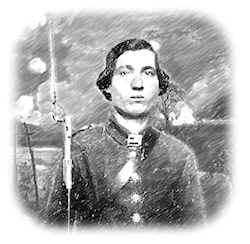
(Note: picture is of an unidentified Confederate soldier.)

0 comments

War Diary of Luman Harris Tenney.

War Diary of Luman Harris Tenney.

2nd. Got the rations up from the post and Okie (MacDowell) helped me issue them. Thede came down. Helped me clean up about the commissary. Felt rather tired when night came. Wrote two small sheets to Fannie and then retired. A cold night.

0 comments

Downing’s Civil War Diary.–Alexander G. Downing.

Diary of Alexander G. Downing; Company E, Eleventh Iowa Infantry

Monday, 2d–An exciting time down at Vicksburg last night was reported in camp this morning. One of our gunboats ran the blockade and while passing their batteries, the rebels fired exactly one hundred and thirty shots at her, but did not hurt her. Our gunboats blew up one of the rebels’ steamers which was tied at the wharf just below the city, and then ran another battery below without being hurt.

0 comments

Diary of Horatio Nelson Taft.

Diary of US patent clerk Horatio Nelson Taft.

Monday Feb’y 2nd 1863

Have not done much in the office today, there has not been much to do. I wrote a letter home inclosing a draft for $75.00, also sent a bundle of news papers. I send one every day, the “daily Chronicle,” which is left at my room every morning. A number of Soldiers have called on me today for assistance. I went to the N York Rooms with them and gave them a supply. Sent a nice can of fruit to Robert White and another to a poor sick fellow by the name of Chandler from Livingston Co, the only two N.Y. men who were at all badly off in that Hospital. Paid my months Board, Room rent &c, wood & Light included, $30.00. Think of leaving here, but do not know where I cou[l]d do any better just now. Went down to the Ave this evening. Sat and read an hour or more in Taylors Book Store. Got hold of Hon Henry Ruttans work on warming and ventilation. He lives in Cobourg C.W. I used to know him. I bo’t Harper’s Monthly and have been reading it since I returned to my room. “A Californian in Iceland” by J Ross Browne is quite interesting and amusing, his powers of description are unequaled. Some body is being Serenaded tonight as a Band of Music has struck upon the street. It is now after eleven o’clock. Some distinguished character is in the neighborhood. Well, the music is good and sounds just as well to the neighbors as though they paid for it. No War news today. Everything quiet on the Potomac. But news expected all the time, especialy from N.C. as well as Vicksburgh. It has been pleasant over head.

0 comments