0

Civil War Day-by-Day

February 7, 1863, The New York Herald

Our White Oak Church Correspondence.

NEAR WHITE OAK CHURCH, Va., Feb. 4, 1863.

The weather yesterday was terribly severe. Although it was clear, there were high winds and a freezing temperature to penetrate the flimsy shelter tents or dash down the chimneys of the soldiers’ huts, and scatter their scanty fuel across the earthen floors. It is a wonder indeed, even protected as they are by unusual luxuries in the way of dwellings, that the men have escaped being frozen. Fuel, it must be remembered, is still very scarce, and even with their superior accommodations, owing to the lack of this necessary article, the men must suffer greatly in this severe weather.

“Pratt’s Light Brigade,” the organization of which I noticed in a previous communication, has at last been completed. The troops have all been picked or selected for estimable qualities, and they have a good commander. The duty of this brigade, it is understood, will be to precede the left grand division on all marches, in the opening of a battle, in skirmish, and all light duty.

Items of news were never more scarce in the Army of the Potomac than at present. At General Hooker’s headquarters, too, this assertion is borne out by a general appearance of dreariness and desolation, indicative of the present very unwarlike state of somnolent inactivity. Everywhere the same dulness is to be observed. Even the mule teams do not move with their wonted alacrity, as if knowing that the exigencies of the case do not demand of them such great exertions as they were compelled to put forth a month or two ago. In short, despite impressions to the contrary, there is a general idea here that we are in winter quarters. In proof of this is advanced the fact that from headquarters has lately been received a systematic plan for granting leaves of absence to a certain number of officers and privates at a time.

There is in high circles a growing antagonism to the left grand division and its officers, and some have gone so far as to [continue reading…]

0 comments

0

Civil War Day-by-Day

February 7, 1863, The Charleston Mercury

BANKS is weaving a net of despotism over that portion of our sister State, the meshes of which are more subtle than the policy of BUTLER. The latter was open in his tyranny, and the brutal and rigorous manner in which he enforced his edicts, only served to strengthen our friends into resistance. The new commander is proving himself an accomplished tyrant, whose insidious advances are more to be feared than the bold attacks of the Brute who has made himself so infamous. We have the Baton Rouge Gazette and Comet, of the 21st, which contains a series of orders from the Federal commander, which demonstrate our friends have nothing to hope from him so far as his power may extend to enforce his edicts. In order No. 7 he makes another assessment, ostensibly for the relief of the poor, upon those have publicly and voluntarily given financial aid, advice and example to the Southern cause, and also directs the immediate collection of the last assessment by BUTLER. He extends a hope – an idle one, of course – that thus applied will be a subject of equitable consideration hereafter. Another order undertakes to regulate the conduct of the citizen, which, although not so odious in its terms as the famous order of BUTLER, so much deprecated by the civilized world, is equally as unusual, and will attach as much odium to the source from whence it emanated. By its terms the children may become grave political offenders. We append the document in full:

HEADQUARTERS DEPARTMENT OF THE GULF,

NEW ORLEANS, January 3, 1863.

Notice is hereby given by the Commanding General of this Department, that offensive personal demonstrations, by language or conduct, of any character, by persons of any class whatever, with the intention of giving personal offence, or tending to disturb the public peace, are forbidden, and will be punished with relentless severity. Parents will be held responsible for the respectful conduct of their children, and prompt measures will be taken to fasten upon the proper parties any act of this character. All persons who may be witnesses to such conduct are directed, as a measure of public [continue reading…]

0 comments

0

Civil War Day-by-Day

February 7, 1863, The Charleston Mercury

It is a well ascertained fact that South Carolina has within her bosom the purest Iron ores that can be found upon the globe. Commencing in Spartanburg, and running through the upper portions of Union and York Districts, there exist vast beds of the finest magnetic, hematite and limonite ores. In 1854 Professor SHEPARD examined the iron ore of this region, and declared the ion equal in quality to the best Swedish and Russian. In 1849 samples of this iron were sent to Washington and tested at the Navy Yard. In strength it was declared superior to any other iron ever tested there. In 1857 some specimens of South Carolina iron, sent to Europe from the Nesbitt Works, were made into steel at Sheffield, and pronounced equal to the celebrated iron from the Dannemora mines of Sweden.

So great a variety of rich iron ores exists nowhere else on this continent; yet, strange to say, the manufacture of iron has never prospered in our State. The great obstacle has been the scarcity of fuel and the lack of transportation to a market. There are now three Iron Companies in the State: the South Carolina Manufacturing Company, at Hurricane Shoals, on the Pacolet River; the Magnetic Iron Company (the old Nesbitt Works), at Cherokee Ford, Union District, Broad River; and the King’s Mountain Iron Company, in York District, two miles below the Cherokee Ford, on Broad River. These companies, we believe, are now in full blast, and are furnishing a large amount of the indispensable metal to the Government and to the planters in the upper portion of the State. The Magnetic Iron Company has been sending down to one of our large foundries a fine article of pig iron, to be cast into a mammoth gun, which will leave its mark upon the first Yankee iron-clad that may venture within its range.

We trust that the iron interest in this State will take a deep root during the present blockade, and become one of the most flourishing branches of home manufactures. We notice that a charter has been obtained from the Legislature for a railroad from Shelby, N.C., to the iron region of our State. This road, when built, connecting with the North Carolina Railroad, will enable the ironmasters to obtain an abundant supply of mineral coal, and will also place them within reach of the markets of the world. With these requisites and the necessary skill in manufacturing, we see no reason why South Carolina iron should not compete with the English and Swedish article.

0 comments

0

Civil War Day-by-Day

February 7, 1863, The New York Herald

There is nothing further of importance from Charleston today later than our former despatches. The Army of the Potomac is still quiescent. The roads, after the late storm, are in sad condition, rendering all movements impossible.

By an arrival at Suffolk from Richmond we learn that the new Merrimac is now lying between seven and eight miles below Richmond. It is pierced for two guns on each side, and will carry one forward and aft. The vessel is pronounced by many a failure, while there are others who are confident of its success. Two other iron-clads are in process of construction there. The rebels are throwing up earthworks in every direction for the defence of the rebel capital.

A propeller which arrived at Norfolk from Newbern yesterday, via the canal and inland route, reports two government schooners ashore on Hatteras Shoals, one loaded with cattle, and one with coal, and that a fleet of one hundred and twenty vessels had sailed, and all bound South.

A portion of General Magruder’s rebel fleet, off Galveston, is reported to have recaptured Sabine Pass, and the United States ship Morning Light on the 21st ult. We publish the official account of the affair by Major Watkins, commanding, together with a map of the Pass.

It was rumored in Louisville that Morgan’s rebel forces contemplated a raid on Lexington, and that the bankers and merchants there were packing up their money and valuables ready for a flight. It was also said that our troops had got possession of Shelbyville.

The brig Wilhelmina, Captain Welsh, at St. Thomas on the 18th of January, reports that she spoke the rebel privateer Alabama on the 15th of that month, about four hundred miles southeast of Bermuda. The Alabama attacked and [continue reading…]

0 comments

Robert M. McGill

Robert M. Magill – Personal Reminiscences of a Confederate Soldier Boy, 39th Georgia Regiment of Infantry

Friday, 6th.—Ground frozen this morning. Nothing has been doing for several days, except some little cannonading along the river.


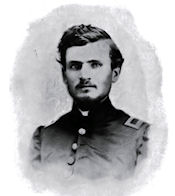
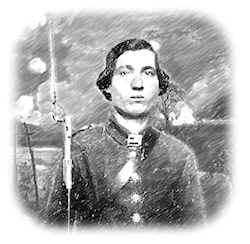
(Note: picture is of an unidentified Confederate soldier.)

0 comments

0

Civil War Day-by-Day

Feb. 6th. Since my last entry nothing has occurred worthy of note. This morning at ten thirty all hands were called to up anchor; got under way and stood down the river; at seven P. M., came to anchor off Pilot Town.

0 comments

War Diary of Luman Harris Tenney.

War Diary of Luman Harris Tenney.

6th. Called at the captain’s quarters. Told me Fannie Hudson was coming that day at noon. Am glad. Would I could see Will, too.

0 comments

Downing’s Civil War Diary.–Alexander G. Downing.

Diary of Alexander G. Downing; Company E, Eleventh Iowa Infantry

Friday, 6th–We hear that we are to move up the river to an island where General McPherson’s command is. About one hundred transports with troops aboard are tied up along the levee on the Louisiana side, awaiting orders to go up the river, while still others are being loaded. The plan is to go into camp at different points to do garrison duty, making it safer for fleets to pass at certain points.

0 comments

Diary of Horatio Nelson Taft.

Diary of US patent clerk Horatio Nelson Taft.

Friday Feb’y 6th 1863.

This day has passed off very quietly. Some rebel stories floating about tonight to the effect that there had been a “raid” on Aquia Creek, that all our immense Stores had been Burned &c. “Secesh” has been quite jubilent about it this evening. It is, of course, all “bosh.” I stoped at Charleys this evening and staid an hour. The baby is getting quite interesting. It is so good natured and quiet, drinks a quart of milk a day, sucks her thumb when she is asleep and grows fat. I went from there to the rooms of Rev Mr Read (at Dr Munsons) and staid there an hour. They (He and his wife) are very friendly and confide their secrets to me. He wants the Agency of the NY S[oldiers]. R[elief]. Ass[ociatio]n to travel through the State. I will do what I can to get it for him as I think him a “sterling” man. Mrs R also attends the NY “Rooms” and deals out to the soldiers such articles as are sent to the Asson for them. She has spent her whole time for months past and should be paid in some way. I called down below upon Dr Munson & family. They always have so much to say that I can never get away from them. They would like much to have me come back there to Board, perhaps I may sometime. They told me all their secrets about Ostrander (which I knew before). The old Lady talked all the time. “Teal” was wide awake. The fat one slept and snored. The Doct dozed. I did not get released till ½ past 10.

0 comments

A Rebel War Clerk’s Diary

Civil War Day-by-Day
A likeness of Jones when he was editor and majority owner of the Daily Madisonian during President John Tyler’s administration.

FEBRUARY 6th.—Gen. Lee thinks Charleston will be assailed, and suggests that all the troops in North Carolina be concentrated near Wilmington, and he will undertake the defense of the rest of the State. Nevertheless, if the government deems it more important to have his troops sent to North Carolina, than to retain them for the defense of Richmond, he must acquiesce. But he thinks Hooker will attempt the passage of the Rappahannock, at an early day, if the weather will admit of it. In regard to the last attempt of Burnside to cross his army (when he stuck in the mud), Gen. Lee says it was fortunate for the Federals that they failed to get over. No doubt he was prepared for their reception.

Congress is doing nothing but voting money for themselves. The President (some of the members say) is their master, and they await his nod. These are his enemies.

0 comments

0

Civil War Day-by-Day

February 6, 1863, The New York Herald

Despatches received from Fortress Monroe at Washington yesterday, state that the blockade at Charleston was not interrupted for any considerable time by the dispersion of the Union fleet on Saturday, the 31st of January. While there can be no doubt that the port was opened by the sudden assault of the rebel rams, it appears that on the 3d inst. the blockade was completely resumed, and that the Union iron-clads were then lying inside the wooden vessels. An attack on the city of Charleston was momentarily expected. Thus news was derived from information conveyed to General Dix from rebel sources – in fact from Charleston itself.

Our news from the Southern journals today contains much of interest. The most prominent feature is, of course, the late attack on our blockading fleet at Charleston, upon which the rebel press is jubilant. It discusses at length the question of international law relative to the subject of blockade, and claims that it is legally raised. They admit that the Union gunboat Ironsides was lying in the offing on the 3d instant. The Richmond Enquirer states that a steamer was despatched to Nassau to notify the British authorities there that the port of Charleston was open to foreign commerce. Mr. Benjamin, the Confederate Secretary of State officially informed the British and French Consuls in Richmond of the same fact. If the news received by General Dix is true they may have been too hasty.

The only news regarding the affair at Fort McAllister today, at Genesis Point, comes from Savannah, and describes that the Union gunboat Montauk was seriously injured, but that before she retired the parapet in front of the guns of the fort was entirely demolished.

The only news from the Army of the Potomac is that the enemy do not seem either as active or as numerous as heretofore. Their pickets and camp fires appear to be reduced. A heavy snow storm commenced at Falmouth yesterday morning, and ended in rain, leaving the prospects of available roads for military operations exceedingly doubtful. A [continue reading…]

0 comments

0

Civil War Day-by-Day

February 6, 1863, The Charleston Mercury

The report of the Secretary of War recently sent into Congress, communicates some interesting and most encouraging information in relation to our military affairs, and present the encouraging conclusion that our army is fully equal, if not superior, in all the elements of strength, to what it has been at any previous period of the war. Its numbers, though still seriously inadequate to fill fully its organizations, yet afford a nearer approximation than heretofore to that result.

SUPPLIES OF ORDNANCE AND MUNITIONS.

Measures to afford adequate supplies of ordnance, arms and munitions for the army have claimed the earnest attention of the Department. The increased stringency of the blockade by the enemy, while it has made the importation of sufficient supplies more difficult and costly, has at the same time induced more energetic efforts to find and develope all internal resources. The results, so far, are very encouraging. Our present supplies, the Secretary says, are at least as abundant as they have been at any time past, and our prospect for the future more promising. Two establishments, in addition to the leading one heretofore existing at this city for making ordnance, have been founded in interior towns under the auspices of the Department, one of which is already in successful operation, and the other will be in a very short time. Besides these same similar establishments have been fostered and engaged in similar works. Thus the serious anxiety which resulted from dependence on one establishment, liable to be interrupted by casualties or the chances of war, has been removed, and a larger provision secured for future supplies. Of small arms, the Department can now furnish stores more adequate to the requirements of the army than at any preceding date, while of munitions it entertains now no dread of deficiency. In these particulars also, by the encouragement and establishment of manufactures within the Confederacy, the Department is daily becoming less dependent on foreign supply, and indulges the hope that it will, at no remote period, be able to dispense altogether with that reliance.

THE IRON INTEREST.

The most serious embarrassment to be apprehended in reference to the ordnance supplies, is in the deficiency of iron. Before the war, nearly all iron works within the States of the Confederacy had languished or decayed, and from the sense [continue reading…]

0 comments

0

Civil War Day-by-Day

February 6, 1863, The New York Herald

Our Fortress Monroe Correspondence.

FORTRESS MONROE, Feb. 4, 1863.

Late Richmond advices have reached us this morning, from which I learn that (according to rebel statements) the blockade of Charleston harbor has been raised by two rams engaging our fleet, sinking the United States gunboat Mercedita and compelling the State of Georgia, or some other vessel, to strike her flag, but allowing her to escape in a sinking condition. Whether this story is true or not cannot be determined until official advices are received from Capt. Armstrong, commanding the State of Georgia. If, however, the rebels tell as much truth about this affair as that of Roger A. Pryor, on the 30th ult., near Suffolk, no fears need be entertained for the safety of our blockaders in Charleston bay. The Southern papers claim that Pryor was met by forces, numbering from ten to fifteen thousand, and that after a fight of ten hours he drove us from the battle field with heavy loss. While, however, admitting a considerable loss of life on the rebel side, the Petersburg Express publishes an official despatch from Pryor, estimating our loss at five hundred killed and thousands wounded, all of whom are accommodated in houses at Suffolk, which proving inadequate to contain them, compelled Major General Peck to seize the churches and to convert them into hospitals. While the official report of our medical director states our loss in this affair at twenty- four killed and eighty wounded, the rebel braggart, Pryor, endeavors to shield himself and his compulsory retreat by falsehoods. However, the character of this man is too well known, and no one therefore will believe any of his statements.

A number of the Suffolk prisoners were brought here and placed on board one of the transports, under guard. The majority of them are representatives of the trash of Dixie; but a few seem to be intelligent fellows. From the latter I learn that the cry of “Merrimac” is merely a bugbear, and calculated to deceive our government. While the Richmond – as this monster is called – is really ready for operations, and ready to pay us a visit at any moment, her advent in coming to Hampton Roads will be merely to convoy the Patrick Henry, late the Yorktown, past our fleet of the mouth of the James river.

The Patrick Henry is a fast side-wheel steamer, and took a prominent part in the engagement in Hampton Roads on the [continue reading…]

0 comments

0

Civil War Day-by-Day

February 6, 1863, The New York Herald

We learn from the Richmond papers which arrived yesterday that immediately after the scattering of our vessels by the rebel rams in the recent unfortunate affair at Charleston a Confederate steamer was despatched to Nassau to give formal notice to the authorities there of the raising of the blockade. step, taken in connection with the fact that the British steamer Petrel was kept waiting the issue of the conflict to convey the British Consul to the entrance of the port, so that he might satisfy himself that their dispersion was complete, sufficiently attest the understanding that existed with agents of the European governments as to the objects intended to be accomplished by it. And to show how thorough and general that understanding was, we have only to point to the additional fact that scarcely had the plan been consummated when the British war steamer Cadmus arrived off the port from Fortress Monroe, having, no doubt, been despatched there by the British Minister at Washington.

It is evident that considerable weight is attached by the rebels to all these formalities. They are intended to constitute the rounds for another appeal against us to the great international tribunal of the world. How far the facts will sustain it has as yet to be ascertained; for we have only their own account of the affair. To enable our readers to form their own judgment as to the legal bearings of the latter, we yesterday placed before them the declarations of such high international authorities as General Magruder, General Beauregard, Commodore Ingraham, Judge Kent, Sir William Scott, the continental writers Hautefeuill and Ortolan, the rebel Secretary of State and Lord John Russell. Notwithstanding all the light thus thrown upon the points at issue, people seem to be none the wiser for it; but, even if they were, it would affect but little their ultimate decision. The writers on international law are not held in much account now-a-days. Our own authority, Judge Kent, has but little weight abroad; and as to Sir William Scott, although his recorded opinions fully sustained us in the Trent affair, they were not listened to. It will no doubt be the same with the continental authorities Ortolan and Hautefeuille, whose views seem to bear in our favor in this Charleston matter. It is in fact unnecessary for us to trouble ourselves about what the text writers may say in regard to the question raised by it. England has set the world an example that will for the future render utterly nugatory their decisions. In the Trent affair she asserted the principle that might constitutes right, and in this Charleston business we shall have to follow her example.

Instead, therefore, of concerning itself about the legal and diplomatic difficulties of the question – of which there is promise of a plentiful crop – let the government at once set itself to avoid all such quibblings, by taking measures for the immediate reduction and capture of Charleston. The enterprise should not be undertaken, however, without such a force as will insure, beyond all chance of failure, the object aimed at. We should no longer underrate the military and naval strength of the rebels, but should prepare for this enterprise as if Charleston was one of the strongest places in the world, and as if its capture was to end the war. Let there be no more peddling, no more cheese-paring of our resources, in connection with it. When the blow is struck it should be decisive and crushing. In this way, and in this way alone, we may bid defiance to the efforts of the rebels and their European sympathizers to embroil us with foreign governments, and to defeat the object of all the sacrifices that this unhappy war has cost us.

0 comments

0

Civil War Day-by-Day

February 6, 1863, The Charleston Mercury

Disasters which have befallen the Confederate States are attributable to inadequate provision in our army and our navy. It has constantly been our Sysiphan task to recover what we have lost, and to keep what we have left. The campaign of last year opened in March and the ample preparations of the enemy were rewarded by a series of early successes, the result of our inferior efforts, and chiefly our great inferiority of numbers in the field. The spirit of our people, however, rallied under these reverses. Our armies were reinforced, the foe was checked, and the cause was saved. But we lost Kentucky, parts of Tennessee, Missouri and New Orleans.

We are soon to begin another bloody campaign. Our troops have to cope with much larger forces than they had to overcome last year. The vital question is, have our armies been strengthened to the utmost? If not, then no time is to be lost in putting in the field all who can serve. To delay is to trifle criminally with the dearest interests of the country – perhaps even to jeopardize the cause. There is yet time to do much. ‘Well begun, half done.’ Let the South now put its best foot foremost at the beginning of this desperate struggle of the North for empire, and the cause, we trust, will be finally and fairly won. A long pull, a strong pull, and a pull all together, is the requirement of the time. We trust our able and energetic Secretary of War will this month see that the Conscript Law is thoroughly enforced in every State.

0 comments

A Confederate Girl’s Diary

Civil War Day-by-Day

February 5th, Thursday night.

A letter from Lavinia has come to me all the way from California. How happy it made me, though written so long ago! Only the 30th of June! Lavinia has changed, changed. There is a sad, worn-out tone in every line; it sounds old, as though she had lived years and years ago and was writing as though she were dead and buried long since. Lavinia, whose letters used to keep me in sunshine for weeks at a time! Well! no wonder she is sad. All these dreary years from home, with so faint a hope of ever again seeing it, and all these sorrows and troubles that have befallen us, combined, are not calculated to make her happy. But I wish she had kept her cheerful heart. Well, perhaps it is easier for us to be cheerful and happy, knowing the full extent of our calamities, than it is for her, knowing so little and having just cause to fear so much. Courage! Better days are coming! And then I’ll have many a funny tale to tell her of the days when the Yankees kept us on the qui vive, or made us run for our lives. It will “tell” merrily; be almost as lively as those running days were. One of my chief regrets over my helplessness is that I will not be able to run in the next stampede. I used to enjoy it. Oh, the days gone by, the dreary days, when, cut off from our own people, and surrounded by Yankees, we used to catch up any crumb of news favorable to our side that was smuggled into town, and the Brunots and I would write each other little dispatches of consolation and send them by little negroes! Those were dismal days. Yet how my spirits would rise when the long roll would beat, and we would prepare for flight!

0 comments

War Diary of Luman Harris Tenney.

War Diary of Luman Harris Tenney.

5th. Continued the reading of “Tom Brown.” The talk of consolidation is making the boys very much dissatisfied. There will be more deserters. In the evening recited my lesson.

0 comments

Downing’s Civil War Diary.–Alexander G. Downing.

Diary of Alexander G. Downing; Company E, Eleventh Iowa Infantry

Thursday, 5th–Weather pleasant. I was detailed to go out on picket, but the order was countermanded. There is some talk of our leaving the place. It is reported in camp that on account of the flood the work on the canal had to be given up, and that an effort would be made to turn the current of the river through the canal, thus letting the river cut it.

0 comments

Diary of Horatio Nelson Taft.

Diary of US patent clerk Horatio Nelson Taft.

Washington Thursday Feb’y 5th 1863.

I hardly know how to fill out a page tonight. It has been cold and Stormy having snowed most of the day, tonight the snow is more like rain and the weather has moderated. I was on the Ave after I left the office and bought a pair of rubbers, then came home directly to my room, which I have not left since except for dinner. I have been writing over a couple pages of foolscap upon the Analogy which exists betwen a Nation and an individual. In a Nation the whole Territory may be compared to the body of a man. The inhabitants are the living Soul. The Mountains are the Bones. The Rivers and roads and canals are the veins and arteries. Trade and Commerce is the Blood which circulates through them & the industrial system of the Nation is the real nutriment which gives life and vigor to the body giving to the Blood its sustaining and life giving principle. I pursued the comparison much farther. I also wrote some verses for Julias Album should they suit her. There is no news worthy of notice today. I have been in the office as usual. The concert proved a “Sell” to the Committee. Ostrander deceived them in every way. But has now time to repent as he was arrested before the concert yesterday for obtaining property by false pretenses and is now in Jail. He has been a Clerk in the Land office for something over a year. But his game is up now. Past 11 o’clock.

0 comments

A Rebel War Clerk’s Diary

Civil War Day-by-Day
A likeness of Jones when he was editor and majority owner of the Daily Madisonian during President John Tyler’s administration.

FEBRUARY 5th.—It snowed again last night. Tuesday night the mercury was 8° below zero.

A dispatch from Gen. Beauregard says sixty sail of the enemy have left Beaufort, N. C., for Charleston. A British frigate (Cadmus) has arrived at Charleston with intelligence that the Federal fleet of gun-boats will attack the city immediately; and that the British consul is ordered away by the Minister at Washington. The attack will be by sea and land. God help Beauregard in this fearful ordeal!

0 comments

0

Civil War Day-by-Day

February 5, 1863, The New York Herald

The news which we published yesterday of the successful raid of the rebel iron-clads against our blockading force at Charleston is, so far as the number and value of the federal vessels destroyed are concerned, of but very little moment. The moral effect of the reverse, however, is very great. It is a humiliation to our navy that will be made the most of by those hostile to us, and that could never have occurred if ordinary foresight and vigilance had been observed.

But it is not merely in relation to this point that we regard this affair as a very serious disaster. It is the principle of international law involved in it that imparts to its gravity. We do not believe that it in reality affects the legal and permanent character of the blockade; but there is no doubt that it is intended to raise that issue with us. The simultaneous and temporarily successful efforts made at Galveston and Charleston to break the blockade, the proclamations issued by the rebel commanders at both places, formally declaring the consummation of the fact, and the endorsement by the foreign consuls of their proceedings, all go to show a preconcerted plan, undertaken either with or without an understanding with the European governments, but, in either case, pregnant with trouble to us. If any doubt existed on this point it would be removed by the declarations of the rebel journals. The Richmond Dispatch states that formal notice of the raising of the blockade at Charleston had been given by the rebel Secretary of State to the British and French consuls in Richmond, and that, by the strict rule of international law, sixty days’ notice must be given before it can be re-established. If this were so it would materially alter the character and probable duration of the war. Two months’ unobstructed commercial intercourse with Europe would place the South, both in regard to finances and war supplies, in a position infinitely stronger than that which it occupies at present. It would infuse fresh life and vigor into its military and naval operations, and render it, with its united sentiment, impossible to conquer.

We have no apprehension that the rebels will be able to establish legal grounds for what they claim. We have looked carefully through all the international authorities – extracts from which will be found in another column – and we can find nothing which, taken in conjunction with the real facts of the case, would go to show a legal raising of the blockade. Neither Ortolan nor Hautefeuille – the two standard writers on international law – contain anything which would go to prove that its temporary disturbance, without freedom of access and exit shown, would constitute such an interruption of it as would require the two months’ notice claimed by the rebels as necessary to its re-establishment. On the contrary, it will be found, by a passage which we quote from the latter writer, that express limits are set to the immunities of neutral vessels profiting by such disturbance, thereby showing that the resumption of the blockade is, within a reasonable time, at the option of the besieging fleet. It is true that the letter of Lord John Russell confirming the efficiency of the blockade, when, in February, 1861, the question was officially brought before him, may be made the foundation of a quibble in this regard. He says that, that the blockade is duly notified, and also that a number of ships are stationed and remain at the entrance of a port sufficient really to prevent access to it, or create an evident danger in leaving it, and that these ships do not voluntarily prevent egress or ingress, the fact that various ships may have successfully escaped through it will not of itself prevent the blockade from being and effective one by international law. It will be sought to show that no portion of our blockading force at Charleston at the entrance to that port after the affair in question, and that there was consequently no danger to neutral vessels in either entering or leaving it. In this view we can understand the stress laid by the rebels on the alleged fact that at a distance of five miles beyond the usual anchorage of the blockaders nothing was to be seen of them. For this statement, however, we have nothing but their own authority. If a neutral vessel had attempted either to enter or leave the port it is a question whether the blockading ships would not have quickly manifested their presence.

Apart from the discredit attaching to this unfortunate affair, the question involved in it is, as we have before observed, a very important one. All international authorities concede that the temporary withdrawal of a blockading force does not per se constitute the raising of a blockade. It is very essential that we should learn whether its being driven to some distance beyond its usual moorings is to be regarded in a different light. This, however, cannot be ascertained until we hear from the European governments interested in the decision of the point.

The worst that can befall us, supposing that decision to be adverse, will be, according to rebel statements, a raising of the blockade at Charleston for sixty days. In the meanwhile we can settle the question for ourselves by assaulting that hotbed of rebellion with such a force as will insure its speedy capture.

0 comments

0

Civil War Day-by-Day

February 5, 1863, The New York Herald

We have news to the 30th ultimo from Vicksburg. At that day General Grant, chief in command, had arrived. The work of widening and deepening – the famous cutoff was progressing; but the rebels, snuffing their danger, had planted a battery on the opposite, or Mississippi, side of the river, which commands the outlet of the canal into the main stream. That battery, however, will be silenced when the time comes for action.

A rebel despatch from Vicksburg of the 30th ult. says that some federal scouting parties had appeared that morning on the river bank immediately in front of the town, but on the Louisiana side of the river, and had burned four houses under the range of the rebel batteries, the river being less than a mile in width, and the rebel batteries being on the Vicksburg bluffs, where they possess the advantages of a plunging fire. This would seem to indicate a design on the part of General Grant to plant a line of batteries in front of Vicksburg, to keep the rebels well employed in his front while our gunboat squadron are running below the town by way of the off. But, whatever may be the designs of General Grant, we have the fullest confidence in his success, not only in removing the Mississippi river, but in removing the rebels from Vicksburg, [~¦..] in upon their works.

Some five hundred miles up the river from General Grant scene of operations, and at the historic Island No. 10, a strong force of rebel guerillas, with three pieces of artillery, had endeavored to arrest the passage of the gunboat New Era, but after a fight of several hours were shelled off. From Fort Donelson, on the Cumberland, February 3, we have the report that a fight was still in progress there at four o’clock in the afternoon, although it had commenced at an early hour in the morning. From this it is evident that the fort had been assailed by a formidable rebel detachment; but as reinforcements had gone forward to the support of the garrison we conclude that the enemy has been expelled.

At the same time, from rebel reports, it appears that their irrepressible guerilla, Wheeler, has been very active of late in [continue reading…]

0 comments

0

Civil War Day-by-Day

February 5, 1863, The New York Herald

Our Memphis Correspondence.

MEMPHIS, Tenn., Jan. 27, 1863.

A portion of Gen. Grant’s army has already moved off in transports for Milliken’s Bend, and the remainder is on the way to this city to be transported to the same destination. In a week or two – judging by the progress lately made – Gen. Grant may find his army concentrated at Milliken’s Bend, preparatory to the grand attack upon Vicksburg. That this one may be successful every loyal heart most devoutly prays; and yet there are many reasons to induce the sagacious observer to fear for the result.

REBEL PREPARATIONS AND PURPOSES.

Some two months ago General Joseph E. Johnston was sent to the West by Jeff. Davis, in order to revive and retrieve the waning fortunes of the confederacy in that quarter. He has most diligently labored for that end, and with what success let the lamentable affairs at Holly Springs and at Vicksburg testify. It is understood to be Johnston’s policy to hold the Mississippi at all hazards, and thus keep up the rebel communication between Richmond and Louisiana, Texas and Arkansas. For this purpose he has massed an immense army at and near Vicksburg and Port Hudson. Neither of these places, in Johnston’s opinion, can be stormed. If taken at all, it must be by siege. It is conceded that Port Hudson may be taken; but Vicksburg they think absolutely impregnable.

STRENGTH OF THE REBEL ARMY.

At last accounts Johnston had an army of fully 100,000 men at Vicksburg, or within easy supporting distance. To take [continue reading…]

0 comments

0

Civil War Day-by-Day

February 5, 1863, The New York Herald

There is nothing new from the Army of the Potomac. Everything is quiet in that direction.

The attack by the rebels on Fort Donelson, which we reported yesterday, resulted in their entire defeat. At the commencement of the action of the enemy took four of our guns at a charge vigorously and gallantly made, but our troops as gallantly responded by taking them back again, killing one hundred and thirty-five of the rebels and wounding fifty. Among the latter is General Forrest, the rebel leader.

A heavy snow storm was raging at Fortress Monroe yesterday, more severely than anything which had occurred there for many years.

We have some reliable intelligence of the movements of the pirate vessel Retribution, from the captain of the schooner Springbok, which has arrived in Boston from Port Paix. Captain Grindle states that the Retribution was off that port about January 15, and sent a boat on shore, pretending to be a merchant vessel. The statement is confirmed by Captain Jordan, of the Schooner H.S. Boynton, who left Fort Paix January 10, at which time also she was understood to be in that vicinity. If so, the report of the destruction of four of five vessels off St. Thomas by that privateer is probably false, as St. Thomas is far to windward, and the Retribution could not have beat up in season to make the report true.

The Union cavalry in the vicinity of Murfreesboro have been active. On the 2d inst. a body of Stokes’ Tennessee cavalry and a Kentucky regiment of infantry made a splendid dash on a rebel camp at Middletown, fifteen miles from Murfreesboro, and captured one hundred of the enemy, with all their camp equipage, horses and wagons. Another fine attack was made at Franklin by a body of Davis’ cavalry, who captured twenty of the rebels.

Brigadier General Robert B. Mitchell, commanding, at Nashville, has issued an order announcing that, accordance with directions from Headquarters, Department of the Cumberland, no person will be allowed to go south from that point except by way of Vicksburg.

In the important news which we published exclusively yesterday morning from the South was a despatch copied from a Richmond paper, and dated at Chattanooga, Tenn., January 30, stating that General Wheeler’s rebel cavalry had attacked a fleet of twenty-five federal transports on the Cumberland river, and destroyed five, on Friday, the 23d ult. This is now known to be false, because we have news direct from Nashville, which states that the fleet which arrived there consisted of twenty-three steamers. They were attacked, as the rebel account states, on Friday; but, beyond a shot which passed through the R.B. Hamilton, and a few bullet holes in the Commerce, no damage was done, and the entire fleet arrived safely at Nashville.

0 comments

0

Civil War Day-by-Day

February 5, 1863, The New York Herald

Since it seems to be now resolved that we are to have a negro army to put the finishing touches on the rebellion, it is to be hoped that no time will be lost in commencing a draft for that purpose. The one hundred and fifty thousand suggested by Mephistopheles Stevens should, at least, be enrolled in the twinkling of an eye. This terrible army should be clothed not in red breeches alone, as already proposed, but in red coats also, so that they may look extremely ferocious, and as nearly like the British negro Zouaves as possible. We can fancy such a negro army marching to the rescue of the country, and the excitement they would produce. Let us have the black army, then, with red coats as well as red breeches.

0 comments