0

News of the Day

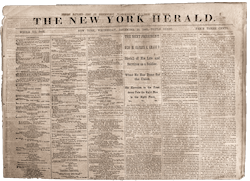
March 9, 1863, The New York Herald

The much despised spade turns out to be a trump in the Southwest, as appears from the map we published yesterday illustrating the three great Union expeditions on the Mississippi. In the peninsular campaign of last year General McClellan was violently abused for resorting to the spade, though it turned out he saved by it thousands of lives. What the spade could accomplish in war was then matter of history, and illustrated in the case of the famous earthworks of Washington in the Revolution and of Tottleben at Sebastopol, and the counterworks of the English and French. It has since done something for the rebels at James Island, in the vicinity of Charleston, and also at Fredericksburg and Vicksburg. This year, however, the spade is the chief weapon of our armies in the Southwest – more potent than cannon to open the highway of the Father of Waters from the mouth of the Ohio to the Gulf. If the simple spade, with the aid of American ingenuity, can neutralize the frowning guns and formidable works of   “The Gibraltar of the Mississippi,” that will be a great triumph of a peaceful implement of agricultural industry over the terrible enginery of war.

The cut-off from the river, commencing four or five miles above Vicksburg, and entering the river again below the city, near Warrenton, is only a work of time, when the blue clay is cut away with the spade and the sand is reached. Then a new channel shall have been opened for our gunboats, leaving Vicksburg far to the east, and, it may be, cutting it off from navigation. But, if the latter result do not follow, Big Black river – near Grand Gulf, on the Mississippi side – can be ascended, and the rear of Vicksburg gained in that way, and the strong-hold reduced by siege and starvation. This, the rebel newspapers say, is the object of the cut-off at Vicksburg.

But the importance of gaining time has suggested two other water routes by which Vicksburg may be circumvented more rapidly, and already each is pronounced not only practicable, but a fait accompli. Our telegraphic intelligence published in yesterday’s HERALD declares that the cut-off to Lake Providence as […..] success,” and that Yazoo Pass is also to be […..] a success.” By the latter boats would be enabled to reach the rear of Vicksburg and the Tallahatchie, and perform a [continue reading…]
0 comments

0

News of the Day

March 9, 1863, The New York Herald

Our news from the South today is very full, interesting and important. The Richmond journals of the 6th inst. contain the extraordinary rumors that the Indianola has been blown up by the rebels, but that her armament fell into the hands of the federals. Admiral Porter despatched to Washington yesterday that both the Indianola and Webb were destroyed in the late engagement, while a host of reports were afloat throughout the capital that the Admiral had telegraphed to the effect that his gunboats have passed through the canal into Lake Providence, and succeeded in destroying the Queen of the West and Indianola, and other armed vessels of the rebels. The only foundation, however, for these rumors is found in the statement of the Richmond papers above alluded to. Despatches to Fortress Monroe say that the federal gunboats are making great destruction on Lake Providence. They further state the rebel Van Dorn repulsed a Union force near Franklin on the 1st inst., and captured 2,200 officers and men. An attack on Port Hudson by General Banks’ forces was looked upon in Richmond as immediate.

The Richmond papers talk boldly of the impregnable condition of Vicksburg, Charleston and Chattanooga. As for Richmond itself, that is not even menaced; but under any circumstances it can be defended by an effective force of sixty thousand men. They boast that the best organizer of troops in the army, General Bragg, and the best maneuverer in the open field, Johnston, are in command at Chattanooga, and with Lee in Virginia, Gustavus Smith in North Carolina, and Beauregard in South Carolina and Georgia, there is no possible fear of a military blunder. They criticise our conscript law severely; but the Examiner does not anticipate that it will lead to a Northern revolution, for it considers the government of the United States has congealed into a despotism, and that its inhabitants have actually sunk down into the characteristics of […..] abject, trembling and undenying slaves.’

By the arrival of the Fah-Kee from Port Royal yesterday evening we have some very interesting intelligence to the 3d, at which time very heavy firing was heard in the direction of Savannah, which was supposed to be an attack by our troops [continue reading…]

0 comments

0

News of the Day

March 9, 1863, The New York Herald

Our Port Royal Correspondence.

PORT ROYAL, S.C., Mar 3, 1863.

The career of the famous rebel steamer Nashville is ended. After having made several successful runs in and out of Southern ports, cleverly eluding our fastest cruisers, and landing large and valuable cargoes, she entered Warsaw Sound some six months since, and passing up the Wilmington river, through St. Augustine creek, and into the Savannah river, safely arrived at Savannah, where she discharged an assorted cargo of immense value to the rebels, and immediately began to load with a cargo of sea island cotton for Europe. Her movements coming to the knowledge of Admiral DuPont, he augmented the naval force in Warsaw Sound, and also strengthened that in Ossabaw Sound, rightly apprehending an attempt to run the blockade at that point, failing to elude it at Warsaw.

When the Nashville attempted to run out of Warsaw Sound she found it so closely and effectually guarded that the plan was given up, and she returned to Savannah. In a few days she again steamed down the Wilmington and Burnside rivers into the Vernon river, which, uniting with the Ogeechee, flows into Ossabaw Sound. Here were found the Seneca, Wissahickon and Dawn closely guarding the avenues to the sea, and again she was thwarted. She then proceeded up the Vernon river, and laid up behind a six-gun battery near Montgomery, and in this position she remained for some weeks, but found no opportunity to elude the sleepless vigilance of the naval officers who, night and day, guarded the rivers. Some weeks since the Admiral learned that they had discharged her cargo of cotton, and were fitting her up and heavily arming her as a privateer, with the intention of fighting her way out and joining the Alabama and Florida in their destructive cruises against our commerce. This report was certainly a startling one, especially when it was additionally reported that the Fingal or an iron-clad was to come down from Savannah to aid her in destroying our blockading fleet and in giving her free access to the sea. About this time she passed from the Vernon into the Big Ogeechee river, and anchored above Fort McAllister. Heavier vessels were immediately sent to Ossabaw to thwart this scheme, so full of [continue reading…]

0 comments

0

News of the Day

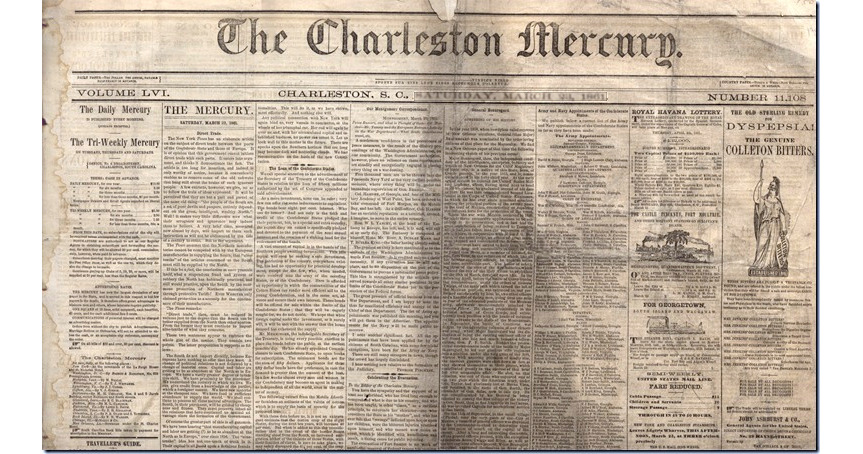
March 9, 1863, The Charleston Mercury

(CORRESPONDENCE OF THE MERCURY.)

RICHMOND, Wednesday, March 4.

This is the last day of the Abolition Congress of the United States. It has done its hellish work well, and leaves LINCOLN invested with ample powers to complete what has been left undone. The vote on the Conscription Bill shows so small a minority against it, that we must needs believe that the Yankee people are ready to sustain its sweeping clauses. Perhaps there is an understanding as to its real intent, viz: to keep the expiring enlistments from being carried into effect.

Government people say things look gloomy enough. The debates in Parliament show that England will not lend France so much as her moral support in the matter of recognition and mediation; and if England will not, then we need expect none of the other great Powers to act with France. Everybody accuses England of cold-blooded selfishness, and it must be confessed there is ground for the accusation. But there is something behind the scenes which we do not see. Have our statesmen studied the ultimate bearings on English interests of French designs in Mexico? Surely England would not endure the horrors of the existing cotton famine merely for the pleasure of thwarting a Slaveholding Confederation.

Dark as the signs are at the North and abroad, we should never forget the potential effect of a thorough victory. True, none of the battles already won have had the effect we anticipated, but every one has helped the cause greatly. Nor should we forget that the English politicians of all shades of opinion unite in the assertion that the Union can never be joined again. Let us whip the Yankees in the Spring, and leave the rest to the Almighty.

It is believed the House passed in secret session yesterday the finance measures lately passed by the Senate, which are substantially those embodied in the report of Mr. Hunter, published some weeks ago. The House amendments are not [continue reading…]

0 comments

0

News of the Day

March 9, 1863, The Charleston Mercury

The drift of events clearly indicates that the lull in the progress of hostilities cannot last much longer. The lengthening days, the roads now rapidly hardening, and the proximity of the great armies which still confront each other at Vicksburg, Tullahoma and on the Rappahannock, admonish us that we are upon the threshold of a season of unexampled trials for the Confederacy. We of Charleston need not flatter ourselves that we are to escape the ordeal. The blow with which we have so long been threatened will sooner or later, be struck, and with tenfold power and malignity, in that is has been so long delayed.

At such a juncture, it behooves all our arms-bearing men, not already in the field, to enroll themselves at once for militia duty, in case of an emergency, and to give their zealous cooperation to the important work of perfecting the organization and discipline of our citizen soldiery. In this connection we would especially direct public attention to the approaching militia elections in this city. It is to be hoped that a full vote will be polled, and that the fittest men will be chosen.

The following vacancies in the Sixteenth Regiment, S. C. M., will be filled by elections to take place on tomorrow, the 10th inst.:

Field and Staff – The office of Major.

Beat No. 1 – All the offices.

Beat No. 2 – Second and Third Lieutenants.

Beat No. 3 – First and Second Lieutenants.

Beat No. 4 – Captain, First and Third Lieutenants.

Beat No. 6 – Captain, First, Second and Third Lieutenants.

Beat No. 7 – First, Second and Third Lieutenants.

Beat No. 8 – Captain, First, Second and Third Lieutenants.

0 comments

Downing’s Civil War Diary.–Alexander G. Downing.

Diary of Alexander G. Downing; Company E, Eleventh Iowa Infantry

Sunday, 8th–Company E went on picket this morning. Had a fearful hailstorm late this evening.

0 comments

Diary of Horatio Nelson Taft.

Diary of US patent clerk Horatio Nelson Taft.

Sunday March 8th 1863

Rained again today most of the time and I have kept my room till near night. I went down to Maj Williams and spent an hour and then came back to tea after which I attended religious Services at the Colored Church on 11th st. A white man preach[ed] a very good discourse and the services were conducted throughout with as much propriety as is usual in any other church. The singing was not as artistic but quite as melodious. The Church was crowded to excess and it soon became very warm. There was quite a sprinkling of white folks who were there like myself out of curiosity. I could not but remark that nothing occured in the Sermon or during the exercises to indicate the Color or condition of the audience. The people were very respectably dressed and among the females crinolines were quite as plenty as in other churches. The morning paper contains no news. The Gold Speculators have “caught it” awfuly, the article having fallen within the past week from 172 to 150. Mr Chase has almost unlimited power now to control the finances of the Nation and can Issue money (paper) to meet all contingencies likely to occur for the next year, the probability is that “green backs” will be our circulating medium henceforth.

0 comments

War Diary of Luman Harris Tenney.

War Diary of Luman Harris Tenney.

8th. Spent the day in camp. Thede came over and we made a little sugar candy. Read some in “Currents and Countercurrents,” by O. W. Holmes. Wanted to read Motley, but Charlie had sent the book back home. Thede and I wished we could be at home two or three hours. A dark and cloudy day.

0 comments

A Rebel War Clerk’s Diary

Civil War Day-by-Day
A likeness of Jones when he was editor and majority owner of the Daily Madisonian during President John Tyler’s administration.

MARCH 8th.— Judge Meredith’s opinion, that foreigners, Marylanders, and others, who have served in the army, have become domiciled, and are liable to conscription, has produced a prodigious commotion. Gen. Winder’s door is beset with crowds of eager seekers of passports to leave the Confederacy; and as these people are converting their Confederate money into gold, the premium on specie has advanced.

Judge Campbell, Assistant Secretary of War, has decided that Judge Meredith’s opinion is not authority; and hence his son-in-law, Lieut.-Col. Lay, who at present wields the Conscription Bureau, acts accordingly. But Gen. Rains has a contrary opinion; and he intended to see the President yesterday, who is understood to coincide with Judge Meredith. It is also alleged that Secretary Seddon concurs in this opinion; and if this be the case, an explosion is imminent—for Judge Campbell must have given instructions by order of the Secretary, without the Secretary’s knowledge or consent.

I advised the general to see the President and Secretary once a week, and not rely upon verbal instructions received through a subordinate; he said the advice was good, and he should follow it. But he is much absorbed in his subterrene batteries.

0 comments

0

News of the Day

March 8, 1863, The New York Herald

Our New Orleans Correspondence.

NEW ORLEANS, La., Feb. 27, 1863.

In consequence of an announcement in the official journal that the steamer Empire Parish would leave the foot of Canal street at one o’clock on the 20th ult., with such paroled rebel prisoners as were desirous of being exchanged, long before that hour a dense mass of living humanity was seen moving along the several streets leading to the place of embarkation. As is usual on such occasions the feminine element was predominant, while here and there were seen the gray uniforms of the rebels all wending their way to the centre of attraction.

By ten o’clock the levee was densely crowded, leaving scarcely room to stir. Every window was ornamented with faces in all styles of beauty and ugliness; and as each rebel soldier passed by handkerchiefs would be waved and cheer after cheer would resound on all sides.

In order to check any hostile demonstration that might be made a battery of field pieces was placed in position and the services of a military guard were held in requisition. In consequence of this arrangement the secessionists have promulgated the absurd story that General Banks had the artillery down to the levee for the purpose of shooting down the women; and a story that five or six women had been run over by the gun carriages was industriously circulated. There is not one word of truth in the report, which was gotten up undoubtedly for the purpose of inflaming the passions of the men, and to stir them up to the commission of some desperate act which could have resulted only in their own destruction. Great has been the manoeuvring at this supposed act of atrocity. General Banks has been stigmatized as being worse than Butler, who, the secessionists declare, would never have done such a thing, […..]as he is.”

As on the last occasion of a flag of truce being sent to Madisonville, the representatives of the press were furnished with one general pass for the whole body; and it was intimated to the gentleman to whom it was given that the hour of departure had been changed to three o’clock. At that hour I went on board, when the first thing that attracted my notice was a rebel soldier undergoing the operation of being searched by a special officer, who had been detailed for that duty. The process was not a very pleasant one, and could not be borne without wincing. Pockets, cap, the linings of coats and other garments, including even that precious article of attire, sacred to the sterner sex – namely, the toga virili – were all subjected to the manipulation of the officer. Nay – and my modest pen blushes as it records the fact – that same [continue reading…]

0 comments

0

News of the Day

March 8, 1863, The New York Herald

HEADQUARTERS, ARMY OF THE POTOMAC, March 7, 1863.

The expedition under Colonel Phelps, to Northumberland County, Va., returned this afternoon, after an eminently successful trip.

The force left Belle Plain last Tuesday, in steamers, and was composed of picked men from the Fourteenth New York State Militia, Twenty-second, Twenty-fourth and Thirtieth New York Volunteers, and Captain Virgen’s company of the First Maine cavalry. The HERALD correspondent accompanied the expedition.

Owing to the ignorance of the pilot concerning the channel, and the high wind, the landing at the head of Coon river was not effected until Wednesday noon, when the whole command debarked, and Colonel Phelps, with his staff, at the head of the cavalry, dashed on into Heathsville, the country seat of Northumberland, capturing a rebel soldier and taking the entire town by surprise.

The Post Office was searched, but nothing was found save a few dusty papers and old letters, the office not having been reopened since the raid of Colonel Fairchild, several weeks since.

The jail was next examined, but the cells were empty.

At night the command bivouacked a few miles outside the place, and next day foraging parties were sent out in various directions and the cavalry despatched on a scouting expedition into Lancaster county.

The foraging parties seized one thousand bushels of corn, fifty horses, and mules, a large number of fine beef cattle and [continue reading…]

0 comments

0

News of the Day

March 8, 1863, The New York Herald

The Mississippi Valley Grand Campaign.

The opening of the Mississippi river is now the grand object which occupies the attention of both the Union and rebel armies. The former is determined to open the navigation of the river, while the latter, as evinced in the proclamation of Jeff. Davis, is as determined that it shall not be accomplished. As an evidence of this we have but to observe that a force of rebels are posted to resist our advance by the Yazoo Pass, while batteries and troops are employed at Vicksburg and Port Hudson to impede, and, if possible, stop our movements in those directions. The Union army is now engaged on three grand plans for the reduction of Vicksburg and the opening of navigation, and these plans the rebels are using might and main to thwart. There is little doubt but that the future historian will have to class the siege of Vicksburg among the most important sieges of the world.

The Three Union Plans.

THE CHANGING OF THE COURSE OF THE MISSISSIPPI.

Wars often cause great changes in the face of the countries in which they take place; but so great a change as the prospective one about to occur in the Mississippi valley has never yet been accomplished in the history of the world. Streams and even rivers have been turned by investing armies, and victories won by such a course of strategy; but never before has such an immense and powerful body of water been changed out of its course as is now contemplated in this region. Napoleon in his maxims recommends the using of streams as a means of either offence or defence, but there is no record of his turning a river for hundreds of miles from its natural bed, or of his opening an entirely new route of navigation by the same means.

CYRUS TURNED THE EUPHRATES AND CONQUERED BABYLON.

In ancient history we find that Cyrus, while commander of the army of the Medes and Persians, conquered Babylon by turning the course of the Uphrates, after having laid siege to the city for over two years. Taking advantage of a great [continue reading…]

0 comments

0

News of the Day

March 8, 1863, The New York Herald

Our Mississippi River Correspondence.

YOUNG’S POINT, LA., THREE MILES ABOVE VICKSBURG, Feb. 26, 1863.

After the capture of the Queen of the West we had hoped that the Indianola would speedily succeed in retaking her. It seems we were doomed to disappointment, and to have the additional mortification of losing the Indianola. The ease with which she passed the batteries at Vicksburg and Warrenton appears to have created too great confidence in her abilities.

THE LOSS OF BOTH THE QUEEN AND THE INDIANOLA has been mainly due to the fact that these boats were allowed to proceed alone into the enemy’s country. Had the Queen of the West been attended by any other of the ram or gunboat fleet she could easily have been saved after running ashore at Gordon’s Landing. Had the Indianola been similarly accompanied it is doubtful if the rebels would have ventured to attack her.

AFTER MEETING THE ERA NO. 5, with those who escaped from the ill-fated Queen, Capt. Brown proceeded with the Indianola to the mouth of Red river in pursuit of the Webb. The chances of overtaking her were very remote, as the Webb could easily steam three miles in the same time that the Indianola could make one. The pursuit was not commenced until the Webb had been absent for some hours, and the only prospect of coming up with the rebel boat was in the event of her lying by for fuel or from some other cause. By the time the Indianola reached the mouth of Red river the Webb was at least a hundred miles above, on her way to Alexandria.

ARRIVED AT RED RIVER, the Indianola proceeded a short distance up that stream, on the lookout for any rebel gunboats or transports that might make their appearance. The entrance to Atchafalaya bayou was watched, in the hope that some boat might emerge on its way to Port Hudson or the upper Red river. No capture was made, as the boats were doubtless warned by couriers of the presence of the Indianola. Ascending Red river some twenty or thirty miles, Captain Brown ascertained that the Queen had been removed from the bar where [continue reading…]

0 comments

0

News of the Day

March 8, 1863, The New York Herald

The Army of the Potomac has been making a demonstration. An expedition, under Colonel Phelps, which left Belle Plain in steamers on Tuesday for Northumberland county, made a most successful thing of it, and returned to headquarters yesterday. The troops visited Heathsville, which they found deserted by the rebels. Then, throwing out large foraging parties from that base into Lancaster county and in other directions, they succeeded in capturing one thousand bushels of corn, fifty horses and mules, an amount of medical stores. Two post offices and several stores were visited, and two important rebel mails captured. The cavalry also seized a large number of horses and mules, and are now on their way overland to Fredericksburg. Some prisoners were also taken, among them Colonel Claybrook, a prominent rebel officer, and two clerks of the departments of Richmond, with a quantity of correspondence for citizens of Baltimore, and official papers addressed to parties in London, to the care of Baring Brothers. The country was quite deserted and almost barren of everything.

We present our readers this day with a map illustrating the important operations now taking place in the Southwest, accompanying it with a full description of the movements as set forth in the rebel newspapers and Western journals. As the region is but little known the map will be very useful, and as the movement is important and is fully understood by the rebels, its description will be exceedingly interesting to our readers. Such a gigantic operation has never before been attempted by any army of the Old or New World, and if successful, the ‘Great Union River’ will carry down to posterity the history of one of the greatest military operations of the greatest rebellion that has ever shaken the earth.

We publish in another column a highly interesting account of the capture of the Indianola from our special correspondent, accompanied by a map of the locality in which we recently lost the two boats, Queen of the West and Indianola. The story of the fight is most graphically and forcibly given. [continue reading…]

0 comments

“It has been so long since I have heard a musket or a cannon that I have almost forgotten how it sounds.”–Letters from Elisha Franklin Paxton.

Elisha Franklin Paxton – Letters from camp and field while an officer in the Confederate Army

Camp Winder, March 8, 1863.

To-day I went to our chapel to hear Dr. Hoge, who preached a very fine sermon, Genl. Jackson being one of the audience. We have preaching in the chapel twice on Sunday, and, I think, pretty much every night. It looks odd to see a church full of people, and all of them men. It would be really refreshing to see a woman among them, to give the audience the appearance of civilization. But the women and children who adorn our churches at home are missing here. Well they may be! I am glad, at least, that mine are not here to share the miseries of this business with me.

During the past week it has been a blow or rain, a hurricane or a shower, all the time. The wind seems to dry up the ground, taking the water up somewhere, and it is no sooner up than down it comes again.

In army matters we have the most profound quiet. It has been so long since I have heard a musket or a cannon that I have almost forgotten how it sounds. I suppose, however, in the course of a month we will have something to refresh our memories and revive old scenes. Yes, we will have the long roll to warn the men that another battle is imminent; then the solemn march to the scene of the conflict, each pondering upon the misty future; then we are halted and our line of skirmishers thrown to the front; then we have the occasional shots, which gradually thicken and extend until there is one continual roar of musketry and artillery; and, perhaps, to close the scene, we lie down exhausted to sleep upon the field, among the dead and dying. You civil people at home all look upon this as terrible. So it is, but we soldiers must get used to it; each waiting in patience for his time to fall among those who rise no more for the contest.

Give my love to Lou [his wife’s sister] and say to her that Mr. Newman’s regiment is now at Fredericksburg; that I will send up to him and let him know to-morrow that his box is at the depot; and that I will write to an officer from my brigade who is on duty at the depot to take charge of it until he sends for it. I was very sorry, indeed, that I was not able to bring the other box with me.

I have had more to do of late than usual, and have sometimes spent four or five hours at my writing-desk,– not, however, without some pain in my eyes when I quit work. I am able to keep pretty well when I live on rice and bread, but if I eat a hearty meal it puts me out of order again. I hope by care to keep fit for duty, but do not expect to get right well until I get a better diet and am able to lead a more regular life. I heartily wish that I were right well. It gives me much anxiety lest, when my services are most needed, I shall prove unfit for duty and be compelled to leave my brigade in charge of some one else.

0 comments

Downing’s Civil War Diary.–Alexander G. Downing.

Diary of Alexander G. Downing; Company E, Eleventh Iowa Infantry

Saturday, 7th–It is quite showery and things are growing fine. Farmers throughout here are putting into corn most all the land that is not flooded. There are few white men here and most of the able-bodied negro men are forming companies and regiments for the army of the North, to be under white officers.

0 comments

Diary of Horatio Nelson Taft.

Diary of US patent clerk Horatio Nelson Taft.

Washington Saturday March 7th 1863.

Another day has passed and no news to encourage any body. They have had a small fight in Tennessee where three or four of our Regiments were overpowered by superior numbers. All quiet on the Potomac. There is in fact a perfect Blockade of Mud and it is almost impossible to get to the Camps or Hospitals out of the City with anything but a Govt Wagon and & [sic] Six Mule teams. Met Gov Sprague on the Ave, he recognized me at once. When he came on with the first RI troops in June/61 His Head Quarters were almost opposite my room in the Pat office. At that time I became quite well acquainted with him and also Genl (then Col) Burnside. The Gov is now U.S. Senator. I have written Six Soldiers letters today and enclosed Money in five of them, amounting in all to about $250.00. It was all sent to Mothers or wives, and sent by Express. It has rained nearly all day and the Streets would be worse than they have been heretofore if it were possible. I have been over to Charleys. Eat some oysters and played a game of Chess. They are living in one Room, Cooking, Sleeping, and all, one of tolerable size on the 2nd floor. It is very inconvenient but the best they could do for the time being.

0 comments

War Diary of Luman Harris Tenney.

War Diary of Luman Harris Tenney.

Saturday, 7th. Finished my letter to Ella. Col. Abbey went to town and sent a barrel of flour to mother. Good. A Democratic mass meeting to consider the best way for democrats to protect their property. Finished “Mistress and Maid.”

0 comments

A Rebel War Clerk’s Diary

Civil War Day-by-Day
A likeness of Jones when he was editor and majority owner of the Daily Madisonian during President John Tyler’s administration.

MARCH 7th.—The President is sick, and has not been in the Executive Office for three days. Gen. Toombs, resigned, has published a farewell address to his brigade. He does not specify of what his grievance consists; but he says he cannot longer hold his commission with honor. The President must be aware of his perilous condition. When in adversity, some of those he has trusted, discuss the bases of reconstruction; and when we are prosperous, others, in similar positions, agitate the question of re-organization—the motive of both being his ruin. But I suppose he has calculated these contingencies, and never anticipated paving a bed of roses to recline upon during the terrible, and sometimes doubtful struggle for independence.

The rumor that Vicksburg had fallen is not confirmed; on the contrary, the story that the Indianola, captured from the enemy, and reported to have been blown up, was unfounded. We have Gen. Pemberton’s official assurance of this.

Col. Gorgas, Chief of Ordnance, a Pennsylvanian, sent into the department to-day, with a request that it be filed, his oath of allegiance to this government, and renunciation of that of the United States, and of his native State. This would indicate that the location of his nativity has been the subject of remark. What significance is to be attributed to this step at this late day, I know not, and care not. An error was committed in placing Northern men in high positions to the exclusion of Southern men, quite as capable of filling them.

0 comments

“I think I have had less trouble in my company than most of the officers.–Army Life of an Illinois Soldier, Charles Wright Wills.

Civil War Day-by-Day

Camp 103d Illinois Infantry, Jackson, Tenn.,
March 7, 1863.

The rumors from Vicksburg in the Tribune of the 5th are enough to make one’s flesh creep, and more than sufficient to account for my little touch of the blues I do feel to-night as though some awful calamity had befallen our army somewhere. God grant it may not be so! We have another report in camp this evening that is not calculated to enliven me much, viz.; “Lawler and some four companies of the 18th Illinois Infantry have been captured some 30 miles east of town.” In my last I spoke of an expedition having started out to look for some of Van Dorn’s forces which were reported as being on the Tennessee river, looking for a crossing place. We don’t give credence to the story of Lawler’s being a prisoner. But if he is, and the Vicksburg rumor be true and we have been repulsed at Charleston, and were whipped at Tullahoma, I wouldn’t feel half as badly over it all if our people at home would quit their wicked copperheadism and give us the support and encouragement they should, as I do now when we are worsted in even a cavalry skirmish. For every little defeat we suffer only seems to make them so much bolder, as is shown in every new set of resolutions which reaches us through the Times and the Enquirer. So that miserable Davidson really published the lie that only one man in my company really voted for the resolutions. Every man in Company G voted for them and with a will, too. I don’t have any politics in my company, although there are some companies in the regiment which indulge considerably in discussing questions of State. Above all things I dislike to hear it. I am glad to hear that my men speak well of me in their letters. I think I have had less trouble in my company than most of the officers. Allen Roodcape, the man you sent your letter of the 1st inst. by, got here to-night. Poor fellow, he will never be fit for a soldier. Davidson has gone home again. The 50th Indiana went out yesterday morning to reinforce Lawler, so we will again be on picket every other day. When it is here, once in three days is the rule. I was out on the worst post last night and it rained nearly all night. It thundered and lightened most splendidly. I like to get pretty wet once and a while for a change. It’s raining hard now. I go on picket again to-morrow. I’m sleepy, tired, and the rain is coming through my tent so much that I believe I’ll get into bed.

0 comments

0

News of the Day

March 7, 1863, The Charleston Mercury

The Richmond Examiner gives us the following particulars of a brilliant success recently gained by our cavalry in the Valley of Virginia:

A few days ago a detachment of Marylanders, from Gen. Jones’ command, had captured nine of the enemy’s pickets, with their horses and equipments, at Kearnstown, four miles from Winchester. On last Friday 480 of the enemy’s cavalry, belonging to Milroy, came to within four miles of Woodstock, in pursuit of the party who had been at Kearnstown. Gen. Jones was in Woodstock at the time, and at once ordered the 11th Virginia Cavalry, Lieut. Col. Funsten commanding, to meet them. Two squadrons of this regiment at the time were on detached service, leaving but 150 to respond. Approaching within about four hundred yards of the enemy, the order to charge with the sabre and not to use the pistol was given, and was most gallantly responded to by Col. Funsten, and the officers and men under his command – Gen. Jones heading in person the charging column.

The advanced guard of the opposing column was ridden down, and every man of it either disabled or captured. Then commenced a running fight, which continued for a distance of thirty miles; the enemy, scattered and routed by the violence of the onset, were never permitted to rally until they reached the top of the hill beyond Cedar Creek Bridge. In the mean time the gallant Eleventh had fastened itself upon the rear of the retreating column, and with their yells and sabres added to the consternation of those in front.

At this point the enemy were reinforced by two squadrons of New York cavalry. The numbers of the Eleventh having been reduced by details to carry back the prisoners, and by the horses of many having given out in the run through the mud to about twenty men, the enemy were enabled to rally and charged this remnant; but, fortunately, at this time the Seventh Virginia cavalry, commanded by Colonel Dulaney, came up, and, with sabres drawn, dashed in. The enemy were again driven back, and another run commenced, which continued to Winchester.

As the Yankees, closely pursed by the Confederates, dashed through Strausburg and Middleton, the whole population seemed to be wild with delight, men cheering, women and children shouting and waving hats and handkerchiefs, exhibiting a lively interest in the turn which affairs had taken.

The loss on our side was two killed and about fifteen wounded. The principal loss of the enemy was the capture of 212 prisoners and about 175 horses, besides equipments, pistols, &c.

0 comments

0

News of the Day

March 7, 1863, The New York Herald

Our news from Nashville reports a further renewal of the fight between our troops and the rebels under Van Dorn, at Springville, near Franklin, Tennessee, on Thursday. General Van Dorn is said to have eighteen thousand men under his command, and the Union force, being very inferior in numbers, were defeated. Three regiments of infantry, under Coburn, of the thirty-third Indiana, were entirely cut to pieces or captured. The cavalry and artillery, numbering five hundred of the former, and one battery, escaped. The men fought splendidly throughout the whole day; but the heavy fire of the enemy’s batteries in front, and the movements of vastly superior numbers on their flanks, were too much for them. General Gilbert was expected to come up with reinforcements from Franklin, but he did not arrive. Our map will illustrate the position of the localities.

The rebel account of the capture of the Indianola near Vicksburg, by the rebel rams Webb and Queen of the West, is officially reported by General Taylor, commanding at that point, which he says was accomplished by an expedition sent out by him for that purpose under Major J.L. Bent. He admits that the Indianola is a good deal damaged, and another report states that she is sunk on the Mississippi side of the river, and that her upper works and boats have been taken out.

Advices from Port Royal to Charleston state that the Union fleet now in the vicinity of that city numbers one hundred and twenty-three vessels, including three frigates and twenty gunboats, with an immense crowd of transports and a force of 30,000 men.

The California steamer Northern Light, from Aspinwall, which arrived at this port yesterday, reports being chased by a mysterious propeller off the coast of Florida, who, when first seen, was flying the Stars and Stripes, Union down – a signal of distress. Before making towards the vessel she hauled down the flag, put steam on, and gave chase; but, as [continue reading…]

0 comments

0

News of the Day

March 7, 1863, The Charleston Mercury

A volume entitled ‘West Point and Political Generals,’ soon to be issued by a Southern publishing house, gives a brief summary of the exploits of MORGAN, the great Kentucky Partisan. They border on the marvellous, yet they are strictly authentic. He began with a small body of horse, which he raised himself, and during his career has brought from within the lines of the enemy, and turned over to the Confederate service, nearly 5000 men. He has generally been at the head of less than 1000 men – in his famous raid on Kentucky he started with 875, and returned with 1200. He has within two years fought more than fifty battles – and killed or wounded more than six thousand of the enemy, and has made upwards of fourteen thousand prisoners. His expeditions have always been of the most daring description; yet he has never, but on two occasions, been forced to fight when he did not wish it. Many of his battles have been of the most desperate character, and he has been uniformly victorious. He has frequently operated hundreds of miles from support, in the midst of overwhelming bodies of the enemy, whose strength was greatly enhanced by the possession of railroads and telegraphs, stretching around him like a web, and almost indefinitely facilitating their power of concentration, while in the same degree, it complicated the dangers of his situation. The sagacity with which he has always been enabled to pluck triumph from the very jaws of these multiplied dangers, indicates the military genius of the highest grade.

The following is a summary of MORGAN’S exploits in the six months beginning 4th July, 1862, and ending 4th January, 1863: Between 12,000 and 15,000 prisoners and 18,000 stand of arms, captured; and $9,500,000 worth of stores, destroyed; 4,695 men raised within the enemy’s lines, and armed and equipped by himself, he having received but 200 saddles from the Government.

0 comments

0

Civil War Day-by-Day

March 7, 1863, The Charleston Mercury

(CORRESPONDENCE OF THE MERCURY.)

RICHMOND, Tuesday, March 3.

Everybody admits that the horizon is darker than at any previous stage of the war, yet everybody is cheerful and confident. Dictator LINCOLN, with his powers of purse and sword, has no terrors for a people who have endured and achieved what we have done. His millions of soldiers are all Yankees; his mighty purse is full of rage 72 1/2 per. cent. below par. Great struggles are at hand, but they are the convulsions of a dying giant. We have only to keep our ranks full to secure a speedy peace. This is the feeling in the Confederate Capital.

The European news is less encouraging than we expected. Lord Derby fails us, and the face of England is set as a flint against us. So much the better. This war was not altogether of man’s making, and it seems that Providence, which has so steadfastly sustained us, intends that we shall work out our own salvation, unaided by foreigners, and without debts of gratitude or complications of any sort to arrest our career of permanent peace. No one is sanguine of aid from France, though many are inclined to court it.

Gold advanced 40 per cent. yesterday. Many causes conduce to the rise. Numbers of foreigners are leaving, taking gold with them. Full one hundred of them were at Gen. Winder’s office this morning. Some of them are scared; others desire to return with stocks of goods at the earliest opening of our ports. Again, the capitalists of our city are engaged extensively in the blockade running business, and they require gold for their operations. Thirdly, the discussion in secret [continue reading…]

0 comments

0

News of the Day

March 7, 1863, The New York Herald

NASHVILLE, March 6, 1863.

There was fighting all day yesterday between the rebel General Van Dorn’s command and a Union force of three regiments of infantry, about five hundred cavalry, and one battery, at Springville, thirteen miles south of Franklin.

Colonel Coburn’s three regiments of infantry were cut to pieces or captured by the rebel forces. They fought desperately, but the ammunition became exhausted, and the Unionists, overpowered by superior numbers, were either killed or captured.

The cavalry and artillery got off safely.

No reinforcement from General Gilbert, at Franklin, reached the scene of action. There were seven regiments of Unionists at that place.

Van Dorn is reported to have eighteen thousand men under his command.

Further details of the fight at Franklin yesterday have been received. Five regiments of infantry and one battery of the Eighteenth Ohio, with the Ninth Pennsylvania and Second Michigan cavalry, all under command of Colonel Coburn of the Thirty-third Indiana, advanced on Springville on the 4th inst. Several spirited skirmishes occurred during the day, our troops camping four miles distant. On the 5th a movement was apparent, and during some disorder on our left, they suddenly opened on our men with three batteries, on different points, at the same time. The enemy also appeared on each flank, in greatly superior force. The unequal contest was maintained with great determination, with heavy loss on [continue reading…]

0 comments