0

News of the Day

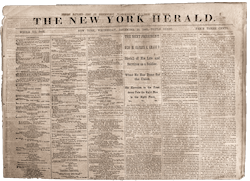
March 7, 1863, The New York Herald

NASHVILLE, March 6, 1863.

There was fighting all day yesterday between the rebel General Van Dorn’s command and a Union force of three regiments of infantry, about five hundred cavalry, and one battery, at Springville, thirteen miles south of Franklin.

Colonel Coburn’s three regiments of infantry were cut to pieces or captured by the rebel forces. They fought desperately, but the ammunition became exhausted, and the Unionists, overpowered by superior numbers, were either killed or captured.

The cavalry and artillery got off safely.

No reinforcement from General Gilbert, at Franklin, reached the scene of action. There were seven regiments of Unionists at that place.

Van Dorn is reported to have eighteen thousand men under his command.

Further details of the fight at Franklin yesterday have been received. Five regiments of infantry and one battery of the Eighteenth Ohio, with the Ninth Pennsylvania and Second Michigan cavalry, all under command of Colonel Coburn of the Thirty-third Indiana, advanced on Springville on the 4th inst. Several spirited skirmishes occurred during the day, our troops camping four miles distant. On the 5th a movement was apparent, and during some disorder on our left, they suddenly opened on our men with three batteries, on different points, at the same time. The enemy also appeared on each flank, in greatly superior force. The unequal contest was maintained with great determination, with heavy loss on [continue reading…]
0 comments

Downing’s Civil War Diary.–Alexander G. Downing.

Diary of Alexander G. Downing; Company E, Eleventh Iowa Infantry

Friday, 6th–I was detailed to go on picket with Company D. Had quite a thunderstorm this evening.

0 comments

Diary of Horatio Nelson Taft.

Diary of US patent clerk Horatio Nelson Taft.

Washington Friday March 6th 1863.

No news today of any importance from the armies or from the southern coast. We are in a State of great anxiety just now. It seems so important that we should now hear of Victories and I cannot but think that our troops will be successful wherever they strike at the Rebels. We are in a better condition now to strike hard blows than we have ever been before. Our armies now in the field are stronger than ever before, if not as numerous, for they have got rid of the most of the inefficient officers as well as soldiers. The “weak kneed” and the faint hearted have gone been going home by the thousands every week all winter. I have been in the office today as usual. After leaving it I went down on to the Ave, droped into Bradys Photograph Gallery which is one of the Institutions of Washington. Genl Sumner of the Army was there and I was introduced to him by my friend the Artist Mulvaney and had some conversation with him. He is not as white haired and bearded as the Pictures represent him, his hair and beard is a fair iron grey. I told him that I found him a much younger looking officer than I expected, which seemed to please him, as he said he the pictures did not do him justice. I spent an hour at Charleys and then was over to Doct Munsons where I staid an hour more.

0 comments

War Diary of Luman Harris Tenney.

War Diary of Luman Harris Tenney.

6th. In the morning the colonel called the officers together and stated in tears that he should resign if the thing were not ferreted out. I was in Case’s tent. C. and H. burned their property. Officers feigned a search but found nothing. In the evening officers held a meeting and passed resolutions. Medary received at the cars by democrats.

0 comments

Through Some Eventful Years

Through Some Eventful Years by Susan Bradford Eppes
Susa Bradford Eppes

March 6th, 1863.—It is hard to even think, because I want to see Grandpa so bad. We were going to him in the summer and now I will never see him again. Father says I will see him in that beautiful Heaven, which he loved to talk of but it seems so far away. Grandma has sent me a lock of his lovely snow-white hair, but there is no comfort in that, for it only makes me long the more to put my arms about his neck and kiss the soft thick hair which glistened like silver.

His will has been read and he has left Uncle Kinchen and Aunt Amy in Mother’s care for the remainder of their lives; all their children were given to Mother, so they will not be separated from their family. Father has sent money to pay their way down and Uncle Kinchen is such a good traveler, they will get on all right.

Grandpa was buried in the cemetery at Enfield. He had stated in his will that he must be brought to Florida and buried beside Grandmother in our “God’s Acre,” but when he was dying he told them not to try to take his body back to Florida, the whole country is in such an upset condition on account of the war and he did not know what complications might arise. I wish he could have been brought here so we could take him flowers every day. I know what I can do, I can bear in remembrance the many talks we have had and try to be just what he wanted me to be.


Susan Bradford is 2 days from her 17thbirthday  when this entry was made.

0 comments

A Rebel War Clerk’s Diary

Civil War Day-by-Day
A likeness of Jones when he was editor and majority owner of the Daily Madisonian during President John Tyler’s administration.

MARCH 6th.—I have meditated on this day, as the anniversary of my birth, and the shortening lapse of time between me and eternity. I am now fifty-three years of age. Hitherto I have dismissed from my mind, if not with actual indifference, yet with far more unconcern than at present, the recurring birthdays which plunged me farther in the vale of years. But now I cannot conceal from myself, if so disposed, that I am getting to be an old man. My hair is gray—but nevertheless my form is still erect, and my step is brisk enough. My fancies, tastes, and enjoyments have not changed perceptibly; and I can and often do write without glasses. I desire to live after this war is over, if it be the will of God—if not, I hope to exist in a better world.

We have no news of interest to-day. A letter says the non-combatants, even the women and children, heedless of danger, were voluntary spectators of the bombardment of Vicksburg the other day. The shells often exploded near them, and behind them, but the fascination was so great that they remained on the ground; even one had an arm carried away by a ball! Can such a people be subjugated?

Houses (furnished) are beginning to be offered more plentifully than ever before; their occupants and owners finding their ordinary incomes insufficient for subsistence. I suppose they mean to find in the country an escape from famine prices prevailing in the city.

There is a rumor this evening of the fall of Vicksburg; but that rumor has been whispered here several times during the last few months. No one believes it. When Vicksburg falls, many an invader will perish in its ruins.

0 comments

0

News of the Day

March 6, 1863, The New York Herald

Our Mississippi River Correspondence.

NEAR VICKSBURG, Feb. 22, 1863.

The daring of the Union ram fleet during the year which has passed, has furnished themes for the admiration of the country. What was accomplished at Memphis before the Union occupation of that city, is still fresh in the minds of your readers. The more recent operations on Arkansas, White and Yazoo rivers, cannot have been forgotten. In this respect, not a boat has acquired more renown than the “Queen of the West.” We well remember her later exploits in running the batteries at Vicksburg, and Warrenton, six miles below, her capture of the rebel steamers below Natchez, and the excitement they occasioned here and elsewhere. Her glory is departed! She is now in the hands of our enemies!

From gentlemen who accompanied her on her last and unsuccessful trip, and arrived yesterday, through much tribulation and after hair breadth escapes, I am able to give you the following account of her adventures:–

THE QUEEN OF THE WEST.

The “Queen” was an old freight boat formerly in the St. Louis, Cincinnati and New Orleans trade, and in her prime, ten years ago, was considered a model of strength and speed. When Colonel C. R. Ellet, the originator of the ram fleet, who died less than a year ago, in consequence of wounds received at the battle of Memphis, was organizing this branch of the service, this boat was one of the first selected. She was strengthened as to her hull by heavy oak timbers, and as to her machinery by a bulwark of solid wood work, twenty-four inches thick, extending from stem to stern, and so enclosing the boilers and engines that they were considered safe from shot and shell from guns of no heavier calibre than six or twelve pounders. When she ran the batteries at Vicksburg she was further strengthened by two rows of cotton bales, extending [continue reading…]

0 comments

0

News of the Day

March 6, 1863, The New York Herald

(From the Richmond Examiner, March 2.) The following Despatch has been received:–

SAVANNAH, Feb. 28, 1863.

The steamer Nashville in coming up the Ogeechee river last night grounded on the sand bar before Fort McAllister and was discovered by the Yankee fleet. A Yankee iron clad opened fire across the marsh at the Nashville at thirty minutes past seven o’clock, and continued it until ten o’clock, when an incendiary shell struck the Nashville and set her on fire, and she is now a total wreck.

The fort fired upon the iron-clad and hit her twice. The other gunboats of the fleet fired at the fort but did no damage.

SKETCH OF THE NASHVILLE.

The Nashville is one of the historic vessels of the rebellion. It was one of the first seized by the rebels in Charleston in 1861, and was sent to sea under the rebel flag. She has on more than one occasion since given our blockading fleet a great deal of trouble. It will be remembered that she ran the blockade of Beaufort, North Carolina, early last year, and after being in the harbor for some time, and supposed to be secure, eluded what was deemed to be a strict watch and again escaped to sea. She has several times run between Bermuda and Charleston with a contraband cargo; but the last time she entered one of the Southern ports she was so completely hemmed in that she could not escape. It was reported last October that she was fitting out with heavy armament for the purpose of joining the privateer vessels now engaged in the rebel cause and committing their ravages upon the open seas. To prevent this a close watch has been kept on her [continue reading…]

0 comments

0

News of the Day

March 6, 1863, The New York Herald

It is the duty of the President to put down the rebellion. The Congress just deceased invested President Lincoln with extraordinary powers. The militia of all the States, the finances of the whole country and the liberties of all the people are placed under his control by the Conscription act, the financial measures and the act authorizing the suspension of the habeas corpus. President Lincoln is now in effect a temporary dictator. What then? Does not the crisis demand extraordinary powers? It not the Union worth the price of a temporary dictatorship? Does not the constitution give Congress the right to confer upon the President such supreme authority in cases of war or invasion? Let copperheads complain and traitors tremble. Patriots will support the President in order to save the nation.

It is the duty of the people to sustain the President. The war will soon fairly begin. President Lincoln and Jeff. Davis are now on an equality as regards their powers, but President Lincoln has the advantage of far superior resources. If this administration can put down the rebellion, now is its opportunity. Hitherto the niggerheads have charged that our want of success arose, not from their diabolical intrigues, but from our neglect to employ all the means we had. There is no longer room for this charge. All our means, all our men – every dollar and every life in the country – are now at the disposal of the President. Jeff. Davis has the same power over the Southern people – with this difference, that the President possesses his powers constitutionally and by consent of Congress, while Jeff. Davis is a usurper. The struggle between the government and the rebellion is therefore a fair one. Neither side can say that one of its hands is tied. We cannot and do not doubt the result. The rebellion must be suppressed. Properly managed, our forces will sweep the rebels from their last stronghold within the next six months. That they will be properly managed is almost certain. With extraordinary powers Congress has also conferred upon the President extraordinary responsibilities. These responsibilities will make him more prudent with regard to whom he entrust commands. The administration has hitherto squandered its resources like a foolish spendthrift. Now this spendthrift has all his remaining fortune placed in his hands, [continue reading…]

0 comments

0

News of the Day

March 6, 1863, The New York Herald

The news from Tennessee reports the progress of the Union arms. The force under the rebel General Van Dorn advanced towards Franklin on the 4th inst., where they were met by the Union troops and driven back with a loss of thirteen killed. The fight was resumed next day; but the particulars have not yet reached us. A body of rebels, numbering fifty cavalry, attempted to surround a picket party of Union troops near Nolansville, but were themselves surrounded and captured. Reinforcements have been sent to Colonel Gilbert at Franklin, which are thought to be large enough capture all Van Dorn’s command.

There appears to be some mystery about the capture of the gunboat Indianola, and some suspicion that her surrender to the rebels was unnecessary.

The canal between the Mississippi river and Lake Providence is completed; but the water is not yet in.

We give today a most interesting account from our correspondent of the daring attempt of the gunboat Queen of the West to run the blockade at Fort Taylor, on the Red river, and her capture by the rebels. A map of the locality accompanies the description, showing the position of the fort, and the different points of interest in the trip of the Queen of the West.

The only news from the Army of the Potomac is the issue of an important order regulating the grating of furloughs, the admission of citizens within the army lines, and commanding that no leave of absence be granted to the officers and men of certain regiments specified as being incomplete in discipline and efficiency.

The story of the total destruction of the rebel steamer Nashville, in the Ogeechee river, near Savannah, is confirmed by the Richmond papers, which state that she grounded on the bar before Fort McAllister on the 27th ult., and was [continue reading…]

0 comments

Downing’s Civil War Diary.–Alexander G. Downing.

Diary of Alexander G. Downing; Company E, Eleventh Iowa Infantry

Thursday, 5th–We had regimental and camp inspection this morning at 10 o’clock, conducted by a major of General McPherson’s staff. We came out in splendid order. The officers of the Eleventh Iowa met at 6 o’clock this evening to draw up resolutions demanding the hunting down of all Copperheads in the North. The steam tug was started on the lake today to inspect and make sure of the outlets from Providence Lake through the Tensas river to the Red river. These outlets must all be open before we let the water into the lake.

0 comments

Diary of Horatio Nelson Taft.

Diary of US patent clerk Horatio Nelson Taft.

Washington Thursday March 5th 1863.

We are disappointed today as the report last night of the Capture of Fort McAllister is contradicted today. Still, there is something that is favorable to the Union cause as gold has fallen down to 150, or twenty percent in one day. We will hear news in a day or two, I think. I notice that the Town Elections in N York are going Democratic all over. But that does not indicate disloyalty to the Union, it is more like an expression of want of confidence in the Managers of the war. Very few democrats at the North (I think) would be willing to see the Union divided or that would consent to it without a much longer Struggle. But they do not want to see our Strength frittered away and are willing to rebuke those in power for their ineficiency and blunders. A few Victories will put the matter all right and I have the faith to believe that we shall soon hear of them. I attended the Lodge till nine o’clock and called on Mr Lieb (Profs). Judge Lieb the Uncle was there, his daughter, and Chas and Sallie. The air is quite keen tonight and it freezes quite hard. I called at Dr Munsons this morning. We have a large quantity of Union news papers to send to the Camps and Hospitals. They are sent from NY for distribution, gratis.

0 comments

War Diary of Luman Harris Tenney.

War Diary of Luman Harris Tenney.

5th. My back quite well. Not much going on during the day. In the evening the boys mostly went out to town and mobbed the “Crisis” and then went to the “Statesman” but did no damage. Medary and the press were in Cincinnati. The boys carried off all the books, etc., they could find.


Note: The episode briefly referred to under date of March 5, 1863, was of this nature: At that time Samuel Medary, formerly a state official of considerable prominence, was conducting a weekly newspaper called “The Crisis” at Columbus. This periodical was perhaps the most bitter and dangerous and disloyal “Copperhead” sheet published in the North. Its utterances distinctly encouraged the Rebellion, instigated desertions of Union soldiers and thus promoted disunion, prolonged the war and increased the slaughter of Union troops. On the night of March 5th, a considerable number of Second Ohio boys mysteriously got through the guard line of the Camp Chase encampment, went quietly down town, threw out pickets for protection from the police, entered “The Crisis” office and thoroughly gutted it, throwing the type, presses, paper, etc., out of the back windows into the Scioto River. Then as quietly as they came they returned to camp, still unobserved by the sentinels on guard at camp, and went to bed. As mentioned in the subsequent entries in the diary, it proved impracticable to identify any of the participants and nobody was punished. The then Colonel of the Regiment, August V. Kautz of the Regular Army, and a son-in-law of then Governor Tod, was naturally greatly wrought up over the circumstance.–A. B. N.

0 comments

A Rebel War Clerk’s Diary

Civil War Day-by-Day
A likeness of Jones when he was editor and majority owner of the Daily Madisonian during President John Tyler’s administration.

MARCH 5th.—Yesterday the government seized the flour in the mills and warehouses; and now the price has risen from $30 to $40 per barrel. I wrote to the Commissary, in view of the dissatisfaction of the people, and to prevent disturbances, advising him to seize the 5000 barrels in the hands of the small speculators, and to allow so many pounds per month to each inhabitant, at the rate paid by government. This would be beneficent and popular, confining the grumblers to the extortioners. But he will not do it, as the Constitution only provides for impressments for the public use.

Our dinner to-day (for seven, for the servant has an equal share) consisted of twelve eggs, $1.25; a little corn bread, some rice and potatoes. How long shall we have even this variety and amount? Bad beef in market, this morning, sold at $1.25 per pound.

After bombarding Fort McAlister on the 3d inst. and all night, the enemy’s fire ceased. The fort was not much injured, says the dispatch. There is a rumor to-day that the fort has been reduced—but no one believes it.

Gen. Van Dorn has had a fight in Tennessee, killing and wounding 1000 and capturing 2600 prisoners. Our loss is said to have been heavy.

Gen. Lee writes that now, since Lincoln may call out 3,000,000 men, and has $900,000,000 voted him, we must put out all our strength, if we expect to keep the field. We shall certainly have an exciting time. But there may be use for some of the Federal troops in the North! If not, I apprehend that Richmond must withstand another siege and assault. It is said they have dropped the “Constitution and the Union” in the United States, and raised the cry of the “NATION” and the “FLAG.” This alarms me. If they get up a new sensation, they will raise new armies.

Gold is selling at a premium of $4.25 in Confederate notes.

We bought a barrel of flour to-day (that is, my wife paid for one not yet delivered), from a dealer who was not an extortioner, for the moderate sum of $28.00. This, with what we have on hand, ought to suffice until the growing wheat matures.

For tea we had meal coffee, and corn cakes without butter. But we had a half-pint of molasses (for seven) which cost 75 cts. The gaunt specter is approaching nearer every day!

Every morning there is a large crowd of Irish and Germans besieging Gen. Winder’s office for passports to go North. Is it famine they dread, or a desire to keep out of the war? Will they not be conscripted in the North? They say they can get consular protection there.

0 comments

“Never since I first entered the service have I passed two months in which there seems so little worth remembering.”–Army Life of an Illinois Soldier, Charles Wright Wills.

Civil War Day-by-Day

Camp 103d Illinois Infantry, Jackson, Tenn.,
March 5, 1863.

You certainly should not complain of my neglect, in writing no more than once in ten days while we are quartered at such an intolerably stupid place as this, for there really have not been two incidents ocurred worthy of notice, since we pitched our tents on this ground. Never since I first entered the service have I passed two months in which there seems so little worth remembering. Nothing but a dull round of picket, fatigue, and camp guard; no alarms and no enemy within a hundred or more miles of us, save “citizen guerrillas,” and they in no force sufficient to scare even a foraging party. In lieu of something real to talk of and speculate about, I give you the following items: There seems this morning to be some movement on foot, though I have not heard a word of the object which has raised such a commotion in our usually quiet military circles. I only know that all the mounted men stationed here have this morning started under command of Colonel Mizner, with an ammunition train and small provision ditto. Also hear that Dodge at Corinth and the command out at Trenton have set all their cavalry in motion. To make the case a little stronger I will add that one of Sullivan’s aids galloped into camp half an hour since, and required at short notice the number of rounds of ammunition on hand. Well, I expect that Van Dorn or Morgan is on our side of the Tennessee again. It can’t be more than that. I’d give a month’s pay to get this regiment into a fight. Don’t want it for myself particularly, but think it would do the regiment a great deal of good. The feeling is some better among the men, but there is still much room for improvement. Desertions are not so numerous, but one slips off occasionally. Colonels Kellogg and Babcock were both here a few nights ago. Both in good health, never saw them looking better. Don’t know that anything of importance was connected with their visit. My own health continues prime. I know that I don’t fully appreciate the Lord’s goodness to me in granting me such continued excellent health, but I assure you I do feel grateful to the Power that rules that matter, although I am tolerably regular in my habits and intemperate in none, yet I know I am very careless of myself and health in regard to dress, sleeping any and everywhere, etc. General Sullivan will visit our camp at 3 o’clock to-day to look into its sanitary conditions, and inspect our policing. The health of the regiment is much improved. Two months more and we will be veterans. Another of my boys, the second, died in General Hospital at this place yesterday. James Conyers, is his name. Formerly worked for Stipp.

0 comments

0

News of the Day

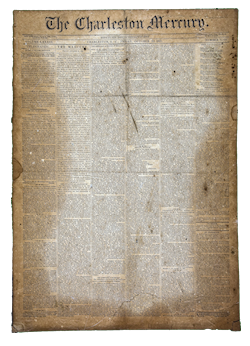
March 5, 1863, The Charleston Mercury

In humiliating ourselves as a people, under the calamities brought upon us in this cruel war, we are called upon to recognize the chastening hand of an Omnipotent, Just and Gracious Father. And, while considering our sins as a people, and confessing that have left undone those things which we ought to have done; and we have done those things which we ought not to have done, it is eminently proper to examine our conduct in regard to civic and political duties.

The people of the Confederate States are now under the rod of discipline. Have they in the past exercised their individual duties as citizens, earnestly and intelligibly, for the good of the country; or have they abused their privileges, devoting time and attention to private interests, and leaving those in office to dispose of public affairs in a manner agreeable to their own views and interests, and without republican accountability? Have they not been too ready to listen to the flattering tales of demagogues, rather than to the voice of truth and soberness? Have they not been too ready to see the future prospects of the country bartered away in compromises for present ease, and for the mere postponement of difficulties? Have they not been too ready to relieve themselves of responsibility and the proper exercise of intelligent judgment, by transferring it upon those in office, and following blindly and subserviently? How stands the case?

0 comments

0

News of the Day

March 5, 1863, The Charleston Mercury

CHATTANOOGA, March 4. – VAN DORN attacked the enemy at Franklin, 18 miles south of Nashville, on Sunday last, with cavalry and light artillery, capturing three thousand Yankee troops, with their stores and equipments.

The enemy captured several foraging wagons belonging to WHEELER’S brigade, near Wartrace on the 1st instant.

The invaders continue to commit depredations around Murfreesboro. A citizen of Rutherford was recently taken out and whipped by order of Yankee officers.

Later.

We have received confirmatory reports to VAN DORN’S successful raid in Franklin. He is now in possession of that place. He captured 30 wagons loaded with stores. The Yankee loss was 1000 killed and wounded. Our loss was heavy. The number of prisoners taken by our troops was 2600.

0 comments

0

News of the Day

March 5, 1863, The New York Herald

We intend to publish tomorrow a carefully prepared and accurate alphabetical table of the rates of internal duty now imposed by the national Tax law. The table will present all the rates imposed by the law as it now stands, including those which were not altered by the act just passed, those amended and those added by it.

The rates of duty have been considerably altered, experience in the practical working of the law of last summer having suggested the changes. Some articles, forgotten or omitted by those who framed the original law, have been inserted in the list of taxable articles. Quite a number of additions have also been made to the number of those person subject to tax for licenses. A provision of great importance to those who have neglected to pay their license tax has been inserted in the amendatory act. It is as follows: –

That if any person or person shall exercise or carry on any trade or business, for the exercising or carrying on of which trade or business a license is required, without taking out such license as is in that behalf required, he, she or they shall, for every such offence, upon conviction thereof, in lieu of or in addition to other penalties now imposed by law, at the discretion of the court, be subject to imprisonment for a term not exceeding two years.

The penalties originally imposed for neglect or refusal to pay the lawful tax in this behalf were quite severe; but they were found to be insufficient, and hence this additional penalty has been imposed. The act, of which the above is a provision, takes effect immediately after its passage. So it will be well for those who have been endeavoring to cheat the government out of its dues to take warning in time, and make an early visit to the Collector’s office.

We have not space to refer in detail to the amendments which have been made in the rates of duty. Those interested will find the changes in the alphabetical table, which will appear tomorrow. As the exact wording of the amended sections [continue reading…]

0 comments

0

News of the Day

March 5, 1863, The New York Herald

Despatches from Savannah state that the rebel steamer Nashville ran aground before Fort McAllister and was destroyed by the Union iron-clads. The fort, however, is not captured. There is nothing in the Richmond journals relative to affairs at Vicksburg, neither has any definite news of importance reached us since our last publication.

The steamers Ruby and Douglas, from Nassau, N.P., with dates to the 26th ult., ran the blockade at Charleston on the 1st inst.

There is nothing stirring in the Army of the Potomac.

A reconnoissance was made recently towards Aldie to surprise a band of rebel guerillas, commanded by Captain Mosely, at the farm of Captain Schultze, now attached to the Union cavalry. The Captain led the attack, and came upon the enemy by secreting his men in his own barn. He captured several prisoners by this manoeuvre and drove the rebels from their haunt.

The various reports prevailing in some of the Western cities for a few days past relative to great battles and victories receive no confirmation whatever at Washington, and are doubtless mere idle gossip.

An arrival at Cairo from Memphis reports that at last advices from Vicksburg two dredges were at work on the canal. The river was then rising so rapidly that the camps at island No. 95 were seriously inconvenienced; the levees were broken down, and the water pouring over at a fearful rate. Another flatboat had run the blockade at Vicksburg. Nearly the whole town of Lake Providence was destroyed by fire on Monday, together with a large amount of commissary stores.

Some rumors were circulated yesterday in the city that the Alabama was taken. This, we believe, is about the sixth time that the famous rebel pirate was captured – in the streets; but as intelligence of any such desirable event comes by the regular channels of reliable information, it may be safe to conclude that the Alabama is still afloat, unless some one has taken Mr. Welles by the shoulder, and given him a good shake and waked him up.

0 comments

0

News of the Day

March 5, 1863, The Charleston Mercury

The Yankee newspapers have latterly abounded in circumstantial accounts of the defences of Charleston harbor, which neither deserters from any particular post nor scouting parties, by day or by night, could possibly obtain. Information being essential to their military operations, it is reasonable to suppose the enemy has employed spies to come into Charleston by land, railroad or water, and to gather carefully the intelligence desired in regard to the different points. What has been already done in this way, of course, is beyond remedy. But our preparations are daily augmenting, and continually improving in strength and completeness, and it is exceedingly important to prevent the further knowledge of our affairs from transpiring, to the aid and benefit of the foe. We, therefore, call attention to the subject, in order to excite our soldiery, guards and detectives to the utmost attainable vigilance and energy. Death is the penalty of spies, and the law is rigidly enforced. Hence those who would here undertake so ticklish a service are apt to be men of sang froid and mental resources, calculated to deceive and unsuspicious and unwary. Too much has, perhaps, already leaked out through these audacious visitors coming into the city in disguise and mingling amongst our people. It is high time to be on the qui vive, and for the safety of the place to make an example. Let one or two be found and arrested. Their fate will soon stop the business.

0 comments

0

News of the Day

March 5, 1863, The Charleston Mercury

From the Savannah papers of yesterday we glean the following additional particulars of the action at Genesis Point:

The fire on the fort was opened about half past 7 o’clock from three iron-clad turret boats, which had taken position in front of the batteries, and two or three mortar boats, which were with the fleet some two miles below. The firing was continuous and brisk from the iron-clads during the day, which was deliberately responded to by the garrison, which directed its shot almost entirely at the nearest iron-clad, supposed to be the Montauk. From Coffee Bluff we witnessed for hours the unequal contest in which our gallant men, in their open earthwork, received the concentrated and enfilading fire of the Yankees, who were securely housed in their […..] safes. The fire was kept up with great spirit by the Yankees until about 3 o’clock, when their energies seemed to flag. A little after 3 p.m., one of the iron-clads hauled off and returned to the fleet. About this time the fire from the other two ceased, and shortly after the second iron-clad returned. The batteries now poured a terrific fire upon the remaining iron-clad, which, after remaining silent for full half an hour, followed her companions in their retreat. As she steamed down the river our garrison redoubled their fire, which was not returned by the retreating Yankee. The last gun from the fort was fired at her when nearly out of range, a quarter to five o’clock.

The latest accounts we have from the battery are up to three o’clock, from which we learn that only two men had been slightly injured, and one gun dismounted. More or less damage was, no doubt, done to the works, but the repairs will be completed by daylight tomorrow morning, when our brave boys will be ready to give the Yankees another day’s entertainment.

Occasional heavy guns were heard last night in the direction of Genesis Point, from which we infer that the mortar boats lying below were engaged in throwing shells at our batteries for the purpose of preventing our men from repairing the [continue reading…]

0 comments

Downing’s Civil War Diary.–Alexander G. Downing.

Diary of Alexander G. Downing; Company E, Eleventh Iowa Infantry

Wednesday, 4th–The engineers finished calking the steam tug and with ropes attached to it some five or six thousand men succeeded in pulling it overland to the lake where it is to be launched. I crossed the lake in a skiff to the south side to buy some notions of a sutler with the Fourth Division. Among other articles, I purchased a diary for seventy-five cents, for the purpose of keeping a record of my army life. We were ordered to prepare for inspection.

0 comments

Diary of Horatio Nelson Taft.

Diary of US patent clerk Horatio Nelson Taft.

Wednesday March 4th 1863.

Congress adjourned at twelve O’clock today. The Senate is again convened by proclimation of the Prest for further Confirmations and perhaps for counsel and as advisors of the Prest. Public affairs look rather more bright. Mr Chase now has almost unlimited powers for raising money confered upon him. Not much apprehension is felt now about his being able to carry the war along. The War news is more favorable. Fort McAllister below Savannah has been taken by our troops and “Iron Clads” and that was the Principal defense of Savannah. We shall hear from Charleston very soon. It is reported in the papers that the Rebels have evacuated Vicksburgh after a hard fought Battle. We will know for certain in a day or two. I got some Photographs of myself at Addiss today, the first I have ever had taken as Photographs. I was on the Avenue after office hours. The celebrated Sword recently presented to Genl Siegel attracts much attention in Jeweler [Semkins?] window. It is a very elegant article. He has just resigned. Genl Halleck to blame for that. Spent an hour at Charleys, a short time in the Hospital, and the bal of the evening with my friends Mr & Mrs Schram at their room very pleasantly. Returned to my room at eleven o’clock.

0 comments

War Diary of Luman Harris Tenney.

War Diary of Luman Harris Tenney.

4th. After the work in the morning repaired to headquarters and heard Andy Johnson of Tennessee and Gov. Wright of Indiana. Both spoke well, said much to encourage us soldiers and discourage traitors. Received good letters from Sarah Felton, Ella Clark and home. Went over to see Charlie. Wrote a line to Delos.

0 comments

A Rebel War Clerk’s Diary

Civil War Day-by-Day
A likeness of Jones when he was editor and majority owner of the Daily Madisonian during President John Tyler’s administration.

MARCH 4th.—The enemy bombarded Fort McAlister again yesterday, several gun-boats opening fire on it. It lasted all day; during which one of the iron-clads retired, perhaps injured. We had only two men wounded and one gun (8 in. columbiad) dismounted. The fort was but little injured.

Recent Northern papers assert that their gun-boats have all passed through the canal opposite Vicksburg. This is not true—yet.

Lincoln is now Dictator, his Congress having given him power to call out all the male population between the ages of twenty and thirty-five years, and authority to declare martial law whenever he pleases. The Herald shouts for Lincoln—of course. We must fight and pray, and hope for revolution and civil war in the North, which may occur any day.

Our cavalry, under Gen. Jones, has done some brilliant skirmishing recently in the vicinity of Winchester; and as soon as the March winds dry the earth a little, I suppose Hooker will recommence the “On to Richmond.” We shall be weaker the next campaign, but our men are brave.

0 comments