0

News of the Day
1860s newsprint

May 19, 1863, Savannah Republican (Georgia)

            Brandon, Miss., May 16.–Five gentlemen who rode to Jackson to-day, and traversed the place while there, report that the city was evacuated by the enemy about two o’clock.  They are supposed to number about 40,000, and they retreated in the direction of Vicksburg.  Firing was heard by the party in that direction, and they suppose Pemberton was in their rear.

            Before leaving Jackson, the enemy burnt the Confederate House, the railroad depots, Green & Phillip’s factories, Storm’s foundry, Lenoir’s hat factory, together with a block of buildings on State street, including the Medical Purveyor’s and other government offices.  Both bridges over Pearl river were destroyed, together with several miles of railroad track.

            It is reported in Mobile that some of this burning was done by the Confederates before they retired.  The Confederate House was burned by the proprietors.

0 comments

0

News of the Day

May 19, 1863, Savannah Republican (Georgia)

            Although Hooker crossed the river without baggage, the spoils of the battle field have proved unusually valuable.  Already fifty thousand muskets and rifles have been picked up and secured, and are being sent to Richmond by rail.  The quantity of great coats, knapsacks and rations, thrown away by the enemy, exceeds anything that has occurred during the war.–Richmond Examiner, 15th.

0 comments

Robert M. McGill

Robert M. Magill – Personal Reminiscences of a Confederate Soldier Boy, 39th Georgia Regiment of Infantry

Monday, 18th.—A. M., all quiet; about 12 o’clock put in ditches; don’t know whether Yanks are coming on us or not. 5 P. M. skirmishing on the left; two hundred and forty of 39th missing; twenty-four out of Company F.


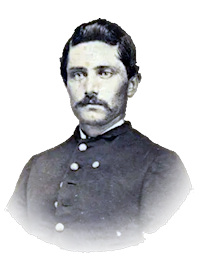
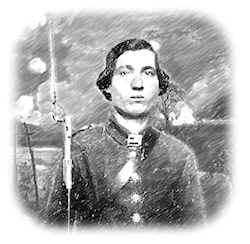
(Note: picture is of an unidentified Confederate soldier.)

0 comments

Diary of a Southern Refugee, Judith White McGuire.

Diary of a Southern Refugee During the War by Judith White McGuire

Monday, May 18th.—This morning we had the gratification of a short visit from General Lee. He called and breakfasted with us, while the other passengers in the cars breakfasted at the hotel. We were very glad to see that great and good man look so well and so cheerful. His beard is very long, and painfully gray, which makes him appear much older than he really is. One of the ladies at table, with whom he is closely connected, rallied him on allowing his beard to grow, saying, ” Cousin R., it makes you look too venerable for your years.” He was amused, and pleaded as his excuse the inconvenience of shaving in camp. “Well,” she replied, ” if I were in Cousin Mary’s place (Mrs. L’s) I would allow it to remain now, but I would take it off as soon as the war is over.” He answered, while a shade passed over his bright countenance, “When the war is over, my dear L., she may take my beard off, and my head with it, if she chooses.” This he said as the whistle summoned him to his seat in the cars, not meaning to depress us, or imagining for an instant that we would think of it again; but it proved to us that he knew that the end was not yet, and disappointed us, for after every great victory we cannot help hoping that the Federal Government may be tired of war and bloodshed, rapine and murder, and withdraw its myriads to more innocent pursuits.

Yesterday evening we were agreeably surprised by a call from W. B. C., just recovered from his dreadful wound, received at [continue reading…]

0 comments

Downing’s Civil War Diary.–Alexander G. Downing.

Diary of Alexander G. Downing; Company E, Eleventh Iowa Infantry

Monday, 18th – A despatch from the front informs us that General Grant has taken the railroad bridge across the Big Black river in the rear of Vicksburg. The troops also took some prisoners. The Eleventh Iowa, accompanied by a gunboat, went on a scout up the Big Black river to destroy a bridge which the rebels had built in the last few days. This river empties into the Mississippi a short distance above our camp.

0 comments

War Diary of Luman Harris Tenney.

War Diary of Luman Harris Tenney.

Monday, 18th. Got Victor Hugo and finished it. An interesting and profitable work, a few exceptions. Capt. Hayes and A. B. called a little while. Gave them some pickles and H. bread and butter. In the evening wrote to Fannie. A delightful day. What a blessing, such weather and good health. Thede has a troublesome boil.

0 comments

0

Cruise of the U.S. Flag-Ship Hartford -Wm. C. Holton

May 18th. At nine twenty A. M. the Sachem came down and out of Red river, and anchored ahead of us. The Albatross got under way and went down the Mississippi river. Saw the smoke of a steamer up Red river; at twelve, noon, the ram Switzerland came out of Red river, and communicated with us; at two P. M. the iron-clad Pittsburgh got under way and went down the Mississippi. Ram Switzerland went up Red river. A steamer reported coming down the Mississippi river; at five P. M. the ram Gen. Sterling Price, arrived from Vicksburg; at nine thirty P. M. ram Switzerland returned from a reconnoissance up Red river, having nothing, though, to report, and anchored ahead of us.

0 comments

0

Civil War

From the diary of Osborn H. Oldroyd

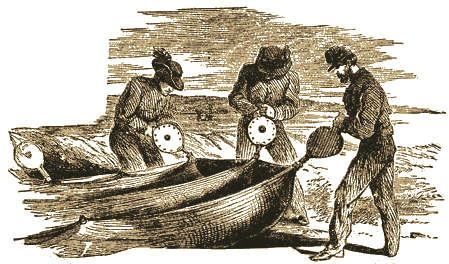
MAY 18TH.–The army last night made pontoons, on which this morning the Black River has been crossed. McClernand is on the left, McPherson in the center, and Sherman on the right. In this position the three great corps will move to Vicksburg by different roads. We are nearing the doomed city, and are now on the lookout for fun.

2007-0002.gif

Sherman’s men inflating rubber pontoon on which to cross Big Black River

As we crossed the river and marched up the bank, a brass band stood playing national airs. O, how proud we felt as we marched through the rebel works, and up to the muzzles of the abandoned guns that had been planted to stay our progress. Every man felt the combined Confederate army could not keep us out of Vicksburg. It was a grand sight, the long lines of infantry moving over the pontoons, and winding their way up the bluffs, with flags flying in the breeze, and the morning sun glancing upon the guns as they lay across the shoulders of the boys. Cheer after cheer went up in welcome and triumph from the thousands who had already crossed and stood in waiting lines upon the bluff above. This is supposed to be the last halting place before we knock for admittance at our goal–the boasted Gibraltar of the west.

Our division has made a long march to-day, and we have bivouaced for the night without supper, and with no prospect of breakfast, for our rations have been entirely exhausted. Murmurings and complaints are loud and deep, and the swearing fully up to the army standard. General Leggett walked into our camp, and in his usual happy way inquired, “Well, boys, have you had your supper?” “No, General, we have not had any.” “Well, boys, I have not had any either, and we shall probably have to fight for our breakfast.” “Very well, General ; guess we can stand it as well as you,” came the ready answer from a score of us, and resignation settled back upon the features of tired and hungry, but unsubdued, patriot soldiers.

“You may study the hopeful, bright brows of these men,
Who have marched all day over hill and through glen,
Half clad and unfed; but who is it will dare
Claim to find on those faces one trace of despair?”

0 comments

0

News of the Day

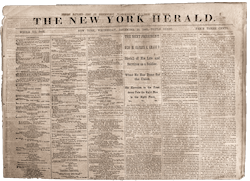
May 18, 1863, The New York Herald

By the arrival of the steamer George Washington, from New Orleans on the 9th instant, we have a full account of the capture of Alexandria, on the Red river, by Admiral Porter, the arrival of Admiral Farragut at New Orleans, and an intensely interesting and most valuable description of the cavalry raid of Colonel Grierson with his gallant Illinois cavalry, which will be found in our Baton Rouge correspondence. His expedition was a magnificent success. He cut his way through the enemy’s country with two regiments of cavalry, destroying on his route four millions of rebel property, capturing over a thousand men and twelve hundred horses, demolishing a camp of instruction, with all its equipments, cutting the communication on the great Northern and New Orleans and Jackson railroads and destroying a large number of cars, telegraph wire, water tanks and army stores. After passing through many dangers and working terrible damage he arrived at Baton Rouge on the 1st inst., to the great surprise of the inhabitants. From thence he pushed on to New Orleans, where he was received with great eclat, as will be seen by our correspondent’s description. The whole movement only occupied seventeen days. This is certainly one of the most brilliant feats of the war.

We have received from the Southern journals a number of highly interesting articles, chiefly dwelling upon the disastrous effects of these grand cavalry raids of ours in Virginia, Mississippi and Georgia, in which it will be seen the enemy admit that terrible damage has been done by our forces in these States. The Richmond journals also lay great stress upon the occupation of West Point, Virginia, by the Union forces, intimating that its possession would be an incalculable damage to that large and most productive portion of Virginia, which, having thus far escaped the ravages of war, has supplied the people of Richmond and the troops and hospitals with large and indispensable supplies of breadstuffs and other provisions. Such is the opinion of the Examiner. And it further states that the presence of an army at West Point will completely paralyze the [continue reading…]

0 comments

0

News of the Day
1860s newsprint

May 18, 1863, Savannah Republican (Georgia)

            We are gratified to learn that this distinguished gentleman has been appreciated in Georgia and assigned to the control of an important interest.  He has been chosen President of the Etowah Iron Mining Company, in Bartow county, who have one among the finest works of the kind in the country.  It is said, and we believe correctly, that, in order to secure his valuable services, the Company transferred to him stock to the amount of $25,000, besides voting him an annual salary of $7,000.

            We congratulate the Etowah Company on their good fortune in securing such superior scientific acquirements and business qualifications in the direction of their important interest.

0 comments

0

News of the Day

May 18, 1863, The New York Herald

Our latest news from the Southwest indicates a successful issue to General Grant’s inland movement in Mississippi for the reduction of Jackson and Vicksburg.

The advanced detachments of his army, wherever they had come into contact with an opposing column of the enemy, had, after a severe contest, invariably routed it. The last reported engagement of this character, (according to a rebel despatch to the Richmond Enquirer, was on the 12th or 13th instant, at Raymond,) some five or six miles from the Jackson and Vicksburg Railroad, from which point, after a fight of several hours, the rebels fell back to Mississippi Spring, where they had reinforcements; but the Chattanooga Rebel of the 16th says that the rebels were driven out of Jackson on the 14th, after a hard day’s fight, not being able to hold that city. Meantime the main body of Gen. Grant’s army was at Willow Spring and among the hills in that vicinity, some thirty miles below Raymond, and in close communication with his base of supplies at Grand Gulf. With his army strongly intrenched against the possible contingency of a rebel sortie in force down the country from Vicksburg, General Grant was awaiting the reinforcements that were moving to his support from various points along the Mississippi river between Memphis and Baton Rouge.

The rebels estimate the forces under General Grant command at one hundred and twenty thousand men; and yet, while they are evidently uneasy and perplexed, they profess considerable confidence in their ability to expel him. Doubtless they have scoured all the Southwest to strengthen Gen. Pemberton, and have thus, in all probability, given [continue reading…]

0 comments

0

News of the Day

May 18, 1863, Tri-Weekly Telegraph (Houston, Texas)

            We acknowledge from Edmundson &  Culmell 185 yards mosquito netting, a donation for the hospital of Sibley’s Brigade.  It was a timely gift, as the hospital of these troops is now in a region perhaps worse infested with mosquitos than any other in America. 

0 comments

0

News of the Day

May 18, 1863, The New York Herald

Our Expeditionary Correspondence.

SOUTH SIDE OF BIG BLACK RIVER,

HANKERSON’S FERRY, MISS., May 3, 1863.

Events have followed each other so rapidly within the last three days that I have been utterly unable to keep you informed of them as they have occurred. In a land blessed with mail facilities those would be an irreparable misfortune in a journalistic point of view; but here, cut off as we are from one of the blessings of civilization and good order, and depending upon the courtesy of returning officer to take our communications, we feel the misfortune less sensibly.

AT BRUINSBURG.

When I wrote you from this place,  it was long past midnight, and at the conclusion of my letter I was forced to throw myself upon the ground, under the friendly shelter of a thrifty cottonwood, to gain a little sleep for the labors of the coming day. Since eleven o’clock of the preceding (Thursday) night we had heard the occasional boom of cannon, followed by the sharp rattle of musketry, and I was not surprised, soon after I went into bivouac, to learn that an order was issued to march at daylight. At five reveille was beaten, and swallowing a cup of coffee and securing within haversack a cracker or two, just as the first rays of the tropical sun came glistening along the surface of the [continue reading…]

0 comments

0

News of the Day

May 18, 1863, The New York Herald

The Great Cavalry Operations in the Southwest.

Our Baton Rouge Correspondence.

BATON ROUGE, La., May 5, 1863.

I embrace the first opportunity to forward to you the particulars of one of the most important expeditions of the war. The excitement of the hour will hardly permit me to do more than relate the dry details, which of themselves will be found sufficiently interesting.

WHERE THE CAVALRY WERE RENDEZVOUSED.

For some time we have had a considerable cavalry force in Lagrange, Tenn. – a small place on the Memphis and Charleston Railroad, about fifty miles east of Memphis, and nearly four miles west of the junction of the Mississippi and Charleston railroads. This force formed a part of General Grant’s army, and has been considered made up of the best material in the service.

THE PLAN, ITS OBJECT, ITS DESIGNER AND IT EXECUTOR.

Colonel Benjamin H. Grierson, commanding First brigade of cavalry under General Grant, has for a long time been desirous of visiting the rebels in Mississippi, and has repeatedly submitted a plan with that view to General Grant. On the 1st of last month it [continue reading…]

0 comments

0

News of the Day

May 18, 1863, The New York Herald

The cavalry expedition of Colonel Grierson through Mississippi has proved a great success. We have received a full and graphic description of the affair from Baton Rouge, by the George Washington, which arrived yesterday, and which we publish in another column.

From the tone of a leading editorial in the Richmond Enquirer of Friday, which we published yesterday – equally prophetic and desponding as it is – it is manifest that our cavalry raids are as much, if not more, feared by the enemy than heavy battles in which whole armies are engaged. The effects of these expeditions, as there admitted, are telling fearfully upon the rebel strength. “They (the Union troops) can cause much sorrow, and heart-break our people by expeditions through thinly populated districts destituted of troops.” “They can rob and demoralize us within our own borders.” “The more of our mills, machine shops and railroads they will have destroyed, the more of our national resources they will have ruined and wasted, and the better chance they will have for a irresistible advance at last.” This is the description of the coil which is winding around the rebellion, given by a leading rebel journal.

In addition to our special account of Col. Grierson expedition, we publish further extracts today from Southern papers commenting on the late raids in Georgia, Mississippi and Virginia, showing how disastrous they have been to rebel interests, by the immense destruction of private property, crops, mills, iron works, railroads, bridges and army stores which has marked the track of our cavalry all over these States, as they swept [continue reading…]

0 comments

Robert M. McGill

Robert M. Magill – Personal Reminiscences of a Confederate Soldier Boy, 39th Georgia Regiment of Infantry

Sunday, 17th.—This A. M. found us two miles south of Big Black River. 9 A. M., heavy fighting back at Big Black River; 11 A. M., Confederates routed again; fell back to intrenchments at Vicksburg; went to our old camp.


(Note: picture is of an unidentified Confederate soldier.)

0 comments

Downing’s Civil War Diary.–Alexander G. Downing.

Diary of Alexander G. Downing; Company E, Eleventh Iowa Infantry

Sunday, 17th – There was some very heavy cannonading out at the front today, and word came that a battle was fought at a place called Champion Hills, with heavy loss on both sides. The rebels are falling back towards Vicksburg. The river is falling and troops are still arriving. General Lauman’s Division arrived last night.

0 comments

War Diary of Luman Harris Tenney.

War Diary of Luman Harris Tenney.

17th. In the morning, Rob, Thede and I went to the creek and took a bath and changed clothes. Read some in “Guide to the Savior.” At 5 P. M. Mr. Brown preached from “And shew thyself a man.” The companies were out. Gen. Carter and staff were present. Good sermon. Letters from home and Fannie.

0 comments

0

Cruise of the U.S. Flag-Ship Hartford -Wm. C. Holton

May 17th. Commences with calm, warm weather; at ten A. M. inspected ship and crew; and at ten thirty A. M. called all hands to muster, and performed Divine service on the quarter-deck; at four thirty P. M. the Albatross came down the Mississippi with a coal barge in tow, and anchored ahead of us. She had been up to Grand Gulf. The Sachem got under way and went up Red river. Light breezes from the northward and westward.

0 comments

…retreat will render it necessary to abandon the works at Snyder’s Mill..,

Civil War Irregulars: Rangers, Scouts, Guerrillas, and Others, Henderson’s Cavalry Scouts, War of the Rebellion: from the Official Records of the Union and Confederate Armies and Navies

Hdqrs. Dept. OF Mississippi AND Eastern Louisiana,
Vicksburg, Miss., May 17, 1863.1

General Joseph E. Johnston, Commanding, &c.:

General: Whilst writing my communication this morning, the enemy attacked me on my right, left, and center. My troops, although strongly posted behind breastworks and protected in rifle-pits, were forced from their positions, owing to the demoralization consequent upon the retreat of yesterday. Every effort is now being made to reorganize the troops, and it is hoped that their numbers, although greatly diminished by incidents narrated, will be speedily increased.

The army has fallen back to the line of intrenchments around Vicksburg. As stated in my communication of this morning, this retreat will render it necessary to abandon the works at Snyder’s Mill, which has accordingly been ordered. All the ammunition possible will be saved. The heavy guns, however, will necessarily be abandoned.

Two companies will be left at that point for the purpose of making a demonstration, and of spiking the guns and destroying the remaining stores whenever the emergency may arise.

The works at Fort Pemberton, which may prove essential to a line along the Yalabusha, have not been abandoned. The garrison of 200 men remain there.

I regret to say that as yet I have received no reliable, information with regard to General Loring’s division. It is reported, but I cannot trace the rumor to a reliable source, that he is crossing the Big Black River at some point below the Big Black Bridge.

In addition to the artillery lost yesterday, I regret to state that most of the artillery of Bowen’s divisionis lost. Yesterday it was all successfully brought off, but to-day was abandoned in the trenches, almost without an effort to save it.

I greatly regret that I felt compelled to make the advance beyond Big Black, which has proved so disastrous in its results.

J. C. PEMBERTON.


  1. This dispatch was carried to General Joseph E. Johnston by Captain Thomas Henderson of Henderson’s Independent Scouts.

Unlike many of the independent or partisan Confederate groups, Henderson’s Cavalry Scouts routinely interfaced and worked with regular Confederate forces and some documentation of their activities was preserved in the Official Records.  Captain Thomas Henderson and his brother, Samuel, also interacted with Confederate spies and agents such as Belle Edmondson.
0 comments

If it is not too late, evacuate Vicksburg…

Civil War Irregulars: Rangers, Scouts, Guerrillas, and Others, Henderson’s Cavalry Scouts, War of the Rebellion: from the Official Records of the Union and Confederate Armies and Navies

CAMP, Between Livingston and Brownsville, May 17, 1863.
[Received, May 18, in Vicksburg.]

Lieutenant-General PEMBERTON:

Your dispatch of to-day, by Captain [Thomas] Henderson, was received. If Haynes’ Bluff is untenable, Vicksburg is of no value, and cannot be held. If, therefore, you are invested in Vicksburg, you must ultimately surrender. Under such circumstances, instead of losing both troops and place, we must, if possible, save the troops. If it is not too late, evacuate Vicksburg and its dependencies, and march to the northeast.

Most respectfully, your obedient servant,

J. E. Johnston.

[P. S.]-Please acknowledge receipt by the bearer.


Unlike many of the independent or partisan Confederate groups, Henderson’s Cavalry Scouts routinely interfaced and worked with regular Confederate forces and some documentation of their activities was preserved in the Official Records.  Captain Thomas Henderson and his brother, Samuel, also interacted with Confederate spies and agents such as Belle Edmondson.
0 comments

0

Louise Wigfall Wright — A Southern Girl in ’61
(excerpt)
May 17, 1863

         “I send you, with our letters, a pound of candy and a box of Guava jelly which was given me. I know you have no sugar, and I have no doubt that although you will laugh at the idea you will nevertheless enjoy the sweets. Mrs. McLean (Gnl. Sumner’s daughter) has been staying with Mrs. Davis for three weeks, waiting for a passport from the Yankee Secretary of War, and Mrs. Chesnut told me the other day that it had been peremptorily refused—so I doubt if Rose will be able to get to Baltimore to her children. We are all very anxious to know the next move. I heard yesterday that Genl. Stuart was to go immediately on an extensive raid, but your father says it is not so. Genl Lee is still here. Your father is talking of going up with Genl. Stuart in the morning.”

0 comments

A Rebel War Clerk’s Diary

A Rebel War Clerk’s Diary at the Confederate States Capital, By John Beauchamp Jones
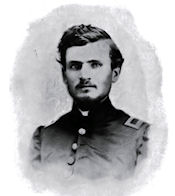
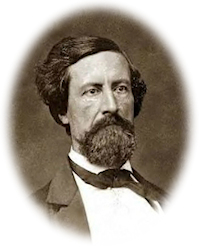
A likeness of Jones when he was editor and majority owner of the Daily Madisonian during President John Tyler’s administration.

MAY 17th.—The last few days have been cool and dry; fine weather for campaigning. And yet we hear of no demonstrations apparently, though I believe Lee’s army is moving.

Mr. Lamar, of Savannah (formerly president of the Bank of the Republic, New York), writes that he and others are organizing an Exporting and Importing Company, and desires the government to take an interest in it. So far the heads of bureaus decline, and of course the Secretary will do nothing. But the Secretary has already engaged with Mr. Crenshaw in a similar enterprise, and so informed Mr. Mason, at London.

About 10 A.M., some 2500 men of all arms arrived at “double quick,” having left Ashland, eighteen miles distant, at 5 o’clock this morning. That was brisk marching. The guns were sent down on the railroad. The government has information that Gen. Keyes, with a full division of infantry and a brigade of cavalry, had marched up to West Point, to threaten Richmond. The troops, however, which arrived from Ashland, had been taken from the batteries here, and did not belong to Gen. Lee’s army.

Messrs. Davenport & Co., Mobile, charge Gen. Buckner with permitting 1000 bales of cotton to be shipped to New Orleans.

The president of the Fredericksburg Road states, in a letter to the Secretary, that, after the battle, by military authority, the cars were appropriated by the Federal officers (prisoners), while our wounded soldiers had to remain and await the return of the trains.

Hon. Mr. Dargin, of Alabama, writes to the Secretary, to procure from the President a disavowal of the “organship” of the Enquirer, as that paper, under the belief that it speaks for the government, is likely to inflict much mischief on the country. He alluded to the bitter articles against the Democrats and peace men of the North, who would soon have been able to embarrass, if not to check the operations of the Republican war party. He says now, that they will write against us, and deal destruction wherever they penetrate the land.

0 comments

0

News of the Day

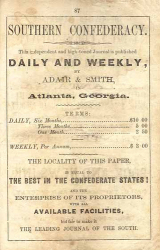
May 17, 1863, Southern Confederacy (Atlanta, Georgia)

            In conformity with a request published some time since, a meeting of the Cotton Spinners of the State was held in Atlanta, Ga., on the 15th of May.

            There were present, John White, Georgia Factory; Isaac Powell, High Shoals Factory; Hugh MacLean, Aguadon Mill; Thomas Leslie, Troup Factory; and E. Steadman, Gwinnet Manufacturing Company.  On motion, John White was elected Chairman, and E. Steadman, Secretary.  After consultation, the meeting agreed upon the following

(Circular)

To the Cotton Spinners of Georgia.

            In pursuance of a call made upon the Cotton Spinners of Georgia, to assemble in Convention in the city of Atlanta, for the purpose of taking into consideration the best means of supplying the great destitution in Cotton Yarns, now being felt all over our State, the undersigned duly assembled.  After a deliberate examination of all the facts laid before us, to-wit:  the great scarcity of Cotton Yarns; the limited means of soldiers’ wives and families; the probably continuance of this unholy war; and the apparent suffering that must continue to accrue to the families of our noble defenders on account of the scarcity of Yarns; and the almost impossibility of procuring cotton Cards, we have determined to act upon the following plan, and earnestly request Cotton Spinners all over the State, heartily to co-operate with us.

            We hereby pledge ourselves to furnish to Gen. Ira R. Foster, Quartermaster General of the State of Georgia, one eighth of our production of Cotton Yarns, weekly, at one half the current prices at the time they are furnished.–These Yarns to be issued to the Inferior Courts of each county, and by them to be distributed to the destitute of their counties, as provided for by a resolution of the late Legislature.  These Yarns to be delivered by us at the nearest depot of [continue reading…]

0 comments

0

Civil War

From the diary of Osborn H. Oldroyd

MAY 17TH.–On the road to Vicksburg, resolved to capture the city or get badly whipped. We have not known defeat since we left Fort Donelson, and we propose to keep our good record up. We have seen hard times on some hotly contested fields, but mean to have nothing but victory, if possible, on our banner.

The advance of our army has made a grand sweep, pell-mell, over the rebel works at Big Black River, routing the foe and capturing twenty-five hundred prisoners with twenty-nine cannon. Their rifle pits were quite numerous, but they were all on low ground, so that when the word was given the Yankees rushed over them with the greatest ease. The rebs may be drawing us into a trap, but as yet we have not a moments’ fear of the result, for when Grant tells us to go over a thing we go, and feel safe in going. Even in time of peace we would not wish the great curtain that hides the future to be rolled away, nor do soldiers now ask to know what lies before them. But every day brings new scenes fraught with dangers, hair-breadth escapes or death, after which the ranks close and move on undaunted. And our love of country still grows as we go.

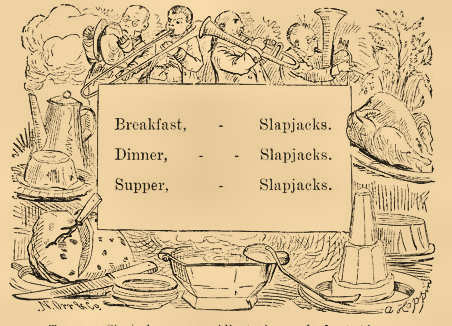
We camped within a few miles of Black River, perfectly satisfied, though we have had no hand in the slaughter to-day. We rather expected to be halted a few days at the river, where the enemy would surely be strongly fortified, and where, as they could certainly spare the greater part of their forces from Vicksburg, if they would but bring them out, they could make a desperate stand. We are now fighting hard for our grub, since we have nothing left but flour, and slapjacks lie too heavy on a soldier’s stomach. But there is great consolation in reflecting that behind us Uncle Sam keeps piled a bountiful supply all ready to be issued as soon as we can find a proper halting place.

2007-00611.jpg

Too many Slapjacks cause a soldier to dream of a feast at home.

0 comments