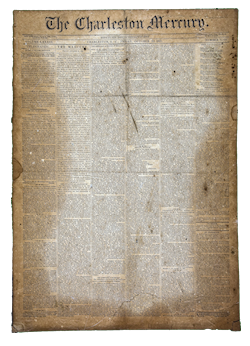
May 17, 1863, The Charleston Mercury
HIGHLY IMPORTANT FROM THE WEST.
REPORTED CAPTURE OF JACKSON, MISSISSIPPI, BY THE ENEMY.
THE ENEMY DRIVEN BACK.
The telegraph, thus far, has brought us no tidings of the capture of Jackson, Miss., by the enemy. Vague rumors of that disaster, however, have been rife since our last issue. The Montgomery Advertiser, which was received at a late hour last evening, contains some definite information obtained from an officer who reached that city on Friday night. His advices from Jackson were derived from refugees who had escaped and telegraphed from Brandon and other points. The Advertiser says:
‘It appears from these accounts that the fight began at an early hour Thursday morning, some eight miles southwest of Jackson, and continued nearly all day, our troops commanded by JOHNSTON and the enemy’s by GRANT. We were finally driven back to Jackson, and fought them through the streets until overpowered by greatly superior numbers, and were compelled to evacuate the city, the enemy’s force amounting to about 20,000 or 30,000, and our own only to about 9000. General JOHNSTON then retreated on Canton, twenty-four miles due north of Jackson, situated on the wagon road connecting thence by Vaiden to the road running due east to the Yazoo River, and leading directly to Vicksburg, some seventy miles from Jackson by this route. ‘ When heard from yesterday morning, the enemy’s cavalry were at Brandon, on the Southern road, twenty odd miles this side of Jackson, near which point we had a force to protect the road. This fact is official, and may be relied on. [continue reading…]
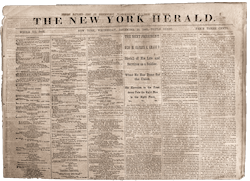
May 17, 1863, The New York Herald
According to information from rebel sources General Grant is actively employed in Mississippi. The Richmond Enquirer of the 14th publishes despatches from Jackson, Miss., stating that one thousand of Grant’s cavalry entered and burned […..] railroad on the 11th inst., at twelve o’clock; that he was fortifying at Rocky Spring and Western Spring; that General Osterhaus is at Cayuga with one hundred and fifty cavalry and six or seven regiments of infantry, and that our forces were being reinforced at Willow Spring and Rocky Spring from the river.
The same journal of a day later, Friday the 15th, says that fighting was then going on in Mississippi. Grant with one thousand men had advanced to Raymond, where General Gregg had a force of 4,000 infantry and a few cavalry. Skirmishing commenced at nine o’clock in the morning, and at one P.M. the battle opened heavily. Reinforcements were then arriving so rapidly to support the Union troops that the rebels fell back through Raymond, making a stand at Mississippi Spring, where they had reinforcements. The firing in the neighborhood of Jackson was continuous throughout the day. Raymond is a small post village, capital of Hinds county, sixteen miles Southwest of Jackson, and connected with the Vicksburg and Jackson Railroad by a branch line eight miles long, running due south. The excellent map of the entire locality of Gen. Grant’s present and prospective operations, which we give today, shows all the prominent places mentioned in the above despatches. The rebel accounts also state that our fleet above Vicksburg is rapidly increasing. They report everything quiet in front of Chattanooga, and announce the arrival of the heavy baggage and tents of the Union army to the rear of Nashville.
With reference to movements at Charleston, the Richmond papers have dates to the 12th instant, and they stated that our forces are building formidable batteries on Folly Island bearing upon Morris Island, and that we were busily engaged fortifying ourselves on Seabrook’s Island. The blockade runner Britain, from Nassau, with merchandise, has entered Charleston harbor in safety. The steamers Bashaw and Pet, from the same port, also arrived at Wilmington, N.C., on Thursday. [continue reading…]
May 17, 1863, Galveston Weekly News
The Chattanooga Rebel expressed the wish that every gallant rifle man of the South who bares his breast to the storm of battle, could be impressed with the importance of making every shot tell, in an engagement. If five out of every ten of the bullets fired at the Yankees for the last two years had taken effect, there wouldn’t be a blue jacket left to tell the story. Better be sure of one Yankee than to fire twenty rounds at random–Keep cool, if you would keep your enemy hot.
May 17, 1863, The New York Herald
Now that all is quiet again on the Rappahannock, and on the Richmond peninsula, and on the Blackwater, and in North Carolina, South Carolina and Georgia, and in Tennessee, Kentucky and Missouri, the advance of General Grant’s army through the interior of Mississippi, for the rear of Vicksburg, becomes the paramount and absorbing topic of the day.
Our latest authentic information from General Grant’s army direct is his own despatch of the 8th inst., to the effect that, since the battle of Port Gibson, he had had no engagement with the enemy; that he was satisfied with the appearance of things in his vicinity, and that the rebels had undoubtedly evacuated Port Hudson, excepting a small garrison and their heavy artillery. A despatch from Cairo, dated May 14, says, further, that General Grant will endeavor to cut the railroad between Vicksburg and Jackson, and that a battle was expected in the vicinity of Black river bridge – a point nearly midway between the two cities. It further appears that our troops, all the way from Memphis down to Young’s Point, near Vicksburg; were moving to reinforce General Grant.
From rebel sources we have information from Jackson down to May 11, from which it appears that a thousand of Gen. Grant cavalry had entered and burned Crystal Springs, on the New Orleans Railroad; that he was fortifying at Rocky Spring and Western Spring; that he was receiving reinforcements; that Gen. Osterhaus, with a strong detachment of infantry and cavalry, was at Cayuga; that Gen. Grant will probably advance eastward, and not direct to Vicksburg) […..]
From all these facts we conclude that, strongly posting the main body of his army, Gen. Grant had paused in his advance, and while awaiting his reinforcements was scouring the country around him; that the most of the rebel forces of Port Hudson had moved, or were moving, around by railroad to reinforce Gen. Pemberton, and that the Union cavalry raid upon the New Orleans road was a movement to cut them off, and all other reinforcements and supplies from that direction; that Gen. Grant was probably aiming for Jackson, which is the base of supplies of Vicksburg and the capital of Mississippi; and [continue reading…]
May 17, 1863, Galveston Weekly News
A friend states that in conversation with one of the Yankee prisoners the other day, he expressed himself very bitterly against the South, stating that the Union was bound to be reconstructed, or that the South would be subjugated. Learning from our friend that he was connected with one of the newspaper offices in the city, he asked him how long before Gen. Houston’s protest would be out.–Our friend asked him what protest he meant, as he had heard of none. He said, “His protest against the Federal officers taken prisoners being put in close confinement in our Penitentiary.” When our friend stated in reply that though Gen. Houston expressed himself to that effect, it was not in the form of any formal protest so far as he had heard, nor had he heard there was to be any publication of Gen. Houston’s opinions on that subject. The Yankee remarked that they ought to be published, and then bestowed some high compliments upon Gen. Houston, and here the conversation ended.
May 17th, 1863.—Hardly was our scanty breakfast over this morning when a hurried ring drew us both to the door. Mr. J., one of H.’s assistants, stood there in high excitement.
“Well, Mr. L., they are upon us; the Yankees will be here by this evening.”
“What do you mean?”
“That Pemberton has been whipped at Baker’s Creek and Big Black, and his army are running back here as fast as they can come and the Yanks after them, in such numbers nothing can stop them. Hasn’t Pemberton acted like a fool?”
“He may not be the only one to blame,” replied H.
“They’re coming along the Big B. road, and my folks went down there to be safe, you know; now they’re right in it. I hear you can’t see the armies for the dust; never was anything else known like it. But I must go and try to bring my folks back here.”
What struck us both was the absence of that concern to be expected, and a sort of relief or suppressed pleasure. After twelve some worn-out-looking men sat down under the window.
“What is the news?” I inquired.
“Retreat, retreat!” they said, in broken English—they were Louisiana Acadians.
About 3 o’clock the rush began. I shall never forget that woful sight of a beaten, demoralized army that came rushing back,—humanity in the last throes of endurance. Wan, hollow-eyed, ragged, footsore, bloody, the men limped along unarmed, but followed by siege-guns, ambulances, gun-carriages, and wagons in aimless confusion. At twilight two or three bands on the court-house hill and other points began playing Dixie, Bonnie Blue Flag, and so on, and drums began to beat all about; I suppose they were rallying the scattered army.
Note: To protect Mrs. Miller’s job as a teacher in post-civil war New Orleans, her diary was published anonymously, edited by G. W. Cable, names were changed and initials were generally used instead of full names—and even the initials differed from the real person’s initials. (Read Dora Richards Miller’s biographical sketch.)
Battle of Champion Hill, Miss.
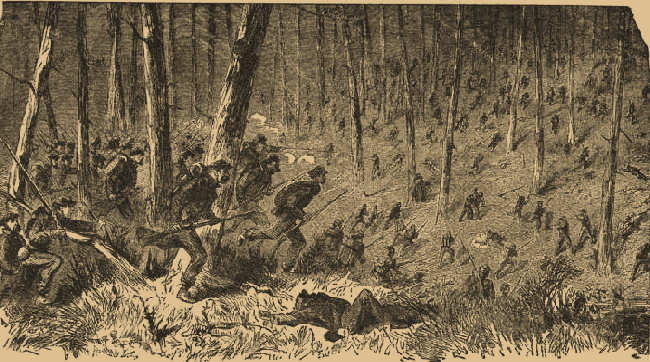
Saturday, 16th.—7 A. M., drew some raw beef; were beginning to barbecue it, when, just at 8 o’clock, a few cannons were fired near us very unexpectedly. Formed immediately and marched back about two miles; skirmishing began before our lines were formed, and it was soon ascertained that the Federals were moving on us in heavy force. 10 A. M., battle opened with great fury on our left; our line was immediately moved to the left in quick time; formed under heavy fire, and in less than five minutes were charged with perhaps two lines of battle. The 34th Georgia was on our right, in a very awkward position, and being struck first, and having no support, after one or two volleys, broke and fled in wild confusion. The Federals pressed through the gap, and on our front at the same moment. Our boys, seeing this, became panic stricken, and in less than ten minutes, the whole brigade was in the wildest confusion. With the exception of about two hundred men, all efforts to rally the brigade were in vain. Having lost all their artillery and about one-fourth of their men, killed or captured, and the Yankees’ triumphant yells in rapid pursuit, whizzing Minnie balls and shells exploding in their midst, were not very soothing antidotes to their agitated feelings. Soon the whole of Stevenson’s Division was in retreat. Reinforcements came, but too late to be’ of much service, and soon we left the field, after having lost about four thousand prisoners and thirty pieces of artillery. Brother I. L., seriously wounded in right breast, called to me in the retreat, saying, “I am killed,” but was walking on. Just then I was ordered into line; the next moment he was out of my sight, in the woods, and I did not see him again until I arrived at home after the siege was over, when he was able to meet me at Tunnel Hill with a buggy. That was the greatest sorrow of my life, that I let him get out of my sight that day, and I spent the remainder of the day as we retreated seeking for him, but all to no avail. Colonel McConnell was also wounded, and this is what I wrote that day. Don’t know whether either of them came through or not. Army falling back to Big Black River. Many of our brigade killed, and great many captured. Some of Company F were captured on the line. William Graham supposed to be killed. In my hurry to get away, my hat fell off, and as I had paid $15.00 for it, I thought I had best not leave it, and picked it up. Just then some Yankee came at me and stuck his bayonet in my gun and knocked off my little finger nail, but I didn’t stop to thank him for it, and so hurried on after the other boys.
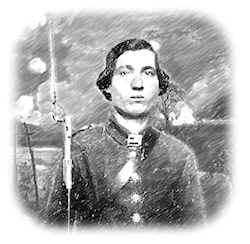
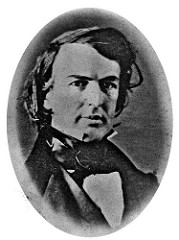
(Note: picture is of an unidentified Confederate soldier.)
May 16th.—We were aroused this morning before daylight, by reports that the Yankees were making a raid, and were very near this place. We all dressed hastily, and the gentlemen went out to devise means to stop the trains which were to pass through. Though within five miles of us, they became aware that notice had been given of their purpose, and they immediately turned their steps to some more private place, where they might rob and plunder without molestation. The miserable poltroons, when on one of their raids, will become frightened by the sudden rising of a covey of partridges, and be diverted from their course; then they will ride bravely to a house, where they know they will only find women and children; order meals to be prepared; search the house; take the valuables; feed their horses at the barns; take off the horses from the stables; shoot the pigs, sheep, and other stock, and leave them dead in the fields; rob the poultry-yards; then, after regaling themselves on the meals which have been prepared by force, with the threats of bayonets and pistols, they ride off, having pocketed the silver spoons and forks, which may have unwittingly been left in their way.
I have been in Richmond for two days past, nursing the wounded of our little hospital. Some of them are very severely injured, yet they are the most cheerful invalids I ever saw. It is remarked in all the hospitals that the cheerfulness of the wounded in proportion to their suffering is much greater than that of the sick. Under my care, yesterday, was one poor fellow, with a ball embedded in his neck; another with an amputated leg; one with a hole in his breast, through which a bullet had passed; another with a shattered arm; and others with slighter wounds; yet all showed indomitable spirit; evinced a readiness to be amused or interested in every thing around them; asked that the morning papers might be read to them, and gloried in their late victory; and expressed an anxiety to get well, that they may have another “chance at them fellows” The Yankees are said to have landed at West Point, and are thence sending out raiding parties over the country. Colonel Davis, who led the party here on the third, has been severely wounded by a scouting party, sent out by General Wise towards Tunstall’s Station. It is said he has lost his leg. So may it be!
Saturday, 16th–The weather has been quite warm for several days. Troops are arriving every day and some of them are going to the front. It is reported that our men are shelling the rebels at Vicksburg and are getting no reply. We received a dispatch from General Grant this afternoon, saying that his head-quarters is in the State House at Jackson, Mississippi. The troops are in fine spirits.
16th. Played at chess in the morning with Chester and Case. Co. returned from scouting. About noon rations came. Issued to the boys. Rushed them through rapidly. Had a shave and spent the evening in quarters. Read the Cincinnati Commercial. Wrote to Lucy Randall and Fred Allen.
May 16th. Commences with light southerly breezes; at seven A. M. saw a wreck floating down, and sent the gunboat Sachem to see what it was; at nine A. M. inspected crew at quarters. The supposed wreck proved to be a snag; at 10 A.M., Commodore Palmer, and his clerk Nathaniel P. S. Thomas, also the Paymaster, Mr. Wm. F. Meredith, left the ship to go on board of the steamer Sachem. Sachem got under way, and steamed up Red river. Between the hours of eight and twelve (midnight), firing was heard down the river, inland, in the direction of Port Hudson.
From the diary of Osborn H. Oldroyd
MAY 16TH.–We rolled out of bed this morning early, and had our breakfast of slapjacks made of flour, salt and water, which lie on a man’s stomach like cakes of lead–for we are out of all rations but flour and salt, though we hope soon for some variety. We heard heavy firing about eleven o’clock. Our division reached Champion Hill about two P. M., and filed into a field on the right of the road. We were drawn up in a line facing the woods through which ran the road we had just left. It was by this road the rebels came out of Vicksburg to whip us. We had orders to lie down. The command was obeyed with alacrity, for bullets were already whizzing over our heads. I never hugged Dixie’s soil as close as I have to-day. We crowded together as tight as we could, fairly plowing our faces into the ground. Occasionally a ball would pick its man in spite of precaution, and he would have to slip to the rear. Soon we got orders to rise up, and in an instant every man was on his feet. If the former order was well obeyed, the latter was equally so. The enemy charged out of the woods in front of us in a solid line, and as they were climbing the fence between us, which separated the open field from the timber, DeGolier’s battery, stationed in our front, opened on them with grape and canister, and completely annihilated men and fence, and forced the enemy to fall back. Such terrible execution by a battery I never saw. It seemed as if every shell burst just as it reached the fence, and rails and rebs flew into the air together. They, finding our center too strong, renewed their charge on our left, and succeeded in driving it a short distance, but their success was only for a moment, for our boys rallied, and with reinforcements drove them in turn. We now charged into the woods and drove them a little ways, and as we charged over the spot so lately occupied by the foe, we saw the destruction caused by our battery, the ground being covered thickly with rebel grey. When we reached the woods we were exposed to a galling fire, and were at one time nearly surrounded, but we fought there hard until our ammunition was exhausted, when we fixed bayonets and prepared to hold our ground. A fresh supply of ammunition soon came up, when we felt all was well with us again. Meanwhile the right of our line succeeded in getting around to their left, when the enemy retreated towards Vicksburg, lest they should be cut off.
Crocker, Hovey and Logan’s Divisions driving theenemy at the point of the bayonet through Champion Hills
The battle to-day was commenced early in the morning by McClernand’s great fighting corps, and was a hot and severe [continue reading…]
MAY 16th.—It appears, after the consultation of the generals and the President yesterday, it was resolved not to send Pickett’s division to Mississippi, and this morning early the long column march through the city northward. Gen. Lee is now stronger than he was before the battle. Gen. Pickett himself, with his long, black ringlets, accompanied his division, his troops looking like fighting veterans, as they are. And two fine regiments of cavalry, the 2d and 59th North Carolina Regiments, passed through the city this morning likewise.
A letter was received from Gen. Beauregard to-day, again protesting against the movement of so many of his troops to Mississippi; 5000 on the 5th, and more than 5000 on the 10th instant. He makes an exhibit of the forces remaining in South Carolina and Georgia—about 4000 infantry, 5000 cavalry, and 6000 artillery, some 15,000 in all. He says the enemy is still on the coast, in the rivers, and on the islands, and may easily cut his communications with Savannah; and they have sufficient numbers to take Charleston, in all probability, without passing the forts. He says information of his weakness is sure to be communicated to the enemy—and I think so too, judging from the number of passports “allowed” by Judge Campbell and Mr. Benjamin!
There is some purpose on the part of Gen. Lee to have a raid in the enemy’s country, surpassing all other raids. If he can organize two columns of cavalry, 5000 each, to move in parallel lines, they may penetrate to the Hudson River; and then the North will discover that it has more to lose by such expeditions than the South. Philadelphia, even, may be taken.
To-day, the regular train on the Fredericksburg road came back to the city, the conductor being in a terrible fright, and reporting that the enemy were again at Ashland. But it turned out that the troops there were our men! It is not probable the enemy’s cavalry will soon approach Richmond again.
May 16, 1863, The Charleston Mercury
IMPORTANT FROM MISSISSIPPI.
Rumors were rife in the city last night that the expected advance of GRANT’S forces into Mississippi had taken place, and that the city of Jackson had been occupied by the enemy. From what we can learn, we fear that this report is correct; although we have no intelligence that any serious battle has been fought.
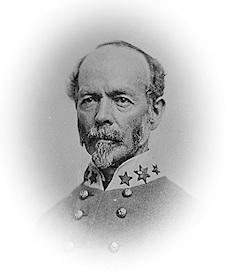
Gen. JOSEPH E. JOHNSTON should have reached Jackson, Mississippi on last Wednesday night with his staff. Jackson is the headquarters of Gen. PEMBERTON. Within the next week a great battle will probably be fought. With JOHNSTON and a fine large army, we may look for news.
NEWS FROM RICHMOND AND THE NORTH.
RICHMOND, May 15. Two finishing shops of the Tredegar Iron Works, and CRENSHAW’S woolen factory, were destroyed by fire this morning. The loss is heavy.
Northern dates of the 12th have been received. A meeting of sympathizers with VALLANDIGHAM took place in New York on the 11th. JAMES BROOKS, of the Express, denounced the arrest as an act of tyranny unequalled in the history of the world. He said that New York and New Jersey were the only States in which freedom still existed. [continue reading…]
May 16, 1863, (Marshall) Texas Republican
The Raleigh State Journal alluding to the high prices of newspaper, and the difficulty of procuring it at almost any price says:
What remedy is there for this state of things? We see but two: either an enormous increase in the price of subscription, or a suspension of the press. With paper at fifty cents per pound a weekly sheet cannot be issued for less than five dollars. This calculation excludes any profit. To preserve the profits of ordinary times, the price would be at least seven dollars. The dailies at that rate must to go to fifteen dollars. To pay, outside of the large cities, a daily must go to twenty dollars.
May 16, 1863, Peoria Morning Mail (Illinois)
A Pennsylvania girl, who has been serving as a soldier in the Army of the West for ten months, says that she has discovered a great many females among the soldiers, one of whom is now a Lieutenant. She has assisted in burying three female soldiers at different times, whose sex was unknown to any one but herself.
May 16, 1863, Natchez Daily Courier
The Macon Telegraph of the 2d, contains the following:
A factory at Seven Islands, in Butts county, had loaded a wagon with seven bales of manufactured goods, and dispatched it by their customary driver, a trusty old negro, to Forsyth, for transportation upon the Macon and Western Railroad.The wagon arrived at Forsyth in due time with only three bales, and the driver’s story, (which there is no reason to doubt, as he identified many of the parties, and is also confirmed by circumstantial evidence,) is as follows:When the wagon had progressed bout seven miles on its journey, it was stopped by a line of twenty-eight women, drawn up across the road–the most of them armed with knifes and pistols, and in the thicket close to the scene of action sat a man upon a stump, also armed with a double-barrelled gun.The women called upon the negro to halt upon peril of his life, and then immediately commenced discharging the load of the wagon–cutting open the bales, as soon as they had taken as many pieces of cloth as they could carry away, made off, leaving Jim to proceed on his journey with the three bales left.
May 16, 1863, The Charleston Mercury
The attention of the country is at this moment fixed upon the important campaign of GRANT against Vicksburg and Jackson, Miss. From our Western exchanges we glean some intelligence from that quarter that will be read with interest. The Jackson correspondent of the Mobile Advertiser, writing on May 7th, says:
Gen. Pemberton is represented to express the fullest confidence in his ability to check Grant and capture the detachments which have been sent inland in order to turn the town of Vicksburg. The only thing which gives him any uneasiness is the raids threatened on the railroads diverging into the State of Mississippi from Corinth and Grand Junction.
Jackson may be visited at any time by a raid of cavalry from the neighborhood of Edwards’ Depot, a few miles this side of Big Black River; but the Bluebellies hardly contemplate the permanent occupation of the place. Every precautionary measure has been taken to secure Government property and private effects, and breast works and rifle pits are being constructed wherever needed. The people are determined to resist to the last, and with the military force now here there is no doubt but that we can successfully hold our own. The President has taken measures to provide arms and equipments for all the men the Governor may raise throughout the State, and everything goes to show that the determination of the Mississippians to defend their soil is cheerful, enthusiastic and universal. Three hundred citizens of Brandon are drilling every day – the same is the case, relatively to their population, at Canton, Meridian and other towns; but it would be imprudent to state how many in Jackson have shouldered their muskets. Suffice it that hardly any one is backward at the call of Governor Pettus. [continue reading…]
May 16, 1863, The Charleston Mercury
PARTICULARS OF HIS DEATH – HOW HE RECEIVED HIS WOUNDS – HIS LAST HOURS – THE FUNERAL CORTEGE IN RICHMOND – HIS BURIAL PLACE.
We copy from Richmond papers of Tuesday morning some interesting details of the last hours and obsequies of the illustrious Stonewall JACKSON:
General Jackson, having gone some distance in front of the line of skirmishers, on Saturday evening, was returning about 8 o’clock, attended by his staff and part of his couriers; the cavalcade was, in the darkness of the night, mistaken for a body of the enemy’s cavalry, and fired upon by a regiment of his own corps. He was struck by three balls – one through left arm two inches below shoulder joint, shattering the bone and severing the chief artery; another ball passed through the same arm, between elbow and wrist, making an exit through palm of the hand; a third ball entered palm of right hand about its middle, passing through broke two of the bones. He was wounded on the plank road, about fifty yards in advance of the enemy. He fell from his horse and was caught by Captain Wormley, to whom he remarked: ‘All my wounds are by my own men.’ He had given orders to fire at anything coming up the road before he left the lines. The enemy’s skirmishers appeared ahead of him and he turned to ride back. Just then some one cried out! ‘Fire!’ and immediately the regiment fired. The whole party broke forward to ride through our line to escape the fire. Captain Boswell was killed, and carried through the line by his horse, and fell amid our own men. Col. Crutchfield, Chief of Staff, was wounded by his side. Two couriers were killed. Major Pendleton, Lieutenants Morrison and Smith, Aids, escaped uninjured.
General Jackson was immediately placed on a litter and started for the rear. The firing attracted the attention of the enemy, and was resumed by both lines. One of the litter [continue reading…]
May 16, 1863, The Charleston Mercury
It is possible, says the Augusta Chronicle, that one may sometimes entertain an angel unawares, though he is far more apt to get hold of the Cloven Foot in the disguise of a gentlemen; but we believe there is not the slightest doubt as to the identity of the uniformed gentry who perambulated our streets on Tuesday. They were no angels, unless […..] angels,’ and as to disguise, neither by garb or speech, was their true character concealed. There were circumstances, too, connected with their presence in this city, which made them known to us as the murderers and plunderers of Southern citizens. Yet with all these convincing proofs before us, one could hardly determine whether they were friends or foes, judging from the treatment they received.
The […..] of the city’ is one of the highest courtesies that can be extended to distinguished strangers, and this many of our blue-coated guests seemed to enjoy, roaming abut the streets at pleasure, mingling freely with our citizens and servants, arguing trite political questions with some, and indulging in insolent swagger in the presence of others. Some residents bought gold and green-backs of them, a few intrusted them with letters to their friends at the North; others furnished them with cigars and refreshments, and a Confederate officer of some rank dismounted from his horse and shook a Yankee by the hand, with remark that he was […..] to see him!’ Did the pressure of that grip leave no stain of blood upon his fingers – the fresh blood of murdered kinsfolk? And women presented the unfortunate prisoners – guests, we mean – with flowers. Did any of our Confederate soldiers who acted as guards to these men receive such floral testimonials of good will and female favor? Not one. No wonder the captives manifested such exuberance of spirits throughout the day, and bore their term of durance so lightly, or that they left the city at evening with the manner of an excursion party returning from a picnic. A rare jaunt they have had through the ‘land of cotton.’ Pleasant reminiscences will they have of their tour to the South, expenses paid – pleasant recollections of Augusta. Soon again in camp they will tell the jolly story of what rare times they had in Dixie, and long for [continue reading…]
May 16, 1863, The New York Herald
General Hooker was yesterday in Washington on official business. Immediately after his unexpected retreat he was visited at his headquarters by the President and General Halleck in order to ascertain at once the exact state of affairs. More recently, Senators Wade and Chandler, the radical chiefs of the Congressional War Committee, went down to the Rappahannock, and it may be in consequence of their call that General Hooker was yesterday at the White House. It is intimated that he has lost caste with the General-in-Chief, and, if the Tribune may be considered as speaking for the radical leaders of its party, Senators Wade and Chandler are of the opinion that Hooker has been tried and found wanting. But President Lincoln is an amiable and generous man – remarkably so, – and, whatever he may believe, in regard to the late retreat, we have no doubt that he has called General Hooker to Washington to consult with him, and instruct him in regard to his preparations, plans and strategy for another trial.
Thus, concluding that Gen. Hooker is to be retained at the head of his splendid army, it is to be hoped that he will do his very best, when next he moves, to retrieve his late misfortune and to recover his lost laurels. He is more fortunate than Pope or Burnside, who were set aside, each after his first failure. We trust he will be more fortunate than Gen. McClellan, if successful as he was in his Maryland campaign, and that “Fighting Joe” will not be removed while in pursuit of the enemy. With the superior army, means and facilities which he possessed, and after all that he promised and all that was reasonably expected of him, it can hardly be denied that his late nine days’ campaign is the most [continue reading…]
May 16, 1863, The New York Herald
Our most important news today is from the Southwest. Gen. Grant despatches to Washington that there is no truth in the reports of his either having beaten the rebels under Gen. Bowen on the 6th inst., or of his having been defeated by them on the 4th inst. He states, however, that Port Hudson is positively evacuated by the enemy, except a small garrison and expresses his entire satisfaction at the state of affairs in his vicinity. Reinforcements are hastening to join him from Young’s Point to Memphis. Probably his next effort will be to cut the railroad between Jackson and Vicksburg, and he may meet the enemy in a general battle in the neighborhood of the Big Black bridge.
Rumors, apparently without any confirmation, reached Murfreesboro yesterday that a heavy land and naval engagement had just occurred at Vicksburg, but the result was not known.
Our correspondence from the same place describes very accurately the raid of Colonel Streight into Georgia, the capture of his force near Rome, and the different collisions he had with the enemy in his progress. We give a map in connection of this bold, brilliant, though not quite fortunate expedition, showing the points Colonel Streight passed through and the place of his capture.
Colonel Hazen, commanding at Readyville, Tenn., telegraphs that all is quiet in that vicinity, where lively work was expected before now. [continue reading…]
May 16, 1863, The New York Herald
The Correspondence of L.A. Hendricks.
FIFTH ARMY CORPS, IN CAMP,
NEAR FALMOUTH, Va., May 10, 1863.
THE STAY-OUT-OF-THE-FIGHT CHAPLAINS.
This is Sunday; but it looks very little like it in this far away, strange, busy camp life. An occasional chaplain, it is true, busies himself an hour in the middle of the day, in exhortation and prayer and song; but he talks and prays and sings to thin; unimpressed and skeptical audiences. And why? Chaplains talk of the good fight; but rarely one is to be seen anywhere near a real fight – a fact that deprives them wholly of influence. Out of the thirty-six regiments in this corps, most of whom have chaplains, I saw but two present at the recent fight.
A BUSY DAY, AND WHY.
Enough of chaplains. What makes the day an unusually busy one in this corps is mustering the various regiments for two months’ pay due the first of this month, special inspections, and issues of clothing and knapsacks to the men, preliminary to having everything in readiness for speedy resumption of offensive operations. But it is quiet compared with last Sunday. Then the air was filled with the roar of terrible [continue reading…]
May 16, 1863, Mobile Register And Advertiser
Jackson, May 6, 1863.
People are leaving Jackson in numbers. The trains for the interior are crowded with non-combatants, and the sidewalks blocked up with cases, barrels, old fashioned trunks and chests, which look antiquated enough to have come out of Noah’s ark. One doesn’t see the rosy, laughing faces of young girls upon the streets now.–Only here and there is a crinoline to be met with. Sunday before last the churches were radiant with an array of beauty which the world could not surpass; but now, alas, the encroaching outposts of the enemy are within our county, and our women are wisely fleeing before their polluting approach.