A Rebel War Clerk’s Diary

A Rebel War Clerk’s Diary at the Confederate States Capital, By John Beauchamp Jones
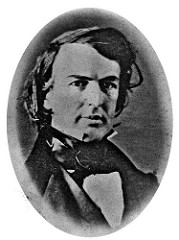
A likeness of Jones when he was editor and majority owner of the Daily Madisonian during President John Tyler’s administration.

JUNE 11th.—It appears that the enemy design to attack us. The following is Lee’s dispatch:

“CULPEPPER, June 9th, 1863.

“To GENERAL S. COOPER.

“The enemy crossed the Rappahannock this morning at five o’clock A.M., at the various fords from Beverly to Kelly’s, with a large force of cavalry, accompanied by infantry and artillery. After a severe contest till five P.M., Gen. Stuart drove them across the river.

 “R. E. LEE.”

We have not received the details of this combat, further than that it was a surprise, not creditable to our officers in command, by which a portion of ten regiments and 600 horses were taken by the enemy. We lost, killed, also a number of cavalry colonels. We, too, captured several hundred prisoners, which have arrived in the city. Of the killed and wounded, I have yet obtained no information—but it is supposed several hundred fell on both sides.

Still I do not think it probable this affair, coupled with the fact that the enemy have effected a lodgment on this side of the Rappahannock below Fredericksburg, and are still crossing, will frustrate any plan conceived by Lee to invade their country. If, however, Lincoln concentrates all his forces in the East for another attempt to capture Richmond, and should bring 300,000 men against us—we shall have near 200,000 to oppose them.

The Northern Democratic papers are filled with the proceedings of indignation meetings, denouncing the Republican Administration and advocating peace.
0 comments

0

Civil War

From the diary of Osborn H. Oldroyd

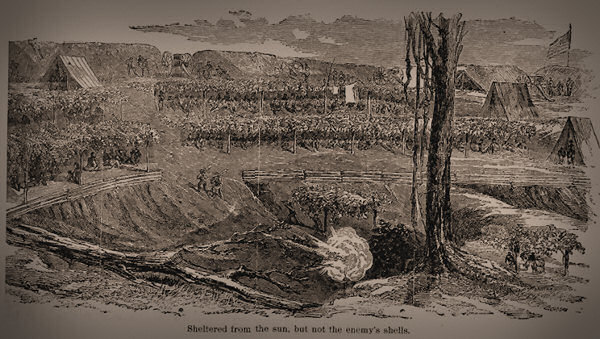
                      JUNE 11TH.–Stayed in camp to-day with the exception of about an hour. The rebs have succeeded in planting a mortar, which has sent a few big shells into our quarters. This sort of practice did not last long, for a hundred guns around our line soon roared the mortar to silence. But one shell dropped near my tent, buried itself in the earth, and exploded, scattering dirt for yards around and leaving a hole big enough to bury a horse. Another fell on top of the hill and rolled down, crashing through a tent. The occupants not being at home it failed to find a welcome.

                      These shells are visitors we do not care to see in camp, for their movements are so clumsy they are apt to break things as they go. However, they are rather rare, while the bullets are so frequent that we have almost ceased to notice them. Their flights remind us of the dropping of leaves and twigs from the trees around us. The balls of lead as they fall are found bent and flattened in every conceivable shape. A friend from the 96th Ohio, on a visit to me, as he walked over, met a rebel bullet which took a piece out of his arm.

0 comments

0

News of the Day
1860s newsprint

June 11, 1863, Clarke County Journal (Alabama)

                      A correspondent of the Savannah News, writing from near Jackson, says:

                      I saw yesterday and the day before, two hundred and seventy-two Yankee prisoners, who were captured in and around Jackson.  It makes them very mad to call them Yankees.  They call themselves “Western men,” and say if them d–––d blue bellied rascals in Virginia would only fight as they have fought, they could have whipped us long before this.  They all seem confident of success in this State, and are very impertinent in their boasting.  They say they intend to overrun and possess Mississippi, and that they have three hundred thousand troops in that State to do it with–that they never saw or heard of such a place as Vicksburg, but that they intend to have it before long, as they had plenty of grape and canister shot.  They seem to think that fighting on gunboats is nonsense, and are opposed to fighting on them.  They were astonished to see us so well clothed, and said we look like gentlemen and not soldiers.  I never saw a set of men dressed so badly as they were.  I saw a dozen or more of them who had no shoes on, and I should judge from their appearance that their army is in a much worse condition than ours.

0 comments

0

News of the Day

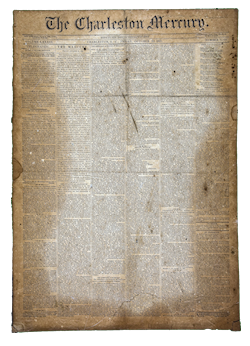
June 11, 1863, The Charleston Mercury

The Crescent City must present a dreary and doleful appearance. The Picayune says that a general desire is evinced on the part of the members for the commercial community to withdraw from the city for a time. The great streets, Plydras, Tchoupitoulas, and New Levee, where the great Western trade is done, are deserted, not a dozen old merchants to be met with in those localities. Nothing but rows of vacant stores and tenantless warehouses are to be seen. Magazine and east of it is as a wilderness of brick and mortar, and Common and Gravier present nothing but closed doors and empty counting rooms. Already the city is deserted, and the few stragglers that are here and there seen wandering where commerce and trade once flourished, remind the passer by of the lingerers in a city cursed with plague or pestilence.

The great Levee, where, in other days, we could stand and view the ships from all parts of the earth, and be jostled from early morn till dewy eve by the crowds of business men, has nothing now to remind the observer of the former greatness and commercial importance of New Orleans. Even the supplies of the staff of life are limited, and prices far above Northern quotations. Flour, $13 to $14 per barrel at the family groceries, and larger dealers have no demand further than a few dray loads at a purchase. Corn $2 per bushel, and hay 3 1/2 cents per pound. Salted meats, says the Picayune, have not touched famine prices, but fresh meats have ruled for months at starvation rates – 40 cents for beef per pound, which, in ordinary times, would be thrown into the Mississippi River as unsaleable, and mutton and pork command the same high rates. Seventy-four bales cleared, 654 sacks in the seed, was all the cotton (and it stolen no doubt) which for one week had arrived. We suppose since the taking of the Teche country, there has been a greater supply of beef and other things sent to New Orleans than they before had. Some sugar and cotton no doubt. It is a bad thing to think that our city, the city which the people of the South prized, boasted of, delighted to visit, presents such a melancholy appearance, and is still in the hands of the detested Yankees. We hope to see the day before long when familiar faces will be plenty again in the Queen city, and the importance of her trade and position increased as the chief city of the Southern Confederacy.

0 comments

0

News of the Day

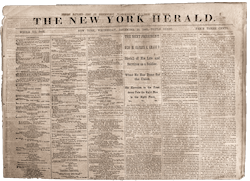
June 11, 1863, The New York Herald

We give to our readers this morning such details as have come to hand of the late severely contested and sanguinary cavalry fight on the Rappahannock. As the force on the Union side engaged was probably not less than ten thousand men, and as the struggle – hand to hand – continued from an early hour in the morning until noon, and as the losses on our side are represented to be heavy, and on the part of the enemy fearful, this contest, compared with any of our previous wars, would be a battle of the first magnitude. In this gigantic war, however, it dwindles down in importance to a chance collision between a reconnoitering detachment from each of the two great armies confronting each other some twenty-five miles lower down the river.

But the main result of this engagement – the repulse and retreat of Stuart’s cavalry force – is claimed to be a matter of very considerable moment. It was discovered that Stuart was organizing on the Upper Rappahannock an immense cavalry expedition, with the evident design of a dashing and destructive raid into Maryland and Pennsylvania, and that, unless speedily checked, the expedition would be off and probably beyond pursuit. Accordingly General Hooker detailed the detachments of cavalry, artillery and infantry indicated in our despatches to defeat this scheme of Stuart, by meeting him and cutting him up while yet within striking distance. In this view it is claimed a very important object has been achieved, being no less, for the time being at least, than the defeat of the contemplated destructive rebel foray into Maryland and the rear of Washington, and perhaps into some of the richest counties of Pennsylvania. [continue reading…]

0 comments

0

News of the Day

June 11, 1863, The Charleston Mercury

In our last we mentioned that Hooker, on Friday morning, was transporting his pontoons down to the Rappahannock, at Deep Run, two miles below Fredericksburg, and making a demonstration, as if about to cross at that point. About four o’clock, p.m., under a tremendous fire of artillery, directed towards our supposed position at Hamilton’s Crossing, he threw over a column of five thousand men. Our pickets at Deep Run exchanged a few shots with the enemy and retired, except a company of forty, said to belong to a Florida regiment, who not obeying, with sufficient promptness, the order to fall back, were taken prisoners. Subsequent events have induced the belief that Hooker had labored under the delusion that we had removed our forces from the vicinity of Hamilton’s Crossing.

At early light the next morning (Saturday) the Yankees, with banners waving, advanced to take possession of Hamilton Crossing. When they had approached within a mile and a half of the railroad, two or three of our brigades started from the bushes, and with shouts and yells made a dash at them. The Yankees, without firing a gun, wheeled about and fled incontinently back to their entrenchments at Deep Run, making such remarkably good time, that our troops did not get within musket shot of them. We captured one fellow, who, it seems, was unable or unwilling to keep up with his countrymen in their flight. This man states that a deserter from our camp on last Wednesday night had informed Hooker that we had withdrawn all our forces from the neighborhood of Fredericksburg. There may be something in this story, but we think it much more probable that Hooker relies upon his balloons for his information rather than on the tales of deserters. [continue reading…]

0 comments

0

News of the Day

June 11, 1863, The New York Herald

We give today very full details of the brilliant and successful cavalry fight on the Rappahannock, near Beverly Ford, on Tuesday morning – the results of which we before published – and which put a sudden check upon the enemy intention to invade Maryland and Pennsylvania with a powerful force of Stuart’s famous cavalry. General Buford, of General Pleasanton’s corps, commanded our troops, together with General Gregg and Colonel B.F. Davis. They crossed the ford ten thousand strong at daylight, and cleared the woods of the enemy after a desperate hand to hand contest. The fight lasted till twelve o’clock, noon, when our artillery opened on the rebels and drove them back six miles towards Culpepper Court House. Our loss is stated to be considerable, including Colonel Davis, of the Eighth New York cavalry, who is reported killed. That of the enemy is said to be fearful. It was undoubtedly a desperate and bloody combat; but it succeeded in thwarting the plans of General Lee to get into the rear of the army of the Rappahannock, and lay waste the fertile counties of Maryland and Pennsylvania. General Stuart and Colonel Fitzhugh Lee commanded the enemy. We give a pretty full list of our killed and wounded in another column.

The position of affairs at Fredericksburg remains unchanged. The enemy opened their batteries on Tuesday upon our camps for a few minutes with shell, but did no material damage. Some mysterious movements on the part of both armies are evidently going on, and important developments may be expected at any moment. [continue reading…]

0 comments

0

News of the Day

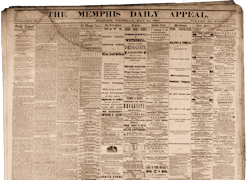
June 11, 1863, Menphis Daily Appeal (Atlanta, Ga)

The arrest of Miss Hozier at Norfolk, with a plan of the fortifications there, and a full statement of the Federal forces and their position, has been published.  The young lady lives a few miles this side of Suffolk, and had been to Norfolk on a visit.  The Norfolk correspondent of the Philadelphia Inquirer gives some interesting particulars of the arrest:

                      As she was embarking upon the noon train from here for her home, she was accosted by several members of the provost guard, who informed her that her presence was immediately needed at the headquarters.  She replied that she had been there, and was furnished with a pass to proceed home.  This was so; but it was merely a ruse by which to entrap other guilty parties.  She refused to accompany the guard or leave the car, maintaining that the right to go home had been guaranteed her.  The excitement was beginning to run high, when one of the guards reminded her that if she did not comply peaceably she would be taken at all hazards, even if force had to be used.  This seemingly cooled the high spirit of the lady, and she yielded, though with apparent reluctance.  She was disarmed of her parasol, a most important trophy, which was the silent and positive witness of traitorous persons’ doings.  It, with its fair owner, was delivered to the proper authorities.

                      She underwent a strict examination, and the parasol a strict dissection.  Ingeniously concealed in the handle was a long compressed roll of thin paper, upon which was an extremely minute description of our forces, with the exact number at each point, the best modes of entrance and exit, by which certain captures could be made.  Localities were marked down, fortifications traced and enumerated.  The number of Monitors and gunboats in the localities were spoken of and it was asserted that the Union forces at Suffolk would shortly abandon that place and fall back within a short distance of Norfolk.  The movement of troops in the vicinity of West Point was given in considerable detail.  A drawing of the country accompanied the letter.  The roads, streams, etc., were marked with great precision.  Everything was mentioned with great accuracy and very minutely.  The information would have been of untold value to the rebels, and it seems extremely strange how so much could be obtained so correctly by the abettors of our enemies.

0 comments

0

News of the Day

June 11, 1863, The New York Herald

The Cavalry Fight on the Rappahannock.

WASHINGTON, June 10, 1863.

The cavalry engagement in the vicinity of Beverly Ford, on the Rappahannock (a brief sketch of which we published yesterday), was a desperate hand to hand encounter, both during the advance and retreat of our forces. The enemy’s cavalry was driven back upon their reserve of infantry and artillery, strongly posted. No official advices have yet been received, but the following statement from wounded participants in the fight now here is probably the most correct and detailed at present accessible: –

From an officer who participated in the fight it is ascertained that yesterday morning two brigades of General Pleasanton’s cavalry, under the command of General Buford, made an important reconnoissance towards Culpepper, and had one of the most obstinate cavalry fights that has occurred during the war.

The force was composed of General Buford’s brigade and another cavalry brigade, under the command of Colonel B. Davis, supported by two batteries of artillery and two regiments of infantry as a reserve.

At half-past twelve o’clock on Monday night the cavalry bivouacked near Beverly Ford, on the Rappahannock. At three o’clock in the morning the men were called, the horses fed and saddled, and at four o’clock they crossed the ford.

Beyond the ford was a semi-circular belt of woods, with a range of rifle pits near the edge of the timber, and a line of pickets guarded the ford and the southern bank of the river. [continue reading…]

0 comments

Robert M. McGill

Robert M. Magill – Personal Reminiscences of a Confederate Soldier Boy, 39th Georgia Regiment of Infantry

Thursday, 11th.—Rained tremendous hard rain late yesterday evening; had to sleep in ditches where water and mud was half-leg deep. Every flash of lightning, the Yanks would shoot at any one who chanced to have his head above the works.


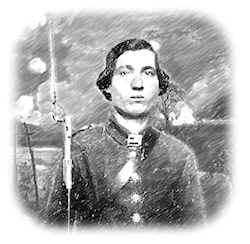
(Note: picture is of an unidentified Confederate soldier.)

0 comments

War Diary of Luman Harris Tenney.

War Diary of Luman Harris Tenney.

Wed., 10th. Up at three A. M. and on to the river. Forded and found rations for men and horses. Remained till noon. Talk of recrossing. Fresh troops on hand. Finally went back to camp. Took a nap and got rested–pretty tired.

0 comments

Downing’s Civil War Diary.–Alexander G. Downing.

Diary of Alexander G. Downing; Company E, Eleventh Iowa Infantry

Wednesday, 10th–The cool morning was followed by a rain all day ending at dark in a heavy windstorm. Companies E and D of the Eleventh Iowa worked all last night in cutting a road through the canebrakes to the rebels’ breastworks. Skirmishing has been going on all day.

0 comments

0

Cruise of the U.S. Flag-Ship Hartford -Wm. C. Holton

June 10th. Commenced with pleasant but warm weather. Thin clothing is the order of the day. At a little before daylight, the mortar vessels of lower fleet, engaging the rebel batteries; at nine A. M., inspected crew at quarters; at about this hour, great guns were fired in and in the rear of Port Hudson. During the watch from eight P. M. to midnight, the mortars inland, of the army, shelling the rebel works.

0 comments

A Rebel War Clerk’s Diary

A Rebel War Clerk’s Diary at the Confederate States Capital, By John Beauchamp Jones
A likeness of Jones when he was editor and majority owner of the Daily Madisonian during President John Tyler’s administration.

JUNE 10th.—We have news of a fight on the Rappahannock yesterday, above Fredericksburg, the enemy having crossed again. They were driven back.

There are also reports from Vicksburg, which still holds out. Accounts say that Grant has lost 40,000 men so far. Where Johnston is, we have no knowledge; but in one of his recent letters he intimated that the fall of Vicksburg was a matter of time.

0 comments

0

A Soldier’s Story of the Siege of Vicksburg

From the diary of Osborn H. Oldroyd

JUNE 10TH.–The heat of the sun increases, and we must improve our quarters. Accordingly a part of the day has been spent in cutting cane and building bunks with it on the side of the hill. Such improvements protect us better from the sun.

2007-00715.jpg

Last night I sat on the top of a hill awhile, watching the mortar shells flying into the city from the river. High into the air they leaped, and, like falling stars, dropped, exploding among the houses and shaking even the very hills. The lighted fuse of each shell could be seen as it went up and came down, and occasionally I have seen as many as three of them in the air at once. The fuse is so gauged as to explode the shell within a few feet of the ground. The destruction being thus wrought in the city must be very great. We learn from prisoners that the inhabitants are now living in caves dug out of the sides of the hills. Alas! for the women, children and aged in the city, for they must suffer, indeed, and, should the siege continue several months, many deaths from sickness as well as from our shells, must occur. I am sure Grant has given Pemberton a chance to remove from Vicksburg all who could not be expected to take part in the fearful struggle.

We have been looking for rain to cool the air and lay the dust, and this afternoon we were gratified by a heavy shower.

0 comments

Through Some Eventful Years

Through Some Eventful Years by Susan Bradford Eppes
Susa Bradford Eppes

June 10th, 1863.—Dr. English came today and with him Captain John Yates Beall, the soldier he had written about. Captain Beall is young and very good-looking. He has the front room up stairs, where he can be cool and we have our orders to make no noise. He must not talk and he has to take nourishment every three hours. Father dressed his wound and left him to sleep a while. I hope I do not forget and make a noise.

Sister Mag, with her family, and Sister Mart have gone to Bath, where Brother Amos has a furnished house, left to him in his father’s will. It is large and pleasantly located, built expressly for the summer-time and cool and airy. Brother Amos has never recovered from his wound and the doctors, who have examined him, say he will never be fit for service again, but he says he is going back, just as soon as he feels well again. That is the spirit which animates all our soldiers.

Mother keeps surprisingly well. We are so glad of it for it is impossible to leave home in search of health in these busy days.


Susan Bradford is 17 years old when this entry was made.

0 comments

0

News of the Day

June 10, 1863, Menphis Daily Appeal (Atlanta, Ga)

A gentleman belonging to the service, now absent from his command on account of wounds received in a late battle, twenty-five years of age, fair personal attractions and moderate income, wishes to make the acquaintance of a young lady with a view to matrimony.  The young lady must be of medium height, handsome, intelligent and educated.  Wealth, although not objectionable, will not be considered essential.  Address Frank R. Summerfield, Marietta, Ga.

0 comments

0

News of the Day
1860s newsprint

June 10, 1863, Montgomery Weekly Advertiser

                      The fiends, under Cornyn, developed, as usual, the absence of all manly instincts in their depredations on women.  For instance:

                      They robbed a poor old lady of a little coffee and sugar, that she had preserved with sedulous care.

                      They threatened to burn down the dwelling house of a lady, who proposed to purchase immunity from the outrage, by giving them $1000.  The leader of the squad agreed to her proposition, but, after receiving the money, said, he would burn the smokehouse and other outbuildings.  “What!” said the lady; “after receiving my money?”  The fellow replied:  “That was only to save the dwelling house,” and intimated that more money would be required to redeem the smoke house, &c.  The lady, indignant at the fellow’s bad faith, in spirit though not in word, told him:  “You may as well burn my house and all, as to deprive me of my means of living” and refused to surrender any more black mail.  He then levelled a pistol at her, but she was resolute and unflinching, and the fellow abashed by her courage, desisted.

                      The Vandals seized a carriage, occupied by a young lady, and ordered her to get out.  She flatly refused, saying, it was her carriage, and she would not give it up.–They persisted in their order, telling her, if she did not get out, they would take her off with the carriage.  She told them:  “Very well, wherever that carriage went she would go.”  Accordingly, they drove off “the booty and beauty” together to the Colonel, Cornyn, who contrary to his antecedents, harkened to her persistent claim of property and released the carriage.–Huntsville Confederate.

0 comments

0

News of the Day

June 10, 1863, The New York Herald

A despatch from Murfreesboro’ dated yesterday, says that a lady who had just arrived from Shelbyville reports the surrender of Vicksburg with its entire garrison of 12,000 men. Later arrivals at the same place repeat the rumor, and it was stated that some rebel papers (names nor locations not mentioned) had published the particulars of the capitulation. In the absence of more reliable intelligence we are safe in regarding the position of Vicksburg to be still as reported from other sources. General Rosecrans’ despatches to the War Department, also yesterday, relates the arrest and execution of two rebel officers who entered his lines as spies, but says nothing of the story about the capture of Vicksburg.

Our special correspondence from Walnut Hills, in the rear of Vicksburg, and other points in that vicinity, gives a fine description of the opening of the bombardment on the city and the desperate attack on the enemy’s works which preceded it. Admiral Porter sends an official despatch to the Navy Department recounting the particulars of the destruction of the Navy Yard and other rebel property on the Yazoo river.

The map which we give today of the fortifications around Vicksburg, and the positions of the Union army now investing it, will prove of great value to our readers.

The rebel army on the south side of the Rappahannock preserve a state of continual activity, and our own is not less active, although the precise objects of either are not known, nor, so far, quite intelligible. Our troops hold their positions below [continue reading…]

0 comments

0

News of the Day
1860s newsprint

June 10, 1863, Southern Banner (Athens, Georgia)

Rev. H. B. Pratt Chaplain of the Sixty-third North Carolina, writes to the N. C. Presbyterian:

                      Allow me to make another suggestion.–Down in these swamp lands of Eastern North Carolina, we find an innumerable multitude of what are called “cypress knees.”  They come up like little tumuli from the swampy, miry earth, and are of rather a pithy nature.  If some enterprising workman would cut these up by a circular saw, into blocks of a convenient size, and by an easily contrived knife, give them a proper shape, he could make a small fortune, as well as confer a benefit on the public, by supplying the country with “Confederate corks.”  Black gum root, well dried, is better still, and both cuts and takes shape better than cork itself.  A drop of warm cement, (1 part wax or tallow and 2 of rosin,) on the top of these corks would make them equal to the best made in Sparta or Portugal, and infinitely superior to the miserable article we commonly see.

0 comments

0

News of the Day
1860s newsprint

June 10, 1863, Montgomery Weekly Advertiser

                      We have before us a letter written by a lady of this State to her husband, who is now in prison for the grave offense of taking up arms against his own State.  This noble woman writes in the kindest spirit, giving the health of the family and connexion, and says she hopes her letter may find him well.

                      She writes:  “I have received your letter this minute and am glad to hear that you are well, but I am sorry of the way you have done.

                      “All of my brothers are in the southern army.  Ma says you ought to be ashamed of the way you have acted–you have been fighting against your wife and children, and Pa and Ma and sisters, and your country.  I want to know whether you intend to join the Southern army or not.  If you want to live with me and the children any more you must join the Southern army, for I never intend to go to the North.  _____ is very smart, she is now carding–she says she don’t want the Yankees to get her.  The babe is growing very fast and can walk.  I must say my home is in the South, and in the South I intend to stay.  Write soon.

I remain your wife till death,
__________”

                      [Atlanta Confederacy.]

0 comments

0

News of the Day
1860s newsprint

June 10, 1863, Montgomery Weekly Advertiser

                      We have been requested by a correspondent to correct an error which occurred in our account of the young lady who piloted Gen. Forrest to a ford on Black Creek in his pursuit of the Yankee marauders.  It was Miss Emma, instead of Miss Jane Sansom, though, they are sisters, both equally devoted to the cause of Southern independence, and imbued with the same heroic spirit that nerved the women of the Revolution of ’76.

                      WE are also informed that at Huntsville, Gadsden, Rome and Atlanta, some money is being raised to procure and present Miss Emma with an appropriate present, to commemorate the important service she rendered.  Any person in this place or vicinity who may be willing to contribute something for this purpose, can leave it at this office.

                      We suggest that at least a portion of this present consist of a gold medal, representing on one side, a lady riding behind a cavalry officer, pointing forward to the ford, and in the foreground, some villainous looking Yankee thieves, peeping and shooting at them from behind trees.  On the opposite side, Forrest with his devoted band, triumphantly marching four times their number of Yankee prisoners into Rome.–Jacksonville Republican.

0 comments

0

News of the Day
1860s newsprint

June 10, 1863, Savannah Republican (Georgia)

                      We have just seen a gentleman from the neighborhood of Edward’s Depot, who informs us that the vandals are making a clean sweep of everything in that vicinity.  They have burnt every gin and mill, and in many instances every building on nearly all the plantations–arrested the men and taken them off, leaving no white person but the women on the premises, and when the negroes remain they are armed.  Our informant thinks that a small force would be able to repel these robbers.  Can’t our military authorities do something for that neighborhood!–Jackson Mississippian.

0 comments

0

News of the Day

June 10, 1863, The New York Herald

Our Walnut Hills Correspondence.

HEADQUARTERS, SEVENTEENTH (McPHERSON’S)

ARMY CORPS, WALNUT HILLS,

REAR OF VICKSBURG, May 22, 1863.

For several days the disposition of the troops designed for the reduction of Vicksburg has been going on with unceasing energy. The peculiar formation of the country in this vicinity makes it a matter of no small importance to thoroughly comprehend the ground before using it for military ends, because there are some hostilities hereabouts which possess striking advantages over others, yet they do not appear upon first sight. Accordingly, the day after the arrival of the army here General Grant spent most of his time in riding over the ground and studying out the positions. This being finished, on the following day the troops were moved to the positions which they were to occupy and hold, in corps, taking positions, with the Fifteenth (General Sherman) on the right, the Seventeenth (General McPherson) in the centre, and the Thirteenth (General McClernand) on the left.

General Sherman the day before had detached part of his command, with orders to march against a strong position in the enemy’s possession at Chickasaw Bluffs. The movement was made, and resulted most eminently in our favor – that is, without the [continue reading…]

0 comments

0

News of the Day
1860s newsprint

June 10, 1863, Savannah Republican (Georgia)

                      The following rules are enforced by the officers of the Unites States Government, in regard to letters offered for transmission under flag of truce by way of City Point:

                      1.  No letter must exceed one page of a letter sheet, or relate to an other than purely domestic matters.

                      2.  Every letter must be signed with the writer’s name in full.

                      3.  All letters must be sent with fie cents postage enclosed, if to go to Richmond, and ten cents if beyond.

                      4.  All letters must be enclosed to the commanding general of the department of Virginia, at Fortress Monroe.  No letter sent to any other address will be forwarded.

                      “All letters sent to Fortress Monroe without a strict compliance with these rules, except for prisoners of war, will be transmitted to the dead letter office.”

                      Equivalent rules will be applied by General Winder, to all letters sent from the South to Fortress Monroe, for parties in the U. States.

0 comments