0

News of the Day
1860s newsprint

June 12, 1863, Corinth Chanticleer (Corinth, Ms)

                      The new and handsome barracks which the soldiers have built for themselves are a great improvement on tents, and add much to the appearance of the city.  Each camp being a town corporate, surrounding the city proper.  The excellent system of policing which is enforced in our camps will insure good health among the troops.

0 comments

0

News of the Day
1860s newsprint

June 12, 1863, American Citizen (Canton, Mississippi)

General Hospital, Canton, Miss.}
May 30, 1863.                        }

Mr. Editor:

                      Since the evacuation of Jackson and severe marching of the few succeeding days, it has been my misfortune to be confined in Hospital some ten days in this place, where I found the Post Surgeon, Ward Surgeon and Master, and other attendants, very kind and polite, using every effort with their limited means to render comfortable and cheerful the unfortunate sick.  ‘Twas during this time, when quite sick, depressed in spirits and almost wearied of life, when my sad heart was cheered by one of those scenes so common among the women of our country.

                      A carriage halted before the hospital door, when all eyes were eagerly fixed upon the inmates, who called out to one of the clerks, handing a dish of jelly and other little delicacies for the more sick, while they called in person to the convalescing to come forward and receive some refreshments which they dispensed with lavish hands to some thirty or more joyful hearts.  ‘Twas both pleasing and amusing to see the grateful beneficiaries as they still clung around the carriage, as if reluctant to leave it, seeking rest on the wheels and elsewhere, while enjoying their unusual delicacy.  After the ladies had retired–not amidst shouts and applause heard and known of men, but with the silent prayer of many known and heard only in Heaven, I sent and procured the names of these kind benefactors.

                      They were Mrs. Ada Latimer and Mrs. George Handy, one of whose face I saw, which was a true index to her character.  I am told the refreshments were sent by a “pick nick party” from the country, but all of the contributors, though unknown, will be rewarded above.  While noticing such acts of kindness, I would not overlook the kindness of Mrs. Cameron, of this town, to a gentleman whose acquaintance she formed on the first day of his arrival in town, and to whom she sent daily a plate of such food as to please the most fastidious taste.  The writer is an entire stranger in Canton, but a close and grateful

                                                                                              Observer.
                      June 12, 1863
0 comments

0

News of the Day
1860s newsprint

June 12, 1863, Corinth Chanticleer (Corinth, Ms)

                      Our officers are becoming alive to the importance of distinguishing between Union men and rebels, and every man in the district is required to take the oath of allegiance or register themselves as enemies of the United States, and be treated as such.  This is a wise regulation, and if adopted long ago, might have saved much trouble and annoyance which has been occasioned by the intercourse between rebel citizens and marauding guerrillas which infest our neighborhood.

0 comments

0

News of the Day

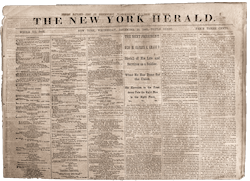
June 12, 1863, The New York Herald

Our latest advices from Vicksburg are to the 8th inst. They come from General Grant himself to official persons in Washington. Up to that date the siege was progressing satisfactorily. On the 4th inst. General Grant and General Banks were in communication, Port Hudson at that time, which is the latest date we have, being closely invested. General Grant expresses no fear either of the army in his front or rear, and regards the capture of Vicksburg as certain. The rebels are said to have made an attack on the 6th inst. at Millikin’s Bend and Young’s Point, and were repulsed.

The despatch which was sent to General Johnston by General Pemberton from Vicksburg, asking for reinforcements, was dated on the 28th of May. That despatch, it will be remembered, was intrusted to Green S. Douglas, and by him taken to General Grant. The letter stated, in effect, that if Johnston could not send thirty thousand men to the relief of the garrison at Vicksburg within ten days the game would be up, and Johnston had better retreat with what forces he had. As our dates from Vicksburg direct are to the 8th inst., the ten days had then nearly expired.

The success of General Kimball’s expedition up the Yazoo is now confirmed. He went up as far as Sataria with a force of 3,000 men, thirty miles below Yazoo City, and arrived there on the 4th inst. He learned that a rebel force under General Wirt Adams, 2,000 strong, was not far off, and he immediately marched to meet him. At ten A.M. on Thursday, the 4th inst., he came up with the pickets of the enemy, when a brisk fight ensued, lasting thirty minutes. The enemy gave way and a total rout ensued. Our loss [continue reading…]

0 comments

0

News of the Day

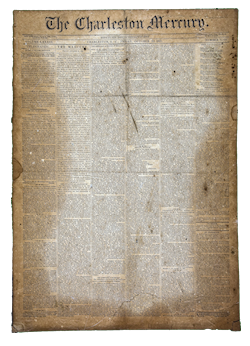
June 12, 1863, The Charleston Mercury

Day by day the track of the destroyer becomes broader. Two-thirds of Virginia, two-thirds of Tennessee, the coasts of North and South Carolina, part of Georgia, nearly all of Florida, Northern Mississippi, Western and Southern Louisiana, a great part of Arkansas and Missouri, have already been laid waste, and every hour brings tidings of fresh destruction. Telegrams of Saturday informed us that the enemy had destroyed a million of dollars worth of property on the Combahee and stolen a thousand negros; it was but a few days ago that they ravaged the county of Mathews in this State, and even while we write tidings come to us that they are burning private houses and destroying every grain of corn they can lay hands on in the county of King and Queen.

Enough has been said of the barbarism of this mode of warfare, and too much has to be confessed of the entire impunity with which it is carried on. Our outcries and our admissions of the weakness or the imbecility of our forces in the field but add to the hellish joy of the foe, without stimulating troops, Government or people to the pitch of retributive vengeance. The belt of desolation widens hourly, nor is there much prospect of an abatement of the evil. Citizens complain of the Government, which in turn complains of the citizens. Meantime common inquiry is made as to the existence and present whereabouts of the organized forces of the Confederacy.

We may be sure this state of things will continue so long as the war is waged exclusively on Confederate soil. Every day the enemy remains in our territory will add to the width of the belt of desolation, and they who now fancy themselves out of danger will soon [continue reading…]

0 comments

0

News of the Day
1860s newsprint

June 12, 1863, Corinth Chanticleer (Corinth, Ms)

                      A female, apparently very ill, was relieved by a family in Chicago, a few days since, and in accounting for her appearance in that city, stated that her name was Anna Lilleybridge of Detroit, and that her parents reside in Hamilton, C. W.  She became attached to a Lieutenant of the twenty-first Michigan regiment, and donning male attire, enlisted in the regiment.–At the battle of Pea Ridge her sex was discovered, but the only individual possessed of the knowledge was killed the next day.  She continued to serve in the regiment until one of her arms became useless from a severe wound, when she was discharged, notwithstanding her earnest entreaty to be permitted to remain in the service.–The most singular part of the story is, that the lieutenant, through love of whom she was induced to undergo so much danger, never knew of her connection with the regiment.

0 comments

0

News of the Day
1860s newsprint

June 12, 1863, Savannah Republican (Georgia)

                      Several families from St. Augustine, Fla., arrived in this city on Wednesday night, by flag of truce via Hilton Head and Pocotaligo, among them Mrs. Smith, the mother of Gen. Kirby Smith, Mrs. B. A. Putnam, wife of Judge Putnam, Mr. and Mrs. Vincent Pacetty, and others.

0 comments

0

News of the Day
1860s newsprint

June 12, 1863, Corinth Chanticleer (Corinth, Ms)

                      Last Sunday we visited the camp of the First Alabama Negro regiment, and were highly gratified with the appearance of the camp, and the soldierly looking men.  We look for big things from those hitherto unfortunate men, who have now, for the first time in their lives, an opportunity to solve the vexed question, whether they are men, or merely automatons, as many have asserted.

                      The first Alabama is officered as follows:

                      Col. Alexander–formerly Chaplain of the Western Sharp Shooters, Lieut. Col. Irvin, formerly Captain in the 7th Iowa, and Major Lowe, formerly Captain of the 9th Ill. Inft.–Surgeon Wesley Humphrey, formerly Asst. Surgeon in the 57th Ill., and Adjt. Gen. Haskins.

                      These men are all well qualified for their positions, and what is better than all, they are heart and soul in the cause.

0 comments

0

News of the Day

June 12, 1863, The Charleston Mercury

The Richmond Examiner, in alluding to the condition of our currency at the present time, says that it is believed with apparent reason to be now at the worst; that is to say, the greatest amount of it that has ever been, and will ever be, outstanding, is in the hands of the people at the present time. In the next month the Tax Bill goes into effect, and before the 1st of August, all the notes that were issued before the 1st of December last must be withdrawn from the currency, and funded in seven per cent bonds. The condition will then be altered.

From the organization of the Government up to this time, the volume of the currency has been perpetually increasing. All the expenses of the Government during this war have been paid by continual issues of notes, and all of these, with the exception of that comparatively insignificant sum called in by the first funding law, are at this moment on the country. No wonder that our currency is depreciated. The sponge of credit has been exhausted, by being squeezed always, without the slightest replenishment. The legitimate income of a Government is derived from taxation; the money it gets from that source is its own; and can be spent without the fear of consequences. But the Confederate Government has not yet seen the first cent from that source – that is to say, it has never had a cent which it might consider its own. It has been spending promises to pay.

The operation of the tax and funding laws will, it is hoped, absorb an amount of currency sufficiently great to bring the relative values of gold and notes to what they were at the time those Acts were passed by Congress. The depreciation will thus be arrested, and the plan of taxation in kind hereafter to be pursued will finally redeem the currency.

0 comments

0

News of the Day
1860s newsprint

June 12, 1863, Corinth Chanticleer (Corinth, Ms)

                      An old maid, who has her eyes a little sideways on matrimony, says:  “The curse of this war is, that it will make so many widows, that will be so fierce to get married and who know how to do it, that the modest girls will stand no chance at all.”

0 comments

0

News of the Day
1860s newsprint

June 12, 1863, Corinth Chanticleer (Corinth, Ms)

Camp 1st Ala. Loyal Inft.
Near Corinth, Miss. June 8th, 1863.

                      Mr. Editor:–You ask for information about the colored regiment, how we get along, and what we think of it.  Well, I must say that with all my researches and posting before and during the war, that I was not prepared to believe the half.  These men, sir, are determined to become the best soldiers in the world.  Mark the prediction.  They will end this war, and in less than ten years will form the bulk of our “National Guard”–the basis of our large standing army we will, for years, be compelled to keep in our sickly southern sea cost and river Forts.  Mark the prediction again.

                      Why do we think so?

                      Because, in the first place, they are physically better adapted to the arduous duties of a soldiers life and hardships.  The examining surgeons pronounced some of them to be the finest specimens of physical perfection they ever saw.  (They were stripped in “regular” style.)

                      In the 2d place they know nothing but perfect obedience, the first great requisite in a soldier.  They pay better attention than our white soldiers, and rarely ever make a mistake when a movement is properly explained beforehand.

                      3d.  They are natural imitators and learn the manual of arms with surprising facility and quickness.  There are boys here fifteen and sixteen years of age who can take up a musket and execute the different maneuvers of the Ellsworth Zouaves almost with [continue reading…]

0 comments

0

News of the Day
1860s newsprint

June 12, 1863, Corinth Chanticleer (Corinth, Ms)

                      There is nothing that tells with such striking examples the difference between the northern and southern armies,–their habits–and mode of living, than the difference in their military posts, and the vast change which they undergo after falling into federal hands.  The rebel slovenlyness and disregard of order and cleanliness, may grow out of the fact that they never expect to hold a place any great length of time.  But be this as it may, there is no one who has been in the successful army of the west who has not observed that the first thing done after taking possession of a rebel town or fortification is to detail a policing squad to cleanse the place and render it fit for the occupancy of “the men of the North.”  As an example of this we wish to site our own beautiful city of Corinth.  Those who entered Corinth with the grand Army of the Tennessee, on the 1st of June, 1862, will remember the sad and dilapidated appearance of the place–its streets covered with old barrels, and the debris of the commissary department,–piles of spoiled provisions, sending up an odor which would disgrace a respectable sewer up north, and camp grounds which gave no evidence of ever having been policed, which promising scene was not at all  improved by the smoldering ruins of the depot buildings and fire gut […..], the contents of which the retreating rebels could not take away with them.

                      This is the condition which Corinth presented when Maj. Gen. Halleck took possession of the place, but as it was now to be held and inhabited by wide-awake, enterprising soldiers of the north, it could not long remain in the loathsome condition in which they found it.  A few days of rest were allowed the army after the fatiguing advance, and the work of renovation began.  Squads of men could be seen all over the [continue reading…]

0 comments

0

News of the Day

June 12, 1863, The New York Herald

Its Defences Described by a Confederate Prisoner.

We have received the following account of the defences of Port Hudson, of the strength of its garrison and its means generally to resist the efforts now being made to reduce it from a young Kentuckian who happened to be in Arkansas at the breaking out of the rebellion, and who was compelled to join the rebel troops raised in that State. His regiment was part of the brigade of General Beal, which soon after the battle of Corinth, or Pittsburg Landing, was sent to Port Hudson, where it has ever since remained. John Harris, our informant, is a native of Kentucky, and is now on his way to his native State, he having joyfully taken the oath of allegiance to the Union government and forever abjured that of disunion and Jeff. Davis. Mr. Harris was in Arkansas when that State seceded, and such was the wild excitement of the people, instigated by the wilder ravings and unbridled denunciations of Hindman and others of his stripe, that there was no alternative for young men but to volunteer and to swell the ranks of the redoubtable Hindman. He consequently joined the Fourteenth Arkansas regiment, which at its first organization numbered twelve hundred men, but which at the time of his capture mustered only one hundred and eighty of the original command. He continued with his regiment throughout its whole career up to the moment of his regiment throughout its whole career up to the moment of his capture, and was present, in the battles of Pea Ridge, I-u-k-a and Corinth, in all of which the rebels were defeated. But Mr. Harris came out scatheless in all. He was never absent from duty, either through wounds or sickness. [continue reading…]

0 comments

0

News of the Day

June 12, 1863, The New York Herald

Sights and Scenes Along the Route – Inside View of the South, &c.

MR. W. YOUNG’S LETTER.

ARMY OF THE POTOMAC, June 9, 1863.

SCENES IN AND ABOUT URBANNA.

In Urbanna, on the south side of the Rappahannock, where Kilpatrick’s cavalry took steam transports for the opposite shore of the river, there were scenes to sadden the heart and cause deeper regrets that was carrying sorrow into every household. One citizen, Mr. Street, had twenty or thirty house and field servants to whom freedom may prove a doubtful blessing. He had thrown wide open his doors to our cavalry officers, and had extended his hospitalities to them with no limit but his means and resources. He had a granddaughter, an estimable young lady, with an infant in her arms. Her husband, a rebel soldier at home on furlough, was secreted in the forest, and she was trembling lest he should be captured. She was kind and courteous to the guests who assembled at the breakfast table.

AUNT MARY HAS GONE, TOO !

It became a military necessity to announce to the slaves that their destiny was in their own hands – to go as free people or remain as property. Most of them chose the former [continue reading…]

0 comments

0

News of the Day

June 12, 1863, The New York Herald

Ever since there have been military schools at which generals are professedly made there have been discussions as to whether generals could be made anywhere else. Against the fact that there were great generals before there were military academies the believers in the latter do not deign to argue. They invoke the name of Vegetius, hold up the diagrams of Jomini and talk of twelve orders of battle, and meanwhile the academies go on and busy themselves principally in teaching things invented by men who never went to military academies. When the war began this discussion was very lively, and is not dead yet, though as many West Pointers have proved failures as have proved successes and though the number of those taken from civil life who have proved good commanders is by no means small. We speak particularly of our own army; for in the rebel army there is no man now in the field of distinction or recognized ability who is not a West Pointer.

In the case of General Banks a man who had already shown decided ability and enemy in civil life, and who was believed to have the eye, cool head and stout heart “which some have thought do more to make a good general than all the diagrams”– there was a promise that for once in our own time this question would have a fair and favorable trial. Unfortunately, General Banks has not had exactly the opportunity we could desire. Appointed to the command in Baltimore when it seethed with faction, he exhibited the best qualities of a military governor; he took the initiative against the plotters – was prompt, fearless and firm, and for the time settled the fate of that city. Given a command in the field upon the retirement of General Patterson, he was unlucky in it; for, though it was upon the theatre where Stonewall Jackson’s reputation was in great part made, and [continue reading…]

0 comments

0

News of the Day

June 12, 1863, The Charleston Mercury

THE BATTLE OF BRANDY STATION.

RICHMOND, June 11. The battle of Tuesday occurred at Brandy Station, on the Orange and Alexandria Railroad, five miles beyond Culpeper C. H. The accounts, so far, are very conflicting; but there seems to be no doubt that the attack of the enemy was unexpected. They gained some advantage in their first onset. On the arrival of our reinforcements a desperate and sanguinary battle ensued, and the enemy was finally driven from the field. Much of the fighting was hand to hand. General STUART commanded our forces. Among the killed were Col. FRANK HAMPTON, of South Carolina, Col. SOL. WILLIAMS, of North Carolina, and Col. GREENE, of Culpeper. Brigadier General ROONEY LEE, a son of General R. E. LEE, received a sabre cut in the thigh. Captain BALL, of the ‘Black Horse Cavalry,’ was shot in the hand, and other casualties amongst our officers are reported. Among the prisoners brought down last night, there are eleven commissioned officers.

LATEST FROM VICKSBURG.

JACKSON, June 5. A rumor prevails here today that a portion of General JOHNSTON’S forces, under command of General WALKER, had engaged the enemy near the Yazoo and drove him back. There are no particulars. All is quiet here, with no news from Vicksburg or Port Hudson.

JACKSON, June 6. We can hear no more particulars in relation to the late battle towards the Yazoo. It is generally rumored and believed that General WALKER whipped the [continue reading…]

0 comments

0

News of the Day
1860s newsprint

June 12, 1863, American Citizen (Canton, Mississippi)

                      We will pay eight cents per pound for all clean white linen or cotton rags, delivered at this office.  Money will neither make nor buy paper; rags alone will do.  If our friends will bring in the rags, we can soon procure paper and enlarge the Citizen, “a consummation devoutly to be wished.”

0 comments

0

News of the Day
1860s newsprint

June 12, 1863, Corinth Chanticleer (Corinth, Ms)

                      There is many a mother who has sent her son into the army as a “little drummer boy” who little thought of the ruin she was bringing upon her child.  The army is no place for children.  It is all a strong minded man can do to withstand the temptations to vice and dissipation which ever beset the pathway of the soldier.  It is vain to say that children will not be subject to the same temptations that would demoralize a grown person.  Our own personal observation teaches the contrary.  We have seen children, between the ages of nine and twelve in the army, who were as thoroughly vicious as is possible for man to become, and who would go to lengths that many men would shrink from.  At this age it is well known that a child’s mind is still subject to be easily moulded for future events, and at some future day when a mother beholds her son wandering from the path of honor and integrity, and dissipating with cut throat associates, she may attribute the acquiring this trait in the army when a youth.  If you have no influence over your child, if he has not sufficient love and respect for you to heed your advice, our advise to you is to find him a guardian who can compel him to do so.

0 comments

0

News of the Day

June 12, 1863, The New York Herald

We have been struck by the number of medals and crosses which are to be observed on the breasts of the returned officers and soldiers of the Army of the Potomac. These have no doubt been all gallantly earned; but, as they have no national character, and are the gifts of individuals or societies, they are open to objection. In the first place, they are an injustice to the many brave men who, though equally distinguished for their deeds, have not been fortunate enough to attract the notice of the donors. In the next, they furnish to swindlers and impostors a ready means of passing themselves off as heroes. In France the red ribbon of the Legion of Honor was at one time made such extensive use of in this way that the Chambers were obliged to enact severe penalties against those assuming it without the permission of the Emperor. It is obvious that the practice that has already sprung up among us will, if not checked, lead to very great abuses and prove a source of continual mortification and annoyance to the army. Seeing that our soldiers take a pride in such rewards the government is bound to legalize them, and to take care that for the future there shall be but one fountain of honor for military and naval men. We never could appreciate the value of the arguments used against military decorations. If there was ever any force in them it has been entirely done away with by the facts to which we allude. When Congress meets it should at once give its attention to this subject. Our conscripts will make all the better soldiers if they find that good conduct in the field is to be rewarded by some conspicuous mark of distinction singling them out from their fellow men.

0 comments

0

News of the Day

June 12, 1863, The Charleston Mercury

Contrary to expectation, the Yankees on yesterday still remained on the south bank of the Rappahannock, at Deep Run. They occupied the angle formed by the creek and the river, and were throwing up a line of entrenchments of a mile in length, extending from Bernard’s house up to Deep Run. By aid of a field glass their dirt digging operations could be distinctly seen from the hills above Hamilton’s Crossing, but it was impossible to form any correct estimate of their numbers. Beside the ditchers, only about two regiments were visible, but there may have been several thousand concealed in the gorge of the creek and under the river bank. On the Stafford hills, just opposite Deep Run, might be seen about a thousand men, apparently cavalry. There had been no skirmishing or cannonading since Saturday. We see no reason to change the opinion hitherto expressed, that this demonstration of the enemy was designed solely to disconcert or retard some supposed plan of General Lee. That it has been a dead failure is already known to the Yankee General.

Where Hooker, with the main body of his forces now is, is a matter open to conjecture. He may be at Kelley’s Ford, thirty miles above Fredericksburg, at Dumfries, on the Potomac, or even so far away as Manassas Junction. We would most strongly incline to the belief that he was at one of the latter places, were he not the great ‘Fighting Joe,’ and in command of ‘the finest army on the planet,’ composed of the victorious veterans of Chancellorsville. But with such a name and such an army he cannot turn his back upon a foe he has always pretended to despise. Wherever he is, we have no fears but that we [continue reading…]

0 comments

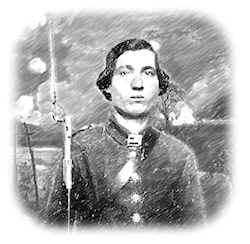
Robert M. McGill

Robert M. Magill – Personal Reminiscences of a Confederate Soldier Boy, 39th Georgia Regiment of Infantry

Friday, 12th.—Very heavy cannonading all round the line all day.


(Note: picture is of an unidentified Confederate soldier.)

0 comments

0

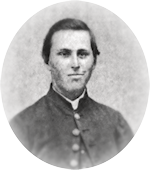
Civil War Diary of Charles H. Lynch, 18th Conn. Vol’s.
Charles Lynch

June 11th. Orders received to prepare for three days’ scouting up the valley. A sharp lookout must be kept for the enemy through the valley and the mountain passes. Tonight we have three days’ rations all prepared for an early start on the morrow.

0 comments

War Diary of Luman Harris Tenney.

War Diary of Luman Harris Tenney.

Thursday, 11th. In the morning issued beef and rations for 5 days. Pontoons gone to the river. Dr. Smith returned and reported John Devlin found in the morning, wounded in bowels and died at 3 P. M. yesterday. Chapman also died. Uncertain in regard to Case. Badly wounded, brave fellow. He told me to tell the Capt. that he fell at the head of his company. Rebs came in with flag of truce to care for wounded. Made fair bargain not to parole our men, if would let theirs alone. Evidently considered themselves whipped and we still near. Afterwards claimed a victory. Took a good nap. Saw C. G. in evening. Letter from home. A. B. much better.

0 comments

Downing’s Civil War Diary.–Alexander G. Downing.

Diary of Alexander G. Downing; Company E, Eleventh Iowa Infantry

Thursday,11th–The Thirty-fifth Iowa received marching orders. A report is that General Burnside with eight thousand troops went on an expedition up the Yazoo river today. Cannonading has been heard on all sides all day. News came that General Banks has Port Hudson surrounded and is now besieging the place.

0 comments

0

Cruise of the U.S. Flag-Ship Hartford -Wm. C. Holton

June 11th. Commenced with pleasant weather, wind from the S. W.; at three thirty A. NI., a squall of wind came up, we having only one anchor down, the starboard one, thought proper to let the good old ship ride the gale out with two, so let go the port anchor; we had no sooner let it go, than we had to heave it up again, as the blow, or tornado, it seemed, coming on, was all over with. Mortar boats engaged bombarding Port Hudson batteries. Squally and rainy weather; at six P. M. raining very hard–clearing off between seven and eight o’clock–accompanied by fresh breezes from S. S. E. Firing at Port Hudson continued the whole of these twenty-four hours.


0 comments