0

News of the Day

June 24, 1863, Tri-Weekly Telegraph (Houston, Texas)

For the Mississippian.

            Among the registered enemies of the United States government, who have been recently sent across the lines, from New Orleans, there is now, in this city, a lady whose adventures place her in the ranks of the Mollie Pitchers of the present revolution.

            At the breaking out of the war, Mrs. Laura J. Williams, (the lady of whom we allude,) was a resident of Arkansas.  Like most of the women of the South, her whole soul was enlisted for the struggle for independence.  Her husband was a Northern man by birth and education, and a strong Union man.–After Arkansas seceded from the Union, he went to Connecticut, he said, to see his relations and settle upon some business.  Mrs. Williams suspected his purpose, and finally she received information that he had joined the Yankee army.  Possessing little of the characteristic weakness of the sex, either in body or mind, Mrs. W. vowed to offer her life upon the altar of her country.  Disguising herself in a Confederate uniform, and adopting the name of “Henry Benford,” she proceeded to Texas, where she raised and equipped an independent company, and went to Virginia with it as first Lieutenant.  She was in the battle of Leesburg and several skirmishes; but, finally her sex having been discovered by the surgeon of the regiment–the 5th Texas Volunteers, to which the company had been attached–she returned to her home in Arkansas.  After remaining there a short time she proceeded to Corinth, and was in the battle of Shiloh, where she displayed great coolness and courage.  She saw her father on the field, but, of course, he did not recognize her, and she did not [continue reading…]
0 comments

0

News of the Day
1860s newsprint

June 24, 1863, Galveston Weekly News

Galveston, June 18, 1863.

            Yesterday morning the wagon of Mr. Butler, market gardener, was surrounded by a number of soldiers at the market place, and about thirty watermelons taken from it.  This is a hard case, as Mr. Butler has been moderate in prices compared with others, who are too exacting.

            Water is beginning to get scarce.  We have lately had but little rain.  There are but few cisterns, most of which are out of repair, and families are already experiencing much inconvenience from so limited a supply.

            A large amount of jewelry was taken from Mr. Shaw’s store, on Tremont street, during Friday night.  The burglars at first were baffled in their attempts to effect an entrance, but finally succeeded by means of a false key.  The articles which have been received were found by some children at play, concealed beneath a house in Mr. Lidstone’s lumber yard.

            Some soldiers have committed depredations on the property of farmers upon the Island, stealing their watermelons, &c.–The latter threaten to destroy their crops, rather than be robbed, if this practice is allowed to continue.                                 B.

0 comments

0

News of the Day

June 24, 1863, The New York Herald

Our Port Royal Correspondence.

PORT ROYAL, S.C., June 19, 1863.

In my last I had only time to announce the capture of the celebrated Anglo-rebel ram Fingal; and even now I have to regret that it is utterly impossible to give such details of this brilliant affair as are characteristic of the HERALD’S correspondents, in consequence of the mail closing in a few moments, which goes North by the gunboat Jas. Adger. I will, however, give as detailed an account as circumstances will admit.

Several days since Admiral DuPont received intelligence from deserters that the Fingal was about to make an attempt to run the blockade, and in the event of being successful would sail immediately for the Charleston squadron, and, in conjunction with the rebel rams at Charleston, would destroy or disperse the fleet there, after which the entire rebel force would make a demonstration against this point. Immediately upon the receipt of this intelligence, Admiral DuPont, with his customary celerity of movement and quick conception of the enemy intention, despatched the Monitors Weehawken and Nahant to the Wilmington waters, with orders to station a picket boat in the above river. The picket boat was secreted and continued to keep a most vigilant watch of the enemy’s movements. Upon the morning of the 17th inst., when about daylight, the Fingal was descried steaming down the river. The alarm was immediately given, and all hands beat [continue reading…]

0 comments

0

News of the Day

June 24, 1863, Dallas Herald

            The New Orleans exiles, driven from the city by Banks, have been arriving at Mobile by hundreds.  They were received with a lively and hospitable welcome by the citizens of Mobile, although some of the “black sheep” which grace that goodly city desired to make a “good thing of it” by charging two hundred and fifty dollars for a carriage to convey the passengers from Pascagoula.  The citizens broke into the arrangement by furnishing private vehicles.

0 comments

0

News of the Day
1860s newsprint

June 24, 1863, Galveston Weekly News

Columbus, Texas, June 14, 1863.

            Ed News.–Dear sir:  I am requested to send to you for publication, the following extract from a letter received by a soldier in the hospital at this place, from his wife.  The soldier is a resident of Johnson county–belongs to Col. Baylor’s Regiment, and having left his home and family to fight for his country, it is natural to suppose he would expect that country to extend to his family all the protection it was able to render.

            The following is the substance of what she writes:  “The Indians are very bad here–worse than they have ever been before.  I think ere long they will take and kill the last horse in the settlement.  They have been here constantly for the last six weeks, leaving yesterday, and taking off ten head of our horses and a number of the neighbors.  They have killed and taken from us every horse we have, except one.  The neighbors who have horses left are taking them across the Brazos river for safety.

            “Nathan Holt was barbarously murdered and scalped by the Indians, while driving a cow and calf home in day time.  Tom Hill, your brother soldier, was shot and scalped by the barbarians.  I am afraid to live in this county any longer.  I will go to father’s if possible.  Many are leaving.                   Your wife,

Lucy Dennis.”

0 comments

0

News of the Day

June 24, 1863, The New York Herald

HEADQUARTERS OF THE ARMY OF THE POTOMAC.

June 23, 1863.

General Pleasanton had the greatest cavalry fight that has yet taken place.

Early on Sunday morning General Pleasanton advanced on the enemy at a point beyond Middleburg, being supported by General Barnes’ division of infantry.

A fight ensued, which was kept up all day, General Stuart being driven back steadily, with heavy loss, clear into Ashby Gap, beyond Upperville, a distance of twelve miles.

General Pleasanton captured two guns (one a Blakeley) and three caissons, and blew up another caisson. He also captured upwards of a hundred prisoners, including one lieutenant colonel, one major and five other officers.

The enemy left their dead and wounded on the field, and in the town of Upperville a large number of wounded rebels were found.

General Pleasanton describes it as a most disastrous day to the rebel cavalry.

Our cavalry behaved with the greatest intrepidity, and as usual did terrible execution with the sabre. [continue reading…]

0 comments

0

News of the Day

June 24, 1863, The Charleston Mercury

LATEST NEWS FROM THE WEST.

JACKSON, MISS., June 23. – Col. WIRT ADAMS’ cavalry attacked 400 of the enemy’s cavalry at Bear Creek, near Mechanicsburg, yesterday, routing them, capturing their artillery, and killing or wounding 100 of their number. Our loss was 25 killed and wounded. Amongst the latter was Capt. W. YERGER, who distinguished himself in the action.

While the Yankees were at Panola on Friday, CHALMERS attacked the 2d Illinois Cavalry four miles south of Hernando, at daylight, killing, wounding or capturing all of them except one company. Gen. GEORGE, with the State troops, and McCULLOCH, are four miles in the rear of the Yankees, who are now marching northward.

JACKSON, June 23. – A bearer of despatches, who left Vicksburg on Wednesday, reports that the enemy on that day made a desperate assault on our centre. The engagement lasted our hours, and the courier escaped through the enemy’s lines during the melee of the battle. He knows that the Yankees were repulsed with heavy loss. At the time he left there had been no loss on our side. The assault was more vigorous than any of those which had preceded it. The rout of the enemy was complete. We have no further official details in regard to Saturday’s fight.

OSYKA, June 23. – Heavy firing was heard this morning near Clinton, La. It is supposed to be a conflict between LYONS and a portion of BANKS’ army.

Our forces have fallen back from Milliken’s Bend, being unable to take all the enemy’s stockades. The enemy are burning all the small water craft in the neighborhood of Natchez. Persons from Memphis say that many are taking the oath for want of means to come away.

0 comments

0

News of the Day

June 24, 1863, Dallas Herald

An Act to establish the Flag of the Confederate States.

            “The Congress of the Confederate States of America do enact, That the flag of the Confederate States shall be as follows:  The field to be white, the length double the width of the flag, with the union (now used as a battle flag) to be a square of two-thirds the width of the flag, having the ground red, with a broad saltier of blue, bordered with white, (a blue cross white edged–Ed. Tel.) and emblazoned with white mullets of five pointed stars, corresponding in number to that of the Confederate States.”

            Approved May 1st, 1863.

            The above act describes the new flag so that with a little attention our readers can form a just idea of it.  We remark merely that a “saltier” in Heraldic language imports the same as the cross of St. Andrew or a diagonal cross–and that “mullets” are five pointed stars.

            We are gratified that the flag of the Provisional Congress has been changed, and that the permanent banner of the Confederacy is so entirely different from the old flag.  The stars and stripes and stars and bars too nearly resembled each other to symbolize the characteristics of the two Governments; and besides were easily mistaken for each other on the field.  This fact induced Gens. Johnson and Beauregard, [continue reading…]

0 comments

Robert M. McGill

Robert M. Magill – Personal Reminiscences of a Confederate Soldier Boy, 39th Georgia Regiment of Infantry

Wednesday, 24th.—Went back to camp to-day, though still very unwell.


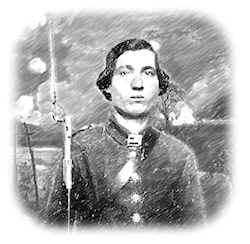
(Note: picture is of an unidentified Confederate soldier.)

0 comments

War Diary of Luman Harris Tenney.

War Diary of Luman Harris Tenney.

23rd. All astir again early. Soon after breakfast teams pulled out. Thede and I went ahead. Got a drink of milk at West’s. Case not so well. Crossed the river and reached camp at 3 P. M. Found good letters from home and Fannie. Have had nice cool weather for marching all the time. Felt like having ague.

0 comments

Downing’s Civil War Diary.–Alexander G. Downing.

Diary of Alexander G. Downing; Company E, Eleventh Iowa Infantry

Tuesday, 23d–Fighting is still going on. A force of thirty thousand under command of General Sherman was sent to rout Johnston. The Eleventh Iowa, with the exception of Company E, went on an expedition[1] in the direction of the Big Black river. Company E was left here for picket duty.


[1] To join Sherman’s forces.—Ed.

0 comments

0

Cruise of the U.S. Flag-Ship Hartford -Wm. C. Holton

June 23d. The forenoon of this day pleasant, but afternoon and evening squally and rainy. Firing at intervals heard at Port Hudson during the whole day.

0 comments

A Rebel War Clerk’s Diary

A Rebel War Clerk’s Diary at the Confederate States Capital, By John Beauchamp Jones
A likeness of Jones when he was editor and majority owner of the Daily Madisonian during President John Tyler’s administration.

JUNE 23d.—From the army on the Potomac we have a dispatch from Lee, saying there have been several cavalry engagements during the last week, wherein our arms were successful. Lee will soon electrify us with another movement of his grand army,—such is the general belief.

From the West we learn that on Saturday last, Grant, no doubt driven to desperation by our occupation of Milliken’s Bend cutting off his supplies and reinforcements, made a more furious attempt than ever to take Vicksburg by assault, and was repulsed disastrously. His loss is estimated at between 7000 and 10,000 men. Pemberton is now greatly praised by many people, while some of our officers shake their heads and say he is fighting with the halter around his neck, and that if he were not to fight and hold out to the last, his own men would hang him.

Notwithstanding the immense amount of goods brought in daily, the prices keep high.

0 comments

0

A Soldier’s Story of the Siege of Vicksburg

From the diary of Osborn H. Oldroyd

            JUNE 23d.–We halted this morning at six o’clock, and but a few minutes elapsed before two-thirds of the regiment were fast asleep. A few very hungry ones, only, made coffee and took breakfast.

            We find ourselves again on the road to Jackson, but what our final destination is, no one knows except the stars in front. We surmise our course to be through Johnston’s army, if we can find it.

            The “blarsted” bugle blasted us out on the road again at seven. I believe I, for one, would rather have spent my hour in eating than sleeping. However, we trudged our eight miles at an easy pace and halted again. The birds were singing merrily, with no sounds of war to interfere. It is rumored that we are out hunting the paymaster instead of Johnston.

0 comments

0

News of the Day

June 23, 1863, The New York Herald

The Chambersburg Telegrams.

CHAMBERSBURG, Pa., June 22, 1863.

I undertook to reach Greencastle today, but could not do so as the rebels are still there.

This afternoon a detachment of the First New York cavalry had a skirmish with the rebels two miles this side of Greencastle. We lost two men. After being chased from Smoketown the rebels prepared to make a stand at the point above stated. They had an infantry force thrown out as skirmishers through the wheat fields.

There is news this morning from Waynesboro that the rebels were there yesterday, but went towards Leitersburg; the greater portion of the rebel force is six miles from Waynesboro, in the direction of Coventown or Frederick.

The rebels have been to Quincy, Tomstown and Mt. Hope.

It is said here that night before last General Ewell had his headquarters at Hagerstown. He had between seven and eight thousand men. [continue reading…]

0 comments

0

News of the Day

June 23, 1863, The New York Herald

Our Port Royal Correspondence.

PORT ROYAL, S.C., June 17, 1863.

The great rebel bugbear, which had for so many months previous to the advent of the Monitor fleet into our waters thrown the military and naval communities into a state of alarm and anxiety, is at last in our possession. The rebel, or rather Anglo-rebel ram, Fingal is captured. I am unable to give you details, as we have just received a despatch from Fort Pulaski announcing simply the facts, and the people must wait until the next steamer to hear particulars.

As near as I am able to learn she was taken in Warsaw Sound, while attempting to run out. It no doubt was the intention of the officer in command of the Fingal to attack the negro troops at St. Simons, or the Forty-seventh New York, on Ossabaw Island. Had she succeeded in eluding the vigilance of our naval officers she might have done an immense amount of damage to the department, especially at the many points where we have but comparatively few troops.

Later intelligence from the South is to the effect that the Fingal fired only four shots and surrendered. The […..] were disloyal to the rebel navy, which accounts for so little fighting.

A day or two since a blockade runner was run ashore just north of Lighthouse Inlet, on [continue reading…]

0 comments

0

News of the Day

June 23, 1863, The New York Herald

Our Hilton Head Correspondence.

HILTON HEAD, S.C., June 17, 1863.

The transport steamer Saxon, Captain Lavender, goes North today for repairs, rendered necessary by damages received some months since while crossing the bar at Stono, against the remonstrances of the captain. She will carry a mail.

During the brief time Gen. Gillmore has been in command here there has been a most noticeable improvement in the spirit of the troops. A quotation, with […..] in it, suggests itself, but is too hackneyed for use. General Hunter was much respected by the soldiers; but they had become addicted to coupling his name with […..],” and had no confidence in his ability to give them any fighting, much less any victories. As soon as General Gillmore arrived and took command a feeling of enthusiasm spread through the department; for he is ranked as a fighting man. He has been constantly busy visiting the troops and acquainting himself with all details in regard to them and every position we hold. There have been some movements of troops which it is improper to mention, but the results of which will be known in good time.

General Gillmore has announced the following as his staff: –

Col. John W. Turner, A. D. C and Chief of Staff.
Major Ed. W. Smith, A. A. General and Com. Of Musters.
First Lieut. Israel R. Sealy, A. A. A. General.
Lieut. Col. R. S. Jackson, Assistant Inspector General.
Lieut. Col. J. J. Elwell, Chief Quartermaster,
Lieut. Co. M. R. Morgan, Chief Com. Of Subsistence. [continue reading…]

0 comments

0

News of the Day
1860s newsprint

June 23, 1863, Weekly Columbus Enquirer (Georgia)

            The Milwaukee correspondent of the Chicago Tribune (Republican) says:

            Another disgraceful scene occurred in our city this afternoon, similar to that of a few days since.  An enrolling officer, while engaged in his duties in one of the wards, was attacked by a large number of women armed with clubs, stones and other missiles, who very seriously injured him.  He succeeded in escaping from the infuriated vixens by taking refuge in a grocery near by, and the mob dispersed without committing further outrages.

0 comments

0

News of the Day

June 23, 1863, The Charleston Mercury

THE NEWS FROM THE WEST.

JACKSON, MISS. June 20. – A soldier who escaped from Louisville, Ky., on the 5th instant, reports that Majors J. H. THOMPSON and F. M. COWAN had been taken from the jail at that place and hung, under BURNSIDE’S order forbidding recruiting in that State for the Confederate service.

Citizens just in report that a heavy engagement has been going on between JACKSON’S cavalry and the enemy, near the Big Black Bridge. At the time they left the musketry and cannonading were awful. Terrific firing was also heard in the direction of Vicksburg.

OSYKA, June 21. – A trustworthy informant just from the vicinity of Port Hudson, reports that BANKS had received eleven transports, bringing him reinforcements from Hilton Head, but he had mustered out of service as many as he received. His army at present consists of from 12,000 to 15,000 men, whose terms of enlistment have expired and who refuse to fight.

A courier from Colonel LYONS reports heavy firing at Port Hudson every night. General GARDNER’S men are firm.

(The statement that BANKS’ reinforcements were drawn from Hilton Head, is merely conjectural and probably erroneous. There is very good reason for believing that there has been no material diminution in the Yankee forces in this department. – Mercury.)

OSYKA, June 20. – Occasional firing was heard at Port Hudson during last night. [continue reading…]

0 comments

0

News of the Day

June 23, 1863, The New York Herald

HEADQUARTERS OF THE ARMY OF THE POTOMAC,

June 22, 1863.

Heavy cannonading commenced early yesterday morning in the direction of Aldie, and continued, with intermissions, during the day.

Towards night the sound became more distant and indistinct.

It is known that General Pleasanton attacked the enemy near Aldie, and it is hoped that he has succeeded in routing General Stuart’s command.

It will probably be late before reports are received, as the battle field is twenty-five miles distant, with no telegraphic communication.

The Fight and the Victory.

OFFICIAL DESPATCH OF GENERAL PLEASANTON.

HEADQUARTERS, CAVALRY CORPS,
CAMP NEAR UPPERVILLE, June 21 – 5:30 P.M.

Brigadier General S. WILLIAMS: –

GENERAL – I moved with my command this morning to Middleburg, and attacked the cavalry force of the rebels under Stuart, and steadily drove him all day, inflicting heavy loss at every step.

We took two pieces of artillery one being a Blakely gun, together with three caissons, besides blowing one up. We also captured upwards of sixty prisoners, and more are [continue reading…]

0 comments

0

News of the Day
1860s newsprint

June 23, 1863, Weekly Columbus Enquirer (Georgia)

        During the recent Yankee raid into Florence they burnt the three Cotton Factories of Martin, Weakley & Co., which worked up 4,000 bales per year; the Woolen Factories of Darby, Benham & Co., and of James Martin & Son–5 factories. In Florence they burnt the Masonic Hall, one unoccupied tavern, two blacksmith, one coach and one carpenter’s shops, three unoccupied houses, one small residence, &c. They broke open every store in the place, took what they could carry off, robbed citizens of money, watches, jewelry, horses, &c., took off some negroes, desolated and burnt Mrs. James Jackson’s place, &c. They were only in Florence about three hours, and got off with but a trifling loss. Their success in this raid will stimulate to other raids into our region.

            P.S.–We also learn that the Yankees burnt several Mills and Tan Yards in the county.  Their force was only about 700 in Florence.–Huntsville Adv., 10th.

0 comments

0

News of the Day

June 23, 1863, The New York Herald

The loss of Winchester by General Milroy is a matter that demands the immediate attention of the government. It is worse than the surrender of Harper’s Ferry and Maryland Heights by Miles and Ford last September, and General Milroy ought to be placed immediately under arrest and tried by court martial.

Winchester is the key of the valley of the Shenandoah, and is a more important position than Harper’s Ferry. The blame of losing it must be equally divided between the War Department and General Milroy. The intention of Lee to move North though the valley was known to the government more than a month ago, and it was the business of the War Department to post a sufficient force at Winchester, and to place in command of it a reliable general. The force does not appear to have been equal to the emergency; but it was enough for a far better defence than General Milroy made with it. If he was taken by surprise he was unfit for such a command. If he was not surprised then he ought to have concentrated the troops of the adjoining posts, to the number of fifteen thousand, which was equal to the attacking force, to say nothing of Milroy’s possession of strong fortifications. But he did not make what deserves the name of a fight. Had he even held the enemy at bay for a day or two longer, in order to give time for Hooker’s army to come up, those two divisions of Ewell’s corps would have been captured or destroyed, and Lee’s game of invasion would not only have been frustrated, but his army so weakened by the loss that its destruction would have been comparatively an easy task, [continue reading…]

0 comments

0

News of the Day

June 23, 1863, The New York Herald

The Harrisburg Telegrams.

HARRISBURG, June 23, 1863.

There is no doubt that the enemy is fortifying Hagerstown. They hold the country between Hagerstown and Williamsport with at least a corps d, probably General Ewell.

Millerstown, eight miles from Gettysburg, has been occupied to-day by a force of rebel troopers two thousand strong. This points to a movement on the Northern Central Railroad for the purpose of isolating Baltimore. Most of the movable property that could be turned to rebel account was removed before the place was occupied. They will have to fight of the possession of the Northern Central.

The first train passed over the new railroad bridge to Scotland to-day, and railroad communication with Chambersburg is resumed.

There is great activity here. It would be unwise to say more on this subject. General Couch has assigned Captain J. S. Brisbin, United States Army, to the position of chief of cavalry in this department.

General Yates, of the New York militia, is here organizing his brigades for active operations. [continue reading…]

0 comments

0

News of the Day

June 23, 1863, The Charleston Mercury

Events have not yet declared the object of General LEE in advancing into Pennsylvania. At first we supposed that it was to carry into Pennsylvania the kind of war the Yankees have carried into the Confederate States – to lay waste this State as they have laid waste the Confederate States, and to burn down Harrisburg as they have burned up the cities of Jackson, Darien, and Bluffton. By this policy, carrying the horrors of the barbarous war they have waged against us to their own homes and firesides, we would not only produce irritation, but terror and a sense of loss and suffering, which might be no inconsiderable coadjutor to the Peace Party now arising in the United States. As long as the people of the United States can have immunity from the horrors of war they are waging against us, and can import thousands of Irishmen and Germans to fill up their armies and carry it on, they may be content that the war shall continue. It was to break up these easy conditions, by which the war is supported, that we supposed Pennsylvania was invaded; but one inference must be erroneous, for we see it stated that our troops at Chambersburg not only did not burn down the town, but they did not even take from our enemies the necessities they required. They paid for them in Confederate money. What effect can such a method of carrying on the war have upon the United States? At this time LINCOLN dares not enforce the Conscription Laws to recruit his army. What he wants above all things now is, that we, by a harmless and terrorless invasion, should irritate the people of the United States, without intimidating them. This would enable him speedily to raise a new army to carry on the war and relieve opposition to its being carried on. It appears to us the sort of war which has thus far been carried on in Pennsylvania is the very thing LINCOLN wants. It is the very worst for the Confederate States.

Still we do not intend to blame General LEE, because he may not have the control of his [continue reading…]

0 comments

0

News of the Day

June 23, 1863, The New York Herald

The news from the Army of the Potomac bespeaks movements of great importance in operation or soon to be enacted in Virginia. The cavalry fight of Sunday may be but the prelude to a grand battle. Orders have been issued by General Hooker that […..] shall be said by correspondents in the front until the grand battle comes off.” This is significant.

General Lee occupies the Shenandoah Valley in large force.

General Pleasanton’s official despatch of the late cavalry fight at Aldie is dated from Upperville, near the eastern foot of the Blue Ridge. The battle of Sunday was not only a desperate one, but resulted in a decided success to the Union arms. General Pleasanton encountered the forces of General Stuart in considerable strength in the morning and drove them before him for the entire day, until he reached Upperville, inflicting a severe loss, as the dead and wounded left upon the field testified. He took two pieces of rebel artillery, three caissons, a number of carbines and pistols, and sixty prisoners, including two field and five line officers. The charges made were terrific and the sabre was used freely. General Pleasanton reports that the fight was most disastrous to the enemy.

Our latest news touching the invasion of Pennsylvania and Maryland, from Harrisburg and Chambersburg yesterday, is to the effect that the rebels are marching in great force upon Harrisburg. They have reoccupied Greencastle, are threatening Chambersburg, from which point Gen. Knipe is prepared to fall back, if hard pressed. His troops were drawn up in line of battle yesterday, awaiting an attack. The enemy visited Millerstown, eight miles from Gettysburg, possibly with the view to a movement against the Northern Central Railroad, to cut off Baltimore. People were flying in crowds from Gettysburg, literally blocking up the roads. The enemy is fortifying Hagerstown.

The fine packet ship Isaac Webb, one of the Liverpool and New York line, was captured [continue reading…]

0 comments