Tuesday, 23d.—Pretty heavy firing on lines last night; reported 57th Georgia captured a lieutenant-colonel and six privates.
(Note: picture is of an unidentified Confederate soldier.)
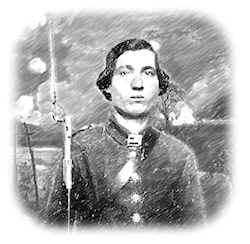
Tuesday, 23d.—Pretty heavy firing on lines last night; reported 57th Georgia captured a lieutenant-colonel and six privates.
(Note: picture is of an unidentified Confederate soldier.)
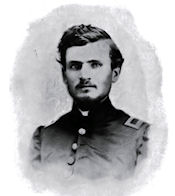
22nd. Last night was quite cold, suffered a little. Rash troubles me. Up at sunrise, breakfast of ham, potatoes and coffee. At 6 commenced falling back. No rebels near by. Seem to have gone to Knoxville. Reached Monticello at about 4 P. M., where found rations for ourselves and horses. Took care of Rowena and made our beds. Passed through a miserable country–poor country and people.
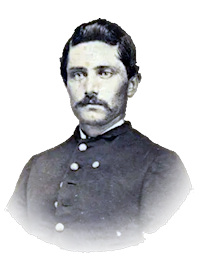
Monday, 22d–It is quite (sic) still along the lines today and there is no news of importance. Some troops were sent out in the rear today, and our regiment received orders to be ready to march at any time. It is thought that Johnston is trying to break the siege by attempting to make a move from the Big Black river, and by Pemberton’s striking our lines at the same time and place, they hope to effect a union and escape. But General Grant is leaving nothing open. He has ordered the felling of large trees across the highways to prevent the moving of their artillery.
June 22, 1863, Semi-Weekly News (San Antonio, Texas)
There have been one hundred and eighty applications filed in our County Court for relief, under the act of the last Legislature, granting assistance to soldiers’ families. The wife is allowed five dollars per month, and children two dollars; additional allowances are, however, made under peculiar circumstances; such as widowhood, orphanage, having house rent to pay, &c. They are also allowed the privilege of trading at the store of the Mutual Aid Society.

June 22d. Firing of musketry and artillery the whole forenoon of this day, in rear of Port Hudson. At nine P. M. steamer Laurel Hill arrived from Natchez.
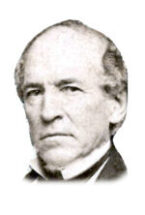
Monday June 22nd 1863
I have hardly fulfilld my purpose of noting down “important events as they occur” for many important events have occured since my last writing. No very important Battle has been fought by the “Army of the Potomac” with the exception of that while Hooker was across the Rappahannock about the first of May. Vicksburg has not yet been captured, but Genl Grant has it closely invested and I think there is no doubt of its capture in a very few days. Genl Banks is also investing Port Hudson with a like prospect of success. There has been much hard fighting at both places and near them. Genl Rosecrantz has remained quiet at Murfreesborogh Tenn. the past two months watching Genl Bragg. For the past few days it has been quite exciting times here as the Rebels are again in Maryland and Pennsylvania in force. They crossed above Harpers Ferry. They have been to Chambersburgh P.a. and now hold some points in that State and Frederick City, and other places in the Western portion of Maryland. Hookers and Lees armies have been near each other for the past week not far from the old Bull Run Battle ground. There has been much heavy skirmishing betwen the Cavalry the past few days and it is supposed that there was a sharp fight yesterday some twenty miles from here in the direction of Bull Run, as heavy guns were heard for some hours in quick succession. A general Battle is expected to occur very soon. They (or rather) we are fortifying Harrisburg P.a. and at Baltimore the Streets are Barricaded and prepared for cavalry “raids.” The sick and wounded from the Army of the Potomac were all sent up here when the Army moved from Falmouth, some seven thousand in number filling the Hospitals. But they are being sent North rapidly. Chas goes every day with his train coming back nights. He still runs to Phila. Frank has been here and stayed some weeks. He came in April and returned to Waterloo the forepart of this month, he writes that he was married to Miss Stiles on the 16th Inst. I intend to make a visit home by the first of Agust. My health is good but I am falling off in weight some as I usualy do in the summer. I am rooming at Mr Bartletts 379 11 St betn K & L Streets. I Board at Doct Munsons, my old Boarding place. I will endeavor to note down events oftener in future and the “events” are likely to take place.
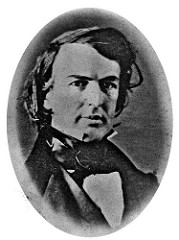
JUNE 22d.—To-day I saw the memorandum of Mr. Ould, of the conversation held with Mr. Vallandigham, for file in the archives. He says if we can only hold out this year that the peace party of the North would sweep the Lincoln dynasty out of political existence. He seems to have thought that our cause was sinking, and feared we would submit, which would, of course, be ruinous to his party! But he advises strongly against any invasion of Pennsylvania, for that would unite all parties at the North, and so strengthen Lincoln’s hands that he would be able to crush all opposition, and trample upon the constitutional rights of the people.
Mr. V. said nothing to indicate that either he or the party had any other idea than that the Union would be reconstructed under Democratic rule. The President indorsed, with his own pen, on this document, that, in regard to invasion of the North, experience proved the contrary of what Mr. V. asserted. But Mr. V. is for restoring the Union, amicably, of course, and if it cannot be so done, then possibly he is in favor of recognizing our independence. He says any reconstruction which is not voluntary on our part, would soon be followed by another separation, and a worse war than the present one.
The President received a dispatch to-day from Gen. Johnston, stating that Lt.-Gen. Kirby Smith had taken Milliken’s Bend. This is important, for it interferes with Grant’s communications.
Gov. Shorter writes that a company near Montgomery, Ala., have invented a mode of manufacturing cotton and woolen hand-cards, themselves making the steel and wire, and in a few weeks will be turning out from 800 to 1000 pairs of cards per week This will be a great convenience to the people.
Gen. Whiting writes that the river at Wilmington is so filled with the ships of private blockade—runners that the defense of the harbor is interfered with. These steamers are mostly filled with Yankee goods, for which they take them cotton, in the teeth of the law. He pronounces this business most execrable, as well as injurious to the cause. He desires the President to see his letter, and hopes he may be instructed to seize the steamers and cargoes arriving belonging to Yankees and freighted with Yankee goods.
It is a difficult matter to subsist in this city now. Beef is $1 and bacon $1.65 per pound, and just at this time there are but few vegetables. Old potatoes are gone, and the new have not yet come. A single cabbage, merely the leaves, no head, sells for a dollar, and this suffices not for a dinner for my family.
My little garden has produced nothing yet, in consequence of the protracted dry weather. But we have, at last, abundant rains. To-day I found several long pieces of rusty wire, and these I have affixed horizontally to the wood-house and to the fence, intending to lead the. lima beans up to them by strings, which I will fasten to switches stuck between the plants. My beets will soon be fit to eat, and so will the squashes. But the potatoes do not yet afford a cheering prospect. The tomatoes, however are coming on finely, and the cherries are nearly ripe. A lady has sent me 50 cabbage plants to set out, and two dozen red peppers. Every foot of my ground is occupied, and there is enough to afford me some exercise every afternoon.
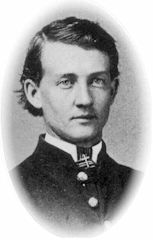
From the diary of Osborn H. Oldroyd
JUNE 22D.–Johnston is getting lively again, and beginning to kick up a dust in the rear; so we have orders to move tonight, with three days’ cooked rations. One regiment from each brigade in Logan’s division constitute our expedition, which, I think, will find him, and if we get sight of his army, somebody will be likely to get hurt.
It is now just a month since we made the charge on the enemy’s line which proved to us so disastrous, and our cannon now are too close to act on Fort Hill, so a wooden gun has been made, which, charged with a small amount of powder, throws the shell inside the fort–a new device, but working well, for it can drop its missile where the cannon cannot.
We have eaten pretty well in camp to-day, and cooked everything we had on hand, since we may not get so good an opportunity again upon the march. When hard tack was first issued there was but one way to eat it, and that was dry, just as it reached us. Practice, however, taught us to prepare a variety of dishes from it. The most palatable way to dispose of hard tack, to my taste, is to pulverize, then soak over night, and fry for breakfast as batter-cakes. Another good way is to soak whole, and then fry; and still another is to soak a little, then lay it by the fire and let grease drop on it from toasted meat, held to the fire on a pointed stick. This latter is the most common way on a march. Sometimes the tack is very hard indeed by the time it reaches us, and it requires some knack to break it. I have frequently seen boys break it over their knees. Just raise your foot up so as to bring the bent knee handy, and then fetch your hard tack down on it with your right hand, with all the force you can spare, and, if not too tough, you may break it in two. But one poor fellow I saw was completely exhausted trying to break a hard tack, and after resorting to all the devices he could think of, finally accomplished it by dropping on it a 12-pound shell. The objection to that plan was, however, that the fellow could hardly find his hard tack afterward.
At midnight we crept out of camp unobserved–everything being quiet except now and then a shot on picket line.
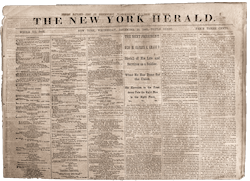
June 22, 1863, The New York Herald
For the first time is laid before the public this morning in the HERALD an accurate narrative of the battle of Winchester, concerning which there had been so many conflicting accounts, most of them of an unfavorable nature, but some giving the Union General extraordinary credit for his performances. The reliable report which we publish to-day shows that nothing which has hitherto seen the light reaches the full amount of the disaster. Accompanying a detailed description of the battle is a correct map of the locality, including the roads, the town, the fortifications and the positions of the contending forces at various stages of the battle.
It will be seen that the fortifications are situated on two hills to the northwest of the town, consisting of […..] main work” nearest to Winchester, and […..] star fort” further north, both being connected with each other by a road. The position is evidently strong, and ought to have been held, as it certainly could have been if there had been generalship and pluck at the head. The attacking force has been estimated at from 15,000 to 18,000. Milroy had 7,000 in the battle, and could have concentrated 15,000 from the adjoining posts. The Confederates advanced by two roads – the Front Royal and the Strasburg – from the south, driving in the pickets and carrying the outposts, at the same time working their way gradually around by the western side of the town, from which on the second day they assaulted the outer works of the main fortification, rushing into the ditch and up the parapet, on which they planted their flag, carrying the works at the point of the bayonet, and killing and capturing considerable numbers. The inner works were still in the possession of Milroy, also the star fort. But a council of war was held after nightfall, and when the battle had ceased, on Sunday, it was decided to take advantage of the darkness and evacuate the place during the night in silence, leaving behind all the cannon, ammunition and stores. Better far to have retreated before the battle or to have fought it out. Milroy had not gone four miles when he found himself confronted by an overwhelming force which the Confederates had sent ahead. Two regiments were captured wholesale, and the slaughter of those who cut their way through was very considerable, while the cavalry pursued and captured great numbers. The loss was terrible. Nothing was saved except what was carried upon the persons of the troops. Not a soldier had a change of clothing. The officers were compelled to leave even their wives behind them in the hands of the enemy. Three entire batteries of field pieces and one battery of siege guns – in fact the whole of the artillery of the command – were lost, together with six thousand muskets, and small arms without stint, all the ammunition and commissary stores, two hundred and eighty wagons and one thousand two hundred horses. Out of seven thousand men only from one thousand six hundred to two thousand had turned up safe, leaving upwards of five thousand to be accounted for. The report in circulation that the train of Milroy had escaped turns out to be without foundation. Our correspondent, writing on the 20th, says nothing whatever belonging to Milroy’s command was saved, and the mistake originated from the fact that the trains from Jones’ brigade, at Martinsburg, and McReynolds’ brigade, from Berryville, escaped to Harrisburg. Thus the defeat of Milroy was most thorough and disastrous, and so much was he scared that he appears never to have stopped till he got to Baltimore.
Now, his troops fought admirably, and they were well handled by the subordinate officers. What, then, is the cause of a disaster as needless and as humiliating as that of Harper’s Ferry last year? Nothing but the want of cool courage and capacity in the commanding general. Unfortunately, Milroy is one of the political generals, appointed not for his military abilities, but for his violent abolition opinions. Such men, being fanatical, have not the brains to lead armies. In the second battle of Bull run, in which Pope commanded, Milroy’s frantic conduct showed that he had no presence of mind in battle. He says himself, in his evidence before a court of inquiry: – “I told him (McDowell) that I was not fighting with General Sigel’s corps; that my brigade had got out of ammunition some time before and gone to the rear, and that I had been fighting with half a dozen different brigades, and that I had not inquired whose or to what particular corps they belonged.” It is evident he has no idea of order or subordination, or command, and is totally unfit to lead troops. The evidence of Captain Cutting and Lieutenant Roebling shows the extraordinary state of mind in which he appeared at that battle. Brigadier General Buchanan bears similar testimony. He says: – “His manner was very excited, and every one inquired who that was rushing about so wildly. I left him haranguing and gesticulating most emphatically; but afterwards found him giving orders to a portion of my brigade. His own brigade was not near there, and he seemed to be rushing about the field without any special aim or object, unless it was to assist in the performance of other officers’ duties.” Lastly, General McDowell says of him: – “When he spoke to me he was in a frensy, not accountable scarcely for what he said, and attracted the attention of every one by his unseemly conduct.” His own report, indeed, written some time after, when his mind might be supposed to be in its normal states, shows how extravagant and unmeasured he is in his language and how illogical his mind.
Now, all this evidence is in print and before the War Department; and yet, since the disastrous battle in which he played so strange a part, General Milroy has been actually promoted. He has been appointed a Major General, placed in command of a division, and entrusted with so important a post as that of Winchester, from whose capture sad consequences have already flowed and more grave disasters may still follow. And now, again, instead of having him put arrest, the War Department send him into Western Virginia in command of other troops, which he will probably suffer to be gobbled up.
It must be in the recollection of many of our readers that, in a letter to one of the meetings of the Loyal league held in this city, General Milroy proposed soon to crush freedom of speech and freedom of the press at the North, inasmuch as the rebels were now nearly conquered; and, that consummation having been achieved, the troops would be at liberty to attend to such Northern traitors as dared to criticise the acts of the administration. He has been ahead of Burnside and every other general in his crusade against the liberties of the loyal and peaceful citizens of the North; but he has made very little headway against the rebels. It is worthy of remark that the generals who are the greatest failures have distinguished themselves most in assailing the constitutional rights of the people.
June 22, 1863, Semi-Weekly News (San Antonio, Texas)
The Macon Telegraph of the 2d, contains the following: A factory at Seven Island, in Butts county, had loaded a wagon with seven bales of manufactured goods, and dispatched it by their customary driver, a trusty negro, to Forsyth, for transportation upon the Macon and Western R. R. The wagon arrived at Forsyth in due time with only three bales, and the driver’s story, (which there is no reason to doubt, as he identified many of the parties and is also confirmed by circumstantial evidence,) is as follows: When the wagon had progressed about seven miles on its journey, it was stopped by a line of 28 women drawn up across the road–the most of them armed with knives and pistols, and in the thicket close to the scene of action set a man upon a stump, also armed with a double-barrelled gun. The women called upon the negro to halt upon peril of his life, and then immediately commenced discharging the load of the wagon–cutting open the bales, and as soon as they had taken as many pieces of cloth as they could carry away, made off, leaving Jim to proceed on his journey with the three bales left.
June 22, 1863, The Charleston Mercury
The Richmond papers bring us little news in addition to that already given with reference to the decisive victory of the Confederate forces at Winchester on Sunday last. The only intelligence they contain is obtained from parties who have left the Valley since the surrender of Winchester by the Federal forces, and the reports they bring are of the most cheering character.
The accounts state that on Friday morning Gen. Ewell, much to the surprise of the enemy, reached Front Royal, Warren county, eighteen miles from Winchester, and at once pushing on to the latter place, encountered a force of the enemy when within some ten miles of the town, with which skirmishing immediately commenced, the enemy retiring and the skirmishing continuing, our forces being in pursuit.
On the morning of Saturday our army renewed the advance, the enemy contesting the ground with some stubbornness, but were compelled to continue their retreat. About noon of that day our forces reached the confines of the town, when a flag of truce was sent in demanding a surrender of the place. The officer commanding replied that he would abide the issue of battle, and if attacked would burn the town, to which General Ewell answered, if any house was burned other than those fired by the bombardment, the black flag would be hoisted, and no quarter given. The assault upon the enemy’s entrenchments was then commenced, and continued until dark. At an early hour on Sunday morning the attack was renewed and continued throughout the day, the [continue reading…]
June 22, 1863, The New York Herald
Our news today from the different scenes of action where the contending armies are employed is exceedingly full and interesting. Our correspondent at Monocacy Station states that the rebels occupied Frederick City last evening. It is certain, at least, that a force of them passed through it. They were attacked and dispersed by our troops under Major Cole, but another force reoccupied it, and were there, though in very small numbers, last night. A despatch from Chambersburg last night says that a battle may be expected there tomorrow, if the rebels do not scatter into small bodies and roam through the mountains. They have already carried off 2,000 head of cattle and as many horses out of Franklin county. They keep so much on the move in the direction of Greencastle, Hagerstown and Williamsport that their exact position or intentions are not known from hour to hour. Gen. Jenkins appears to be moving with a force of 1,100 mounted infantry in the direction of Gettysburg or the Northern Central Railroad. He is committing great depredations upon the horses of the farmers and in the mountains.
We publish today a brilliant account in full detail, from our correspondent in the field, of the late desperate two days’ battle at Winchester between General Milroy and General Ewell, which terminated in a disastrous retreat of the Union forces to Martinsburg and Harper’s Ferry, with only two thousand men out of seven thousand, and having lost all the artillery, stores, baggage and everything except what the men carried on their persons. Three entire batteries of field artillery and one battery of siege guns, about two hundred and eighty wagons, over twelve hundred horses and mules, all the commissary [continue reading…]
June 22, 1863, The Charleston Mercury
A correspondent of the Columbus Times, writing from one of our camps on the Yazoo River, June 8th, gives an interesting statement of the condition and prospects of the Mississippi Campaign. He says: ‘Important movements are going on here now, which it would be imprudent to state. It is enough to know that they are in progress. That General JOHNSTON is embarrassed with a small force is most true – smaller than the reader has been led to conclude from the information derived from the press. But small or large, he will dispose of it to the best advantage and to the best purpose. At present Mississippi is upon the brink of being run over by the Hessians. That they have received a check at Vicksburg is most gratifying, and we hope that the stubborn little city may never yield. The force of the enemy is estimated at eighty thousand men. Gen. GRANT is in command, and has under him three corps d. Maj. Gen. SHERMAN commands the right; Maj. Gen. JOHN A. McPHERSON the left. SHERMAN is an old army officer, and the superior to all the Yankee Generals in their army, in the estimation of Gen. JOHNSTON. Major General McCLERNAND is a politician from Illinois. Formerly a member of Congress – a leading supporter of DOUGLAS, and, like MAYNARD, a traitor from Tennessee, voted for by the South for Speaker in the last Congress of the old Union. McPHERSON is from Ohio – ranked first in his class at West Point, where he graduated in 1853. These are the three Yankee corps commanders under GRANT, who, it cannot be disguised, lead braver men than HOOKER, being rough Hoosiers and Suckers from the hardy West.
‘The plan of GRANT seems to be to avoid an engagement with JOHNSTON, whose small [continue reading…]
June 22, 1863, The Charleston Mercury
STATE OF SOUTH CAROLINA.
ADJUTANT AND INSPECTOR GENERAL’S OFFICE,
COLUMBIA, S.C., June 17, 1863.
GENERAL ORDERS No. 21.
II. THE FOLLOWING PERSONS ARE EXEMPTED by Act of the General Assembly of this State from [….] militia service,’ and, therefore, from draft under General Orders No. 20, viz: The Lieutenant Governor, the Judges of the Courts of Law and Equity, the Ordinaries, Clerks of the Courts of General Sessions and Common Pleas; Sheriffs, Masters, Commissioners and Registers in Equity; the Secretary of State; Surveyor General, Comptroller General and Treasurers of the State. And the following persons are exempted by said Act from service beyond the limits of their respective Districts, and will not be subject to said draft, viz: The members of both branches of the legislature and their respective officers, including the Attorney General and the Solicitors of the State, persons in the Confederate and State military service, officers and cadets of the State Military Academy, regularly officiating clergymen, regularly licensed practising physicians over the age of thirty-five years, one apothecary to each regularly established drug store of six months standing, officers and Faculty of the South Carolina College, and Professors in other incorporated Colleges and Theological Schools, while such Colleges and Schools are in operation; the Superintendent, Teachers and Steward of the Cedar [continue reading…]
June 22, 1863, The Charleston Mercury
(CORRESPONDENCE OF THE MERCURY.)
RICHMOND, Tuesday, JUne 16.
LEE’S favorite movement, en echelon – that by which he uncovered the fords of the Chickahominy and swept McCLELLAN back to Harrison’s Bar, by which he advanced upon Manassas last year, and lately upon HOOKER at Chancellorsville and the Wilderness – is now being executed on a grand scale. On the extreme left, Jenkins, with his cavalry, began the movement by threatening Milroy at Winchester, while under the dust of Stuart’s noisy cavalry review, Ewell’s infantry marched into the Valley by way of Front Royal. Longstreet, in Culpeper, silently edged his van within supporting distance of Ewell rear, keeping at the same time Picket’s division detached for the purpose of reinforcing A. P. Hill at Fredericksburg, or of strengthening the brigades defending Richmond in case the city were seriously menaced from below. The head of Ewell’s column no sooner appeared in the Valley than Jenkins pushed still further to the left in the direction of Martinsburg and Romney, and the great arc of movement was increased by the advance, still en echelon, of columns as far down as North Carolina. The whole of this great maneouvre was at once developed and completed on Sunday last, by the retirement from Stafford of Hooker’s rear guard, which left A. P. Hill free to take his place in the line of progress.
You see at once the entire system of curved, lapping lines of advance, stretching from [continue reading…]
June 22, 1863, Menphis Daily Appeal (Atlanta, Ga)
A correspondent of the New York Times, writing from Grant’s camp, states that a Federal captain who was taken prisoner during the siege, and who was kept in Vicksburg several days, reports the scenes in the city as fearful. He says:
The women and children all remain in town, although ordered at various times to leave. On the day our men left, a morning report showed the sad fact that, up to that time, 119 of these unfortunates had been killed by our shells, among whom is the wife of General Pemberton. The women of Vicksburg are either brave beyond ordinary mortals, or desperate in the extreme. Shells search every part of the town, and yet the children play as usual upon the streets, and the women seek no protection, but boldly promenade the public thoroughfares and attend to their household duties without fear. In a house close to the jail our men saw several ladies, who sat in groups on the piazza, moved leisurely about the house, and at times made the air melodious with voice and piano.
What quality is this shown by these women? Is it heroism, desperation, or what? Death is all about them–it hisses through the air; crashes through their edifices, smites down their innocent children and themselves, and yet they unconcernedly sit, sing, chat, and laugh through it all–through a combination of horrors that would almost make a coward of the bravest men that ever drew a sword.
These things seem incredible but they are true, for our prisoners unite in vouching for the fact, all phases of which they themselves heard and witnessed.
June 22, 1863, The Charleston Mercury
The negros in the Yankee service are enumerated as follows: General THOMAS’ recruits, 11,000; under General BANKS, 3000; in Kansas, 1000; in South Carolina, 3000; in North Carolina, 3000; under General ROSECRANS, 5000; under General SCHOFIELD, 2000; Massachusetts regiments, 1200; in the District of Columbia, 800; total, 30,000. There are also 5000 negros in the Yankee navy.
June 22, 1863, Tri-Weekly Telegraph (Houston, Texas)
The following letter shows what sort of stuff some of our boys are made of. Good for the little patriot. His example is worthy of imitation by children of larger growth:
Iron Stone House, Two Miles Above Sutherland }
Springs, Wilson County, Texas, }
June 9th, 1863. }
General Baylor: I am not quite thirteen years old, so I cannot join your company to “still hunt Yankees,” though I have a very good young horse, suitable for the service, which I wish to present to you, or through you to some true Southern soldier in your command. I feel very unwilling to part with my favorite, except to assist in driving the hated Yankees from our land. Can I aid a mite in doing this, I will be repaid a thousand times for a horse, that has been my pride and pleasure a long while. Please call the horse “Gus.” Send here to my father’s place for him, when he is wanted.
Augustus Weyman Houston.
Monday, 22d.—Still unwell; various reports about Johnston, but don’t think any of them are reliable.
(Note: picture is of an unidentified Confederate soldier.)
21st. Breakfasted and were off at 6. Rained a little. Crossed over to the Jamestown road. Found the roads over the mountain very rough indeed. Hills very steep and rugged. Several hills capped with high pinnacles of rocks. Rested at a house on the creek. One intelligent girl, but secesh. Reached Traversville at 4 P. M. Several houses but no occupants. Grazed our horses, camped. Scouting party went near Jamestown. Bathed in creek.
Sunday, 21st–Things are quite still all along the lines today, but the mortar boats continue to throw shells day and night. Our chaplain preached a sermon to us this afternoon; his text was from John, fourteenth chapter and second verse. It was the first sermon our regiment has heard for nearly six months.

Sunday, June 21st.
How about that oath of allegiance? is what I frequently ask myself, and always an uneasy qualm of conscience troubles me. Guilty or not guilty of perjury? According to the law of God in the abstract, and of nations, Yes; according to my conscience, Jeff Davis, and the peculiar position I was placed in, No. Which is it? Had I had any idea that such a pledge would be exacted, would I have been willing to come? Never! The thought would have horrified me. The reality was never placed before me until we reached Bonfouca. There I was terrified at the prospect; but seeing how impossible it would be to go back, I placed all my hopes in some miracle that was to intervene to prevent such a crime, and confidently believed my ill health or something else would save me, while all the rest of the party declared they would think it nothing, and take forty oaths a day, if necessary. A forced oath, all men agree, is not binding. The Yankees lay particular stress on this being voluntary, and insist that no one is solicited to take it except of their own free will. Yet look at the scene that followed, when mother showed herself unwilling! Think of being ordered to the Custom-House as a prisoner for saying she supposed she would have to! That ‘s liberty! that is free will! It is entirely optional; you have only to take it quietly or go to jail.
That is freedom enough, certainly! There was not even that choice left to me. I told the officer who took down my name that I was unwilling to take the oath, and asked if there was no escaping it. “None whatever” was his reply. “You have it to do, and there is no getting out of it.” His rude tone frightened me into half-crying; but for all that, as he said, I had it to do. If perjury it is, which will God punish: me, who was unwilling to commit the crime, or the man who forced me to it?

21st [June]
Arthur came up on the 10 & remained 10 days he had his clothes washed & mended & several little things done for him, we found him improved. Mr Grimball gave him 100 dollars to assist in paying his mess bill &c. It was a pleasant visit, we were glad to see him.
June 21st. Commences with pleasant weather. From twelve to four A. M., heavy firing going on at Port Hudson, mostly of musketry. At ten A. M., inspected crew at quarters, and performed Divine service upon the quarter-deck. Between the hours of eight P. M. and twelve midnight, heard reports of great guns in rear of Port Hudson.
June 21st.—To-day we have an account of the burning of Darien, Ga. The temptation is strong for our army to retaliate on the soil of Pennsylvania.