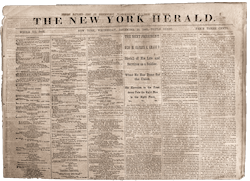
June 27, 1863, The New York Herald
Our Harrisburg Correspondence.
HARRISBURG, June 21, 1863.
CONFIRMATION OF GOV. CURTIN’S ORDER ABOUT ENLISTMENTS.
The telegram I sent you of the confirmation by the Secretary of War of Governor Curtin’s promise to the Pennsylvania troops to muster them out of service as soon as the public necessities would permit of it acts as a balm in Gilead in some of the organizations. Others again do not receive it in that loyal, trusting spirit they should. They pretend to doubt the faith of the authorities, and think there is some quibble in the pledge so solemnly made by the Governor, whereby the government will retain their services. Things have arrived at a pretty pass when troops doubt the consistency of promises made by the government. They say they have confidence in the State Executive, and that he will endeavor to do al all he promises; but they fear he will be overruled. Now, there is no grounds for this fear or doubt; Governor Curtin will carry out his plighted faith at all hazards, and will do it up to the very letter of his promise. I think that a great part of the dissatisfaction in the Pennsylvania troops is the fault of the officers commanding them. They have no desire to remain in the field, and prefer going home as a regiment to leaving singly. The disgrace attached to their withdrawal could never be removed, and the soldiers are loth to do any act by which they would merit it.
THE REFUGEES – ALEX. McCLURE.
Those who fled to this place from Chambersburg and vicinity to escape the visit of the rebs still remain in a very unenviable and uncertain state of mind. Their case is a hard one and one to excite the sympathies of those who can feel for the distress of others. Their property has either been stolen or destroyed, and even if it has escaped so far the [continue reading…]
June 27, 1863, The New York Herald
Our Baltimore Correspondence.
BALTIMORE, June 25, 1863.
The light breaks at last. The news which I have received this morning, and which I send you below, dispels the last remaining doubt in regard to General Lee’s intentions, and affords, as you will see, a clear prognosis of what that wily and astute general proposes to himself, and the route which he has marked out for the progress of his army towards Washington. Now that this development has become clear, it is impossible not to admire the adroitness with which, up to this time, the rebel general has concealed his real line of march.
On reaching Warrenton, with the head of his army about ten days ago, General Lee found that Gen. Ewell, in obedience to his instructions, had not only defeated Milroy and General Tyler, and captured Winchester and Martinsburg, with the immense quantity of military stores and all the artillery at the former place, but that he had also, with the aid of the guerillas, under Imboden, Jenkins and Jones, made an extensive reconnoitering expedition into Maryland and Pennsylvania, and has ascertained the exact position of affairs in those two States as far north as Carlisle, and as far out as Point of Rocks and Frederick City. Since that time all of General Lee’s manoeuvres have been directed to the object of making Hooker believe that he designed to move on Washington through Thoroughfare Gap, and by way of Centreville and Fairfax or Gum Spring and Drannesville. Hence the various skirmishes, even amounting to battles, or at least to engagements of considerable magnitude, at Centreville, between Aquia creek and [continue reading…]
June 27, 1863, The New York Herald
Mr. F.G. Chapman’s Letters.
MARYLAND HEIGHTS, Md., June 19, 1863.
With the promised return of the rebels to the Shenandoah valley and the line of the Upper Potomac, all outlying forces were ordered to concentrate upon certain points, with a view to making a final stand, if hard pressed, at the fortified positions of Maryland Heights, opposite Harper’s Ferry, Va. How this was accomplished by troops on the eastern side of the valley the retreat of General Milroy’s forces from Winchester will explain. Upon the western side the forces gathered at Martinsburg. On the afternoon of Saturday, the 13th inst., the One Hundred and Sixth New York Volunteers, Colonel Edward C. James commanding, broke up their camp at North Mountain, nine miles west of Martinsburg, and fell back to the latter place, having shipped all government stores at North Mountain safely to Harper’s Ferry. Colonel B. F. Smith, of the One Hundred and Twenty-sixth Ohio Volunteers, commanded the post of Martinsburg. On Sunday morning the two regiments already mentioned, with the Sixth Virginia battery, Captain Maulsby, and two companies of cavalry, comprised the entire force.
PICKETS.
About half-past ten in the morning our pickets on the Winchester road were sharply set upon by rebel cavalry, but held their posts without loss. The forces were immediately drawn up in position on the farm of Hon. C. J. Faulkner, between the Charlestown and Winchester pikes. The enemy pressed our line of skirmishers vigorously, and a sharp fire was kept up until our artillery opened, when they fell back and ceased to fire. In this attack a rebel cavalry captain was captured and a few of his men shot. [continue reading…]
June 27, 1863, The New York Herald
Mr. George H. Hart’s Letter.
HEADQUARTERS, CAVALRY, June 24, 1863.
My despatches embrace all the points of general interest or importance relating to the reconnoissance to the front by a portion of the Union cavalry; but a more detailed account may not be unacceptable.
AT NEW BALTIMORE, a pretty little village of about fifteen houses and a population in ordinary times of about one hundred, we halted and refreshed man and beast. We found at this place – and, in fact, such was the case all along the route travelled – that the male population consisted only of decrepit old men and small boys under the age of sixteen.
The female portion of the community practised no dissimulation to conceal their political sentiments, but, on the contrary, vauntingly displayed their secession proclivities, forcibly reminding me of Alexander the Great visit to the Amazons. As a general rule the people are reduced in the way of provisions to the simplest necessaries of life, possessing no luxuries, not even the luxury of a lucifer match.
THE VALUE OF A LUCIFER MATCH.
I was much surprised when, on asking for a light for my segar I was informed they had [continue reading…]
June 27, 1863, The New York Herald
Our Harrisburg Correspondence.
HARRISBURG, June 25, 1863.
I regret to say that General Couch has been compelled to issue orders restricting the privileges of correspondents. He feels aggrieved, and, though desirous of affording every means of information to the representatives of the various papers; is certain that some advantage has been taken of the liberties afforded them whereby the enemy has been benefited. The
HERALD CORRESPONDENTS are not blamed; but, while they will be afforded their usual facilities, they are debarred from visiting rooms that were heretofore open to their inspection. This is generally lamented by the various officials here and the several correspondents; but it is a matter of small moment to the HERALD force, who have unusual facilities in the securing of every important item that may transpire, from the fact that the HERALD never gives ‘aid and comfort” to the enemy by publishing any other information than what is strictly legitimate. You have very rightly suppressed news that I sent you, for which General Couch has expressed his thanks; and, while it was unimportant as to details, it was calculated to give our foes information which it is desirable they should not be made acquainted with. The various
HEADS OF DEPARTMENTS here are in excellent hands, that of the State particularly so, and Governor Curtin may be congratulated upon the able assistants he has drawn around him. His Adjutant General, A. L. Russell, is a splendid looking man, standing some six feet [continue reading…]
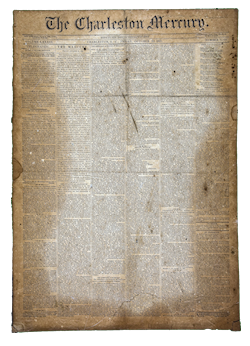
June 27, 1863, The Charleston Mercury
The following extract from a letter from an officer in a Richmond battery, gives the clearest and most correct idea of the manner of the capture of Winchester and the movements of our troops immediately preceding that event, that has yet been given to the public. To those unfamiliar with the geography of the Valley, that they should read the account with a map before them is essential to the proper understanding and appreciation of the skill with which General EWELL threw the meshes of his net around the army of MILROY. It will be seen that before the latter was aware of the approach of danger, his position was surrounded and his principal avenues of retreat held by our troops. We give the extract:
CAMP 1ST VA., ARTILLERY.
Four Miles beyond Winchester, June 15th, 1863.
* * * On the 11th instant Ewell’s corps, to which our battalion is attached, started from Culpeper Court House. We marched that day to Little Washington, in Rappahannock county, a distance of twenty-six miles, and on the next day reached Front Royal, on this (west) side of the Blue Ridge, twenty-three miles from Little Washington, having made forty-nine miles in the two days. Five days before our arrival at Front Royal, General Jenkins, who was stationed at Middletown, twelve miles south of Winchester on the Valley Pike, had carefully picketed the roads on this side of the Ridge leading from Front Royal to Winchester, and in consequence of this wise precaution [continue reading…]
June 27, 1863, The New York Herald
Carlisle Not in Possession of the Enemy.
Gettysburg Occupied by the Rebels in Force.
The Harrisburg Telegrams.
HARRISBURG, June 26, 1863.
The rebel advance in this direction still continues at a stand still in the vicinity of Carlisle. Telegraphic communication is open with the town up to the present.
General Knipe, deeming his forces not strong enough to meet the enemy, evacuated Carlisle last night.
General Knipe reports that the rebels are advancing ten thousand strong.
A skirmish is reported near Bloody run, between the column under General Milroy and the enemy.
In the skirmish at Bloody run to-day Milroy lost no men. It was a dash upon the enemy.
The citizens were aroused from their slumbers this morning by another scare that the Philistines were then approaching. Matters are becoming more quiet. [continue reading…]
June 27, 1863, The New York Herald
POSITION OF GENERAL BANKS. –
The latest news from New Orleans and Port Hudson is of grave importance. Our correspondents accompanying the army of investment, under General Banks supply full and interesting details of the most recent operations against that stronghold. From these it appears that, after a long and furious bombardment of the enemy’s works, the commanding general determined on a second assault along their whole line. The attempt was most heroically made, and doubtless would have succeeded if the Union forces had been powerful enough of the exigencies of the occasion. Unfortunately, the immense strength of the rebel works proved too much for the small force which General Banks could bring to the attack, and after a desperate and determined contest, in which our soldiers displayed the greatest heroism, the federal columns were compelled to fall back on their own intrenchments. Thus the second assault on Port Hudson, like the first has failed, because troops enough have not been sent to operate against the place.
But, though this second advance has been checked, the defenders of the beleaguered city have gained no advantage over us, but on the contrary, have suffered severely in killed and wounded. This is no time for us to falter or fall back. Let the government immediately see to it that strong reinforcements be sent to Gen. Banks from the nearest points whence they can be obtained. It is said that a heavy rebel force is concentrating in this rear to attack him and prevent his retreat upon Baton Rouge. This may be very true, as in their great extremity the rebels will lose no chance to redeem their failing fortunes. But the fate of Vicksburg is now almost decided, and before long the reduction of that city will release a large portion of Gen. Grant’s fine army, which will then be free to operate against Port Hudson. In such a case the fall of the place will be no longer doubtful. To make the matter doubly secure and certain, Gen. Banks should be immediately strengthened to such an extent that he may be able, not only to keep up the siege of Port Hudson, but to take care of the rebels in his rear.
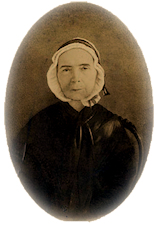
Saturday Evening.—Just heard from W. and S. H.; both terribly robbed by the raiders in the last three days. All of my brother’s horses and mules taken. Some of the servants were forced off, who staid so faithfully by them, and resisted all the Yankee entreaties twice before. They attempted to burn the wheat, which is shocked in the field, but an opportune rain made it too wet to burn. The raiders came up the river, destroying crops, carriages, etc., stealing horses and cattle, and carrying off the servants from every plantation, until they got to Hickory Hill, (Mr. W. F. Wickham’s,) where they found a prize in the person of General W. F. Lee, who was wounded at the cavalry fight of Beverley’s Ford, and was at Mr. Ws, unable to move. Notwithstanding the remonstrances of his wife and mother, they took him out of his bed, placed him in Mr. Wickham’s carriage, and drove off with him. I can’t conceive greater hardness of heart than it required to resist the entreaties of that beautiful young wife and infirm mother. F. has just received a note from the former, written in sorrow and loneliness. She fears that the wound may suffer greatly by locomotion; beyond that, she has much to dread, but she scarcely knows what.
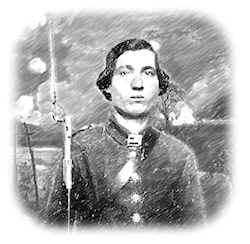
Saturday, 27th.—All pretty quiet; boys getting very low-spirited.
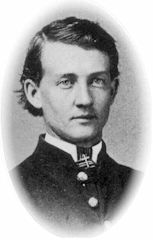
(Note: picture is of an unidentified Confederate soldier.)
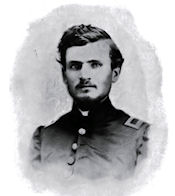
26th. Wounded boys all happy with the promise of going home on furlough. Rebs reported at the river again. Invitation to dinner at Mrs. Vickery’s. Col. and his men. Stayed in camp. Bought some cakes, pies and bread from bakery. Still continues to rain. Makes camp life seem rather dull.
Friday, 26th–I went on picket again this morning with very strict orders as to passes and keeping cartridge boxes on day and night. The rebels are becoming active and desperate in their determination to get out, for their provisions are very low. No news from the rear.
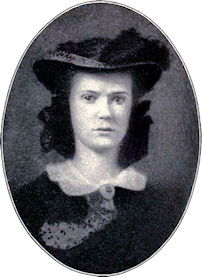
Friday, June 26th.
O praise the Lord, O my soul! Here is good news enough to make me happy for a month! Brother is so good about that! Every time he hears good news on our side, he tells it just as though it was on his side, instead of on ours; while all bad news for us he carefully avoids mentioning, unless we question him. So to-day he brought in a budget for us.
Lee has crossed the Potomac on his way to Washington with one hundred and sixty thousand men. Gibbes and George are with him. Magruder is marching on Fort Jackson, to attack it in the rear. One or two of our English ironclads are reported at the mouth of the river, and Farragut has gone down to capture them. O Jimmy! Jimmy! suppose he should be on one of them? We don’t know the name of his ship, and it makes us so anxious for him, during these months that we have heard nothing of his whereabouts.
It is so delightful to see these frightened Yankees! One has only to walk downtown to be satisfied of the alarm that reigns. Yesterday came the tidings of the capture of Brashere City by our troops, and that a brigade was fifteen miles above here, coming down to the city. Men congregated at corners whispering cautiously. These were evidently Confederates who had taken the oath. Solitary Yankees straggled along with the most lugubrious faces, troubling no one. We walked down to Blineau’s with Mrs. Price, and over our ice-cream she introduced her husband, who is a true blue Union man, though she, like ourselves, is a rank Rebel. Mr. Price, on the eve of making an immense fortune, was perfectly disconsolate at the news. Every one was to be ruined; starvation would follow if the Confederates entered; there was never a more dismal, unhappy creature. Enchanted at the news, I naturally asked if it were reliable. “Perfectly! Why, to prove how true, standing at the door of this salon five minutes ago, I saw two young ladies pass with Confederate flags, which they flirted in the face of some Federal officers, unrebuked!” Verily, thought I, something is about to happen! Two days ago the girls who were “unrebuked” this evening would have found themselves in jail instead.
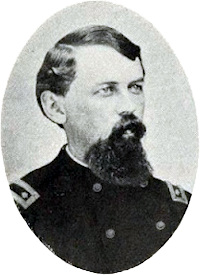
Jackson, Tenn., June 26, 1863.
Such splendid weather—nice, fresh breezes ruffling the leaves on the trees all the day long—and plenty of rain to keep the dust in order. I was up early this morning and the mocking birds were playing a reveille, from whose sweetness bees might make honey. There are hundreds of these birds living in a grove near our headquarters, and I can’t find time and ease enough to enjoy their concerts as I want to.
A flag of truce came to our lines yesterday on the Holly Springs road. The general sent me out to receive it. A lieutenant and eight men, all rough, dirty fellows, made the party. They were not very communicative. They brought a small mail and a trifling communication about prisoners. They belonged to Colonel Morton’s 2d Tennessee (Rebel) Cavalry, and were sent by General Ruggles. The general has promised to let me take a flag to Okolona. Don’t know when I shall go. I do think that General Oglesby is the very ideal of a chivalric, honorable, gallant, modest, high-spirited, dignified, practical, common-sense, gentleman. Nobody can help loving him. He hates a particle of meanness as much as he does a bushel. If we were only doing something more active I should be perfectly happy. As it is, I think seriously of asking to be sent back to my regiment. [continue reading…]

June 26th. This morning received on board two deserters from Port Hudson. They made their escape by swimming Thompson’s creek, and report the rebel garrison living on half rations, and in expectancy of soon having to eat mule beef. If such be the case, Port Hudson must soon be surrendered to our forces. Many are deserting from there at present, and coming within our lines. From four to six P. M., firing going on at Port Hudson; from eight o’clock to midnight, moderate firing from mortars and guns of lower fleet upon the enemy’s works.
From the diary of Osborn H. Oldroyd
JUNE 26TH.–We have heard that Port Hudson is ours, and I hope this may be true, for it will tend to hasten the surrender of Vicksburg.
A little dirt has been thrown up ahead of us, as a shield, in case we have to fight the enemy. We hear all sorts of reports about the strength of Johnston’s army, but the truth will only appear when we meet it. One captive said the report in Vicksburg was that Pemberton despaired of getting help from the out side, and was ready to surrender when the last meal rations have been eaten. He probably understands the resources of our commissary, as well as the magnanimous disposition of Grant to issue provisions to a starving foe.
Well; why not? The first square meal received from Uncle Sam will be an occasion to them of thanksgiving. They will get the best that we can issue. And when the war is over, true soldiers of both armies will be among the first to break the bread of reunion and quaff the cup of restored peace and good will.
June 26, 1863, Menphis Daily Appeal (Atlanta, Ga)
Among the heroic defenders of Vicksburg, none merit more honorable mention than those of the gentler sex who dwell in that fire girdled city. We are told that most of them have excavated caves in the hill sides where they repose with their children safe from the bursting shells of the enemy, and all day long they toil for the soldiers, taking care of the sick and wounded, cooking for the well, and providing as far as possible for their comfort in the way of clothing. A wreath of glory awaits every one of these heroines, when Vicksburg shall emerge triumphant from the tempest of fire. To say that they were in Vicksburg during the siege and to tell what they saw and experienced, will itself be worth the sufferings they have endured. — Macon Telegraph.
June 26, 1863, American Citizen (Canton, Mississippi)
We have been requested to solicit all the people in this and the adjoining counties, to bring in butter, eggs, chickens, mutton, roasting ears, vegetables of all kinds–and those living near are requested to bring milk, sweet or butter,–for the use of the hospitals in Canton.
In addition to the above-mentioned commodities, almost every one can spare a few
Old Shirts,
Drawers,
Pants,
Coats,
Sheets,
Pillow-cases,
Lint and bandages.
It is well known to all that a great battle is expected to take place very shortly between Gen. Johnston’s and Gen. Grant’s armies; in which event, many wounded will be sent to the hospitals in this place, and unless there is a supply on hand of the articles named, the noble men who are now defending our homes ill suffer greatly. It is therefore urged upon every neighborhood to act in this matter without delay–to collect and bring the articles named to the depot of the Ladies’ Aid Society, where they will be received by Mr. S. C. Cochran.
We hope the unceasing efforts of the ladies to mitigate the sufferings of the soldiers in the hospitals will be promptly seconded by the people generally.
June 26, 1863, Richmond Enquirer
People in civil life cannot pretend to criticise, in its present stage, a grand campaign such as that now entered upon by our army of Northern Virginia. We do not so much as know its object; and therefore still less can we pronounce on the suitableness of the means. – Some of the Confederate newspapers write as if they had expected the cavalry advance into Pennsylvania to have been at once let loose upon a general plundering expedition. But independently of the fact that nothing disorganizes troops and renders them useless like indiscriminate plunder, it is well to recollect that it may be absolutely necessary to the general plan to keep that cavalry force well in hand, so as to cover other movements of the main body. On the great chess-board of war there is a mighty game in progress; and neither we at home, nor Hooker, the opposite player himself, has yet divined the nature of General Lee’s combinations. It is true that Confederates owe no consideration or forbearance to their enemies. It is true, further, that our Generals owe it to their own people to visit a terrible devastation and havoc upon the enemy country, whenever they have the means in their hands to do so effectually, and on a grand scale. But this is not yet the case. General Hooker, with a vast army, is still to be disposed of, and every movement of each composed of, and every movement of each command must, doubtless, be calculated with a view to this needful preliminary business. It may be needful even to deceive the enemy as to the ultimate object of the Confederate General, by adopting the very course complained of – that is, forbearing from plunder now, on the very threshold of the expedition. In order to do the business well and thoroughly, the just retaliation (which we demand and the foe expects,) must be organized and regulated as deliberately as any other military movement; and it might be fatal to the whole campaign if Jenkins’ [continue reading…]
June 26, 1863, The New York Herald
We have some additional facts, and a superabundant supply of rumors and conjectures, regarding the movements and designs of the rebel army of Virginia. In other words, a bushel of chaff has accumulated upon our hands since yesterday morning, and we desire to ascertain, as far as possible, how much wheat there is in it.
First we have the report that on Friday last Generals Lee and Longstreet were at Winchester with one hundred thousand men. Now we remember that last August, when Gen. Pope, with his small army, was retreating before the overwhelming columns of Lee, the whole of the forces under Lee’s command were estimated by United States army officers to be hardly less in the aggregate than three hundred thousand men. We know, too, that this enormous army dwindled down at Antietam to less than seventy-five thousand. Accordingly, we doubt whether the present army of Lee, which is guessed to be from a hundred to a hundred and twenty-five thousand strong, can in reality muster more than fifty or sixty– say sixty-thousand men. This is the army that General Hooker has to deal with. We cannot believe that with anything near a hundred thousand men Lee would have stolen away from the Rappahannock over the Blue Ridge chain of mountains. On the contrary, turning sharply upon the flank of General Hooker, which he had the opportunity to do, Lee would have compelled him to fight somewhere on the direct road between Culpepper and Washington, to secure his communications with the capital, and to secure the capital itself. Lee, in a word, knows that his army is inferior to our opposing army in every sense, or he would not have gone a hundred and fifty miles out of his way to find General Hooker. [continue reading…]
June 26, 1863, The New York Herald
The Harrisburg Telegrams.
HARRISBURG, Pa., June 25, 1863.
The Coatesville cavalry, of Chester county, received orders to proceed to Carlisle immediately.
Mr. Fisher has arrived here from Chambersburg, and gives an entirely different version to the sensation intelligence received from there. He states that he saw no rebel infantry there up to four o’clock on Tuesday afternoon.
Colonel Lemule Todd arrived here to-day from Carlisle. He feels confident that there is no rebel infantry this side of Chambersburg. He urges the immediate sending of reinforcements to General Knipe.
Strong, able bodied men are arriving here hourly from the border. They do not care about enlisting to defend their homes, but make quite a loud talk about what the authorities and government ought to do.
Parties of respectability have called upon the Governor and urged him to declare martial law. He refers them to General Couch. That officer declines resorting to extreme measures as yet.
A band of minstrels – Carncross & Dixey– fled from here at noon to-day. Their scare led them to flee towards Lancaster. They were advertised to stay all of this week. [continue reading…]
June 26, 1863, The New York Herald
Despatches from Harrisburg to half-past two o’clock yesterday afternoon stated that the enemy was advancing slowly, but that the best order prevailed in the city. The excitement of the previous days had considerably abated. During the entire of Wednesday night and all day yesterday, long trains of wagons, laden with goods and furniture, were entering the city for protection. Farmers were driving in their horses and cattle, and negroes in large numbers were also flocking in. At six o’clock reports reached there that the enemy had halted, but were foraging all over the country and destroying the crops. At ten o’clock last night the people of Carlisle, the nearest point to the rebel advance, within which they were only four miles distance at five o’clock, did not anticipate any attack before morning at least. General Ewell’s headquarters were then at Shippensburg. Despatches from Frederick say that General Rhodes’ division, ten thousand strong, left Hagerstown on Tuesday for Chambersburg. General Johnson’s division, twelve thousand strong, with thirteen pieces of artillery, crossed at Shepherdstown on Sunday. One half of this force was at Boonsboro on Monday, and left on Tuesday for the North. The other half went to Williamsport. The aqueduct at Williamsport has been blown up by the rebels, and the bridges over Black creek, Sleepy creek, Sir John’s run, Green Spring run and South Branch have been destroyed. One span of North Branch bridge has also been destroyed. It is generally believed that the greater part of General Lee’s army crossed over into Maryland since Friday, at Antietam, Shepherdstown and Williamsport. [continue reading…]
26th.—While in the midst of preparation to visit my sisters at W. and S. H., we have been startled by the account of Yankees approaching. They have landed in considerable force at the White House, and are riding over the country to burn and destroy. They have burned the South Anna Bridge on the Central Railroad, and this evening were advancing on the bridge over the South Anna, on this railroad, which is but four miles above us. We have a small force there, and a North Carolina regiment has gone up to-night to reinforce them. We are, of course, in considerable excitement. I am afraid they are ruining the splendid wheat harvests which are now being gathered on the Pamunky. Trusting in the Lord, who hath hitherto been our help, we are going quietly to bed, though we believe that they are very near us. From our army we can hear nothing. No one can go farther than Culpeper Court-House in that direction. Why this has been ordered I know not, but for some good military reason, I have no doubt. It is said that Stuart’s cavalry have been fighting along the line of the Manassas Gap Railroad with great success. We can hear no particulars.
25th. Answered home letter and wrote a little to F. Kept raining most of the day. Had to keep pretty close to tent. In the evening Rob and I rode to town. Got some figs and called at the hospital. Henry prospering nicely, so are the remainder of the boys wounded. Mr. Wright in the hospital. Gave some figs to the boys.
Thursday, 25th–Everything on the outside is quiet as usual. Our engineers blew up one of the main rebel forts, and the infantry rushing in tried to hold the place, but on account of the fierce cross firing had to fall back to their rifle pits. A number of our forces were killed, including one colonel, and a number were wounded. Only a few of the rebels were killed by the explosion, not many being in the fort at the time. Our cannon opened up all along the line. A negro in the fort blown up, was thrown high up in the air and came down on his head within our lines unhurt.[1]
[1] A photograph was taken of the negro and the boys had him on exhibition for a few days at five cents admission.—A. G. D.