0

News of the Day

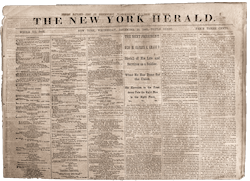
June 29, 1863, The New York Herald

IMPORTANT MILITARY CHANGE.

General Hooker Relieved and General Meade Appointed to the Command of the Army of the Potomac.

WASHINGTON, June 28 – 10:20 P.M.

The following is from your special correspondent, dated Frederick, June 28:–

General Hooker was this morning relieved of the command of the Army of the Potomac. General Meade succeeds him. General Hooker is relieved at his own request.

General Hooker leaves this afternoon for Baltimore.

It is reported that the rebels are in occupation of York and Hanover Junction, on the Northern Central Railroad. Lee headquarters were yesterday at Hagerstown. Longstreet’s corps crossed yesterday at Williamsport.

Everything is working well with us.

HEADQUARTERS, ARMY OF THE POTOMAC, June 28, 1863.

This morning Colonel Hardie arrived here by special train from Washington, as a bearer of despatches, relieving General Hooker from the command of the Army of the Potomac, [continue reading…]

0 comments

0

News of the Day

June 29, 1863, The New York Herald

It is with no ordinary feelings of gratification that we announce to our readers this morning the retirement of General Hooker and the appointment of Major General George G. Meade, late of the Fifth army corps, to the command of the Army of the Potomac.

With regard to the qualifications of this officer for this supremely important position at this crisis, the reader will be amply satisfied from the simple facts of his military history, which will be found in the special biographical sketch given elsewhere in this paper. Distinguished for his good and gallant conduct in the Mexican war, General Meade, in the peninsular and Maryland campaigns of General McClellan, and in the late eventful Rappahannock campaigns of General Burnside and General Hooker, has still added to his high reputation as a brave skilful and capable military leader. His merits are approved by the officers of the Army of the Potomac, and we are assured that this appointment as their Commander-in-Chief on the field will be hailed with unqualified satisfaction by the soldiers of every State and of every regiment of the army. As we understand this appointment, in another sense, it is a compromise which will be satisfactory not only to the old soldiers of McClellan, but to his friends outside of the army; for, according to our information, Gen. Meade has not been mixed up and is not the creation of any political faction, but the independent professional soldier, who has won his claims to distinction and his present promotion by his sword.

We have no inclination now to deal harshly with Gen. Hooker. In the all important fact that he has been relieved at his own request we recognized an act of patriotism on his part which disarms us of any desire to reproduce the evidence of his experience at the head of the Army of the Potomac against him. We congratulate him, as well as the country, on the patriotic considerations which have induced him to retire in season to enable his successor to move forward without delay upon the enemy; and the country will feel grateful to President Lincoln that an officer whose record and reputation give every assurance of success is now at the head of the army upon which the safety of the national capital and the fate of the rebellion depend.

0 comments

0

News of the Day

June 29, 1863, The New York Herald

The enemy is pressing closely upon Harrisburg. General Lee’s whole army is undoubtedly in Pennsylvania. His own headquarters are at Hagerstown, Maryland, from which he is directing the movements. General Longstreet’s corps crossed the river at Williamsport on Saturday. A great battle is impending at Harrisburg today. Last night the rebels were within three miles of the city, and heavy firing was going on all day. This was probably the outposts skirmishing as the enemy advanced. Mechanicsburg was surrendered by our troops yesterday morning, and immediately occupied by the rebels. They also took possession of York, our troops clearing out before them. They have done serious damage to the Northern Central Railroad, both at York and Hanover Junction. They have burned two bridges at York Haven. The splendid bridge across the Susquehanna, at Columbia, a mile an a quarter long, which cost a million of dollars, was burned by our own troops, under Colonel Frick, yesterday, who, after making a bold defence in his rifle pits at Wrightsville, on the south side of the river, was compelled to retreat across the bridge, which he burned behind him. He lost a hundred men, who were captured by the enemy. At last accounts the rebels were shelling Wrightsville without warning the inhabitants to leave. The rebels were reported to be at Bainbridge last night, twelve miles above Columbia, with pontoon trains sufficient to construct a bridge. We give a map of the whole region today.

The utmost consternation prevails throughout the State of Pennsylvania, and at last there appears to be a disposition on the part of the people to rally for their defence. Companies are arming and turning out at Lancaster, Norristown and Scranton. Fugitives, however, keep pouring into Harrisburg, Lancaster and other cities, in a state of complete [continue reading…]

0 comments

0

News of the Day

June 29, 1863, The New York Herald

The events of yesterday on the western side of the Susquehanna river, between Harrisburg and Columbia, ought to be sufficient to bring within the next three days a hundred thousand armed Pennsylvanians to the rescue. Philadelphia, from her population of half a million, ought to be able to report within twenty-four hours the mustering within her limits of at least twenty-five thousand armed men. All the stupid and embarrassing formalities of red tape as between county and State, and State and federal authorities, should be cast to the winds, and the people of every county of the Commonwealth, trusting to the general organization and the disposition of their forces by the Governor and by Gen. Couch, should send forward their troops by regiments, battalions and companies as fast as they can be armed and equipped from their own resources, not for thirty days or sixty days, but for the expulsion of the invading army of the rebellion.

The federal administration and General Meade are now occupied in covering approaches by which this daring rebel army may advance upon Washington or Baltimore; and, if General Meade’s army amounted to half a million of men, we conjecture that it could not for several days to come be marched over the interval between its present lines of occupation and the army of Lee to the deliverance of Pennsylvania.

It appears to us that the cunning rebel General Lee has been deliberately widening the distance between the two armies, in order, first, to draw our Army of the Potomac as far away from Washington as possible before giving battle; and secondly, to prey as long as [continue reading…]

0 comments

0

News of the Day

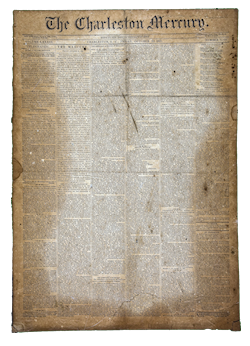
June 29, 1863, The Charleston Mercury

We have no recent intelligence of an authentic character from the army of Northern Virginia. The Richmond Examiner, of Friday, says:

It was reported on the streets yesterday morning that General Lee’s pickets were at the Chain Bridge, over the Potomac, four miles above Washington, but our utmost diligence failed to discover the origin of the report. Yet, that it is true is by no means improbable. If, as is believed, General Lee crossed the Potomac last Sunday morning, his pickets may, by this time, be even nearer Washington than the Chain Bridge. The story that Hooker crossed the Potomac between Leesburg and Washington is discredited in official circles. It is believed, if he has crossed the river at all, it was at Washington city. But we must confess that as regards the whereabouts of either the Northern or Southern army, all is mist and darkness here. Still, no one is dissatisfied with or uneasy about the situation. All feel confident that General Lee knows everything that need be known, and for the rest, they must trust confidently to the God of battles and the prowess of Southern arms.

The Central train, that rarely failing source of interesting intelligence, brought us last night not so much as a rumor. From Staunton to Richmond all was reported quiet, a certain evidence that the tide of war is rolling northward. Today, for the first time, we are enabled to lay before our readers some well authenticated facts concerning the capture of Winchester, and the subsequent operations of the left wing of our own army. Milroy was certainly surprised at Winchester, and as certainly deserted his army and, disguised in [continue reading…]

0 comments

War Diary of Luman Harris Tenney.

War Diary of Luman Harris Tenney.

28th. Up for breakfast at daylight. Fed and cleaned our horses and saddled. Creek quite high, current strong. One fellow got a good ducking. Rained considerable during the day. Passed through a thickly wooded, rough and barren country. Reached Jamestown about 4 P. M. Got a lunch of cakes and cheese. 112th Ill. there. Went back a mile and camped. Grass, had a few oats. Onions for supper.

0 comments

Downing’s Civil War Diary.–Alexander G. Downing.

Diary of Alexander G. Downing; Company E, Eleventh Iowa Infantry

Sunday, 28th–I was sent out on picket duty today and everything is quite (sic) still along the line. It is also quiet at the front, except along General Logan’s Division, where the rebel sharpshooters are trying to silence our batteries. News came that Port Hudson had not been taken, and that instead General Hooker was falling back. The little news we get from the Potomac is discouraging, but since we are so sure of a victory here at Vicksburg, we can stand discouraging reports from the Potomac.

0 comments

0

Cruise of the U.S. Flag-Ship Hartford -Wm. C. Holton

June 28th. Commences with pleasant weather. Occasional firing at Port Hudson by the army mortars and great guns. At nine fifty A. M., inspected crew at quarters, and performed Divine service. Firing still going on at Port Hudson. This afternoon despatches were sent by Paymaster Meredith to Gen. Banks’s headquarters. At one P. M. an orderly came on board from the General’s headquarters. Steamer Bee came down the river, from Bayou Sara, with despatches and three soldiers of the 75th regiment N. Y. V., who were arrested at St. Francisville. From eight o’clock to twelve midnight, artillery firing heard in the rear of Port Hudson.

0 comments

 John has been ordered to sea and ran the blocade with a party of officers in charge…

Journal of Meta Morris Grimball
Meta Morris Grimball

28th June

       Received a letter from Papa in which he says Mr G. Lowndes & Mr Heyward have sold their Combahee places very well & advises Mr Grimball to sell his plantations he goes down on Friday the 3d to arrange matters if possible.—

       The prices of articles of food are very high. Bacon $1.25 per lb Corn $3.50 per bushel & in Charleston cows sell for 3 hundred & 50 dollars. Mrs Wilkins writes she has one but did not buy it & sold her calf for $60 was told afterwards she ought to have got more her son Berkley paid $6 for a breast of veal.

       Arnoldus Vanderhorst who is now Major on Whiting’s staff was married to Miss Adele Allston with 10 groomsmen, and all things in the usual style, a fine supper & two receptions with cake and wine, in these war times quite appreciated.

       John has been ordered to sea and ran the blocade with a party of officers in charge, 8, he was delighted & wrote to us from Bermuda that every roll of the Ocean seemed the welcome of a friend, he thinks he is to go to France. Charles also went out with a party & got to Nauso, after a boisterous voyage, and being shot at by the Yankees.—

0 comments

Through Some Eventful Years

Through Some Eventful Years by Susan Bradford Eppes
Susa Bradford Eppes

June 28th, 1863. The army of Northern Virginia is pushing on to the invasion of the North. In this land of ours a curious species of fault-finders has developed. While the men, the true men, are at the front, struggling with might and main to save the South from destruction, there are others, poor weak-kneed cowards, who stand on street corners and criticise President Davis and the generals in command of our armies.

These cowardly back-biters have never smelled gun powder, they are Carpet Generals and yet, to listen to them talk, you would think that the only thing needed to insure victory would be to put them in command. I turn sick with scorn when I am obliged to be present while they are exploiting their wisdom.


Susan Bradford is 17 years old when this entry was made.

0 comments

0

A Soldier’s Story of the Siege of Vicksburg

From the diary of Osborn H. Oldroyd

            JUNE 28TH.–The boys of the 20th left at Vicksburg joined our regiment to-day. We were very anxious to hear how the siege was progressing, and, to our surprise, learned that it was going right on as usual, without our assistance. It was interesting to hear of the blowing up of Fort ‘Hill by our division, but we did not ascertain the number killed, though the explosion
                        Hoisted two or three.
                        And blew a darky free
                        From slavery to freedom.

            This negro, blown up with other chattels in the fort, was dropped into our lines and taken to General Logan’s headquarters, none the worse for his trip. When asked what he saw, he said, “As I was comin’ down I met massa gwine up.” Nothing, however, was gained by blowing up the fort, except planting the stars and stripes thereon, by our troops who made the charge after the explosion ; but our colors were removed, for safety, after dark. While our men lay all the afternoon on the side of the fort, the rebels threw into their ranks hand-grenades which killed and wounded quite a number. Our boys, however, would occasionally catch them and toss them back to the place from which they came, just in time to explode among their owners.

            Living out here in the woods is quite different from camping before Vicksburg. Yet all is life and bustle wherever we are, from reveille at daybreak, to tattoo at night. Each man must answer to his name in ranks at roll-call in the morning, and must be properly dressed. Some of the most ludicrous scenes of army life are to be witnessed at this exercise. A few of the old fashioned, steady fellows, as a general thing appear quite thoroughly dressed ; but as you go down the ranks from the head where they stand, you will begin to find, now and then, a man who has but one boot or shoe on, with the other but half way on. Another boy will be putting on his blouse–having grabbed it in the dark–of course wrong side out. Another has tossed his blouse over his shoulders, and is trying to hide close to his right-hand man. Still another, trying to get his pants on between his bed and the line, has caught a foot in the lining, and hops along like a sore-footed chicken. I saw one fellow come out, at the foot of the company, wrapped only in a blanket. The orderly, however, sent him back to be better uniformed; he could not play Indian at morning roll-call. The last one of those who have overslept, makes his appearance holding on to his clothes with both hands. Some answer to their names before taking position in the ranks, and in fact, even some before they are fairly out of bed. A company which has for its orderly a person who is a little lenient, fares well ; but if he is inclined to strain his authority, he is bound to have its ill will. After roll-call, some of the half-dressed return to bed for another snooze, while the rest complete their toilet. After that comes the splitting of rails, building of fires, and a general rush for breakfast, which winds up the duties of the morning.

0 comments

A Rebel War Clerk’s Diary

A Rebel War Clerk’s Diary at the Confederate States Capital, By John Beauchamp Jones
A likeness of Jones when he was editor and majority owner of the Daily Madisonian during President John Tyler’s administration.

JUNE 28th.—By order of Brig.-Gen. G. W. Custis Lee, the department companies were paraded to-day, armed and equipped. These, with the militia in the streets (armed by the government to-day), amounted to several thousand efficient men for the batteries and for guard duty. They are to rendezvous, with blankets, provisions, etc., upon the sounding of the tocsin. I learn that 8000 men in the hospitals within convenient reach of the city, including those in the city, can be available for defense in an emergency. They cannot march, but they can fight. These, with Hill’s division, will make over 20,000 men; an ample force to cope with the enemy on the Peninsula. It has been a cool, cloudy day (we have had copious rains recently), else the civilians could not have stood several hours exercise so well. A little practice will habituate them by degees to the harness of war. No one doubts that they will fight, when the time for blows arrives. Gen. Jenkins has just arrived, with his brigade, from the south side of the James River.

I was in the arsenal to-day, and found an almost unlimited amount of arms.

We get not a word from Gen. Lee. This, I think, augurs well, for bad news flies fast. No doubt we shall soon hear something from the Northern papers. They are already beginning to magnify the ravages of our army on their soil: but our men are incapable of retaliating, to the full extent, such atrocities as the following, on the Blackwater, near Suffolk, which I find in the Petersburg Express:

“Mr. Smith resided about one mile from the town, a well-to-do farmer, having around him an interesting family, the eldest one a gallant young man in the 16th Virginia Regiment. When Gen. Longstreet invested Suffolk a sharp artillery and infantry skirmish took place near Mr. Smith’s residence, and many balls passed through his house. The Yankees finally advanced and fired the houses, forcing the family to leave. Mrs. Smith, with her seven children, the youngest only ten months old, attempted to escape to the woods and into the Confederate lines, when she was fired upon by the Yankee soldiers, and a Minié-ball entering her limb just below the hip, she died in thirty minutes from the loss of blood. The children, frightened, hid themselves in the bushes, while Mr. Smith sat down upon the ground by his wife, to see her breathe her last. After she had been dead for some time, the Yankee commander permitted him to take a cart, and, with no assistance except one of his children, he put the dead body in the cart and carried it into the town. On his arrival in town, he was not permitted to take the remains of his wife to her brother’s residence until he had first gone through the town to the Provost Marshal’s office and obtained permission. On his arrival at the Provost Marshal’s office, he was gruffly told to take his wife to the graveyard and bury her. He carried her to her brother’s, John R. Kilby, Esq., and a few friends prepared her for burial; Mr. Kilby not being allowed to leave the house, or to attend the remains of his sister to the graveyard.

“Nor did the cruelty of the fiends stop here. Mr. Smith was denied the privilege of going in search of his little children, and for four days and nights they wandered in the woods and among the soldiers without anything to eat or any place to sleep. The baby was taken up by a colored woman and nursed until some private in the Yankee army, with a little better heart than his associates, took it on his horse and carried it to town. Mr. Smith is still in the lines of the enemy, his house and everything else he had destroyed, and his little children cared for by his friends.

“Will not the Confederate soldiers now in Pennsylvania remember such acts of cruelty and barbarism? Will not the Nansemond companies remember it? And will not that gallant boy in the 16th Regiment remember his mother’s fate, and take vengeance on the enemy? Will not such a cruel race of people eventually reap the fruit of their doings? God grant that they may.”

SUNDAY AFTERNOON.—There are two reports of important events current in the streets: first, that Lee’s army has taken and destroyed Harrisburg, Pennsylvania; and second, that Vicksburg has fallen. I am not prepared to credit either, although the first is said to be true by no less a person than Gov. Letcher. And yet one or both may be confirmed to-morrow; and if so, that is, if Vicksburg has fallen, and Lee should retire, as he must sooner or later, there will be a dark and desponding season in the Confederacy. But the war will go on.

0 comments

War Diary of Luman Harris Tenney.

War Diary of Luman Harris Tenney.

27th. Thunder shower during the day. Passed the day reading and resting. At 5 P. M. commenced marching towards Jamestown. 7th and 2nd Ohio. Rained very hard. Fishing Creek too high to ford. Bivouacked on the bank. Cleared off, so slept very well, save wet clothes. Thede and I went together. Three days’ rations. A. B. along, first for two months.

0 comments

Downing’s Civil War Diary.–Alexander G. Downing.

Diary of Alexander G. Downing; Company E, Eleventh Iowa Infantry

Saturday, 27th–Our company is still on picket here about five miles southeast of Vicksburg, while the other companies of the regiment are with our brigade out on the Big Black river. There is no telling when we shall be relieved from picket; yet our boys are pretty well satisfied, for we have plenty of blackberries and we drew three days’ rations today.

0 comments

0

Louise Wigfall Wright — A Southern Girl in ’61

“ORANGE C. H., June 27th, 1863.

        “. . . I was very glad to get your note of the 18th June, and only wish I knew where you were now. We are all an anxious set of women at present. Mrs. Gordon (J. B.) leaves to-day for Winchester to try and hear something of her husband. He commands Lawton’s old brigade. . . .

“We are all much delighted with the accounts from the Yankee papers—of their alarm and dismay—but it seems unaccountable, after their disgraceful and barbarous treatment of our people that we should not be repaying them in their own coin.”

0 comments

0

Cruise of the U.S. Flag-Ship Hartford -Wm. C. Holton

June 27th. At seven thirty A. M., steamer Bee came down from Bayou Sara. Cannonading going on at Port Hudson all this day.

0 comments

0

A Soldier’s Story of the Siege of Vicksburg

From the diary of Osborn H. Oldroyd

            June 27TH.–A number of our boys went a few miles, blackberrying, and picked quite a quantity to bring home, when we heard the sound of horses’ hoofs, and suddenly concluding we had berries enough, we beat a hasty retreat for camp and got there safely.

The weather is not quite as hot here as it was in our close quarters at the front, but while we enjoy that change we would much prefer remaining at our post there, until the end of the siege.

            Some of the boys have had to boil their pants–the only process which is sure death to an enemy lurking there which we find most troublesome. While our pants are boiling the owner leans over the kettle anxiously, for it is probably his only pair. Well, it is now summer time, and, it will do to sun ourselves an hour or two. These little pests lurking in our pants become very annoying when they go foraging. These creatures are about the only war relics from which I have not gathered specimens to send home. I have, in fact, gathered enough of them, but with no view to a museum or cabinet. It is fun to see a fellow get into a pair of boiled pants. The boiling has shrunk them till they fail to reach the top of his brogans by some inches, and accordingly he bends over to try to pull them down to a junction, when the contrary things seem to recoil still further ; and the only satisfaction left to him at last–and it is no mean one, either–is that they are at least clean, and he himself is once more their sole occupant. How long he will remain so, however, it is hard to say.

0 comments

A Rebel War Clerk’s Diary

A Rebel War Clerk’s Diary at the Confederate States Capital, By John Beauchamp Jones
A likeness of Jones when he was editor and majority owner of the Daily Madisonian during President John Tyler’s administration.

JUNE 27th.—An officer of the Signal Corps reported, yesterday, the force of Gen. Keyes, on the Peninsula, at 6000. To-day we learn that the enemy is in possession of Hanover Junction, cutting off communication with both Fredericksburg and Gordonsville. A train was coming down the Central Road with another installment of the Winchester prisoners (some 4000 having already arrived, now confined on Belle Island, opposite the city), but was stopped in time, and sent back.

Gen. Elzey had just ordered away a brigade from Hanover Junction to Gordonsville, upon which it was alleged another raid was projected. What admirable manœuvring for the benefit of the enemy!

Gen. D. H. Hill wrote, yesterday, that we had no troops on the Blackwater except cavalry. I hope he will come here and take command.

Gen. Whiting has arrested the Yankee crew of the Arabian, at Wilmington. It appears that she is owned by New Yorkers, sailed from New York, and has a Yankee cargo!

Capt. Maury writes from London that R. J. Walker, once a fire-and-fury Mississippi Senator (but Yankee-born), is in Europe trying to borrow £50,000,000 for the United States. Capt. Maury says the British Government will not willingly let us have another “Alabama;” but that it is also offended at the United States for the atrocities of Wilkes, and this may lead to war. The war, however, would not be intended as a diversion in our behalf.

Nothing is heard to-day from Lee, except what appears in Northern papers several days old, when our troops were occupying Hagerstown, Cumberland, etc., in Maryland, and foraging pretty extensively in Pennsylvania.

Nothing from Vicksburg.

Just as I apprehended! The brigade ordered away from Hanover to Gordonsville, upon a wild-goose chase, had not been gone many hours before some 1200 of the enemy’s cavalry appeared there, and burnt the bridges which the brigade had been guarding This is sottishness, rather than generalship, in our local commanders.

A regiment was sent up when firing was heard (the annihilation of our weak guard left at the bridges) and arrived just two hours too late. The enemy rode back, with a hundred mules they had captured, getting under cover of their gun-boats.

To-day, it is said, Gen. Elzey is relieved, and Gen. Ransom, of North Carolina, put in command; also, that Custis Lee (son of Gen. R. E. Lee) has superseded Gen. Winder. I hope this has been done. Young Lee has certainly been commissioned a brigadier-general. His brother, Brig.-Gen. W H. F. Lee, wounded in a late cavalry fight, was taken yesterday by the enemy at Hanover Court House.

Gen. Whiting’s letter about the “Arabian” came back from the President, to-day, indorsed that, as Congress did not prohibit private blockade-running, he wouldn’t interfere. So, this is to be the settled policy of the government.

This morning the President sent a letter to the Secretary of War, requesting him to direct all mounted officers—some fifty A. A. G.’s and A. D.’s—to report to him for duty around the city. Good! These gentlemen ought to be in the saddle instead of being sheltered from danger in the bureaus.

3 O’CLOCK P.M.—Three proclamations have just been issued! One (a joint one) from the President and the Governor, calling upon everybody to organize themselves into companies, battalions, and regiments, when they will be armed. They say “no time is to be lost, the danger is great.” The Mayor, in his document, warns the people in time to avoid the fate of New Orleans. He says the enemy is advancing on the city, and may assail it before Monday morning. This is Saturday. The third proclamation is by E. B. Robinson, one of my printers, twenty years ago, at Washington. He calls upon all natives of Maryland and the District of Columbia to report to him, and he will lead them against the enemy, and redeem them from the imputation of skulking or disloyalty cast upon poor refugees by the flint-hearted Shylocks of Richmond, who have extorted all their money from them.

Besides these inflammatory documents, the militia colonels have out notices for all men under forty-five years of age to meet in Broad Street to-morrow, Sunday.

I learn, however, that there are some 25,000 or 30,000 of the enemy at Yorktown; but if we can get together 12,000 fighting men, in the next twenty-four hours, to man the fortifications, there will not be much use for the militia and the clerks of the departments, more than as an internal police force. But I am not quite sure we can get that number.
0 comments

0

News of the Day

June 27, 1863, The Charleston Mercury

It is high time for the State authorities to do something towards furnishing labor, if it is expected that Charleston is to be saved from destruction at the hands of the enemy next fall. There is a vast deal of work to be done which the soldiers we have cannot possibly accomplish. Much precious time has already been wasted, and it will now require every effort on the part of all parties concerned, to get ready to fight twenty iron-clads, besides the land forces. The times require resources and boldness and energy in all those who, in the public service, have any hand in controlling the destinies of our people. The legislation of the tempest-in-a-teapot Legislature may be very bungling. It may satisfy legal technicalities to say that requisitions have been made and certain forms have been gone through. The public care nothing about personal records and shiftings of responsibility. They have a right to judge, and will judge, every public servant, whether in the army or out of it, by results. Papers and writings may do very well in ordinary times, but in a crisis of difficulties and dangers like the present, when such enormous interests are at stake, nothing but successful results can satisfy. Difficulties must be expected, must be met – ways must be found to overcome them. To fail is to prove unequal to the occasion. We tell the people of Charleston and of South Carolina that without more effort and more progress in our defences, the fall of Charleston and the whole Low Country of the State, are events not improbable. These […..] are of truth and soberness.’ ‘They that have ears, let them hear.’ Labor is wanted; work is absolutely essential to our safety, and no small amount of it. Richmond has been fortified by the incessant labor of fifteen thousand slaves for nine months. Cannot enough labor be got in South Carolina to save Charleston? A few weeks delay may render all subsequent efforts fruitless. A pressing need is upon us now.

0 comments

0

News of the Day

June 27, 1863, The Charleston Mercury

THE CAMPAIGN ON THE BORDER.

RICHMOND, June 25. – Ten Yankee transports appeared at the White House this morning, and a small force landed. It is reported that their pickets advanced as far as Teustall Station. No apprehensions are felt in official circles. Efficient measures have been taken to repel the advance, if it should be attempted.

We have further news from the border. IMBODEN has destroyed all the workshops, machinery, locomotives and cars, at Cumberland, and every bridge between that point and Little Capon, west of Cumberland. He also destroyed an immense tunnel and knocked to pieces the great iron bridge. This is the greatest blow of the kind ever given to the enemy.

The Baltimore American of the 22d contains the following telegram, dated Harrisburg, June 21: ‘The rebels are reported 40,000 strong at Hagerstown, Md., and fortifying that place. The troops collected here are expecting marching orders every moment. Governor CURTIN has received a despatch from Chambersburg, dated last evening, and saying that the rebel JENKINS was at Gainesboro’ last night, and has been plundering the houses in the mountains.’

Gen. COUCH had received a despatch reporting the rebel cavalry at Gettysburg. The force that went to McConnelsville helped themselves to whatever they wanted in the [continue reading…]

0 comments

0

News of the Day

June 27, 1863, The New York Herald

SIXTY THOUSAND MEN CALLED OUT TO REPEL THE REBEL INVASION.

HARRISBURG, Pa, June 26, 1863.

In the name and by the authority of the Commonwealth of Pennsylvania, Andrew Curtin, Governor of said Commonwealth.

A PROCLAMATION.

Pennsylvania – The enemy is advancing in force into Pennsylvania. He has a strong column within twenty-three miles of Harrisburg, and other columns are moving by Fulton and Adams counties, and it can no longer be doubted that a formidable invasion of our State is in actual progress. The calls already made for volunteer militia in the exigency have not been met as fully as the crisis requires. I therefore now issue this my proclamation, calling for sixty thousand men to come promptly forward to defend the State. They will be mustered into the service of the State for a period of ninety days, but will be required to serve only so much of the period of muster as the safety of our people and honor of our State may require. They will rendezvous at points to be designated in the general order to be issued this day by the Adjutant General of Pennsylvania, which order will also set forth the details of the arrangements for organization, clothing, subsistence, equipments and supplies.

I will not insult you by inflammatory appeals. A people who want the heart to defend [continue reading…]

0 comments

0

News of the Day

June 27, 1863, The New York Herald

The alarm of the Pennsylvanians at the invasion of Lee is extraordinary. The population along the Maryland State line are rushing across the Susquehanna in a state of panic, believing they are comparatively safe with that barrier between them and the enemy. But the citizens of Harrisburg and those in its vicinity residing on this side of the Susquehanna are packing up their valuables for flight, and seem to think they will not be secure till they have crossed the Delaware. It is said that the rebels openly proclaim that they will not stop till they reach Philadelphia. We hope, however, that Governor Curtin’s draft of 50,000 men will arrest many of the fugitives in their flight. How can Pennsylvanians expect the militia of New Jersey and New York to defend them if they will not defend their own firesides against invasion? Pennsylvania is famous for a vast amount of self-esteem. It calls itself the Keystone State. Let us see how its population will now fight for the arch of the Union, of which Pennsylvania is the binding stone. There is no use in running away; for the fugitives will have to turn round and give battle at last. The people did not thus flee when McClellan was in command. Have they no confidence in the present commander of the Army of the Potomac? This is a question that deserves investigation.

0 comments

0

News of the Day

June 27, 1863, The New York Herald

The enemy progresses slowly, but with large force, into Pennsylvania. Affairs at Harrisburg wore a more quiet aspect yesterday, although the country people, with droves of cattle and horses, were rushing into the city in large numbers. Preparations for defence were going on actively. General Knipe evacuated the town of Carlisle yesterday afternoon, not deeming his force strong enough to hold it against the approaching enemy, who were reported to be from ten to twelve thousand strong. Up to nine o’clock last night, however, it does not appear that the rebels were in possession, nor any nearer than within four miles of the place. Much perplexity exists as to the exact route the rebels have taken.

The rebel force which occupied Gettysburg yesterday belong to Longstreet’s corps, General Early’s division. It is believed that this force intends to strike the Northern Central Railroad, either at Hanover Junction or York, which is distant about thirty miles. They comprise ten regiments of infantry, and with cavalry and artillery. Governor Curtin has received information that the rebels hold all the passes of South Mountain. This makes two corps which have crossed the Potomac. General Rhodes’ division of Ewell’s corps which now occupy Chambersburg is twelve thousand strong, with five batteries and an immense wagon train. It was raining hard all day yesterday, and the Susquehanna was rising. This, should it continue, may obstruct the operations of the rebel armies for a time. [continue reading…]

0 comments

0

News of the Day

June 27, 1863, The New York Herald

Our Chambersburg Correspondence.

CHAMBERSBURG, June 18, 1863.

The following is a correct and truthful account of Jenkins’ raid into Chambersburg, having witnessed it personally. You will remember that Franklin county, Pa., of which Chambersburg is the shire town, is a border county of the State, about eight miles from the Potomac river at its nearest point at Williamsport, so that any movement in the valley of Virginia is immediately sympathized with in this region. You will also recollect that General Stuart demonstrated the feasibility of taking this place last fall. Indeed, full of all agricultural productions, teeming with thousands of cattle upon her thousand hills, frugal and industrious people, it lies a tempting bait to the daring but hungry armies of the South. The propriety of its defence I leave to be settled by a debating society said to exist in the State Lunatic Asylum at Harrisburg. The movement of a cavalry force about Winchester, forty miles south of Williamsport held by Milroy with a large force, was the first intimation of immediate danger. On last Sabbath we heard that large bodies of negroes, the avant courriers of disaster to our arms, were pouring into Hagerstown; then that the rebels had crossed the river at different points. On Monday morning about nine o’clock they commenced arriving in our town. Gen Couch came up here from Harrisburg, but left after a brief stay, leaving in command his chief of staff, Major Burt, a gentlemanly and, I should judge, efficient officer. About eleven o’clock on Monday morning the wagon [continue reading…]

0 comments

0

News of the Day

June 27, 1863, The New York Herald

Our Frederick City Correspondence.

FREDERICK CITY, June 20, 1863.

The excitement occasioned by the proximity of the enemy continues, and the streets are occupied by groups of residents eagerly devouring the reports of refugees. Nearly all of the prominent Union citizens have left. Many of the stores are closed, and those open have been stripped of nearly all their goods. The Examiner failed to appear this week in consequence of the absence of its editor and employes; but the Citizen was published, containing a number of articles calculated to encourage secessionists and secure the favor of the enemy. The banks have sent off their specie, the livery keepers their horses and some of the inhabitants their furniture. The town is wild with rumors. The most exaggerated and contradictory reports are constantly coming in, and at times it is hard to believe whether the enemy is in the outskirts of the city or evacuating the State.

Yesterday the cars ran up to this place, and during the afternoon a locomotive was sent up to Point of Rocks for the purpose of bringing off the engine disabled a few days since by White’s cavalry. The country this side of South Mountain is believed to be entirely free from the enemy. No trains have ventured up as far as the Ferry since the attack upon the stations this side, but it is expected that they will soon resume their trips. At present they come up as far as place No. 1, where they receive reports from Monocacy concerning the safety of the road. If deemed safe they then move cautiously to the latter [continue reading…]

0 comments