Civil War Day-By-Day

Civil War Day-by-Day

August 21, 1861

  • Second Wheeling Convention adjourns.

A Chronological History of the Civil War in America1

  • Wheeling Convention adjourned sine die.
  • Skirmish at Cross Lanes, Va.

  1. A Chronological History of the Civil War in America by Richard Swainson Fisher, New York, Johnson and Ward, 1863
0 comments

A Rebel War Clerk’s Diary at the Confederate States Capital, By John Beauchamp Jones

Civil War Day-by-Day

AUGUST 20th.—Secretary Walker returned last night, having heard of the death of Col. Jones before reaching his destination. I doubt whether the Secretary would have thought a second time of what had been done in his absence, if some of his friends had not fixed his attention upon it. He shut himself up pretty closely, and none of us could see or hear whether he was angry. But calling me into his room in the afternoon to write a dispatch which he dictated, I saw, lying on his table, an envelope directed in his own hand to the President. Hints had been circulated by some that it was his purpose to resign. Could this communication be his resignation? It was placed so conspicuously before me where I sat that it was impossible not to see it. It was marked, too, “immediate.”

0 comments

Extracts from the journal of Commander Semmes, C.S. Navy, commanding C.S.S. Sumter

War of the Rebellion: from the Official Records of the Union and Confederate Armies and Navies
Tuesday, August 20.—Weather clear and temperature, out of the sun, quite cool and pleasant. Called on the governor and had an agreeable interview with him. Returned the calls also of the Dutch and French commanders. Received the visits of two Dutch commanders and several citizens. Made arrangements for receiving a supply of coal. The French steamer of war Abeille arrived from Cayenne. Sent an of?cer on board of her. Her commander called a few hours after.
0 comments

“It was our first meal in the army and consisted of boiled potatoes, fried bacon and baked beans.”–Alexander G. Downing.

Diary of Alexander G. Downing; Company E, Eleventh Iowa Infantry

Tuesday, 20th–I went early this morning to Inland, where all who enlisted were to meet and go to Davenport.[i] Several of the friends came in to see us off. There were forty-five of us and at 9 o’clock we left in wagons for Davenport. After a hot, dusty ride we arrived at Davenport at 4 o’clock in the afternoon, and marched out to Camp McClellan, where they received us very kindly. We had very fine barracks to go into and the boys of the Eighth Iowa had a good supper for us. It was our first meal in the army and consisted of boiled potatoes, fried bacon and baked beans. We have lots of straw to sleep on at night. We were to meet a part of a company from Le Claire under command of Captain Foster and together form one company in the Eighth Iowa Infantry. But Captain Foster did not come, and since there are only eight Le Claire boys here we have not enough to make a company.

[i] When I bade father good-by, he said: “Well, Alec, as you have made up your mind to go into the army, I want you to promise me that you will not enter into any of the vices that you will come in contact with while in the army, but try to conduct yourself just as if you were at home.” Of course I was not an angel while in the army, but I always remembered father’s advice and to that I attribute what little success I have had in life—and this is my seventy-second year. Father was in his forty-sixth year, but he told me that if it were not for leaving the family alone, he would go with me. He was a strong Union man, and his father had served all through the War of the Revolution, in the command of General Wayne.—A. G. D.

0 comments

“General Lyon killed and his troops routed.”—Diary of a Southern Refugee, Judith White McGuire.

Diary of a Southern Refugee During the War by Judith White McGuire

August 20.—We are rejoicing over a victory at Springfield, Missouri—General Lyon killed and his troops routed. Our loss represented large. I have only seen the Northern account.

No news from home, and nothing good from that quarter anticipated. We are among dear, kind friends, and have the home feeling which only such genuine and generous hospitality can give; but it sometimes overpowers me, when I allow myself to think of our uncertain future.

0 comments

“I was at home most of the day contriving what course to pursue for the time being.”—Horatio Nelson Taft

Diary of US patent clerk Horatio Nelson Taft.

TUESDAY, AUGUST 20, 1861.

Many people in the City were much alarmed last night at a report that “the rebels had crossed the River below and were marching on Washington.” Similar rumors are constantly afloat. Went to the Express Office and sent off (as requested) Lieut Martins trunk which was left with me. Called at the “National” and also a[t] Bradys Photograph Gallery. Saw Maj Anderson there. I was at home most of the day contriving what course to pursue for the time being.

______

The three diary manuscript volumes, Washington during the Civil War: The Diary of Horatio Nelson Taft, 1861-1865, are available online at The Library of   Congress.

0 comments

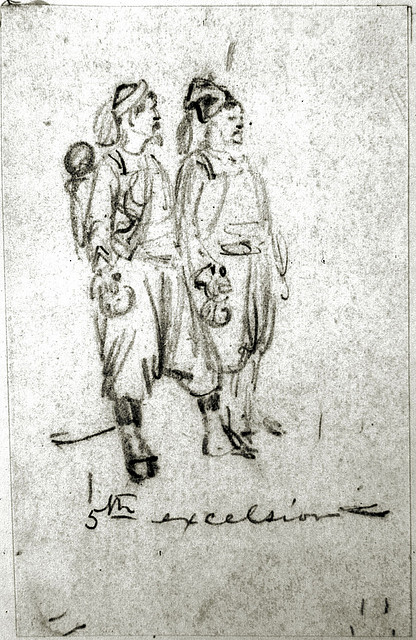
5th Excellsiors

Library of Congress

image

74th Infantry Regiment .
Civil War .
Fifth Excelsior Regiment; Fifth Regiment, Sickles’ Brigade.

This regiment was recruited under the special authority of the War Department, issued to Gen. D. E. Sickles; organized under Col. Charles K. Graham at Camp Scott, L. I., and mustered in the service of the United States for three years between June 30 and October 6, 1861.   (New York State Military Museum and Veterans Research Center)

__________

Alfred R. Waud Civil War Art

5th excelsiors

Sketch of two soldiers.

1 drawing on cream paper : pencil ; 9.9 x 6.4 cm. (sheet).

CREATED/PUBLISHED: [between 1860 and 1865]

Part of Library of Congress Civil War drawing collection

hdl.loc.gov/loc.pnp/cph.3a00529

0 comments

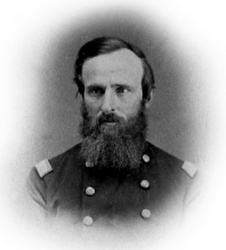
“…so sleepy; no rest or sleep the night before.”—Rutherford B. Hayes

Diary and Letters of Rutherford Birchard Hayes

August 20. Tuesday.–After marching three miles we stopped for water and to let the teams come up. One man reclining was accidentally shot by another hitting his foot against the hammer of a musket. Poor Carr received the ball in the heel of his shoe; it passed up his leg, grazing it merely, grazed his body and arm and shoulder, and left him without a serious wound! Fortunate. Reached Buckhannon about 3:30 P. M.–so sleepy; no rest or sleep the night before. Stopped at noon–got good bread and milk, honey and blackberry jam, and slept nearly an hour in a barn. Buckhannon a pretty place.

0 comments

William Howard Russell’s Diary: Harper’s Ferry.—John Brown.—Back by train to Washington.

My Diary North and South – William Howard Russell

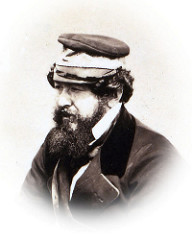
Next day (20th)I took the train, at Ellicott’s Mills, and went to Harper’s Ferry. There is no one spot, in the history of this extraordinary war, which can be well more conspicuous. Had it nothing more to recommend it than the scenery, it might well command a visit from the tourist; but as the scene of old John Brown’s raid upon the Federal arsenal, of that first passage of arms between the abolitionists and the slave conservatives, which has developed this great contest; above all, as the spot where important military demonstrations have been made on both sides, and will necessarily occur hereafter, this place, which probably derives its name from some wretched old boatman, will be renowned for ever in the annals of the civil war of 1861. The Patapsco, by the bank of which the rail is carried for some miles, has all the character of a mountain torrent, rushing through gorges or carving out its way at the base of granite hills, or boldly cutting a path for itself through the softer slate. Bridges, viaducts, remarkable archways, and great spans of timber trestle work leaping from hill to hill, enable the rail to creep onwards and upwards by the mountain side to the Potomac at Point of Rocks, whence it winds its way over undulating ground, by stations with eccentric names to the river’s bank once more. We were carried on to the station next to Harper’s Ferry on a ledge of the precipitous mountain range which almost overhangs the stream. But few civilians were in the train. The greater number of passengers consisted of soldiers and sutlers, proceeding to their encampments along the river. A strict watch was kept over the passengers, whose passes were examined by officers at the various stations. At one place an officer who really looked like a soldier entered the train, and on seeing my pass told me in broken English that he had served in the Crimea, and was acquainted with me and many of my friends. The gentleman who accompanied me observed, “I do not know whether he was in the Crimea or not, but I do know that till very lately your friend the Major was a dancing master in New York.” A person of a very different type made his offers of service, Colonel Gordon of the 2nd Massachusetts Regiment, who caused the train to run on as far as Harper’s Ferry, in order to give me a sight of the place, although in consequence of the evil habit of firing on the carriages in which the Confederates across the river have been indulging, the locomotive generally halts at some distance below the bend of the river. [continue reading…]

0 comments

A Diary of American Events.–August 20, 1861

The Rebellion Record – A Diary of American Events; by Frank Moore

August 20.–General Rosecrans issued the following card to the press, dated Clarksburg, Va.:–The General Commanding the Army of occupation in Western Virginia, and the Department of the Ohio, invites the aid of the press to prevent the enemy from learning, through it, the position, strength, and movements of the troops under his command. Such information is of the greatest service to the enemy, and deprives the commander of our own forces of all the advantages which arise from the secrecy of concentration and surprise. These advantages are constantly enjoyed by the rebels, whose press never betrays them.

–The bill entitled an Act to increase the Corps of Artillery, and for other purposes, passed by the “Confederate” Congress at Richmond, Va., was approved by Jeff. Davis and became a law.–(Doc. 198.)

–A Skirmish took place to-day at Hawks’ Nest, in Kanawha Valley, Va., eight miles beyond the river. The rebels, some four thousand strong, advanced to where the Eleventh Ohio Regiment had erected barricades, and were driven back with a loss of fifty killed and a number wounded and taken prisoners. The Federal loss was only two slightly wounded and one missing. They captured quite a number of horses and equipments.–(Doc. 199.)

–The New Orleans Delta declares: We want no corn, no flour, no swill-fed pork, no red-eye, no butter or cheese from that Great Western Reserve, no “sass,” no adulterated drugs, no patent physics, no poisoned pickles. We want none of these, we say, to exchange our money for them. And we will not pay the “Blue Grass” country of Kentucky for its loyalty to Lincoln by opening our markets to its hemp fabrics. Let it lay in the bed it has chosen until it awakes to a sense of its duty as well as its interest. We must discriminate in favor of our gallant ally, Missouri, and give her the benefits of our marts in preference to either open foes or insidious neutrals. It is the clear duty of our Government now to declare Kentucky under blockade. If in the existing state of affairs a sea separated us from that State, it would, with the naval power to execute our behests, behoove us to close the ports of a people who seek for themselves profit by impoverishing us and enriching our foes. The fact of their territorial contiguity does not weaken the argument. Kentucky and the West must be made to feel this war, and feel it until they cry peccavi.

–The Fifth Regiment of the Excelsior Brigade, N. Y. S. V., under the command of Col. C. K. Graham, left New York for the seat of war.–N. Y. Herald, August 21.

–A Train arrived at Jefferson City, Mo., this morning from Syracuse, having on board twenty-five passengers and two hundred and fifty United States soldiers. When the train was near Lookout station, about thirty shots were fired into it from behind a wood-pile and bush skirting the road, killing one of the soldiers and wounding six others, one of them fatally. One secessionist was killed. The train was stopped half a mile beyond the point where the attack was made, and two hundred soldiers put off and sent in pursuit of the miscreants. Guerilla parties are scouring the counties west of Jefferson City, selling property and arresting prominent citizens.–N. Y. World, August 21.

–The Second and Fourth battalions of Boston, Mass., voted unanimously to offer their services to the Government for three months.

Gov. Andrew, in a brief proclamation, calls upon citizens of Massachusetts to come forward and fill up the regiments already accepted for the war.–(Doc. 200.)

–August Douglas, a merchant of Baltimore, was arrested in Philadelphia, charged with an attempt to induce Lieutenant Hain to join the rebels, promising him higher rank and pay.–N. Y. Evening Post, August 21.

–The Albany Journal of to-day has the following: “Men and presses who are to-day preaching ‘Compromise’ and ‘Peace,’ are doing more to cripple the Government and help treason than the rebel armies themselves. We would hang a spy who should be caught prowling about our camp to obtain information to be used against as; but we must tolerate if not respect these loyal traitors who labor in the rostrum and through the press to aid the enemy!”

–This morning Albert Sanford, United States marshal of Rhode Island arrived at New York from Newport, having in custody a gentleman named Louis de Bebian, who claims to be a French citizen, but a resident of Wilmington, North Carolina. This gentleman is charged with some kind of political offence, or else appears to be suspected of going to Europe in the service of the Confederate States, or for purposes inimical to the United States. His story, which does not differ much from that of the marshal who has brought him here as a prisoner, is as follows:–He has been a resident and carrying on business as a merchant in Wilmington for several years, and being desirous to go to Europe on business and to see his family, he took passage on board a British vessel called the Adelso, bound to Halifax, N. S., in order to meet one of the Canard steamers. This vessel sailed from Wilmington without hindrance. During the storm of the 12th instant the vessel became disabled, and the captain, rather than let her go down with all hands on board, bore up for a friendly port, as he supposed, in distress. Having got safely into Newport, Rhode Island, under the British flog, the Adelso was boarded by the revenue yacht Henrietta, Lieut. Bennett, who, ascertaining that the Adelso was last from Wilmington, South Carolina, took possession of her and put a prize crew of one officer and five men on board, sealed up the trunks and papers of the master and passengers, and made them all prisoners, and processes for libel and condemnation were issued in the courts of that district by the captors. M. Bebian wished to go ashore and see the French consul, or to be permitted to go to some part of the British dominions, but was refused. After being kept in custody and subjected, as he complains, to a number of personal indignities, ho was sent to New York in custody, and will be transferred to one of the military prisons in the harbor until further orders as to his ultimate destination. Among the papers taken from the prisoner were letters of credit to the amount of $40,000, with which he was to purchase clothing, arms and iron, for shipment to Wilmington, N. C., and other places south.–N. Y. Evening Post, August 20.

–General McClellan assumed the command of the army of the Potomac, and announced the officers attached to his staff.–(Doc. 201.)

–The Convention of Western Virginia passed the ordinance creating a State, reported by the select committee on a division of the State, this morning, by a vote of fifty to twenty-eight. The boundary as fixed includes the counties of Logan, Wyoming, Raleigh, Fayette, Nicholas, Webster, Randolph, Tucker, Preston, Monongahela, Marion, Taylor, Barbour, Upshur, Harrison, Lewis, Braxton, Clay, Kanawha, Boone, Wayne, Cabell, Putnam, Mason, Jackson, Roane, Calhoun, Wirt, Gilmer, Ritchie, Wood, Pleasants, Tyler, Doddridge, Wetzel, Marshall, Ohio, Brooke, and Hancock. A provision was incorporated permitting certain adjoining counties to come in if they should desire, by expression of a majority of their people to do so. The ordinance also provides for the election of delegates to a Convention to form a constitution; at the same time the question “for a new State” or “against a new State” shall be submitted to the people within the proposed boundary. The election is to be held on the 24th of October. The name of the new State is to be Kanawha.– National Intelligencer, August 22.

–Got. Curtin issued a proclamation to the freemen of the Commonwealth of Pennsylvania, “in which he urges them again to sustain the country in its danger,” and calls upon every man to “so act that he will not be ashamed to look at his mother, his wife, or sisters.”–(Doc. 202.)

–Gen. Butler assumed command of the volunteer forces near Fortress Monroe in pursuance of the following order:

Headquarters Department of Virginia, &c.

Fortress Monroe, August 20, 1861.

Special Order No. 9.–Major-General B. F. Butler is hereby placed in command of the volunteer forces in this department, exclusive of those at Fort Monroe. His present command, at Camps Butler and Hamilton, will include the First, Second, Seventh, Ninth, and Twentieth Regiments, the battalion of Massachusetts Volunteers, and the Union Coast Guard and Mounted Rifles. By command of

Major-General Wool.

C. C. Churchill, Adjutant-General.

–Sterling Price issued a proclamation at Springfield, Mo., to the effect, that a great victory had been won; that northern oppressors of Missouri had been driven back; that every one belonging to the Home Guard organization would be regarded and treated as an enemy to the Southern Confederacy; but that his protection would extend to such who quietly return to their homes, and allow the Southern sway to prevail, and that whoever recognized the provisional government of Missouri would be considered as an enemy to the State, and dealt with accordingly.–(Doc. 204.)
0 comments

Civil War Day-By-Day

Civil War Day-by-Day

August 20, 1861

  • The pro-Union Second Wheeling Convention calls for the creation of the state of Kanawha

A Chronological History of the Civil War in America1

  • Skirmish at Hawk’s Nest, in the Kanawha Valley, Va.: 4,000 rebels attacked the barricades of the 11th Ohio Regiment, and were driven back with the loss of 50 killed.
  • Attack on Charleston, Mo., and rout of 1,200 rebels.
  • Wheeling Convention passed an ordinance, erecting a new State to be called “Kanawha,” by a vote of 50 to 28. The boundary as ?xed included the counties of—Logan, Wyoming, Raleigh, Fayette, Nicholas, Webster, Randolph, Tucker, Preston, Monongahela, Marion, Taylor, Barbour, Upshur, Harrison, Lewis, Braxton, Clay, Kanawha, Boone, Wayne, Cabell, Putnam, Mason, Jackson, Roan, Calhoun, Wirt, Gilmer, Ritchie, Wood, Pleasants, Tyler, Doddridge, Wetzel, Marshall, Ohio, Brooke, and Hancock. Other adjoining counties might be admitted, if acceded to by a majority of the voters.

  1. A Chronological History of the Civil War in America by Richard Swainson Fisher, New York, Johnson and Ward, 1863
0 comments

Sharpes Rifles and More for Kansas

Miscellaneous document sources

1856

Tuesday New York 19 Aug

W F M Arny

Dear Sir,

I succeeded yesterday in getting our Tabernacle Committee to pass Resolution paying over the Funds to the Chicago Com. I have sent Winchell to Hartford for 50 Sharpe’s Rifles & are negotiating here for 2 or $3,000 worth of side arms. Col Topliff is here in consultation with me & I think he must be with us at Saratoga on the 27th. The moment you rec this please call your com: together & have them authorize me to receive the Tabernacle Fund. I shall be drawn on for the Sharps Rifles probably at 10 days light.

I am arranging to have an earnest call made for Funds for the Chicago Committee. I am writing to Gov Reeder in reference to a public meeting here for 1st week in September.

Let Mr. Dole telegraph as follows:

“To Thaddeus Hyatt.

120 West Broadway N. Y.

Thaddeus Hyatt is authorized by the Chicago Committee to receive the Tabernacle Funds”

.As I shall leave for Saratoga on the 25th probably, unless I am telegraphed & shall not receive Mr Doles authority for the N. Y. funds in time to meet my obligations.

The arms will be all forwarded to Chicago & be under the Supervision of the Committee.

I hope to secure the Tribune Fund likewise but this most likely will not be until after our Saratoga meeting. We must then adopt such an appeal as cannot fail to arouse the North. I am anxious for our meeting then.

In Haste

Yours truly

Thaddeus Hyatt.

0 comments

“Rumors of the “rebels” crossing the River into Maryland. Hard fighting expected soon near the City.”—Horatio Nelson Taft

Diary of US patent clerk Horatio Nelson Taft.

MONDAY 19

This will pass for a rainy day and a disagreable one. I was at Genl Porters office (Provost Marshall), a great crowd there after “passes” to Virginia. The Court Marshall was sitting in the same building. I saw four of the mutineers of the NY 79th who were awaiting their trial. They were hand cuffed. Went to the P.O. and was awhile at the Pat office. Rumors of the “rebels” crossing the River into Maryland. Hard fighting expected soon near the City. Called upon Mr Reynolds to sell him my furniture, think of sending the family north soon.

______

The three diary manuscript volumes, Washington during the Civil War: The Diary of Horatio Nelson Taft, 1861-1865, are available online at The Library of   Congress.

0 comments

The Southern forces have beaten the Union Army in the West.

Journal of Meta Morris Grimball
Meta Morris Grimball

19 August

       Things go on very successfully. The Southern forces have beaten the Union Army in the West. William was made one of the prize commissioners and went to North Carolina to see after a prize. He placed seals on it and took possession and returned home,—rather a fatiguing journey to Beaufort on the Coast. Since his return the Governor of N. C. has taken possession, too, so the matter has to be decided in Court. W. might get 1 or 2 hundred dollars for his work:—perhaps he will only have his expenses paid. There is much fever all over the Country now, and also in the City, Typhoid. The accounts from the Army are that 20 thousand troops are ill & wounded &c., and that the South Carolina troops are the worst provided & the North Carolina the best. The Counties are assessed in that State & the men provided in that way. There was a sad accident on Sulivan’s Island, Mr Tom Porcher trying to save his niece while bathing was drowned, also the young lady, Miss Ellen White, 14 years old.—

       Papa writes that he has been suffering from his gout.—

0 comments

“After a world of confusion…, we got off at daylight.”—Rutherford B. Hayes

Diary and Letters of Rutherford Birchard Hayes

August 19. Monday.–No more rumors. A tolerably pretty day. At 12 M. [midnight] got orders to quietly strike tents and with three days’ rations and the minimum amount of baggage move to Buckhannon. Two companies, Captain Drake’s and Captain Zimmerman’s, had just returned from a scouting expedition to Walkersville, etc. No rest yet. After a world of confusion, aggravated by an incompetent quartermaster, we got off at daylight.

0 comments

General Scott issues a comprehensive pass to Eliza and Georgy to give them access to outlying camps and hospitals.—Woolsey family letters.

Woolsey family letters during the War for the Union
Government hospitals were multiplying in Washington, Georgetown, and Alexandria. As regiments were ordered forward extemporized camp hospitals were broken up, and patients were sent back to these large general ones in the rear.
 
By this time J. H. had ordered his horses and carriage sent on from Fishkill for our use and we were constantly driving about, seeing where the need was in camps and hospitals and supplying wants. In order to make our way to the many outlying hospitals about Washington and also to visit Joe’s camp over the river, it was necessary for us to be provided with passes–not always an easy thing to procure. General Scott, however, came to the rescue and gave the following comprehensive one which was “good daily” during the rest of our stay in Washington:–
 

Headquarters of the Army,
Washington, Aug. 19, 1861.

Mrs. Joseph Howland (wife of the Adjutant of the New York 16th Regt.), sister Miss G. M. Woolsey, and man-servant (Stanislas Moritz) will be permitted to pass the Bridges to Alexandria (and return) and are commended to the courtesy of the troops.

Good daily.

Winfield Scott.

By command:

H. VAN RENSSELAER,

Col. and Aid de Camp.


Armed with this we constantly dashed over the Long-Bridge, the carriage filled with all sorts of supplies from the abundant and unfailing stores committed to us by the family and friends and societies at home. Warm woolen socks were always one item. Abby and many others never ceased knitting them during the war. Wherever we found a camp-hospital in need, there we thankfully left comforts from home, or arranged that the Sanitary Commission, whose general office was directly opposite to the Ebbitt House, should supply the want.
 
The Commission on its side was always glad to have our report and responded promptly to all our suggestions.
0 comments

Extracts from the journal of Commander Semmes, C.S. Navy, commanding C.S.S. Sumter

War of the Rebellion: from the Official Records of the Union and Confederate Armies and Navies
Monday, August 19.—Day broke clear, had all hands at quarters at 5:30 a.m., daylight. The strange steamer got up steam and ran toward us. Got our anchor and stood down for her. Hoisted the French colors. Soon afterwards the stranger hoisted French colors also. Hauled down the French colors and hoisted our own, and continued our course toward the stranger, and having come within speaking distance we hailed. A colloquy ensued, each of us asking the other if he had a pilot. The Frenchman ran in for the light vessel and we followed him. At the light vessel the Frenchman took a pilot. Soon after passing the light vessel we anchored to wait for the tide. At meridian got underway and proceeded up the river. The muddy waters of this stream and the low banks reminded us of the Mississippi. A dense, rich foliage covered the banks on either side and we passed several sugar estates with their tall chimneys and factories, and saw other in the distance, giving evidence of more prosperity in this slave state than we had seen either in Trinidad or Cayenne. Nothing can exceed the fertility of the soil, laden with rich crops of the sugar cane, beauti?ed and densi?ed with the charming tropical trees and plants, among which were the stately and graceful palm, the banana, the mango, etc. The negro population appeared well clothed and well fed, but the slave tenure is very precarious here, and the fear of their losing it has a sensible effeect upon the prosperity of the colony. Sent a lieutenant to call on the governor soon after anchoring and received a Visit from the French captain and from the senior Dutch ship. Some dealers in coal also came om board of us.
0 comments

John B. Jones goes to the presidential mansion and requests to see Jefferson Davis.—A Rebel War Clerk’s Diary at the Confederate States Capital.

Civil War Day-by-Day

AUGUST 19th.—The Secretary has gone to Orange C. H., to see Col. Jones, of the 4th Alabama, wounded at Manassas, and now in a dying condition.

Meeting with Mr. Benjamin this morning, near the Secretary’s door, I asked him if he did not think some one should act as Secretary during Mr. Walker’s absence. He replied quickly, and with interest, in the affirmative. There was much pressing business every hour; and it was uncertain when the Secretary would return. I asked him if he would not speak to the President on the subject. He assented; but, hesitating a moment, said he thought it would be better for me to see him. I reminded him of my uniform reluctance to approach the Chief Executive, and he smiled. He then urged me to go to the presidential mansion, and in his, Mr. B.’s name, request the President to appoint a Secretary ad interim. I did so, for the President was in the city that day, and fast recovering from his recent attack of ague.

Arrived at the mansion in Clay Street, I asked the servant if I could see the President. He did not know me, and asked my name, saying the President had not yet left his chamber. I wrote my business on a card with a pencil, not omitting to use the name of Mr. Benjamin, and sent it up. A moment after the President came down, shook hands with me, and, in his quick and rather pettish manner, said “send me the order.” I retired immediately, and finding Mr. Benjamin still in the hall of the department, informed him of my success. Then, in conformity with his suggestion, I repaired to Adjutant-General Cooper, who wrote the order that A. T. Bledsoe discharge the duties of Secretary of War during the absence of Mr. Walker. This I sent by a messenger to the President, who signed it.

Then I informed Col. Bledsoe of what had been done, and he proceeded without delay to the Secretary’s office. It was not long before I perceived the part Mr. Benjamin and I had acted was likely to breed a storm; for several of the employees, supposed to be in the confidence of Mr. Walker, designated the proceeding as an “outrage;” and some went so far as to intimate that Mr. Benjamin’s motive was to have some of his partisans appointed to lucrative places in the army during the absence of the Secretary. I know not how that was; but I am sure I had no thought but for the public service. The Secretary ad in. made but few appointments this time, and performed the functions quietly and with all the dignity of which he was capable.

0 comments

Downing’s Civil War Diary.–Alexander G. Downing.

Diary of Alexander G. Downing; Company E, Eleventh Iowa Infantry

Monday, 19th–I helped haul and stack hay this forenoon, and in the afternoon went to Inland with the other boys who enlisted yesterday, to see about going to Camp McClellan, at Davenport.

0 comments

Journal of Surgeon Alfred L. Castleman.

Journal of Surgeon Alfred L Castleman.

19th.–To-day came from Baltimore and joined my regiment at Meridian Hill, where I find the whole country a vast city of camps.

0 comments

William Howard Russell’s Diary: “‘Battle expected to-morrow’ has been a heading in the papers for the last fortnight.”

My Diary North and South – William Howard Russell

Next day (19th) the rain fell incessantly. The mail was brought in by a little negro boy on horseback, and I was warned by my letters that an immediate advance of McClellan’s troops was probable. This is an old story. “Battle expected to-morrow” has been a heading in the papers for the last fortnight. In the afternoon I was driven over a part of the estate in a close carriage, through the windows of which, however, I caught glimpses of a beautiful country, wooded gloriously, and soft, sylvan, and well-cultivated as the best parts of Hampshire and Gloucestershire, the rolling lands of which latter county, indeed, it much resembled in its large fields, heavy with crops of tobacco and corn. The weather was too unfavourable to admit of a close inspection of the fields; but I visited one or two tobacco houses, where the fragrant Maryland was lying in masses on the ground, or hanging from the rafters, or filled the heavy hogsheads with compressed smoke.

0 comments

“Our ‘ossifers’ we think are really scared about an attack here..,”–Army Life of an Illinois Soldier, Charles Wright Wills.

Civil War Day-by-Day

Cairo, August 19, 1861.

The boys are writing to-day for some butter and things from home. The expense by express from Peoria is not worth speaking of and the other boys have things sent them often. We have made up our minds to lying here six weeks longer at least, and conclude that time will pass better with a few home extras to grace our table.

0 comments

A Diary of American Events.–August 19, 1861

The Rebellion Record – A Diary of American Events; by Frank Moore

August 19.–The bill admitting Missouri into the Southern Confederacy, on certain conditions, was passed by the “Confederate” Congress. The conditions are, that Missouri shall duly ratify the Constitution of the Southern Confederacy, through her legally constituted authority, which authority is declared to be the government of Gov. Jackson, who was lately deposed. President Davis is also authorized to muster into the Confederate service, in Missouri, such troops as may volunteer to serve in the Southern army. The bill likewise empowers the President of the Confederate States, at his discretion, at any time prior to the admission of said State as a member of the Confederacy, to perfect and proclaim an alliance, offensive and defensive, with the said government, limited to the period of the existing war between the Confederacy and the United States, the said treaty or alliance to be in force from the date thereof, and until the same shall be disaffirmed or rejected by this Congress.–National Intelligencer, September 5.

–The Republican, published at Savannah, Ga., has the following, in reference to the defences of that city: “In response to numerous inquiries propounded through the press of the interior, we would simply say that within a week from to-day no Federal fleet will be able to enter a harbor or inlet, or effect a landing of troops on the coast of Georgia. Month after month elapsed and the State, with all the boasting of its chief executive officer, and with over a million in his hands for the purpose, did absolutely nothing for our protection. The Confederate authorities, to whom the matter has been turned over, have recently been industriously at work, and the fortifications along the coast are nearly completed.”

–E. W. Hinman, of New York, respectfully submitted the following proposition to President Lincoln:–”Whereas the commercial and mercantile interests of our country are being destroyed, it is proposed by numerous masters and owners of vessels, which may be deemed acceptable on the part of the Government of the United States, to aid and assist in capturing any steamer or other craft which may be found on the ocean, sailing under the Confederate or rebellion flag of the seceded States, or which may be found acting under a privateer commission issued by the Government under Jefferson Davis as its President. Therefore the undersigned, in behalf of Captain George Walen and others, -would respectfully make application to your Excellency, as President of the United States, to issue an order to the undersigned to capture and take such vessels for a bounty to be paid by the Government, under such stipulations and conditions as may be deemed advisable, with a view to protect our commerce and mercantile interests of such of our citizens as may be considered loyal and patriotic, in behalf of the Government of the United States, who are desirous of the maintenance of the Constitution, the Union, and the laws of our country.”

–To-day two hundred and forty fugitives from East Tennessee, men driven from their homes, were fed in the Seminary yard in Danville, Ky. Some of them were elderly men and some young, and all had been compelled to abandon their families, and were ill-clad, almost barefoot, weary, and hungry. The whole of the two hundred and forty fugitives enlisted in the United States service at Camp Dick Robinson, in Kentucky.–Louisville Journal.

–The office of the Sentinel at Easton, Pa., was destroyed by a crowd of Unionists.–Phila. Press, August 20.

–The town of Commerce, Mo., forty miles from Cairo, Ill., which was taken by a battery planted by the secessionists, was retaken by five hundred troops sent down from Cape Girardeau by order of Gen. Fremont. The rebels made no stand with their battery on the approach of the National troops. Their number was about one hundred and fifty infantry and one hundred and fifty cavalry.–Boston Transcript, August 21.

–Tnis day the Department of State, at Washington, gave notice that “no person will be allowed to go abroad from a port of the United States without a passport either from this Department or countersigned by though Secretary of State; nor will any person be allowed to land in the United States without a Passport from a Minister or Consul of the United States, or, if a foreigner, from his own Government, countersigned by such Minister or Consul. This regulation, however, is not to take effect in regard to persons coming from abroad until a reasonable time shall have elapsed for it to become known in the country from which they may proceed.

–At Philadelphia, Pa., Pierce Butler was arrested this afternoon by the United States marshal at the order of the Secretary of War and taken to New York. The arrest was caused by intercepted letters from him giving information to the Confederates.–National Intelligencer, August 21.

–In Haverhill, Mass., this evening, Ambrose L. Kimball, editor of the Essex County Democrat, was forcibly taken from his house by an excited mob, and, refusing information, was covered with a coat of tar and feathers, and ridden on a rail through the town. Subsequently, under threats of violence, Mr. K. promised to keep his pen dry in aid of rebellion, and was liberated. The town authorities and many good citizens unsuccessfully attempted to quell the mob. Mr. Kimball, after suffering the abuse and indignity of the mob for a long time, made the following affirmation on his knees: “I am sorry that I have published what I have, and I promise that I will never again write or publish articles against the North and in favor of secession, so help me God.” After this he was conducted to his home.–N. Y. Herald, August 21.

–A Battle took place to-night at Charleston, Mo., between the National forces, about two hundred and fifty strong, consisting of the Twenty-second Illinois Regiment, under command of Col. Dougherty, accompanied by Lieut.Col. Ransom, of the Eleventh Illinois Regiment. The rebel force was estimated at six to seven hundred men, and commanded by Col. Hunter, of Jeff. Thompson’s army. The National force was victorious, completely routing the rebels, killing forty and taking seventeen prisoners. The National loss was one killed, viz.: Wm. P. Sharp, of Company A. Among the wounded were Col. Dougherty, slightly; Lieut.-Col. Ransom, shot in the shoulder, not serious; Capt. Johnson, Company A, shot in the leg; George A. Perry, slightly wounded in the arm. Capt. Noleman, with fifty mounted men, left Bird’s Point at about six o’clock this evening for Charleston, to join the forces under Col. Dougherty, but failed to form a junction with them. They met a party of rebels about one hundred strong and gave them battle, killing two and taking thirty-three prisoners, also capturing thirty-five horses, without the loss of a man.–(Doc. 195.)

–The Jeffersonian newspaper office in West Chester, Pa., was quietly visited by a crowd and cleaned out.–There was no disturbance; most of the residents of the place were ignorant of what was going on until the work was effected.–Ohio Statesman, August 21.

–William Henry Odenheimer, Bishop of New Jersey, issued a pastoral letter to the clergy and laity of his diocese, appointing the service to be used on the fast day recommended by the President of the United States.–(Doc. 196.)

–Brigadier-general Hurlburt issued an order directing the authorities of Palmyra, Mo., to deliver up the marauders who fired upon the train of the St. Joseph and Hannibal Railroad on the evening of the 16th inst. In case of a refusal to comply, he signified his intention of levying contributions upon the county to the amount of ten thousand dollars, and upon the city of five thousand dollars.–(Doc. 197.)

0 comments

Civil War Day-By-Day

Civil War Day-by-Day

August 19, 1861

  • Henry Halleck promoted to Major General.

A Chronological History of the Civil War in America1

  • U. S. Sec. of War issued an order calling upon governors of States to send immediately to Washington all regiments and parts of regiments within their respective jurisdictions.
  • U. S. Sec. of State ordered that all persons leaving or entering the United States shall be possessed of a passport.
  • Editor of the Essex County (Mass) Democrat was tarred and feathered for rebel sentiments.
  • O?ices of the Jeffersonian, Westchester, Pa, and of the People’s Friend, Covington, Ind., cleaned out by mobs—both secession.

  1. A Chronological History of the Civil War in America by Richard Swainson Fisher, New York, Johnson and Ward, 1863
0 comments

Rebel War Clerk

Civil War Day-by-Day

AUGUST 18th.—Nothing worthy of note.

0 comments