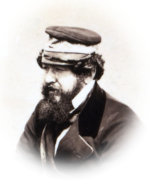
William Howard Russell’s Diary.

My Diary North and South – William Howard Russell

October 20th.–I saw General McClellan to-day, who gave me to understand that some small movement might take place on the right. I rode up to the Chain Bridge and across it for some miles into Virginia, but all was quiet. The sergeant at the post on the south side of the bridge had some doubts of the genuineness of my pass, or rather of its bearer.

“I heard you were gone back to London, where I am coming to see you some fine day with the boys here.”

“No, sergeant, I am not gone yet, but when will your visit take place?” [continue reading…]

0 comments

“Our poor boys! What may not each battle bring forth? Scarcely a battalion of the army, in any part of the Confederacy, where they are not.”—Diary of a Southern Refugee, Judith White McGuire.

Diary of a Southern Refugee During the War by Judith White McGuire

Sunday Night.—To-day went to church, and heard an admirable sermon from Mr. J. As we returned, we called at the post-office, and received a newspaper from Dr. Drane, of Tennessee, in which is recorded the death of his son James. He belonged to the army in Western Virginia, and died there of typhoid fever. He was one of the late pupils of the E. H. S., a most amiable, gentlemanly youth; and it seems but as yesterday that I saw him, light-hearted and buoyant, among his young companions. He is constantly before my mind’s eye. His parents and young siste—–how my heart bleeds for them! Our poor boys! What may not each battle bring forth? Scarcely a battalion of the army, in any part of the Confederacy, where they are not.

0 comments

A Diary of American Events.

The Rebellion Record – A Diary of American Events; by Frank Moore

October 20.–Two or three companies of the Forty-third Indiana regiment, stationed at Camp Vigo, in Terre Haute, under command of their colonel, proceeded quietly this evening to the office of the Journal and Democrat, and in a short time demolished every thing it contained. They then proceeded to several private houses, and served them in the same manner.–New York Times, October 22.

–This morning a heavy detachment from General Smith’s division made a reconnoissance to Flint Hill, Va., which is about two miles and a half from Fairfax Court House, and from which there is a good view of the village. A strong picket was observed there, and indications that a large or reserve force was in the vicinity. The reconnoitring party consisted of portions of Mott’s and Ayres’ batteries, and companies from the Fifth (regular) and from Col. Friedman’s regiment of cavalry. Generals McClellan, Porter, Smith, and Hancock accompanied the expedition.–National Intelligencer, October 21.

–The Sixth regiment of Vermont Volunteers, under the command of Colonel Nathaniel Lord, Jr., passed through Jersey City, N. J., en route for Washington. The regiment numbered one thousand and fifty men.

0 comments

… a fight with the rebels at Harper’s Ferry and Bolivar Heights.—Rhode Island Light Artillery

Diary of Battery A, First Regiment, Rhode Island Light Artillery, by Theodore Reichardt

Saturday, October 19.—Gen. Banks and staff honored our battery drill with their presence. Col. Geary of the Twenty-eighth Pennsylvania, and Capt. Tompkins, with the right section, had a fight with the rebels at Harper’s Ferry and Bolivar Heights. Our right section, occupying Mary land Heights, fired into Bolivar and on a rebel battery on Loudon Heights. Even the drivers served an old iron gun. Col. Geary’s troops, crossing the river in scows, carried the fight to Bolivar Heights. No loss of men in the right section.

0 comments

Rebel War Clerk

Civil War Day-by-Day

OCTOBER 19th.—Col. Ashby with 600 men routed a force of 1000 Yankees, the other day, near Harper’s Ferry. That is the cavalry again! The spies here cannot inform the enemy of the movements of our mounted men, which are always made with celerity.

0 comments

Battery drill and visit by Gen. Banks—Rhode Island Light Artillery

Diary of Battery A, First Regiment, Rhode Island Light Artillery, by Theodore Reichardt

Wednesday, October 16.—Battery drill, and speech by our First Lieutenant. Gen. Banks visited our camp this evening. Nothing important up to (October 19)

0 comments

I think we are in dark & trying times, and I am afraid.

Journal of Meta Morris Grimball
Meta Morris Grimball

October 19

       Mrs Butler was written to by her Lawyer and came from the North by the way of Washington where she got a permit from Gen. Scott, was forwarded to Fortress Monroe and from thence to Norfolk where she arrived with a Flag of Truce. She left Cornelia at School at the North. She looks very well is thinner than she was and still very handsome, expects to go to Georgia the last of the Month to be there perhaps to the end of the war.

       Things seem to go on so slowly, and are so ruinously low and high that I suppose at the end of it we shall be in a deplorable state. I think it was all right to sepparate from the North but to us as a family it was just ruin.—

       The Northern property was then sold, and we were about to realize something from it the prices last Fall were very high, & now this is all over and the attainment of positions are so difficult the boys have nothing to do now apart from the war.

       John is a Lieutenant, which he greatly enjoys, but William & Arthur are much in need of Commissions they belong to Militia Companies they do not pay except on service. The regular companies always pay & always have something to do, such a young man as William seems to deserve all distinction, but it is not easily got.—How dreary life is & how sinful we are.—

       There have been some interesting speeches in Court, about the sequestration of property of alien enemies, Mr Pettegrew Nelson Mitchel on our side and others against their view.—

       Mrs Butler is at the Mills House & has dined here twice & spends all her evenings with us. Her daughter is at her place at the North.—near Philadelphia. She comes on to secure her property. After spending 3 weeks here she went on to Savannah and had her business arranged to her satisfaction.

       The Yankee fleet attacked Hilton Head and Bay Point silenced the Batteries there and are now in Broad River. The poor Beaufort people fled in every direction, leaving the Town to be sacked by the negroes. The Batteries were abandoned it is now thought too soon and as is always the case where there is a failure it is considered mismanaged. Gen. Drayton, Trapier & Ripley & Lee has come on from Virginia to take charge. Troops have come from North Carolina to assist, and they are waiting to protect the Rail Road. The Women were seized with a perfect panic and many fled into the interior, such terror stricken creatures disgrace their Revolutionary Ancestry. William, Berkley & Arthur are with their Company encamped at the Race Ground every day or two they come in and I see them. John paid us a visit and it was charming to see him he has been away all the Summer. Berkley is not very enthusiastic about Military affairs, and finds the camp life perfectly horrible. It is very amusing to hear him recount his annoyances, damp hay to lie on, & such a hard bed, was in a nice mess, but did not know how to arrange paying his share, got some tea & sugar to put in and went off rather pleased. Charles has been passing the Summer at Savannah in the same house with Miss Emma & Miss Clem Wallister and not long since he offered himself to Miss Clem was accepted & engaged 3 days when Miss C. found out she loved another Charley & not Charley Morris so C. came here with Mrs Butler, & having business in Savannah returned there and having a conversation with Miss Emma again reconciled himself to Miss Clem & arrived here in a state of great beatitude was now engaged & to be married on Wednesday 20 Nov. On the 15 a telegram arrives telling him to come to Savannah & then another to come on alone so we are all in a maze fearing Miss Clem has again pranced off and Charles went off yesterday & was in Savannah at 8 this morning. He is so crazy to get married it is quite ridiculous. Ella says when Clem first pranced off Charles having just recovered from an attack of fever was terribly nervous & Miss Emma & herself had to administer nervines to him and sustain his sinking spirits & on one occasion when Miss Emma left the room he said he thought it was a pity he had not addressed Miss Emma. Last summer Richard who is here told Ella Charles felt himself very near dying and told R. if that happened he must give all his effects to Mrs Nightingale which highly insenced Mrs B. who has always been very kind to C. She says at any rate she would keep the things she had in charge the Nightingales should not have them.—Richard looks very well & is very agreeable, he is stouter & improved in appearance. Papa & Mr Grimball came to Town on a visit, both looking well & reporting all quiet and going on as usual. We are to stay here for the present. Mr Grimball will be on the Plantation keeping the negroes together & I taking care of the girls, the boys in the tented field:—

       The Yankees have not made much progress, a Flag of truce came from the fleet to one of the Batteries and one of the Officers said they had no wish to disturb quiet & loyal Citizens, the reply given by Captain O Barnwell was there were no such about there. Mr Edward Barnwell has his nephew Cap W. Barnwell, the son of the Rev. Mr Barnwell at his house desperately wounded by accident by a pistol said to be a very clever young man. His Mother & Sisters are with him a very sad case. Arthur made $51 in the Medical Director’s office which enabled him to purchase with others a tent. John is in Wapoo with his Davis.—John is now here with his Davis quite busy & happy. Charles has married Miss McAllister and brought her here, Clementina, as she chooses to be called. A woman of the world, of good family & in peace times would have 40 thousand dollars. Has red hair a good figure & add is a sensible educated woman, quite accustomed to society and will manage Charles & take care of his money & make him very happy. Mr Grimball writes that Pinebury is a Military Station and seems to be having an interesting time there entertaining the Officers.—There is a detatchment of Cavalry on the lawn, 2, 6 pounders at the Bain landing, a bridge of Flats accross the river.

       I think we are in dark & trying times, and I am afraid. The people of the Sea board so loud in their expressions of determination while the war is in Virginia feel very faint now that it has come upon us. The Yankees have landed on Tybee & put up the Flag, so these two States, Georgia & South Carolina have now the Flag of the enemy floating on their coasts. In Florida they have Brag to Fight it out on the Coast, Pensicola fortunately for them Gen Drayton & Trapier are not men to be depended on, they have not heads to command. Gen. Lee, who was thought slow, & said to be a grand General he is superior over all.

       The Camp seems to be a nice place William, who has lost his watch a gift from me (I think through carelessness) says they live very well in his mess. He looks very well indeed.

0 comments

“Everybody seem to be waiting like Mr ‘Micawber’ for ‘something to turn up.’—Horatio Nelson Taft

Diary of US patent clerk Horatio Nelson Taft.

SATURDAY, OCTOBER 19, 1861.

A dense fog all over the City this morning and it has been a misty damp day. I have not been out today yet do not feel very bad, had a restless night and some fever but feel better tonight. A great deal of heavy firing all day over the river, some fighting down with the Batteries last night and this morning. No particular news afloat. Everybody seem to be waiting like Mr “Micawber” for “something to turn up.”

______

The three diary manuscript volumes, Washington during the Civil War: The Diary of Horatio Nelson Taft, 1861-1865, are available online at The Library of   Congress.

0 comments

Plenty

Miscellaneous document sources, News of the Day

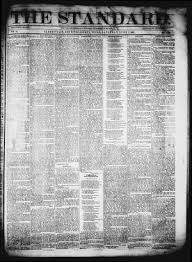
Standard [Clarksville], Tx, October 19, 1861

In Northern Texas we have the fruits of the earth in abundance. Corn rates at 25 cents per bushel. Immense quantities could be contracted for at that rate, to be delivered in any of our Country Towns. Wheat can be purchased at 50 cents per bushel in large quantity. The best flour made in Northern Texas, and not excelled in quality anywhere can be purchased in Paris, Lamar County, and probably throughout several counties, at $2 per hundred pounds. Sweet Potatoes are plentiful, and are sold in the County Towns at 50 cents per bushel. Apples of excellent quality, are offered upon the Streets of Clarksville, every two or three days at one dollar per bushel. Beef is abundant, fat and cheap. Pork will be worth about $5 per hundred at Christmas. Hogs are not in excess, but there is Mast, and Corn is a drug, consequently Pork cannot be at a high price. Now is the time for migration to Northern Texas, and emigrants are daily coming in, many of them from Kentucky, accompanied by trains of dark colored followers. Their force migration will not prove a hardship, but will result in great blessings to them, cheap and fertile lands, health, plenty, freedom from political cares, as members of an undivided body politic.

0 comments

“…to my disappointment I found they were the 4th New Hampshire regiment.”—War diary and letters of Stephen Minot Weld.

War diary and letters of Stephen Minot Weld

Saturday, October 19.—Nothing of any interest occurred to-day. We expected our regiment to come on board and waited all day in vain. Finally, about eight o’clock P.M. they came, and to my disappointment I found they were the 4th New Hampshire regiment, as I hoped to see some Massachusetts troops. Church, the reporter of the New York Sun, and Green of the Boston Journal came on board.

0 comments

Downing’s Civil War Diary.–Alexander G. Downing.

Diary of Alexander G. Downing; Company E, Eleventh Iowa Infantry

Saturday, 19th–The Eleventh Iowa Infantry was completed today. All the companies now have their full quotas.

0 comments

“Do not be disturbed by any newspaper reports about us.”—Reminiscences of the Civil War by William and Adelia Lyon.

Reminiscences of the Civil War, William and Adelia Lyon

Letter from Captain Lyon to Mrs. Lyon.

“Pilot Knob, Saturday, Oct, 19, 1861.–We arrived here on Thursday afternoon. This place is ninety miles southwest of St. Louis. Ironton is only two miles from here. The country is rough, wild and mountainous. Pilot Knob is a conical hill, rising some eight hundred feet above us. There are also extensive lead mines in the vicinity. I wrote you at De Soto, forty miles from here. We came on to where the bridge across Big River was burned, and my company and another were sent on here in advance of the rest of the regiment. Col. Murphy, who was with us, had a telegram from here saying the rebels were advancing on this place. We hurried up, the train running with frightful velocity, and when we got here the inhabitants were running from the place to the hills and everybody said a battle was being fought three or four miles out. We expected to be sent right on. It was concluded, however, that we should wait for the balance of the regiment, which had been sent for in great haste. Before they arrived we learned the facts about the fight. It was a mere skirmish, some twenty miles from here, between three hundred Indiana cavalry stationed here and a detachment of cavalry from the rebel army. Five or six men wounded on our side, none killed. Several reported killed on the other side.

“There are about four thousand troops here. The men are all anxious to fight. It is impossible to foretell our future movements. Do not be disturbed by any newspaper reports about us. One of the St. Louis papers yesterday puts us in a battle here and has us badly cut up. That is a fair specimen of their accuracy. I was in more danger on the cars Thursday than I shall be in any battle. When I see the misery and suffering which I see this war causes here, I thank God that you are all in peaceful homes and that the trials and perils of the contest, so far as you are concerned, can be borne by me alone.”

0 comments

Letters of Rutherford B. Hayes.

Diary and Letters of Rutherford Birchard Hayes

Camp Tompkins, Near Gauley Bridge, October 19, 1861.

Dear Uncle: – It is late Saturday night. I am away from my regiment at General Rosecrans’ headquarters and feel lonesome. The weather is warm, threatening rain. We are waiting events, not yet knowing whether we are to stay here or go to some other quarters for the winter. I can’t help suspecting that important events are looked for near Washington which may determine our course for the winter. All things in that direction have, to my eye, a hopeful look. A victory there if decisive will set things moving all over. We know the enemy we have been after is heartily sick of this whole business, and only needs a good excuse to give it up. A party of our men, bearing a flag of truce, spent a night with a party of Lee’s men a few days ago, and the conversations they report tell the story.

Matthews has gone home for a fortnight. It is quite probable that I shall go home during the fall or winter for a short visit.

We have done no fortifying yet. We occasionally hear of a little guerrilla party and scamper after them, but no important movements are likely to occur here, unless a road should be opened from Washington to Richmond.

I see that Buckland is in the war. That is right. The noticeable difference between North and South in this war is, that South, the leading citizens, the lawyers and public men of all sorts, go into the fight themselves. This has not been so with us in the same degree. I am less disposed to think of a West Point education as requisite for this business than I was at first. Good sense and energy are the qualities required. . . .

Sincerely,

R. B. Hayes.

S. Birchard.

0 comments

Letters of Rutherford B. Hayes.

Diary and Letters of Rutherford Birchard Hayes

Camp Tompkins, October 19, 1861.

Dearest: – I got your letter of last Sunday yesterday. You can’t be happier in reading my letters than I am m reading yours. Very glad our little Ruddy is no worse.

Don’t worry about suffering soldiers, and don’t be too ready to give up President Lincoln. More men are sick in camps than at home. Sick [men] are not comfortable anywhere, and less so in armies than in good homes. Transportation fails, roads are bad, contractors are faithless, officials negligent or fraudulent, but notwithstanding all this, I am satisfied that our army is better fed, better clad, and better sheltered than any other army in the world. And, moreover, where there is want, it is not due to the general or state Government half as much as to officers and soldiers. The two regiments I have happened to know most about and to care most about – McCook’s Ninth and our Twenty-third – have no cause of complaint. Their clothing is better than when they left Ohio and better than most men wear at home. I am now dressed as a private, and I am well dressed. I live habitually on soldiers’ rations, and I live well.

No, Lucy, the newspapers mislead you. It is the poor families at home, not the soldiers, who can justly claim sympathy. I except of course the regiments who have mad officers, but you can’t help their case with your spare blankets. Officers at home begging better be with their regiments doing their appropriate duties. Government is sending enough if colonels, etc., would only do their part. McCook could feed, clothe, or blanket half a regiment more any time, while alongside of him is a regiment, ragged, hungry, and blanketless, full of correspondents writing home complaints about somebody. It is here as elsewhere. The thrifty and energetic get along, and the lazy and thoughtless send emissaries to the cities to beg. Don’t be fooled with this stuff.

I feel for the poor women and children in Cincinnati. The men out here have sufferings, but no more than men of sense expected, and were prepared for, and can bear.

I see Dr. S– wants blankets for the Eighth Regiment. Why isn’t he with it, attending to its sick? If its colonel and quartermaster do their duties as he does his, five hundred miles off, they can’t expect to get blankets. I have seen the stores sent into this State, and the Government has provided abundantly for all. It vexes me to see how good people are imposed on. I have been through the camps of eight thousand men today, and I tell you they are better fed and clothed than the people of half the wards in Cincinnati. We have sickness which is bad enough, but it is due to causes inseparable from our condition. Living in open air, exposed to changes of weather, will break down one man in every four or five, even if he was “clad in purple and fine linen and fared sumptuously every day.”

As for Washington, McClellan and so on, I believe they are doing the thing well. I think it will come out right. Wars are not finished in a day. Lincoln is, perhaps, not all that we could wish, but he is honest, patriotic, cool-headed, and safe. I don’t know any man that the Nation could say is under all the circumstances to be preferred in his place.

As for the new governor, I like the change as much as you do. He comes in a little over two months from now.

A big dish of politics. I feared you were among croakers and grumblers, people who do more mischief than avowed enemies to the country.

It is lovely weather again. I hope this letter will find you as well as it leaves me. Love and kisses for the dear ones. Affectionately, ever,

R. B. Hayes.

Mrs. Hayes.

0 comments

Mr. Seward and Lord Lyons.—William Howard Russell’s Diary.

My Diary North and South – William Howard Russell

October 19th– Lord Lyons and Mr. Seward were driving and dining together yesterday en ami. To-day, Mr. Seward is engaged demolishing Lord Lyons, or at all events the British Government, in a despatch, wherein he vindicates the proceedings of the United States Government in certain arrests of British subjects which had been complained of, and repudiates the doctrine that the United States Government can be bound by the opinion of the law officers of the Crown respecting the spirit and letter of the American constitution. This is published as a set-off to Mr. Seward’s circular on the seacoast defences which created so much depression and alarm in the Northern States, where it was at the time considered as a warning that a foreign war was imminent, and which has since been generally condemned as feeble and injudicious.

0 comments

A Diary of American Events.

The Rebellion Record – A Diary of American Events; by Frank Moore

October 19.–Colonel Morgan, with two hundred and twenty men of the Eighteenth Missouri regiment, with two pieces of artillery, had a fight with some four hundred rebels, on Big Hurricane Creek, in Carroll County, Mo., killing fourteen, taking eight prisoners, and putting the balance to flight. Colonel Morgan had fourteen men wounded, two mortally.–(Doc. 98.)

–The Leavenworth (Kansas) Conservative of this date gives an account of the surrender of Fort Fillmore, New Mexico, as follows:–

On the 6th of July, Major Lynde had command of seven companies of infantry and two of cavalry, in all about seven hundred men. The next officers in rank were Captains Poster and Stevenson and Lieut. McAnnelly. On the 24th of July, at three o’clock p.m,, four hundred and eighty men, with four pieces of artillery, started for Mesilla; arrived there at dark; were drawn up in line of battle between two cornfields; there were no flankers and no skirmishers out; the cavalry were within eighty-five yards of the ambuscade laid by the Texans, who numbered less than two hundred, and were poorly armed. Shots were fired out of the cornfield, one of them taking effect on Lieut. McAnnelly, a true Union man. Major Lynde was behind a wagon. A perfect cross fire was opened on the cavalry, and, no officer now being in command of them, they retreated. No order had been given them to dismount, fire, or charge, and they retreated “on their own hook” to the rear of the infantry, in order to give the artillery a chance to fire. Our own infantry opened a perfect volley on our own cavalry– by mistake, it was said. A few shots were fired by the artillery, when the whole command was ordered to retreat back on the post. Arrived there at nine o’clock. Next day all were engaged in fortifying. At half-past ten an order was given to evacuate that night. The commissary was ordered to roll out the whiskey, and the infantry were allowed to drink it and fill their canteens. No water was furnished for the hot march before them. The march was undertaken in the most irregular manner, and before we had gone ten miles men were dropping from the ranks and falling down drunk. At two in the morning Texan troops were seen advancing on the Los Crusas road. Our adjutant, on being informed of it, made no preparations to resist an attack, but said:–”They have nothing to fear from us.” Of the seven companies, so many had been left drunk and captured that no more than two companies went into camp. The officers left the men, and held a long council of war. The men of the rifle command decided among themselves to fight. Just as they were ready Captain Gibbs came up, ordered a retreat upon camp, saying:–“We will fight them there.” As soon as they reached there, they were formed into line, and told to dismount for the last time. “You are turned over as prisoners of war,” was all they heard. All the arms and supplies were given up, the oath was administered, and next day the men were released on parole.

–The schooner Fairfax, of Georgetown, D. C., bound up the Potomac with 1,100 bales of hay and 500 barrels cement, was captured by the rebels off Shipping Point. This schooner and another vessel, in tow of the steam-tug Resolute, were fired upon when passing the rebel batteries, and at that critical moment the hawser by which the Fairfax was attached to the steamer broke. The vessel had necessarily to be left to her fate. She drifted toward the batteries, from which several boats started and took possession of her. The Resolute, with the other vessel in tow, proceeded up the river. This is the first serious disaster that has happened to any vessel in passing these batteries. –National Intelligencer, October 21.

–Twenty rebel prisoners, selected from among the North Carolinians on Bedloe’s Island, were sent to Fortress Monroe, there to be released upon taking the oath not to bear arms against the United States Government. This is done in response to the recent release of fifty-seven wounded soldiers at Richmond. As nearly all the persons released by the rebel authorities are disabled by wounds and disease, more than half of them having had a limb amputated, Col. Burke made a selection in the same manner from among the common soldiers, and these were taken who appeared to be most disabled and weakened by disease. Their names are not given. This action of the Government was an agreeable surprise to the prisoners, and the fortunate ones hailed their deliverance with unfeigned delight.–Baltimore American, October 21.

–Abel Smith, colonel of the Thirteenth regiment of New York Volunteers, died this morning, at Mechanicsville, N. Y., from injuries sustained on the railroad, at that place.– Gen. Heintzleman made a reconnoissance in considerable force along the telegraph road as far as Pohick Church and Acotink Creek, in Virginia, when some of the rebel pickets were met and driven back. It was ascertained that the rebel forces were posted between the telegraph road and Occoquan.– Washington Star, October 21.

–General Wool, at Fortress Monroe, issued an order, giving every male contraband employed in the department, eight dollars per month, and every female four dollars per month. –New York Tribune, October 21.
0 comments

Civil War Day-By-Day

Civil War Day-by-Day

October 19, 1861

  • President Davis tries to quell an on-going dispute between Generals Johnston [CS] and Beauregard [CS].

A Chronological History of the Civil War in America1

  • Skirmish at Big Hurricane Creek, Carroll Co., Mo.

  1. A Chronological History of the Civil War in America by Richard Swainson Fisher, New York, Johnson and Ward, 1863
0 comments

This embarkation business. . . .

Woolsey family letters during the War for the Union
Francis Bacon to Georgeanna Muirson Howland (his future wife).

Camp Walton, Annapolis, Oct. 18th, ‘61.

Pardon a wretched notelet, written on camp stationery with the very dregs of the day’s ration of nervous energy. Everybody is both tired and busy to-night with this embarkation business. . . .

You will readily believe they are sober enough, these long, undulating files of honest brown faces, as they pour down upon the wharves, but there are good, rousing cheers, too, as the tenders swing out into the stream and go scuttling away to the great motionless ships in the roads.

I notice with surprise, and with some apprehension as well, that the 6th and 7th Connecticut, green as I have thought them, are farther advanced in the military art than any other troops I have seen here. This is not brag, you will please consider, it is very reluctant conviction. But still, as for me, turning more sadly than ever before from the loyal North, I feel an exultation in helping to strike, as we are hoping, the heaviest blow at the great crime that it has yet felt.

Your basket is such a miracle of packing that I have hesitated to thoroughly ransack it, fearing that the attempt to restore its contents to their normal condition might reduce me to a state of hopeless idiocy, like a Chinese puzzle, or a book on political economy.

Moritz delicately hinted at French rolls as being the only things that could not defy the ravages of time, and so, one terribly stormy evening, being the second after the arrival of the basket, Chaplain Wayland, my brother the Captain and I, having our rival teapots all in a row, each singing over her own spirit-lamp, I removed the stratum of rolls and disposed of them to the immense satisfaction of the tea-party. This gave me a glimpse of the blue and gold Tennyson lying lapped among the balmy bolognas. Ever since, I have been longing for the golden moment to come when I could sit, or, more properly, lie down to my own individual, personal, particular, blue and gold Tennyson. This may probably be when every soul in the regiment except myself is helplessly, hopelessly seasick, and nobody can “come a botherin’ me.”

0 comments

Rebel War Clerk

Civil War Day-by-Day

OCTOBER 18th.—I cannot perceive that our army increase as much in strength, particularly in Virginia. The enemy have now over 660,000 in the field in various places, and seem to be preparing for a simultaneous advance.

It is said millions of securities, the property of the enemy, are transferred to the United States. It is even intimated that the men engaged in this business have the protection of men in high positions on both sides. Can it be possible that we have men in power who are capable of taking bribes from the enemy? If so, God help the country!

0 comments

“I heartily despise the whole of them and would ask no favors in ordinary times.”—Horatio Nelson Taft

Diary of US patent clerk Horatio Nelson Taft.

FRIDAY 18

Wrote a note to Maj Watt this morning, sent it by “Bud.” He returned with a fine Boquet from Mrs Lincoln for the Sec’y of the Interior, C B Smith. Bud took it down to him when I called upon him about noon. He said he would confer with the Comr of Pats and see what could be done for my restoration to the office. I heartily despise the whole of them and would ask no favors in ordinary times.

______

The three diary manuscript volumes, Washington during the Civil War: The Diary of Horatio Nelson Taft, 1861-1865, are available online at The Library of   Congress.

0 comments

If we save Pilot Knob this time, I shall rejoice.—The Letters of Samuel Ryan Curtis

The Letters of Samuel Ryan Curtis

Head-Quarters Camp of Instruction
Benton Barracks, (near St. Louis, Mo.,) Oct 18 1861

General1

I asked by Telegraph a suspension of your order directing the 8th Wisconsin to report at Jeffersonville to Genl Sherman; mainly because General Fremont was draining this point when Thomson was moving against us, to pursue Price2 who was retreating far towards Arkansas, and I saw that any accident or apparent danger in this vicinity would renew the cry of persecution and neglect. I therefore pressed the Wisconsin and another regiment towards Pilot Knob and Telegraphed the Commander at Cairo to send a force through from St. Jenevive towards Pilot Knob to save our force and stores at that point and peradventure close in on Thompson. I hear the Wisconsin has reached Pilot Knob but I have no response from Cairo. If we save Pilot Knob this time, I shall rejoice. The only importance attached to the point is our guns and stores.

If they were not there no army would be tempted to within fifty miles of the poor sterril volcanic labarynth of hills and defiles. True it is the end of a Railroad, but the end of a railroad without the rolling stock which should be held here in this city; is of no use to a foe, and hence there is no need of half a million of stores and useful force at that point to invite the starving scoundrals of McCuIlough to come and steal them. Whatever be the result then, do not overlook the movements of the enemy this side which took Capt Elliot and his company and faught the Home guards in the vicinity. The Wisconsin 8th and Boyds Regiment were needed. I started about 300 Cavelry, but Capt. McKeever very sumeraly ordered them back and sent them to Geni Fremont taking away every armed cavalier in this Command.

At last accounts Genl Fremont was about 30 miles south of the Railroad–Price far below.

I hope that persuit will not be prolonged far in that direction, with the large force now accumulated out there; as it will be very expensive, and no considerable force of the enemy will make a stand there.

If I had Cavelry arms I could send 3000 to the Pilot Knob and that is the force most needed. But every arm goes West, and my Cavelry is useless. My infantry is very little better being mainly with no arms and [continue reading…]

0 comments

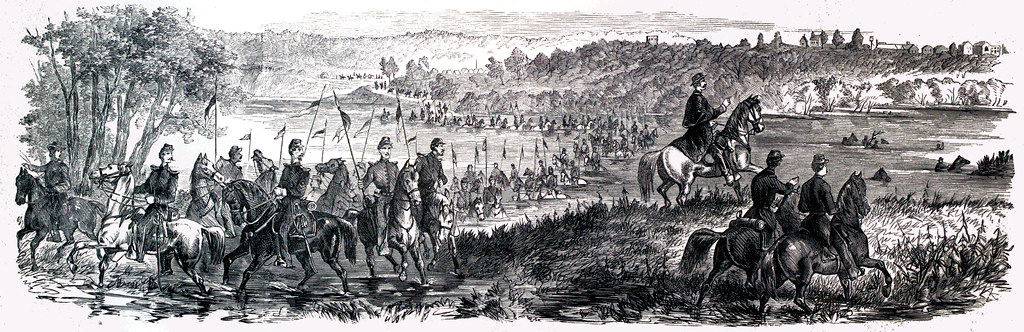
Fording of the Osage River at Warsaw Missouri by the Fremont Hussars, October 18th, 1861

Frank Leslie’s Illustrated Newspaper
Fording of the Osage River at Warsaw, Mo, by the Fremont Hussars, October 18th, 1861

The Confederate general Price, when retreating before General Fremont, rightly believed that if he could put the Osage River between him and the Federal commander, and destroy the bridge across it, he could so delay pursuit as to make an easy escape into Arkansas. But he did not rightly judge the resources or vigor of General Fremont. When Fremont approached the river at Warsaw he rode forward through mud and rain twenty-five miles, viewed the stream and gave prompt orders for bridging it; which were carried out so rapidly that within four days his entire force was able to cross and follow up the pursuit.

(from Frank Leslie’s Illustrated History of the Civil War…, edited by Louis Shepheard Moat, Published by Mrs. Frank Leslie, New York, 1895)

0 comments

Annapolis—War diary and letters of Stephen Minot Weld.

War diary and letters of Stephen Minot Weld

Friday, October 18.—We reached Annapolis about 11 o’clock in the morning, and had to anchor in the stream about 4 miles from the city. I went ashore in the afternoon, and took a look at the city. We landed at the Naval School, and found the grounds full of troops, etc. The 21st Massachusetts, Colonel Morse, is stationed here, but I had no chance to see any of the officers. The grounds of the Naval School are quite spacious, and face the Chesapeake on one side, and the river Severn on the other. The buildings are of brick and quite substantial, though by no means handsome. Right on the water is a round building with guns mounted, which was used for the middies to practice in. On the right of this battery a long pier runs out into the river, and at the end of it, the Constitution was anchored. Uncle Oliver told me that when he came here last April, the rebels were erecting a battery on the other side of the river, and about an eighth of a mile distant, to destroy the Constitution. His timely arrival, however, put an end to their villainous schemes, by taking the ship and school away. The professors’ houses were built in a row on the right side of the ground.

Having procured a pass, we got outside the grounds, and into the city, the capital of Maryland. The streets were in a terrible state from the rain, which made a horrible clayey sort of mud, much to the detriment of our shoes, which were soon covered with a good coat of this Maryland blacking. We finally came out on a street which was roughly paved and which led us to the post-office and the hotel. I inquired for letters, but found none, and was consequently much disappointed. The next place I visited was the State House. It stands on a hill, the highest one in the town, and has a green around it. From this green the streets all diverge, making a sort of cobweb. On entering the State House, I was saluted by a young boy about ten years old, who was smoking a cigar, and who seemed to think himself the owner of the place. Accepting his services as an escort, we were shown into the Senate and House of Representatives. They were both of them ordinary-looking rooms with very common-looking pine chairs and desks. On first entering the House, the visitor sees the arms of the State staring him in the face, and the motto, “Crescite et multiplicamini,” written under them. The city, however, belies the motto as far as I could see, for it looks as if it had not increased for a century, but had stood still, and as if all its inhabitants and buildings had been enjoying a century’s rest. From the cupola I had a most magnificent view, and one which well repaid me for the trouble I had in getting ashore. Close around me was the town, with its quaint, old-fashioned houses, with gables and over-hanging roofs, many covered with moss, and, in some cases, plants growing from the eaves. It was more like a view of an old-fashioned English town which one often sees painted on canvas in stage-scenery. Then beyond the town were fertile fields, with crops ready for gathering, and every little way, a beautiful hillock rising up, with splendid trees growing there, and the river winding among them, now sparkling like a silver cord, and now hidden from the sight. Then again, the white tents of the soldiers would peep out from the dark green of the trees, and what at first sight seemed a long fence, but on closer inspection proved to be the troops going through their dress-parade, would meet one’s view. The sight was a most beautiful one, and one which I cannot describe. The rivers on both sides of the city, with their steep banks thickly wooded, and winding so prettily among the hills, were in themselves a sufficient compensation for the climb up to the cupola. Then looking out on the Chesapeake and seeing over twenty steamers, in addition to a large number of small craft quietly at anchor in the bay, and the long blue shore of Virginia opposite, made one wish to stay forever almost, and enjoy the beautiful sight. I could hardly tear myself away; but as I had little time to waste, I soon descended.

I saw here a cannon which Lord Baltimore brought over in 1624, and which had fallen into the river and had lately been fished up. I saw Captain Eldridge and went on board the Baltic with him.

0 comments

Diary of Rutherford B. Hayes.

Diary and Letters of Rutherford Birchard Hayes

Camp Tompkins, October 18, 1861.

Dearest : – Soon after I had sent off my letter yesterday, Mr. Schooley stopped with your bundle and letter. All most acceptable, gloves, etc., particularly. I get all your letters. . . .

Don’t worry about the country. Things are slowly working around. For a first campaign by a green people, we have done well. The Rebellion will be crushed even at this rate by the time our three years are up. McClellan is crowding them. They must fight or run soon, and I think either is death.

We have a little excitement every day over some guerrilla story. But the rumors as they are sifted vanish rapidly into smoke.

Dr. Menzies was here today. He is troubled about his family, about his colonel, and so on. Very queer how some clever people manage to keep in a worriment under all circumstances.

One paymaster has come up. We hope to see ours some day. I shall send you funds as soon as they are paid me.

It is raining – a settled fall rain. But we are in a valley (not on top of Mount Sewell). I have a board floor to my tent. Who cares for the rain? – especially if my wife and bairns are safe under a tight roof by a warm fire. Keep up good courage. Kiss the boys, give my love to all, and continue to have happy dreams about your

Affectionate husband,

Rutherford.

Mrs. Hayes.

0 comments

Downing’s Civil War Diary.–Alexander G. Downing.

Diary of Alexander G. Downing; Company E, Eleventh Iowa Infantry

Friday, 18th–Nothing of importance. At the sound of reveille every man has to get up, fall in line, and answer to his name. We then march down over the bluff to the river to wash for breakfast, going by companies, each under the command of an officer.

0 comments