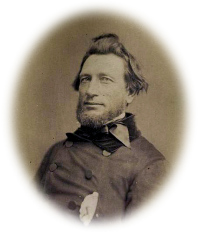
“Some days it is a constant Cannonade.”—Horatio Nelson Taft

Diary of US patent clerk Horatio Nelson Taft.

MONDAY, DECEMBER 9, 1861.

The day has been warm and soft as May. No fires necessary in the house. The northern soldiers are highly delighted with this kind of winter. Nothing new in the City. The immence Army near the City keep so quiet that we hard[ly] realize that 250,000 Soldiers are within a few miles of us. There is a great deal of practicing with the guns at the Forts. Some days it is a constant Cannonade. I did a little glazeing tonight, then called with Julia at Mr Fenwicks and spent an hour or two. Mr Munson, owner of “Munsons Hill,” was there. He is the Fatherinlaw of Mr Fenwick. Very inteligent man.

______

The three diary manuscript volumes, Washington during the Civil War: The Diary of Horatio Nelson Taft, 1861-1865, are available online at The Library of   Congress.

0 comments

Rebel War Clerk

Civil War Day-by-Day
A likeness of Jones when he was editor and majority owner of the Daily Madisonian during President John Tyler’s administration.

DECEMBER 9th.—Gen. Winder informed me to-day that he had been ordered to release Mr. Custis; and I learned that the Secretary of War had transmitted orders to Gen. Huger to permit him to pass over the bay.

0 comments

The enemy knows our national flag and had already tried to deceive us by hoisting it at their head.

Civil War Day-by-Day

MANASSAS JUNCTION, VA., December 9, 1861.

Dear Mother:

I received your letter some days since and was very glad to hear from you and would have answered immediately but Walter has gone to Richmond and I thought I would wait until he came back. He went with a detail of men to carry prisoners who were taken by the N. C. Cavalry. He came back day before yesterday and brought us several books to read. Among the prisoners was a deserter from the Federal camp. He was a Baron in Russia and being of an adventurous disposition, he came over to participate in a battle or two and accepted a Lieutenant’s commission in the Federal army, but finding, as he said, that there was not a gentleman in the whole army, he deserted, took a horse and came into our camp and has been sent to Richmond for trial. Formerly he had a commission in the Russian army, which he showed to the people.
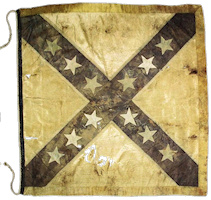
We are expecting a battle daily. Yesterday we were presented with a battle flag from General Beauregard, consisting of white cloth crossed with blue. This is for us to fight under and also every other regiment has one. The enemy knows our national flag and had already tried to deceive us by hoisting it at their head. Now I guess we will deceive them next time.

Our company has been detached from the regiment for the purpose of taking charge of two batteries which another company has left. We are now relieved of a great deal of duty, for we only have to guard the batteries which take six men a day and that brings us on about once a week, and we drill occasionally. With that exception we have nothing to do, but if the regiment leaves to go into a fight our company goes also, and if the battle rages at this point we will give them a few grapes to eat and also a few shells to hide themselves in and then we will play ball with them for a while.

Walter is still at his old, or rather, new post, and has a great deal to do as the chief clerk is very sick. I hope we shall get a chance to come and see you before the winter is gone, but I have given up the idea of seeing you this Christmas, altogether, but after the fight I reckon we can get a chance to go home. Give my love to all and tell them to write soon.

Goodbye. I remain as ever,

Your loving son,
GEORGE.


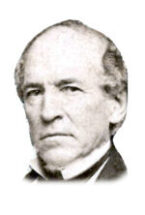
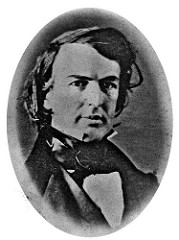
Letters from two brothers who served in the 4th North Carolina Infantry during the Civil War are available in a number of sources online.  Unfortunately, the brothers are misidentified in some places as Walter Lee and George Lee when their names were actually Walter Battle and George Battle. See The Battle Brothers for more information on the misidentification.
0 comments

“The purpose of the expedition was to destroy a dam across the Potomac which feeds the canal now used by the enemy in shipping coal.”–Letters from Elisha Franklin Paxton.

Elisha Franklin Paxton – Letters from camp and field while an officer in the Confederate Army

Martinsburg, December 9, 1861.

I did not write my accustomed Sunday letter to you on yesterday. I was otherwise busy until 9.30 o’clock last night, when I reached here. Then I was so sleepy and tired, I could hardly stand upon my feet, having been awake all the night before, and hard at work most of it . Yesterday I spent on the bank of the Potomac, not as decent people generally spend the Sabbath, in peace and rest, but listening to the music of cannon and musket, and witnessing their work of destruction. There was much firing, but little damage on either side, as the river intervened, and the men of the enemy, as well as our own, were well sheltered from fire. Our loss, I learn, is one mortally wounded and two very seriously; one of the latter is the son of Shanklin McClure of our county, and a member of the Rockbridge Artillery. The purpose of the expedition was to destroy a dam across the Potomac which feeds the canal now used by the enemy in shipping coal. I was appointed to superintend and direct the execution of the work, with some men detailed to do it. We reached the ground about sunset on Saturday evening, when a few shots from our artillery drove off the force of the enemy stationed on the opposite side. I then took down my force and put it to work and continued until about eleven o’clock, when we were surprised by a fire from the enemy on the opposite side again, which made it impossible to proceed until they could be driven away. At daybreak Sunday morning our cannon opened fire upon them again, but they were so sheltered in the canal–from which in the meantime they had drawn off the water–that it was found impossible to dislodge them. As my workmen could not be protected against the enemy’s fire, I found it necessary to abandon the enterprise. So you see, Love, entrusted with an important work, I have made a failure. If I had succeeded, the Yankees would have suffered much in Washington for want of coal. But they must get it as usual, for which they may thank their riflemen, who drove my party from the work of destruction upon which they were engaged.

I begin to think, Love, there is no amount of fatigue, exposure and starvation which I cannot stand. I got notice on Thursday about three o’clock that I was wanted at Jackson’s headquarters; there I got my directions, and rode here in a hard trot of about six miles to the hour. The next afternoon I rode up and took a view of the work which I had in contemplation and returned here. On Saturday’morning we left here with our forces to accomplish it. On Sunday at twelve o ‘clock I could not help but remark that I felt fresh, although I had not slept the night before, and had nothing to eat since Saturday morning at breakfast, with the exception of a small piece of bread, and had been upon my feet, or my horse, nearly the whole time. I think this war will give me a stock of good health which will last a good while. And now, Love, whilst I have been in the perils of minie-balls, I expect, when I get to Winchester, to receive a letter from somebody saying that you have been in worse perils, and that we have an addition to our small stock of children. The only special message I have is that its name may be yours or mine, just as you like. Whilst, Love, I have just been expressing my gratification at my good health, and my capacity for fatigue and exposure, I cannot help feeling this war is an uncertain life, and there is no telling that you and I may never see much of each other again. I shall try and get a leave of absence to go home this winter; but I suppose it will not be possible until after Christmas, as I think Col. Echols has the promise of a leave at that time, and it would not be proper for us both to be away at the same time.

How much I wish that I was with you, that I could stay at home! But to turn my back upon our cause, to leave the fatigue, patriotism and risk of life which it requires to be borne by others, when duty and patriotism require that I should share it, I cannot do.

0 comments

Mr. Chase’s Report.—William Howard Russell’s Diary.

My Diary North and South – William Howard Russell

December 9th.–Spent the day over Mr. Chase’s report, a copy of which he was good enough to send me with a kind note, and went out in the evening with ray head in a state of wild financial confusion, and a general impression that the financial system of England is very unsound.

0 comments

“At noon we boarded the train for Jefferson City, riding in box-cars and open cars, and reached our destination at 6 p. m.”–Alexander G. Downing.

Diary of Alexander G. Downing; Company E, Eleventh Iowa Infantry

Sunday, 8th–Reveille sounded this morning at 2 o’clock. We jumped out of our bunks, packed our knapsacks, and got started for the railroad station by daylight. As we left the barracks and entered the main street leading down to the city, the sun away to the southeast, just above the hills, showed its face–a regular ball of fire. How glorious it was! I think I shall never forget it. Arriving at the railroad yards, we stacked arms and went to loading our commissariat onto the cars–coal cars. At noon we boarded the train for Jefferson City, riding in box-cars and open cars, and reached our destination at 6 p. m.

While loading our train at St. Louis, we heard the church bells calling the people to worship. It made many of us think of home and I wonder if the folks at home were thinking of us boys here at the seat of war. For here there is no church for us, and when we get orders to go, there is no stopping for Sunday.

0 comments

Diary of Horatio Nelson Taft

Diary of US patent clerk Horatio Nelson Taft.

SUNDAY 8

A warm pleasant day, too warm for an overcoat. Went to church all day with the Family. Doct Smith preached in the morning, Mason Noble in the afternoon. Doct Smith attended the funeral of an old member of the Col[or]ed Pres[byteria]n Church. Walked with wife up to Franklin Square, called on our return at Mr Bartletts and at Mr Pecks. In the evening went down to the National and spent an hour with Aldrich of Palmyra and [T?] Mosely of Detroit (formerly of Lyons).

______

The three diary manuscript volumes, Washington during the Civil War: The Diary of Horatio Nelson Taft, 1861-1865, are available online at The Library of   Congress.

0 comments

Rebel War Clerk

Civil War Day-by-Day
A likeness of Jones when he was editor and majority owner of the Daily Madisonian during President John Tyler’s administration.

DECEMBER 8th.—I saw Mr. Benjamin to-day, and asked him what disposition he intended to make of Mr. Custis. He was excited, and said with emphasis that he was investigating the case. He seemed offended at the action of Gen. Winder, and thought it was a dangerous exercise of military power to arrest persons of such high standing, without the clearest evidence of guilt: Mr. Custis had signed the ordinance of secession, and that ought to be sufficient evidence of his loyalty.

0 comments

Visit to Washington’s Tomb.—William Howard Russell’s Diary.

My Diary North and South – William Howard Russell

December 8th.–A certain excellent Colonel who commands a French regiment visited us to-day. When he came to Washington, one of the Foreign Ministers who had been well acquainted with him said, “My dear Colonel, what a pity we can be no longer friends.” “Why so, Baron?” “Ah, we can never dine together again.” “Why not? Do you forbid me your table?” “No, Colonel, but how can I invite a man who can command the services of at least 200 cooks in his own regiment?” “Well then, Baron, you can come and dine with me.” “What! how do you think I could show myself in your camp–how could I get my hair dressed to sit at the table of a man who commands 300 coiffeurs?” I rode out to overtake a party who had started in carriages for Mount Vernon to visit Washington’s tomb, but missed them in the wonderfully wooded country which borders the Potomac, and returned alone.

0 comments

Downing’s Civil War Diary.–Alexander G. Downing.

Diary of Alexander G. Downing; Company E, Eleventh Iowa Infantry

Saturday, 7th–The Eleventh Iowa received marching orders today, and we are to carry forty rounds of extra ammunition, besides our cartridge box of forty rounds. There was no drill or dress parade today on account of an all-day rain.

0 comments

200,000 men—Horatio Nelson Taft

Diary of US patent clerk Horatio Nelson Taft.

SATURDAY 7

Another very delightful day. But it was a foggy morning, busy in the office all day. There has been heavy firing heard all day over the River. There has been no Battle and they are only practicing at the Forts. The force over the River is now said to be 200,000 men. There are many on this side, probably not less than Fifty Thousand. They keep coming all the time. I have not been on to the Ave tonight. The boys go to bed at 8, the rest of us about 1/2 past 10. We get up about 1/2 past 6. Breakfast at 8.

______

The three diary manuscript volumes, Washington during the Civil War: The Diary of Horatio Nelson Taft, 1861-1865, are available online at The Library of   Congress.

0 comments

Rebel War Clerk

Civil War Day-by-Day
A likeness of Jones when he was editor and majority owner of the Daily Madisonian during President John Tyler’s administration.

DECEMBER 7th.—Quite a commotion has been experienced in official circles by the departure of Mr. W. H. B. Custis, late Union member of the Virginia Convention, without obtaining a passport to leave the city. Some of his secession constituents being in the city, reported that they knew it was his purpose to return to the Eastern Shore of Virginia, and avow his adherence to the United States authorities, alleging that he had signed the ordinance of secession under some species of duress, or instruction. Under these representations, it seems Gen. Winder telegraphed to Norfolk, whither it was understood Custis had gone, to have him arrested. This was done and it is said he had passports from Gen. Huger to cross the Chesapeake Bay. I must doubt this. What right has a military commander to grant such passports?

0 comments

“The report to-day is that we shall now go into winter quarters here, at a safe distance from the enemy we came to whip!”–Journal of Surgeon Alfred L. Castleman.

Journal of Surgeon Alfred L Castleman.

7th.–Eight days ago to-day, the sick list was 144. Today it is 72! I begin to think that a Surgeon may be as indispensable to an army as a Colonel,–that

“A doctor skilled our deadly wounds to heal,
Is more than armies to the common weal.”

Another “speck of war” yesterday. About ten thousand men from the three divisions here having seen a “track” of the enemy, started in pursuit. After four or five miles march, we came on them in line of battle. Our army looked at t’other army and t’other army looked at our army, when our army came to the conclusion that the “touch” had become “too fresh,” and so they turned around and came home! Oh, but we are a great people. For four months we have been coaxing them to “come out,” and when at last they came out we ran off and left, and the report to-day is that we shall now go into winter quarters here, at a safe distance from the enemy we came to whip! Wonder if we may not soon expect a consignment of petticoats. Hope the ladies association will not send any. I have too much respect for the garment to see it disgraced by being worn by such officers.

The honor of the day is divided between Captain _____, of _____’s Battery, and Colonel _____, of the regiment of _____ Volunteers.[1] Yesterday, on the field, they disputed, each claiming the honor of command. To-day they dispute, each claiming that this honor attaches to the other. “Par nobile fratrum.”


[1] Were I publishing a history of the war, I should feel it my duty to fill these blanks; but as it in only a journal or record of events, as they appeared, at the time, I feel that it is more proper, as a general thing, to turn over persons to the care of the historian.

0 comments

A polyglot dinner.—William Howard Russell’s Diary.

My Diary North and South – William Howard Russell

December 7th.–A visit to the Garibaldi Guard with some of the Englishry, and an excellent dinner at the mess, which presented a curious scene, and was graced by sketches from a wonderful polyglot chaplain. What a company!–the officers present were composed as follows:–Five Spaniards, six Poles and Hungarians, two Frenchmen–the most soldierly-looking men at table–one American, four Italians, and nine Teutons of various States in Germany.

0 comments

Downing’s Civil War Diary.–Alexander G. Downing.

Diary of Alexander G. Downing; Company E, Eleventh Iowa Infantry

Friday, 6th–Very warm and pleasant. There are soldiers drilling almost all the time. Our drill ground is level but well drained, so that even after a heavy rain it is soon dry again.

0 comments

“Great crowds at all the Hotels.”—Horatio Nelson Taft

Diary of US patent clerk Horatio Nelson Taft.

FRIDAY, DECEMBER 6, 1861.

Pleasant day, fine as could be. The City all alive with people. Penn Ave is thronged from morning till late at night. I was in the office all day. At night went down to the Hotels. Called upon Judge Granger at the “Washington House.” At the “National” met W F Aldrich from Palmyra. Great crowds at all the Hotels. Miss Hartly spent the evening with Julia, her Father called for her at 9 o’clock. No news of importance afloat. Congress adjourned till Monday.

______

The three diary manuscript volumes, Washington during the Civil War: The Diary of Horatio Nelson Taft, 1861-1865, are available online at The Library of   Congress.

0 comments

Rebel War Clerk

Civil War Day-by-Day
A likeness of Jones when he was editor and majority owner of the Daily Madisonian during President John Tyler’s administration.

DECEMBER 6th.—It is rumored to-day, I know not on what authority, that the President mentioned the matter of the Drainsville disaster to the Secretary of War, and intimated that it was attributed to the machinations of the Union men discharged from prison here. It is said Mr. Benjamin denied it—denied that any such men had been discharged by Gen. Winder, or had been concerned in the affair at all. Of course the President had no alternative but to credit the solemn assertions of his confidential adviser. But my books, and the register of the prisons, would show that the Drainsville prisoners sent hither by Gen. Joseph E. Johnston were discharged by Gen, Winder, and that their expenses home were paid by the government; and officers of unimpeachable veracity are ready to testify that Gen. Stuart was misled by these very men.

0 comments

“The dishonest quartermasters are a curse to our army and our cause. . . . ” Abbie Howland Woolsey writes about the slavery question and rails about men being badly off for socks.

Woolsey family letters during the War for the Union
Abby Howland Woolsey to Georgeanna and Eliza.

December 6th.

If Mr. Craney thought the bundle of hair was a feather-bed, he will certainly think that the stocking box, when it arrives, is the bedstead following on. . . . Let me describe its contents. In the first place, E’s cheque bought seven dozen and a half pairs of socks. . . . We have added as many more dozen as our own purchase, and friends sent in nearly two dozen knitted ones, so that the whole number is sixteen dozen. The pair of Mackinaw blankets looked like very heavy and handsome ones, from one of Robert’s parishioners. We added two pairs more of less expensive ones, and in the folds of one are a couple of little framed pictures, out of a lot Charley brought down to be sent, but I thought two were enough to run the risk of breakage. . . . Of woolen gloves there are five dozen–Jane’s purchase, etc., etc. . . . Lastly, after the box was all nailed up, came Dorus with a dozen of “country-knit socks” from the store in Friendsville, near where Annie Woolsey lives. We had the middle plank of the box taken off and stuffed them in. . . . It is unpardonable that Wrage’s men, or any men, should be badly off for socks. The dishonest quartermasters are a curse to our army and our cause. . . . Mother thinks the best part of all this is to be able to put the pillows yourselves under the sick men’s heads. What a scene your room must be with its boxes and bags! . . . We are amused to think that you admire the President’s message. . . . What do you think of his muddle about the slavery question? about Government taking slaves at so much a lump for taxes? expatriating a man from the soil he was born on and loves, because he is loyal to the government and of dark complexion.

0 comments

Box of delicacies.–Talk of movement.–Female nurse trouble. President’s message.–Journal of Surgeon Alfred L. Castleman.

Journal of Surgeon Alfred L Castleman.

6th.–Have received to-day a box of delicacies from the good people of Middletown, Connecticut, for my hospital. It is a great comfort to us to feel that the _____ Regiment is remembered in so many places and by so many good people. The contents are generally in fine order, except that a few of the eatables became saturated by some brandy–the corks in some manner having got out of place. This, however, has not injured them. Indeed, many of the sick boys think thatthe contact of the ” spiritual essence” has rather improved them.

All the talk now is of moving, and if we should not be “put forward” next week, I fear our General will lose prestige with this part of the army.

I have had to forbid one of the female nurses admission to the hospital on account of her improper interference with matters under my supervision. I regret this. She is a capable good nurse, but sometimes some things are just as contagious as others, and she meddled and made trouble. I begin to doubt very much the expediency of having female nurses in field hospitals. They are absolutely necessary in the general hospital, but in the field they are out of place.

We have had time to read and deliberate on the President’s Message. It is not what the soldiers expected, or wished. They had prepared their minds for a real sharp-shooter message, but they think this is a “smooth bore,” and carries neither powder nor ball. They like Secretary Cameron’s talk much better, But new beginners are always impatient to be at it. We may become sobered down before long.

0 comments

Paper currency—William Howard Russell’s Diary.

My Diary North and South – William Howard Russell

December 6th.–Mr. Riggs says the paper currency scheme will produce money, and make every man richer. He is a banker, and ought to know; but to my ignorant eye it seems likely to prove most destructive, and I confess, that whatever be the result of this war, I have no desire for the ruin of so many happy communities as have sprung up in the United States. Had it been possible for human beings to employ popular institutions without intrigue and miserable self-seeking, and to be superior to faction and party passion, the condition of parts of the United States must cause regret that an exemption from the usual laws which regulate human nature was not made in America; but the strength of the United States–directed by violent passions, by party interest, and by selfish intrigues–was becoming dangerous to the peace of other nations, and therefore there is an utter want of sympathy with them in their time of trouble. Terrapin soup and canvas-backs, speeches, orations, music, and song, carried the company onwards among the small hours.

I dined with Mr. Gait, at Willard’s, where we had a very pleasant party, in spite of financial dangers.

0 comments

Downing’s Civil War Diary.–Alexander G. Downing.

Diary of Alexander G. Downing; Company E, Eleventh Iowa Infantry

Thursday, 5th–No news of importance. There are troops from all of the western states here in camp and working together in harmony.

0 comments

Diary of David L. Day.

David L Day – My diary of rambles with the 25th Mass

Courts Martial.

Dec. 5. Courts martial seems to be a prominent feature in camp affairs just at present, and almost every night at dress parade the charges and specifications are read against some unlucky wight. The burden of the song seems to be too drunk to perform the duties of a soldier; but as this is a camp of instruction, I presume these courts are really more for practice than anything else.

0 comments

Diary of Horatio Nelson Taft

Diary of US patent clerk Horatio Nelson Taft.

THURSDAY 5

This has been a very pleasant day, bright & not cold. The nerves of the old ladies have been greatly tried today by the constant firing across the River. It has been almost incessant. But it was all practice. I have been putting down Carpet and quite weary. Our dining room is now quite comfortable with a good Coal Stove. Lieut McFarlan called this evening. Everything seems to be quiet. No news from any quarter of importance, to bed at 11 o’clock.

______

The three diary manuscript volumes, Washington during the Civil War: The Diary of Horatio Nelson Taft, 1861-1865, are available online at The Library of   Congress.

0 comments

Rebel War Clerk

Civil War Day-by-Day
A likeness of Jones when he was editor and majority owner of the Daily Madisonian during President John Tyler’s administration.

DECEMBER 5th.—The account of the Drainsville massacre was furnished me by an officer of the 6th S. C. Regiment, which suffered severely. The newspaper accounts of the occurrence, upon which, perhaps, the history of this war will be founded, give a different version of the matter. And hence, although not so designed at first, this Diary will furnish more authentic data of many of the events of the war than the grave histories that will be written. Still, I do not aspire to be the Froissart of these interesting times: but intend merely to furnish my children, and such others as may read them, with reliable chronicles of the events passing under my own observation.

0 comments

The war goes on and the panic which took possession of the Town… has rather subsided

Journal of Meta Morris Grimball
Meta Morris Grimball

Dec. 5

       The war goes on and the panic which took possession of the Town and caused people to rush off in great haste to the interior, Columbia, Edgefield, &c, has rather subsided. Old Mr Matthews finding that the Yankees landed 7 miles from him burned down his Mill, his negro houses, his crop, his sons’ negro houses and crop. It is said he was in rather an excited state . The poor Edisto Planters have met with great loss & annoyance. We are on the Frontier and Mr Grimball intends making some arrangements about the provisions and negroes but still hopes to plant the crop.—

0 comments