JULY 29th.—Pope’s army, greatly reinforced, are committing shocking devastations in Culpepper and Orange Counties. His brutal orders, and his bragging proclamations, have wrought our men to such a pitch of exasperation that, when the day of battle comes, there will be, most be terrible slaughter.
American Civil War Chronicles
A Confederate Girl’s Diary
July 29, 2022
July 29th.
This town, with its ten thousand soldiers, is more quiet than it was with the old population of seven thousand citizens. With this tremendous addition, it is like a graveyard in its quiet, at times. These poor soldiers are dying awfully. Thirteen went yesterday. On Sunday the boats discharged hundreds of sick at our landing. Some lay there all the afternoon in the hot sun, waiting for the wagon to carry them to the hospital, which task occupied the whole evening. In the mean time these poor wretches lay uncovered on the ground, in every stage of sickness. Cousin Will saw one lying dead without a creature by to notice when he died. Another was dying, and muttering to himself as he lay too far gone to brush the flies out of his eyes and mouth, while no one was able to do it for him. Cousin Will helped him, though. Another, a mere skeleton, lay in the agonies of death, too; but he evidently had kind friends, for several were gathered around holding him up, and fanning him, while his son leaned over him crying aloud. Tiche says it was dreadful to hear the poor boy’s sobs. All day our vis-á-vis, Baumstark, with his several aids, plies his hammer; all day Sunday he made coffins, and says he can’t make them, fast enough. Think, too, he is by no means the only undertaker here! Oh, I wish these poor men were safe in their own land! It is heartbreaking to see them die here like dogs, with no one to say Godspeed. The Catholic priest went to see some, sometime ago, and going near one who lay in bed, said some kind thing, when the man burst into tears and cried, “Thank God, I have heard one kind word before I die!” In a few minutes the poor wretch was dead.
Downing’s Civil War Diary.–Alexander G. Downing.
July 29, 2022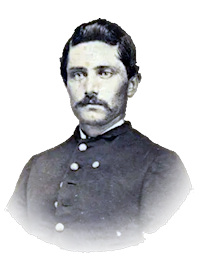
Tuesday, 29th–We got on the right road and started at 8 o’clock this morning. We marched twelve miles and bivouacked for the night. The weather is extremely hot and the roads are very dusty. Orlando Stout of Company E fell out of the ranks today, and getting too far behind, was taken prisoner.
Robert M. McGill
July 29, 2022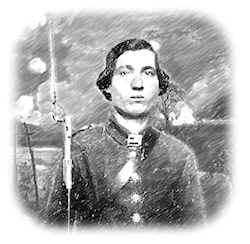
Tuesday, 29th.—Left home 11 A. M. Got to Chattanooga, 4 P. M.
(Note: picture is of an unidentified Confederate soldier.)
Journal of Surgeon Alfred L. Castleman.
July 29, 2022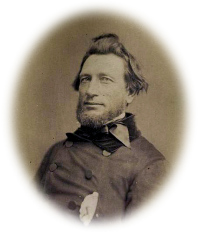
29th.–It is a source of unspeakable gratification to me that after my long fights, the comforts of the suffering soldiers are being heeded; whether on account of my much importunity, or from the fact that the necessity of this course has become apparent to the Military Department, or that the new Surgeon General has directed his attention more particularly to it, it matters not. When I call for aid for the hospitals under my care I get it. All the surgeons in this department now have only to call for help to procure enough to clean, drain, and sweep camp grounds every day, to ask for the necessary food, medicine and furniture, and if they will then give their personal attention to it, they can have it. The scurvy has been rapidly increasing with us, but we have now the means of arresting it. Thanks to U. S. Sanitary Commission for the larger share of them.
Some mysterious movements are going on in this army. At night we look over a large flat covered with tents, lighted by camp fires, resonant with the sounds of living soldiers. In the morning that same flat is deserted and still, as if the angel of death had enjoyed a passover. What has become of the busy actors of the night, none who dare speak of it can conjecture. In fact, in the present perilous condition of the army all purposes are necessarily secret. Some think the troops thus disappearing are crossing the river and marching on Fort Darling. Some think they are moving down the river to possess ourselves of a fort which is being built to blockade the river and cut off our supplies. Others think Washington is again in danger, and that a part of this army is being shipped thither, whilst many others are of opinion that we are slowly and secretly withdrawing our forces, and that Gen. Smith’s division is to be left here as a blind and sacraficed to save the balance of the army. This would seem hard; yet when it becomes necessary, Gen. Smith will be found to be the very man, and his the very army to submit to the necessity without a murmur.
I am, however, of the opinion that the bulk of the rebel army has withdrawn from about us, and is after General Pope, and that we are taking advantage of their absence to escape from our present perilous position. General Pope’s antecedents warrant the belief that whatever is in his power to do for our relief will be accomplished to the utmost of his ability.
“I am so thankful that the scurf of the earth, of which the Federal army seems to be composed, has been driven away from Hanover.”—Diary of a Southern Refugee, Judith White McGuire.
July 28, 2022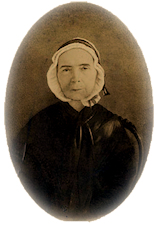
28th.—The report of Hindman’s having captured Curtis untrue; but our army is doing well in the West. Murfreesboro’, in Tennessee, has been captured by Confederates—a brigade, two brigadiers, and other officers, taken. “Jack Morgan” is annoying and capturing the Kentucky Yankees.
The true Southerners there must endure an almost unbearable thraldom!
A long letter from S. S., describing graphically their troubles when in Federal lines. Now they are breathing freely again. A number of servants from W. and S. H, and indeed from the whole Pamunky River, went off with their Northern friends. I am sorry for them, taken from their comfortable homes to go they know not where, and to be treated they know not how. Our man Nat went, to whom I was very partial, because his mother was the maid and humble friend of my youth, and because I had brought him up. He was a comfort to us as a driver and hostler, but now that we have neither home, carriage, nor horses, it makes but little difference with us; but how, with his slow habits, he is to support himself, I can’t imagine. The wish for freedom is natural, and if he prefers it, so far as I am concerned he is welcome to it. I shall be glad to hear that he is doing well. Mothers went off leaving children—in two instances infants. Lord have mercy upon these poor misguided creatures! I am so thankful that the scurf of the earth, of which the Federal army seems to be composed, has been driven away from Hanover. I would that “Clarke” were as free.
Rebel War Clerk
July 28, 2022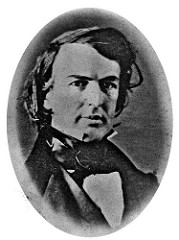
JULY 28th.—The Examining Board of Surgeons, established by the Secretary of War, has been abolished by order of Gen. Lee. It was the only idea of the Secretary yet developed, excepting the “handing over” of the” whole business of passports to Gen. Winder.”
0
July 28, 2022
We had a pleasant passage to New Orleans, where we arrived July 28th, and found the U. S. transport Connecticut awaiting us with a large mail. On this evening we had a heavy shower of rain, accompanied by heavy thunder and sharp lightning, purifying the air to a very pleasant degree. We now proceeded to coal ship preparatory to proceeding on our way. The sailors were here given liberty on shore–about eighty at a time–for twenty-four hours each. I here took a few hours to myself, and set foot on shore for the first time in six months. I had a very limited view of a portion of the city, and came back to the ship after a stay of four hours.
On the night of the 25th intelligence arrived from Baton Rouge that the rebels had made an attack on the latter place and, killing General Williams, had been repulsed. The Hartford was immediately turned up the river for Baton Rouge. On our passage we lost our orderly sergeant of marines, who died of bilious colic; we buried him at the latter place. On arriving we learned that a hard battle had been fought, and that the rebel ram Arkansas had been attacked and destroyed. As the rebels had left the place, and the Arkansas had ceased to trouble us, we turned our ship, and for the last time sailed down the stream. Things went quietly until arriving at Donaldsonville, where we came to, and after bombarding the little village for an hour, sent a few boats ashore and burned the place to the ground. This act was occasioned by guerrilla bands repeatedly firing upon our transports, and after being warned, the Commodore determined to make an example of it. Nothing in the line of eatables was found here, but large quantities of choice wines were discovered, of which our sailors partook freely, notwithstanding their fear of poison.
We arrived at New Orleans on the following day, where we remained several days.
Downing’s Civil War Diary.–Alexander G. Downing.
July 28, 2022
Monday, 28th–We struck our tents and at sunup started on our march for Bolivar, Tennessee. Our guide took us on the wrong road and we countermarched about ten miles, thus not being far from our starting point. The guide was tied and taken back to Corinth.[1] It is very warm and the roads are dusty. Our road being on high ground, we found water very scarce, and what little we got was of poor quality. General Turtle is in command of our division, the Sixth.
[1] I never learned what became of him.–A. G. D.
War Diary of Luman Harris Tenney.
July 28, 2022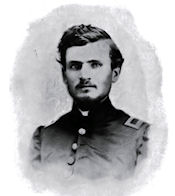
28th. Mail came. Letter from home. Rather discouraging news. Adjutant Weeks slept with the Major. Such a time talking and carrying on.
Rebel War Clerk
July 27, 2022
JULY 27th.—Gen. Lovell, it is said, will be tried by a court-martial. The same has been said of Generals Magruder and Huger. But I doubt it.
A Confederate Girl’s Diary
July 27, 2022
July 27th.
I have my bird back! As I waked this morning, I heard a well-known chirp in the streets, and called to mother I knew it was Jimmy. Sure enough it is my bird. Lucy Daigre has had him ever since the shelling, as a negro caught it that day and gave it to her.
Downing’s Civil War Diary.–Alexander G. Downing.
July 27, 2022
Sunday, 27th–We had regimental inspection this morning by Colonel Hare. We received orders to march in the morning. The Eleventh Iowa lost two men by disease while here in this camp—such is the penalty of camp life.
War Diary of Luman Harris Tenney.
July 27, 2022
27th. Sunday. Wrote home and read some in “Nathalie,” by Julia Kavanagh. Very good story.
“We take what is necessary and give vouchers, which say the property will be paid for at the close of the war, on proof of loyalty.”–Army Life of an Illinois Soldier, Charles Wright Wills.
July 27, 2022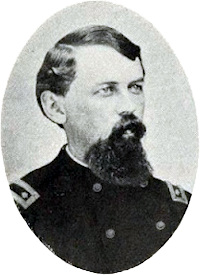
Headquarters, 1st Brigade Cavalry Division,
Tuscumbia, Ala., July 27, 1862 (Sunday).
We received orders for our brigade to march on the 19th, and started the 21st. We only made Jacinto that night, when the colonel and myself stayed with Gen. Jeff. C. Davis, who is a very approachable, pleasant and perfectly soldier-like man. There is a strong sprinkling in him, though, of the Regular Army and West Point. Next day we rejoined the command and marched 15 miles, camped at Bear Creek, 22 miles west of this place and just on the Mississippi and Alabama line. Thursday we joined General Morgan’s division and that night the brigade camped within four miles of Tuscumbia, and the headquarters came on into town. This is a perfect little Eden. Houses for 2,200 people with only 1,200 living here at present. We stayed at the hotel Thursday night, and the old negro who lighted me to my room amused me considerably with his account of General Turchin’s proceedings here. Turchin brought the first federal force across the Tennessee in Alabama, and I guess he “went it loosely.” The old Negro said that he only had 1,200 men and brought no luggage, knapsacks or anything else with him, but went away with 300 wagons, and everything there was in the country worth taking. That his men made the white women (wouldn’t let the colored women) do their cooking and washing, and that although they only brought one suit of clothes, they put on a new one every morning and always looked as though they had just stepped from a bandbox. People here hate General Mitchell’s whole command as they do the d___1, and many of them more. Well, we’ve settled once more, and I’ll be contented if allowed to stay here for sometime. We’re guarding about 100 miles of railroad from Iuka to Decatur, and it promises to be pretty rough work. Day before yesterday a guerilla party swooped down on a station 24 miles east of here where General Thomas had 160 men and captured all but 20 of them. We are relieving General Thomas’ [continue reading…]
Rebel War Clerk
July 26, 2022
JULY 26th.—There is a pause in the depreciation of C. S. securities.
Downing’s Civil War Diary.–Alexander G. Downing.
July 26, 2022
Saturday, 26th–Nothing of importance. Much of our time in camp is taken up with the question of rations. During this hot weather the regular army rations are drawn, but the men use very little of the salt bacon. But the bacon being issued, the company cook takes care of it and now has a wagon load of it stacked up beside his tent, anyone being permitted to go and help himself to it. At noon the company cook prepares the bean soup and cooks the pickled beef, after which he calls out for every man to come and get his portion. All the other rations are issued every five days, each man carrying his portion in his haversack. We haven had no Irish potatoes issued for eight months now, but fresh beef we draw, sometimes twice a week, and it is cooked for us by the company cook. The rations are all of good quality with the exception of crackers, which at times are a little worm-eaten.
War Diary of Luman Harris Tenney.
July 26, 2022
26th. Wrote a letter to Fannie. Played chess with Sergeant Spencer.
Wild Times in Mississippi
July 26, 2022
Oak Ridge, July 26, 1862, Saturday.—It was not till Wednesday that H. could get into Vicksburg, ten miles distant, for a passport, without which we could not go on the cars. We started Thursday morning. I had to ride seven miles on a hard-trotting horse to the nearest station. The day was burning at white heat. When the station was reached my hair was down, my hat on my neck, and my feelings were indescribable.
On the train one seemed to be right in the stream of war, among officers, soldiers, sick men and cripples, adieus, tears, laughter, constant chatter, and, strangest of all, sentinels posted at the locked car-doors demanding passports. There was no train south from Jackson that day, so we put up at the Bowman House. The excitement was indescribable. All the world appeared to be traveling through Jackson. People were besieging the two hotels, offering enormous prices for the privilege of sleeping anywhere under a roof. There were many refugees from New Orleans, among them some acquaintances of mine. The peculiar style of [women’s] dress necessitated by the exigencies of war gave the crowd a very striking appearance. In single suits I saw sleeves of one color, the waist of another, the skirt of another; scarlet jackets and gray skirts; black waists and blue skirts; black skirts and gray waists; the trimming chiefly gold braid and buttons, to give a military air. The gray and gold uniforms of the officers, glittering between, made up a carnival of color. Every moment we saw strange meetings and partings of people from all over the South. Conditions of time, space, locality, and estate were all loosened; everybody seemed floating he knew not whither, but determined to be jolly, and keep up an excitement. At supper we had tough steak, heavy, dirty-looking bread, Confederate coffee. The coffee was made of either parched rye or cornmeal, or of sweet potatoes cut in small cubes and roasted. This was the favorite. When flavored with “coffee essence,” sweetened with sorghum, and tinctured with chalky milk, it made a curious beverage, which, after tasting, I preferred not to drink. Every one else was drinking it, and an acquaintance said, “Oh, you’ll get bravely over that. I used to be a Jewess about pork, but now we just kill a hog and eat it, and kill another and do the same. It’s all we have.”
Friday morning we took the down train for the station near my friend’s house. At every station we had to go through the examination of passes, as if in a foreign country.
The conscript camp was at Brookhaven, and every man had been ordered to report there or to be treated as a deserter. At every station I shivered mentally, expecting H. to be dragged off. Brookhaven was also the station for dinner. I choked mine down, feeling the sword hanging over me by a single hair. At sunset we reached our station. The landlady was pouring tea when we took our seats and I expected a treat, but when I tasted it it was sassafras tea, the very odor of which sickens me. There was a general surprise when I asked to exchange it for a glass of water; every one was drinking it as if it were nectar. This morning we drove out here.
My friend’s little nest is calm in contrast to the tumult not far off.
Yet the trials of war are here too. Having no matches, they keep fire, carefully covering it at night, for Mr. G. has no powder, and cannot flash the gun into combustibles as some do. One day they had to go with the children to the village, and the servant let the fire go out. When they returned at nightfall, wet and hungry, there was neither fire nor food. Mr. G. had to saddle the tired mule and ride three miles for a pan of coals, and blow them, all the way back, to keep them alight. Crockery has gradually been broken and tin-cups rusted out, and a visitor told me they had made tumblers out of clear glass bottles by cutting them smooth with a heated wire, and that they had nothing else to drink from.
Note: To protect Mrs. Miller’s job as a teacher in post-civil war New Orleans, her diary was published anonymously, edited by G. W. Cable, names were changed and initials were generally used instead of full names—and even the initials differed from the real person’s initials. (Read Dora Richards Miller’s biographical sketch.)
Rebel War Clerk
July 25, 2022
JULY 25th.—More Northern papers received to-day, containing news from the South. Most fortunately, they can know nothing reliable of what is passing within Gen. Lee’s lines. The responsibility of keeping his gates closed against spies rests in a great measure on myself, and I endeavor to keep even our own people in profound ignorance of what transpires there.
A Confederate Girl’s Diary
July 25, 2022
July 25th.
An old gentleman stopped here just now in a carriage and asked to see me. Such a sad, sick old man! He said his name was Caldwell, and that passing through East Feliciana, Mrs. Flynn had asked him to deliver a message to us. Had we heard from our brothers? I told him the message from Mr. Bell. He commenced dying. There was one of them, he said, who got hurt. I held my breath and looked at him. He cried more still, and said yes, it was Gibbes – in the hand – not dangerous – but – Here I thought he meant to tell me worse; perhaps he was dead; but I could not speak, so he went on saying Lydia and the General had gone on to Richmond instantly, and had probably reached there before today. He took so long to tell it, and he cried so, that I was alarmed, until I thought perhaps he had lost one of his own sons; but I dared not ask him. Just then one of the horses fell down with sunstroke, and I begged the old gentleman to come in and rest until they could raise the horse; but he said no, he must go on to the river. He looked so sick that I could not help saying he looked too unwell to go beyond, and I wished he would come in. But he burst into tears, saying, “Yes, my child, I am very, very sick, but I must go on.” Poor old man, with his snow-white beard!
Downing’s Civil War Diary.–Alexander G. Downing.
July 25, 2022
Friday, 25th–The quartermaster drew some clothing today for our regiment. The regiment was out for drill today, with better success than the other day when it was so hot.
War Diary of Luman Harris Tenney.
July 25, 2022
25th. Started at 4 A. M. Marched 7 miles beyond Hudson’s Crossing. Met the third battalion.
Diary of David L. Day.
July 25, 2022
Warning
The following diary entry contains wording that is offensive to many in the world of today. However, the entry is provided unedited for its historical content and context.
Company Drills.
July 25. The colonel, thinking that guard duty and dress parades are not quite exercise enough for us, has ordered company drills in the forenoon. The company officers do not take very kindly to this, and thinking it a good opportunity to give the sergeants a little practice in drilling the companies, they shirk out of it every time they can invent an excuse to do so. The companies are seen out under command of the orderlies or some other of the sergeants frequently. B company moves out of the company street on to the parade ground, and after executing a few brilliant maneuvers, starts off across the fields to the Trent road, a little out of sight of the camp, and here in the shade of the trees we sit down and await the recall, when we march back into camp with all the pomp and circumstance of glorious war. The duty has been performed and everybody seems well enough satisfied, except perhaps the performers.
Patriotism Suppressed.
And now, right here under the broad banner of freedom, personal liberty and rising patriotism has been suppressed. A party of small darky boys organized themselves into a drum corps and furnished themselves with old tin pans and kettles for an outfit. Being natural musicians, they soon acquired the art of drumming, and when they thought, they could make a creditable appearance before the public appeared one evening, standing just outside the guard in front of our dress parade. [continue reading…]