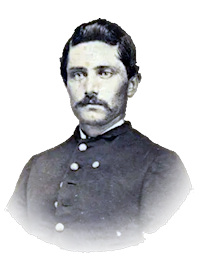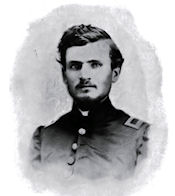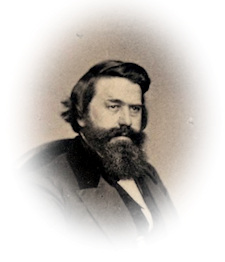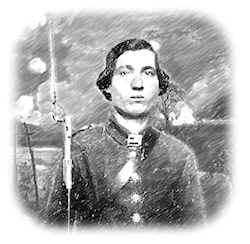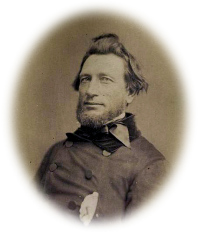
Journal of Surgeon Alfred L. Castleman.

Journal of Surgeon Alfred L Castleman.

13th.–At a quarter past 9 o’clock, picket firing commenced, and at 9 1-2 o’clock the enemy opened with artillery, on our left wing. In a few minutes the engagement was general. The smoke hangs thick and heavy, making it impossible to tell, this morning, whether the enemy is in force here, or whether his opening the fight is a ruse to cover his falling back. My own opinion is that he means fight. If he had intended to fall back, he would have taken advantage of our crossing, then have opened on us and have fallen back under the fire. Large fires were seen all night in the rear of his lines, which many inferred were from the burning of his stores, preparatory to a retreat. I entertain no such thought. His position is too strong, and should there fall a heavy rain daring the battle, it would, by inundating the large flats on which we are posted, render the situation of our army an exceedingly perilous one. I have not a doubt that the enemy has seen this, and permitted us to cross. I saw some very bad surgery yesterday, and I here enter the remark, that I have witnessed but four amputations by other surgeons since I came to the army, and two of those had to be amputated a second time, before they could be dressed. This speaks very badly for our Surgeons.

Night has come, and the firing has ceased. It has been a terrible day. The wounded have been sent in to us in great numbers. I have been amputating and otherwise operating all day. The result of the battle I do not know. It certainly has not been decisive on either side, and although the wounded brought to us talk freely of “our victory,” I am strongly inclined to the opinion that we have had the worst of it. Gen. Vinton is wounded, and now lies in the hospital. Gen. Bayard, Chief of our artillery, and Gen. Campbell, also lie near me, the former mortally, the latter badly wounded.

The enemy is very strongly posted, and I exceedingly doubt our ability to dislodge him. I hear hints of the want of hearty co-operation of our subordinate Generals. I have feared this from the start, but I will not yet credit it.

Whatever is the result it has been a terrible day, and I now write amidst the groans of the wounded, just dressed, but not yet had time to be relieved of pain.

In my letter of the 10th inst., to C––, I prophesied that we should cross without much fighting; that when we should cross, the enemy would contest every inch of ground, but that if Burnside was heartily sustained by his officers he would drive the enemy. The two first have been fulfilled to the letter. He has not yet driven the enemy, but the fight is not over, and has he had hearty co-operation? On this last point we are not informed. I hope he has, for I would rather suffer defeat honorably, than gain success amidst the treachery of our trusted officers.

0 comments

“Colonel Dickerman appointed me provost and sent my company to guard a bridge one and one-half miles south of this place.”–Army Life of an Illinois Soldier, Charles Wright Wills.

Civil War Day-by-Day

Provost Marshal’s Office, Waterford, Miss.,
December 12, ’62.

From captain of the provost guard, I have been changed to provost marshal. I had charge of two companies, doing the guard duty for the provost of our division until yesterday; the division was ordered forward to Oxford, except our regiment, which was left to guard the railroad between this point and the Tallahatchie river. Headquarters being here, Colonel Dickerman appointed me provost and sent my company to guard a bridge one and one-half miles south of this place. My business is to attend to all prisoners, deal with citizens (administer oaths, take paroles, etc.), give all passes for citizens and soldiers leaving, have charge of all soldiers straggling from their regiments, issue permits to sutlers, etc., and overlook the cotton trade. Altogether, quite enough for any one man to attend to. The little advantage of having a comfortable house to live in, etc., is worth something; but I kind o’ feel as if I would rather be with my company. Another regiment came in to-night, 12th Indiana, and we may possibly be relieved to-morrow. Shall be glad if we can only get with our division again. General Lanman has again taken command of our division, and although we know nothing against McKean, yet we know so much good of Lanman, that we’re much pleased. Eight of our companies are guarding bridges, so we only have two here. Confound this railroad guarding; I’m down on it. ‘Tis more dangerous than regular soldiering, harder work, and no shadow of a chance for glory. There’s a smart chance of fun in my present business, particularly in the citizens branch thereof. It would have furnished you with amusement enough for a month, could you have heard an old lady talk who visited me to-day. She was a F. F. and blooded, Oh, Lord! We let all come within the lines; but before they can pass out, an oath or parole is required of them. How they squirm! Rebels, though they are, ’tis shocking and enough to make one’s blood boil to see the manner in which some of our folks have treated them. Trunks have been knocked to pieces with muskets when the women stood by, offering the keys, bureau drawers drawn out, the contents turned on the floor, and the drawer thrown through the window, bed clothing and ladies’ clothing carried off and all manner of deviltry imaginable perpetrated. Of course the scoundrels who do this kind of work would be severely punished if caught, but the latter is almost impossible. Most of the mischief is done by the advance of the army, though, God knows, the infantry is bad enough. The d–d thieves even steal from the negroes (which is lower business than I ever thought it possible for a white man to be guilty of) and many of them are learning to hate the Yankees as much as our “Southern Brethren” do. The army is becoming awfully depraved. [continue reading…]

0 comments

A Confederate Girl’s Diary

Civil War Day-by-Day

Friday, 12th December.

My cripple friend that I mentioned so far back continues to send me the most affecting messages. “He is really wretched about me; never was more distressed; thinks of nothing else”; and so on through the whole list. To cap the climax, he sends me word that he can now walk on crutches, and the first time he can venture in a buggy, means to call on me. Que le ciel m’ en preserve! What could we talk about? “His’n” and “her’n “ several misfortunes? That’s too bad! Every one teases me unmercifully about my new conquest. I can’t help but be amused; and yet, beware, young girls, of expressing sympathy, even for soldiers! There is no knowing what effect it may produce.

0 comments

Downing’s Civil War Diary.–Alexander G. Downing.

Diary of Alexander G. Downing; Company E, Eleventh Iowa Infantry

Friday, 12th–Nothing of importance. I was relieved from picket this morning. New regiments from the North are arriving and passing out to the front to hear their first roar of cannon.

0 comments

War Diary of Luman Harris Tenney.

War Diary of Luman Harris Tenney.

Friday, 12th. Issued clothing in the morning. Bathed. Marched in P. M. to Fort Lincoln. Took charge of 10 soldier prisoners.

0 comments

A Rebel War Clerk’s Diary

Civil War Day-by-Day
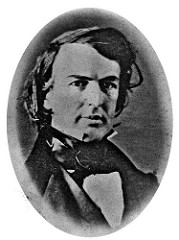
A likeness of Jones when he was editor and majority owner of the Daily Madisonian during President John Tyler’s administration.

DECEMBER 12th.—The enemy have possession of Fredericksburg, and succeeded in crossing a large portion of their force three miles below, on their pontoon bridge. Up to 3 P.M. to-day, we have no other intelligence but that “they are fighting.” We shall know more, probably, before night.

The President has passed through East Tennessee on his way to Mississippi.

Lieut.-Col. Nat Tyler, publisher of the Enquirer, the organ of the government, was in my office this morning, denouncing Mr. Memminger, Secretary of the Treasury. He says Mr. M.’s head is as worthless as a pin’s-head. He also denounced the rules of admission to our Secretary, adopted by Mr. R. G. H. Kean, Chief of the Bureau, and asked for a copy of them, that he might deounce them in his paper. It appears that Mr. Jacques is to say who can see the Secretary; and to do this, he must catechize each applicant as to the nature of his business. This is deemed insulting by some of the hot bloods, and will make friend Mr. J.’s position rather a disagreeable and derogatory one.

0 comments

Journal of Surgeon Alfred L. Castleman.

Journal of Surgeon Alfred L Castleman.

12th–At 9 o’clock, A. M., troops are crossing, and again has commenced our cannonading, but there is no response. I sit in the building prepared for hospital, out of sight and out of danger. Are we to have a fight to-day? Doubtful. I find myself indulging in some feelings of pride on the distinction which was conferred on me, unasked, yesterday, though I do not doubt it will excite some of my brother Surgeons to jealousy against me. I almost wish it were otherwise; for, after the long personal battles I .have had to fight, to maintain my proper position in the regiment, I was getting at peace with all, and I should have liked a little quiet. God grant that I may prove adequate to the responsible duties imposed by my new position. I deeply realize the fact that it places in my hands the limbs and lives of many poor fellows who are to be brought under my care. Ambulances and litter-bearers are passing to the expected battle field, and I too, must prepare, though I much doubt our having a fight to-day.

11 o’clock.–We have ” crossed the Rubicon,” and I now sit on the south bank of the Rappahannock, watching the crossing of our left wing, about, fifty thousand strong. I hear that our centre and right wing are crossing on bridges from two to four miles above us. Not a shot of resistance yet this morning, except from a few sharpshooters, and they are now silenced. The smoke of the burning city, and of the heavy cannonading of yesterday, have settled, casting a thick pall over all the country, and we cannot see more than a few rods around us. We know not, therefore, whether the enemy is before us, but the general impression is, that he has fallen back, to draw us on. I am of the opinion that it will require but little suction to draw our Commander on to destruction or to victory. He evidently means business; But will McClellan’s friends, who now hold most important commands under General Burnside, betray him as they did Pope? or will they prove true to the country in this hour of its greatest trial. When I see General Franklin in charge of the most important position, my recollection will revert to his conduct at West Point and at Centreville, and whilst I hope, I fear. From what I have seen of that man, I have lost all confidence in him. How I hope that he may now retrieve himself in the estimation of those who feel towards him as I do. The developments being made in the trial of Porter may make some Generals cautious. God grant it may.

It has been a matter of wonder to me, how the rebel army lives in its marches through this country, without transportation. We have now marched over one hundred miles in this State, and on the line of our march for a width of six miles, (making an area of six hundred square miles.) I am satisfied that there are not provisions enough, if all were taken, to subsist Lee’s army one day.

At 1 o’clock I take possession, for a hospital, of the house of Arthur Bernard, on the south bank of the river, two miles below Fredericksburg. This is one of the most magnificent places I ever saw. I shall not undertake to journalize a description of it. It is owned by one of the old bachelor F. F. Vs. He is now trying to compromise with us, so as to be permitted to retain a part of it. He is very ridiculous in his demands, and it will not surprise me if it results in his arrest. Weather still beautiful, but I fear that the great smoke hanging over us will bring heavy rains, and embarrass our locomotion. Night has come, but brings no fight. There has been an exchange of a few random shots, killing and wounding some twenty or thirty.

0 comments

Downing’s Civil War Diary.–Alexander G. Downing.

Diary of Alexander G. Downing; Company E, Eleventh Iowa Infantry

Thursday, 11th–I was on the picket line again today. Picket duty is less dangerous now than it was, as the rebels have fallen back. We maintain a brigade guard at this camp.

0 comments

A Rebel War Clerk’s Diary

Civil War Day-by-Day
A likeness of Jones when he was editor and majority owner of the Daily Madisonian during President John Tyler’s administration.

DECEMBER 11th.Gen. —Lee dispatched this morning early that the enemy were constructing three pontoon bridges, and that firing had commenced on both sides. At nine o’clock A.M. the firing increased, and Gen Lee dispatched for ammunition, looking to the contingency of a prolonged battle.

At three P.M., Gen. Lee says, the enemy had been repulsed in two of their attempts to throw bridges over the river; but the third attempt would probably succeed, as it was under cover of batteries which commanded the river, and where his sharpshooters could not reach the workmen. But, he says, his batteries command the plain where the enemy must debouch. We may speedily hear of a most sanguinary conflict.

Burnside must have greatly superior numbers, or else he is a great fool to precipitate his men into a plain, where every Southern soldier is prepared to die, in the event of failure to conquer! There is no trepidation here; on the contrary, a settled calm on the faces of the people, which might be mistaken for indifference. They are confident of the success of Lee, and really seem apprehensive that Burnside will not come over and fight him in a decisive battle. We shall soon see, now, of what stuff Burnside and his army are made. I feel some anxiety; because the destruction of our little army on the Rappahannock might be the fall of Richmond.It is rumored that the President started two days ago for the West–Tennessee and Mississippi. No papers have been sent in by him since Tuesday, and it may be true. If so, he means to return speedily. I think we shall soon have news from the lower James River.

A letter from the Governor of Alabama calls urgently for heavy guns, and a reserve force, for the defense of Mobile. Major Hause, the government’s agent in Europe, has purchased, up to this time, 157,000 stand of arms, besides many cannon, much ammunition, quartermaster’s stores, etc. A portion was lost in transitu, however, but not a large amount. Besides the large sums he has expended, he has obtained credit to the extent of $6,000,000!

They are calling for a guard at Petersburg against incendiaries. A factory was burned the other night. This is bad. Scully and Lewis, condemned to die as spies, have been pardoned by the President, and are to be sent North.

Another dispatch from Gen. Lee, dated 3 ½ P.M., says the enemy has nearly completed his bridge, and will probably commence crossing this evening or in the morning. The bulletin boards in the city purport to give intelligence of the passage having been effected in part; but I do not see how the editors could have obtained their information. At 6 P.M., passengers by the Fredericksburg train (which left at 1 P.M.) report the shelling of the town, and a great battle in progress on this side of the river. I doubt both; and I saw but one excited man (a Jew) who said he was in Fredericksburg when the shelling began. I do not believe it. The cars were not within four miles of the town, and perhaps merely conjectured the cannonading they heard to be directed at the town. There were no ladies or children in the cars. But doubtless the enemy will cross the river, and there will be a battle, which must result in a great mortality.

0 comments

Journal of Surgeon Alfred L. Castleman.

Journal of Surgeon Alfred L Castleman.

11th.–At 5 o’clock, A. M., as clear and calm a morning as ever a bright and beautiful moon shone on. We struck tents and took up our line of march in the direction of Fredericksburg, only five miles distant. At a quarter before 6, precisely, the heavy reports of two large guns came booming through the woods, telling us that the ball was opened. The sound came from Falmouth. Frequent and more frequent came the peals, and in half an hour, so constant was the roar that the intervals between the reports was undistinguishable. At 11 o’clock, A. M., we are in line of battle along the north bank of the Rappahannock, about two miles below Fredericksburg. A pontoon bridge is nearly completed just in front of us. The artillery fight at Falmouth continues; our troops are pouring into the plain along the river. Will the enemy contest our passage! Doubtful.

At 11 1-2 o’clock, I sit on my horse, on a high ridge overlooking Fredericksburg, Falmouth, the river, and the vast plains on either side, where the hosts of both armies are marshalling for the great trial. How beautiful the plains, the cities, the river! How grand the tout ensemble! How different may be the scene on which the rising moon of tomorrow morning may shed her silver light.

transparent

“On Linden, when the sun was low,
All bloodless lay the untrodden snow,
* * * * * * * *
But Linden saw another sight
When the drums beat at dead of night,
Commanding fires of death to light
transparenttransparentThe darkness of her scenery.”
transparent

Oh, beautiful Rappahannock! are you on this most beautiful day to take the dark rolling Yser for your type? And must this bloodless and untrodden snow, e’er another rising sun, be stained by the blood of valiant hearts, struggling in the cause of government and humanity, against anarchy and oppression? I am at this moment notified of my appointment as a ” Chief operator” for General Howe’s division, during the approaching battle, and am ordered to duty. This is a most flattering distinction, but I rather regret it, as it takes me from the scenes of the field.

3 P. M.–Having prepared my hospital, and the fight not having commenced in our division, I have ridden to Fredericksburg, two and a half miles, and, for the first time, witnessing the bombarding of a city. Rebel sharpshooters are concealed in the houses, and have been shooting our pontooniers. The city is already on fire, and thus ends this ancient town, where children, and children’s children, have lived and died in the same house, for generations. Alas! their homes are destroyed and they homeless. To them the seat of their acutest joys and sorrows, of their hopes and their fears, their histories, and their traditions will be known no more forever. But how strange that I should sit here writing on horseback, almost in the midst of their sharpshooters, without being able to reason myself into a sense of my danger! Have I a life charmed against such exposure, that I should be thus insensible to it? However, if some were here, who have an interest in this matter, co-ordinate with myself, they would say “Go!” and I will do it. Come, Joseph,1 yours is not a charmed life, and you at least must be taken away.

Night has come, and we have not crossed the river. Rumors are rife, that the enemy has evacuated. I do not credit them.


1 My faithful and affectionate horse.

0 comments

Diary of a Southern Refugee, Judith White McGuire.

Diary of a Southern Refugee During the War by Judith White McGuire

December 10.—Just returned from a visit of a week to my old friend Mrs. C. Her home in Richmond is the very: picture of comfort and hospitality; having wealth, she uses it freely, in these troublous times, for the comfort of others. If all hearts were as large as hers, there would be no refugees in garrets and cellars. I was touched by her attention to Mr. ––, whom she had always seen engaged in his duties as a minister of the Gospel. She seemed to think it a kind of sacrilege to see him employed from nine until four o’clock in the duties of his secular office, and “to think of his reverend and hoary head bending over a clerk’s desk;” she would say : “Oh, what awful times!” I told her that she must not think of it in that light; that he had been greatly blessed to get the office, which supported us so much better than many other refugees. While talking this way, she would be suiting the action to the word, by rolling up a most delightful chair to the fire, placing a small table before it, ready for some nice refreshment when he returned. It is trying to see him work so hard for our support, in his delicate state of health. The girls and myself are very anxious to get work from Government, signing notes, copying—any thing to assist in supporting ourselves; but we have tried in vain, and I suppose it is right, for there are so many widows and orphans who have a much higher claim to any thing that Government can do for them. We have heard heavy firing to-day. The car passengers report that there is skirmishing near Port Royal.

0 comments

Downing’s Civil War Diary.–Alexander G. Downing.

Diary of Alexander G. Downing; Company E, Eleventh Iowa Infantry

Wednesday, 10th–Our troops are still moving out to the front. It is fine weather for marching. There is very little sickness among the men now.

0 comments

War Diary of Luman Harris Tenney.

War Diary of Luman Harris Tenney.

Wednesday, 10th. Maj. P., Capt. S., Capt. N. with 25 men came into the fort. Arrived about 2 P. M. Got supper at Mrs. Harris’–very kind. Other detachment came in. Several boys drunk.

0 comments

A Rebel War Clerk’s Diary

Civil War Day-by-Day
A likeness of Jones when he was editor and majority owner of the Daily Madisonian during President John Tyler’s administration.

DECEMBER 10th.—Not a word from the Rappahannock. But there soon will be.

Official dispatches from Gen. Bragg confirm the achievement of Col. Morgan, acting as brigadier-general. There was a fight, several hundred being killed and wounded on both sides; but Morgan’s victory was complete, his captures amounting to 1800 men, a battery, wagon train, etc.

We have also a dispatch that Major-Gen. Lovell, the Yankee, had a battle with the enemy, killing, wounding, and capturing 34! A characteristic letter was received to-day from Mr. Sanford, Alabama, recommending Col. Dowdell for a brigadiership. I hope he may get it, as he is a gallant Southerner. Mr. S. has some hard hits at the government; calling it a government of chief clerks and subordinate clerks. He hopes Mr. Seddon will not be merely a clerk.

Gen. Jos. E. Johnston has written from the West a gloomy letter to Mr. Wigfall, Texan Senator. He says he is ordered to reinforce Lieut.-Gen. Pemberton (another Northern general) from Bragg’s army. Pemberton is retreating on Grenada, Mississippi, followed by 40,000 of the enemy. How is he, Gen. J., to get from Tennessee to Grenada with reinforcements, preceded by one army of the enemy, and followed by another? Mr. Wigfall recommends the Secretary (as if he could do it!) to concentrate all the armies of the West, and beat the enemy out of the Mississippi Valley. Gen. Johnston says Lieut.-Gen. Holmes has been ordered to reinforce Pemberton. Why, this is the very thing Mr. Randolph did, and lost his clerkship for it! The President must have changed his mind.

Gen. Randolph sent in his resignation as brigadier-general to-day. The younger brigadiers, Davis (the President’s nephew) and Pryor, have been recently assigned to brigades, and this may have operated on Randolph as an emetic.There are two war steamers at Charleston from abroad; one a Frenchman, the other an Englishman. Gen. Beauregard entertained the officers of the first the other day.

Gen. Banks has sailed down the coast on an expedition, the nature of which, no doubt, will be developed soon.

0 comments

Journal of Surgeon Alfred L. Castleman.

Journal of Surgeon Alfred L Castleman.

The following letter, though not a part of my journal, is occasionally referred to in it, and I therefore have it inserted here:–

Camp Near Belle Plaines, Virginia,
December, 10, 1862.

My Dear C–– :

* * * * Our whereabouts is four miles from Falmouth, three and a half from the mouth of the Potomac Creek, and about three to the nearest point of the Rappahannock River. As we may be ordered to leave here within an hour, that is sufficiently explicit. Although I have not hesitated at times to express my opinion, confidentially, of the conduct and merits of men, I rarely venture one prospectively, of military matters and strategy. As, however, you express so great a wish for my opinion on the prospects and plans of the war, I will tell you what I know of the present, and guess of the future state of things, reminding you that I am not a military man, and give but little of my attention to military affairs. The Medical Department occupies al my time.

One month ago to-day, our forward movements were arrested by General Burnside superceding McClellan, in the command of the army. We supposed that it would require at least a week or two for him to mature a plan of operations, and have the army mobilized; we were mistaken. Five days sufficed, and we were off like a quarter horse; but just as we arrived at the seat of operations, we were suddenly brought to a stand by the failure of somebody to furnish the supplies to enable us safely to cross the Rappahannock, and to take possession of the heights before the arrival of the enemy. We were consequently stationary, and he got possession of the ground we meant to occupy. Did we do right to stop? My partiality for and confidence in the opinions of General Burnside strongly incline me to think we did, whilst my own reasoning questions it. It seems to me, that we had at Falmouth, before the arrival of the enemy, a force sufficient to have taken the ground and held it till we should get the railroad from Acquia Creek, in order to transport supplies for the whole army, and then, for an object so important, we might have put our men on half rations, for a few days. The enemy, in all his campaigns, runs a heavier risk than that. Indeed, in one of his reports he speaks sneeringly of “the immense transportation trains, without which it seems impossible for the Yankees to move.” But there are doubtless many reasons which I cannot see. But the position is lost. What next?

We must advance.–Public pressure will compel us to, against any odds. Yet we cannot advance without crossing the river. The enemy occupies all the heights, both front and enfilading, and with a force at least equal to our own, commands the crossings. Shall we risk it against such odds? In my opinion we must. But is this the only place to cross? Our pontoons are already in the river, some above, some below. An hour’s time will suffice to throw them into bridges, where we choose. Have we not ingenuity enough to draw attention by a feint at one point, whilst we bridge and cross at another. Should we cross either above or below, we shall occupy a flanking position with decided advantage. I think we shall cross, and I shall not be surprised if even before this letter is finished, we are summoned to attempt it. I think, too, that we shall cross without much resistance. What then?Will the enemy withdraw? Not an inch. He cannot fall back without disaster, and every foot of ground hence to Richmond, will be contested. For, give us Saxton’s Junction, twenty-five miles south of us, and Petersburg, which we can take when we want it, and Richmond is cut off from supplies, and must fall. I stop here to say that my prediction is already verified. Major B. has this moment left me an order to move at 2 in the morning. He says that in a council of war just held, it is decided to cross at three points at daylight. Shall we do this? I doubt it; and simply because it is the result of a council. It is too public. Burnside is not the man to send word to the enemy when he is coming. This, however, is all conjecture. The morning will tell how well grounded.

Yours, &c.

0 comments

Downing’s Civil War Diary.–Alexander G. Downing.

Diary of Alexander G. Downing; Company E, Eleventh Iowa Infantry

Tuesday, 9th–No news of importance. Our foraging parties destroy a great deal of property unnecessarily, especially when the owner of a plantation is away with the rebel army—then there isn’t much left when the boys get through.

0 comments

War Diary of Luman Harris Tenney.

War Diary of Luman Harris Tenney.

Tuesday, 9th. Saw a good many rebels about Turkey Creek. Camped 30 miles from fort.

0 comments

A Rebel War Clerk’s Diary

Civil War Day-by-Day
A likeness of Jones when he was editor and majority owner of the Daily Madisonian during President John Tyler’s administration.

DECEMBER 9th.—W_____l, another of Provost Marshal Griswold’s policemen, has arrived in Washington. I never doubted he was secretly in the Yankee service here, where many of his fellows still remain, betraying the hand that feeds them. Gen. Winder and the late Secretaries of War must be responsible for all the injury they may inflict upon the country.

Yesterday, the President received a letter from a gentleman well known to him, asserting that if Mississippi and Alabama be overrun by the enemy, a large proportion of the people of those States will certainly submit to the Government of the United States. The President sent this letter to the Secretary of War “for his information.”

A letter from W. P. Harris, Jackson, Mississippi, urges the government to abandon the cities and eastern seaboard, and concentrate all the forces in the West, for the defense of the Mississippi Valley and River, else the latter must be lost, which will be fatal to the cause, etc. Hon. J. H. Reagan has written a savage letter to the Secretary of War, withdrawing certain papers relating to an application for the discharge from service of his brother-in-law, on account of feeble health. He says he will not await the motions (uncertain) of the circumlocution office, and is unwilling to produce evidence of his statements of the disability of his relative. Mr. Seddon will doubtless make a spirited response to this imputation on his office.

We have a rumor that Morgan has made another brilliant raid into Kentucky, capturing 1800 of the enemy. The small-pox is spreading in this city to an alarming extent. This is the feast to which Burnside is invited. They are vaccinating the clerks in the departments.

Gen. Floyd writes the government that, as the enemy cannot advance from the West before spring, Echol’s and Marshall’s forces (10,000) might be used on the seaboard. I wish they were here.The United States forces in the field, by their own estimates, amount to 800,000. We have not exceeding 250,000; but they are not aware of that.

0 comments

This constant thundering of the cannon!

Civil War Day-by-Day

Washington County Historical Society version (1965)1

Dec. 9—Nani is with me. All day long we heard cannonading. Who will be victorious? This constant thundering of the cannon! If the Southern troops should win, it would go hard with us.

The Arkansas Historical Quarterly version (1947)2

Dec. 9

Nani is with me. All day long we have heard the roar of cannon.3 Who is winning? We have heard that the Southern army is made up of 40,000 men, the Northern army of 17,000. This continuing boom, boom. Oh, if the other side should win, things will go hard with us.


  1. Lemke, W. J. The Hermanns of Old Hermannsburg: Washington County, Arkansas. Fayetteville, AR: Washington County Historical Society, 1965.
  2. Memoirs, Letters, and Diary Entries of German Settlers in Northwest Arkansas, 1853-1863.  Selected and Translated By Clarence Evans, Tahlequah, Oklahoma. The Arkansas Historical Quarterly. Vol. VI Fall, 1947 No. 3
  3. The cannonading was actually the December 7th Battle of Prairie Grove meaning that the date of this diary entry is off by two days.
0 comments

“The retreating Rebels destroyed every culvert and bridge as they fell back, and it of course takes time to rebuild so many.”–Army Life of an Illinois Soldier, Charles Wright Wills.

Civil War Day-by-Day

Provost Marshal’s Office, 4th Division, Army of the
Tennessee, near Tallahatchie, Miss.,

December 8, 1862.

Still we tarry by the wayside anxiously awaiting the order to move forward. We did provide three days’ rations once, but devoured them without leaving camp. Two divisions, McKean’s and Ross’, have left here, while the remainder of the army has pushed onward. We hear of the advance skirmishing 50 miles in front of us. Think the main force is at Oxford, about 25 miles from here. We’re probably waiting for the railroad to be repaired so that supplies can be furnished us when we move. The retreating Rebels destroyed every culvert and bridge as they fell back, and it of course takes time to rebuild so many. The road is not yet in running order to Holly Springs, and everything has to be wagoned to the army, which but a very little rain in this country makes impossible. We suffered three days of cold, drizzling rain last week which most effectually blockaded the roads, but the last three days have been beautifully clear, etc., and travel is again resumed. We will change camp to-morrow to improve our water facilities, probably moving four or five miles back toward Holly Springs. One mile northward is harder to travel than 10 in the opposite direction. My whole company is detached from the regiment as provost guard. It relieves us from picket duty, fatigue, etc., gives us officers’ quarters in a house (there are a sofa, two rocking chairs, soft-bottomed chairs, a library, feather bed, etc., in the room I am now writing in and occupy). I’ve soldiered long enough to never refuse these little good things Providence throws in my way. The detail is permanent, but suppose [continue reading…]

0 comments

Downing’s Civil War Diary.–Alexander G. Downing.

Diary of Alexander G. Downing; Company E, Eleventh Iowa Infantry

Monday, 8th–The Sixth Division is running a mill now, the quartermaster having taken possession of a grist mill which he is running day and night. We are now drawing full rations of meal instead of crackers and we have plenty of fresh pork and sweet potatoes. The boys have confiscated every bake oven in the country; each company has from three to five, and by keeping them hot all day we bake all the corn bread needed. We all appreciate full rations after our fast at Grand Junction.

0 comments

0

Louise Wigfall Wright — A Southern Girl in ’61

“December 8, 1862.

“My dear Sir:
         “I have just received a letter from Genl. Johnston which causes gloomy forebodings as to our future in the West. Pemberton, he says, has fallen back before a superior force and he, Johnston, is ordered to reinforce him with troops from Bragg’s command. Consider the position of their different armies. As Pemberton falls back he will be each day one march further from Bragg. Grant is between them, with, I suppose, a superior force to either. If he falls upon either before their junction, may he not destroy him and then turn upon the other? When Bragg crosses the Tennessee river Grant may turn upon him at any moment. How long will it take to cross the Tennessee without Birago trestles or pontoon boats? Before his raid into Kentucky, Bragg was some two or three weeks in effecting a crossing. Holmes, Johnston writes me, has been ordered to reinforce Pemberton, but he does not say with what force. In that movement, it seems to me, lies our only hope of safety. Let me beg you will urge upon Holmes the utmost energy and promptness in his movements. I trust that his whole force has been ordered across. Vicksburg should be the objective point in this campaign. That being safe, as I think it would be, upon the junction of Pemberton and Holmes, the destruction of Grant’s Army should be our next object. Political considerations should weigh nothing in the movement of troops. A distinguished writer upon the art of war, says, that political objective points, if adopted during a campaign, must be in accordance with the principles of strategy, and that when that is not possible, then they should be adjourned till after a decisive victory. When Oldham and Bob Johnston were badgering me for not joining them in insisting that all the troops from the other side of the river should be returned, I told them that if I had control of the army every soldier from Arkansas and Texas should be brought at once to this side so that Bragg might at once crush Buel. The debate was published and I have to see the first man from Texas who does not approve my course. I mention this to show, that those who oppose the concentration of our troops, be it on one side, or the other, of the river, on political grounds, are mistaken as to public opinion. Our people are full of good sense and patriotism, and they will not refuse the means necessary to secure success. Let us save Vicksburg and then crush Rosecranz and then I am indifferent whether you winter the army in Kentucky or Missouri.
         “One word more as to the policy to govern in the West. The valley of the Mississippi should be the échequier of operations and the armies of the West should be under one head. On whichever side of the river the enemy appears, he should be met with our whole force, and crushed. If he appears on both sides, concentrate on one, and crush him there, and then cross and crush him again. I trust that the last battle has been fought by us with inferior numbers. Whenever the enemy divides, concentrate and crush; and then ‘follow up the hand,’ as at ten pins when you make a ten strike. I am induced to write you more fully on this subject from a conversation I had with Boteler during my last visit to Richmond in which he was urging the propriety of giving Jackson a separate command. The entire army of Virginia should continue under Lee. I write you freely and unreservedly because I know you will not misunderstand me, nor regard my advice as obtrusive. I would be obliged if you would answer this letter, as I feel great anxiety and uneasiness as to the fate of Pemberton’s Army. I am writing currente calamo and in great haste and beg that you will excuse this scrawl and believe me very truly and sincerely,

“LOUIS T. WIGFALL.

“HON. J. A. SEDDON
         “P. S. Have you any information as to the state of things at Fredericksburg? If not, what is your conjecture? Does Burnside simply wish to get into Fredericksburg, claim a great victory à la McClellan and winter there?”

0 comments

A Rebel War Clerk’s Diary

Civil War Day-by-Day
A likeness of Jones when he was editor and majority owner of the Daily Madisonian during President John Tyler’s administration.

DECEMBER 8th.—A letter from Gen. Lee, received to-day, states that, in the recent campaigns, he has experienced the effects of having inferior artillery and fixed ammunition. But this discrepancy is rapidly disappearing, from captures of the enemy’s batteries, etc. He recommends that our 12-pounder howitzers and 6-pounder smooth bores be recast into 12-pounder Napoleons, 10-pounder Parrott guns, and 3-inch rifle cannon. He wants four 12-pounder Napoleons-sent him immediately, for a special purpose. His next battle will be principally with artillery.

Gov. Vance sends a letter, referring to an order of the government that all cotton not removed west of the Weldon and Williamsburg Railroad, by the 16th instant, is to be destroyed. He says his State is purchasing 15,000 to 20,000 bales, to establish a credit in Europe, and asks that the Confederate Government authorities will respect the cotton designed for this purpose. He says he will destroy it himself, when the enemy approaches. He says, moreover, that the order will have an unhappy effect; that many of the people have already lost their slaves, grain, etc. from the inroads of the enemy, and have nothing to live on but their cotton. If it remains where it is, how can they subsist on it without selling it to the enemy? And that would be treason, pretty nearly. But why does the government issue such an order in North Carolina, when the government itself is selling, not destroying, the cotton of Mississippi?

The President of the Central Railroad says that Messrs. Haxhall, Crenshaw & Co., who have the gigantic contract with the government to furnish flour, and who have a preference of trans­portation by the contract, are blocking up their depots, and fail to remove the grain. They keep whole trains waiting for days to be unladen; and thus hundreds of thousands of bushels, intended for other mills and the people are delayed, and the price kept up to the detriment of the community. Thus it is that the government contractors are aiding and abetting the extortioners. And for this reason large amounts of grain may fall into the hands of the enemy.

0 comments

I feared Fritz would enter the Northern army

Civil War Day-by-Day

Washington County Historical Society version (1965)1

Dec. 8—My man has returned with 28 Northerners. Maria is helping me prepare food for them. Fritz is packing up goods to take to the Northern camp to sell. At night they all left. I feared Fritz would enter the Northern army as a soldier but he promised to wait a while.

The Arkansas Historical Quarterly version (1947)2

Dec. 8

My husband is with 28 Northern men. Maria is helping me cook. Fritz packed up several articles to be sold to Northern soldiers. Someone advised him to enlist in the Northern army, but he has promised me he will wait a while.


  1. Lemke, W. J. The Hermanns of Old Hermannsburg: Washington County, Arkansas. Fayetteville, AR: Washington County Historical Society, 1965.
  2. Memoirs, Letters, and Diary Entries of German Settlers in Northwest Arkansas, 1853-1863.  Selected and Translated By Clarence Evans, Tahlequah, Oklahoma. The Arkansas Historical Quarterly. Vol. VI Fall, 1947 No. 3
0 comments

Robert M. McGill

Robert M. Magill – Personal Reminiscences of a Confederate Soldier Boy, 39th Georgia Regiment of Infantry

Sunday, 7th.—John and Alexander Smith came to-day and brought letter and some comforts from home; sent letter and $50.00 home by Mr. Smith. From this until the 19th, we were doing nothing special except marching and camping around Bradyville and Readyville.


(Note: picture is of an unidentified Confederate soldier.)

0 comments