Diary of Belle Edmondson

Diaries and Letters of Belle Edmondson

May SUNDAY 24, 1863

The raide passed in to Memphis this evening. Col Strunk’s company1 allowed our Negros to come home—the horses & Dashiell taken in. Mr Seymour sent for Mrs Taylor and Patton, they went over to Mrs Duke’s preparatory to going up River.


  1. Union
0 comments

0

News of the Day
1860s newsprint

May 24, 1863, Mobile Register And Advertiser

            Our exchanges frequently record romantic incidents connected with the war, but we have seen none better than the following, which we clip from the Nashville Dispatch:

Dep’t of Cumberland,
May 17, 1863.

            General:  The general commanding directs me to call your attention to a flagrant outrage committed in your command, a person having been admitted inside of your lines without a pass and in violation of orders.  The case is one which calls for your personal attention, and the general commanding directs that you deal with the offending party, or parties, according to law.

            The medical directory reports that an orderly sergeant in Brigadier General ______’s division was to-day delivered of a baby, which is in violation of all military law, and of the army regulations.  No such case has been known since the days of Jupiter.

            You will apply the proper punishment in this case, and a remedy to prevent a repetition of the act.

            The above, says the Dispatch, is a copy of a genuine letter, emanating from the headquarters of that rigid disciplinarian, General Rosecrans.

0 comments

Diary of a Southern Refugee, Judith White McGuire.

Diary of a Southern Refugee During the War by Judith White McGuire

23rd.—We tremble for Vicksburg; an immense army has been sent against it; we await its fate with breathless anxiety.

0 comments

0

Civil War Diary of Charles H. Lynch, 18th Conn. Vol’s.
Charles Lynch

May 23d. After an uneventful ride we arrived at Sandy Hook at four o’clock this morning, getting our first view of the Potomac River. Orders received to turn out and form in line for a march. The road was along the side of the Ohio and Chesapeake Canal, under the Maryland Heights. The march continued on over the iron railroad bridge crossing the Potomac River into Harper’s Ferry. Here we first put foot on what was called the sacred soil of Virginia. Harper’s Ferry was historical ground. Here John Brown started an insurrection to liberate the slaves. Our march through the town was by way of Shenandoah Street, then by file left into a large open lot in town. Here we prepared our breakfast. Later we were allowed to visit the town and the points of interest. The old brick fire-engine house, known as John Brown’s Fort was one of the points of interest. Saw where the bricks had been knocked out for port-holes to fire through. A government arsenal had been located here. Destroyed by the rebels, only the old walls remained standing. Some severe fighting had taken place in this side hill town. At 5 P. M. we left the town on the march for Winchester. After a march of eight miles camped for the night in woods. Not being strong, after my illness, I was obliged to fall out by the roadside. Lieutenant Merwin wished me to return to the hospital. I answered no, I would rather die in the field, I wanted to stay with the boys. The Lieutenant was very kind to me, he taking my knapsack and the boys my equipment. After a short rest and a bath in a brook I was able to follow on, finding the regiment in camp for the night near Charlestown.

0 comments

Downing’s Civil War Diary.–Alexander G. Downing.

Diary of Alexander G. Downing; Company E, Eleventh Iowa Infantry

Saturday, 23d – We started this morning at daylight and marched five miles to General McPherson’s headquarters at the center of the army. Here we lay until 4 o’clock in the afternoon, when we marched back to our old place on the extreme left. The rebels again commenced to shell us, but the shells went over our heads. The Eleventh Iowa went on picket. Our men are shelling the rebels from all sides, and they are falling back behind their fortifications. When passing the headquarters of the Seventeenth Army Corps today, I saw a most dreadful sight at the field hospital ; there was a pile, all that a six-mule team could haul, of legs and arms thrown from the amputating tables in a shed nearby, where the wounded were being cared for.

0 comments

War Diary of Luman Harris Tenney.

War Diary of Luman Harris Tenney.

23rd. Drew rations for the 7th Ohio. Got rations over for the remainder of the month. Potatoes and beans. Thede went out a mile or so with the horses and came back used up. Looks miserable. Eyes glaring and face emaciated. Made me frightened. Had the doctor look at him. Gave some rhubarb, uneasy during the night, cramps. Slept with him. Wrote to Fannie.

0 comments

0

Cruise of the U.S. Flag-Ship Hartford -Wm. C. Holton

May 23d. Commences with pleasant weather. Two steamers came down the river about two o’clock this A. M., at three o’clock this morning, the mortar schooners below, opened a heavy fire on the batteries at Port Hudson. Between the hours of four and eight A. M. a steamer loaded with cavalry went alongside of the landing; at twelve noon, the Arizona went down the river, iron-clads went up the river. From eight to midnight, heavy firing heard at Port Hudson.

0 comments

(Geo) was taken prisoner first thing this morning

Diaries and Letters of Belle Edmondson

May SATURDAY 23, 1863

Poor [George] Dashiell1 was taken prisoner first thing this morning—two Regts of Yanks in front of the gate, before we knew anything of it. My uneasiness about Geo is now solved, they took also, three Negros Elam, Lee, and Ben, horses for cash.


  1. Captain George Dashiell, chief paymaster to Nathan Bedford Forrest’s cavalry corps.
0 comments

A Rebel War Clerk’s Diary

A Rebel War Clerk’s Diary at the Confederate States Capital, By John Beauchamp Jones
A likeness of Jones when he was editor and majority owner of the Daily Madisonian during President John Tyler’s administration.

MAY 23d.—The reports from Mississippi have not been confirmed by official dispatches, and it is understood that the President remarked yesterday, at dinner, that he was satisfied with the condition of affairs in that State. If this be so, Vicksburg must not only be still in our possession, but likely to be held by us at the end of this campaign. The President, I know, feels a peculiar interest in that State, and I learn by a letter from Tennessee, that on the 9th inst. troops left McMinnville for the rescue of Vicksburg—a Texas brigade.

Cavalry continue to pass through this city from the south, while infantry are passing to the south. These movements will puzzle the spies, who are daily, and without difficulty, obtaining passports to leave the Confederate States.

We have Northern papers to-day, containing Gen. Hooker’s grandiloquent address to his army, a few days after his flight. I preserve it here for the inspection of the future generation, and to deter other generals from the bad policy of publishing false statements.

“[Copy.]

“HEADQUARTERS ARMY OF THE POTOMAC,
“May 6th, 1863.

“GENERAL ORDERS No 49.

“The Major-General commanding tenders to this army his congratulations on its achievements of the last seven days. If it has not accomplished all that was expected, the reasons are well known to the army. It is sufficient to say they were of a character not to be foreseen or prevented by human sagacity or resources. In withdrawing from the south bank of the Rappahannock, before delivering a general battle to our adversaries, the army has given renewed evidence of its confidence in itself, and its fidelity to the principles it represents.

“In fighting at a disadvantage we would have been recreant to our trust, to ourselves, our cause, and our country. Profoundly loyal and conscious of its strength, the Army of the Potomac will give or decline battle whenever its interest or honor may demand. It will also be the guardian of its own history and its own honor. By our celerity and secrecy of movement our advance and passage of the rivers were undisputed, and on our withdrawal not a rebel returned to follow. The events of the last week may swell with pride the hearts of every officer and soldier of this army. We have added new laurels to its former renown. We have made long marches, crossed rivers, surprised the enemy in his intrenchments, and whenever we have fought we have inflicted heavier blows than we have received.

“We have taken from the enemy five thousand prisoners and fifteen colors, captured and brought off seven pieces of artillery, and placed hors du combat eighteen thousand of his chosen troops. We have destroyed his depots filled with vast amounts of stores, damaged his communications, captured prisoners within the fortifications of his capital, and filled his country with fear and consternation. We have no other regret than that caused by the death of our brave companions; and in this we are consoled by the conviction that they have fallen in the holiest cause ever submitted to the arbitrament of battle.

“By command of

” (Signed)MAJOR-GENERAL HOOKER.

“S. WILLIAMS, A. A. G.”

To-day we have another official report from the Chief of Ordnance of the fruits of our victory, as far as they have been gathered, though the whole field has not been carefully gleaned, which I append as a commentary on the statements of Hooker.

Five twelve-pounder Napoleons; 7 three-inch rifled guns; 1 Parrott gun, ten-pounder; 9 caissons; 4 rear parts of caissons; 3 battery wagons; 2 forges; 1500 rounds artillery ammunition; large lot of artillery harness; large lot of wheels, axles, ammunition chests, etc.; 16,500 muskets and rifles; 4000 cap pouches; 11,500 haversacks, and 300,000 rounds infantry ammunition. The report says thousand of our soldiers helped themselves on the field to better arms, etc., which cannot be computed.

Now for the prisoners. To-day the last lot taken by Hooker arrived by flag of truce boat, making in all just 2700. We have already sent off 7000 prisoners taken from him, and 1000 are yet to go. Our killed, wounded, and missing amount to but little over 8000. Hooker’s killed and wounded are admitted by the Northern papers to be 20,000, and some say his entire loss was fully 40,000. So much for his march over the Rappahannock and his flight back again. If he is not satisfied, Lee will try him again.

0 comments

0

A Soldier’s Story of the Siege of Vicksburg

From the diary of Osborn H. Oldroyd

MAY 23D.–Our regiment lay in the rifle pits to-day, watching the enemy. For hours we were unable to see the motion of a man or beast on their side, all was so exceedingly quiet throughout the day. After dark we were relieved, and as we returned to the camp the enemy got range of us, and for a few minutes their bullets flew about us quite freely. However, we bent our heads as low as we could and double-quicked to quarters. One shot flew very close to my head, and I could distinctly recognize the familiar zip and whiz of quite a number of others at a safer distance. The rebels seemed to fire without any definite direction. If our sharpshooters were not on the alert, the rebels could peep over their works and take good aim; but as they were so closely watched they had to be content with random shooting.

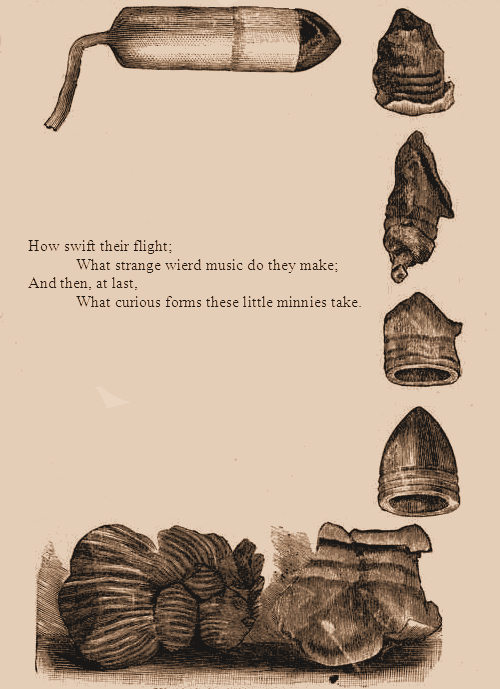
If this siege is to last a month there will be a whole army of trained sharpshooters, for the practice we are getting is making us skilled marksmen. I have gathered quite a collection of balls, which I mean to send home as relics of the siege. They are in a variety of shapes, and were a thousand brought together there could not be found two alike. I have picked up some that fell at my feet–others were taken from trees. I am the only known collector of such souvenirs, and have many odd and rare specimens. Rebel bullets are very common about here now–too much so to be valuable; and as a general thing the boys are quite willing to let them lie where they drop. I think, however, should I survive, I would like to look at them again in after years.

2007-00613.jpg

Shovel and pick are more in use to-day, which seems to be a sign that digging is to take the place of charging at the enemy. We think Grant’s head is level, anyhow. The weather is getting hotter, and I fear sickness; and water is growing scarce, which is very annoying. If we can but keep well, the future has no fears for us.

0 comments

0

News of the Day

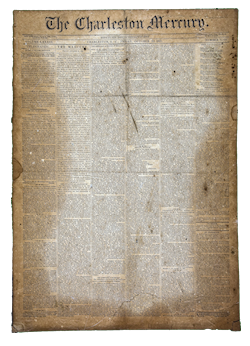
May 23, 1863, The Charleston Mercury

We were of those who opposed the breaking up of the South Carolina College, and the encouragement given to boys abandoning education and going into the field. But the boys were encouraged and permitted to leave College and go into the army, the College exercises were discontinued, and the buildings were loaned to the Government to be used for Hospital purposes. Being most admirably adapted to that end, they have been of great benefit, accommodating a very large number of the sick and wounded soldiers of the country. And the Legislature, after a mature consideration of the subject, agreed, by an almost unanimous vote, to advise the Trustees, under all the circumstances, permit the buildings to remain for the present in the occupation of the Confederate authorities, for the purpose of a Military Hospital, and that in the meantime the exercises of the College be suspended.’

We learn that the Trustees have recently made application for the buildings in order to open the College and resume its exercises. For ourselves, we can see no satisfactory reason for this change of policy or a renewal of an experiment which failed last year. The same reasons which held good in December, hold good now. The College was broken up and converted into a hospital. Let it then be a hospital for the war. The buildings are now employed to the important end of restoring our soldiers. We hope matters will remain as they are. Let youths of 18 go into the Confederate army; youths of 10 into the State Militia as the law required. Education after the war. This has already been determined.

0 comments

0

News of the Day
1860s newsprint

May 23, 1863, Savannah Republican (Georgia)

            We are happy to record the arrival at this place of Mrs. Mary Samuel, her two daughters and son, who have recently been released from confinement in the bastille of the North, where they were subjected to treatment of the most brutal and outrageous character.

            Mrs. Samuel and her daughters were arrested on the first of February, and her son was seized by the United States authorities on the 1st of January, 1863.  They were dragged from their home in Nashville, while peacefully attending to their legitimate business, and without trial and upon a mere suspicion of disloyalty to the United States government, were incarcerated at Camp Chase, Ohio, for three months.  They were afterwards transferred to Columbus, and from thence to Washington, D. C.  At each of these places they experienced the worst of ill usage, poor fare, miserable accommodations, deprived of all clothing excepting such apparel as they wore, insulted by insolent and depraved soldiery, and made the objects of every indignity.

            While in Washington, Mrs. Samuel had a guard stationed in her chamber night and day, and they were paraded in company with others three successive days through the streets of the city to induce the belief that new lots of prisoners had at each time arrived.

            The family is destitute.  Every thing valuable, money, clothes, jewelry–all has been taken.

            They have come to cast their destiny among us rather than dwell with a people lost to every feeling of honor and humanity.–Atlanta Confederacy.

0 comments

Robert M. McGill

Robert M. Magill – Personal Reminiscences of a Confederate Soldier Boy, 39th Georgia Regiment of Infantry

Friday, 22d.—12 M. Federals charged S. D. Lee’s Alabama brigade. Being on reserve, we were sent through a perfect shower of shot and shell to re-inforce. Heavy fighting; Feds driven back; captured three or four stands of colors and several prisoners. General Lee’s aid killed by shell, within twenty feet of us. D. Brown wounded. Gunboats attacked river batteries, but were driven off; pretty hot times on all sides; great many Federals killed to-day in the several charges made; not very many Rebels killed, but several wounded. 8 P. M., ordered back to our place on reserve.


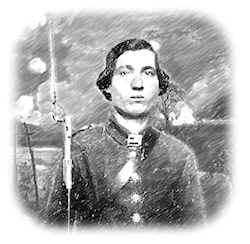
(Note: picture is of an unidentified Confederate soldier.)

0 comments

0

Civil War Diary of Charles H. Lynch, 18th Conn. Vol’s.
Charles Lynch

May 22d. We bid farewell to Fort Marshall and Baltimore. Marched across the city to the Camden Street railway station, Baltimore and Ohio R. R. After a long wait a train of box cars ready to receive us, into which we were packed and started on our journey. A slow tiresome ride in the old cars.

0 comments

Downing’s Civil War Diary.–Alexander G. Downing.

Diary of Alexander G. Downing; Company E, Eleventh Iowa Infantry

Friday, 22d – This morning we moved out a short distance from our bivouac and formed a line of battle. The rebels commenced throwing shells at us, and continued it all day; but as their guns were aimed too high, our greatest danger was from the falling limbs of trees hit by their shells. Four companies, including Company E, were sent out on the skirmish line. Company B had one man killed 1 and one wounded. We withdrew after dark and moved five miles farther on toward the right wing of the army and bivouacked in a cottonfield for the night. We were in heavy timber all day, which with the rough land, all hills and gullies, afforded us some protection. We are on the extreme left of Grant’s army, which almost encircles Vicksburg.

0 comments

War Diary of Luman Harris Tenney.

War Diary of Luman Harris Tenney.

22nd. After breakfast sleeked up. Charlie blacked my boots. Bill shaved me. Played two games of chess with Capt. N. Even games. Wrote to Sarah. Received two papers. Very warm day– uncomfortable. Major Purington’s horse died. Seems to have very bad luck.

0 comments

Diary of Belle Edmondson

Diaries and Letters of Belle Edmondson

May FRIDAY 22, 1863

I returned home this morn. My friend Mrs Clay Taylor and friend Mrs Patton arrived from Dixie. No late news.

0 comments

A Rebel War Clerk’s Diary

A Rebel War Clerk’s Diary at the Confederate States Capital, By John Beauchamp Jones
A likeness of Jones when he was editor and majority owner of the Daily Madisonian during President John Tyler’s administration.

MAY 22d.—A letter from Gen. Howell Cobb, declining the offer of the Secretary of War, of the position of Quartermaster-General, was received to-day. His wife is ill, and he prefers to remain with her; besides, he doubts his qualifications—he, who was Secretary of the Treasury of the United States! He says, moreover, referring to the imperfect ordnance stores of his brigade, that there can be no remedy for this so long as Col. G. is the Chief of the Bureau of Ordnance. So Col. Myers is to be disposed of at last, and Col. G. has but an uncertain tenure.

We have sad rumors from Vicksburg. Pemberton, it is said, was flanked by Grant, and lost 30 guns, which he abandoned in his retreat. Where Johnston is, is not stated. But, it is said, Vicksburg is closely invested, and that the invaders are closing in on all sides. There is much gloom and despondency in the city among those who credit these unofficial reports. It would be a terrible blow, but not necessarily a fatal one, for the war could be prolonged indefinitely.

I met with Robt. Tyler to-day, who offers to wager something that Gen. Stuart will be in Philadelphia in a fortnight, and he said there was a proposition to stop the publication of newspapers, if the President would agree to it, as they gave information to the enemy, and at such a time as this did no good whatever. He thinks they are on the eve of revolution in the North, and referred to Gov. Seymour’s letter, read at a public meeting in New York.

0 comments

0

A Soldier’s Story of the Siege of Vicksburg

From the diary of Osborn H. Oldroyd

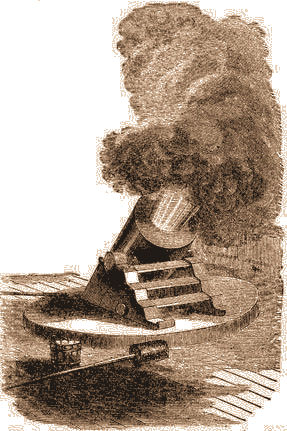
MAY 22ND. –Last night mortar-shells, fired from the boats on the river in front of the city across Point Louisiana, fell thick over all parts of Vicksburg, and at three o’clock this morning every cannon along our line belched its shot at the enemy. Nothing could be heard at the time but the thundering of great guns–one hundred cannons sent crashing into the town –parrot, shrapnell, cannister, grape and solid shot–until it seemed impossible that anything could withstand such a fearful hailstorm. It was indeed a terrible spectacle–awfully grand.

2007-0003.gif

Mortor from the river in front.
“During the siege of Vicksburg, sixteen
thousand shells were thrown from the
mortor gunboats and naval batteries
into the city”– Hamersly

At ten o’clock we had orders to advance. The boys were expecting the order and were busy divesting themselves of watches, rings, pictures and other keepsakes, which were being placed in the custody of the cooks, who were not expected to go into action. I never saw such a scene before, nor do I ever want to see it again. The instructions left with the keepsakes were varied. For instance, “This watch I want you to send to my father if I never return”–”I am going to Vicksburg, and if I do not get back just send these little trifles home, will you?”–proper addresses for the sending of the [continue reading…]

0 comments

0

News of the Day

May 22, 1863, The Charleston Mercury

The Richmond Sentinel learns that arrangements are on foot to procure at once a full size bronze statue of Gen. JACKSON, with the design to place it, when completed, on the plateau in front of the south portico of the Capitol. There are ample materials from which a perfect likeness of the General can be had, and no unnecessary delay will occur in sending these materials to the same foundry in Munich at which the equestrian statue of Washington was cast, after the necessary funds shall have been obtained. The estimated cost of the statue in Confederate funds is sixty to eighty thousand dollars. Our brethren of the press will gladly assist in making the appeal known; and we are pursuaded that nothing more will be necessary to secure the amount required. Col. S. BASSETT FRENCH, Aid de camp to the Governor of Virginia, and a member of General JACKSON’S staff during the campaign of last summer, has been appointed to receive all contributions to the testimonial of a nation’s love, and has agreed to act. All communications should, therefore, be addressed to him at Richmond.

0 comments

0

News of the Day

May 22, 1863, The New York Herald

Sailing Exercises on Board the Sloop Marion.

Our Naval Academy Correspondence.

NEWPORT, R.I., May 20, 1863.

The day dawned upon us calm and beautiful; but the clouds bespoke for us a breeze early in the day, while the atmosphere here promised us a fine day for the exercise of the young gentlemen in the various evolutions on board ship.

At nine o’clock the board convened at the Aquidneck House, and proceeded to the wharf, accompanied by several ladies, where they embarked on board of the steam tender Fanny, and started for the sailing sloop-of-war Marion. A more propitious day could not have been selected, and as we glided over the smooth and spacious waters of the harbor every one felt invigorated by the freshness and purity of the air. A delightful sail of a few minutes brought us to the Marion, which lay at anchor off the breakwater, with the first, second and third classes of midshipmen on board, who were to be exercised in practical seamanship.

On reaching the vessel the blue flag of the Admiral was hoisted at the mizen, a guard drawn up to receive us, and, amid the roll of the drum and shrill whistle of the boatswain at the gangway the distinguished party was ushered on board. [continue reading…]

0 comments

0

News of the Day

May 22, 1863, The New York Herald

In looking over the general field of the war there appears to be very little going on in the way of active operations except in the State of Mississippi. From that quarter we are momentarily expecting the news of General Grant’s occupation of Vicksburg. The latest accounts of his movements – which are officially reported by the rebel General Joe Johnston – represent that he defeated General Pemberton at Edwards’ depot, on the railroad between Jackson and Vicksburg, on Saturday, and drove him back behind the Big Black river towards the latter point. Further rumors from scouts state that Grant had advanced, engaged, and beat Johnston near Brownsville. These are favorable symptoms of coming good fortune at the great rebel stronghold of the Southwest. But, in the meantime, what is General Burnside doing against a threatened rebel invasion of Kentucky? Why has not Gen. Rosecrans moved out from Murfreesboro? Why this inactivity on the part of our land and naval forces in the southeast concern of Virginia, in North Carolina, South Carolina and Georgia? If we wait a few weeks longer all aggressive operations, from Pamlico Sound to the Savannah river, will most probably have to be suspended until the return of the malaria-killing frosts of autumn. But, above all, why lingers the Army of the Potomac on the northern side of the Rappahannock?

Taking up these questions in their order, we may answer, that, in addition to his laborious campaign against Vallandigham, General Burnside, in order to checkmate the threatened rebel invasion of Kentucky, has been preparing for the movement of a heavy army column to meet the enemy more than half way; that General Rosecrans is biding his time, inasmuch as his army may be considered an army held in reserve to support the [continue reading…]

0 comments

0

News of the Day

May 22, 1863, The New York Herald

The news from the Southwest is most important. It is known that General Grant’s forces abandoned Jackson on Friday and Saturday last, having other work to attend to. General Joe Johnston telegraphs to Adjutant General Cooper, from the rebel camp between Livingston and Brownsville, that General Pemberton had been attacked on Saturday morning near Edwards’ depot by the Union forces, and was compelled to fall back behind the Big Black river after a hard fight of nine hours duration. A despatch to the Mobile register, dated from Jackson on the 18th, says that the Union loss in the attack on that city was admitted to be six hundred men by a Union officer, who bore a flag of truce into Jackson; that the rebels had retreated beyond the Big Black, destroying the bridge behind them; but that our forces had advanced eight miles north and there found General Joe Johnston in line of battle. This correspondent, however, states that, according to rebel advices, their troops – twelve thousand strong – fought twenty-four thousand Union troops, sustained themselves and fell back to their intrenchments at night. They admit a heavy loss, and pronounce the battle severe, though indecisive.

A despatch from Murfreesboro yesterday says that the rebels admit that General Grant has defeated Johnston, and secured the railroad bridge across the Big Black river, thus cutting off Vicksburg from supplies and reinforcements. These statements, it must be observed, all come, either directly or indirectly, from rebel sources. The latest official news we have is the announcement t General Halleck by General Grant of this capture of the city of Jackson on the 14th instant. [continue reading…]

0 comments

0

News of the Day

Warning

The following article contains wording that is offensive to many in the world of today.  This, unfortunately, includes the title.

However, the article is provided unedited for its historical content and context.

It is important to note that this article reflecting Civil War era attitiudes about blacks is  from a Northern newspaper.

Nigger Regiments.

 May 22, 1863, The New York Herald

The process of transforming the […..] into a military auxiliary of the white soldier is being actively carried out by our republican generals. In Tennessee Adjutant General Thomas has, it is stated, already raised twelve black regiments, whilst in Louisiana General Banks has enrolled fifteen. In the District of Columbia Secretary Stanton has got together some twelve hundred darkeys, who are being organized in a regiment bearing his name and wearing regulation beards in imitation of their patron. It is refreshing to watch these embryo heroes strutting up and down Pennsylvania avenue, and aping the port and gait of their illustrious prototype. In Massachusetts, the Mahomet of the new Hegira, Gov. Andrew, after scouring not only the State, but the States, for upwards of six months, in search of nigger volunteers, has at last succeeded in getting together a regiment of them, which he is busy drilling under the shadow of Bunker Hill Monument. By the 1st of June we will probably have from forty to fifty of these nigger regiments in the field, each of which will, no doubt, in due time, furnish its quota of Toussaint L’Ouvertures. Great things are expected from this new principle of military amalgamation. Whether it will change […..] Ethiopskin” to white or convert the white man’s skin to black remains to be tested. The experiment would have a fairer chance, perhaps, if a few of our strong minded women were apportioned to each brigade. In other respects it promises to be attended with beneficial results. The free niggers of the North are, as a general thing, lazy, worthless fellows, and two or three years of military training cannot fail to improve their moral and industrial status. Those from the South will be easier to break in, thanks to the discipline of the overseer. Who knows, after all, but that the salvation of this great nation is to be found in the nigger element? In the utter lack of military genius which prevails in the republican ranks, we may yet be glad to trust our fortunes to the guidance of some ebony Caesar.

0 comments

0

News of the Day

May 22, 1863, Tri-Weekly Telegraph (Houston, Texas)

            We are informed there is a party of deserters in the Big Thicket, who are living in the woods and marauding.  It is reported that they are also freebooting on the highway.  It behooves the military to find out if it is so, and have these runaways searched out.

0 comments