0

News of the Day

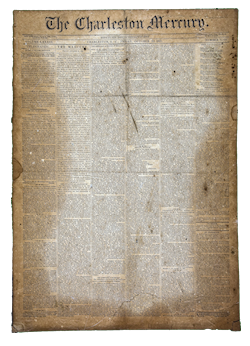
May 26, 1863, The Charleston Mercury

A scouting part from one of our commands near Bluffton, visited Bull Island last week. They report that every house on the island has been burnt; even the fencing has been torn down, made into heaps and consumed. The property was owned by Col. E.M. SEABROOK and a small portion by Mr. BAYARD, and was originally one of the most magnificent estates in our tide water section. The Yankees were in small force, and bivouacked on the island for several days. The fragments of their commissary stores showed that they were well fed; sardine boxes, preserved fruit cans, &c., could be seen near their bivouac. They also slaughtered some cattle. All the valuable machinery has been destroyed in the conflagration.

0 comments

0

News of the Day
1860s newsprint

May 26, 1863, Savannah Republican (Georgia)

Communicated.

                      Mr. Editor:  Heretofore, during the war, the wives and daughters of our poor soldiers from this city have been enabled to obtain, through their needles, a support, in working for the government on clothing, tents, &c.  Of late this work has been removed to interior towns, and none left to be done here–thus cutting off the sole dependence of hundreds of industrious females.  I speak, Mr. Editor, in behalf of those poor people, and ask, through your columns, that some consideration for their condition be had by our government officials, who have the disposal of this encouragement to the poor.  Cannot the work be distributed–a portion to Savannah as to other cities–and thus help those whose condition is rendered dependent exclusively on the patronage of the government.

                                                  Impartial.

0 comments

0

News of the Day
1860s newsprint

May 26, 1863, Savannah Republican (Georgia)

                    The ladies of Burke county have completed their beautiful and patriotic arrangements at Millen, and are now dispensing their hospitality daily to large numbers of traveling soldiers.  We dropped in a few evenings since and found a well supplied table and every comfort prepared for our brave defenders, the gentle hands that provided these benefactions rendering them doubly acceptable.  We wish them every success in their praiseworthy undertaking, and as they rely on contributions and their own means alone for the support of their “Home,” we hope the public will deal liberally with them.  Will not the friends of the soldier in Savannah lend them a helping hand?  We feel assured they are so disposed, and we would add that, to save them trouble, all contributions left at this office will be promptly acknowledged and forwarded.

0 comments

Robert M. McGill

Robert M. Magill – Personal Reminiscences of a Confederate Soldier Boy, 39th Georgia Regiment of Infantry

Monday, 25th.—One artilleryman killed and another wounded by sharp-shooters. 3 P. M., flag of truce, and Federals allowed to bury their dead; some of our boys went out and talked to them.


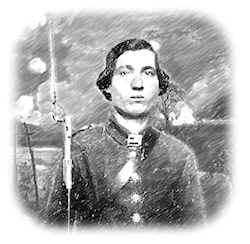
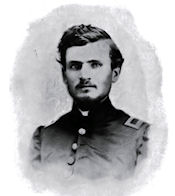
(Note: picture is of an unidentified Confederate soldier.)

0 comments

Diary of a Southern Refugee, Judith White McGuire.

Diary of a Southern Refugee During the War by Judith White McGuire

25th.—The enemy repulsed at Vicksburg, though it is still in a state of siege. General Johnston is there, and we hope that the best means will be used to save that heroic little city; and we pray that God may bless the means used.

A friend called this morning, and told us of the fall of another of those dear youths, over whose boyish sojourn with us memory loves to linger. Kennedy Groghan, of Baltimore, who, in the very beginning of the war, came over to help us, fell in a skirmish in the Valley, a short time ago. The only account given us is, that the men were forced to retreat hastily, and were only able to place his loved body under the spreading branches of a tree. Oh! I trust that some kindly hand has put him beneath God’s own earth, free from the din of war, from the strife of man, and from the curse of sin forever. I remember so well when, during our stay in Winchester, the first summer of the war, while General Johnston’s army was stationed near there, how he, and so many others, would come in to see us, with their yet unfaded suits of gray—already sunburnt and soldier-like, but bright and cheerful. Alas! alas! how many now fill the graves of heroes—their young lives crushed out by the unscrupulous hand of an invading foe!

0 comments

0

Civil War Diary of Charles H. Lynch, 18th Conn. Vol’s.
Charles Lynch

May 25th. Again on the march after an early breakfast. Marched in good order through the town, by music of the drum corps. The town is an old Virginia one. Many old buildings, some showing the effects of the war. Reaching the center of town, filed to the right, going west, on the Winchester Pike. On the march we were obliged to ford three small rivers, or creeks, as the natives called them. Passed a number of large mansions. Many small outhouses, the homes of slaves in prosperous times. We surely are now in the enemy’s country. In conversation with the natives we would try and keep them talking, on account of their peculiar dialect. We never could find out how far it was to the next town, in miles. The answer would be “Right smart aways, I reckon.” After a tiresome march we reached the town of Winchester late in the afternoon. After a halt in the town for a while, until the Colonel could report to the Commander, General Milroy, we again were on the march, out the south side of the town, to locate camp about two miles from town.

0 comments

Downing’s Civil War Diary.–Alexander G. Downing.

Diary of Alexander G. Downing; Company E, Eleventh Iowa Infantry

Monday, 25th–Fighting commenced this morning all along the line, but it proved to be mostly picket fighting. There was also some heavy cannonading and the mortar boats and the gunboats were in action. Our command, the Sixth Division, lay in bivouac all day. In the evening the rebels came out and captured some of our pickets, and we then formed a line of battle. The First Missouri Battery threw some shells into the rebels’ camp after night. General Lauman’s division arrived this morning, but did not get into action.

0 comments

War Diary of Luman Harris Tenney.

War Diary of Luman Harris Tenney.

25th. After breakfast, just as most of the Cos. had started to graze, word came that rebels were crossing at Fisher’s Creek in force and had captured pickets. “Boots and Saddles” sounded and we were soon under way for the ford. Issued rations first. Rebels gone. Followed trail some distance and rested at the Brewery. Got back into camp before dark. Got some supper. Cleaned my horse. Wrote a little and retired.

0 comments

Diary of David L. Day.

David L Day – My diary of rambles with the 25th Mass

The Boys’ Story.

May 25. For the past day or two I have been a good deal amused and interested in hearing the boys relate their adventures at Dover and Gum swamps. Their stories conflict a little, but as near as I can make it out I fix up a little story. To prepare it a little, we hold an outpost and signal station some twelve miles up the railroad, at Bachellor’s creek towards Kinston. This is garrisoned by the 58th Pennsylvania, Col. Jones. He is one of those stirring, active, restless sort of men, always finding out everything and getting interested in it. Well, he had discovered an outpost of the enemy some ten or twelve miles in his front and some six miles this side of Kinston, at a place called Gum swamp, and garrisoned by a considerable force. Now it occurred to him that it would be a capital joke to capture that post. So he comes down and shows his plans to the general, asking permission and troops to carry them out. He knew just who was there and how many; he had been around that swamp half a dozen times and knew all about it. That suited the general; he patted Jones on the back, called him a good fellow and told him to sail in, and he should have all the troops he wanted.

On the afternoon of the 21st, the 25th, with two or three other regiments, went aboard the ears for Bachellor’s creek. Not feeling very well, I was excused from going. Arriving at the creek, Col. Jones with his regiment heads the column, and leads off into the woods. This was a night march, and just here I will explain that always on the march, whether day or night, all the officers that are mounted (and any of them can be who will take the trouble to steal an old horse or mule), have a disagreeable habit of [continue reading…]

0 comments

0

Cruise of the U.S. Flag-Ship Hartford -Wm. C. Holton

May 25th. Commences with pleasant but warm weather. From four to eight A. M. heard musketry-firing in rear of Port Hudson. This morning Lieut. Watson went across the point to communicate with lower fleet; at eleven A. M. steamer Bee came down the river and communicated with us. Received on board three more rebel prisoners from the Albatross; at one P. M. sent fourteen rebel prisoners, in charge of Lieut. Higby, U. S. M. Corps, and fourteen marines, to Bayou Sara; the lower fleet shelling Port Hudson; at six thirty P. M. called all hands, got up anchor and steamed up river; at seven P. M. came to anchor a little further up the river. Lieut. Rigby and the marines returned to the ship; at eleven forty P. M. beat to general quarters.

0 comments

0

A Soldier’s Story of the Siege of Vicksburg

From the diary of Osborn H. Oldroyd

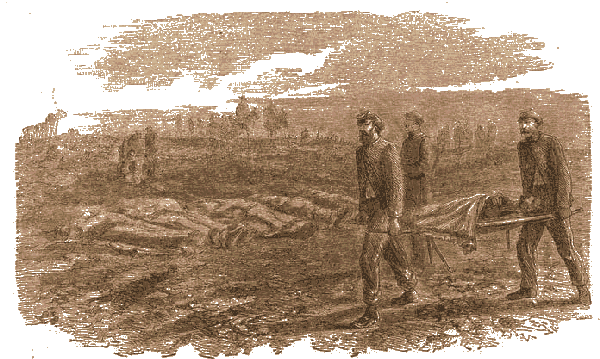
MAY 25TH.–Pemberton sent a flag of truce to Grant at two P. M., and the cessation of hostili ­ties thus agreed on, lasted till eight o’clock in the evening. It made us happy, for we fancied it was a sign they wanted to surrender–but no such good luck. It was simply to give both sides a chance to bury their dead, which had been lying exposed since the twenty-second. Both armies issued from their respective fortifications and pits, and mingled together in various sports, apparently with much enjoyment. Here a group of four played cards–two Yanks and two Rebs. There, others were jumping, while everywhere blue and gray mingled in conversation over the scenes which had transpired since our visit to the neighborhood. I talked with a very sensible rebel, who said he was satisfied we should not only take Vicksburg, but drive the forces of the south all over their territory, at last compelling them to surrender; still, he said, he had gone into the fight, and was resolved not to back out. He said they had great hope of dissension in the north, to such an extent as might strengthen their cause. There have been grounds for this hope, I am sorry to say, and such dissen ­sions at the north must prolong the war, if our peace party should succeed in materially obstructing the war measures of govern ­ment. From the remarks of some of the rebels, I judged that their supply of provisions was getting low, and that they had no source from which to draw more. We gave them from our own rations some fat meat, crackers, coffee and so forth, in order to make them as happy as we could. We could see plainly that their officers watched our communications closely.

2007-0004.gif

Burying the dead that had lain between the Confederate and Union lines for three days.

0 comments

A Rebel War Clerk’s Diary

A Rebel War Clerk’s Diary at the Confederate States Capital, By John Beauchamp Jones
A likeness of Jones when he was editor and majority owner of the Daily Madisonian during President John Tyler’s administration.

MAY 25th.—Dispatches from the West inform us that three attempts to carry the city of Vicksburg by assault have been repulsed with heavy loss. Johnston is on the enemy’s flank and rear, engendering a new army with rapidity, and if the garrison can hold out a little while, the city may be safe.

Gens. Ewell and A. P. Hill have been made lieutenant-generals, and will command Jackson’s corps. It appears that the Senate has not yet confirmed Hardee, Holmes, and Pemberton.

The Washington correspondent of the New York Commercial Advertiser says Hooker’s loss in killed and wounded amounted to “over 23,000 men, and he left 24 guns on the other side of the Rappahannock.” We got 8000 prisoners, which will make the loss 31,000 men, and it is said the stragglers, not yet collected, amount to 10,000 men! Only 13 guns fell into our hands, the rest fell–into the river!

0 comments

0

News of the Day

May 25, 1863, The Charleston Mercury

HIGHLY IMPORTANT FROM VICKSBURG.

JACKSON, MISS., May 22. – Heavy firing has been heard this morning in the direction of Vicksburg. It is reported, and believed in official circles, that the enemy assaulted the works at Vicksburg on Wednesday, but was badly repulsed. Snyder’s Bluff has been evacuated by our troops. A courier reports that Yazoo City was captured yesterday by the enemy. The Navy Yard there was burned by our own men.

Later. – An officer, just arrived from Vicksburg, reports that GRANT has been beaten back. The enemy made three desperate assaults upon our position, but were repulsed.

Semi-official information has been received of the capture of Helena, Ark., by PRICE.

MOBILE, May 22. – A correspondent, writing from Jackson on the 19th, says: ‘Gen. JOHNSTON this morning threw ten thousand men over the Big Black to the Vicksburg side.’

It is reported here that we have reoccupied Snyder’s Bluff. The alleged occupation of Yazoo City by the enemy is not credited here.

General GRANT entered the State of Mississippi, crossing the river five miles below Grand Gulf, from 60,000 to 100,000 strong, with a heavy force of cavalry. He has received no reinforcements from Louisiana, but receives them constantly from the west [continue reading…]

0 comments

0

News of the Day

May 25, 1863, The New York Herald

By the news which we published during the last two or three days, and particularly yesterday, our readers were prepared for the glorious intelligence which we are enabled to announce this morning, that Stars and Stripes float over Vicksburg, and the victory is complete.

This brilliant success of Grant redeems from reproach the generalship which has hitherto conducted our armies, and it opens a new era in the war. The rapidity, skill and energy of his movements, together with his indomitable pluck and the fighting qualities of his troops, evidently took the rebel generals by surprise, and neither gave them time to concentrate their forces nor to escape from being defeated and dispersed or captured in detail. The probability is that the whole garrison, numbering from 15,000 to 20,000, remaining to the rebels after their losses in killed and captured in the previous fights, have been made prisoners of war, as were the garrison at Fort Donelson by the same energetic commander.

This is undoubtedly the greatest victory of the war. Its results, not only in a military, but in a moral and political point of view, are of the highest interest. The rebel Congress and rebel journals have recently held out to the Northwest the free navigation of the Mississippi as a bribe to induce that section of the republic to swerve from its allegiance to the Union. But they misunderstood the Northwest, which has resolved to stand by the Union to the last, and at the same time to recover the freedom of the Mississippi as an indefeasible right, and not as a boon at the hands of rebels in arms. By the noble [continue reading…]

0 comments

0

News of the Day

May 25, 1863, The New York Herald

Two important events in the news received yesterday, and duly chronicled in an extra HERALD in the afternoon, created considerable excitement throughout the city. The first was the capture of Vicksburg by the army of General Grant; the other was the raising of the siege of Puebla by the French invading army in Mexico. The interest which the first piece of intelligence excites, pregnant as it is with hopes of grand successes over the power of the enemy in the Southwest, is hardly excelled by the news from Mexico, which predicts a failure in the designs of the French Emperor upon the American continent. The French accounts state that the siege of Puebla was raised temporarily in the absence of heavy guns and reinforcements. Other statements, however, from Mexican and English sources, represent a severe defeat and retreat of the invaders towards Orizaba.

The capture of Vicksburg, however, claims the first position in importance. After a brilliant and successful campaign of three weeks, Gen. Grant has taken possession of Vicksburg and planted the old flag there. The outer works and rifle pits having been taken, as we announced yesterday, the fall of the city was inevitable. It is said that Admiral Porter co-operated with General Grant in the siege, his fleet cannonading the city and its works, still in the hands of the rebels, by night, while Grant’s army assailed it by day, thus giving the rebels within the town and intrenchments not a moment’s relaxation from the perils of their situation. The garrison consisted of from fifteen to twenty thousand men, and are probably captured. The official accounts of the battles which preceded the fall of Vicksburg at Baker’s creek and Big Black river bridge are given in our columns today, together with a map of Vicksburg and its surroundings. [continue reading…]

0 comments

0

News of the Day
1860s newsprint

May 25, 1863, Savannah Republican (Georgia)

From the Brandon, Miss., Republican

            In order to ascertain the amount of damage done by the Yankees during their forty-eight hours occupation of the city of Jackson, we went over and took a careful survey of the place yesterday morning, and give below the result of our observations.  We could not get a complete list of the property burned and otherwise destroyed owing to great confusion in the city.  The following buildings were burned:

            Green’s Cotton Factory, together with all the machinery, 300 bales of cotton, and all the buildings connected with the factory, Phillips’ factory, and all the small buildings connected therewith, J. A. Stevens’ foundry, Bailey’s cotton shed, containing a large quantity of tar, lime, cement, &c., Catholic Church and parsonage, Mrs. Bakewell’s house, and contents; Confederate House, together with furniture &c., Railroad depot, and all the buildings immediately west and south of the same; State penitentiary, with all the machinery; flouring mill, near Phillips’ factory, all the houses on State street, from  Shaw’s store to Graves’ corner, including Green’s Banking House; Ambrozier’s grocery, Allen & Legon’s store, and Grave’s large brick building, with a number of small intervening houses; all the houses on the south side of Pearl street from State street to the Mississippi Baptist office, including the Confederate Quartermaster’s office; a number of sheds or were houses, near the old old depot of the Southern Railroad, containing an immense quantity of cotton, sugar, molasses, &c., and a number of old cars, belonging to both railroads, all the houses in front of the City Hall, and Market house, except Mrs. Sanders’ boarding house and one or two small shops, Lemley’s hat factory, Robinson’s warehouse, General Freeman’s dwelling house, all the buildings belonging to the fair grounds, rope factory and salt petre works; the railroad and city bridges across Pearl river, and all the bridges and trestle work on the Southern  Railroad for several miles; all shops where government work was being carried on.  All the stores in the city were pillaged, their contents either carried off or thrown into the street and burned.  The Mississippian office was broken open, the type thrown in the street and the presses and furniture broken up.  The Post Office was rifles of its contents.  The Governor’s mansion was broken open and pianos and furniture destroyed. [continue reading…]

0 comments

0

News of the Day

May 25, 1863, Tri-Weekly Telegraph (Houston, Texas)

            We have received from Col. G. R. Jefferson of Seguin, the sum of two hundred and seventy two dollars, the proceeds of a concert given by the children of Sequin, for the benefit of the sick and wounded of Sibley’s Brigade.

Seguin, May 2, 1863.

            Editor Telegraph:–Last evening I had the pleasure of attending a concert given by the pupils of Mrs. Pauline Nelson’s high school, at this place, for the benefit of the sick and wounded of Sibley’s Brigade.  The affair was quite a success, the young ladies, one and all, acquitting themselves admirably.  Many of the pieces elicited enthusiastic bursts of applause from the audience.  The May pole was a magnificent thing of the kind, gotten up by Miss Mattie Jefferson, to whose exertions much of the success of the evening is due.  The sum realized was two hundred and seventy-two dollars.  If anything could nerve the arms of our soldiers to strike heavier blows it is such efforts in their behalf as this by the children.

Bystander.

0 comments

…three or four inevitable days of doubt and lying despatches at the time of the Chancellorsville battles..,

Woolsey family letters during the War for the Union

Jane Stuart Woolsey to a friend in Europe.

Washington, May 25.

We have just been spending a month in Washington, my first visit since the war, and the city certainly looks like war-time, the white tents showing out of the green of all the hills, headquarters’ flags flying above all the remaining bits of wood, and everywhere on the highish places, the long, low, dun banks of earthworks you get to detect so soon, looking like a western river levee. Then it is strange not to be able to go in the ferry-boat to Alexandria, or take an afternoon drive across the bridges into the country, without producing a document which sets forth over your names in full,–men and women,–that your purpose is pleasure visiting, and that you solemnly affirm that you will support, protect and defend the Government, etc., against all enemies, domestic or foreign, etc., any law of any State to the contrary notwithstanding, so help you God. It was odd, too, at the opera one night, to see an officer of the Provost Guard come into the theatre between the acts and accost the gentlemen in front of us: “Sorry to trouble you, Major; your pass if you please”; and so, to every pair of shoulder-straps in the house. Then there are the great Barrack hospitals and the dwelling-houses turned into hospitals, the incessant drum-beat in the streets and the going and coming of squads of foot and horse, the huge packs of army-wagons in vacant lots, the armed sentinels at the public buildings, and all the rest of it. Washington certainly shows the grim presence. It is a calumniated city in some respects. It is as bright and fresh this springtime as any town could be. The sweet, early, half-southern spring is nowhere sweeter than in the suburbs of Washington; on the Georgetown Heights, as we drove with Dr. Bacon up the river-edges to the Maryland forts or the great new arch “Union” of the new aqueduct, or down the river-edges by the horrible road, or went on a little breezy rushing voyage in a quartermaster’s tug to Mount Vernon to see Miss Tracy, the lady who lives all alone with the Great Ghost,–all these little excursions are most charming. . . . But some days of our visit were dark ones,–the three or four inevitable days of doubt and lying despatches at the time of the Chancellorsville battles; then the days when the truth came partially out (Mr. Sumner told one of our party last week that it has never yet come out); then the days when the wrecks drifted in, hospitals filled up and our hotel, being a quiet one, became almost a hospital for wounded officers. In the evening we used to hear the tugs screaming at the wharf; soon after, carriages would drive up, a servant get out with one or two pairs of crutches, then a couple of young fellows, painfully hoisted upon them, would hobble in. Some were brought on stretchers. Then one day came our friends, Frank Stevens, 1st New York, shot through the knee, and Captain Van Tuyl, shot through both legs; then Lieutenants Asch and Kirby, one, arm gone, one, leg gone; then Palmer and Best of the t6th, etc. Stevens was left on the field at Chancellorsville, taken prisoner, sadly neglected. But it is astonishing to see the cheerful courage of these young men. I went to see Captain Bailey, 5th Maine, with superfluous condolences. “In six weeks I shall be in the service again; if they can’t make me a marching leg I’ll go into a mounted corps; you don’t suppose I call that a ‘disability’!” pointing to where his right leg used to be; lying, pale and plucky, encouraging three other more or less mutilated men in the same room with him; and much more in the same strain, like the music of Carryl, “pleasant and mournful to the soul.” We saw a long train of rebel prisoners come in, not by any means, I am bound to say, ragged or gaunt or hungry-looking; dirty, of course, with queer patchwork quilts in many cases for blankets; some without shoes, some without hats, but fighting men, not starvelings, every one of them. [continue reading…]
0 comments

Robert M. McGill

Robert M. Magill – Personal Reminiscences of a Confederate Soldier Boy, 39th Georgia Regiment of Infantry

Sunday, 24th.—Sergeant Wright, of Company C, killed by Minnie ball. Crocket White mortally wounded.


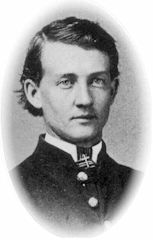
(Note: picture is of an unidentified Confederate soldier.)

0 comments

0

Civil War Diary of Charles H. Lynch, 18th Conn. Vol’s.
Charles Lynch

May 24th. After a night’s rest and breakfast I was very much improved, taking my place in the company. We left the camp at 6 A. M. Sunday morning with drums and fifes, to the tune of Old John Brown, which was kept up until we passed through the town. In this town John Brown had been tried and hung, which event had become history. The town was pleasantly located but showed the effects of the war by its ruined buildings. The scenery was fine looking up the valley. The march continued on towards Berryville, a hot dusty one. It caused many of the boys to fall out by the roadside. After a march of about ten miles we camped for the night near Berryville.

0 comments

Downing’s Civil War Diary.–Alexander G. Downing.

Diary of Alexander G. Downing; Company E, Eleventh Iowa Infantry

Sunday, 24th – The rebels tried to shell us again this morning, but could not get range of us. There was not much fighting today, our men having orders not to advance. Our siege guns, mortar boats and gunboats are throwing shells into the rebels day and night. We were relieved from picket this afternoon by another regiment.

0 comments

War Diary of Luman Harris Tenney.

War Diary of Luman Harris Tenney.

24th. In the morning early issued potatoes and beef. Thede felt a little better. After breakfast got water and helped him bathe. Bathed myself and changed clothes. Read Independents and Congregationalist. Word that chaplain would preach at 5 p. M. but ne’er a sermon. Report came that Grant had defeated Pemberton. Wrote home. Made thickened milk. Slept with Thede.

0 comments

0

Cruise of the U.S. Flag-Ship Hartford -Wm. C. Holton

May 24th. Commences with pleasant weather. Light winds from S. E. Transports in sight coming down the river, and cavalry and infantry landing at the levee at Bayou Sara from four to eight A. M.; at eight thirty A. M. hove up anchor, got under way and steamed down the river; at nine thirty A. M. rounded to above Port Hudson, and fired a shell from the Sawyer rifle on poop, into the rebel batteries, to let them know we had come down to see them once more; at nine forty A. M. came to anchor five miles above Port Hudson. Received from the Albatross five rebel prisoners, hard looking fellows, on board, and kindly cared for them. These unfortunates were captured on a point of land opposite the rebel Gibraltar No. 2 of the Mississippi; at ten thirty A. M. called all hands to muster and performed Divine service. Heavy firing going on at Port Hudson. Received some more rebel prisoners this morning from the Albatross; they proved to be an officer and two privates belonging to a signal corps, they having been captured the day before by some of our pickets. Heavy firing heard in rear of Port Hudson. The mortar schooners below, engaged the rebel batteries also, from two thirty until four P. M. From four to six P. M., heavy cannonading between lower fleet and rebel batteries at Port Hudson, during this watch; also our army in rear of Port Hudson, engaged with the enemy; at six P. M. inspected crew at quarters. Received a mail on board from below.

0 comments

A Rebel War Clerk’s Diary

A Rebel War Clerk’s Diary at the Confederate States Capital, By John Beauchamp Jones
A likeness of Jones when he was editor and majority owner of the Daily Madisonian during President John Tyler’s administration.

MAY 24th Sunday.—We have had a fortnight of calm, dry, and warm weather. There is a hazy atmosphere, and the sun rises and sets wearing a blood-red aspect. At night the moon, dimly and indistinctly seen (now a crescent), has a somber and baleful appearance. This is strange at this season of the year; it is like Indian summer in May. The ground is dry and crusted, and apprehensions are felt for the crops, unless we have rain in a few days. My poor little garden has suffered for moisture, but the area is so small I am enabled to throw water over it in the evening. My beets, tomatoes, early potatoes, and lettuce look pretty well, though not so far advanced, in consequence of the late spring, as I have seen them in Burlington. But they are a great comfort to me. I work them, water them, and look at them, and this is what the French would call a distraction. I have abundance of roses,—this is the city of roses. And my cherries are coming on finely,—I know not yet what kind they are; but it relieves the eye to gaze on them. And then my neighbor has a pigeon-house, and the birds come into my yard and are fed by my daughters, being pretty and tame. I sit for hours watching them.

Alas! this cruel war! But independence will be ample compensation. Our posterity will thank us for our sacrifices and sufferings. Yet all do not suffer. The Gil Biases, by their servility and cringing to their patrons, the great men in power, and only great because they have patronage to bestow, which is power, are getting rich. Even adroit clerks are becoming wealthy. They procure exemptions, discharges, and contracts for the speculators for heavy bribes, and invest the money immediately in real estate, having some doubts as to its ultimate redemption, and possibly indifferent as to the fate of the country, so that their own prosperity be secure. After the war the rascals and traitors will be rich, and ought to be marked and exposed.

0 comments

0

A Soldier’s Story of the Siege of Vicksburg

From the diary of Osborn H. Oldroyd

MAY 24TH.–Sunday; and how little like the Sabbath day it seems. Cannon are still sending their messengers of death into the enemy’s lines, as on week days, and the minnie balls sing the same song, while the shovel throws up as much dirt as on any other day. What a relief it would be if, by common consent, both armies should cease firing to-day. It is our regiment’s turn to watch at the front, so before daylight we moved up and took our position. We placed our muskets across the rifle pits, point ­ing towards the fort, and then lay down and ran our eyes over the gun, with finger on trigger, ready to fire at anything we might see moving. For hours not a movement was seen, till finally an old half-starved mule meandered too close to our lines, when off went a hundred or more muskets, and down fell the poor mule. This little incident, for a few minutes, broke the monotony. A coat and hat were elevated on a stick above our rifle pits, and in an instant they were riddled with bullets from the enemy. The rebels were a little excited at the ruse, and probably thought, after their firing, there must be one less Yankee in our camp. In their eagerness a few of them raised their heads a little above their breastworks, when a hundred bullets flew at them from our side. They all dropped instantly, and we could not tell whether they were hit or not. The rebels, as well as our ­selves, occasionally hold up a hat by way of di ­version. A shell from an enemy’s gun dropped into our camp rather unexpectedly, and bursted near a group, wounding several, but only slightly, though the doctor thinks one of the wounded will not be able to sit down comfortably for a few days. I suppose, then, he can go on picket, or walk around and enjoy the country.

0 comments