0

News of the Day

May 30, 1863, The New York Herald

OUR SPECIAL ARMY CORRESPONDENCE.

THREE MILES IN THE REAR OF VICKSBURG, May 20, 1863.

The army crossed the river early on Monday morning over the bridge constructed during the night by General Lee. General Osterhaus’ division first crossed, followed by General A. J. Smith, which in turn was followed by McPherson’s army corps. Sherman had continued north of the railroad from Jackson, striking Big Black river a little west of Bridgeport. Here he crossed on his pontoon bridge, and moved upon the Vicksburg and Haines’ Bluff and Spring Dale roads. McPherson moved out on the main Vicksburg and Jackson road, while McClernand took possession of the Baldwin’s Ferry road.

On the summit of the high bank across the river the column moved through the camp whence the night before the enemy made his hasty exit. On the plateau nearest the river before the hill is reached numerous tents were left standing just as the occupants had hastily left them. They could not be destroyed under the heavy fire of our skirmisher posted on the hither bank of the river. When the hill was reached we found abundant evidence of the demoralization of the enemy. Several piles of gun barrels, with stocks but half consumed, were lying by the roadside. Tents, wagons and gun carriages were in ashes, corn was burning, and officers’ baggage and soldiers’ clothing were scattered all over the camp. The column moved to Bovina, where no evidence of the enemy was seen, save a rebel hospital filled with sick and wounded. Here General Grant was joined by General Dwight from Banks’ army. [continue reading…]

0 comments

0

News of the Day

May 30, 1863, The New York Herald

OUR SPECIAL ARMY CORRESPONDENCE.

EDWARDS’ STATION, May 16, 1863.

Early on the morning of the day following the occupation of the city of Jackson it was decided to evacuate the position. There were several reasons which induced General Grant to arrive at this decision, prominent among which was the difficulty of keeping intact his long line of communication, and the fear that General Johnston – who was known to be hovering in the region north of Jackson with a force estimated at from fifteen to twenty thousand men – would attack his rear. The force which we encountered just before we reached Jackson, under General Gregg, had divided, one portion going to Canton from the north and the other from the south. Johnston and Gregg combined might prove altogether too formidable. It was therefore decided to return to Clinton and move upon Vicksburg.

From documents which fell into our hands it was learned that the main column of the enemy was at Edwards’ Station, proposing to dispute our passage and give us battle there. Soon after daylight the column was in motion, Gen. McPherson in advance. They reached Clinton at noon, and after an hour delay marched to their camping ground, a short distance from the village of Bolton.

It may be of interest to describe the topography and appearance of the country through which the route lay. Imagine a region rugged and broken, with a succession of hills and [continue reading…]

0 comments

0

News of the Day

May 30, 1863, The New York Herald

Three cases of treason have been tried in the Army of the Potomac of prisoners captured in the rebel service while still citizens of the United States. One of them is the case of James R. Oliver, who being a citizen of Maryland, was taken prisoner while in arms in the ranks and uniform of the rebel army, at Rappahannock Ford, February 15, 1863. Upon these facts a court martial found him guilty of treason, and sentenced him to be hanged. Nothing could be more illegal or absurd. The offence was one clearly for a civil court, as provided in the constitution, and the trial must take place in the district where the offence was committed. The finding was forwarded by General Hooker to the President, with the endorsement approved. Mr. Lincoln returned the papers disapproved, and declaring that the man in question was a prisoner of war, and must be treated as such and exchanged. This is the dictate of common sense as well as humanity. The Union army has far more men from the Confederate States in its ranks and uniform than the rebel army has men from the loyal States. Besides the barbarity of the proceeding, leading to bloody retaliation, the Northern army would be a greater loser by such a course than the Southern, and no benefit could result from the mutual slaughter in cold blood. We always said the President was humane. His decision in this case proves that he is, and that he is above the malignant passions of those who seek to influence him in the Cabinet or the camp.

0 comments

0

News of the Day

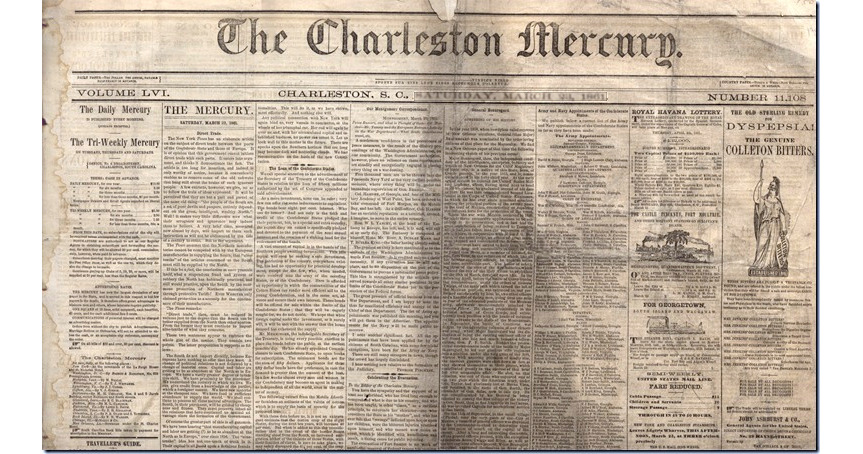
May 30, 1863, The Charleston Mercury

We see, from the newspapers in various quarters, indications of dissatisfaction with the people of Charleston, in consequence of the foreign commerce carried on by her merchants. The running of the blockade – exporting cotton and importing goods – is regarded as unpatriotic, and injurious to the interests of the Confederacy. By this means, it is said, we supply Great Britain (who refuses to enforce the laws of nations touching blockade) with a necessity, which, if kept from her, will at least make her feel our power and her dependency. It is said to be even worse than this. We supply our enemy with cotton, and consume many goods in return; for who in the Confederate States can control the trade at Nassau, and determine that the Yankees shall not purchase our cotton when sold there, or return as their goods in payment therefor?

The State of Georgia, doubtless actuated by such reasons, has taken action upon the subject, and we find in the proceedings of the Senate in Congress the following statement:

SENATE – MONDAY, April 27, 1863. – Mr. Johnson, of Georgia, presented a preamble and resolutions adopted by the Legislature of Georgia, in favor of the passage of a law to prevent the running of the blockade, either by land or water, during the existence of the present war by any person whatever, except under the direct control and for the exclusive benefit of the Government of the Confederate States.

The resolutions were referred to the Committee of Finance.

Now, we beg leave to submit a few facts upon this subject. The people of Charleston, at the opening of this war, were as much opposed to the exportation of our great staples to [continue reading…]

0 comments

0

News of the Day

May 30, 1863, The Charleston Mercury

LATEST NEWS FROM VICKSBURG.

JACKSON, MISS, May 25 – (To the Mobile Advertiser.) – Com. BROWN sunk four boats in Yazoo River, which blockaded it, saving all the others.

The Mississippian publishes a statement that it was MARMADUKE, not PRICE, who captured Helena. It is reported that he hung a negro regiment, officers and men. The fact of the capture is doubted, and it is believed the news comes from Memphis. There has been no boat up the river to Memphis for five days.

The Federals have been so severely punished in their different assaults upon Vicksburg, that they have fallen back and gone to fortifying. – Their numerous dead still lie on the field, and the stench is awful. Their loss is variously estimated at from 10,000 to 25,000 men. They are reported to be hauling siege guns from Snyder’s Bluff.

They told their troops that Richmond was taken, and that all they had to do was to take Vicksburg and end the war. They were shelling this morning.

0 comments

0

News of the Day

May 30, 1863, Charleston Mercury

                      The people of Mobile have exerted themselves most energetically and humanely to provide for the transportation from Pascagoula and shelter in their city of the large number of refugees which the barbarous edict of the Yankee Government has driven from New Orleans.  It was estimated that they numbered from five to six thousand!  They embrace all ages, sexes and conditions of life.  It would take many days, and the Mobile Register says possibly weeks, to remove them from their place of landing on Pascagoula Bay to the city.  Such a scene of wholesale exile has not been witnessed in modern times.  It carries back the world to barbarous ages, and exhibits the Yankee nation in the light of one of the most cruel, unrelenting and brutal of the races of men that have flourished in any age.

0 comments

Robert M. McGill

Robert M. Magill – Personal Reminiscences of a Confederate Soldier Boy, 39th Georgia Regiment of Infantry

Friday, 29th.—Very heavy cannonading from 7 to 8 A. M., along the center. Gunboats came up and shelled the woods in our front; throwing some shells from mortars across the peninsula, but doing little damage.


(Note: picture is of an unidentified Confederate soldier.)

0 comments

Downing’s Civil War Diary.–Alexander G. Downing.

Diary of Alexander G. Downing; Company E, Eleventh Iowa Infantry

Friday, 29th–We started on the move early this morning and after marching about ten miles came upon the rebel pickets. We drove them in and forming a line of battle advanced towards them about two miles, our batteries throwing a few shells. But the rebels refused to take a stand and finally withdrew altogether. It was a small detachment of Johnston’s army. We lost one killed and two wounded. Our regiment went out on picket.

0 comments

War Diary of Luman Harris Tenney.

War Diary of Luman Harris Tenney.

29th. Felt quite feverish in the morning. Afternoon, light attack of ague. Felt miserable all day. Got badly beaten at chess in the morning by Chester. Spent a very restless night. Sore, headache and uneasy every way. Thede very kindly did my work. Col. Kautz went out with 450 men. Aggravating.

0 comments

“I am by no means an enthusiast over the negro soldiers yet.”–Army Life of an Illinois Soldier, Charles Wright Wills.

Army Life of an Illinois Soldier, Charles Wright Wills, (8th Illinois Infantry)
The following material contains wording that may be offensive to many in the world of today. However, the work is provided unedited for its historical content and context.

Camp 103d Illinois Infantry, Lagrange, Tenn.,
May 29, 1863.

‘Tis becoming fiendishly warm in this latitude again; but the delightfully cool nights of which I wrote you so much last summer, are also here again, and amply repay one for the feverish days. We have moved our camp from the town to a grove on a hill about midway between Grand Junction and Lagrange It is one of the best defensive positions that I know of. It seems to me much better than Corinth, or Columbus, Ky., or New Madrid. Our negro troops are fortifying it. I suppose that no one anticipates danger from the Confederates, on this line, any more; but I can understand that the stronger we make our line, the less object the secesh will have in visiting us. We are raising a regiment of blacks here. Captain Boynton, who has an Illinois Battery, is to be the colonel. He looks like a good man, but I think that a better could have been selected. I am afraid they are not commissioning the right material for line officers. Two are to be taken from our regiment, and if we have two men who are good for nothing under the sun, I believe them to be the ones. I know that first rate men have applied for these places, and why they give them to such worthless fellows, I can’t see. I think poor Sambo should be allowed a fair chance, and that he certainly will never get under worthless officers. I suppose that the regiment organization here numbers some 800 now, and will soon be full. I don’t know whether I wrote it to you or not, but a year ago I sincerely thought that if the negro was called into this war as a fighting character, I would get out of it as quickly as I could, honorably. I am by no means an enthusiast over the negro soldiers yet. I would rather fight the war out without arming them. Would rather be a private in a regiment of whites than an officer of negroes; but I don’t pretend to set up my voice against what our President says or does; and will cheerfully go down the Mississippi and forage for mules, horses and negroes and put muskets in the hand’s of the latter. I have no trouble in believing that all these Rebels should lose every slave they possess; and I experience some pleasure in taking them when ordered to. [continue reading…]

0 comments

0

Cruise of the U.S. Flag-Ship Hartford -Wm. C. Holton

May 29th. The cessation of hostilities on both sides seems to have, in part, taken place, and our forecastle is not crowded with officers and blue jackets, like on the two previous days, straining their eyes almost out of their sockets in their anxiety to see where our shells and those of our armies fell in the rebels’ works, and what execution they do. Oh, the excitement caused by seeing two parties striving for the mastery! I presume that the almost abandonment of the siege to-day is for good reasons,—probably to rest and recover strength for an early renewal of the assault, and this time with a larger force, or else for the purpose of burying their dead, and giving the enemy an opportunity to care for theirs, the performance of which is a sacred duty, and so held by all civilized nations.

0 comments

A Rebel War Clerk’s Diary

A Rebel War Clerk’s Diary at the Confederate States Capital, By John Beauchamp Jones
A likeness of Jones when he was editor and majority owner of the Daily Madisonian during President John Tyler’s administration.

MAY 29th.—A dispatch from Gen. Johnston, dated 27th inst., says fighting at Vicksburg had been in progress ever since the 19th instant, and that our troops have been invariably successful in repulsing the assults. Other dispatches say the unburied dead of the enemy, lying in heaps near our fortifications, have produced such an intolerable stench that our men are burning barrels of tar without their works.

But still all is indefinite. Yet, from the persistent assaults of the enemy it may be inferred that Grant is inspired with the conviction that it is necessary for him to capture Vicksburg immediately, and before Johnston collects an army in his rear. A few days may produce a decisive result.

Hon. E. S. Dugan, Mobile, Ala., writes that it is indispensable for our government to stipulate for aid from Europe at the earliest moment practicable, even if we must agree to the gradual emancipation of the slaves. He says the enemy will soon overrun the Southwestern States and prevent communication with the East, and then these States (Eastern) cannot long resist the superior numbers of the invaders. Better (he thinks, I suppose) yield slavery, and even be under the protection of a foreign government, than succumb to the United States.

The enemy, wherever they have possession in the South, have adopted the policy of sending away (into the Confederate States) all the inhabitants who refuse to take the oath of allegiance. This enables them to appropriate their property, and, being destitute, the wanderers will aid in the consumption of .the stores of the Confederates. A Mr. W. E. Benthuisen, merchant, sent from New Orleans, telegraphs the President for passports for himself and family to proceed to Richmond. The President intimates to the Secretary of War that many similar cases may be looked for, and he thinks it would be better for the families to be dispersed in the country than congregated in the city.

The following are the wholesale prices to-day:

“PRODUCE, PROVISIONS, ETC.–The quotations given are wholesale. Wheat—nothing doing—we quote it nominal at $6.50 to $7; corn, very scarce, may be quoted at $9 to $10; oats, $6 to $6.50 per bushel; flour—superfine, $32, extra, $34, family, $37 per barrel; corn-meal, $11 per bushel; bacon, hoground, $1.45 to $1.50—a strictly prime article a shade higher; butter, $2.50 to $3 per pound; lard, $1.50 to $1.60; candles, $2.75 to $3 for tallow, $5 for adamantine; dried fruit—apples, $10 to $12, peaches, $15 to $18 per bushel; eggs, $1.40 to $1.50 per dozen; beans, $18 to $20; peas, $15 to $18 per bushel; potatoes, $8 to $10 per bushel; hay and sheaf oats, $10 to $12 per cwt.; rice, 18 to 20 cents per pound; salt, 45 to 50 cents per pound; soap, 50 to 60 cents per pound for hard country.

“LEATHER—Market unsettled. We quote as follows: Sole, $3.50 to $4 per pound; harness, $1 to $1.25; russett and wax upper, $5 to $5.50; wax kip skins, $6 per pound; calf skins, $300 to $325 per dozen.

“LIQOURS.—We continue to quote apple brandy at $23 to $25; whisky, $28 to $32; French brandy—common, $45, genuine, $80 per gallon.

“GROCERIES.—Brown sugar, $1.40 to $1.55 per pound–no clarified or crushed offering; molasses, $10.50 to $11 per gallon; coffee, $3.75 to $4 per pound ; tea, $8.50 to $10 per pound.”
0 comments

0

A Soldier’s Story of the Siege of Vicksburg

From the diary of Osborn H. Oldroyd

MAY 29TH.–”The early bird catches the worm.” We tried the truth of that adage this morning, but failed to make the catch. A few graybacks were seen afar off, but we failed to get within range of them. Where, O where, is General Johnston and the grand army he was to bring against us ? We have looked for him in vain. I have the utmost confidence in Grant’s judgment and the prestige of his army which has never yet known defeat, but I confess, till now, I have been afraid of some attack in our rear. And why such a thing does not occur is a mystery to me–at least an attempt at it. Day by day Grant is intrenching and pushing nearer to the enemy’s works, planting heavy guns and receiving fresh troops, so the opportunity for a saving stroke by the enemy is fast disappearing.

Camped again at dark, within two miles of Mechanicsville, through which we passed, finding all quiet after our cavalry had driven a few rebs beyond the town.

0 comments

0

News of the Day

May 29, 1863, The New York Herald

THE SIEGE.

WASHINGTON, May 28, 1863.

The latest information from Vicksburg received by the government is contained in an unofficial despatch from Memphis, dated May 27, which states that two boats from Vicksburg had just reached Memphis.

The telegram says he official despatches have been received by these boats, but that they report that the attack on Vicksburg was progressing, and that General Grant was still gaining.

It was also reported that Gen. Carr and Col. Bloomer had been killed.

Telegraphic advices to the government from the headquarters of the Army of the Potomac report that the rebel pickets today shouted across the river to our pickets that the Yankees had taken Vicksburg. This undoubtedly is the opinion of the rebels on the Rappahannock, but whether correct or not time will show.

Nothing is heard in regard to the movements of Gen. Johnston, but he undoubtedly engaged in collecting forces with the intention of attacking General Grant in the rear; but it is not believed that he can obtain force enough before Vicksburg is carried to make a formidable demonstration. [continue reading…]

0 comments

0

Civil War

May 29, 1863, The Charleston Mercury

(CORRESPONDENCE OF THE MERCURY.)

RICHMOND, May 25.

Quite a pleasant and unexpected change from the intolerable heat of last week occurred this morning. The dust is laid, the day is cool and humid – fine weather for marching.

PEMBERTON’S despatches to the President are encouraging to outsiders. But a Government officer said yesterday that Pemberton had in the fight at Big Black Bridge so few men that he was ashamed to tell their number. His assertion that his men are cheered with the belief that Johnston is near with a large army, is not satisfactory, for we all know what Johnston’ force is. Our main hope is in the obstinacy of the men inside the defences, the strength of the works, and the effect of the bad water on Grant’s army. – People have been appealed to come and fight. Conscript law has never been rigidly enforced. But let us hope for the best. We have an able Secretary and an able General.

The facts in regard to the ladies confined in Chancellor house are not given correctly by the papers. I get them from a direct source. Mrs. Chancellor, an old lady of 60 or 70, mother of a surgeon in our army and a relative of the owner of the house, had moved from Loudoun to Chancellor, as the place of all others which the Yankees would never reach. Other ladies, to the number of 12 or 13, were there. Gen. Percy had promised to give them warning of the enemy’s approach, but Hooker’s advance was made so suddenly that they were caught. All the white people for miles around, down to children [continue reading…]

0 comments

0

News of the Day

May 29, 1863, The New York Herald

The latest official news from Vicksburg still remains as we first announced it – only up to Friday night at nine o’clock– just a week ago. Several reports from rebel sources and others have reached us since, and have been published in order as they arrived. Vicksburg is not yet taken, as far as any reliable accounts testify. A despatch to Mobile from Jackson, Mississippi, dated on Sunday last, says that firing was heard in the vicinity of Vicksburg (forty-five miles off) up to nine o’clock that morning, and had then ceased. The same despatch states that on that morning the Twentieth Mississippi regiment (mounted) dashed into Raymond, capturing four hundred prisoners, that fourteen were sent to Mobile and that the rest, being sick and wounded, were paroled.

The rebel journals appear to gain confidence day by day. The Richmond Whig of the 27th says that the news from Vicksburg up to Thursday evening, the 21st, was most encouraging for the rebels. It quotes the Mobile Register to show that the city of Vicksburg can only be reduced by very slow operations, that Joe Johnston is in the rear of General Grant with a largely increasing force, and that he may be compelled to raise the siege by cutting off his supplies.

It is reported from Cairo that one portion of General Banks’ army had arrived at Warrenton, on the Mississippi river, a short distance below Vicksburg.

There is some interest today in our news from the vicinity of the Rappahannock – not that General Hooker has made any advance movement, but that the enemy is in motion, their trains being observed moving towards Culpepper, followed by a heavy column of [continue reading…]

0 comments

0

News of the Day

May 29, 1863, The Charleston Mercury

IMPORTANT FROM VICKSBURG.

RICHMOND, May 28. – An official telegram from General JOHHSTON, dated yesterday, states that General STEVENSON reports that hard fighting has been going on at Vicksburg since Tuesday last with continued success, and that our men are confident of their ability to hold the place, and in fine spirits.

JACKSON, May 27. – Reports from below state that BANKS, with his army, has crossed at Bayou Sara. A Federal deserter confirms the report of the carnage of the enemy in their repeated attacks on Vicksburg. GRANT sent a flag of truce today to enquire after his sick and wounded. General PEMBERTON is burning tar and using the disinfectants to save his troops from the effects of the Federal dead rotting in front of our works. The slaughter of the enemy has been far greater that in any battle of the war. The Mississippian states that two gunboats were sunk in front of Vicksburg. The same paper also states that Saturday’s battle at Vicksburg was the most stubborn of all.

News came from Memphis to Grenada, and believed at Memphis to be true, that Helena had been captured by the rebels. Afterwards a dispatch from Oxford to Grenada stated that Helena was today captured. On Monday a man from the river reached Canton, who said he had read a dispatch to Col. FERGUSON, who stated that MARMADUKE had taken Helena and hanged a regiment of negros, three hundred and forty strong, with their Yankee officers. The Quartermaster at Canton says positively that the above statement may be relied on. Several Yankee gunboats are reported at Yazoo City.

0 comments

0

News of the Day

May 29, 1863, The Charleston Mercury

THE MEDICAL PURVEYOR of Charleston has left at our office, for inspection, a lump of Opium collected from the Garden Poppy, by G.B. FARMER, Esq., from his grounds at Walterboro’. Mr. FARMER has a variety of the Garden Poppy – double and single, and of various colors. His Poppies, planted in September, have attained the height of 4 1/2 feet, and are of vigorous growth, whilst those planted in March are not over 3 feet high. The difference in the size of the capsules is also remarkable, those planted in September being nearly double the size of those planted in March. Mr. FARMER will make Opium sufficient to supply his family and plantation negros for twelve months. He has promised to furnish the Medical Purveyor with the yield of the different varieties, and will carefully preserve the seed for distribution. The Poppy must become a plant of great interest to our country, and we invite the attention of persons engaged in its cultivation to call and examine the Opium now at our office.

0 comments

0

News of the Day

May 29, 1863, The Charleston Mercury

‘They were both killed by the first fire, and died without a struggle. Their bodies were delivered to their friends from Kentucky by order of Gen. BURNSIDE.’ Thus read the telegrams from Sandusky, Ohio, announcing the execution of T.P MCGRAW and WM. CORBIN, who were sentenced to death, we believe, for endeavoring to enlist men in Kentucky for the Southern cause. They ‘died without a struggle,’ is the consoling announcement; and Gen. BURNSIDE most graciously ordered their lifeless bodies to be ‘delivered  to their friends.’ That man, at the beginning of the war, put on the air of the humane gentleman; but finding that not popular with the Yankees, he essays now a shorter road to favor and thrift in the Northern mind, by throwing off all hypocrisy and becoming the unrelieved and unmitigated brute. He sees how BUTLER has thriven in Yankee esteem – how he has firmly fixed himself on a granite base on the very rock of Plymouth, where he cannot be shaken or displaced by his crimes against justice and humanity. He has, therefore, become his imitator, and is rising in the popular scale along with him. Humiliated and disgraced by his failures on the Potomac, he finds a malicious satisfaction, as well as a facile way of lifting himself up in Yankeedom, in issuing inhuman and bloody orders against all sympathisers with the men whose valor and skill in arms drove him in disgrace from the battle field. Safely ensconsed in his headquarters, in his own country, he is doing a slashing business among those who, through the agency of his spies and informers, incur the penalties of his orders. He thus seeks a spite that is free from present peril – a quiet and safe revenge, comforting to a coward’s heart, and grateful to a coward’s feelings.

But BURNSIDE is only performing the duty assigned him by his master at Washington. Like the execrated headsman, he is the mere instrument appointed to his bloody office. There is, however, a more serious view of the sanguinary orders now being enforced through him and others by the inhuman Government at Washington. It becomes the duty of the Government of the Southern Confederacy, as far as lie in its power, to protect those enlisted in its cause, and to retaliate upon our ruthless enemy his wanton and unjustifiable cruelties. It has already been announced that measures would probably be taken to retaliate for the execution of two Kentuckians, and we believe those mentioned in this article. If the cases of those men are properly understood, there can hardly be two opinions as to the propriety of this retaliation.

0 comments

0

News of the Day

May 29, 1863, The Charleston Mercury

It will be recollected how great, in the beginning of the war, was the anxiety which filled the breast of every patriot in relation to the scarcity of powder in the Confederate States. Every grain was husbanded; each sportsman and farmer brought in his little store, and poured it upon the heap to keep up the supply. Percussion caps were scarcely to be obtained at all. And at the first battle of Manassas, many of the soldiers had not one cap to each cartridge in their cartridge boxes. The terrible rout at that period was a God-send in this particular, thousands of cartridges were collected and saved, and thus we made in one glorious day, preparation for a whole campaign.

But during the interim every effort possible had been made by president Davis and the then Secretary of War, Hon. Leroy P. Walker, to establish a mill for the manufacture of powder on an extensive scale. The matter was entrusted to the superintendence of Col. Kaines, formerly an officer of note in the army of the old Federal Government, and at one time Professor of Chemistry at West Point.

The ingredient most difficult to procure was saltpetre; but every inducement was offered to the people throughout the South to bring out this precious substance from the caves and banks where it had long lain hidden from want of an exigency calling for its production. The call was promptly answered, and a superabundance of saltpetre was soon produced, and brought to hand. By that time we were ready to commence the manufacture of gunpowder, which was done forthwith. The result of the whole matter is, [continue reading…]

0 comments

0

Civil War
1860s newsprint

May 29, 1863, Savannah Republican (Georgia)

                      The German Ladies’ of Savannah are invited to assemble in Concordia Hall School on Wednesday, 3d June, at 4 o’clock in the Afternoon, in order to form an Association for the benefit of those families whose fathers or husbands are in the army.

0 comments

Robert M. McGill

Robert M. Magill – Personal Reminiscences of a Confederate Soldier Boy, 39th Georgia Regiment of Infantry

Thursday, 28th.—Skirmishing and heavy cannonading all day.


(Note: picture is of an unidentified Confederate soldier.)

0 comments

Diary of a Southern Refugee, Judith White McGuire.

Diary of a Southern Refugee During the War by Judith White McGuire

May 28.—Hospital day. The wounded cheerful and doing well. I read, distributed books, and talked with them. They are always ready to be amused, or to be instructed. I have never but in one instance had an unpleasant word or look from any whom I endeavoured to treat with kindness in any way. Bible reading is always kindly received. J. J. has returned home, as usual much interested in hospital work.

0 comments

Downing’s Civil War Diary.–Alexander G. Downing.

Diary of Alexander G. Downing; Company E, Eleventh Iowa Infantry

Thursday, 28th–Last night we bivouacked twenty miles east of Vicksburg and remained there till noon, waiting for rations. We then moved on ten miles and went into bivouac for the night. The country is very rough in this part of the state and there are only a few small farms to be seen. Water is scarce, our main reliance being cistern water.

0 comments

War Diary of Luman Harris Tenney.

War Diary of Luman Harris Tenney.

28th. Spent the day in camp as usual. Read May Ballou. Some good things and some silly. In the evening felt quite aguey.

0 comments