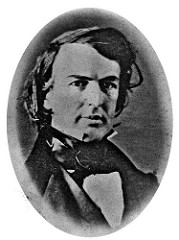
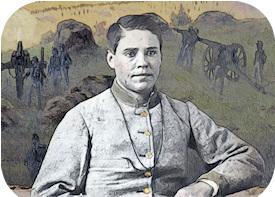
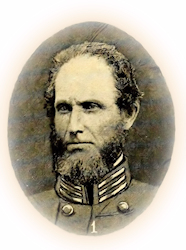
Robert M. McGill

Robert M. Magill – Personal Reminiscences of a Confederate Soldier Boy, 39th Georgia Regiment of Infantry

Sunday, 19th.—Found some of 36th regiment here; having fine time eating watermelons and peaches. Drew three days’ rations; bought a dressed chicken and came very near killing myself eating; very sick for a little while.


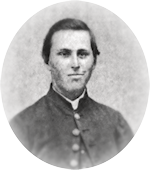
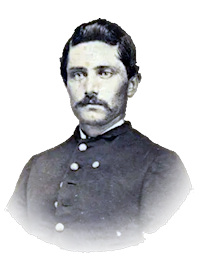
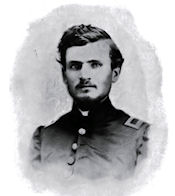
(Note: picture is of an unidentified Confederate soldier.)

0 comments

Diary of a Southern Refugee, Judith White McGuire.

Diary of a Southern Refugee During the War by Judith White McGuire

19th.—When shall we recover from this fatal trip into Pennsylvania? General Pettigrew, of North Carolina, fell on the retreat, at a little skirmish near the Falling Waters. Thus our best men seem to be falling on the right hand and on the left. When speaking of General P’s death, a friend related a circumstance which interested me. General P. was severely wounded at the battle of “Seven Pines.” He was lying in a helpless condition, when a young soldier of another command saw him, and, immediately stooping to the ground, assisted him in getting on his back, and was bearing him to a place of safety, when he (the soldier) was struck by a ball and instantly killed. The General fell to the ground, and remained there, unable to move, until he was captured by the enemy. He was subsequently incarcerated in Fort Delaware. Having learned from the soldier, while on his back, that his name was White, from Westmoreland County, Virginia, as soon as the General was exchanged he inquired for the family, and found that the mother was a respectable widow who had had five sons on the field, but one of whom survived. He immediately wrote to her, expressing his deep sense of obligation to her son for his gracious effort to save his life, delicately inquired into her circumstances, and offered, if necessary, to make a liberal provision for her. I did not learn the widow’s reply.

We have had this week a visit of two days from Mrs. General Lee. She was on her way to the Hot Springs in pursuit of health, of which she stands greatly in need. She is a great sufferer from [continue reading…]

0 comments

A Rebel War Clerk’s Diary

A Rebel War Clerk’s Diary at the Confederate States Capital, By John Beauchamp Jones
A likeness of Jones when he was editor and majority owner of the Daily Madisonian during President John Tyler’s administration.

JULY 19th.—We have no news this morning. But a rumor prevails, which cannot be traced to any authentic source, that Texas has put herself under the protection of France. It is significant, because public sentiment seems to acquiesce in such a measure; and I have not met with any who do not express a wish that it may be so. Texas, Louisiana, and Arkansas are now isolated, and no protection or aid can be given them by the government here; and it is natural, after the fall of New Orleans and Vicksburg, for the people to hope that the invaders may be deprived of their prey just at the moment when they anticipated a realization of its enjoyment.

Hon. Win. Porcher Miles writes that, after consultation, the officers have decided that it would be impracticable to hold Morris Island, even if the enemy were driven from it at the point of the bayonet. Therefore they call loudly for Brooke guns of long range, and guns of large calibre for Sumter, so that the fort may prevent the enemy from erecting batteries in breaching distance. They say, in their appeal, that since the fall of Vicksburg there is no other place (but one) to send them. They are now idle in Richmond. I understand the Secretary of War, etc. are in consultation on the subject, and I hope the President will, at last, yield to Gen. Beauregard’s demands.

Gen. Maury also writes for guns and ordnance stores for the defense of Mobile, which may be attacked next. He will get them.

If the insurrection in New York lives, and resistance to conscription should be general in the North, our people will take fresh hope, and make renewed efforts to beat back the mighty armies of the foe—suffering, and more than decimated, as we are.

But if not—if Charleston and Richmond and Mobile should fall, a peace (submission) party will spring up. Nevertheless, the fighting population would still resist, retiring into the interior and darting out occasionally, from positions of concentration, at the exposed camps of the enemy.

0 comments

0

Civil War Diary of Charles H. Lynch, 18th Conn. Vol’s.
Charles Lynch

July 19th. The enemy are marching up the Shenandoah Valley. They seem to have the lead. Came to a halt at Snicker’s Gap, twenty miles south of Harper’s Ferry, after making a forced march. Here Major Peale received orders for us to report at Sharpsburg, Maryland, where another detachment of our regiment was on duty.

0 comments

Downing’s Civil War Diary.–Alexander G. Downing.

Diary of Alexander G. Downing; Company E, Eleventh Iowa Infantry

Saturday, 18th–Our wagon trains now move unmolested back and forth from Vicksburg to Jackson, since there are few of the rebels’ cavalry left in this section. Our brigade is to remain here at Clinton as a reserve to escort wagon trains when needed. We hear that Sherman is still after Johnston. Our camp here is quite low and damp, and a great many of the boys are coming down with the ague.

0 comments

A Confederate Girl’s Diary

A Confederate Girl’s Diary by Sarah Morgan Dawson

Saturday, July 18th.

It may be wrong; I feel very contrite; but still I cannot help thinking it is an error on the right side. It began by Miriam sending Mr. Conn a box of cigars when she was on Canal the other day, with a note saying we would be delighted to assist him in any way. Poor creature! He wrote an answer which breathed desolation and humility, under his present situation, in every line. The cigars, an unexpected kindness, had touched a tender cord evidently. He said he had no friends, and would be grateful for our assistance.

But before his answer arrived, yesterday morning I took it into my head that Colonel Steadman was also at the Custom-House, though his arrival had not been announced, the Yankees declining to publish any more names to avoid the excitement that follows. So Miriam and I prepared a lunch of chicken, soup, wine, preserves, sardines, and cakes, to send to him. And, fool-like, I sent a note with it. It only contained the same offer of assistance; and I would not object to the town crier’s reading it; but it upset Brother’s ideas of decorum completely. He said nothing to Miriam’s, because that was first offense; but yesterday he met Edmond, who was carrying the basket, and he could not stand the sight of another note. I wish he had read it! But he said he would not assume such a right. [continue reading…]

0 comments

0

Cruise of the U.S. Flag-Ship Hartford -Wm. C. Holton

July 18th. At eight A. M., U. S. M. steamer George Cromwell sailed for New York, with mails and passengers. Work going on this day, viz: repairing rigging, fishing mizzen mast, and provisioning ship, &c.

0 comments

War Diary of Luman Harris Tenney.

War Diary of Luman Harris Tenney.

18th. Moved at 3 A. M. Up at 1:30 awakening officers, etc. Reached some large iron furnace where we fed our horses and got breakfast. Morgan stripped Rutland of most everything. Rested an hour and fed. Some old Vermonters. Reached Chester at midnight. Hour’s rest. Got a lunch. People much frightened. “A” 31 bivouacked one mile in rear of Morgan. Awful roads through woods.

0 comments

Robert M. McGill

Robert M. Magill – Personal Reminiscences of a Confederate Soldier Boy, 39th Georgia Regiment of Infantry

Saturday, 18th.—Got to Morton at 10 last night. Got on gravel train that was gathering up railroad stuff. Conductor said engine could not pull so many soldiers; there were quite a lot of us by this time, and tried to make us get off; had soldier guards, that he ordered to shoot us if we did not get off, but we were not at all afraid of soldiers shooting another soldier that had been through the siege of Vicksburg. So we told the conductor to go ahead as far as he could, and if he did stall, we would get off and push. After cursing awhile, and finding we were determined to ride, he went on to Lake Station; here we got on a freight train, which took us to Meridian, about sundown. We called at Provost Headquarters and were ordered to go to Provost camps, but knowing our regiment was marching to Enterprise, we walked to the depot. A cotton train coming by and stopping, we climbed on, and in a short time we were in Enterprise, beating the regiment that had left us sick at Raymond, about two days.


(Note: picture is of an unidentified Confederate soldier.)

0 comments

Diary of a Southern Refugee, Judith White McGuire.

Diary of a Southern Refugee During the War by Judith White McGuire

July 18.—This day two years ago the battle of Bull Run was fought, a kind of prelude to that of Manassas, on the 21st. Since that time what scenes have been enacted! Battles have been fought by scores, and lives, precious lives, have been sacrificed by thousands, and that, too, of the very flower of our country. Again I have heard of the death of one of our dear E. H. S. boys—William H. Robb, of Westmoreland. He was with us for four years, and was very, very dear to us all. He died of wounds received in a cavalry fight at Brandy Station. We thought he had recovered, but this evening brought the fatal tidings. The news of the New York riots, which they got up in opposition to the draft, is cheering! Oh! that they could not get up another army, and would fight each other! Fitz Lee’s cavalry had a fight yesterday at Shepherdstown, and repulsed the enemy handsomely. All eyes turn gloomily to Charleston. It is greatly feared that it will have to succumb to Federal force. I trust that our Heavenly Father may avert so dire a calamity!

0 comments

0

Louise Wigfall Wright — A Southern Girl in ’61
(Note: picture is of an unidentified Confederate soldier.)
“CAMP NEAR LEETOWN,
“JEFFERSON Co., Va., July 18, 1863.

         “. . . I wrote a short note to Papa from near Funkstown on the other side of the river on the 9th inst., though I have very great doubts as to whether it ever reached you. The battery is in very bad condition as to horses and is out of ammunition. Two of the guns got some of the latter before we recrossed the river, leaving the other two without and I was left with them and have consequently been in the rear ever since the cavalry fight near Boonsboro’, Md. on the 8th inst. All the guns are now in the same condition, but the Ordnance officer of the Division, Capt. John Esten Cooke, perhaps better known as Tristran Joyeuse, Gent., has sent to Staunton for ammunition and as Lt. Johnston has gone to Richmond I shall be done for the present with ‘Company Q.’ I think that when we reached Westminster Md. on Genl. Stuart’s expedition round the Yanks, I was a little the richest specimen of a Confederate officer that you, at all events, ever saw. My boots were utterly worn out. My pantaloons were all one big hole as the Irishman would say: my coat was like a beggar’s—and my hat was actually falling to pieces, in addition to lacking its crown, which loss, allowed my hair, not cut, since sometime before leaving Culpeper, to protrude, and gave me a highly picturesque finish to my appearance. I fortunately there got a pair of boots, a pair of pantaloons and a hat which rendered my condition comparatively better. We left Union in Loudon Co., Va., on that expedition on the morning of the 24th of June—and reached the lines of our army at Gettysburg, Adams Co., Penn. late in the afternoon of the 2nd of July. During that time the harness was off the horses only twice. You should have seen the Dutch people in York Co. turning out with water and milk and bread and butter and ‘apple butter’ for the ‘ragged rebels.’
         “I was quite surprised at the tone of feeling in that part of the State. In two or three instances I found people who seemed really glad to see us and at scores of houses they had refreshments at the door for the soldiers. The people generally seemed not to know exactly what to expect and I don’t think would have been at all astonished if every building had been set on fire by us as we reached it, nor would a great many have been surprised if we had concluded the business by massacring the women and children!
         “I stopped at a house in Petersburg, Adams Co., Penn. and almost the first question addressed me by the daughter of the house, a girl of eighteen or twenty and a perfect Yankee, was whether our men would molest the women! I told her not, and she seemed to feel considerably reassured. It was this same girl who told me in all seriousness that she had heard and believed it, that the Southern women all wore revolvers. I suppose, of course, by this time you have seen from the papers who has been killed, wounded and captured and have very little doubt that you know more about these points than I do, myself, for beyond hearing the report that Genl. Lee’s Headquarters are at Bunker Hill and that the Infantry are beyond Martinsburg and some little inkling of the position of portions of the Cavalry Division I am in the same condition as honest John Falstaff before he formed the acquaintance of Prince Hal, and ‘know nothing.’
         “I received yesterday a double letter of the 23rd of June from you and Mama, the first since I left Rector’s X Roads on the 18th of that month. Gen. Lee has issued an order curtailing all transportation except that for the Corps and General Reserve Ordnance trains. This is evidently getting ready for another move, but whether it is in order to cross the Potomac again or to fall back behind the Rappahannock, or merely to be in readiness for any movement of the enemy, is more than your correspondent is aware of.”


(Note: picture is of an unidentified Confederate soldier.)

0 comments

A Rebel War Clerk’s Diary

A Rebel War Clerk’s Diary at the Confederate States Capital, By John Beauchamp Jones
A likeness of Jones when he was editor and majority owner of the Daily Madisonian during President John Tyler’s administration.

JULY 18th.—Lee has got over the Potomac with a loss, in crossing, of 1500; and Johnston has abandoned Jackson, Miss.

But we have awful good news from New York: an INSURRECTION, the loss of many lives, extensive pillage and burning, with a suspension of the conscription!

Gen. Morgan is in the enemy’s country.

0 comments

Downing’s Civil War Diary.–Alexander G. Downing.

Diary of Alexander G. Downing; Company E, Eleventh Iowa Infantry

Friday, 17th–We heard that our wagon train went through to Jackson without attack, and that the rebels evacuated the place this morning, with Sherman’s forces in hot pursuit. We hear that Johnston, after crossing the Pearl river, burned the bridges behind him and is now in rapid retreat on the other side. News came that Meade had taken Richmond, Virginia, together with thirty thousand prisoners. Things are very lively here today–there is singing and rejoicing.

0 comments

0

Cruise of the U.S. Flag-Ship Hartford -Wm. C. Holton

July 17th. Calm and pleasant. Carpenter’s gang employed during the day fishing mizzen-mast, and crew at work repairing rigging, fore and aft.

0 comments

War Diary of Luman Harris Tenney.

War Diary of Luman Harris Tenney.

17th. Up at sunrise. Crossed after some trouble and breakfasted at Piketon. Morgan well in advance. A Miss Lou C. Bailey wanted my photograph. None along. Rather pretty girl. Newton, old Oberlin student, along. Reached Jackson a little after dark and found an abundance of good things for our craving appetites. Horse mired. Camped near the fair grounds, nice village.

0 comments

Robert M. McGill

Robert M. Magill – Personal Reminiscences of a Confederate Soldier Boy, 39th Georgia Regiment of Infantry

Friday, 17th.—Marched to Brandon to-day by 2 P. M. Found Colonel McConnell there. Gave first direct news from Brother I. L. By the help of some of the boys he got back to a house where there was a surgeon with some other wounded. The Federals coming on, they were paroled. After some days, getting able to walk out, he and another soldier found an old horse that had been forsaken by the army, which they took charge of, and, by the help of the old horse, managed to get to Brandon, where they found Colonel McConnell, who had been wounded and captured, but again re-captured by General Loring’s men, and so brought out to Brandon. He gave brother a furlough and sent him home. This was joyful news to me. Johnston was falling back towards Enterprise, and we got on the last train that left Brandon.


(Note: picture is of an unidentified Confederate soldier.)

0 comments

A Rebel War Clerk’s Diary

A Rebel War Clerk’s Diary at the Confederate States Capital, By John Beauchamp Jones
A likeness of Jones when he was editor and majority owner of the Daily Madisonian during President John Tyler’s administration.

 JULY 17th.—At last we have the authentic announcement that Gen. Lee has recrossed the Potomac! Thus the armies of the Confederate States are recoiling at all points, and a settled gloom is apparent on many weak faces The fall of Charleston is anticipated. Subjugation is not apprehended by the government; for, if driven to an interior line of defense, the war may be prolonged indefinitely, or at least until the United States becomes embroiled with some European power.

Meantime we are in a half starving condition. I have lost twenty pounds, and my wife and children are emaciated to some extent. Still, I hear no murmuring.

To-day, for the second time, ten dollars in Confederate notes are given for one in gold; and no doubt, under our recent disasters, the depreciation will increase. Had it not been for the stupidity of our Dutch Secretary of the Treasury, Mr. Memminger, there would have been no financial difficulties. If he had recommended (as he was urged to do) the purchase by the government of all the cotton, it could have been bought at 7 cents per pound; and the profits alone would have defrayed the greater portion of the expenses of the war, besides affording immense diplomatic facilities and advantages. But red-tape etiquette, never violated by the government, may prove our financial ruin beyond redemption. It costs this government five times as much to support an army as it does the United States; and the call for conscripts is a farce, since the speculators (and who is not one now?) will buy exemptions from the party who, strangely, have the authority to grant them.

The last accounts from Jackson state that Burnside is reinforcing Grant, and that heavy skirmishing is going on daily. But all suppose that Johnston must retreat. And Bragg is in no condition to face Rosecrans.

Whether Lee will come hither or not, no one knows; but some tremble for the fate of Richmond. Lee possibly may cross the Potomac again, however, if Meade detaches a heavy force to capture Richmond.

What our fate would be if we fall into the hands of the invader, may be surmised from the sufferings of the people in New Orleans.

0 comments

Pass at Will

Experience of a Confederate Chaplain—Rev. A. D. Betts, 30th N. C. Regiment

July 17—Rain, rain. Ask leave to go to Winchester to see Dr. Deems. Colonel approves. Brigade and division commanders say there is no need for me to go! They offer to send my written statement! I meet Bro. B. T. Lacy in camp. He asks me if I have a “pass at will” from the corps commander. I tell him that is what every Chaplain ought to have. He asks me to stand still a moment. He steps into Lieutenant General’s tent and returns with the needed pass. I gallop to Winchester and find Dr. Deems gone. The division commander meets me on the street. Does not ask me how I came. I wanted him to ask. I was anxious to show him my pass. It served me a good purpose many times in trying to do my duty as Chaplain in caring for sick and wounded men, and in going from point to point in that army. Colonel Christie dies.

0 comments

Downing’s Civil War Diary.–Alexander G. Downing.

Diary of Alexander G. Downing; Company E, Eleventh Iowa Infantry

Thursday, 16th–We left our bivouac with the wagon train at an early hour and moved on quite rapidly, expecting to be attacked at any moment. We passed the place on the road where the train just ahead of us was attacked by the rebel cavalry, which captured and burned fifteen of the wagons, taking with them the mules and carrying off the drivers and guards as prisoners. This was a terribly hard day for us. We were not allowed to climb the wagons, but were ordered to keep up with them, and with muskets loaded and bayonets fixed, be ready to fight at the drop of a hat. Then, too, the weather was awfully hot, and the dust kicked up by the mules was stifling; besides this, we were almost famished, the little water we could find being unfit for use because of its sickly odor. But late in the afternoon we arrived at Clinton, where we were relieved by another regiment and went into camp with our brigade which was stationed here.

0 comments

0

Cruise of the U.S. Flag-Ship Hartford -Wm. C. Holton

July 16th. Commenced with pleasant and calm weather, as usual. Crew at quarters at nine A. M., and loosed sail to day. Took the fish off the mizzen-mast, and got topsail-yard ready for sending aloft; at eleven forty-five, furled sail, and during the remainder of this day, employed in repairing rigging, and fishing mizzen-mast.

0 comments

War Diary of Luman Harris Tenney.

War Diary of Luman Harris Tenney.

16th. 2nd Ohio in advance. Rations came and delayed us a little. Drew none. Breakfasted at Winchester. Our brigade ordered to the front and to act independently. Moved over a rough road by Jacktown and Locust Grove. A high mountain to climb. Stout work. Morgan but a few miles in advance. Bridge over the Scioto burned. Bridge and mill at Jasper burned. Bivouacked two hours. Could not ford the stream. Built a temporary bridge. One Union man shot because he would not take the oath. Put him in skiff.

0 comments

Robert M. McGill

Robert M. Magill – Personal Reminiscences of a Confederate Soldier Boy, 39th Georgia Regiment of Infantry

Thursday, 16th.—By very hard marching, we got ten miles to-day; improving some.


(Note: picture is of an unidentified Confederate soldier.)

0 comments

0

Louise Wigfall Wright — A Southern Girl in ’61
(excerpts)
“ORANGE C. H., July 16th, 1863.

         “It is some time since I have written to you, my dearest son, but the uncertainty of your getting letters make it almost useless to write. The note you sent in pencil by Mr. Winston came yesterday and was thankfully received. ‘Tis the only tidings we have had of you for weeks except from Col. P., who told me you were well up to the 23rd of June, and your father saw an officer on the cars who said he had seen you on the 4th. Your note bears date a week later. Write, my child, whenever opportunity offers. You cannot tell the intense anxiety and uneasiness of those left at home. We have all been watching with painful interest the course of our Army since it crossed the border, and although late accounts have cast a gloom upon us, we all feel assured that Lee will yet do something to make them tremble as much as they are now exulting over our misfortunes. Troubles seem to thicken upon us all at once. The fall of Vicksburg and the attack on Charleston when so many of the troops have been withdrawn are enough to dispirit us, but we are not dismayed, but believe that all will yet be right. The most sickening feature is the prolongation of the war. Groaning, however, will do neither you nor me any good, so a truce to it.”
         “I had a long letter from Mrs. Johnston dated July 5th. She had not then heard of the fall of Vicksburg, but fully expected it as did we. Genl. Johnston wrote fully to your father June 28th, and told him it was utterly impossible with his 25,000 men, scarcely then equipped, to relieve the place and that if Kirby Smith could do nothing it must fall. Mrs. Johnston encloses me a letter to her from her husband, which is so noble and manly in its tone that I don’t wonder that she is proud of him. . . .
         “F. has just come in with a letter from Genl. Hampton to your father. He writes from Charlottesville, says he is doing well and hopes in a few days to go home. Genl. Hood came with him to Staunton where he is under the care of Dr. Darby, requires nothing but good nursing and generous diet and proposes to pay us a visit if he can.”

0 comments

July 16, 1863

Experience of a Confederate Chaplain—Rev. A. D. Betts, 30th N. C. Regiment

July 16—Very unwell. Army moves on. I stop and rest at Dr. Burkhart’s in Darkville. Night in tent with Bro. Stradley. Heard from Mary. She and children are “prayerful, hopeful and happy.” Got letter from Bro. Deems, inquiring after his son, Lieut. T. D. Deems, and asking me to come to see him. Dr. Deems left us for North Carolina June 9. He heard his son was wounded at Gettysburg, and had come to Winchester hoping to see or hear something of him. The military authorities did not allow citizens just then to go to our army. All he could do was to ask me to come to see him. Bro. Stradley held prayer meeting for 2d and 20th.

0 comments

A Rebel War Clerk’s Diary

A Rebel War Clerk’s Diary at the Confederate States Capital, By John Beauchamp Jones
A likeness of Jones when he was editor and majority owner of the Daily Madisonian during President John Tyler’s administration.

JULY 16th.—This is another blue day in the calendar. Nothing from Lee, or Johnston, or Bragg; and no news is generally bad news. But from Charleston we learn that the enemy are established on Morris Island, having taken a dozen of our guns and howitzers in the sand hills at the lower end; and that the monitors had passed the bar, and doubtless an engagement by land and by water is imminent, if indeed it has not already taken place. Many regard Charleston as lost. I do not.

Again the Enquirer, edited by Mitchel, the Irishman, is urging the President to seize arbitrary power; but the Examiner combats the project defiantly.

Mr. Secretary Seddon, who usually wears a sallow and cadaverous look, which, coupled with his emaciation, makes him resemble an exhumed corpse after a month’s interment, looks to-day like a galvanized corpse which had been buried two months. The circles round his eyes are absolutely black! And yet he was pacing briskly backward and forward between the President’s office and the War Department. He seems mach affected by disasters.

The United States agent of exchange has sent a notice to our agent that the negroes we capture from them in battle must be exchanged as other soldiers are, according to the cartel, which said nothing about color; and if the act of Congress in relation to such soldiers be executed, the United States would retaliate to the utmost extremity.

Captains H. W. Sawyer and John Flinn, having been designated by lot for execution in retaliation for two of our captains executed by Gen. Burnside for recruiting in Kentucky, write somewhat lugubriously, in bad grammar and execrable chirography, that, as they never served under Burnside, they should not be made to suffer for his deed. They say we have two of Burnside’s captains at Atlanta (and they give their names) who would be the proper victims.

I saw a paper to-day, sent to the department, with a list of the United States officers at Memphis who are said to have taken bribes; among them is Col. H–r, of Illinois, Provost Marshal General (Grant’s staff); Col. A–, Illinois, ex-Provost Marshal; Capt. W–, Illinois, Assistant Provost Marshal; Capt. C– (Gen. Herbert’s staff), and “Dan Ross,” citizen of Illinois, procurer.

On the 9th instant Gen. D. H. Hill (now lieutenant-general, and assigned to Mississippi) asks if troops are to be sent to cover Lee’s retreat; and fears, if the enemy establish themselves at Winchester, they will starve Lee to death. Speaking of the raid of the enemy to the North Carolina Railroad, he said they would do the State infinite service by dashing into Raleigh and capturing all the members of the legislature. He also hits at the local newspapers here. Their mention of his name, and the names of other officers in the campaign round Richmond, informed the enemy that we had no troops at Goldsborough and Weldon, and hence the raid. And, after all, he says the enemy were not more numerous than our forces in the recent dash at Richmond. He says it was no feint, but a faint.

To-day an order was issued for the local troops to deliver up their ammunition. What does that mean?

And to-day the President calls for the second class of conscripts, all between eighteen and forty-five years of age. So our reserves must take the field!
0 comments