February 12, 1861; The New York Herald WASHINGTON, Feb. 11, 1861. The most positive assurances are received here by Secretary Dix and others that Northern capitalists decline taking any portion of the twenty five million loan in the present distracted condition of the country. They complain that the administration daily permits extravagant violations of the [...]
February 12, 1861; The New York Herald WASHINGTON, Feb. 11, 1861. Lieutenant Putnam, of the army, who was despatched some days ago by the Secretary of War to Pensacola with despatches to Captain Slemmer and Captain Walker, commander of the Brooklyn, has just returned with despatches to the government from these officers. He left Pensacola [...]
February 11, 1861; The Charleston Mercury Washington, February 8, 1861 If proof were needed of South Carolina’s wisdom and foresight in seceding promptly, it is to be found in the present attitude of the Border States. Virginia has acted irresolutely, and the other States have done worse. In the face of actual dissolution, we find [...]
February 11, 1861; The New York Herald The President elect leaves Springfield this morning en route for the White House. He travels in special trains, accompanied by a numerous suite. The arrangements are all completed; no outsiders are to be admitted to the Presidential presence, and office beggars are particularly requested to clear the track. [...]
February 11, 1861; The Charleston Mercury Stephens, of Georgia, Vice President. THE PROVISIONAL CONGRESS, ETC., ETC., ETC. MONTGOMERY, February 8 – The Congress last night unanimously agreed to a Constitution for the Provisional Government. A strong and vigorous Government will go into immediate operation, with full power and ample funds. No proposition for compromise or [...]
February 11, 1861; The Charleston Mercury WASHINGTON, February 7, 1861. A distinguished gentleman, just returned from a long sojourn abroad, says that the duty of the Southern Confederacy is to pay no earthly attention to the opinion of the foreign public. The South is universally despised at all the European Courts. Our people are regarded [...]
February 11, 1861; The New York Herald Much excitement was created in this city on Saturday by the receipt of a despatch from Savannah, Georgia, stating that five New York vessels had been seized in that port by order of the Governor, in retaliation for the recent seizure in this city by our Metropolitan police [...]
February 11, 1861; The Charleston Mercury Mr. GEORGE S. COOK, the well known Photographist, by special permission of the Governor, visited Fort Sumter on Friday, and succeeded in taking several lifelike likenesses of Major ANDERSON and a group of the officers under his command. Mr. COOK has made several copies of the originals, which may [...]
February 11, 1861; The Charleston Mercury ‘The United States of North America,’ as the great Central Government of all the Republican States of this continent, no longer exists. It is now a dwarfed and factional authority. It was a confederation or union of thirty six States for common purposes of defence, and the benefits of [...]
February 11, 1861; The New York Herald Since the secession movement commenced resignations in the army and navy have been plentiful. In the army two lieutenant colonels, two majors, eight captains, ten lieutenants and four cadets have resigned. In the navy three captains, three commanders, three pursers, two surgeons and two assistants, sixteen lieutenants, three [...]
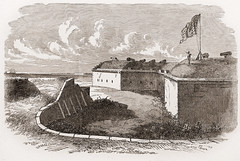
February 11, 1861 The Electoral College begins to meet amid fears of a show of force against the election of Abraham Lincoln. General Winfield Scott reinforces the city and the meeting occurs as planned. Vice-president John C. Breckinridge declares Lincoln the winner of the Election of 1860. (Joint session of Congress will meet to count [...]
February 10, 1861; The New York Herald SPRINGFIELD, ILL., Feb. 9, 1861. The President elect, having completed the first draft of his inaugural, is now busily engaged in arranging his domestic affairs. He attends to the minute details of the preparations for the impending removal of himself and family with his characteristic dutifulness. The close [...]
February 10, 1861; The New York Herald —Full details will be found in another column, of the most grave and momentous event that has yet occurred, in the progress towards civil war and military despotism, of the revolution which convulses the country. Two barks, two brigs, and a schooner, the property of citizens of this [...]
February 10, 1861; The New York Herald The news from the South this morning is of the highest importance. The Southern Congress at Montgomery, Alabama, on Friday unanimously adopted a constitution for a provisional government. It is in substance the same as the constitution of the Union. It gives the congress ample power as regards [...]
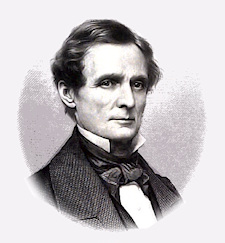
February 10, 1861 At his plantation home outside Vicksburg, Jefferson Davis receives the news by telegram he is the first President of the Confederate States of America. He was hoping to be the commander of the military.
February 9, 1861; The New York Herald The President sent in a message to the House yesterday, embodying the correspondence between the government and Colonel Hayne, of South Carolina. The reply of Colonel Hayne to the last communication of the President was not received in time to be laid before the House, but will be [...]
February 9, 1861; The Charleston Mercury WASHINGTON, February 6, 1861. We behold a strange spectacle this bright, soft, spring-like morning. The Coercionists and Secessionists are both flinging up their hats at the same thing – both rejoicing over the submission triumph in Virginia. The Coercionists hail it as the harbinger of an abject surrender to [...]
February 9, 1861; The Charleston Mercury Whereas, By virtue of a resolution adopted by the people of the State of South Carolina, in Convention assembled, power is given to the Governor, by and with the advice of the Executive Council, to declare and establish Martial Law over any of the coasts, islands and waters in [...]
February 9, 1861; The New York Herald We learn from our Washington correspondence of Thursday that Colonel Hayne, the South Carolina Commissioner to Washington to negotiate the surrender of Fort Sumter to the seceded republic, has failed in attaining the object of his mission, and has returned home. The mooted question then, recurs, will Fort [...]
February 9, 1861; The Charleston Mercury MONTGOMERY, February 6, 1861. Words are certainly very shadowy in their meaning. Whilst the Convention of South Carolina meant one thing, in the resolutions it passed inviting the other Southern States to meet her, to form a Provisional Government – the States accepting the invitation, in the very words [...]
February 9, 1861 At the Confederate convention at Montgomery, Alabama, after privately considering William Yancey, Howell Cobb, Robert Toombs, Alexander Stephens, and Robert Barnwell Rhett for President of the Confederate States of America, the Convention settles on Jefferson Davis. They select Alexander Stephens, both pro-Union and a friend of Abraham Lincoln, as vice-president. In a [...]
February 8, 1861; The New York Herald WASHINGTON, Feb. 7, 1861. The following statement in relation to the surrender of the revenue cutter Robert McClelland is derived from an official source: The cutter is one of the largest and best in the revenue service, just rebuilt and refitted. Her commander was Capt. Breshwood, of Virginia. [...]
February 8, 1861; The Vindicator, Staunton, Virginia The return so far received from the election on Monday last, show that a majority of “Union”candidates have been chosen over their “Secession” opponents. The complete returns from the State will not be received in time for publication in our issue of this week. We are glad to [...]
February 8, 1861; The Charleston Mercury It is evident, to those who have watched events, that the future of the Cotton States is now in the balance, and will go up or down according to the course pursued by the members of the Cotton States Convention, now assembled at Montgomery. A Southern Confederacy, or a [...]
February 8, 1861; Richmond Enquirer Governor Letcher, accompanied by Col. Mumford, Secretary of the Commonwealth, and the Adjutant General, visited the Armory on Wednesday, and made a minute inspection of every department thereof. The Governor and suite arrived at the Armory at half past nine o’clock, and were received in true military style by Captain [...]