0

News of the Day
1860s newsprint

Texas Baptist [Anderson, TX], February 2, 1860

For the Texas Baptist .

Brother Baines: In the first issue of your paper for the present year, I find an article devoted to the very disgusting practice of smoking and chewing tobacco. Sister Caroline, I think, has selected a subject too little spoken of, and there is, doubtless an injury connected with this practice too seldom thought of. We cannot believe, that tobacco was ever designed as a luxury for man, nor snuff for woman. I highly appreciate the spirit and language of the sister’s article, but I think while she was in such a good spirit, and commanding such appropriate language, might consistently have spent, at least a portion of it, for the benefit of snuff dippers. Is it a fact that there are no snuff eaters about Bonham? If so, happy town, happy people, happy country. If our worthy sister has been so fortunate as not to have been thrown into the company of those greedy persons she has escaped wonderfully well; and hence, she may not be conscious of the alarming extent to which this practice has been carried. If any person is ignorant of this, let them itenerate a short while, and if they possess any power of observation they will be forced to exclaim:

“Snuff, thou art no small curse
To health, beauty and the purse.”

In some schools I have seen the snuff bottle occupying a position equally as prominent as the dinner bucket and milk bottle.

I feel grateful to the sister for what she has said about the use of tobacco; and when she has heard my reason I am satisfied she will say it is a good one. I have been a regular smoker for the last three or four years, during of which time I have done full justice to the practice; and I have just finished smoking the last cigar I have on hand, trusting through the influence of her article I may never smoke another.

It is admitted by the majority, if not by all physicians, that snuff dipping is more injurious than the use of tobacco in any other way. If then it is any greater evil than smoking and chewing, I trust the sister will not take any exceptions should I use the whole of her article with the following changes: using snuff where tobacco occurs, and woman where man occurs. Let us make the change and see how it will sound:

“A certain habit has become prevalent among women to an alarming extent, which I can never think of without feelings of the most enfeigned disgust. I allude to the unnatural consumption of snuff. The use of snuff by professed ladies has absolutely become a universal nuisance. It seems impossible for women to become addicted to any other habit in society that could, in degree of filthiness, afford a parallel to this.

The filthy worm that preys upon the green tobacco leaf, and draws its nurishment from the foul plant, is, without dispute, a most loathsome object to behold; yet, it can hardly be said to equal in this respect the shameless female biped who robs it of the noxious food nature has prepared for its use.

When I see a woman who once had brains, now stuffing her mouth with foul unwholesome snuff, I cannot help thinking, alas, good woman, what a fall is here. And then when I see these same ladies who have already immolated themselves, as it were, upon the alter  of stupidity and extravagance, still stalking about among human beings, and claiming the dignity of a place among women, I am made to wonder how it is that the noxious weed, that stultified their brains, can still serve to stimulate them in such a presumptious  conceit. Verily snuff consumers deserve, and I think it is high time they should receive, the unsparing denunciation and censure of the more intelligent and refined portion of society. I repeat, the thing has actually become an unsurportable  nuisance, and I do think that forbearance longer ceases to be a virtue, for it is no unusual or strange thing now-a-days, to see the stupid beings who use snuff, thrusting themselves even into the society of [illegible], while their [illegible] I really think there is hardly any one in this country, of refined feelings, that has not been repeatedly shocked at witnessing these creatures discharging their venomous saliva (except the pint or two that creeps unbidden down their chins) in disgusting profusion upon the floors of church houses, school rooms and even private residences.

Are not snuff dippers guilty of this? –I think so. But I had better use some caution in denouncing this most disgusting practice, for this is leap-year, when women’s rights prevail. Yet I trust they will bear in mind that leap year does not necessarily take away any of the rights of men.

In some slight hope of reform among the Queens of creation, I subscribe myself,

Your brother,
J. P. T.

0 comments

0

News of the Day
1860s newsprint

[Little Rock] Old-Line Democrat, February 2, 1860

Since the 1st of January the great house of Stewart & co., of New York—as we learn from the papers of that city—have discharged FIFTY of their employees in consequence of the reduction of their Southern trade. The same holds good in other cities, and the north will soon appreciate fully the magnitude of the peril with which her commercial and manufacturing interests are treated.

Unfortunately, many innocent people must suffer for the misdeeds of the Republicans, but when [illegible] pinches them they must attribute it to the [illegible] of the northern conservatives who have allowed the constitutional rights of the South to be assailed and her peace disturbed without resistance. Let them hold their own people responsible for what they suffer.

0 comments

0

Miscellaneous document sources

Mr. Hart to Mr. Phelps.

El Paso, Texas, January 31, 1860.

My Dear Major: This morning I received another express from Chihuahua to myself and the Mexican prefect, Señor Vilarde, asking me to furnish the means to buy two hundred stand of arms for account of the governor Of Chihuahua, giving me a lien on the revenues of the State to reimburse the amount. The prefect, with myself, have procured the arms, and they leave to-morrow for the city of Chihuahua with an escort of one hundred men from El Paso.

Panal has been taken by the insurgent thieves, after much slaughter and cruelty. The prisons were emptied, and the prisoners, with a captain set over them by the invaders, were let loose to murder, sack, and despoil.

Particulars were not received at Chihuahua when the governor sent off the express for the arms. I presume American citizens were the ?rst to suffer at Panal, as they are leading merchants and business men of that city, of some 15,000 inhabitants, it being one of the richest mining regions of the State.

I will forward to you such information as I may receive from this part of Mexico.

Very truly, yours,

S. HART.

Hon. JOHN S. PHELPS,
Washington, D. C.


A letter in Difficulties on Southwestern Border, House Documents, Volume 126; Volume 128, United States House of Representatives, U.S. Government Printing Office, 1860

During the 12 years following the Mexican-American War there were present on the frontiers of Texas and Mexico many factors that tended to create disturbances. The topography of the country, the sparsity and general character of its population, the lack of an extradition treaty and of sufficient national authority, wild Indians of uncertain abode, the Mexican tariff system, all caused friction and gave encouragement to lawlessness which not only retarded the development of the region but often threatened to interrupt friendly relations between the two republics. [Border Troubles along the Rio Grande, 1848-1860, The Southwestern Historical Quarterly, Vol. 23, No. 2 (OCTOBER, 1919)]

0 comments

0

Miscellaneous document sources

Robert Toombs to Alexandr H. Stephens. R.

Washington, D. C, 31st Jany., 1860.

Dear Stephens, … I send you a copy of my speech today. The account in the Union by mistake cutts off a column and a half of it. We have whipped out Sherman and the Helperites. Pennington will be elected today or tomorrow; but he professes to be only a New Jersey opposition man. Seward died hard but he is slain. The common impression here is that my speech did them great harm. It had the tendency to bring us together. Every Southern vote stood together solidly for two days and every Northern Democrat but two stood with them, even on a Southern Whig. Smith declared himself independent of all parties and declared he had never belonged to any party but the old Whig party and bolted that in 1852 on Scott. If we could [get] a fair man for a candidate we could elect him, but the factions here are terrible and destructive. . . .


From Annual Report of the American Historical Association for the Year 1911.

Robert Augustus Toombs was an American lawyer, planter, and politician from Georgia who became one of the organizers of the Confederacy and served as its first Secretary of State. They are looking ahead to the 1860 general election and the likelihood of a “Black Republican” prevailing.

Alexander H. Stephens would later become Vice President of the Confederated States of America

Impending Crisis of the South, by Hinton Rowan Helper, was one of the most sensational books ever published in the United States. Appearing in the spring of 1857 as the nation was sliding toward civil war, the book became the centerpiece of an intense debate on the floor of the U.S. Congress. Helper, an obscure yeoman farmer from North Carolina, claimed that slavery was an economic disaster for the South and an insurmountable barrier to the economic advancement of the region’s slaveless farmers. There was nothing new about this argument. Political economists had long claimed that slavery inhibited economic development and undermined small farmers, craftsmen, and manufacturers. Much of The Impending Crisis was a tedious recitation of dull statistics designed to prove this familiar argument. But Helper also added a shockingly inflammatory threat: If the southern planters did not voluntarily dismantle the slave system, he warned, the small farmers would launch a sustained class war across the South. Helper even hinted at a slave rebellion, although he himself had racist proclivities and little or no sympathy for the plight of the slaves. Coming at such a sensitive moment in national politics, it was no wonder southern leaders denounced Helper’s northern supporters with such vehemence. (Encyclopedia.com)

0 comments

0

Miscellaneous document sources

Crawfordville, Georgia, 30th December, 1860.

Dear Sir,—Yours of the 22d instant was received two days ago. I hold it and appreciate it as you intended. Personally, I am not your enemy,—far from it; and however widely we may differ politically, yet I trust we both have an earnest desire to preserve and maintain the Union of the States if it can be done upon the principles and furtherance of the objects for which it was formed. It was with such feelings on my part that I suggested to you in my former note the heavy responsibility now resting upon you, and with the same feelings I will now take the liberty of saying, in all frankness and earnestness, that this great object can never be obtained by force. This is my settled conviction. Consider the opinion, weigh it, and pass upon it for youself. An error on this point may lead to the most disastrous consequences. I will also add, that in my judgment the people of the South do not entertain any fears that a Republican Administration, or at least the one about to be inaugurated, would attempt to interfere directly and immediately with slavery in the States. Their apprehension and disquietude do not spring from that source. They do not arise from the fact of the known anti-slavery opinions of the President-elect. Washington, Jefferson, and other Presidents are generally admitted to have been anti-slavery in sentiment. But in those days anti-slavery did not enter as an element into party organizations.

Questions of other kinds, relating to the foreign and domestic policy,—commerce, finance, and other legitimate objects of the General Government,—were the basis of such associations in their day. The private opinions of individuals upon the subject of African slavery, or the status of the negro with us, were not looked to in the choice of Federal officers any more than their views upon matters of religion, or any other subject over which the Government under the Constitution had no control. But now this subject, which is confessedly on all sides outside of the constitutional action of the government, so far as the States are concerned, is made the ‘central idea’ in the platform of principles announced by the triumphant party. The leading object seems to be simply, and wantonly, if, you please, to put the institutions of nearly half the States under the ban of public opinion and national condemnation. This, upon general principles, is quite enough of itself to arouse a spirit not only of general indignation, but of revolt on the part of the proscribed. Let me illustrate. It is generally conceded, by the Republicans even, that Congress cannot interfere with slavery in the States. It is equally conceded that Congress cannot establish any form of religious worship. Now suppose that any one of the present Christian churches or sects prevailed in all of the Southern States, but had no existence in any one of the Northern States,—under such circumstances suppose the people of the Northern States should organize a political party, not upon a foreign or domestic policy, but with one leading idea of condemnation of the doctrines and tenets of that particular church, and with the avowed object of preventing its extension into the common Territories, even after the highest judicial tribunal of the land had decided they had no such constitutional power. And suppose that a party so organized should carry a Presidential election. It is not apparent that a general feeling of resistance to the success, aims, and objects of such a party would necessarily and rightfully ensue? Would it not be the inevitable consequence? And the more so, if possible, from the admitted fact that it was a matter beyond their control, and one that they ought not in the spirit of comity between co-States to attempt to meddle with. I submit these thoughts to you for your calm reflection. We at the South do think African slavery, as it exists with us, both morally and politically right. This opinion is founded upon the inferiority of the black race. You, however, and perhaps a majority of the North, think it wrong. Admit the difference of opinion. The same difference of opinion existed to a more general extent among those who formed the Constitution, and when it was made and adopted. The changes have been mainly to our side. As parties were not formed on this difference of opinion then, why should they be now? The same difference would, of course, exist in the supposed case of religion. When parties or combinations of men, therefore, so form themselves, must it not be assumed to arise, not from reason or any sense of justice, but from fanaticism? The motive can spring from no other source, and when men come under the influence of fanaticism there is no telling where their impulses or passions may drive them. This is what creates our discontent and apprehension. You will also allow me to say that it is neither unnatural nor unreasonable, especially when we see the extent to which this reckless spirit has already gone. Such, for instance,as the avowed disregard and breach of the Constitution in the passage of the statutes in a number of the Northern States against the rendition of fugitives from service, and such exhibitions of madness as the John Brown raid into Virginia, which has received so much sympathy from many, and no open condemnation from any of the leading men of the present dominant party. For a very clear statement of the prevailing sentiment of the most moderate men of the South upon them I refer you to the speech of Senator Nicholson, of Tennessee, which I enclose to you. Upon a review of the whole, who can say that the general discontent and apprehension prevailing is not well founded?

In addressing you thus, I would have you understand me as being not a personal enemy, but as one who would have you do what you can to save our common country. A word ‘fitly spoken’ by you now would indeed be like ‘apples of gold in pictures of silver.’ I entreat you be not deceived as to the nature and extent of the danger, nor as to the remedy. Conciliation and harmony, in my judgement, can never be established by force. Nor can the Union under the Constitution be maintained by force. The Union was formed by the consent of independent sovereign States. Ultimate sovereignty still resides with them separately, which can be resumed, and will be, if their safety, tranquillity, and security, in their judgment, require it. Under our system, as I view it, there is no rightful power in the General Government to coerce a State, in case any one of them should throw herself upon her reserved rights and resume the full exercise of her sovereign powers. Force may perpetuate a Union. That depends upon the contingencies of war. But such a Union would not be the Union of the Constitution. It would be nothing short of a consolidated despotism. Excuse me for giving you these views. Excuse the strong language used. Nothing but the deep interest I feel in prospect of the most alarming dangers now threatening our common country could induce me to do it. Consider well what I write, and let it have such weight with you as in your judgment, under all the responsibility resting upon you, it merits.

Yours respectfully,               
Alexander H. Stephens


Life of Alexander H. Stephens,Richard Malcolm Johnston, William Hand Browne
J.B. Lippincott, 1878

Alexander H. Stephens would later become Vice President of the Confederated States of America.

0 comments

0

Miscellaneous document sources

Mr. Hart to Mr. Phelps.

EL Paso, Texas, January 29, 1860.

My Dear Major: By the return of the express to Chihuahua, I advised the governor, Señor Munoz, (who by the by is my wife’s cousin,) in the event that he could not hold Chihuahua, to fall back on the Rio Grande, bringing with him the congress and all the civil officers, and to take post in El Paso, in front of this place, where a secure force, American volunteers and no doubt United States troops, could be organized, with which the governor could return to his capital and drive the insurgent church-party out of the State. I also said to the governor that if he would make formal application through the Chihuahua United States consul for United States troops, that I would proceed to Santa Fé with such application and endeavor to induce Colonel Fauntleroy to take prompt action in the matter, and anticipate authority from the President to do so.

I have fully arranged with the authorities of El Paso, to the effect that they will ask for United States troops to occupy that town and Guadalupe and San Ygnacio, should such occupation be deemed necessary to protect Americans and their property in those towns.  I expect by next mail from Santa Fé, due here in ?ve days, that orders will come from Colonel Fauntleroy for the troops at Fort Bliss to occupy the above towns, when the Mexican authorities ask that it may be done.

I have no doubt such occupation will be necessary, perhaps, indeed, before we can hear from Santa Fé, or at any moment news may reach here that Chihuahua is taken, and the next hour may witness in the towns on the other side of the river the utmost disorder and injury to Americans, and their property spoliated beyond redress and remedy. I have $30,000 in personal property and real estate in the said towns, and you may suppose I am uneasy regarding its safety. I trust the President has lost no time in taking measures for our safety.

Truly and sincerely yours,

S. HART.

Hon.John S. Phelps,
Washington, .D. C.


A letter in Difficulties on Southwestern Border, House Documents, Volume 126; Volume 128, United States House of Representatives, U.S. Government Printing Office, 1860

During the 12 years following the Mexican-American War there were present on the frontiers of Texas and Mexico many factors that tended to create disturbances. The topography of the country, the sparsity and general character of its population, the lack of an extradition treaty and of sufficient national authority, wild Indians of uncertain abode, the Mexican tariff system, all caused friction and gave encouragement to lawlessness which not only retarded the development of the region but often threatened to interrupt friendly relations between the two republics. [Border Troubles along the Rio Grande, 1848-1860, The Southwestern Historical Quarterly, Vol. 23, No. 2 (OCTOBER, 1919)]

0 comments

0

Miscellaneous document sources

Major Heintzelman to Colonel Seawall.

Headquarters Brownsville Expedition,

Fort Brown, Texas, January 29, 1860.

Sir: I have the honor to report that I left Roma on the 15th and arrived here on the 21st of January with Captain Stoneman’s company of cavalry.

On the march along the main road we found all the ranchos deserted, (and many burned,) with the exception of a Mexican family at Edinburg, and another at a place called “Los Peñitos,” until we came almost in sight of this town.

At San Rosario, thirty-five to forty miles from here, five or six Mexicans were seen and pursued, but they escaped into the chapparal. These, undoubtedly, were some of the Cortinas men, as at this place the mail-carrier was stopped and robbed a few days before. This is the only place on the road at which we saw any signs of the enemy.

We have frequent accounts of small parties being on this side of the river, stealing cattle, and several individuals have been arrested who certainly belonged to them.

The three companies of the 8th infantry, ordered to form a camp near Laredo, are too far off to cooperate with me. There does not appear to be any necessity for more than one company at that point. As they are only ordered to cooperate, I have hesitated about asking them to come further down. I could employ them with advantage below Edinburg.

I will send Captain Stoneman’s company to escort from this point, some twenty-five miles above, and, with another company of cavalry to be employed above that, considerable security would be afforded along the river. Complete security can only be obtained by crossing the river into Mexico, or by more active exertions on the part of the Mexican authorities in arresting these parties. These marauding parties have the active sympathy of all the lower classes of the Mexican population. When Cortinas escaped to the other side, after his defeat on the 27th of December last, many small parties were seen, mostly unarmed. Now they are found at various points, well supplied with arms, ammunition, and supplies, and must be paid from funds obtained from the Mexican population. Small parties cross daily, steal cattle, or interrupt the travel and mails, and, when discovered, recross, being protected by their comrades on the other side. Cortinas himself was recognized by a party of rangers a few days ago, when they made a prisoner (caught stealing cattle) of one of his men, who was with him in Brownsville on the 28th of September.

The mail has now failed for the past week, and has, no doubt, been intercepted.

Every rancho owned by an American has been destroyed, and it is not safe for one to return to his home under the present situation of affairs. The Mexicans who are friendly are also afraid, and the consequence is, that although now is the time to prepare to put in a crop, not a plough is in the ground. Everywhere on the other side I saw preparations going on, or ploughing.

From the distracted state of parties at Matamoras it is idle to expect any active measures to put a stop to this state of affairs. There is not, therefore; and any movement in such a direction would prove exceedingly unpopular with the masses.

I intended to return immediately to Ringgold barracks, but I fnd it advisable to remain here until the country becomes more quiet. In Matamoras there is a strong fear of an invasion’ from this side.

I am, sir, very respectfully, your obedient servant,

S. P. HEINTZELMAN,
Major 1st Infantry, Commanding Expedition.

Capt. Jno. Withers,
Assist. Adjt. Gen. U. S. A., San Antonio, Texas.


A report in Difficulties on Southwestern Border, House Documents, Volume 126; Volume 128, United States House of Representatives, U.S. Government Printing Office, 1860

During the 12 years following the Mexican-American War there were present on the frontiers of Texas and Mexico many factors that tended to create disturbances. The topography of the country, the sparsity and general character of its population, the lack of an extradition treaty and of sufficient national authority, wild Indians of uncertain abode, the Mexican tariff system, all caused friction and gave encouragement to lawlessness which not only retarded the development of the region but often threatened to interrupt friendly relations between the two republics. [Border Troubles along the Rio Grande, 1848-1860, The Southwestern Historical Quarterly, Vol. 23, No. 2 (OCTOBER, 1919)]

0 comments

0

News of the Day

Standard [Clarksville, TX], January 28, 1860

 Natchez, Jan. 10—A man whose name is not given, attempted to commit a rape on a young girl only ten years of age, last Saturday. He was arrested and imprisoned. A mob marched to the jail, took him out by force and hung him on a tree in the Court-house yard, about eight o’clock to night.—Everything passed off quietly.

0 comments

Diary of a Tar Heel Confederate Soldier By Louis Léon

Diary of a Tar Heel Confederate Soldier By Louis Léon [53d North Carolina Regiment, infantry]

January–Nothing, only that I fear that our cause is lost, as we are losing heavily, and have no more men at home to come to the army. Our resources in everything are at an end, while the enemy are seemingly stronger than ever. All the prisoners in Northern prisons, it seems, will have to stay until the end of the war, as Grant would rather feed than fight us.

0 comments

0

News of the Day

[Marshall] Texas Republican, January 28, 1860

Our thanks are due Dr. E. J. Beall and T. J. Beall, Esq., for late New Orleans and Mobile papers. These gentlemen have been on a visit to Alabama. They reached home a few days ago.  Mr. Beall states that the emigration from Alabama, and through that State, to Texas has been very great this year. When he came down the Alabama river, there were a number of steamboats that started about the same time, carrying in all about eighteen hundred passengers, the most of them destined for this State. He learned that more slaves had been cleared this year from the custom house at Mobile destined for Texas, than for five preceding years, as large as the emigration has been during that period. Every portion of the State reports a heavy immigration,  If the increase has been as great elsewhere as through this immediate section, the prospects are indeed flattering. Our vast extent of territory, presenting millions of acres of unoccupied lands,  from which to make selections; the fact that Texas herself possesses a hundred millions of public domain; that she has made ample provision out of this fund for common schools and for the endowment of a magnificent free University, to be open alike to poor and rich; but more than all,  the inauguration of a liberal railroad policy, promising the most brilliant results, has stimulated capital and enterprize to seek this new theatre of exertion. None of our great public works are languishing; all of them are being prosecuted with redoubled energy. The confidence felt in their success has brought a vast emigration, and this increase of population, wealth, and enterprize, is destined to give them an extraordinary impetus. If the history of Texas for the last ten years has been replete with interest, the succeeding decade will contain much more to challenge admiration. We have had roads opened through the haunts of the red man, counties created, and towns built up as if by magic; but within the next ten years, the great body of our lands will be settled, the State in all probability ramified by railroads, and cities rivaling in population and wealth many of the older States. The immigration into Texas since the period of annexation has been of the most desirable character. We venture to say that no State in the  Union possesses so many intelligent, enterprizing men, or presents a more fruitful field for the exercise of energy, talent, and capital.

0 comments

0

News of the Day

[Fayetteville, Ark.] The Arkansian, January 27, 1860

Note:

This “conversation” is an early form of an infomercial, but it provides an interesting perspective of the Arkansas of 160 years ago, including the sectional politics and slavery.

Something like the following conversation occurred in _______, in Missouri, between a citizen of Fayetteville and a gathering of men in the village tavern, who had learned from the tavern register that our friend was an Arkansian.

“Stranger, are you from Arkansas?”

“I have the pleasure to be one of her citizens; I’m an “Arkansaw Traveller.”

“What part of the State do you hail from?”

“The Northwest part, from the town of Fayetteville, county of Washington.”

“Stranger, how do you like your country?”

“First rate; there’s no better anywhere. Come and see for yourselves.”

“How long have you lived there?”

“All my life.”

“Do you know much of the State?”

“Well, I know a great part of it; most of it from actual observation; and all the remainder from the best and safest testimony. I know that Arkansas is a great country.”

“What part do you prefer?”

“Of course, living in the North-west part, I prefer it. But other sections of the State possess equal, and to some superior, attractions. It is according to the tastes and means a man has as to what part he likes best. He can chose from variety and find suits. If a man is wealthy, owns many negroes, he had better raise cotton, and should choose lands either in the Arkansas, Red or White river vallies or those of some of their affluents. If I desired to cultivate cotton, to produce it, I should select land in the Arkansas valley, as good cotton district as there is in the world. I live just beyond the cotton land line proper, it being only a day’s ride from Fayetteville. But Arkansas is a large State, the southern boundary being distant 250 miles from the northern; so that we have more than one climate and unite within our country the grain and grazing lands to the cotton. The eastern half, bounded by the Mississippi, is sheltered by a broad belt of timber and differs from the west part bordering on the Great Prairies.”

“Is there much cotton land yet unoccupied and what is it worth?—are your negroes healthy?”

“Thousands and thousands of acres are yet virgin, worth from $1.25 to $10 per acre. Improved cotton lands can be bought for $10 to $75 per acre. Our negroes are as healthy as they can be—they don’t die as often as your mules. If you Missourians dislike and dread the pressure of free-soilism, which we from Arkansas can see is pressing you, I know of no country that would please you better than Arkansas.—Such of you as own slaves could not make a better investment than in buying cotton lands there. There are planters in our State who make from $2,500 to $80,000 per annum; and the cotton bears a premium in market.”

“How are you off as to transportation of cotton?”

“The Arkansas, Red and White rivers, with some of their tributaries, besides the Mississippi, wash our State. The first two afford navigation from five to seven months annually; while White river, so far as the cotton lands extend, is equal to the Mississippi for boating. Above the cotton lands the river, with a comparatively small outlay, could be made perpetually navigable into the heart of the grain country, even unto the limits of Washington county.”

“Is there any free-soil feeling in your midst?”

“None whatever; unless it is locked in the breasts of some who dare not even mention the word. We are as free from all Abolition effects as yet as if their vile sentiments had never been bruited all over the North; that is, we are utterly free from any practical effect. Like all the South, however, we perceive the threatening approaches of Black Republicanism, and that at any time we may be exposed. We do not ignore the fact that Arkansas also, as well as Missouri, has Kansas on her frontier. But our people are organizing military companies for self-protection in case we should be aggrieved by Abolition; and also, when needs be, to drive from the Indian lands west of us all Abolitionists who may invade or settle upon these lands.”

“What is the health of your State, both in the cotton and grain regions? What kind and how much water have you?”

“The climate of Arkansas is a delicious medium between the severe winter and the hot, short summer of northern latitudes. Our winters are generally mild, varied, in order to contrast its blessings, some years with “cold snaps.” Our proximity to the Great Prairies gives us something like the coolings of the sea, the breezes from the [tear in paper] Plains blowing over us much abating [tear in paper] of summer. The cotton [corner torn out] their waters running between or over beds of limestone, flint, chert or sandstone. The advantages for mills, especially in Benton the county north of Washington, are numberless and unequalled; and there are very many mills of the first class. The climate and health of my country are not surpassed by any portion of the Great Mississippi Valley. The diseases, peculiar to a new country, are easily subdued, while throughout almost the entire State we are fortunately exempt from epidemics and contagions prevalent in portions of this Valley. Some summers, latterly, we have been vexed with droughts which injured our grains, grasses and cotton; while in few instances the frost has injured cotton.”

“What is the quality of lands in your and contiguous counties?—and at what rate are they held?”

“There are to be found in Washington, Benton, Madison, Carroll, Crawford and other adjacent counties, as fertile land as ever ‘crow flew over;’ the rich black loam, the rich ‘mulatto’ land, the strong yielding ‘hickory upland’ and the equally productive prairie land are all excellent and tempting. West of us, however, is a country the finest, in my opinion, in the Mississippi Valley.—Washington and other counties are only the “breaks” of this good land. It now belongs to the civilized Indian tribes; but it is to be hoped that they will open their surplus territory to the settlement of honest, Southern white men. Then that country will be the garden of the West, or rather the centre. Lands may be bought in the counties named above at 75 cents to $1.25 an acre. Improved lands sell at $5.00 to $20.00.”

“What are the staple products of your own section, and your conveniences for market?”

“Grain is our staple at present. The finest of wheat is raised by our farmers, the yield being from 12 to 30 bushels to the acre. The best of flour is manufactured therefrom. Corn, oats, rye, barley, and all the grasses grow hugely with us. Bluegrass, timothy and clover will do and does do as well as in Kentucky or Tennessee. Tobacco, so far as it has been cultivated, proves an excellent crop. It is beginning to attract attention. Horses, cattle, sheep, and hogs need no better country. They thrive well, require no great feeding extra in winter; and as my county gets older, they will be first of their kind. No better apples can be raised on earth than in my region. We have all the varieties. It is a natural apple country. Pears, plums, peaches, grapes and all the berries flourish exceedingly. Garden “truck” is plenteous and second only to California.—Fine openings for sheep raising, especially in Washington and the hillier counties, offer. Men can purchase even in the near vicinity of Fayetteville, where they may enjoy all the advantages a man may wish for, the best of land for sheep. There are great inducements for sheep raisers, as it is in our county as yet almost an untried field, sufficiently tested, however, to prove its great capability. Wool sheared from blooded sheep in my region may be found as fine as any, equal, indeed, to the best Spanish Merino or Saxony. Our climate is so perfectly adapted to sheep, that those who should raise sheep and shear wool could excel the sheep raisers of colder and severer latitudes. Not near so much food would be required, and the staple would be improved by the geniality of our climate. As to our facilities for market, have already mentioned them. Time will so perfect them that in the whole United States they will not be excelled. In the morning, as it is now getting late, I will take great pleasure in detailing to you more of the advantages of the fine and great State of Arkansas.”

[To be continued.]

0 comments

0

News of the Day
1860s newsprint

[Little Rock] Old-Line Democrat, January 26, 1860

We made a most delightful visit to our thriving and enterprising sister town of Pine Bluff last week, and was much gratified to witness its prosperity and enjoy the hospitality of its kind and warm hearted citizens. There is no town in Arkansas that exhibits more cheering and substantial evidences of progress and advancement than Pine Bluff, and none whose present prosperity promises a more brilliant future. Occupying a high and eligible position in one of the richest cotton growing regions of the State, it is destined at no very distant day to command a commerce that must eventually build up a large and flourishing city. We were told that its trade at this time in the one article of cotton alone amounts to upwards of a hundred thousand bales per annum, and is rapidly increasing every year.

We were gratified to learn that the projected Railroad from Napoleon to that point is in a condition to justify its friends in looking for a speedy completion, and the marvelous results that are sure to follow thereafter. With all our heart we wish it the most abundant success.

During our temporary sojourn at the Bluff we had the pleasure of meeting with the accomplished and affable editor of the “Independent” Wm. F. Douglas, Esq., a gentleman whom we feel proud to call our friend, and whose qualities of both mind and heart show him to be no degenerate scion of the illustrious family whose name he bears.

Among the most emphatic attractions which we encountered while there, we will be pardoned for confessing that the “charms of lovely women” had for us a more enchanting spell. In this respect we have no hesitation in saying that Pine Bluff stands in our estimation A No. 1.

“Oh! long be my heart with such memories filled,” &c.

In conclusion we would pay a most glowing tribute to our boon compagnons du voyage, Messrs. Williams, Garland and King, but language fails to express the emotions that the association of their names awaken, and we must content ourself with lingering for a moment upon the plaintive dying echoes of poor, misused Robin Ruff!

0 comments

0

News of the Day
1860s newsprint

Hinds County Gazette [Raymond, MS], January 25, 1860

We announce with no little satisfaction, that the old Jail property in this place, is soon to be transformed into a Negro Depot. It was purchased at the recent sale, we believe, with that view, and will soon be stocked, by a couple of gentlemen well and most favorably known to our citizens, with a large supply of Slaves for sale. The establishment of the Depot at our doors, and by gentlemen of acknowledged character, responsibility and permanency, will prove quite a convenience to our country people, (save many a trip to Vicksburg and New Orleans,) as well as add to the business of the town. Persons who design making purchases of slaves in the early spring, would probably do well to hold off for a time, and give the Raymond Depot an opportunity to demonstrate its capacity to accommodate the public.

0 comments

0

News of the Day
1860s newsprint

Hinds County Gazette [Raymond, MS], January 25, 1860

On reference to our advertising columns it will be seen that Dr. H. Estes has established, at his residence near Edwards Depot, in this county, an Infirmary for the treatment of sick and diseased negroes. We confidently recommend Dr. E. and his new enterprise to all of our readers who may require his services.

0 comments

0

Harper’s Weekly

CONGRESS

On Tuesday 24th, in the Senate, Senator Sumner (Mass.) introduced a bill to secure wages to seamen in case of wreck. Senator Brown (Miss.), a bill to provide for the public printing. Senator Rice (Minnesota) moved that a bill be framed for the organization of the Territory of Dacotah, which was laid over. Senator King’s (N. Y.) resolution relative to paying for the public printing was adopted. Senator Iverson (Ga.) offered a joint resolution relative to the pay of retired and decrepit officers of the Navy, which was adopted. The President sent in the information called for relative to the Perugia affair. Senator Douglas’s (Ill.) resolution was then taken up, and Senators Toombs (Ga.), Foster (Conn.), Mallory (Fa.), and Benjamin (La.) spoke on it, when the resolution was postponed ; an Executive session was had, and the Senate adjourned.—In the House, a personal matter was brought tip and discussed, relative to the Douglas Democracy of Illinois, by Messrs. Welernand (Ill.), Farnsworth (In.), and Logan when Mr. Corwin (Ohio) resumed his remarks commenced yesterday, and speaking four hours, the House adjourned without a vote for Speaker.

Harper’s Weekly, February 4, 1860

0 comments

0

Harper’s Weekly

CONGRESS.

ON Monday, January 23d, in the Senate, after the adoption of a resolution, offered by Senator Hale (N. H.), calling for the names and salaries of the persons employed in the Treasury Department whose appointments have not been confirmed by the Senate, Senator Douglas’s (Ill.) resolution, directing a bill to be framed to protect States of the Union from external invasion, was taken up, and Senator Douglas proceeded to sustain the resolution. He charged the Republican party with the responsibility of the John Brown invasion. Senator Fessenden (Me.) replied in defense of that party, and Senator Douglas retorted, when the Senate adjourned.—In the House, speeches on the ruling topic and on the organization of the House were made by Messrs. Barksdale (Miss.) and Corwin (Ohio).

Harper’s Weekly, February 4, 1860

0 comments

0

News of the Day

Alexander H. Stephens to J. Henly Smith.

Crawfordville [Ga.] , Jan. 22d, 1860.

Dear Smith, Your long letter of the 9th inst. was not received by me until my return the other day from Savannah, where I was at the Supreme Court for ten days. Since my return I have been very busy with a case in Hancock county. I have noticed Major Cooper’s articles in the Constitutionalist but I have not had time to read a single one of them and therefore cannot give you an opinion upon the subject. In relation to the matter of Union or disunion I have only a word to say and that is, if I thought our own people, our public men and private men, were prepared for it, had the proper elements of character, stability of purpose, loyalty to principle, devotion to country, etc., I should not look upon such an alternative with the apprehension I do. The truth is I fear that if disunion should result, if by necessity it should come, we should be no better off in a new republic than we are in the present one. We should have the same or similar wrangling and confusion. Indeed if we were now to have a Southern convention to determine upon the true policy of the South either in the Union or out of it, I should expect to see just as much profitless discussion, disagreement, crimination and recrimination amongst the members of it from different States and from the same State, as we witness in the present House of Representatives between Democrats, Republicans and Americans. The troubles that now beset and environ us grow not out of the nature of our gov’nt or any real “irrespressible conflict” between adverse interests. No such things; they grow out of the state of public opinion and the character of our public men North and South. There is a general degeneracy, confined not to one section or the other. The gov’nt in itself is good enough—the danger lies in no inherent defect in it. It is in the men who have charge of it, and the people who put such men in charge. The danger is much more radical, I fear, than the Southern people generally imagine, especially those who think disunion would be a remedy for the evils they feel. One may talk as flippantly or as seriously as one pleases of disunion, but one thing is evident to my mind, it will only render confusion worse confounded unless our people can agree upon some line of policy to be pursued and shall generally at least unite and agree to stand together in its maintenance. And if they would do this there would be no necessity for disunion. If they will not do this beforehand have we any reason to hope that they will do it afterwards? I fear not. When the passions of men are once let loose, without control legal or moral, there is no telling to what extent of fury they may lead their victims. Republicks can only be maintained by virtue, intelligence and patriotism. We have but little public virtue, heroic virtue or patriotism now amongst our public men. They are generally selfish, looking not to country but to individual aggrandisement. There are but few now in Congress who consider anything so much as how their own votes affect them at home. This is a lamentable truth. And if we should break up, all these fellows would be striving to get the inner track of each other, each to take the lead of all the rest. It would be a race between demagogues to see who could pander most to the passions, prejudices and ignorance of the people, that they might profit thereby—just such a sort of thing as was seen in France, 1792, and in Mexico now. This is my apprehension. If the necessity comes I shall hope for the best; but I am by no means sanguine. I wish I were. I can but look upon the alternative as little better than jumping out of the frying pan into the fire. We would quit one set of demagogues to try another. But enough. These sentiments I give to you. They are hastily penned and not intended in this shape for anybody’s use and reflection but your own.

0 comments

0

Harper’s Weekly
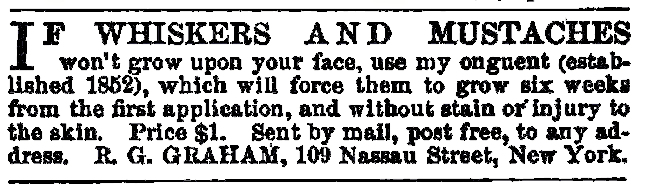
Whiskers and Mustaches ad from Harper's Weekly January 21, 1860

Harper’s Weekly, January 21, 1860

0 comments

0

Harper’s Weekly

Harper’s Weekly, January 21, 1860

0 comments

0

News of the Day

[Fayetteville, Ark.] The Arkansian, January 20, 1860

Fayetteville, Arks.}
January 18, 1860 }

Messrs. Pettigrew & Boudinot.—The Arkansian has become the most popular paper ever published in the city of Fayetteville, consequently the people look to it for a proper exposition of politics and morals.

As to your positions on the political issue of the day, they meet my full approval, and your course as to the morals of the community are good as far as it goes.—There is one of the lowest vices practiced here on the holy Sabbath; that of drinking mean whiskey; there are several doggeries in the city, and in each of them pop skull is either sold or given away on the Sabbath, from daylight until twelve at night, it is evident they do not give it away; but even if they do is it right, thus to profane God’s holy day? Are there no State Statutes or city ordinances to stop their vile practice? If there is no city ordinance or Statute that will effect a cure of this crying evil. What say you to giving them broken doses in the Arkansian. I think if you will turn your battery upon these sinks of pollution, you will not only stop them from selling or giving mean whiskey to white men on the Sabbath, but also stop them from selling to negroes, which is the custom every Sabbath, if we are to judge from the drunken negroes on the streets. We have a beautiful young city, and shall the order loving citizens be compelled to submit to this outrage upon our citizens?

Yours, Washington.

0 comments

0

News of the Day

[Fayetteville, Ark.] The Arkansian, January 20, 1860

Messrs. Editors.—I beg leave to suggest that until we pull the beam out of our own eye, we had better leave the moat in our neighbor’s alone. All your comments, though meant for a good purpose, against Abolitionists in the free States, are like so much chaff before the wind, if the people of Fayetteville harbor Abolitionists in their midst. If Abolitionists can be tolerated at home, our mouths should be closed towards those in the free States. If we can take by the hand here in a State where slavery exists; the “free Soiler” the “free State man” and the “negro equality”—individual, why should we clamor against the people of the free States for tolerating this freedom of opinion? Messrs. Editors, let us “put our own house in order” and no longer suffer Fayetteville to be the reproach of our neighbors; let us no longer be regarded as harborers of Abolitionists.

It is said we have in our midst some of the filthiest Abolitionists, both men and women. One single instance, the report of which is current among us, is sufficient to turn the stomach of all decent white men; viz: that a certain white “lady” entertained at her house, until dark, a mulatto slave, and as the latter started to go home, she requested her dusky guest to wait a few minutes, when she would send for her cousin to escort her home.

A correspondent in the last Van Buren Press alludes to other cases, equally disgusting. It is time that our citizens should take this matter in hand, give it due investigation, and all guilty persons should be expelled from the limits of the city.—If some such course is not adopted the character of our city will suffer; and our schools will go down. Who of our friends abroad, will send their children to Fayetteville for educational purposes, when the present condition of society here is known?

Jeemes.

0 comments

0

News of the Day

[Fayetteville, Ark.] The Arkansian, January 20, 1860

A Mounted Rifle company was organized by the citizens of this county, on last Saturday, by the election of the following officers:

Captain—J. M. Tuttle; 1st Lieu, P. P. Vanhoose; 2d Lieut, W. R. Cunningham; 3d Lieut, J. R. Pettigrew.

Another meeting of the company will be held at the Court House, on Saturday the 4th prox. for the purpose of completing the organization. We understand that on that day the non- commissioned officers will be elected and other necessary arrangements will be made; a full attendance is required.

It seems that the desire among our citizens to join a mounted company is prevalent; and the rapid increase of members of the company bids fair to swell it to an unusual size. We would suggest that another mounted company be organized. We do not think that a company ought to number over 80 rank and file. Were there a call for active service, we have no doubt that Washington county would turn out 500 men.

In connection with this subject, we beg leave to remind our contemporaries that our Senior has been promoted to a Lieutenant in this company; he no longer occupies that respectable position of a “high private;” and hereafter he will wield the sword as well as the pen, if the editorials of the Arkansian lose their milky character and assume one more sanguinary, we hope our readers will attribute the fact to this new position of our Senior.

0 comments

0

News of the Day
1860s newsprint

[Little Rock] Old-Line Democrat, January 19, 1860

From Northern Institutions.  The late news from Richmond, informing us of the revolt of the Southern students from the Medical Colleges of Philadelphia and New York, is one of the most striking and gratifying assurances to the people of the South, that the pride, interests, and future glory of our southern country, is increasing and advancing with rapid progress every day. During the past fifty years Northern institutions have been in a great degree supported by Southern patrons. The halls of Harvard, Yale, Amherst and Dartmouth, have been crowded with the talent of the South, while the Medical Universities of Philadelphia, New York and Cambridge have been thronged with young men from Southern States.

The Professorships and President’s chairs, have been supported by the wealth of the South, and while they slyly laughed and chuckled over their ill-gotten gains, they have been continually crowding, and infringing upon the dearest interests and most sacred rights, of the South.

But a bright day has dawned upon our land. The hour when a young man felt constrained to enter a Northern University to secure a good education, has passed; and the true spirit of independence and energy has taken possession of every son in our Southern country. The thousands of young men who have heretofore made up that bright circle of students in Northern Colleges, will hereafter seek institutions in their own section of the Union.

The hundreds of thousands of dollars which have yearly been expended at these institutions from Southern patrons, will hereafter build up universities of our own, within our own limits. The Universities of the South which even now stand high in the catalogue of American Institutions of learning, will each year increase in wealth, and position until they rank as high as any in the North. Let it be the aim of every State within the galaxy of Southern States, to inaugurate a system of education, which will add honor, and renown upon her history, and reflect credit, and fame upon the graduates of these institutions.

It behooves the young men of the South in this “impending crisis” to look well to their own interests, and to guard well the interests of the future. Let them foster a pure Democratic faith, and allegiance to their mother country, and support none else but the institutions of their own section.

And this plan well applies to every industrial system which is carried on both in the North and South. Our merchants should protect Southern trade, while our mechanics, and agriculturalists should vie with the North in all of their products.

With this principle we may succeed. In encouraging this system, we can become at once a happy and prosperous country. In fostering these resolutions we may advance with the astonishing rapidity towards the high point which the hand of the Almighty has marked out for us.

And we trust the movement which our friends in other States have made, will not be lost upon the people of Arkansas, but that every son and daughter of our growing State, will work hand in hand for her future success and prosperity. Let all the friends of Education put their shoulders to the work, and erect institutions of learning, which may forever stand as proud monuments to her name. Let the artisans of the anvil, and the husbandman on his farm, labor with their best energies, for the advancement of their objects.

Now is the time for us ALL to commence in earnest, and soon a bright future will dawn upon our State. Soon the cries of fanaticism will be hushed, and the South will be a happy and independent community.

0 comments

0

Uncollected Letters of Abraham Lincoln—1917

This is one of many forged Lincoln documents that can be found online.

The House Divided website goes into detail on a blog post titled, We Got Punked, Lincoln Forgery-Style.

For now, I am leaving this up, with the text crossed out, so that searching  on the text might come across this post and realize something is hinky about it.

To ALEXANDER H. STEPHENS [i]
SPRINGFIELD, ILLINOIS, 19 January, 1860.

Duplicated for Senator Jno. J. Crittenden

HONORABLE A. H. STEPHENS

Dear Sir: Your letter and one from Hon. J. J. Crittenden, reached me at the same time. He wants a new party on the platform of “The Union, the constitution and the enforcement of the Laws”—not construed. You from your retirement at Liberty Hall complain of the bad faith of many in the free states who refuse to return fugitives from labor, as agreed in the compromise of 1850, 1854: but I infer that you agree with Judge Douglas that the territories are to be left to “form and regulate their own domestic institutions subject only to the Constitution of the United States.” I remember the letter of the Whigs in Congress in 1852 which defeated Gen’l Win?eld Scott on the ground that he did not present your view of States’ rights. Also that your letter destroyed the Whig party and it is said that you and Toombs voted for Webster after he was dead. You are still “harping” on “my daughter” and you supported Zach Taylor as a sound Kentuckian. If I understand you, here are two constructions: Crittenden being willing for the Henry Clay gradual emancipation, I think. The rights of local self-government as de?ned by Webster, also including state determination of citizenship, are clearly in the Constitution. When we were both Members of the Young-Indian Club in Washington you then argued for paramount state Sovereignty going very nearly to the extreme of state nulli?cation of Federal laws with John C. Calhoun: and of secession at will with Robert Toombs. The Colonies were subject up to July 4, 1776, and had no recognized independence until they had won it in 1783: but the only time they ever had the shadows of separate sovereignty was in the two years before they were compelled to the articles of Confederation July 9, 1778. They fought England for seven years for the right to club together but when were they independent of each other? Let me say right here that only unanimous consent of all of the states can dissolve this Union. We will not secede and you shall not. Let me show you what I think of the reserved rights of the states as declared in the articles of Confederation and in the Constitution and so called Jeffersonian amendments; suppose that I sold a farm here in Illinois with all and singular the rights, members and appurtenances to the same in any wise belonging or appertaining, signed, sealed and delivered: I have now sold my land. Will it at all change the contract if I go to the clerk’s of?ce and add a post script to the record; that all rights not therein conveyed I reserve to myself and my children? The colonies, by the Declaration of July 4, 1776, did not get nationality, for they were leagued to ?ght for it. By the articles of Confederation of July 9, 1778, under stress and peril of failure without union, a government was created to which the states ceded certain powers of nationality, especially in the command of the army and navy, as yet supported by the states. Geo. Washington was Commander in Chief and congress was advisory agent of the states, commending but not enacting laws for the thirteen, until empowered. This proved insufficient and the peril of failure was great as ever, at home and abroad. Alexander Hamilton and others of New York were ?rst to urge that a government with no revenues, except state grants, could have no credit at home or abroad. Three years later Virginia led the states in urging concessions of power, and then by twelve states—Rhode Island objecting—was framed our original Constitution of 1787 fully three and a half years after the peace that sealed our United national Independence. The post-script erroneously all attributed to Thomas Jefferson, came in three installments. The ?rst ten (10) proposed in the ?rst session of the Congress of the United States 25th September 1789 were rati?ed by the constitutional number of states 15 December 1791, New Jersey 20 November 1789 and Virginia 15 December 1791, eleven states only, Georgia and Connecticut dissenting. The eleventh amendment, proposed 5 March 1794, Third Congress, was then declared duly adopted by a President’s message of 8 January, 1798, eleven states consenting & ?nally all consenting. The twelfth amendment was proposed in congress 12 December 1803 and declared rati?ed through the secretary of state 25 September 1804 by the constitutional quorum of states. The ?rst ten articles are the Bill of Rights and each set of amendments had a preface. The eleventh limited the Federal Judiciary. The twelfth regulated general elections for President and Vice-President of the United States. Do any or all of these retract the fee-simple grant of great and permanent powers to the Federal Government? There are three great Departments: I, the President commanding the Army and Navy and with a veto upon a plurality of Congress. II, the Congress coining all moneys; collecting all imposts on imports, regulating all interstate as all external commerce; making all subordinate Federal Judiciary as appointed of the President with power to have a ten mile square seat and to take grants or to buy for Forts, Dock yards and Arsenals; having post of?ces and post roads under laws executed by the President, and to frame supreme constitutional laws and set up courts and Judges. III, The supreme court set as arbiter and expounder of the constitution and of all differences of states and with states or of them with the Federation; no loop hole left for nulli?cation, and none for secession, — because the right of peaceable assembly and of petition and by article Fifth of the Constitution, the right of amendment, is the Constitutional substitute for revolution. Here is our Magna Carta not wrested by Barons from King John, but the free gift of states to the nation they create and in the very amendments harped upon by states rights men are proposed by the Federal congress and approved by Presidents, to make the liberties of the Republic of the West forever sure. All of the States’ Rights which they wished to retain are now and forever retained in the Union, including slavery; and so I have sworn loyalty to this constitutional Union, and for it let me live or let me die. But you say that slavery is the corner stone of the south and if separated, would be that of a new Republic; God forbid. When a boy I went to New Orleans on a ?at boat and there I saw slavery and slave markets as I have never seen them in Kentucky, and I heard worse of the Red River plantations. I hoped and prayed that the gradual emancipation plan of Henry Clay or the Liberian colonization of John Q. Adams might lead to its extinction in the United States. Geo. Washington, the Massachusetts Adams, Presidents James Madison and Monroe, Benj. Franklin opposed its extension into the territories before I did. The ordinance of 1784, 1787 for the North West territory ceded by Virginia, was written by Thomas Jefferson and signed only by slave-holders and that prohibited forever slavery, or involuntary servitude not imposed for crime. Your grandfather, Captain Stephens, suffered at Valley Forge and bled at Brandywine for the principles of the men of 1776-1783. Your Uncle, Justice Grier of the Supreme Bench has recently expounded the Supreme Law as I honestly accept it. Senator Crittenden complains that by the device of party conventions and nominations of candidates for Presidents and Vice-Presidents the Federal plan of separate and unbiased Electoral Colleges is taken away and the popular feature of elections is restored to the people. I reckon they wanted it so. What are you agoing to do about it? To abolish conventions you must abolish candidates. In your Oxford College orations, you say “I love the Union and revere its memories; I rejoice in all its achievements in arts, in letters and in arms.” If it is a good thing, why not just keep it and say no more about it?

I am not in favor of a party of Union, constitution and law to suit Mr. Bell or Mr. Everett and be construed variously in as many sections as there are states.

This is the longest letter I ever dictated or wrote. But this is to only you alone, not to the public.

Your truly,

A. LINCOLN.

[i] From a pamphlet entitled Some Lincoln Correspondence with Southern Leaders before the Outbreak of the Civil War, from the Collection of Judd Stewart, 1909. The letter was there printed from a copy certified as correct by Mr. Stephens.

0 comments

0

News of the Day
1860s newsprint

Daily Gazette & Comet [Baton Rouge , LA], January 19, 1860

Mr. Editor—As a chronicler of events, your attention is invited to the American Graveyard, near the Garrison. Almost every afternoon you might witness scenes of vandalism unequaled anywhere in the world. The rising generation, boys from ten to eighteen, repair thereto and amuse themselves by shooting at a mark on monuments and headstones! thus desecrating what in all nations, even where paganism prevails, is held sacred. Tuesday afternoon the youngsters were in ecstacies  when a good shot was made, that shattered some monuments or headstones over loved ones. The guilty ones are not of the lower classes. The sons of some of our most worthy and well behaved citizens are there, and some not twelve years old had pistols in hand yesterday. It is the imperative duty of every good citizen to see that their children have no pistol, or other bodily weapons in their possession, and to ascertain the company they keep, as near as possible. It would surprise some our most orderly citizens to take a walk unperceived in that rendezvous of those depredators, and see their very young sons, pistol in hand, engaged in those sports. Something must be done to stop those proceedings, and it is impossible for the police to effect much without the cooperation of the parents (especially as the graveyard is not fairly under the municipal jurisdiction).

A Parent.

0 comments