0

News of the Day
1860s newsprint

[Little Rock] Old-Line Democrat, January 19, 1860

We had the pleasure of making the acquaintance of Messrs. Slaughter and Sawyer of Natchez, who have come to this city for the purpose of building the Gas Works. The ground is surveyed, and the contracts signed. Messrs. Robbins and Fisher are the contractors for the brick and wood work. The excavation commenced on Wednesday, and the work is to be pushed forward with at once. Our citizens may rely upon seeing our city illuminated with gas, by the first of July next. Mr. Slaughter will remain in this city for the present, and will soon have an extensive assortment of chandeliers and burners for sale. Mr. Sawyer has had a large experience in Eastern, Western and Southern cities, and intends to do his best in this new contract. The plans can be seen at the Book Store of John E. Reardon’s.

See Advertisement of J. A. Slaughter.

0 comments

0

News of the Day
1860s newsprint

Texas Baptist [Anderson, TX], January 19, 1860

Students are leaving the northern Colleges by hundreds on account of the insults they have to hear upon the South since the hanging of Brown. Three hundred medical students left the two schools in Philadelphia on the 21st December.

0 comments

0

News of the Day
1860s newsprint

Louisiana Democrat [Alexandria, LA], January 18, 1860

A writer in the Philadelphia Free Press, after personal  inspection of the condition of fugitive slaves in Canada, says:

I have recently returned from a month’s sojourn in Chatham, and can speak from personal observation. Every one knows that this town, lying on the flats between Lakes Erie and St. Clair,  about fifty miles from Detroit, is the headquarters of the negroes who arrive by the Underground  Railroad. Here some thousands are congregated, in every grade of wretchedness. A more worthless emigration can no where be found. Trained to no self-reliance, able only to perform one branch of industry, they are totally unfit to be thrown on the wide world without a guide, and they suffer all manner of hardships. Ill-fed, ill-clad and ill-housed, they are ready victims to the ague of that district, and disease impairs the little energy originally possessed by these children of a milder clime.

0 comments

0

News of the Day
1860s newsprint

Southern Broad-Axe [West Point, MS], January 18, 1860

I take this method of informing the citizens of Lowsdes, Oktibbeha, Monroe, and the surrounding counties, that I am located one mile South of Artesia, on the M. & O. R. R., for the purpose of catching negroes, where I shall always be in readiness to serve those who may require my service. I flatter myself that I have as good a pack of negro dogs as can be found in the State. My terms are $25.00 for catching. When I do not catch, five dollars per day for hunting— and when I arrive in eight hours after the track is made and do not catch, no pay.

 James M. Sandifer.
Artesia.

0 comments

0

News of the Day
1860s newsprint

Southern Broad-Axe [West Point, MS], January 18, 1860

On Friday the 20th instant, the Military Company recently gotten up under the appropriate name of the West Point Grays, assembled according to previous announcement at Dunlap’s old store house, in West Point. At an early hour a large and full meeting was in attendance, whereupon B. F. Robertson, Esq., was called to the chair, and B. M. Howorth, Esq., appointed Secretary. . . .

Upon motion, a committee of five was appointed to draft a suitable constitution and necessary by-laws to be submitted at the next meeting. Also to propose a becoming style of uniform, to be adopted by the company. . .

On motion of Dr. J. W. Crump, it was

Resolved, That the uniform to be adopted by the company, shall be made of either Southern or English manufactured goods. . . .

0 comments

0

News of the Day

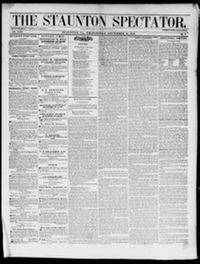
Staunton Spectator, Virgina,  January 17, 1860

It is a matter of surprise that any serious apprehensions as to the stability of the Union should now be felt in any quarter. With the exception of the insignificant faction of ultra abolitionists at the North and a few equally insane gentlemen of the fire-eating stripe at the South, nobody seems disposed at the present to tolerate dissolution. On the contrary the prominent men of all the great parties, of both sections of the confederacy, are bold in the declaration that the “Union must and shall be preserved.” The Democratic party, it is gratifying to perceive, are taking the true ground here at the South, that dissolution is no remedy for the evils under which we have naturally become very restive, and we are waking up to an appreciation that the Union and the Constitution belong to the South as well as the North, and that the rights and privileges guaranteed to us by the Constitution, which is the bond of the Union, may and ought to be maintained within the Union and under the Constitution.—It seems now to be the general opinion that it is not only unwise and ridiculous, but absolutely cowardly, to think of abandoning our rights under the and retreating ingloriously from the glorious American Union, because some of the parties confederate are disposed to trample upon and abuse us; but that, on the contrary, the true and manly position to assume is, that we have rights in the Union, guaranteed by the Constitution, which we mean to assert and maintain “at all hazards and to the last extremity,” Gov. Wise placed his foot upon this solid ground first, in his speech to the medical students at Richmond, and following his lead many of the prominent men and presses of the Democratic party have taken the same sensible position. Mr. Pryor, well known to be a champion par excellence of Southern rights and interests, has made up his mind to save the Union, and declared in Congress that the South does not intend to abandon the Union, but will vindicate her rights in the Union, “peaceably if possibly, by force if necessary.” Heretofore, says the Baltimore American “Southern politicians seem never to have thought it possible for the South to do anything but run away from Seward and his fanatics— dissolution (in other words, backing out) being the only resource of the “despoiled nationalities” below Mason and Dixon’s line. But Mr. Pryor, for the first time in the history of Southern Eloquence, takes a more courageous stand. He thinks it just as easy for the South to whip the North as for the North to whip the South in.—At all events, the South, according to Mr. Pryor rather than secede under any provocation, is fully bent upon violence—”force if necessary.” Instead of backing out, it is going to fight to keep in.

While this strong position is taken by Southern Democrats, Mr. Hickman, of Pennsylvania, an anti-Lecompton Democrat who has been voting with the Republicans, and therefore a representative of both, is equally positive that the Union shall not be dissolved. “No matter what the antagonism between sections,” says that gentleman, “the Union must and shall be preserved.”

In addition to these developments of a determination to preserve the Union, on the part of two great parties, both of which have heretofore been inclined to its destruction, we find a movement in progress under the lead of such men as Crittenden and Broom and Stuart, having for its object the organization of another great national party, to aid Messrs. Pryor and Hickman in their patriotic intentions.

In view of all of these facts who can apprehend any danger to the Union? Who is to accomplish the work of dissolution. As the American remarks, if Mr. Hickman shall resort to arms to prevent the South from leaving the Confederacy, and Mr. Pryor is resolved that the South shall urge war to keep from leaving, it is pretty clear that the Union is tolerably safe–we confess to like the idea of the South’s fighting to keep in, while the North is fighting to make the South stay in.

0 comments

0

Harper’s Weekly
Singer Sewing Machine Ad from January 14, 1860

Ad  from January 14, 1860 Harper’s Weekly

0 comments

0

Miscellaneous document sources

A. J. Grover, Esq Springfield, Ills.

My dear Sir:                       Jany. 15. 1860

Yours of the 9th. was duly received. In my joint debate with Douglas, at Freeport, Aug. 27. 1858, I said about all I have ever publicly said concerning the Fugitive slave law of 1850, and you can find it in print in the report of that debate. I said then in substance, and have often said, I think Congress has constitutional power to enact a Fugitive slave law; that the law of 1850 appears to me objectionable in some of its provisions; but whether it is unconstitutional in any of it’s provisions, I do not remember that I have ever undertaken to decide. I should be glad to see you, and to talk with you more fully than I can write. Yours truly

A. LINCOLN

___________________________

From House Divided

0 comments

0

News of the Day
1860s newsprint

Standard [Clarksville, TX], January 14, 1860

 A confirmed opium-eater in Rochester has dropped the filthy habit. He is now an old man of seventy years, and for four years, he has not used the drug in any shape, though before he had been an opium-eater for forty years. When he commenced breaking himself of the habit, he was using the opium at the rate of eighty grains per day, and it took him about two years to accomplish his purpose.

0 comments

0

News of the Day

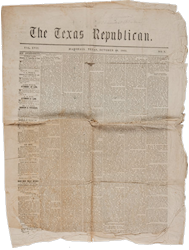
[Marshall] Texas Republican, January 14, 1860

This very stringent measure goes into effect the 1st of  January. All free negroes found in the State at that period are to be sold into slavery. The papers of the State are re-publishing the act to give those interested timely notice.

0 comments

0

News of the Day

[Marshall] Texas Republican, January 14, 1860

On the 5th inst., an abolitionist was arrested at Jefferson by the name of Fory R. Arnold.  He had been heard to say that “he was born upon freesoil—that he was proud of it, and that he  was an abolitionist and expected to be one as long as he lived.” He had also been tampering with  slaves. The citizens of Jefferson passed the following resolutions:

“Resolved, That we as a committee appointed to investigate the conduct of Fory R.  Arnold, have unanimously concluded that the words and expressions used by him are of such a  character as to deserve immediate action on the part of a southern community.

“Resolved, That we therefore require the said Fory R. Arnold to leave this country within  24 hours in search of a region more congenial to his abominable sentiments.

Resolved, That the day has at length arrived when the south must take decided action,  and use the most cogent means to put a stop to every thing that has the least tendency to  abolitionism.

“Therefore, we recommend to the legislature to repeal the laws authorising peddling, and affix a penalty for the violation of the same.

“Whereas this meeting is informed that the postmaster-general has declared that in States  where incendiary publications are inhibited, postmasters may refuse to distribute such documents  and destroy the same, that they be requested to do it.”

0 comments

0

News of the Day

[Marshall] Texas Republican, January 14, 1860

It is a waste of raw materials to put five dollars worth of hat on ten cents’ worth of brains.

0 comments

0

News of the Day

Warning

The following article contains wording that is offensive to many in the world of today. However, the article is provided unedited for its historical content and context.

 [Fayetteville, Ark.] The Arkansian, January 13, 1860

Messrs. Editors:–Since my last letter to you I have seen, in the columns of your paper, that Geo. Butler Esq., Cherokee Agent, has advertised a “notice” to all squatters and interlopers who have thrust themselves upon Cherokee soil, that they must “vacate” by the 1st of April next—ominous day—or be therefrom ejected by the U. S. Military.

This is a good but late step. It ought long ago to have been taken, and the Military now be employed in removing those lawless, speculating land-lovers. Too much importance cannot be put upon this innovation, invasion, of Cherokee and Slave rights. Not satisfied with acquiring Kansas, these freedom-shrieking land-stealers are bent on gaining the lands of the Cherokees, Creeks and Choctaws, where slavery has long been peacefully established. The longer these land-invaders are suffered to remain the more claim will they set up to the ownership of the land, the more will they cry out that Government should buy the land they have invaded for the benefit of these Abolition, meddling, land-speculating, “third party” squatters. These may obey the injunction of Butler’s “notice;” these may leave before, and after the 1st of April next; but I don’t believe they will. They may stay away after their forcible ejection by the U. S. Military; I don’t believe that either. They have got a taste of Cherokee land, have got their teeth in for a good bite, and they will, therefore, be loath to let go. They know full-well that the Indian Territory west of Arkansas is far superior to Kansas, and they hanker after it, as well as for the niggers within. They will not quit their hold quietly, and consequently something else must be done besides advertising notices of Military coercion, should they not leave the land they have lawlessly seized.

It becomes the welfare of the Cherokees, as well as the citizens of the border counties of this State, to enquire what is this something else? What will stem and throw back this wave of Abolition immigration now threatening Cherokee territory; which has already settled upon Cherokee lands not only within the limits of the “Neutral Land,” but deep down within the Cherokee country proper?

The Cherokee soil must be preserved, unless broken in its integrity; the door then must not be opened to immigration rashly and NEVER to Northern immigration. It should be eternally shut out. The faith of Treaties ought to remain inviolate, but what if Northern immigration cannot be checked? what if the faith of Treaties cannot be maintained? what if the integrity of Cherokee soil cannot be preserved? What if the Cherokees cannot continue to occupy their present political status? These are grave questions. They require serious, studying reflection and grave answers.

I can think of but one remedy. That, the interests of Cherokees, Creeks, Choctaws, and the slave state of Arkansas demand shall be put in virtual force ere the land be over-run by hordes from the North. This is the remedy. This Territory must be preserved to slavery. Any step is legitimate and right that will secure this end. This territory belongs to the South; and if a dissolution of the Union should occur this territory will be claimed by the South, and, in all probability, become the last great battle field where shall be fought the last fight against Slavery—for I believe, in the nature of things, that Slavery is to be ultimate victor in all its contests.

In order, therefore, to preserve this territory to slavery and to its present owners, the Cherokees, Creeks, and Choctaws should have their lands surveyed, and a sufficient portion set off to each family of each tribe; the residue of each tribe to be held as the domain of each, to be by them and to slave-holding immigrants, men from the South with whom each tribe has long been friendly, commercial and social interaction. This is the only way whereby the Cherokees, Creeks, and Choctaws can maintain possession of their respective territories.—They cannot remain much longer as they now are. Their land is too well known and too tempting. Their own safety demands a change above indicated. If they do not soon take some such step, with the aid of Government, their lands will be inundated with a flood of Black Republican immigration, and the names, rights and privileges of Cherokees, Creeks, and Choctaws be swallowed up for ever. Rather than such should be the event, I will exhort the South to rush in and take possession of this land ere it be too late to snatch it from the jaws of Abolition.

These fears of Northern immigration into the Indian Territory west of Arkansas may be, by some, regarded as idle and unworthy of thought. To all such I have only to say: Look at Kansas. Ten years ago it was an unheard of wilderness more wild than the wildest part of the territory west of us, and less known. How long did it take Northern immigrants to possess Kansas? How long will it take it to occupy Cherokee lands? Ten years hence will not witness less great wonders and ravages than ten years since. A word to the wise etc.”

 Your friend,
Be Ready.
Beattie’s Prairie,
Jan. 8th, 1860.
 

0 comments

0

News of the Day

[Fayetteville, Ark.] The Arkansian, January 13, 1860

Clarkesville Arks. }
Dec. 21st, 1859. }

Messrs. Editors:–We are all on the qui vive for the good time coming, Christmas, the time when all is mirth and enjoyment, is nearly here and we young folks are anticipating a vast deal of fun. But while this is the case rumors of a far different character are float. It has been ascertained that the negroes of this and several adjoining counties intend to start for Kansas or leave as soon as the arms, which were promised them, should arrive from Cincinnati. Three white men of Dardanelle are implicated in the plot whose names have been divulged by the negroes at that place. We are wide awake and prepared for any emergency. Patrols are out every night in town and throughout the County.

The Harper’s Ferry affair and these rumors of an intended stampede of the negroes have prompted our citizens to get up and organize a Military company, of which O. Basham was elected Captain, E. T. Adams 1st., C. B. Gillespie, 2nd., and J. T. Stone 3rd Lieutenants.

In consequence of more exciting topics of conversation I hear very little about politics. . .

Truly yours,
Aristides.

0 comments

0

News of the Day

Dr. Chase, Coroner, held an inquest on Tues. night and yesterday, on the body of Charles Smelzer, found dead, hung by the neck to a tree, in the Court House yard, in this city, on Tuesday night last.

The testimony of Jailor McDowell was to the effect that he had locked up the prisoners, Smelzer among them, looking well, or at least not sick, previous to 7 o’clock on Tuesday night, a little earlier than usual, and that apprehensive of an outburst from the excited populace, he had hid the keys. He was in his office about 7 o’clock when some eight or ten persons, masked, and unknown to him, quietly entered his room, bound him and locked him up. He was powerless from fright. That in the course of fifteen or twenty minutes he was released by a lady who was with his family at the jail, and that he looked for his keys and found them in his room, though not where he had concealed them. That he examined the cells, &c., and all the prisoners were safe, except Smelzer, who was gone. That he went over to the Court House yard, attracted by a crowd there gathered, and found Smelzer hanging to a tree and dead.

The verdict of the Jury (there being no further witnesses to be found or heard of) was—

“The said deceased was found dead, between 7 and 8 o’clock, P. M; Tuesday, Jan. 10th, hung with a rope by the neck to a tree in the Court House yard, by whom or in what manner is unknown to the Jury.”

Smelzer, it is stated, poisoned his wife several years ago at Bayou Sara, set fire to that town, was a thug and had murderously assaulted many good citizens here and elsewhere. He was a bad man and a dangerous character.

0 comments

0

News of the Day
1860s newsprint

Southern Broad-Axe [West Point, MS], January 11, 1860

We have succeeded in getting sixty names on our list now, and need only four more. Will not some of our young friends in the country come in and let us organize at once? Our word for it, you will never regret it. Let us get under drill immediately.

0 comments

0

Miscellaneous document sources

Robert Toombs to Alexander H. Stephens. R.

Washington, D. C, 11 Jany., 1860.

Dear Stephens, I recd. your letters of the 1st, 3d, and 6th and 7th inst. yesterday morning and last night. The freezing up of the Potomac piled up all the mails at Acquia Creek and expect kept mine to you here. Yours of the 7th inst. contained your check, for which I am obliged to you. I must have left my brief in the Swan case at home with the bill of exceptions, as I can find it nowhere; but I do not know that I have anything new in it. The Missouri case I suppose you can find in Savannah.

I should pay no attention to the letter of Judge Warren. You have said your say and ought to let it rest. If you answer all the suggestions of the same nature which will be made before the Charleston convention you will get tired of it. Hunter is hurt in Virginia by Wise tho’ he is very confident of carrying a majority of the delegates. Wise’s friends are willing to support him if he can get the greater outside of Virginia influence, about which there can be no doubt if he has any chance at all. There are very decided indications of the North in favor of Breckinridge. Pennsylvania is certainly for him and so is N. York if she can carry him. His great difficulty is with Douglas. Douglas is very much opposed to him, indeed he told me in private that he was Ms last choice,—but keep this to yourself. I am very sorry for it. I do not see how we can elect a President or even nominate one without Douglas men, and he is not cordial in favour of Hunter; in fact he would go to him with reluctance. I fear Hunter’s want of vim will defeat his nomination. I am quite sure if we could get him up he would make the best race and the best President of any in the lot. But I much fear that he is [too] honest for the tricksters and too modest to make his way even with the better materials. Douglas’s friends and he himself seem more inclined if he can not get it himself to go for you. This may be because you are not in the ring by your own act of exclusion.

I think Mr. Buchanan would like to prevent the nomination of an other in order to make himself necessary. This is impossible. He weakens with the party every day. You can understand how little he knows of the use of patronage when he sends Grund to Havre and Faulkner to Paris. Grund caught a senatorial veto. I suppose they will pass Faulkner.

The weather here has been warm and foggy for the last three days, as disagreeable as possible overhead and underfoot. I intended to speak this week but my throat has been sore and I have had a very bad cold. I think I shall speak early next week. I shall give a very thorough review of the present and urge the union of all sound elements to drive out the Black Republicans next fall as the only mode of giving peace and security to the country.

Julia is well. I saw Ward a few days ago, he has not yet finished your bust, he says it will be ready in a week or two.

___________________________________________

From Annual Report of the American Historical Association for the Year 1911.

Robert Augustus Toombs was an American lawyer, planter, and politician from Georgia who became one of the organizers of the Confederacy and served as its first Secretary of State. They are looking ahead to the 1860 general election and the likelihood of a “Black Republican” prevailing.

Alexander H. Stephens would later become Vice President of the Confederated States of America

0 comments

0

News of the Day

[Marshall] Texas Republican, August 11, 1860

The following account of the “heated term” has been condensed from a weather journal, kept at the Railroad Office in Marshall, the thermometer in the shade:

The “term” commenced about the 1st of May, and the end is not yet. The period of the greatest heat was during the month of July, when the thermometer indicated over 100 degrees Farenh. excepting four days, when it was between 90 and 100. The greatest heat attained was 115½ degrees, on Sunday the 8th, and 113 degrees on Sunday, the 29th.

On the 15th, a slight norther and a change of temperature; at 8 o’clock, A.M., 88 degrees, and at 8¼ P.M., 75, with high wind, clouds of dust, but no rain. From the 15th to the 18th, the temperature was below 100. The average for the month of July, between 8 o’clock, 1.m., and 5 o’clock., P.M., has been 93 degrees.

There was a light rain on the 23d of April. On the 14th of July a few drops fell; on the 23d a slight sprinkling; on the 26th and on the 30th, more showers, just enough to keep the dust quiet for an hour or two. The wind has been very uniformly South, and in the month of July especially, has blown with considerable strength, and served to mitigate the suffering which such intense heat is likely to produce, particularly at night, and every night, the thermometer often indicating a temperature as low as 70 degrees.

It will perhaps be unnecessary to state, that we are suffering some from drouth , as the preceding abstract will show.

0 comments

0

News of the Day
1860s newsprint

Daily Gazette & Comet [Baton Rouge , LA], January 10, 1860

It is known at home, if not abroad that Third street, in this considerable city is a fast place. The reasons why are diverse. It is not simply because fast people live in it, because fast people can be found all over the mile square, from Catfish to Spanish Town—from Goose Hollow even as far out as Pete’s Alley and Stag Hall. Third street is fast because it presents an inviting dead level of a mile, and because our clever friend in Main street, Capt. Tunnard has introduced to the attention of Red Stickers all the new fangled, two and four wheeled spider built traps in which fast people at the North and the West go, until they run down or run on a snag—or run against one another, and conclude everlastingly the race of earth. They have been putting down gas pipes in Third street recently and in doing this, they have been tearing up the earth in straight lines and the straight lines run into each other at right angles— forming oblong squares and triangles.

On Saturday evening last we noticed our fast friend, F., who knows a thing or two about fast horses and fast machines—going down the street with a fast nag fastened to the same. His continuations were spread out on either side of the machine at the angle marked by fashion—he held the strings “taught” in his left hand, and with his right ever and anon took six inches from his mouth of the divine weed from the Antilles in order to blow away smoke and steam from the furnace. The upper part of his body was slightly bent forward to give the machine additional impetus and on his head he had one of the close fitting caps which people who go fast and take the risk on their own shoulders, generally wear. The machine itself was bright with fresh varnish and threw the light about recklessly, as it passed down the street and disappeared. Presently we heard the dogs bark; the children cry and women scream; whilst gents with their coat tails standing out straight were making tracks to get out of harm’s way. We thrust our head further out the window and saw the sleek fast trotting animal making tracks back where he came from at a 2:32 rate; parts of the clay-colored machine flew up and parts flew down; whilst other parts were picked up by small boys on the lightning line. At the corner of Florida street the body of the fast trap lay, the other side up, the wheels danced round until they seemed spokeless, and a crowd gathered about to witness the motion.—After a full quarter’s spinning, certain brave gentlemen ventured to approach—stopped the unspent motion, and set it on its legs again. Where was our friend, F.? He brought up the rear with a single string in his hand—glad to say unhurt. We have been particular in this matter, because we made a prediction just a year ago, that to this complexion things would come at last. If there is a moral lesson in it, some gentleman of leisure will please point it out.

0 comments

0

News of the Day
1860s newsprint

Daily Gazette & Comet [Baton Rouge , LA], January 10, 1860

As the “Glorious Eighth” did not come until the 9th, the demonstration was given us yesterday, in a very neat and creditable manner. The Pelican Rifles made their first regular turn out—armed and equipped. How the times have changed! Twenty years ago, Sunday would have been the day of all others for the Anniversary. Indeed, when such events came by appointment of the Almanac, in the early time, then the gallant Chasseurs, and the Guards, would fix Sunday for the parade, and come down early in the morning with an assault on Old Michael’s; firing, but not falling back, until the going down of the sun. We have improved in more than one respect since the early time; though on the backward track in many things. Music came up from below by appointment, and at 12 o’clock every thing was in readiness to move from the head quarters of the company in Third street. So dense was the throng of men, woman  and children who took possession of the capitol to witness the ceremony of presenting the banner, that the idea was abandoned of getting into the Senate chamber, which had been prepared for the purpose. The presentation took place on the steps of the east gate of the building.—Miss Phillie Nolan, presented it, in the name of the donor (our fellow-citizen Wm. S. Pike, Esq., and the citizens of Baton Rouge.) The speech was an elegant and appropriate one, and responded to by Capt. W. F. Tunnard, Commander of the company. After the presentation—and after parading through town, the company marched to the Harney House, where a sumptuous repast was spread for them, under the direction of the host of that establishment, Col. Rhodus. A long life to the Pelicans say we; may they prosper and grow strong with age, and turn out, long after many of us have turned under and gone to the great rest, that knows no waking. Where pray, was Col. Peirce and the Dragoons, on this occasion? Certainly they are not already hors du combat. Will the Col. drop us a line on this subject from Fort Hamilton?

0 comments

0

Miscellaneous document sources

Hon. Abraham Lincoln

Jan. 9th 1859 [1860].

Dr Sir — It has been publicly stated in this place that you endorse the Fugitive Slave Law of 1850, as constitutional in its object, & in its provisions in All Respects– You would would confer a favour upon the writer of this as well as upon many Republicans hereabouts by briefly giving your views upon the matter–

Yours Very Truly
A. J. Grover
Mem. of Rep. County
Com. of La Salle Co.

___________________________

From House Divided


0 comments

0

News of the Day

Mistress Columbia, who has been taking a nap, suddenly wakes up and calls her noisy scholars to order. (Page 16 of January 7, 1860 Harper's Weekly)160 years ago, a New Years had dawned with sectional issues and a presidential election that by years end would literally be tearing the nation apart.

Page 16 of January 7, 1860 Harper’s Weekly

0 comments

These little Yankees.—January 8th, 1860

Through Some Eventful Years by Susan Bradford Eppes
Susa Bradford Eppes

These little Yankees

January 8th, 1860—This is Aunt Sue’s birthday; and she is spending the day with us. She brought the boys and Teresa and little Mary Eliza, who is a darling. Cousin Henry Whitaker is here, Aunt Sue and Mother love him dearly; but he hurt Aunt Sue’s feelings today. He is a great tease and sometimes he is not as careful as he should be not to give offense. Since all this trouble between the North and South, there is a tendency to say disagreeable things and you often hear of “Yankees” and always in derision. Everybody does not do this but you do hear it sometimes. Cousin Henry lives in North Carolina and we do not see him often, Aunt Sue called her children to speak to him and as he shook hands with the dear little boys he said: “Well, Sue, what are you going to make of these little Yankees?”

Uncle Arvah is a New Yorker by birth and it was a thrust at him and Aunt Sue was angry and hurt; the children did not know what was meant. It is a pity to “stir up strife.”


Susan Bradford is 13 years old when this diary entry was made.

0 comments

0

News of the Day

[Marshall] Texas Republican, January 7, 1860

We learn that a few nights ago, Mr. Bell, our jailor, gave the prisoners who were in jail in the cage, an oven of coals to keep them warm, and that having a razor in the cage with them,  they converted it into a saw, with which they cut the cage, and then with their fire burnt through the loft of the jail, and were preparing to pick the brick out of the gable end of the building, and let themselves down with their blankets. But the jailor happening to hear them at their work,  went up and put a stop to their operations, and blasted their expectations of a Christmas frolic on  the outside.—Henderson New Era.

0 comments

0

Harper’s Weekly
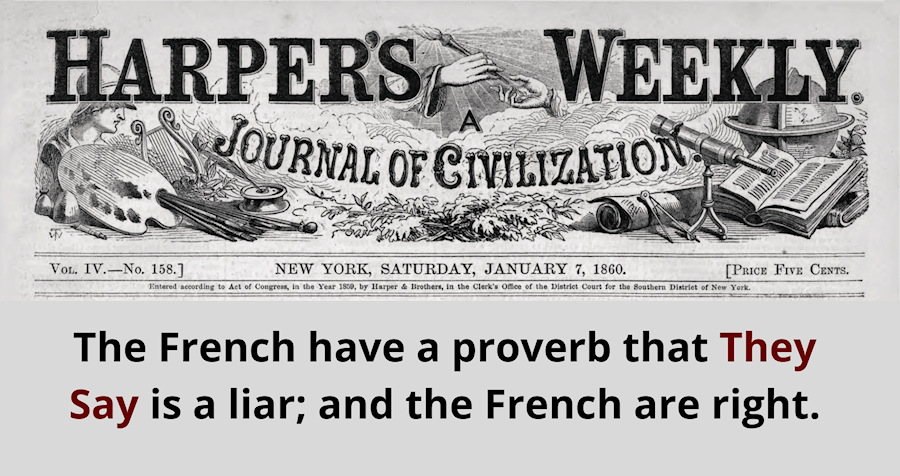
The French have a proverb that They Say is a liar; and the French are right.

THEY SAY.

Do they, indeed; and who are they? What is this tyrant which ruins so much private peace and public fame? They say that Deacon Dodder was seen coming home late Saturday night in such a state! Drunk? Oh, I don’t know. I am sure I know nothing; but they do say that he was about the crankest man in town that evening. They say that his wife was sitting at home crying her eyes out. Poor thing! and only married last June. It’s really dreadful! They say she wishes she had never been married; and that her uncle Timothy vows lie will never give her a cent, because they say that his cousin Joshua heard him say that he had no money to spare to buy grog for Deacon Dodder.

Poor Deacon Dodder! who all this time is just as honest and sober a man as Cousin Joshua, or Uncle Timothy, or any body else; and against whom They Say has leveled his darts because he chances to be the most convenient target.

The French tell the truth about They Say. The French have a proverb that They Say is a liar; and the French are right. This sly, malicious, insidious snake, that crawls and squirms all over fair fames and pure characters, he is a liar, and the father of lies. Of course he is perfectly irresponsible. What They Say does its work, whether you find it to be true or untrue. You may prove Deacon Dodder to be, and to have been always, the most sober and honest of men. But the air tainted by They Say is poisoned air, and whoever has breathed it, though but for a moment, has breathed death. The bride weeping for her dead husband may dry her eyes when she finds him living; but you can not dry the tears that have been shed. The child, frightened at night, may be comforted and his fears removed; but who shall console the terrors that shook him before the succor came? They Say may be proved the blackest of liars, but the proof does not blunt the point of the sting which is forever resharpened.

Don’t suffer him in your house. Don’t give him the hospitality of your conversation. If any body tries to introduce They Say, insist upon discovering if he knows what he is doing. Whatever is told you upon the authority of They Say reject at once—or, better still, cling to it, and show how false and futile it is. For, even if the thing be true, you will be sure to find it untruly told—sure to find it so grinning all over with suspicion and malignity as to be another thing altogether.

If a man lived in a tower over a beautiful city swarming with busy men and women, and teeming with lovely children, and night and day, in his lofty tower, he were distilling poison from marsh flowers and garden vegetables and noble trees, which he secretly infused into the air, and, by his wicked machinery, drove into the streets and houses, so that the people breathed the corruption, and slowly and mysteriously withered and died, what a criminal the man would be—how he would be scorned through history! Yet everybody who gives aid and comfort to They Say, by repeating his stories, is really helping that poisoner in the lofty tower—is really distilling death for the busy men and women and the lovely children. They Say is a mask from behind which envy and jealousy stab. It is a secret mine which is lighted by a slow match from a distance, and explodes only after the criminal who puts the fire to it has escaped. “They Say” is an anonymous letter, spoken, not written.

0 comments