0

Miscellaneous document sources
The Adjutant General to Colonel Lee.

Adjutant General’s Office,          
Washington, March 3, 1860.
          Colonel: In further reference to the subject concerning which the Adjutant General had the honor to address you on the 2d instant, I am instructed by the Secretary of War to say, that should the Mexican authorities on the Rio Grande frontier refuse or fail on your requisition, or that of the officer you may delegate, to break up and disperse any band of banditti on the Mexican side of the river, having for their object depredations on our side, you will cause this to be done by the force under your command.
          I am, sir, very respectfully, your obedient servant,
E. D. Townsend,          
Assistant Adjutant General.
          Brevet Colonel R. E. Lee, U. S. Army,
                    Commanding Department of Texas, San Antonio, Texas.

A dispatch in Difficulties on Southwestern Border, House Documents, Volume 126; Volume 128, United States House of Representatives, U.S. Government Printing Office, 1860

During the 12 years following the Mexican-American War there were present on the frontiers of Texas and Mexico many factors that tended to create disturbances. The topography of the country, the sparsity and general character of its population, the lack of an extradition treaty and of sufficient national authority, wild Indians of uncertain abode, the Mexican tariff system, all caused friction and gave encouragement to lawlessness which not only retarded the development of the region but often threatened to interrupt friendly relations between the two republics. [Border Troubles along the Rio Grande, 1848-1860, The Southwestern Historical Quarterly, Vol. 23, No. 2 (OCTOBER, 1919)]

0 comments

0

News of the Day

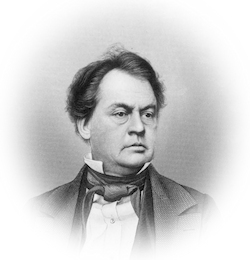
Long-simmering divisions in America were heating up in the years preceding the American Civil War.  In early 1860, Georgia’s Robert Toombs spoke to the Senate chamber in Washington in a speech that became known as Invasion of States.

In a 2017 doctoral program dissertation, Antislavery Violence and Secession, October 1859 –April 1861, David Jonathan White writes concerning Toombs speech:

“On January 24, 1860, Georgia Senator Robert Toombs delivered a speech that helped set the tone for the coming presidential election and the secession crisis that followed. It is difficult to overstate the importance of Toombs “Invasion of States” speech because the Georgian, on this occasion, first laid out ideas that he would revisit in a speech urging his state to hold a secession convention as well as in Georgia’ssecession declaration.

“Toombs offered a strong condemnation of the Republican Party as an implicit and often explicit danger to southern security. First, Toombs condemned Republicans for their constitutional infidelity, particularly for their failure to comply with the “fugitives from labor” provision. Toombs asserted that whenever anyone tried to enforce that law in the North, Republicans winked at antislavery violence and sometimes were active participants. If Republicans assured white southerners they would suppress antislavery violence, said Toombs, they could not be trusted to honor their word. They “mock at constitutional obligations, [and] jeer at oaths. They have lost their shame [along] with their virtue.” Toombs charged that Republicans were saying to southerners, “let us be, brothers, or we will cut your throats—that is, if we can get your negroes to do it.”

0 comments

0

News of the Day

Warning

The following article contains wording that is offensive to many in the world of today. However, the article is provided unedited for its historical content and context.

Natchez Daily Free Trader [MS], March 3, 1860

For the Free Trader.
Communication.

Editor of Free Trader:–

The earnest appeal contained in the two columns of the Courier in its issue of the 29th  inst., in behalf of the much abused negro traders, from its urgent character and potent reasoning,  has attracted the attention of all of its readers.

The Courier truly says Natchez has become drowsy and she may, with some little justice,  be termed “old fogy.”

When we first commenced the perusal of the article so attractively headed, we fully  expected that some great scheme of improvement was about to be suggested, which was destined  to arouse the sleeping city from her lethargy. But “Mirabile Dictu,” what was our astonishment  to find the remedy prescribed for the somnolent patient was calculated to infuse into the veins a  deadly poison; in one word, the city of Natchez must be made a slave depot, or else sink into  utter insignificance. Rather than see her revenue derived from this source of commerce, the  majority of the people would unhesitatingly say, “let her sink into oblivion.”

The Courier complains that the ordinance prohibiting the sale of slaves within the city  limits is still enforced. It argues that such traffic is not a nuisance or dangerous to health, and  consequently Natchez should, like other cities, allow and encourage this branch of commerce.  We assert that a slave mart in any city or anywhere else is a nuisance. Did any man of any  sensibility ever pass one of these slave depots without experiencing a sense of unutterable  disgust for the whole trade? we think not; and the experience of those living in cities contiguous  to these depots, would testify that they were nuisances, and grievous ones at that. Even driven  beyond the limits of the city, located at the convergence of two of the most frequented  thoroughfares leading to the city, it is a great nuisance; a nuisance to those gentlemen and their  families who are compelled to pass the tempting Bazaar, tastily arranged with the choicest  commodities of the slave dealer; a nuisance to the seeker for health and pleasure in his rides over  the best of roads in the county; a horrid nuisance to those living in the neighborhood of  “Niggerville.”

If, then, it is a nuisance there, how much greater nuisance would it be to some of our  merchants. How think you they would like to be next door neighbors of a negro shop. Their  lady customers would certainly enjoy the contiguity in their shopping excursions. How think  you that the editor of the Courier would like to have one of these establishments adjoining his  sanctum. As to a sanitary point, no foresight could prevent the importation of contagious  diseases by negroes coming from all sections of Kentucky, Missouri, Virginia and Maryland,  even if we were disposed to impose the task of examination upon the health physician. We could  cite instance where diseases have been brought even to the Forks of the Road; and it would be  exceedingly dangerous to have importations of negroes, one or two hundred at a time, brought  into the heart of the city.

Now let us look at the arguments of the Courier: No. 1, The editor of the Courier  anticipates a large increase to the city revenue, say in the sum of $3000 or $4000, by the tax on  sales of slaves in the city, which sum would gravel and keep in repair all the streets and pay the  gas bills of the city. Now, we beg the editor’s pardon, he being City Printer, one of the City  Fathers and Chairman of the Gas Committee, for differing with him; we would, however, call  his attention to these figures. He must certainly have seen the statement made by the City Clerk  of the expenditures and liabilities of the city for the year 1859. In that we find the expenditures,  on account of roads and streets, to have been $9318 46; on account of gas, deducting the price of  lamps, $3808 70; total, $13,127 16. The $3000 or $4000 would, it seems, fall short of the  required amount, particularly as Natchez must renew her youth and be a little faster in future.  Again, we would ask the editor of the Courier if he has ever glanced at the Auditor’s tabular  statement, found in his report to the Legislature, November 7th, 1859, for the year 1858. The  Courier asserts that the amount of slaves sold in the county, per annum, is upwards of two  millions of dollars. By reference to the Auditor’s report above referred to, he will see the amount  of sales of slaves, horses and mules reached the sum of $25,985.00. That this return is correct,  we will not venture to say, but, as these injured slave traders [who are so mercilessly driven into  shanties out of the city] make their returns on oath to the Assessor, we must take it for granted it  is correct. Certainly there is a great discrepancy between the Courier’s statement and the negro  traders. The revenue then to be derived from these sales, at an assessment of three-tenths of one  per cent., would amount to about $77 95. What becomes of the Courier’s $3000 or $4000.  Where is the revenue to be derived. “O Tempora! O Mores!” figures will not lie.

No. 2, The editor argues that, by receiving and encouraging these slave depots in the city,  a great convenience would be afforded the purchasers. True, it would be just as easy to step into  the shop and buy a negro as it would a cigar or a drink. We take it that too many facilities are  already given to the trade.

No. 3, The editor of the Courier argues that by taxing the sales of slaves with an  additional city tax, would reduce the price. Now, we should like to see the editor’s text book on  political economy. It is a new principle of that science which teaches that taxation reduces the  price of an article.

No. 4, The Courier argues that the sales of slaves in the city would stimulate business,  encourage mechanics and the business portion of the community. We venture to assert that not  one cent’s worth of trade or building would accrue from this contemplated change. Probably a  few shanties might be built, but the merchants sale would not increase one dollar.

No. 5, The Courier argues that, if the ordinance is not repealed, these useful migratory  tradesmen that bring so much wealth with them in the Fall, and take away so much more from us  in the Spring, will be driven off. We say we would gladly see them go. Then our people would  only purchase for themselves at the prices the negro traders buy at. We would not then act  contrary to the policy of the South by draining the border States of their negroes and thus weaken  their interest in the institution of slavery.

The whole traffic is wrong; I am, Mr. Editor, no freedom-shrieker, as you well know, but  a native Mississippian, zealous for the interest of the State. It is against the policy of the extreme  Southern States to withdraw the slaves from the border States and thus abolitionize them. We  increase our slave population, but not our votes in Congress.

In conclusion, Mr. Editor, we beg pardon for our lengthy letter. The article in the Courier  has astonished many, as we considered the editor of that paper an anti-slave trade man.

Yours, &c.,

A Planter.

0 comments

0

News of the Day

Natchez Daily Free Trader [MS], March 3, 1860

The Undersigned have on hand about Forty Negroes, consisting of Men and women,  which we will sell as low or lower than any one else in this market. Men from $1400 to $1500  and Women from $1200 to $1400. We have no Virginia nor unacclimated negroes. We are  bound to sell, and will sell. All who wish to purchase will call at the old Elam House and  examine for themselves.

Griffin & Pullum.

0 comments

0

News of the Day
1860s newsprint

Daily Chronicle & Sentinel [Augusta, GA], March 2, 1860

Nearly all the Southern pupils of the Bethlehem, Pa., Female Institute, have withdrawn from that institution within the past few days, for the same reason that the Southern Medical students left the Colleges in Philadelphia. Five young ladies, from Mississippi, left a few days since.

0 comments

0

Miscellaneous document sources
The Adjutant General to Colonel Lee.

Adjutant General’s Office,          
Washington, March 2, 1860.
          Colonel: Referring to the letter I had the honor to address to you the 24th ultimo, in relation to the outlaw Cortinas, I am now in structed by the Secretary of War to say that you will notify the Mexican authorities on the Rio Grande frontier that they must break up and disperse the bands of banditti concerned in the outrages which have been committed for some time past in that quarter upon the persons and property of American citizens; and further, that they will be held by you responsible for the faithful performance of this plain duty on their part.
          I am, sir, very respectfully, your obedient servant,
S. Cooper,          
Adjutant General.
          Brevet Colonel R. E. Lee, U. S. Army,
                    Commanding Department of Texas, San Antonio, Texas.

A dispatch in Difficulties on Southwestern Border, House Documents, Volume 126; Volume 128, United States House of Representatives, U.S. Government Printing Office, 1860

During the 12 years following the Mexican-American War there were present on the frontiers of Texas and Mexico many factors that tended to create disturbances. The topography of the country, the sparsity and general character of its population, the lack of an extradition treaty and of sufficient national authority, wild Indians of uncertain abode, the Mexican tariff system, all caused friction and gave encouragement to lawlessness which not only retarded the development of the region but often threatened to interrupt friendly relations between the two republics. [Border Troubles along the Rio Grande, 1848-1860, The Southwestern Historical Quarterly, Vol. 23, No. 2 (OCTOBER, 1919)]

0 comments

0

News of the Day

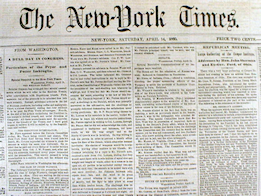
New York Times, March 1, 1860

Washington, Wednesday, Feb. 29.

The Senate Yesterday.

The report that Senator Seward would speak to-day, crowded the immense galleries, and by noon it was impossible to procure standing room within hearing of the chamber, although the proceedings did not commence till 1 o’clock.

The great leader of the Republican Party was in fine condition, and exhibited unmistakeable consciousness of his own power to meet the expectation of his party and his country. With the calmness of a May morning he approached the subject, and for more than an hour riveted the attention of all. The Democratic side of the chamber bore the excoriation administered to secession and disunion, though it was restless under the expose of Southern fanaticism.

Mr. Douglas followed in reply, and ably espoused the cause of the South, and defended the Democratic Party against the charges preferred by the great “Irrepressible” leader. Every one was commenting on the fact, that whenever the “tug of war” came, Mr. DOUGLAS was put forward to fight the battle for Slavery, while his rival aspirants for the Presidency draw back, and retire from the field. The speech of Mr. Douglas to-day drew upon him flattering compliments from Gen. Jeff. Davis, and will go far towards securing him the Charleston nomination by acclamation.

Gen. Davis, the Cicero of the Senate, followed Judge Douglas, and explained the great Doctrine of State Rights.

0 comments

0

News of the Day

New York Times, March 1, 1860

The Opposition State Convention of Kentucky, which was in session at Frankfort last week, adopted a platform denouncing the House of Representatives and the National Administration, and urging the necessity of the organization of a National Union Party. The resolutions appended to the platform declare the supremacy of the Federal Constitution, the necessity of observing the precepts inculcated in the Farewell Address of Washington, and of enforcing the Fugitive Slave law. In addition to these, the following were of the resolutions which were unanimously adopted:

  1. No interference of any character with Slavery, or the rights of slaveholders in the Slaveholding States in the Union, and the suppression of any such interference by the requisite means, moral, legal or physical.
  2. Opposition to any Presidential candidate who will indorse, or be likely to follow the proscriptive, wasteful, disorganizing and downward course which has lately characterized the Federal Administration.The rights of the citizens of the United States, resident in the Territories, when authorized to form a State constitution, to admit or reject by it the institution of Slavery.
  3. Opposition to the reopening of the African Slave trade.
  4. We deny the power of the people of the Territories, prior to the formation of their State Constitution, by legislation or otherwise, to impair any right which any citizen of the United States possesses under the Federal Constitution in the Territories. We stand by the principles of the compromise measures of 1850, which were subsequently indorsed by almost the entire population of the Union.
  5. That, as far as depends upon us, we will stand by, support, and uphold the Union, against all attacks from without or within, and against all ultraism, whether at the North or the South.
  6. We invite our fellow-citizens, of all party names, to unite with us in our internal struggle in the common cause of the Constitution and the Union, and in the election of a President of ability, integrity, and patriotism, not identified with a sectional party, who will be the President of the Nation, of the whole people, and not of a faction; and who will strictly enforce the laws, and sustain alike, under the Constitution, the rights and interests of every section of the country.
  7. Such a President we should recognize in our distinguished fellow-citizen, Hon. John  J. Crittendon, whom we recommend to the favorable consideration of a National Union Convention, as worthy of that exalted position. His whole life gives ample assurance that if elevated to the Chief Magistracy of this nation, he will, in the administration of the Government, know nothing but his common country.
0 comments

0

Miscellaneous document sources
1. Major Heintzelman to Colonel Lee.
______

Headquarters Brownsville Expedition,          
Fort Brown, Texas, March 1, 1860.
          Sir: In compliance with the instructions contained in your letter of January 7, 1860, I have the honor to make the following report:
          In compliance with Special Order No. 103, headquarters department of Texas, San Antonio, November 12, 1859, I repaired to San Antonio and reported to the commanding general for instructions.
          I was directed to proceed towards Brownsville and disperse any hostile parties I might meet, &c. From accounts received soon after, the reports were believed to be greatly exaggerated, and the expedition was broken up. But I was directed to proceed to Brownsville and make full inquiries there and on the frontier above.
          I reached Brownsville on the night of the 5th of December.
          Juan Nepomosina Cortinas, (or Cortina,) the leader of the banditti who have for the last five months been in arms on the Lower Rio Grande, murdering, robbing, and burning, is a ranchero, at one time claiming to be an American, and at another a Mexican, citizen. At the time General Taylor arrived on the banks of the Rio Grande, he was a soldier in General Arista’s army. He has been for years noted as a lawless, desperate man.
          Ten years ago he was indicted for murder, and the sheriff attempted to arrest him, which made him for a long period keep out of the way until the witnesses were gone. In 1854 he again began to be seen about ; but no effort was made to arrest him until in the spring of 1859, when he was indicted for horse stealing, and he has since been a fugitive from justice. When he came to town he was always well armed, or had some of his friends around him, making it dangerous to interfere with him. His principal business has been dealing in stock, purchasing or stealing, as was the most convenient. He had great influence with his class of the Mexican population, and thus, as he controlled so many votes, was courted at elections by politicians.
          He has a ranch called San José, a few miles from town, and whenever there was any danger of arrest he would retire to this place and keep himself surrounded by a band of outlaws, as desperate as himself. Leading this lawless life, he and those around him made numerous enemies. On the 13th of July last he was in Brownsville with some of his ranchero friends, when a man who was formerly a servant of his was arrested by the city marshal for abusing a coffee-house keeper. Cortinas attempted to rescue the man ; he fired twice on the marshal, the second shot wounding him in the shoulder, and rescued the prisoner. He mounted his horse, took the prisoner up behind him, and with his friends around him rode off defying the authorities to arrest him. He escaped to Matamoras, and there was treated with consideration and lauded as the defender of Mexican rights.
          For this an effort was made by the sheriff to arrest him. A party was got up, but they did not succeed in getting what they considered a sufficient force and the possee never started. Several of the men who were active on this occasion were known to Cortinas, and they were marked.
          It has been reported that he held a captain’s commission in the Mexican army. He at one time was a lieutenant under General Garcia, but was detected selling the horses given to him for a remount, and was dismissed. Since these troubles commenced he has offered his services with fifty men to General Garcia, but they were declined.
          He probably held some commission in the custom-house or maritime guards. Under this pretext he recruited men and purchased arms. Don Miguel Tigerino, his first cousin, on the 28th of September, said in Brownsville to some of his friends that he “was a desperate, contrary, fellow. When every one thought that he had started for the interior he turned up suddenly in Brownsville.” He no doubt, when he came over here, intended to kill all his enemies that he could catch, and then go into the interior.
          Before daylight on the morning of the 28th of September Cortinas entered the city of Brownsville with a body of mounted men, variously estimated at from forty to eighty, leaving two small parties of foot outside—one near the cemetery, the other near the suburb of Framireno. The citizens were awakened by firing and cries of “Viva cheno Cortinas!” “Meusau los Gringos!” “Viva Mexico I’’ The city was already in his possession, with sentinels at the corners of the principal streets and armed men riding about. He avowed his determination to kill the Americans, but assured Mexicans and foreigners that they should not be molested. Thus was a city of from two thousand to three thousand inhabitants occupied by a band of armed bandits, a thing till now unheard of in these United States.
          He made his headquarters in the deserted garrison of Fort Brown, and sent mounted men through the streets hunting up their enemies. He broke open the jail, liberated the prisoners, knocked off their irons, and had them join him. He killed the jailer, Johnson, a constable named George Morris, young Neale in his bed, and two Mexicans; was after Glaseche, the wounded city marshal, and others. One of his men was killed by the jailer, in the attack on the jail.
          Cortinas himself rode up to a store on the levee and called for spirits of turpentine. A few minutes after this, General Caravajal made his appearance on the levee, and said that he would try and put a stop to all this, and seeing Don Miguel Tiguino on the opposite bank of the river, called to him to cross over to this side instantly. This he did, on horseback, accompanied by Don Agassito Longosia. General Caravajal then sent for Cortinas, and, after a talk with him, he with his men, mounted and on foot, numbering about sixty, marched along the levee out towards his mother’s rancho, about nine miles above the town.
          His party did not make any attempt to plunder or rob, but were active in looking for the persons who had assembled to accompany the sheriff to arrest him, or for those who could be witnesses against him for former offences. Two of those killed had personal enemies amongst Cortinas’s men.
          His sole object appeared to be revenge, but his men were getting liquor, and the consequences were only prevented by the exertions of the gentleman above named and the Mexican consul, Don Manuel Tresino, in inducing him to leave the town. There were but thirty or forty native Americans in the place, and they mostly unarmed, and being taken completely by surprise, no effort was made to oppose him. There are said not to be over eighty American citizens, native or naturalized, in the two counties of Cameron and Hidalgo. Many of the foreigners in Brownsville refused to give any aid in its defence.
          Two days after (30th of September) Cortinas issued his first proclamation, in which he bid defiance to law, and assumed to protect those whom he alleged had been injured on account of their Mexican origin, and accusing the lawyers of despoiling them of their lands.
          After leaving Brownsville he encamped at his mother’s rancho, and was there joined by stragglers from town, and Mexicans from the neighboring ranches. Several of the citizens of Matamoras and Brownsville now visited his camp, and had interviews with him. He appeared only to wish to have time to cross his property, stock, &c., into Mexico. He took his time, without being molested, and then crossed with his men. He and his men stayed about Matamoras publicly, unmolested by the authorities.
          About the 12th of October, several days after he left this side, the sheriff, with a posse, started up the river to visit his rancho, and to reconnoitre the country. They caught Thomas Cabura, said to have been Cortinas’s second in command, on the 28th of September, and brought him in a prisoner. When Cortinas, who was in Matamoras, heard this, he told some of the most influential men there that if the citizens of Brownsville did not immediately release Cabura, that he would “lay the town in ashes, &c.” A prominent merchant in Matamoras came over at 11 o’clock p.m., at the request of those Mexican gentlemen, to persuade the people of Brownsville to comply with his demand, whilst an express awaited, on the other side, their answer, to carry it to Cortinas. His demand was refused, but he was informed that the man was in the hands of the sheriff, to be dealt with by the laws of the country.
          The night after the arrival of Captain Tobin’s company Cabrera was found hung.
          Cortinas, with forty men, crossed the river the same night. He received their answer, and took up his old quarters, at his mother’s rancho. Here he collected men and arms, and prepared to carry out his threats, occasionally sending threatening communications to the authorities. His men would make their appearance on the outskirts of the town in open daylight; but the citizens had now organized and armed, and kept a guard day and night.
          Some Mexican troops, who had been called over about the 30th of September, and who had returned home when Cortinas recrossed to the Mexican side, were now invited over again. About seventy-five men came over, with a piece of artillery, to join an expedition which the citizens were preparing for the purpose of attacking Cortinas. They were of the National Guards, of Matamoras, under the command of Colonel Loranco and Don Miguel Tigerino, who accompanied the expedition as a volunteer.
          There were about twenty Americans, under Captain Thompson, and forty Mexicans, from the town and ranches below, under a Mexican called Portillo, all mounted. They took along a four-pounder howitzer.
          The expedition started on the 22d of October, met the enemy nine miles from town on the 24th, routed him from his first position, and followed him up as he retreated into the chaparral, from which, without being seen, he kept up a constant fire. Here the Mexican gun stuck in the mud, and on the second discharge it was dismounted, and was then abandoned. The advance fell back. The other gun, with its ammunition, was also abandoned, but, it is said, not until it was thrown into the river. However, both the guns were in Cortinas’s camp that night. The flight now became general, all being anxious to be the first to reach Brownsville. The Mexican troops had four men wounded, and brought up the rear. One Mexican with Portillo was also badly wounded. Two men of Cortinas’s—all that he lost— were killed by the Mexican troops.
          The Mexican troops had but from eight to twelve rounds of ammunition, and they did not retreat until it gave out. They are accused, but I think most unjustly, of having fired blank cartridges, and that the cap squares were loosened to dismount the gun.
          Cortinas now had two pieces of artillery, and was much emboldened by his success. Large reinforcements joined him, some voluntarily, others he compelled from the neighboring ranches. He commenced levying contributions of arms, horses, beef cattle, corn, everything that he wanted for his men, sometimes giving receipts for what he took.
          He intercepted all the mails to and from this place, except the Point Isabel, by capturing the mail riders, cut open the mail bags, and had the letters read to him ; he cannot read or write. Once he sent in the letters opened, with a note apologizing to the postmaster, “as it was a matter of necessity for him to know what steps were taken against him.” By this means he knew more of what was going on outside of Brownsville than its citizens.
          He knew when the rangers with Captain Tobin were expected, and made arrangements to intercept them. Glaseche, however, went and guided them in about midnight, without their meeting any one. The same night Cortinas was known to be hovering about town, and Tobin’s men were received with a shower of grape, fired at them before they were recognized. This was the 10th of November.
          About eight days after, thirty men were sent under Lieutenant Littleton, towards the arroyo Colorado, to meet Captain Donaldson’s company. He missed Donaldson, but on the Palo Alto prairie fell into an ambuscade prepared by Cortinas, and lost three men killed and one wounded and a prisoner. The next day, when a party went out to bring the dead they found this man murdered and all the dead mutilated. They went to Santa Rita, seven miles from here, to attack Cortinas, but knowing that he had artillery, and thinking he was too strong, they only made a demonstration and returned to the city. All this only served to give Cortinas and his followers confidence. He now believed that he could stand his ground against the whole State of Texas.
          In the meantime more volunteers arrived. On the 22d of November the rangers under Captain Tobin, numbering about two hundred and fifty men, including in this Captain Kenedy’s company of citizens from Brownsville, the Indianola company, and a 24-pounder howitzer in charge of Lieutenant Langdon, United States artillery, who volunteered, again started out to exterminate Cortinas. On the 24th Captain Tobin had his whole force collected at Santa Rita, seven miles above town. Here he left the 24-pounder and about sixty men, and advanced with the main body of his force to make a reconnoissance. The advance, when near the intrenchment, two miles above Santa Rita, was fired upon by both cannon and small-arms. The fire was returned. Captain Tobin now gave the order to fall back and wait for the artillery, but the whole force fell back to Santa Rita. Here there was another council and a misunderstanding, and the next morning sixty men started back to town. The next day (25th) Captain Tobin again advanced, but when near the barricades there was another consultation, and it was decided to be imprudent to risk an attack, and the whole force marched back to Brownsville.
          It was a wise decision. In their disorganized condition an attack would have brought certain defeat. About a month before this the streets of Brownsville were barricaded.
          Cortinas was now a great man; he had defeated the “Gringos,” and his position was impregnable; he had the Mexican flag flying in his camp, and numbers were flocking to his standard. When he visited Matamoras he was received as the champion of his race—as the man who would right the wrongs the Mexicans had received; that he would drive back the hated Americans to the Nueces, and some even spoke of the Sabine as the future boundary. The lower order of Mexicans hate Americans, and the educated classes are not always exempt from this feeling. This is well shown from the difficulty we had in obtaining information. When his force and all his movements were well known in Matamoras, with daily intercourse with his camp, we were answered with vague and exaggerated accounts. Men who have lived here for years, and are united to Mexican women, could learn nothing reliable.
          A party of forty men, under Santo Cadena, joined him from Agua Leguas, in Nueva Leon, remained until they were loaded with plunder and then returned to their homes. Another party of sixty convicts escaped from prison at Victoria, in Tamuulipas, armed themselves, and, after a fight with the authorities, marched through the country to the Rio Grande, and joined him. Affairs remained in this state until we arrived here on the night of the 5th of December.
          I entered the town that night with Captain Stoneman’s company “E,” 2d cavalry, forty-six men, and “L” and “M” companies, 1st artillery, sixty-six men, and five men of the 1st infantry—in all, five officers and one hundred and seventeen men. In Fort Brown, were Captain Rickett’s company, 1st artillery, of forty-eight men.
          On our march from the Nueces to the arroyo Colorado we only met two Americans and a Mexican cart; all travel had ceased for some time. At the arroyo we first learned to a certainty that Captain Tobn was in Brownsville, but that he had not dislodged Cortinas, and got the most exaggerated accounts of the latter’s forces.
          The morning after our arrival I endeavored to get information as to the number, position, and objects of Cortinas ; every one appeared to be as ignorant of these matters as I was ; accounts ranged as high as fifteen hundred men. I finally satisfied myself that he could not have over three hundred and fifty men, and that he occupied a fortified position across the river road, about nine miles above town, and that his works were armed with two pieces of artillery. As to his objects no one knew.
          Captain Tobin informed me that he had about one hundred and fifty rangers, and placed himself under my command; I wished him to send out parties to reconnoitre their position; several went, but none of them ever got near enough to give me any information. At 1 o’clock a.m., the 14th of December, we marched out of Brownsville with one hundred and sixty-five officers and men of the regular army, and one hundred and twenty rangers; half an hour before day I halted a mile and a half from the point where I was told his intrenchment was.
          I was desirous of having a reconnoisasnce made before proceeding further; the rangers were so thoroughly stampeded by their previous expedition that it was only after much difficulty and delay that I could get any one to go, and then only by Judge Davis, who had been out with them before, volunteering to go with them ; we advanced and found that the intrenchment had been abandoned apparently for a week; it consisted of a heavy breastwork of ebony logs and earth mixed with brush across the road, with two embrasures and a ditch in front; about one hundred yards beyond another had been commenced to face the other way ; the first was badly located and could easily have been turned.
          After a short delay in clearing a road around these obstructions the march was resumed. About three miles further, where the road is straight and passing through a very dense chaparral with ebony trees, our attention was attracted by the waving of a flag six or seven hundred yards in advance, with a few men about it. In a moment more a burst of smoke and a round shot down the road informed me that the enemy was before us. Until this event the general impression was that Cortinas would not dare fire upon the United States troops.
          I immediately ordered the guns unlimbered and the fire returned. The rangers seeing with how much coolness the regular troops stood the fire of the enemy regained confidence, and were finally induced to advance to the attack. With the aid of “L” and “M” companies, 1st artillery, they took the enemies’ camp, at Vicente Guenais, a few hundred yards beyond, capturing some provisions and arms. The pursuit was continued about two miles further. Some horsemen made their escape across the river into Mexico. Where the enemy was posted the chaparral was so dense that but a small portion of the force was engaged. This was one of Cortinas’s principal camps, and had been long occupied, but he was not in it. The infantry were commanded by Pancho Balli, and the artillery by Antonio Juarez or Jantes, and in all about sixty men. The resistance they made was quite trifling. We had two men of the artillery slightly wounded, and a ranger mortally. The enemy lost eight.
          Here, whilst we halted to refresh the men and animals, Major Ford came up with fifty-five men. He heard the firing in the morning, and rode forty miles, via Brownsville, to join us.
          A rain set in, and continuing, the next morning we returned to town. I had learned that Cortinas was behind us, back in the country, and would probably come in on the river. We reached town without meeting any of the enemy.
          I was, on my return to town, informed that Cortinas was on his way to attack Point Isabel and burn the custom-house, full of valuable goods, and that he had also large parties towards the arroyo Colorado. I sent out three strong parties, but in a few days they returned with out meeting any one. I was now satisfied that he had concentrated his whole force, and was retiring up the river to lay waste the country.
          I started on the 21st of December with all the force I could collect, amounting to one hundred and fifty regulars and one hundred and ninety-eight rangers. I had information that was deemed reliable that Cortinas had fortified himself at the Baston, thirty-five miles from town, in Mr. Neale’s brick house, loop-holed and surrounded by corrals. We came in sight of the Baston at twelve o’clock, m. on the 23d, found the fences, corrals, and jacales burned, the house sacked, and the enemy gone.
          The next place I was told that we should certainly meet him was in a bend of the river a mile beyond—Edinburg. We reached Edinburg on Sunday, the 25th of December. Although we met several Mexicans from Reynosa, Mexico, not one could tell us anything about him, except that he had left after plundering the custom-house, post office, &c.,which we could see ourselves. His next position was a cane-brake,
a few miles beyond Edinburg; but when we arrived he had left.
          The next day I learned that Cortinas was occupying Ringgold barracks and Rio Grande City, with his troops encamped on the plaza. Major Ford, who was in advance here, sent Colonel Lockridge with the information. I determined to surprise him by a night march. As our march was most of the way in full view from the Mexican side of the river, we went into camp at the usual time and in the usual manner. At midnight we resumed our march in silence, and an hour before daylight were three miles from Rio Grande City. Here our spies met us with the assurance that he was still encamped in Rio Grande City.
          I now made the arrangement for Ford’s and Henon’s companies, eighty-five men, to make a detour, and get on the road to Koma, above the city, and Captain Tobin, with Tomlinson’s and Hampton’s companies, one hundred and thirteen men, to move in advance of our right flank, whilst the regulars, giving the rangers half an hour’s start, would advance with the artillery along the road, and attack him in front.
          We advanced in this order, but when we reached the barracks some ranger rode up and reported that Major Ford could not get beyond on the road, and had commenced the attack in front. On entering the town, I learned that most of his men had encamped about half a mile beyond. Here he had been attacked by Ford, who was supported by Captain Tobin, with his, Tomlinson’s, and Hampton’s companies. The enemy made a vigorous resistance, but as soon as he saw the regular troops, with the “white-topped wagons,” rise the ridge back of the town, he gave way. He here abandoned his provisions, half-cooked breakfast, and a baggage cart, but carried off his artillery.
          I ordered up more troops, but the men, fatigued by a march of forty miles since the morning before, could not overtake the advance, and were sent after those who had escaped into the chapparal. At this time a dense fog set in, enabling many of the enemy to escape into the thick chapparal which lined the whole road. I rode forward, and found the ranger companies all broken up, and strewed along the road, with most of the officers in advance. I soon overtook Major Ford, and gave directions to press the pursuit, as our victory would not be complete if they succeeded in carrying off their guns. After a pursuit of more than nine miles, we captured both his guns, loaded. There was no more attempt made at resistance, and here the last dispersed.
          Within a few minutes after the capture of the second gun, the men on foot and guns and all our wagons were up. They had made a march of nearly fifty miles in twenty-five hours, thirty of them with out stopping for water. There was not a straggler from the regular troops.
          The defeat was complete. We captured his guns, ammunition and baggage carts, provisions, everything he could throw away to lighten his flight, and entirely dispersed his force.
          We had sixteen rangers wounded, mostly very slight cases. Cortinas had between five and six hundred men, and his loss was about sixty killed and drowned in the river. Most of them who escaped got across the river into Mexico, and without arms. He fled to Grunoro, where he made his appearance next day. He afterwards was seen at Mier Camargo, Keynosa, and so continued down the river, collecting his stragglers. Many small parties were seen on the Mexican side of the river, but generally unarmed. I sent Captain Stoneman’s company the same evening to Koma for its protection. Captain Dawson, with “L” and “M” companies, first artillery, left on the 29th of December to garrison Fort Brown. I went to Koma, and remained until the 15th of January, 1860, then returned to this place to collect, in compliance with instructions, the names of the killed and amount of damage done by Cortinas.
          A difficulty about the organization and command of the rangers created much embarrassment and delay. An election was held, and Tobin was elected major. I endeavored to have the rangers distributed along the river in small parties to prevent the reorganization of the enemy’s forces, but my orders were never fully carried out.
          Two commissioners of the State of Texas, Messrs. Navarro and Taylor, now arrived in Brownsville, to inquire into the causes of this disturbance, and authorized to reorganize the rangers They mustered all out of service, and then mustered in Ford’s and Littleton’s companies
          I was called upon by the commissioners to say what force of rangers would be sufficient for the protection of the frontier. With but one company of cavalry I was of the opinion that the two then in service would be sufficient. They were placed under my command.
          I placed Captain Stoneman’s cavalry and Ford’s and Littleton’s companies of rangers on the river between here and Rio Grande City, with orders to keep out small parties. Cortinas’s men were very active at this time crossing over and driving stock into Mexico.
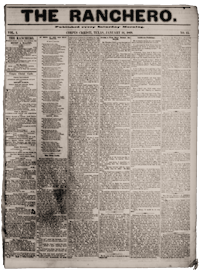
          Cortinas, soon after his defeat at Rio Grande City, established a camp at La Bolza, thirty-five miles above here, with the avowed object of attacking the steamboat Ranchero, on her return from the towns above. This being her first trip since last September, it was well known that she would have a valuable freight. Her whole cargo was valued by the officer of the boat at $200,000.
          During his stay at La Bolza Cortinas recruited men, procured arms, ammunition, and supplies. He crossed at Las Rusias to the American side of the river, intercepted the United States mail carrier, cut open the mail bags, and rifled them of their contents. He threatened the carrier with death for serving the Americans, and only spared him because the contractor is a Mexican. He was taken to La Bolsa and there kept until he made his escape in the confusion of the fight of the 4th of February. At La Bolsa a frequent subject of conversation was the intercepting and robbing of the steamboat. During the time Cortinas was in constant communication with the inhabitants of Matamoras and other towns on the river.
          On the 31st of January I called, with one of the Texas commissioners and the American consul, on General Garcia, the Mexican commander of the line of the Brazos. He showed us the instructions he had to coöperate with the United States forces in arresting Cortinas and dispersing his bands. He told us that he had sent out but could not learn where Cortinas was to be found. We had known for near a month past that he was at La Bolsa.
          On the 4th of February, near La Bolsa, Cortinas’s men fired from the Mexican side of the river on a party of Captain Ford’s men, mortally wounding one, and also a few minutes after, on the steam boat; to repel this attack, and to protect the lives and property on board the boat, it was advisable to cross into Mexico; Captain Ford, with Major Tobin and Captain Tomlinson, crossed with forty-nine men, attacked Cortinas in his camp, and after a sharp skirmish drove him out of it. Cortinas is said to have had about two hundred men, and that his loss was twenty-nine killed and forty wounded. We had but two men slightly wounded. Captain Stoneman, who was a few miles below, hastened up with his company, and before daylight the next morning we had over two hundred men on the ground.
          At 10 ½ o’clock p. m. an express reached me with a report of what had occurred. The town was wild with excitement; people declared that war had commenced. A party got together with the object of crossing at this ferry and seizing the ferryboats, which are kept at night on the Mexican side in charge of a guard. As there has been, for some time past, considerable alarm of an invasion of filibusters and rangers, a strong Mexican guard has been kept at the ferry.
          Some gentlemen who met them came and told me as I was returning to the garrison. I found the party armed on the bank of the river; I had but little difficulty in convincing them of the folly of such an act; that it would only complicate affairs; that the boats were now in our power, but that we were not prepared nor authorized to occupy Matamoras.
          The next morning I addressed a note to General Garcia, informing him of what had occurred, and calling upon him now to co-operate with me in arresting Cortinas. I knew that he had received an express an hour or two earlier than we, and that from eighty to a hundred men had left the same night, but it was believed more to aid Cortinas than to arrest him. The object of my note was more to learn the feelings of the Mexican authorities than from any expectation of any action on their part towards arresting Cortinas. He had too many friends in Matamoras, and I doubt whether they had the power, if they had the inclination, to arrest him.
          A few hours brought me a reply, in which General Garcia informed me that he had sent out a portion of the rural police, and would send more as soon as they could be organized, and asking me to withdraw our troops. Don Miguel G. Cabezas, the second alcalde, and Don Manuel Treviño, the Mexican consul, brought the letter, and were authorized to give me explanations.
          I learned from these gentlemen that about forty men of the police force had gone, and that more would leave in the afternoon and evening. More went, as promised. In the conversation with them I impressed upon them the absolute necessity for the most prompt and energetic measures on their part to arrest this man, for if he was permitted to go on, the most grave consequences would follow. As we had accomplished our object, and as I did not wish to continue this cause of irritation, I sent orders for the troops to recross, which they did the next day, after an interview with the commander of the police force.
          When Captain Ford came in sight of the police force there was a large number of armed men around. Some sixty of these withdrew to our side. These men the police force would not vouch for. They were evidently Cortinas’s men.
          The prudence of Captain Ford and the good order he had observed, together with his prompt withdrawal, have quieted down the excitement. After the flight at La Bolsa, some one along, but not of his command and contrary to Captain Ford’s orders, set fire to the jacales and fences, and they were consumed. On the 7th of February Inaquin Arguilles, who succeeded General Garcia in the command, addressed me a note making reclamations for the burning of these jacales, as some compensation for the violation of their territory. In my reply I justified the act, as they had failed in their international obligations in permitting Cortinas, after having been driven from our soil, to occupy their territory, recruit, arm, and equip his men, and occupy those jacales for weeks, for the avowed object of attacking this steamboat engaged in lawful traffic, &c. To this I have received no reply.
          A few days after his defeat at La Bolsa we again heard of Cortinas, with from forty to sixty men, encamped near a rancho called “La Mesa” about six miles further from the river and nearly opposite his old place.
          Captain Ford took post on our side of the river, nearly opposite, and was getting minute information as to the localities, with the intention of surrounding his camp. A few days ago he broke up this camp and went up the river, it is supposed by some, to Camargo, and by others for the interior. Linaus and Cadruta are mentioned. He has evidently left this frontier. His brother says that he intends to join the Indians. His mother and a brother are desirous to return to this side of the river and to reoccupy their ranches. This has strengthened me in the belief that he has left permanently.
          In reviewing the events of the past five or six months, I arrive at the following facts:
          Cortinas has been an outlaw and fugitive from justice for the last ten years. Some politicians found that he could influence a large vote amongst his countrymen, and during an election he was courted. Thus there was never any great effort made to bring him to justice. His mother owns ten leagues of land in a body near town, much of it covered with a dense chapparal. A few miles back from his house, near the river, he built a rancho called San José, which is arranged for a secure retreat, where it would be difficult to surprise any one. This was an asylum for horse and cattle thieves, robbers, and murderers, for those whose enemies would not permit them to live on the Mexican side of the river, or who dared not show themselves in the thickly settled parts of this State.
          In Brownsville there were several persons who had made themselves obnoxious to him and his associates. His first object in coming here was, no doubt, revenge to get rid of these. Then he would have gone off into the interior with some of his friends, in a government employment, until his deeds were forgotten. But the arrest of Cabrera, as he was ready to leave, kept him back. He recrossed the river to rescue Cabrera, and punish those who held him in custody. The idle and the dissolute flocked around him, lured by the prospect of plunder. He soon gained notoriety, and the affair grew beyond his control. The hatred of Americans on the frontier, amongst all classes of Mexicans, brought him men and means. Our side of the river furnished some horses and beef, with but few arms. Most of his arms, ammunition, and supplies to maintain his forces for so many months, came from Mexico, and principally from Matamoras Most of his men were “pelados” from the towns and ranches along the Rio Grande. On the Mexican side he always found a market for his plunder. At Rio Grande City, in an ammunition box which we captured, were orders in which he is styled “General en Gefe,” and he went about with a body guard.
          The whole country from Brownsville to Rio Grande City, one hundred and twenty miles, and back to the Arroyo Colorado, has been laid waste. There is not an American, or any property belonging to an American, that could be destroyed in this large tract of country. Their horses and cattle were driven across into Mexico, and there sold, a cow, with a calf by her side, for a dollar.
          At Rio Grande City, in answer to the complaints of his men that he had not fulfilled his promises, he told them that they should the next day have “manos libres’’ from ten to twelve. Our unexpected arrival saved the city from being sacked and burned, and the few Americans left from murder.
          Rio Grande City is almost depopulated, and there is but one Mexican family in Edinburg. On the road this side I met but two ranchos occupied, and those by Mexicans. The jacales and fences are generally burned. The actual loss in property can give but a faint idea of the amount of the damage. The cattle that were not carried off are scattered in the chapparal, and will soon be wild and lost to their owners. Business, as far up as Lerido, two hundred and forty miles, has been interrupted or suspended for five months. It is now too late to think of preparing for a crop, and a whole season will be lost.
          The amount of the claims for damages presented is three hundred and thirty-six thousand eight hundred and twenty-six dollars and twenty one cents; many of them are exaggerations, but then there are few Mexicans who have put in any.
          There have been fifteen Americans and eighty friendly Mexicans killed. Cortinas has lost one hundred and fifty-one men killed; of the wounded I have no account.
          The severe punishment that this people have received it is to be hoped will long deter anyone from another such undertaking. A small garrison in Fort Brown would have prevented a thought of such a thing. No people care less for the civil, and are more afraid of the military power.
          His idea and that of his dupes was that this was in the nature of a Mexican pronunciamento; that he would, when he became formidable, be bought off by the authorities; that his men would return unmolested to their homes, and soon all be forgotten.
          The citizens of Brownsville are not entirely guiltless. Had they performed their civil duties, and brought this man to justice in the first part of his career, or had they even have had a military organization, the morning of the 28th of September Cortinas would have been shot down or arrested.
          It will be a long time before the ill-feeling engendered by this outbreak can be allayed. It is dangerous for Americans to settle near their boundary. The river is narrow, and now low, and easy to cross. A robbery or murder is committed, and in a few minutes the criminal is secure from pursuit. Both banks must be under the same jurisdiction. It will at once add to the value of the lands and promote settlement. The industrious, enterprising, active race on one side cannot exist in such close proximity with the idle and vicious on the other without frequent collisions.
          The class of the Mexican population (pelados) who joined Cortinas, are an idle, thriftless, thieving, vicious people, living principally on jerked beef and corn, a frijole as a luxury. The climate is such that they require but little in the way of clothing, or to shelter themselves from the weather, and the soil produces spontaneously much that they live upon. When they have enough to eat they only work on compulsion, which the system of peonage furnishes on the Mexican side of the river.
          For the protection of the frontier, I think that it will be necessary to station at least one company of infantry at Fort Duncan, one at Fort McIntosh, one at Fort Ringgold barracks, and two at Fort Brown. Until there is a more stable government on the other side, I would keep two companies of cavalry in the field, between Ringgold barracks and Brownsville.
          My thanks are due to the officers and men of the regular army, and to those of the rangers for their cheerful and efficient aid during the last four months. I also am much indebted for valuable information to Judge Haris, Mr. Yturia, Mr. Cummins, and Mr. Galsan.
          The accompanying lists give the names of the killed and the accounts of damages with the claims. I also add a few letters which, with my previous reports, will give you a full history of what has occurred. The two field returns give the names of the officers engaged on the 14th and 27th of December, 1859.
          Respectfully submitted,
S. P. Heintzelman,          
Major 1st Regiment Infantry, Com’dg Brownsville Expedition.
          Captain John Withers,
                    Ass’t Adj’t Gen., U. S. A., San Antonio, Texas.

 
Attachments to Heintelman’s March 1, 1860 dispatch to Colonel Robert E Lee.


Troubles on Texas Frontier, Letter from The Secretary of War (John B. Floyd), Communicating, In compliance with a resolution of the House, information in relation to the troubles on the Texas frontier, May 5, 1860; House Documents, Otherwise Publ. as Executive Documents: 13th Congress, 2d Session-49th Congress, 1st Session, Volume 12
 
“During the 12 years following the Mexican-American War, there were present on the frontiers of Texas and Mexico many factors that tended to create disturbances. The topography of the country, the sparsity and general character of its population, the lack of an extradition treaty and of sufficient national authority, wild Indians of uncertain abode, the Mexican tariff system, all caused friction and gave encouragement to lawlessness which not only retarded the development of the region but often threatened to interrupt friendly relations between the two republics.” [Border Troubles along the Rio Grande, 1848-1860, The Southwestern Historical Quarterly, Vol. 23, No. 2 (OCTOBER, 1919)]

0 comments

Village Life in America

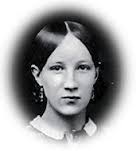
Village Life in America, 1852 – 1872, by Caroline Cowles Richards

February 9.–Dear Miss Mary Howell was married to-day to Mr Worthington, of Cincinnati.

February 28.–Grandfather asked me to read Abraham Lincoln’s speech aloud which he delivered in Cooper Institute, New York, last evening, under the auspices of the Republican Club. He was escorted to the platform by David Dudley Field and introduced by William Cullen Bryant. The New York Times called him “a noted political exhorter and Prairie orator.” It was a thrilling talk and must have stirred men’s souls.

0 comments

0

News of the Day
1860s newsprint

Daily Gazette & Comet [Baton Rouge , LA], February 28, 1860

It is entirely useless to give words of caution and advice in the paper, unless people profit by it. Our fast young men should paste the following in the crowns of their hats: On Sunday morning last a young gentleman dressed in the most elegant extreme of fashion, with his hat on one side of his head, a long nine in the other corner of his mouth, a rattan in his right hand, covered with mouse colored gloves, came to the corner of Laurel, leading into Lafayette street, and instead of making a wide turn on the side-walk, hugged the corner and would have shaved it close but for the fact that a small colored individual with a plate of eggs, essayed to do the same in order to get into Laurel street by the shortest cut. A collision was the consequence—the plate was knocked out of the hand of the colored individual and the contents lost on the person of the young gent. It was about the church time of day, and the street was full of ladies, the young man vanished—it is supposed, into Greenwald’s Lager Saloon, as he has not been heard of since, we note the fact to prevent a sensation advertisement on the part of his friends, who may think that he has been abducted, or foully dealt with.

0 comments

Diary of a Tar Heel Confederate Soldier By Louis Léon

Diary of a Tar Heel Confederate Soldier By Louis Léon [53d North Carolina Regiment, infantry]

February–The smallpox is frightful. There is not a day that at least twenty men are taken out dead. Cold is no name for the weather now. They have given most of us Yankee overcoats, but have cut the skirts off. The reason of this is that the skirts are long and if they left them on we might pass out as Yankee soldiers.

0 comments

0

News of the Day
New York Times, February,26, 1860
Leavenworth, K. T., Feb. 25, 1860.          
         The Pike’s Peak express arrived here this morning with twenty-five hundred dollars in gold and the mails. The news is meagre.
         Good prospects had been obtained in the mountains, between Denvers City and Gregory’s mines. Two cords of quartz, mingled with pyrites of iron, had yielded, after crushing, seventeen hundred dollars in gold.
         Trains laden with breadstuffs and produced had arrived from New Mexico.
         A new and extremely rich gulch had been discovered ten miles from Gregory’s mines, which, it is said, exceeds any of the old diggings in richness.
0 comments

0

News of the Day
1860s newsprint

Daily Chronicle & Sentinel [Augusta, GA], February 24, 1860

From a private letter to a gentleman in this place, we learn that the students of Mercer University, at Penfield, held a Southern Rights Meeting on last Saturday afternoon, and adopted strong resolutions, declaring their eternal allegiance to Southern homes and hearths. Among the resolutions was one which binds every one appearing on the rostrum at Commencement, to be dressed in clothing of Southern manufacture. Several members of the faculty were present.—Madison Visitor.

0 comments

0

News of the Day
The Adjutant General to Colonel Lee.

Adjutant General’s Office,          
Washington, February 24, 1860.
          Sir: Information having reached the War Department of the continued depredations of Cortinas and his followers on American soil, the Secretary of War directs that you make use of your best exertions to put a period to the predatory operations of that band of outlaws, and that you employ for this purpose, if required, all the troops under your command that can possibly be spared for such service.
          The most vigorous measures for the capture of Cortinas and his band will be resorted to, and, if necessary, the Secretary of War directs that they be pursued beyond the limits of the United States.
          I am, sir, very respectfully, your obedient servant,
S. Cooper,                    
Adjutant General.
          Brevet Colonel R. E. Lee, U. S. A.,
                    Commanding Department of Texas,
                              San Antonio, Texas.

A dispatch in Difficulties on Southwestern Border, House Documents, Volume 126; Volume 128, United States House of Representatives, U.S. Government Printing Office, 1860

During the 12 years following the Mexican-American War there were present on the frontiers of Texas and Mexico many factors that tended to create disturbances. The topography of the country, the sparsity and general character of its population, the lack of an extradition treaty and of sufficient national authority, wild Indians of uncertain abode, the Mexican tariff system, all caused friction and gave encouragement to lawlessness which not only retarded the development of the region but often threatened to interrupt friendly relations between the two republics. [Border Troubles along the Rio Grande, 1848-1860, The Southwestern Historical Quarterly, Vol. 23, No. 2 (OCTOBER, 1919)]

0 comments

0

News of the Day
1860s newsprint

Daily Gazette & Comet [Baton Rouge , LA], February 24, 1860

It must be gratifying to all our National and Union loving people to know that the bright light of early patriotic desire has not altogether been smothered or quenched by the fire of fanaticism on one hand and fire-eating on the other.—Indeed fire-eating has come to be so common with some of our great political captains lf late years that it is no longer an attractive feature in the show of daily existence.—How such must quail at the reading of the “Farewell Address.” It is the voice of a great spirit from the other world, talking to us again, and cautioning the people against the insidious wills of domestic and foreign demagogues. How it seems to have anticipated this day in the history of the nation! At no previous anniversary of the birthday has there been a more extended disposition on the part of the people of this city to celebrate the day.—The stores were closed and business suspended; whilst a large half of the town went into the country to take a whif at the pure fresh air. The military companies turned out in full feather, with fine music—calling into the street a happy smile of faces. At night there was a celebration in the Hall of the House, where Col. Waggman delivered an eloquent and patriotic address.—The interesting sight to us was the turn out of the boys of Magruder’s Collegiate Institute; a noble looking band of fellows from all parts of the State, a string of over a hundred. As they passed our door we could not help but think this the greatest army of the two, we mean not to fight with weapons of destruction, but in the great battle of truth against error which shall wind up with a glorious conquest. If but ten out of the hundred, or even one come up to the full proportions of manhood, in moral principles of right and justice he is the conqueror, whom the world will yet recognize as the greatest of heroes with claims to the laurel. Principles boys! Principle. This is what is wanted to fight the battle of life successfully—this is armour of steel in which you may stand up against ignorance on one hand and bigotry on the other. With this you may take what little good there is afloat at this time of day, and hand it to those who shall come after you, when it becomes your duty to take the first part in the drama of life. At night the boys gave an exhibition of their acquirements in oratory at the Methodist church, where there was a house full to its last capacity. We were not only highly pleased with the manner but the method of the speaking, and every one present bore away a most favorable impression. If there is any one institution of which, or rather for which we feel more pride than another, it is Magruder’s Collegiate Institute.

0 comments

0

Miscellaneous document sources
Crawfordville [Ga.], Feb. 24th, 1860.          
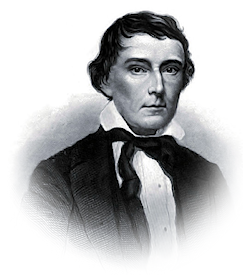
          Dear Smith, Some time has past since I heard from you last. I fear you are sick again. Sam McJunkin got home three days ago. He came here but I was at Glascock Court. He doubtless would have been able to give me full information about you but as I did not see him I am the more anxious. In my last I inquired of you after Ward’s bust. Has he finished it or not? Some friend sent me a copy of the proceedings of some art association of which Dr. Stone is President in Washington City. At the exhibition I see this bust of Ward’s mentioned. Still I do not know whether it is finished or not. I have not heard a word from him on the subject since last November or October. If you are well I wish you would find it and after looking at it tell me what sort of a thing it is—is it good or not— well executed I mean—would you from seeing it know for whom it was taken, that is the question, and is the association quick? Nobody here ever thought of me in looking at Sander’s bust! Another thing I would inquire about—that is what has become of Peyton’s article or sketch that you told me some time ago would appear in the Constitutionalist? Is it still on hand, will it appear, or is the idea abandoned? I simply wish to know how the matter stands. If you are not sick I wish you to write to me and give me the news generally. I should like to know what Bright and Fitch are after—who are they for in the Charleston convention—they seem to be dead against Douglas. Who is Vallandingham for? What is the present prospect for Hunter? He is the man above all others I should prefer to see nominated. Still if Douglas should be, I should support him most cordially if ho does nothing worse than he has yet done. This is of course for yourself ; I do not wish to have anything to do with public affairs further than to act my part as a private citizen and do not wish to be figuring in the newspapers in any way. I have been excessively annoyed by the use made of my name in our own newspapers. I do not intend to allow the Milledgeville March convention to connect my name in any way with the Charleston convention. The Presidency is an office I do not want and would not have if I could get it by my own mere volition. Write to me soon. I am now at home but will soon be on the circuit again.

From Annual Report of the American Historical Association for the Year 1911.

Alexander H. Stephens would later become Vice President of the Confederated States of America.

0 comments

0

News of the Day
1860s newsprint

Semi-Weekly Mississippian [Jackson, MS], February 24, 1860

For the Mississippian.

Ed. Mississippian:–The Abolition papers, says the New York Day Book of the 11th inst.,  just now contain a very affecting and melancholy appeal from some free negroes who have left  Arkansas for good, asking alms and support from Northern people, the names of whom, at the  close of the paragraph, some dozen in number, are given, which it is barely possible, the Day  Book adds, our friends in Arkansas will find to be fictitious. Now, whatever may have been the  fate of a majority of those unfortunate creatures driven from their homes to fail in receiving the alms and protection sought at the hands of those who have brought upon them their present distress, the following narrative related to me a day or two since, will at least account for the whereabouts of some five or six of them who have sought as the last resort save one, the blessings of liberty in a free State. Says Mr. F., the brother of Judge F., for many years a well-known and popular citizen of Mississippi, but now of Arkansas, on his arrival at Napoleon, a town on the bank of the Mississippi, a few days ago, he witnessed at no great distance a somewhat enthusiastic mingling and shaking of hands between a crowd of citizens and some negroes which at first struck him with some surprise. On his near approach, however, he recognized one of the men, a barber who had just arrived with four or five other negroes from Cincinnati for the avowed purpose of becoming slaves to Southern masters in preference to the enjoyment of freedom, so-called, in the Northern States. A more affecting scene, says Mr. F., than the one above mentioned, he has rarely witnessed. With tears and sobs, they told of the cold reception, illiberal and inhuman treatment they had received at the hands of those who make such loud professions of love and friendship for the negro race, and declared themselves then ready to be sold into slavery.

Now, however strange this may appear to Southern men, it is a matter of no surprise.—Nothing is better understood in the South than the total aversion that the more intelligent negroes of the South have to Northern men and Northern freedom; and if there was no other evidence with which to disprove the slanders heaped upon the institution of Southern slavery and slaveholders, and forever stamp the dark and malignant brow of Abolition with wilfull  and unmitigated falsehood, the tenacity with which free negroes of the South cling to Southern men and southern institutions, would be ample and overwhelming; preferring, as many do, as a last resort, slavery itself, to be driven out among those whom they know are only hypocritically professing to be their friends. It is a well-known fact that had the bill which passed the late House of Representatives, and failed by only one vote in the Senate, become a law, our free negroes had determined on Jackson slavery in preference to Northern freedom.—So much for the glories of Northern freedom and the horrors of Southern slavery.

….. N.

0 comments

0

Miscellaneous document sources
83. Major Thomas to Colonel Seawell.

Headquarters, Camp Cooper, Texas,          
February 22, 1860.
         Sir: I have to report, for the information of the department commander, that on the night of the 17th instant the sentinel on post over the public mules at this post permitted, by criminal neglect of his duty, some person or persons to pull up a number of the pickets on one side of the yard, cut the bell from the neck of the bell-mule, and drive off the whole herd, and gave no alarm for fifteen or twenty minutes afterwards. Immediately after daylight I sent a party in pursuit, and twenty-one mules and two condemned horses, which had strayed from the herd, were recovered. At 9 a.m. another party, under Lieutenant Lowe, adjutant 2d cavalry, was sent, with instructions to pursue them as far as possible. I enclose Lieutenant Lowe’s report here with, and will also state, in confirmation of the opinion expressed in the last paragraph, that the depredations this winter all appear to have been committed upon a systematic plan, and with such an evident understanding among the parties committing them that I am inclined to think there is some foundation for the opinion referred to by Lieutenant Lowe. The night after the mules were stolen from the post all the animals at the agency, except those locked up in the stable, were carried off. This party was pursued by four Mexicans living with Colonel Leper on mules which I loaned them for the occasion. On the Little Wicheta, some distance above the crossing of the Radzeminski road, they came upon a couple of Indians, who had with them six horses, four of which were taken by the Mexicans, the Indians making their escape on the other two. Mr. B. Harden, a citizen from one of the lower counties, had left a private horse in charge of the quartermaster until his return with the scout under Lieutenant Cunningham, which scout he had accompanied to show the trail made by the party from Erath and Palo Pinto counties. This horse was carried off by the persons who broke into the mule-yard. I also enclose Lieutenant Cunningham’s report.
         I am, sir, very respectfully, your obedient servant,
George H. Thomas,          
Major 2d Cavalry, Commanding Post.
         The Assistant Adjutant General,
Headq’rs Dep’t of Texas, San Antonio, Texas.
         
__________
83 a.
         
Camp Cooper, Texas,         
February 21, 1860.
         Sir: I have the honor to report that in obedience to your instructions I left this camp on the morning of the 18th instant, with a party consisting of one noncommissioned officer and nine privates of the regimental band, and six privates of company “D,” to pursue a party of depredators who had stolen some government animals on the night of the 17th.
         After a search of two hours I struck the trail, about 12 o’clock, and followed it at a brisk trot until dark. The next morning I again started at a rapid gait, but after going some twelve miles (I had then followed it nearly sixty miles) buffalo became so numerous that the trail was completely obliterated, and I found it impossible to go further with any possibility of overtaking them. The trail in its general direction bore N.NE.
         I found two mules that had been killed, and one alive, which I brought back. Neither of the three had any of the marks or brands usually found upon animals belonging to Comanches; and from this fact I am led to believe that the thieves must belong to some other tribe. I would take occasion to state, from reports which seem to be well authenticated, that the prevailing impression in this part of the country is that most of the animals taken from Texas are driven to Bent’s Fort for sale.
         I am, sir, your obedient servant,
W. W. Lowe,         
First Lieutenant and Adjutant 2d Cavalry.

         Major G. H. Thomas,
2d Cavalry, Commanding Post.


A report in Difficulties on Southwestern Border, House Documents, Volume 126; Volume 128, United States House of Representatives, U.S. Government Printing Office, 1860

During the 12 years following the Mexican-American War there were present on the frontiers of Texas and Mexico many factors that tended to create disturbances. The topography of the country, the sparsity and general character of its population, the lack of an extradition treaty and of sufficient national authority, wild Indians of uncertain abode, the Mexican tariff system, all caused friction and gave encouragement to lawlessness which not only retarded the development of the region but often threatened to interrupt friendly relations between the two republics. [Border Troubles along the Rio Grande, 1848-1860, The Southwestern Historical Quarterly, Vol. 23, No. 2 (OCTOBER, 1919)]

0 comments

0

News of the Day
The Adjutant General
to the Commander of Fort Bliss.

          
War Department, February 21, 1860.          
          Sir: Representations have been made to the War Department to the effect that large bands of armed banditti are marauding upon the Mexican side of the Rio Grande, and that the property and lives of American citizens are in imminent danger of destruction by them.
          If this be the case, you are authorized by the Secretary of War to march such a force to the relief of the American citizens in the vicinity of your post as will give them protection against the banditti, if, in your judgment, such protection is necessary, and the same may be asked for by the Mexican authorities.
          I am, sir, very respectfully, your obedient servant,
E. D. Townsend,          
Assistant Adjutant General.
          The Commanding Officer,
                    Fort Bliss, Texas.


A report in Difficulties on Southwestern Border, House Documents, Volume 126; Volume 128, United States House of Representatives, U.S. Government Printing Office, 1860

During the 12 years following the Mexican-American War there were present on the frontiers of Texas and Mexico many factors that tended to create disturbances. The topography of the country, the sparsity and general character of its population, the lack of an extradition treaty and of sufficient national authority, wild Indians of uncertain abode, the Mexican tariff system, all caused friction and gave encouragement to lawlessness which not only retarded the development of the region but often threatened to interrupt friendly relations between the two republics. [Border Troubles along the Rio Grande, 1848-1860, The Southwestern Historical Quarterly, Vol. 23, No. 2 (OCTOBER, 1919)]

0 comments

0

News of the Day
Governor Houston to
Mr. Floyd.

[Telegram.]
New Orleans, February 20, 1860.          
          Sir: The commissioners sent by me to the Rio Grande have reported that the territory of Texas has been invaded. The banditti recruit their forces and gain supplies in the face of the authorities of Matamoras, and they are unable to restrain them. The steamer Ranchero was fired into from the Mexican side of the river on the third (3d) instant. The Texans thereupon crossed the river with sixty men, and, after an engagement with some two hundred banditti, repulsed them, with a loss of twenty-five or thirty of the enemy. The immediate interposition of the federal arm is besought. I have used all necessary caution and prudence, and may now act, upon the facts before me. Unless prompt measures are adopted by the federal government, circumstances may impel a course on the part of Texas which she desires to avoid. Texas cannot be invaded with impunity. If thrown upon her own resources, she will not only resist, but adopt measures to prevent a recurrence of the outrage.
          A reply is respectfully asked, stating the decision of the department. I would request that that this despatch be submitted to his excellency President Buchanan.
          The report of the commissioners will be sent by mail.
                    I have the honor to be,
Sam Houston.          
          Hon. John B. Floyd.

A telegram in Difficulties on Southwestern Border, House Documents, Volume 126; Volume 128, United States House of Representatives, U.S. Government Printing Office, 1860

During the 12 years following the Mexican-American War there were present on the frontiers of Texas and Mexico many factors that tended to create disturbances. The topography of the country, the sparsity and general character of its population, the lack of an extradition treaty and of sufficient national authority, wild Indians of uncertain abode, the Mexican tariff system, all caused friction and gave encouragement to lawlessness which not only retarded the development of the region but often threatened to interrupt friendly relations between the two republics. [Border Troubles along the Rio Grande, 1848-1860, The Southwestern Historical Quarterly, Vol. 23, No. 2 (OCTOBER, 1919)]

0 comments

0

Miscellaneous document sources

February 20, 1860

To the Senate and House of Representatives of the United States:

Eight memorials numerously signed by our fellow-citizens, “residents for the most part within the territorial limits of Kansas and Nebraska at and near the eastern slope of the Rocky Mountains,” have been presented to me, containing the request that I would submit the condition of the memorialists to the two Houses of Congress in a special message. Accordingly, I transmit four of these memorials to the Senate and four to the House of Representatives.

These memorialists invoke the interposition of Congress and of the Executive “for the early extinguishment of the Indian title, a consequent survey and sale of the public land, and the establishment of an assay office in the immediate and daily reach of the citizens of that region.” They also urge “the erection of a new Territory from contiguous portions of New Mexico, Utah, Kansas, and Nebraska,” with the boundaries set forth in their memorial. They further state, if this request should not be granted, “that (inasmuch as during this year a census is to be taken) an enabling act be passed with provision upon condition that if on the 1st day of July, 1860, 30,000 resident inhabitants be found within the limits of the mineral region, then a Territorial government is constituted by Executive proclamation; or if on the 1st day of September, 1860, 150,000 shall be returned, then a State organization to occur.”

In transmitting these memorials to Congress I recommend that such provision may be made for the protection and prosperity of our fellow-citizens at and near the eastern slope of the Rocky Mountains as their distance and the exigendes of their condition may require for their government.

JAMES BUCHANAN.

0 comments

0

Miscellaneous document sources

February 19, 1860

Fellow-Citizens:—I see that you are providing a platform for me. I shall have to decline standing upon it, because the president of the company tells me that I shall not have time to wait until it is brought to me. As I said yesterday, under similar circumstances at another gathering, you must not draw the inference that I have any intention of deserting any platform with which I have a legitimate connection because I do not stand on yours. Allow me to thank you for this splendid reception, and I now bid you farewell.


The Papers And Writings Of Abraham Lincoln, Volume 2: 1860 – 1865;
By Abraham Lincoln, Lamb Publishing Company, 1923

0 comments

0

News of the Day

Sugar Planter [West Baton Rouge, LA], February 18, 1860

The lands and slaves belonging to the succession of the late Joachim Daigle, were sold at extraordinary prices. The exact prices per acre of the lands we have not been able to learn, but they exceeded the expectations of every one. Some of the negroes brought almost fabulous prices. A carpenter brought $4,400; a field hand, $3,600; a negro woman with three children, the eldest nine years of age, brought $5,000. All the other negroes of the plantation brought very high figures. The entire plantation, if we are correctly informed, was appraised at about $60,000, but competition was so great that near $90,000 were realized for it. Who says lands and negroes are not worth money in West Baton Rouge.

0 comments

0

News of the Day

The Ranchero [Corpus Christi, TX], February 18, 1860

The following letter which will prove interesting to the members of the Walker Rifles, and our community generally, explains itself:

 Austin, Texas, January 31st 1860.

Lieut. Henry A. Maltby, Walker Mounted Rifles, Corpus Christi.

Lieutenant:–Enclosed herewith, you will find your Commission as 1st Lieut. of the Walker Mounted Rifle Company, also those of the Senior and Junior Lieutenants, which please deliver to them.

The Governor, His Excellency Sam Houston, has granted us 50 good and serviceable percussion rifles, almost new.—Also as many sword bayonets, cartridge boxes, belts, and scabbards, as can be found here in a suitable condition. His predecessor, Gov. Runnels, issued all the arms of the State to the Rangers, and with them they were either lost or rendered unserviceable, so it is out of the power of the present Governor, to do more for us at the present time. He has, however, promised me to give us the benefit of the quota of arms, due the State from the United States, for the past year of 1859, amounting to the equivalent of 169 muskets, and this requisition will arm us quite satisfactory. The arms and accoutrements I am now getting cleaned, fixed and packed, and by next week I think that I shall be able to get them shipped via Powderhorn. All these expenses have to be borne by the company. We either had to pursue this course, or we would not and could not have obtained any arms for the next twelve months, and ere then occasion might occur to render them very useful and beneficial.

Very respectfully, Your Ob’t Serv’t,

 Chas. Lovenskiold.

0 comments