0

News of the Day

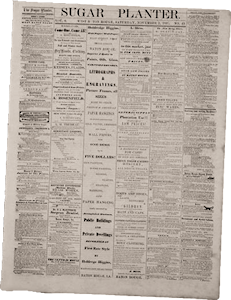
Sugar Planter [West Baton Rouge, LA], April 7, 1860

A Baltimore paper states that the organization of the Branch of the Knights of the Golden Circle now numbers nearly one thousand men, mostly young, and many from some very respectable families. They have an Armory, where they meet for daily drill, under the instruction of U. S. officers. The aim in this association is the invasion of Mexico, and they expect to leave in a few days unmolested by Government, as they will not arm themselves until beyond the jurisdiction of the United States.

0 comments

0

News of the Day
1860s newsprint

Daily Gazette & Comet [Baton Rouge , LA], April 6, 1860

This organization, whose sole aim at presents seems the invasion of Mexico and assists in the establishment of a new government, has caused some interest, especially among the young men of the city, many of whom are unemployed.—They have formed an association, and for some time past have been engaged in drilling and perfecting themselves in the use of arms, at their rooms, corner of Baltimore and Holiday streets. There are nearly one thousand signatures to the muster roll, some of whom are of very respectable families. The companies are being drilled by experienced officers, who have done service in the United States army, and the membership are quite sanguine in leaving this port in two or three weeks, unmolested by the Government. They do not intend arming themselves until they get beyond the jurisdiction of the United States.—Baltimore American.

0 comments

0

News of the Day
1860s newsprint

Texas Baptist [Anderson, TX], April 6, 1860

During the past session of our court, nineteen negroes chose masters for themselves and were made slaves for life. Wise choice, far better than to sink to the level with the free blacks of Canada and the North.

0 comments

0

News of the Day
1860s newsprint

[Little Rock] Old-Line Democrat, April 5, 1860

Thirteen slaves belonging to Gov. Fitzpatrick of Alabama, recently received $900, the proceeds of cotton raised by them in the odd hours they were allowed by their master to work for themselves.—[Ex.

We do not publish the above for our own benefit, or for the benefit of southerners, for we all know that slaves have time enough given to them to enable them to earn and lay up many dollars yearly, if they are so disposed. But our object is to convince our northern friends that our statements while in the North during the past winter, in relation to slaves having and holding their own earnings, were correct. Indeed, there are thousands of poor white families in the North who would be looked down upon by the slaves of the wealthy planter.

0 comments

0

News of the Day
1860s newsprint

Louisiana Democrat [Alexandria , LA], April 4, 1860

We are happy to announce to the citizens of Alexandria, and the public generally that our indefatigably enterprising fellow-citizen, M. R. Ariail, has received his supply of ice for the present season, and is to-day having it stored away. The 375 tons just received, added to the 50  or 60 tons left over from last season’s supply, is more than will supply this market. Judge Ariail has therefore gone up to Natchitoches, to make arrangements to supply our neighbors.

Mr. Ariail requests us to say that the J. D. Perry, Commanded by the good Samaritan  Kimball, towed up his Ice boat, and desires us in his name and that of the public to heartily thank the noble Captain for lending his handsome craft to so useful and so difficult a task as towing  375 tons of Ice up Red River’s current.

Any commander who accomplishes it, deserves credit in point of skill, and the gratitude of our people when we take into consideration how few commanders will undertake the task, and what a luxury and necessity it is in the midst of Summer’s heat and Summer’s fevers.

This is the third time Capt. Kimball has thus accommodated this people, and they are not the people to forget favors of that sort.

0 comments

0

News of the Day

Mailbag, that is!

160 years ago today, this letter was probably somewhere in Nebraska on the first 10-day Pony Express relay, headed to California.

Letter in first west bound Pony Express relay.
0 comments

0

News of the Day
1860s newsprint

Daily Gazette & Comet [Baton Rouge , LA], April 3, 1860

It is remarkable how universal is the demand for this product. The official returns show a list of one hundred and twenty-five different articles of export; and out of that number, with the exception of grain, there is not one that is shipped to so many different countries as tobacco. The Government report enumerates seventy-one different foreign markets to which our products are exported. Out of that number, there are only six that do not buy our tobacco, viz: Madeira, the air of which is possibly too pure to be polluted by the fumes of the weed; Egypt, San Domingo, Greece, Bolivia and Equador —most of which places produce their own

The value of the tobacco exported from the United States last year, was nearly five times that of our sea products, fifty per cent more than the products of the forest—not quite three millions of dollars less than the whole export of vegetable food, and rather over an eighth of the value of the cotton crop.

It is clear that the general taste for tobacco smoking is steadily increasing, whether to the public injury or otherwise we leave for those better skilled in the doctrines of narcotics than ourselves to decide. The fact is, that despite of King James’ counterblast, and Urban’s excommunication, and the ever-issuing anti-narcotic fulminations of our modern physicians—the people are most resolvedly intent upon having the weed; and this being the case, our tobacco planters will continue to grow it and prosper.

0 comments

0

News of the Day
1860s newsprint

Daily Gazette & Comet [Baton Rouge , LA], April 3, 1860

We have received the following letter from Mr. John J. Drake, of Clinton, La.:

Clinton, La., March 31st, 1860.
Editor of the Gazette and Comet:–

Dear Sir:–On my way to this place from Baton Rouge Friday last, in the vicinity of Midway, on the Port Hudson railroad, I was startled by the noise of many voices in the adjacent woods. My curiosity took me in the direction of the noise; I turned my horse’s head and proceeded about five hundred yards from the road when I discovered a camp of Indians, not less in number I judge between one hundred and thirty and fifty. Such an unusual gathering at this time, when the race has nearly disappeared from the State, caused me to secrete myself as well as I could, and watch their actions. There was but few women among them. The men were fantastically dressed: decorated with feathers and had their faces painted. The place in which they were camped, was a ravine. They had a large fire, around which they were dancing in the wildest and most fantastic manner. I must confess that I was not only surprised but frightened at their appearance, and very soon returned to the road and on my journey. About two miles north of this point, I stopped at a house on the roadside, and was informed by the people there that they had visited the house the evening previous and hints were thrown out by some of the party that they would pass through your town, cross the river and go over to the Marangoin country. I have deemed it my duty to communicate these facts to you, that you may know how to receive them.

 Respectfully,
Your obedient servant,
John J. Drake.

0 comments

Village Life in America

Village Life in America, 1852 – 1872, by Caroline Cowles Richards

April 1.–Aunt Ann was over to see us yesterday and she said she made a visit the day before out at Mrs William Gorham’s. Mrs Phelps and Miss Eliza Chapin also went and they enjoyed talking over old times when they were young. Maggie Gorham is going to be married on the 25th to Mr Benedict of New York. She always said she would not marry a farmer and would not live in a cobblestone house and now she is going to do both, for Mr Benedict has bought the farm near theirs and it has a cobblestone house. We have always thought her one of the jolliest and prettiest of the older set of young ladies.

0 comments

0

News of the Day

Sugar Planter [West Baton Rouge, LA], March 31, 1860

Instructions for marshals and assistants in taking the next census are nearly prepared. The modifications from those of 1850 will be slight. A compliance with the recommendations of the New York Chamber of Commerce, regarding commercial statistics, is not deemed practicable.—The importance of information about internal commerce is fully appreciated by the Census Bureau, but no method of collecting that which is reliable, through the census, has been discovered. The multiplicity of exchanges which products and manufactures undergo in the course of sale, resale and transportation from one end of the Union to the other, renders an exact computation of the value of domestic commerce impossible. It is estimated that the cost of taking the census this year will reach fifteen hundred thousand dollars, and the enumeration will exceed thirty-one millions of people. Superintendent Kennedy intends to have returns complete in less than three months from the 1st of July.—They will be laid before Congress next session, so that an appointment law may be passed at once. This, however, will not be in season to act upon the ratio for the Thirty-seventh Congress, as a majority of its members will have been elected previous to the commencement of the next session, but it will enable those States whose Legislatures meets  biennially to apportion their districts in ample time for the election of members of the Thirty-eighth Congress.

0 comments

0

News of the Day

Natchez Daily Free Trader [MS], March 30, 1860

A society of the K. G. C., or Knights of the Golden Circle, will be formed in this city at  an early day. The originators of this mystic order were certain military characters who resided in  Lexington, Kentucky—the spring of 1854 being the date of its organization. The first object of  the organization was to cultivate a martial spirit among the people of the South. The second  object was to have a military organization in the South fully capable of defending our social and  political rights from all assaults from our enemies at home and abroad. The past history and  present aspects of our political affairs seemed to demand that an organization such as the K. G.  C., fully armed and equipped and officered, was absolutely necessary. The order has steadily  grown until now it numbers nearly forty thousand members, who are scattered over the Southern  States of the Union, and the Northern States of Mexico. No society of the kind has in this  country combined such an amount of talent, resources or numbers as has this. If we understand  correctly, the present object of the K. G. C., is the invasion of Mexico. It is well known, that in  this distracted country a cruel war has raged with scarce an intermission, for the past ten years.  The country has been weakened by these intestine feuds; agriculture, commerce and manufacture  have languished and the Mexican people have groaned under the oppression and tyranny of rival  chieftains. At the present time there are two parties in Mexico, contending for the supremacy of  the government. On the one hand stands the church party, with Miramon as their leader. On the  other hand stands the liberal party, with Juarez as their leader. Our Minister to Mexico, Mr.  McLane, has recently made a treaty with Juarez, which will be one of vast benefit to our  government. Our government has already recognized the Liberal party as being the government  of Mexico. The K. G. C.’s have already espoused the cause of the Liberals, and we are informed  that it is their fixed determination to place it at the head of the Mexican Government, and thus  aid them in restoring peace and harmony to a distracted country and an oppressed people. Our  citizens will be addressed shortly on the subject of armed intervention in the affairs of Mexico,  by one of the most distinguished of the “Knights of the Golden Circle,” when we hope to see a  large turn out. We speak what we know, or, as Hamlet would say, “by the Card,” on this  subject. The statements we have made in this connection have been derived from parties who  are perfectly reliable and who are entitled to respectful consideration. Long live the K. G. C.’s— Vicksburg Sun.

0 comments

0

News of the Day
1860s newsprint

Daily Gazette & Comet [Baton Rouge , LA], March 27, 1860

The death of Aunt Cicily, well known to all the market people for her faithful, honest and upright conduct, called out between three and four hundred of her colored friends and fellow-servants to attend her funeral on Sunday last. We do not recollect ever to have witnessed a larger or more orderly procession on a similar occasion. Over the grave, George Menard made an honest, sincere and effective prayer, after which one of the old fashioned Methodist hymns was sung by the company concluding the ceremony in an impressive manner. What a contrast this! Aunt Cicily was a slave (conventionally speaking), but had her friends about her to minister to her wants in the hour of affliction, and the children of her Mistress and their friends were by her, weeping at the parting hour. On the other hand, how many poor and friendless souls starving in the pinching squalidness of extreme poverty, died that day in the hells and hidden corners of the great city who were carried away to death unnamed and unknown in what is vulgarly called “free society.”

0 comments

0

Miscellaneous document sources
96. Colonel Brown to the Adjutant General.
Fort Brown, March 26, 1860.
          Colonel: Under the impression that information of the state of affairs, on the Rio Grande would be desirable to the government, being immediately from there, having travelled over the whole country from Brownsville to Ringgold barracks along the river, the scene of hostilities, having been for two weeks an attentive observer and inquirer, and having frequently conversed with the commanding officer and other army officers and respectable citizens on the subject of the outbreak of Cortinas and the present state of affairs, I despatched from New Orleans, on my arrival there on the 13th, the result of my observations. This despatch having been considered of sufficient importance to found in it the reply of the Secretary of War to the requisition of Governor Houston, an importance I never dreamed of its attaining, I now feel constrained to give the facts on which the opinions expressed in that dispatch were founded, that the government may be able to set on my opinions their due value. I had not then nor have I now a doubt of their substantial correctness.
          1. I concur fully with Major Heintzelman and the officers of the posts of Fort Brown and Ringgold barracks; and the former distinctly stated to me that he had received reliable information that Cortinas had left the country, and that the war was over, and that he had so officially reported to department headquarters; and the latter one, I believe, with only one exception, of the opinion that the affair having been, from the commencement, greatly exaggerated, never approached the dignity of a war, but was, in its commencement and continuance, a mere raid, which, in all its parts, had been very greatly exaggerated, and was now finished unless renewed by aggressions on one part.
          2. In travelling to and from, and while at Brownsville and Ringgold barracks, I heard, at different places, and from different individuals along the frontier, reports immediately from the Mexican side, which uniformly (with, I think, only one solitary exception) represented Cortinas to have retired into the interior of Mexico; some of them stating that he had taken his family and all his stock with him.
          3. The citizens who had abandoned their plantations on the river, were many of them returning.
          4. Persons, singly and without escort, and small parties travelled safely over the road. I met them frequently.
          5. Cortinas’s mother, who has a plantation a few miles from Brownsville, (the buildings and fences of which were destroyed by the Texan rangers,) and his brother, who had returned to the Mexican side, had petitioned the authorities of Brownsville for authority to return.
          6. All the numerous reports of Cortinas being at Matamoras, or in its vicinity, were subsequently found to be false.
          7. Perfect quiet and apparent security prevailed at Brownsville, Ringgold barracks, Edyburg, Rio Grande City, and all along the river between those places.
          8. Communications between the two countries was constant and undisturbed, and immense quantities of goods were constantly being crossed from Brownsville and Matamoras.
          These, with the incidental considerations, convince me of the correctness of that despatch, any subsequent contradicting report to the contrary notwithstanding; and I feel the most perfect assurance that, by the removal of the Texan volunteers (a great and reciprocal animosity subsisting between them and the Mexicans) from the frontier, by a judicious distribution of regular troops along the line, the present force there is amply sufficient to preserve peace and give protection to our citizens.
Before closing, it may be proper for me to say that newspaper reports, as also those of anonymous letter-writers, are not to be relied on, and should be received with the greatest caution; reports, the most false and exaggerated, being put in circulation by persons interested in fomenting trouble immediately before the sailing of the New Orleans steamer for the evident purpose of exercising an influence on public opinion in the States.
          I am, colonel, very respectfully, your obedient servant,
Harvey Brown,          
Brevet Colonel, U. S. A.
          Col. S. Cooper, Adjutant General, Washington city, D. C.

Difficulties on Southwestern Border, House Documents, Volume 126; Volume 128, United States House of Representatives, U.S. Government Printing Office, 1860

During the 12 years following the Mexican-American War, there were present on the frontiers of Texas and Mexico many factors that tended to create disturbances. The topography of the country, the sparsity and general character of its population, the lack of an extradition treaty and of sufficient national authority, wild Indians of uncertain abode, the Mexican tariff system, all caused friction and gave encouragement to lawlessness which not only retarded the development of the region but often threatened to interrupt friendly relations between the two republics. [Border Troubles along the Rio Grande, 1848-1860, The Southwestern Historical Quarterly, Vol. 23, No. 2 (OCTOBER, 1919)]
0 comments

Another soldier to fight for the flag.—March 1860

Through Some Eventful Years by Susan Bradford Eppes
Susa Bradford Eppes

March 26th, 1860.—The baby is not to have Father’s full name after all; he is to be named for both of his grandfathers and that makes him James Edward Whitehead. Maybe I won’t love him so well, but I think I will, for he is Sister Mag’s own dear little son and I shall love him for that, even if I am disappointed. When Brother Junius looked at him he said, “another soldier to fight for the flag,” but I hope he will never have the opportunity to fight. War and bloodshed seem very terrible to me.

Lucy Brodie is making us a visit, she does not think much of babies. Her father was my father’s commission merchant once and the Brodie family lived in Tallahassee but they went back to New York when Lucy was quite young and she does not remember her Florida home. She is thirteen years old now and deeply interested in all she sees. The negroes are something new to her every time she looks at one and she often remarks on their queer looks and ways. Yesterday when Lulu had braided her hair and dressed her, even putting on her shoes, she said, “When I get back home I am going to think of this and wish I had one of my very own to carry about with me.” I do not believe Lucy has been kept at school as steadily as I have been, for the books she studied last term are like those I studied three years ago. Lucy has been visiting at Woodstock and Goodwood and she says she has enjoyed it all. She would like to stay longer and she has promised to come again.


Susan Bradford has just turned 14 years old when this diary entry was made. Educated by tutors and hired teachers, her education is three years further along than her 13-year-old visitor from New York.

0 comments

0

Miscellaneous document sources
6. Major Heintzelman to Colonel Lee.
          
Headquarters Brownsville Expedition,          
Fort Brown, Texas, March 25, 1860.
          Sir: I have the honor to report that our troops returned to this side of the river on the morning of the 21st, after examining several ranchos, and going as far back from the river as the Cayetano ranchos, forty-two miles from the Rio Grande.
          At several places they learned that Cortinas had been there, and they saw large numbers of his old camp fires. At Cayetano they learned that he had been apprised of their movements by an express from the river, and that he had left for Burgos, three days’ march in the interior. It was useless to continue the pursuit.
          The whole operation was carried forward with much energy. A march of one hundred miles was made in two days and nights. It is not believed that Cortinas will again attempt to concentrate a force in the vicinity of the Rio Grande.
          He has not, and it is doubtful whether any of his banditti have, been seen this side of the river since the affair at the Bolsa on the 4th of February.
          I am, sir, very respectfully, your obedient servant,
S. P. Heintzelman,          
Major 1st Infantry, Comd’g Brownsville Expedition.
          Capt. John Withers,
                    Asst. Adjt. Gen., U. S. A., San Antonio, Texas.


Troubles on Texas Frontier, Letter from The Secretary of War (John B. Floyd), Communicating, In compliance with a resolution of the House, information in relation to the troubles on the Texas frontier, May 5, 1860; House Documents, Otherwise Publ. as Executive Documents: 13th Congress, 2d Session-49th Congress, 1st Session, Volume 12
 
“During the 12 years following the Mexican-American War, there were present on the frontiers of Texas and Mexico many factors that tended to create disturbances. The topography of the country, the sparsity and general character of its population, the lack of an extradition treaty and of sufficient national authority, wild Indians of uncertain abode, the Mexican tariff system, all caused friction and gave encouragement to lawlessness which not only retarded the development of the region but often threatened to interrupt friendly relations between the two republics.” [Border Troubles along the Rio Grande, 1848-1860, The Southwestern Historical Quarterly, Vol. 23, No. 2 (OCTOBER, 1919)]

0 comments

0

Miscellaneous document sources
5. Major Heintzelman to the Adjutant General.
          
Headquarters Brownsville Expedition.          
Fort Brown, Texas, March 25, 1860.
          Sir: I have the honor to report that I received orders to join Colonel Lee with Captain Lee’s company, 8th infantry, at Ringgold barracks, where this company will be stationed, and that we leave to-morrow.
          I have also to report that Captain Stoneman crossed into Mexico on the 17th with the two cavalry and two ranger companies, and endeavored to surprise Cortinas at the rancho of the Mera, where he was reported by General Garcia to be. He escaped.
          Several ranchos which were examined showed indications of his having been there. The troops went as far as Cayetano rancho, 42 miles from the river, and then returned (on the 21st) to our side of the Rio Grande. The operation was conducted with much energy.
          Cortinas has left for Burgos, three days’ march from the river, and it is not believed that he will again venture to concentrate a force in the vicinity of the Rio Grande.
          I have the honor to be, sir, very respectfully, your obedient servant,
S. P. Heintzelman,          
Major 1st Infantry, Commanding Brownsville Expedition.
          Colonel S. Cooper,
                    Adjutant General U. S. A., Washington.


Troubles on Texas Frontier, Letter from The Secretary of War (John B. Floyd), Communicating, In compliance with a resolution of the House, information in relation to the troubles on the Texas frontier, May 5, 1860; House Documents, Otherwise Publ. as Executive Documents: 13th Congress, 2d Session-49th Congress, 1st Session, Volume 12
 
“During the 12 years following the Mexican-American War, there were present on the frontiers of Texas and Mexico many factors that tended to create disturbances. The topography of the country, the sparsity and general character of its population, the lack of an extradition treaty and of sufficient national authority, wild Indians of uncertain abode, the Mexican tariff system, all caused friction and gave encouragement to lawlessness which not only retarded the development of the region but often threatened to interrupt friendly relations between the two republics.” [Border Troubles along the Rio Grande, 1848-1860, The Southwestern Historical Quarterly, Vol. 23, No. 2 (OCTOBER, 1919)]
0 comments

Diary of a Tar Heel Confederate Soldier By Louis Léon

Diary of a Tar Heel Confederate Soldier By Louis Léon [53d North Carolina Regiment, infantry]

March–Nothing new. It is the same gloomy and discouraging news from the South, and gloomy and discouraging in prison.

0 comments

Through Some Eventful Years

Through Some Eventful Years by Susan Bradford Eppes
Susa Bradford Eppes

March 24th, 1860.—I have a splendid piece of news to record here, my diary: Sister Mag has a baby boy and he is the first grandson in the house and my nephew. I feel as if I could not love him enough for he is to be named for Father. He is very small and very red, but he is a dear in spite of that and I know he will be lots of fun.


Susan Bradford is 14 years old when this diary entry was made.

0 comments

0

News of the Day

Warning

The following article contains wording that is offensive to many in the world of today. However, the article is provided unedited for its historical content and context.

Sugar Planter [West Baton Rouge, LA], March 24, 1860

The relative position in point of comfort and good treatment of the slaves at the South and the poor oppressed white operators of the manufacturing districts of New England, seems to be realized by the shoemakers now on the strike of Lynn, if we can judge from the following colloquy, said by a Boston paper to have occurred there at a recent meeting:

First Shoemaker—What is the use of our making such a fuss about the slaves of the South? I tell you we are almost as much oppressed as they are. In fact, in one sense, we are worse oppressed, for they don’t work so many hours in the week as we do; and they get a living, while most of us could’nt  live, with our families, if we could’nt  get trusted for necessaries of life, which we never expect to be able to pay for at this rate.

Second Shoemaker—We are worse treated than the slaves of the South, in every sense, so far as I can see.

Third Shoemaker—You know, gentlemen, we are not a quarter as bad off as the slaves of the South, though we ought to be. They can’t vote, nor complain, and we can. And then, just think of it; the slaves can’t hold mass meetings nor “strike,” and we haven’t lost that previllege  yet, thank the Lord.

First Shoemaker.—That’s so; but what’ll those privileges amount to, if they come to nothing? You see gentlemen, the superiority over that of Southern slaves is, we have got the manufacture ourselves out of this strike. Shall we fail, or shall we assert our superiority over Southern niggers?


0 comments

0

News of the Day
1860s newsprint

Louisiana Democrat [Alexandria , LA], March 21, 1860

Here is something new under the sun, taken from the N. O. Courier, of a recent date.   Secret organization seem to be the order of the times:

The K. G. C.

We observe a call for the K. G. C.’s to meet at the hall over the Carrollton R. R. Depot,  on this evening, at 7 o’clock. In conjunction with this call we observe that many of the leading members of this organization are now in our city. Gen. Bickley, the Commander-in-Chief, Col.  Temple and Surgeon Semple, are at the St. Louis Hotel; Gen. Greer, who is well-known as one of our bravest Volunteer Colonels from Mississippi during the recent war, and who now commands a division of the K. G. C., together with Major Richardson, one of his staff-officers,  and Col. H. C. Young, of Memphis, who commands the First Tennessee Regiment are at the City  Hotel; while others, as Captain Scott and Lieutenant Breese, are at the Merchants’; Captain Gay,  the wagon-master, is at the “Texas Home;” and still many others of note and character are at the  St. Charles, or quartered with private friends in the city. Besides, there are hundreds of our own  citizens in hourly contact with these gentlemen, so that one cannot but inquire, “What’s in the  wind?”   

As our readers must feel some interest in whatever is likely to create excitement we feel ourselves justified in making the following statement respecting this powerful organization, from sources of information, which, from the character of the parties from whom we have derived it,  we deem worthy of respectful consideration. The K. G. C., or “Knights of the Golden Circle,”  was organized in 1854, more to cultivate the martial spirit of our people, than anything else;  since then it has steadily grown, until now it numbers over 30,000 members, who are scattered over the Southern States, and holding within its charmed circle many of our most influential men and best soldiers. No organization of the kind has in this country ever combined so much talent with such immense financial resources, and under the present aspect of political affairs, we do not deem it too much to say that the whole nation may soon become deeply interested in the ultimate labors of the K. G. C.

It is generally understood that the K. G. C. are preparing to operate in the broad field which civil war has opened in Mexico to American enterprise and industry, and the first thought of the great public is that it is to be a grand “filibuster” operation, destined to meet the same reverses which have befallen all similar expeditions. But, for our part, if our information in the main be correct, the gentlemen who stand at the head of the movement are of an entirely different intellectual calibre from those whom we have heretofore seen directing these military operations. If we were allowed to guess, we should say that these gentlemen are about embarking in a scheme not unlike that in which Lafayette, Kosciusco, DeKalb, and their compatriots so generously engaged in when we were striving to shake off the shackles of British despotism; and we are assured that it is their steady determination to place the “Liberal” or  Juarez party in the full and peaceful occupation of the City of Mexico, and thus prove to the world that Americans will never refuse to other struggling peoples the aid so opportunely rendered us by the French in 1777. This noble work is one that we have frequently advocated,  and the necessity of which is truly felt by the masses in this country, as well as of the Republic of  Mexico. We say God speed to the K. G. C.! Should they fail, they will have fallen in a noble cause.

0 comments

Troubles on the Western Frontier

News of the Day
4. Colonel Lee to the Adjutant General.
Headquarters Fort Duncan,
March 20, 1860.
          Colonel: Information from Eagle Pass was received at San Antonio the day I left (15th instant) that Cortinas, with a large force, was ascending the valley of the Rio Grande, and threatened to attack the village at this place. This report was corroborated by letters received from Laredo. On coming up with Captain Brackett’s company, 2d cavalry, on the 16th, I therefore directed my course to Fort Duncan, instead of Fort McIntosh, as I had intended.
I find, upon my arrival, that there is no truth in the report. Mr. Duclos, a well-known citizen of Eagle Pass, and for some years engaged in furnishing supplies to the army in Texas, made the above communication to the chief quartermaster at San Antonio. He now informs me that he derived the intelligence from the officers of the Mexican custom-house in Piedras Negras, a village opposite.
Everything in this section of country is quiet, and the usual intercourse and commerce between Mexico and the United States is uninterrupted.
I shall therefore to-morrow proceed down the Rio Grande to Laredo, and if affairs in that quarter are quiet, will continue to Ringgold barracks, above which point I cannot learn that Cortinas has at any time ascended. Before leaving San Antonio, I had ordered to this place one of the artillery companies from Fort Clark, which has arrived, and I shall take with me to Laredo company H, 2d cavalry, commanded by Lieut. Eagle, in case it may be required.
I have given you the above information lest the report I speak of may have reached Washington, and caused uneasiness to the Secretaryof War.
I am, very respectfully, your obedient servant,

R. E. Lee,
Brevet Colonel, Commanding Department of Texas.
          Colonel S. Cooper,
Adjutant General U. S. Army, Washington City, D. C

A dispatch in Difficulties on Southwestern Border, House Documents, Volume 126; Volume 128, United States House of Representatives, U.S. Government Printing Office, 1860

During the 12 years following the Mexican-American War there were present on the frontiers of Texas and Mexico many factors that tended to create disturbances. The topography of the country, the sparsity and general character of its population, the lack of an extradition treaty and of sufficient national authority, wild Indians of uncertain abode, the Mexican tariff system, all caused friction and gave encouragement to lawlessness which not only retarded the development of the region but often threatened to interrupt friendly relations between the two republics. [Border Troubles along the Rio Grande, 1848-1860, The Southwestern Historical Quarterly, Vol. 23, No. 2 (OCTOBER, 1919)]

0 comments

0

Miscellaneous document sources
March 19, 1860.          
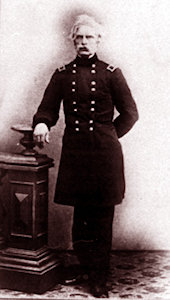
          An officer, Colonel Brown, has just arrived here from Fort Brown, who brings later news from the lower Rio Grande than Colonel Lee possessed at the date of his report. Major Heintzelman reported to Colonel Lee, early in this month, that the disturbances in that quarter had ceased, and that Cortinas had fled to the interior of Mexico. Colonel Brown concurs in these impressions, as did all the officers under Major Heintzelman. The latter, therefore, needs no reinforcement.
          The recent disturbances on our side of the lower Rio Grande were commenced by Texans, and carried on (vainly) by and between them. Cortinas himself and most of his brigands are natives of Texas. A brother horse-thief burned a house belonging to the mother of Cortinas, living in Texas, consequent on a quarrel about dividing the stolen property. Cortinas retaliated, and hence our side of the river, for many miles, has been devastated. But few, if any, Mexicans from the opposite side took part in the disturbances. There was no attack from the Mexican side upon our boat, the Ranchero, loaded with provisions. Her colors were not rent by bullets, &c.
                    Respectfully submitted to the Secretary of War.
Winfield Scott.          

Difficulties on Southwestern Border, House Documents, Volume 126; Volume 128, United States House of Representatives, U.S. Government Printing Office, 1860

During the 12 years following the Mexican-American War there were present on the frontiers of Texas and Mexico many factors that tended to create disturbances. The topography of the country, the sparsity and general character of its population, the lack of an extradition treaty and of sufficient national authority, wild Indians of uncertain abode, the Mexican tariff system, all caused friction and gave encouragement to lawlessness which not only retarded the development of the region but often threatened to interrupt friendly relations between the two republics. [Border Troubles along the Rio Grande, 1848-1860, The Southwestern Historical Quarterly, Vol. 23, No. 2 (OCTOBER, 1919)]
0 comments

0

Miscellaneous document sources
3. Major Heintzelman to Colonel Lee.
Headquarters Brownsville Expedition,          
Fort Brown, Texas, March 18, 1860.
          Sir: I have the honor to enclose herewith copies of a letter from Captains Stoneman and Ford and my reply, dated to-day and yesterday.
          I received information a few days since from General Garcia that Cortinas had made his appearance again at the Mera with about 40 men. I immediately gave notice to the troops on the line. Captain Stoneman suggested a plan to attack him, which was approved. They unfortunately came in collision with a force General Garcia had sent up to co-operate with them.
          Both Captain Stoneman and Captain Ford are pretty well convinced that Cortinas was at the Mera that night, but got away. A boy and some women said that he was in the rancho. Another man says positively that Cortinas was in the Mera the morning before. It is very difficult to arrive at the truth.
          I have no doubt but that the authorities of Matamoras are sincere in their efforts to arrest him, but I more than doubt the fidelity of their troops. Cortinas or some of his friends have recently been in the interior, and it is generally believed that he is in communication with the Miramon party. Should this party gain the ascendancy in Matamoras, I doubt whether the force at my disposal would be sufficient to protect this frontier.
          I am, sir, very respectfully, your obedient servant,
S. P. Heintzelman,          
Major 1st Infantry, Com’g Brownsville Expedition.
          Captain John Withers,
                    Asst. Adj. Gen. U. S. A., San Antonio, Texas.
   
3 a.
   
Camp on Rio Grande, Mexico,          
March 18, 1860.
          Dear Sir: We have the honor to make the following hasty report: We crossed the river with all the disposable force at our command last night, and half an hour before daybreak we were at the Mera; but instead of finding Cortinas with 40 men, as reported by the commanding officer of Matamoras, we found a body of troops claiming to be national guards. Upon arriving within about half a mile of the racho we heard the cry of a sentinel, which the guide, whom we procured in Mexico, assured us was from Cortinas’s camp; we intended to have hidden our horses in the chaparral and surrounded the place on foot and attacked it at daylight, but in endeavoring to do so, we surprised a picket guard which ran into camp and gave the alarm.
          We had therefore no time to lose, but immediately charged into the place on three sides, the back being a dense chaparral; shots were exchanged before we found that our opponents claimed to be national guards, and we regret to say that one Mexican soldier and one woman were wounded, the latter mortally, while she was trying to close a door from which an officer was firing at the cavalry as they were passing the house; none of our command was wounded, but the operation has cost us four horses. While taking breakfast within a few hundred yards of the rancho, a command numbering 150 or more of foot and mounted men, arrived, and the commander thereof asked for a
conference.
          We informed him that we were after Cortinas, and that we had been informed officially that he was at the Mera with forty men or more, and he informed us that he was on the same duty; yet he, as well as all his officers, disclaimed all knowledge of his whereabouts. From conversation with him and others we learned that he had been watching us during the past day and night, and this, together with the conduct of the troops, led us to believe that he intended to attack us, but found our united force too strong for him to venture an attack upon us.
          During the interview he requested that we should remain where we were until he could send to Matamoras and get a reply, which we declined doing, and informed him that in the pursuit of our object we should act according to the circumstances which might arise from time to time. We shall remain on the Mexican side of the Rio Grande until the passage down of the steamer, or until our presence here is no longer required, unless we receive orders to the contrary.
          We are, very respectfully, your obedient servants,

George Stoneman,          
Captain 2a Cavalry, Comd’g Regular Force.
John S. Ford,                    
Capt. Comd’g R. G. Squadron, Texas Rangers.
          C. W. Thomas,
                    Lieut. and Adjt. Brownsville Expedition, Fort Brown, Texas.
   
3 b.
   
Headquarters Brownsville Expedition,          
Fort Brown, Texas, March 19, 1860.
          Captain: Your joint letter with Captain Ford of the 18th has been received. I much regret to hear that you failed to secure Cortinas. Should you have certain information of Cortinas being in the vicinity you will attack him; but if not, you will recross to the American side of the river, and make such disposition as you may deem necessary to protect the steamboat on her way down. Should she be attacked, and it become necessary for her protection, you will cross again to the Mexican side. Lieutenant Gillem, with company M, 1st artillery, and one gun, will join you immediately. After the boat is in safety you will direct him to return to this post.
          I am, sir, very respectfully, your obedient servant,
S. P. Heintzelman,          
Major 1st Infantry, Commanding Brownsville Expedition.
          Captain G. Stoneman,
                    2d Cavalry, Comd’g Troops, Camp on Rio Grande, Mexico.
  

A dispatch in Difficulties on Southwestern Border, House Documents, Volume 126; Volume 128, United States House of Representatives, U.S. Government Printing Office, 1860

During the 12 years following the Mexican-American War there were present on the frontiers of Texas and Mexico many factors that tended to create disturbances. The topography of the country, the sparsity and general character of its population, the lack of an extradition treaty and of sufficient national authority, wild Indians of uncertain abode, the Mexican tariff system, all caused friction and gave encouragement to lawlessness which not only retarded the development of the region but often threatened to interrupt friendly relations between the two republics. [Border Troubles along the Rio Grande, 1848-1860, The Southwestern Historical Quarterly, Vol. 23, No. 2 (OCTOBER, 1919)]
0 comments

0

News of the Day

Crawfordville [Ga]., Mch. 18th, 1860.

Dear Smith, Your letter of the 14th inst. was received last night. The catalogue of books came duly to hand. It was from that that I gave Mr. Shockly the information about where he could get Niles’s Register, and he authorized me to get some one, I named you, to purchase the set for him. But I did not know who sent the catalogue to me at the time. Your letter however to which you allude giving me the information that you had sent it did come after a while. I got it just before going to Greene Court the past week. It was delayed somehow and somewhere, I know [not] how or where. It is safely at hand now however. This I state that you may not be uneasy about it, as you express some anxiety on that point. The letter gave me a good deal of information on subjects that I was glad to be informed about, and I am obliged to you for it. I have been a good deal annoyed by the use I have seen made of my name in connection with the Charleston nomination, particularly in our own State. An effort has been made to get up a sort of “a tempest in a tea pot” here between Mr. Cobb and myself. Now this I need not assure you was all against my will and wishes. I have done all that I could to prevent any reference to me whatever. And I have felt truly mortified at hearing as I have that Mr. Cobb’s friends thought I was at the head of the opposition to him. This is utterly groundless. How little do men who so talk know of what I have done to harmonize that opposition. Our convention is just over and to my surprise the December recommendation of Mr. Cobb was voted down! This only shows the strong opposition to him in the state that nothing could allay. The truth is Mr. Cobb is not the choice of the Democracy of Georgia, not as between me and him but as between him and any other prominent man of the party. He would be the weakest man that there is any probability of being nominated so far as the State of Georgia is concerned. This is my deliberate judgment; it is needless to say why it is so. I regret that it is so. I give the judgment with no pleasure for I esteem Mr. Cobb highly and would support him warmly. As for any individual rivalship with him I scorn the imputation. I have none of it. I do not wish the office and have no personal favouritism for any other one over him for it. But what I say is simply what I believe to be the naked, un-sophisticated truth. Mr. Cobb’s friends ought to be able to account for this fact without attributing it directly or indirectly to me. Did he not try his strength with his party for the Senate when he and they thought his election almost certain, and yet instead of getting the nomination by a 2/3 vote he did not get even 1/3 I believe. I was not then acting with the party, and was openly for him with the opposite party then against any other man of his own party. I mean I did with the opposite party with which I acted all I could for him if the election came into the Legislature between him and any other of his own party. I preferred him to all others of his party. I have always esteemed him highly and have been on good terms with him personally. All this I say to you, for it is the truth. But I do not wish you to say anything of the opinion I have given of his standing in the State, for my motives would be questioned by an ignorant uncharitable world and I would not have him injured even to the extent that my opinion, if known, would do it. I wish him to keep hold and maintain all the strength he has got. I would do or say nothing to weaken it. Whether he or his friends would act the same magnanimous part by me I know not and care not, for I have no wishes to be gratified or vanity to be flattered. I feel as independent of the world as any man ever did. Had my name been presented to our late convention I have no doubt it would have been substituted for his by a large majority, much larger than the vote against his recommendation was, for I know several of my warmest friends voted for him, knowing it was my wish, and I had written several letters to particular friends urging them most positively and earnestly not to offer my name or permit it to be offered. These are the facts; but I have not time to say more.

0 comments

0

News of the Day

Natchez Daily Free Trader [MS], March 17, 1860

Owners of slaves, who suffer them to hire their own time or  act as their own masters, violate the law. The city Marshal, as in duty bound, is taking notice of these cases. He is right, and good citizens will back him.

Fornenst the Law.—Owners of slaves, who suffer them to hire their own time or  act as their own masters, violate the law. The city Marshal, as in duty bound, is taking notice of these cases. He is right, and good citizens will back him.

fornenst

(f???n?nst)

prep

dialect Scot and Northeast English situated against or facing towards
0 comments