Through Some Eventful Years

Through Some Eventful Years by Susan Bradford Eppes
Susa Bradford Eppes

April 22nd, 1860.—Grandpa has consented to stay until after the May Party and we feel so complimented that he should honor us with his presence. Now I am going to practice my part in good earnest for I do not want to fail when he is coming to look on.


Susan Bradford is 14 years old when this entry was made.

0 comments

0

News of the Day

Navarro Express [Corsicana, TX], April 21, 1860

Gen. Bickley, “chief cook and bottle washer” of the K. G. C.’s, has called a convention of the whole organization to meet at Raleigh, N. C. on the 7th of next May.

We think he is a humbug.

0 comments

0

News of the Day

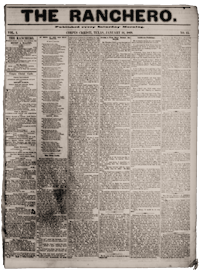
The Ranchero [Corpus Christi, TX], April 21, 1860

We take the following items from the last Courier received:  It is rumored that a cargo of African negroes have been landed on the coast of Western Texas, somewhere between this place and Corpus Christi, and that some of them are now in Victoria county. We give the rumor for what it is worth.

0 comments

0

News of the Day

Navarro Express [Corsicana, TX], April 21, 1860

We had a call from Capt. I. T. Davis, of Upshur, who is a member of the above named mysterious order, yesterday morning. The Captain informed us that he has a company numbering some fifty three men just ahead of him, several along and fifteen on his trail; also, that there are about fifteen companies, numbering in all some several hundred men, who are endeavoring to get together, and that their intention is to march immediately into Mexico. Captain Davis has authority to initiate all who feel desirous of joining the order. His men were raised in Upshur and Hopkins counties.

Messrs. B. H. Ragsdale and T. C. Ripley, members of the “Press-Gang” also paid us a visit. We suppose their intention is to hang the banner on the outer wall,

“Charge, Chester, charge!
On, Stanly, on!”

 Centerville Times.

0 comments

0

News of the Day

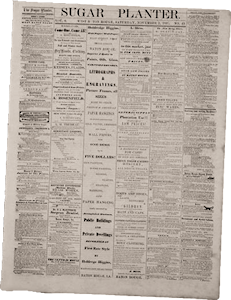
Sugar Planter [West Baton Rouge, LA], April 21, 1860

From the New Orleans Mirror.

An article in a late number of DeBow’s Review, from the pen of Judge Hopkins of Mobile, directs attention to the injury which is likely to be inflicted on the South by the system of instructing negroes in the mechanic arts, and employing them as mechanics. He says: ‘If it be desirable to preserve the patriarchal system of negro slavery now subsisting at the South, as the very best bases of social order, of moral and domestic integrity, as well as an agricultural necessity, which none may doubt who has evoked wisdom and virtue in pursuing the question, slaveholders should allay this antagonism in their midst, by agreeing, through legislative action to confine the negro to the soil, thus to elevate and open up the mechanic trades to the non- slaveholding people around them. Dignify the trades to the level of the professions, in common acceptation, and idling, loafing, lounging, fox-hunting, or, in other words, general dissipation of health, energy, and time, among the young men of the South would almost entirely cease, and in their place be substituted general and busy industry. By confining the negro to the soil, the mechanic would be at once converted from an open or secret enemy of negro slavery, into its finest advocate and supporter, because he would then feel himself lifted up in the scale of social respectability, and maintained in that position by the subordinated negro confined exclusively to menial services. Before the law and the community, all white citizens would stand strictly on a footing of equality, and be lone distinguished by courtesy and merit.’

At present it is so common to instruct negroes in the mechanic arts, that in almost every list of plantation slaves advertised for sale some are put down as carpenters, blacksmiths, bricklayers, and not unfrequently, engineers. Considering then the social inequality recognized by law in the South as existing between the negro and white races—an inequality tacitly admitted even in the North—it is by no means remarkable that we have not many free Southern born mechanics. The white mechanics has to submit here to the competition of negro mechanics, and, not only so, but to the degradation consequent on so unnatural and improper a competition. He must work as cheaply as the slave; must submit to an unpleasant companionship which is not expected of him in the North, and must often consent to consider the negro in the light of an overseer. These are facts which cannot be denied, and no young southerner of spirit will consent to learn a trade or calling the pursuit of which tends to degrade him in his own eyes and that of his associates.

If we wish to foster Southern manufactories in which the white men of the South are to seek employment, we must encourage white mechanics by removing the rivalry which now confronts them in our servile population. In the workshops of Northern cities the free negro is not permitted to enter as a mechanic. He can not work at the same bench with the white workman, and his right to a seat in the same railroad car is even sometimes questioned. But here in the south the difference in status between white and colored folks is by no means so distinctly marked. Our planters teach their slaves trades, which, by the inevitable law of social relationships, tends to degrade skilled labor, and in our railroad cars the lady and her servant are seated side by side. In the North the free negro is forced by the pressure of public opinion into the lowest of human employments—such employments as white men are disenclined  to engage in—but here the slave is placed in the workshop, or engaged in the erection of new buildings, and the white mechanic who seeks employment of a like character must submit to the degrading companionship. It is therefore evident that the true policy of the South would be to confine negro labor to the cultivation of the soil, leaving the mechanic arts open to that large portion of our population who have not the means to become planters, and see no very flattering prospects of success in the overcrowded “learned professions.” This is a matter worthy of being gravely pondered and promptly dealt with, for the permanent interests of the South are more deeply involved in it than the casual observer would be inclined to imagine.

0 comments

0

News of the Day

The Ranchero [Corpus Christi, TX], April 21, 1860

By the latest intelligence from Brownsville, it is stated that all the Rangers serving on the Rio Grande have been disbandoned  by order of Gov. Houston. This course has been pursued only upon positive assurances from Washington that a Federal force adequate to the task will be maintained hereafter on the Mexican frontier. Such being the case, Governor Houston has acted wisely; but the “powers that be” have had a very plain intimation, that if they prove direlect  to their promise, Old Sam will put the train through on his own responsibility. A large force is already on the river, and more are on their way from various quarters.

0 comments

0

Miscellaneous document sources

Washington, D. C, 20th Apl, 1860.

Dear Stephens, . . . The city is pretty well vacated. All the scheming active politicians have “hied away” to Charleston to select an almoner for the Great Democratic party. The uncertainty of the result is even greater now than at any former period of the contest. Hunter cannot be nominated; nobody will go for him at the North simply because he is an honest man and they want no such a person to guard the exchequer; they pretend that he cannot run at the North on account of his free-trade opinions, which simply amounts to saying that the northern democrats will not support any man who holds the principles of the party. Breckinridge it is said can get Penn. but N. York will not touch him, his character is too good for them. Guthrie I think will show more Northern strength than any of our Southern men. Douglas will be beaten, I think, with absolute certainty. He will get as good as no support in the North but of the Northwest, and his enemies are numerous, vindictive and remorseless. His aggressive policy makes all opponents enemies both North and South, and nothing but a large break in the South in his behalf can possibly elect him. This I do not look for, altho’ I am quite sure he is stronger in the South than he will be with her representatives at Charleston ; but I suppose speculations will be of no use now as the end is near. Julia and Sallie and the Capt. are all in good health and send their best regards.


From Annual Report of the American Historical Association for the Year 1911.

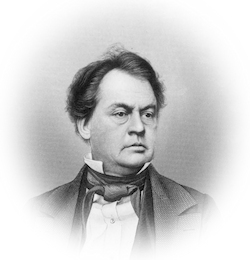
Robert Augustus Toombs was an American lawyer, planter, and politician from Georgia who became one of the organizers of the Confederacy and served as its first Secretary of State. He served in the Georgia House of Representatives, the US house of Representatives, and the US Senate.  In the Confederacy, he served in Jefferson Davis’ cabinet as well as in the Confederate States Army, but later became one of Davis’ critics.

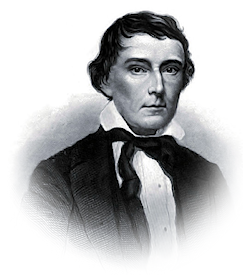
Alexander Hamilton Stephens was an American politician who served as the vice president of the Confederate States from 1861 to 1865. After serving in both houses of the Georgia General Assembly, he won election to Congress, taking his seat in 1843. After the Civil War, he returned to Congress in 1873, serving to 1882 when he was elected as the 50th Governor of Georgia, serving there from late 1882 until his death in 1883.


0 comments

0

News of the Day
1860s newsprint

Daily Gazette & Comet [Baton Rouge, LA], April 19, 1860

The Goliad (Texas) Messenger says, a company of twenty-seven armed men passed through that place en route for Mexico the other day. The expedition is a secret one, and the Messenger has done wrong to herald it to the world. Should the news of their coming go before them and the matter be whispered in the halls of the Montezumas—past any reasonable doubt, the walls of the same will crack. The K. G. C’s are supposed to have a finger in this affair.

0 comments

0

News of the Day
1860s newsprint

[Little Rock] Old-Line Democrat, April 19, 1860

On last Saturday, the 31st day of March a terrible storm of wind and hail passed over the southern part of this county doing great damage to houses, fences, &c. A friend in Green Brier township has sent on the following account of it.

 Green Brier Township,}
April 1st, 1860,}

 Mr. Editor:

On yesterday evening the 31st ult., we were visited with a most fearful Tornado, with the heaviest hail storm that perhaps was ever witnessed in this country. The hail stones were from the size of a pea to the size of a goose egg. The heaviest of the storm passed south of here some two miles, crossing the stage road leading from Batesville to Little Rock. It presented a terrific appearance and prostrated almost every thing in its course—houses, fences and timber. No lives lost as heard of yet. One old gentleman and daughter slightly hurt in this neighborhood. I visited the scene of destruction after the storm subsided. It was truly distressing to witness the loss of houses, fences and household stuffs. I visited three houses that lay in ruins, and heard of some others in the same condition. I have not as yet heard to what extent its destructive effects have been realized. Its course was from Southwest to Northeast.

Yours Respectfully,

H. Kenemur.

April 1st, 1860—Batesville Bul.

0 comments

0

News of the Day
1860s newsprint

Columbus [GA] Enquirer, April 17, 1860

The Salt Lake Valley Tan, of February 29th, contains a statement from Wm. H. Rogers, in regard to the massacre at Mountain Meadows in September, 1857, when 120 men, women and children, emigrants from Arkansas, were murdered by Mormons. In company with Dr. Forney, Superintendent of Indian Affairs for Utah Territory, Mr. Rogers, about a year since, traversed the district of country where the massacre occurred. The scene of the tragedy is thus described:

“When we arrived here in April, 1859, more than a year and a half after the massacre occurred, the ground for a distance more than a hundred yards around a central point, was covered with the skeletons and bones of human beings, interspersed in places with rolls or bunches of tangled or matted hair, which, from its length, evidently belonged to females. In places the bones of small children were lying side by side with those of grown persons, as if parent and child had met death at the same instant and with the same stroke. Small bonnets and dresses, and scraps of female apparel were also to be seen in places on the ground there, like the bones of those who wore them, bleached from long exposure, but their shape was, in many instances, entire. In a gulch or hole in the ravine by the side of the road, a large number of leg and arm bones, and also of skulls, could be seen sticking above the surface, as if they had been buried there, but the action of the water and digging of the wolves had again exposed them to sight. The entire scene was one too horrible and sickening for language adequately to describe.”

On the authority of information communicated in his presence to Judge Cradlebaugh, by a participant in the massacre, Mr. Rogers describes the attack on the emigrants, the protracted siege which they endured, and finally the treacherous artifice by which they were induce to surrender—when all were brutally murdered. He says:

As soon as it became known that Judge C. intended holding a court, and investigating the circumstances of the massacre, and that he would have troops to ensure protection, and enforce his writs if necessary, several persons visited him at his rooms at late hours of the night, and informed him of different facts connected with the massacre. All these that called thus, stated that it would be at the risk of their lives if it became known that they had communicated anything to him; and they requested Judge Cradlebaugh, if he met them in public in the day time, not to recognize them as persons that he had before seen.

One of the men who called thus on Judge Cradlebaugh, confessed that he participated in the measure, and gave the following account of it—Previous to the massacre there was a council held at Cedar City, which President Haight, and Bishops Higby and Leed attended. At this council they designed or appointed a large number of men residing in Cedar City, and in other settlements around, to perform the work of dispatching these emigrants. The men appointed for this purpose were instructed to resort, well armed, at a given time, to a spring or small stream, lying a short distance to the left of the road leading into the Meadows, and not very far from Hamblin’s ranch, but concealed from it by intervening hills. This was the place of rendezvous; and here the men, when they arrived, painted and otherwise disguised themselves so as to resemble Indians. From thence they proceeded, early on Monday morning, by a path or trail which leads from his spring directly into the Meadows, and enters the road some distance beyond Hamblin’s ranch. By taking this route they could not be seen by any one at the ranch.

On arriving at the corral of the emigrants, a number of the men were standing on the outside by the camp fires, which, from appearances, they had just been building. These were first fired upon, and at the first discharge several of them fell dead or wounded; the remainder immediately ran to the inside of the corral, and began fortifying themselves, and preparing for defence as well as they could, by shoving their wagons closer together, and digging holes into which to lower them, so as to keep the shots from going under and striking them. The attack continued in a desultory and irregular manner for four or five days. The corral was closely watched, and if any of the emigrants showed themselves they were instantly fired at from without. If they attempted to go to the spring, which was only a few yards distance, they were sure to fall by the rifles of their assailants. In consequence of the almost certain death that resulted from any attempt to procure water, the emigrants, before the siege discontinued, suffered intensely from thirst. The assailants, believing at length that the emigrants could not be subdued, by the means adopted, resorted to treachery and strategem to accomplish what they had been unable to do by force. They returned to the spring where they had painted and disguised themselves pervious to commencing the attack, and there removed those disguises, and again assumed their ordinary dress.

After this, Bishop Lee, with a party of men, returned to the camp of the emigrants, bearing a white flag as a signal of truce. From the position of the corral, the emigrants were able to see them some time before they reached it. As soon as they discerned it, they dressed a little girl in white, and placed her at the entrance of the corral, to indicate their friendly feelings to the persons bearing the flag. Lee and his party, on arriving, were invited into the corral, where they staid about an hour, talking with them about the attack that had been made upon them. Lee told the emigrants that the Indians had gone off over the hills, and that if they would lay down their arms and give up their property, he and his party would conduct them back to Cedar City; but if they went out with their arms, the Indians would look upon it as an unfriendly act, and would again attack them. The emigrants, trusting to Lee’s honor and to the sincerity of his statements, consented to the terms which he proposed, and left their property and all their arms at the corral, and, under the escort of Lee and his party, started towards the North in the direction of Cedar City. After they had proceeded about a mile on their way, on a signal given by Bishop Higby, who was one of the party that went to the corral with Lee, the slaughter began.

The men were mostly killed or shot down at the first fire, and the women and children, who immediately fled in different directions, were quickly pursued and dispatched.

Such was the substance, if not the exact words, of a statement made by a man to Judge Cradlebaugh, in my presence, who at the same time confessed that he participated in the horrible events which he related. He also gave Judge C. the names of 25 or 30 other men living in the region, who assisted in the massacre. He offered also to make the same statement in court and under oath, if protection was guaranteed to him. He gave as a reason for divulging these facts, that they had tormented his mind and conscience since they occurred, and he expressed a willingness to stand a trial for his crime.

0 comments

0

Miscellaneous document sources
9. Colonel Lee to the Adjutant General.
Headquarters Department of Texas,
Fort Brown, April 17, 1860.
          Colonel: I have the honor to enclose a copy of a letter, (marked E.,) I addressed on the 12th instant to General J. Garcia, commander-in-chief of the line of the Bravo, with his reply, (marked F.) You will perceive that he gives full assurances of the intention of the authorities of Mexico to prosecute Cortinas and his band, and announces that he now holds in prison at Matamoras some of his accomplices.
I also enclose the reply of the authorities of Reynosa to my letter to them of the 9th instant, (marked I.) I had no reason to doubt the sincerity of the profession of the Mexican authorities, and believe they are disposed to maintain peace with the United States; but their ability to control the unruly among their people is not, in my opinion, adequate to the purpose. I shall, therefore, not hesitate to disperse and punish all marauders on our territory. I hear of no aggressions on the frontier, nor can I learn of any preparations to disturb the existing quiet. The last reliable account of Cortinas was that he was retiring further into the interior of Mexico. He had with him his family and two men, and was more than one hundred miles from the frontier. General Garcia informed Major Heintzelman, on the 13th instant, that orders had been given by the Mexican authorities to arrest him wherever found.
The disposition of the United States troops on the river, is the same as at my last report. The recruits for the three companies of artillery at this post have arrived, and nearly completed their complement of men.
I am, very respectfully, your obedient servant,
R. E. Lee,
Brevet Colonel, Commanding Department of Texas.
          Colonel S. Cooper,
Adjutant General U. S. Army, Washington City, D. C. [continue reading…]
0 comments

0

News of the Day
1860s newsprint

Semi-Weekly Mississippian [Jackson, MS], April 17, 1860

There is much truth contained in the following communication which we take from the Nashville Gazette. However humiliating the acknowledgment may be, the people of the South are generally sending North for Superintendants , not only in cotton Manufacturing establishments, but in almost every other branch of Mechanics. This fault should be remedied, and the communication is well-timed and sensible. The correspondent says:

In the March number of Hunt’s Merchant’s Magazine there is an article which declares the startling fact, that of the four million bales of cotton raised last year, only one hundred thousand was manufactured into cloth in the South. Of this amount, North Carolina manufactured 29,000; South Carolina 20,000; Georgia 26,000; Tennessee, 13,000; and Alabama, 10,000 bales. There has, however, been a gradual increase of the amount. In 1855 there was only 59,000 bales made into cloth, which amount has gradually increased, and in 1859, 100,000 were manufactured, which shows an increase of nearly double the amount in four years. The reports from most of the factories shows a healthful and prosperous condition, and gradual increase in the number of bales manufactured, proves conclusively that the business is paying.

This writer says that “the great bug bear in the South, is the cry that labor is too high, an assertion which is not true, as can be proven by the history of the factories which have been successively managed in Georgia. This kind of labor required in cotton factories, occupies persons to whom it is almost a charity to give employment, and the compensation is established by the employer. Women and children do most of the work, and a cotton factory well managed, operates as a blessing to the town, by giving the poor and helpless people employment.

It is true that all the factories do not pay good dividends in the South, neither do they all pay in the North; if badly managed, they do not pay North or South; and the fact that some do pay, is conclusive evidence that all might be made to pay. The objection is often urged in Nashville, that we must have northern men to manage our manufacturing establishments; that we have not the men here to conduct such establishments. Is this not a humiliating confession? Is Tennessee ready to make such a confession? Are we dependent upon the north for every thing? If we have no brains in the South, it would be well to import a cargo. Or to save our people the trouble of using the little they have, hire some men to do our thinking for us. Shame on such contemptible old fogies. No man can teach our children but a northern man and not satisfied with that, those of riper years are to be taught to manage their own business by men of the same sort—they must manage our factories. If such is the general feeling and sentiment of the south, then they ought to be made “the hewers of wood and the drawers of water,” for the north. If the northern people are superior, they deserve to enjoy all that superiority. But it is not so. Hear what a Georgian says on this subject:

“When the Macon Factory was first established, it was under the control of a man brought from New England at a high salary, but he soon convinced his employer that he did not understand our people, and would not answer for the place. Mr. William S. Holt, a Georgian born and raised, was then appointed as his successor, a position he still occupies with much credit to himself, and satisfaction to the Company; and this is not the only case in Georgia. Mr. Banington King manages a factory at Raswell  with marked success. The Augusta mills are, also, prosperous.”

Then, according to this testimony, we may manufacture profitably in the south, and we are not dependent upon the North for a manager. The point is then settled as to our ability. We have the capital, we have the material, the hands begging for employment, and a market at our own doors. Shall we have manufactories in Nashville? There are many young men who would like to remain in Tennessee; who are too proud to work; the country is over-stocked with merchants as well as all the learned professions. What are they to do? Do the parents of such wish to see their sons a set of gentlemen leafers  and drunkards? If not, let them have some useful employment. “Idleness is the great fomenter of evil.” Here is a field of usefulness, in which they may be made a blessing to the community in which they live. Let some of the capital be employed in manufactories, and our beautiful city will grow to be a giant in size, and make glad the hearthstones of many a poor family.

W. R. H.

0 comments

0

News of the Day
1860s newsprint

Standard [Clarksville, TX], April 14, 1860

The successive numbers of the Frontier Journal, the White Man, are filled with accounts of outrages by Indians, and the efforts of the worried and impoverished frontiersmen to repel aggression, and punish the aggressors.

Lately Governor Houston has authorized Col. M. T. Johnson, an old and efficient Ranger, to raise 500 men, and act against the Indians, at his discretion. Companies are raising in several Counties. The one in Fannin was complete and ready to organize on Saturday last. We have hoped that this expedition would do much good. We are authentically informed that it is Col. Johnson’s intention to follow the aggressors to their Camps; and if the trails concentrate in the Reserves, to attack and exterminate them. We hope and believe, that if Gov. Houston does not restrain him, he will do much good. The editor of the White Man, however, has no confidence in all this preparation, and says, in his issue of the 5th inst.:–

“The Frontiersman will have to depend solely upon themselves and their friends in the interior for any permanent good effects. Let every one go to work, and work earnestly, for the organization of a force at this place, on the 20th May next, to exterminate the Reserve Indians.

“We have ample assurances of assistance from fifteen counties.—Men will come from any portion of the State, and if Governor Houston will authorize his forces to go with us our troubles will be ended.”

In another column, in an address to his readers, preparatory to leaving home on the expedition referred to above, he says:–

“In conclusion, we cannot refrain giving our opinion (humble tho’ it be) in reference to the grand display attempted by Gov. Houston for protection.

“It is a subterfuge to defeat any popular movement against the Reserve Indians, and virtually aiding the real depredators, by exterminating their enemies, the wild tribes.

“And the whole expedition to ‘repel, pursue, and punish,’ will end in a farsical calico treaty upon the ‘base line.'”

0 comments

0

News of the Day
1860s newsprint

Standard [Clarksville, TX], April 14, 1860

The weather is dry and sunshiny. Rain much needed—a great deal of corn planted, cannot come up without it. Everything will be late this year.

The River is nearly run out. We shall live in hope of more water. We want that railroad iron to get into Sulphur, and we want to see some Bacon and Flour brought up the stream, or both will be scarce here.

0 comments

0

Miscellaneous document sources
8. Governor Houston to Mr. Floyd.
Executive Department,
Austin, April 14, 1860.
          Sir: Actuated by a sense of duty, as well as impelled by the helpless condition of our frontier people, I again address your department. Did the condition of things afford any hope that the shocking barbarities, which I have already reported to you, would cease at an early period, I would be loth to press upon the federal government a subject of even this importance, deeming that my former communications were sufficient to convince all of the importance, as well as the necessity, of immediate action.
          The misfortunes to which we have been subject, since annexation, have, I think, demonstrated the fact that it is entirely useless to think of rendering protection to Texas by the regular army. In the first place, it is a description of service which they heartily detest. In the next place, the Indians move in their forays with wonderful celerity, and it is ridiculous to suppose that infantry can afford any protection against such a foe, because they cannot go in pursuit, and if they did, it would be useless, and a subject of amusement and ridicule to the Indians. No one doubts the value of our regulars, or the skill of our officers. Both are a subject of pride to the country; but unless the Indians are fools enough to go up to a garrison and be shot down, garrisons will be of no use, only to shelter the inmates. If cavalry are sent to the frontier, they are generally mounted on fine American horses, accustomed to being fed on grain, which cannot be procured even at an enormous price; and if they could be grain-fed, they must be shod, or they are unable to give pursuit after Indians for more than a day, without becoming “tender-footed,” which is exceedingly detrimental to success.
          Were a regiment of Texas volunteers called out, and the ten companies stationed at ten different points on the line of our frontier, and patrols made to pass between the different stations, no Indians could pass into the settlements without their trails being discovered, and pursuit given before they would have an opportunity to massacre and depredate upon our people.
          The only question, then, arising is, as to what description of troops will be most efficient for purposes of protection against the Indians. It is evident to my mind that Texas rangers stand pre-eminent on the score of economy and usefulness. I have, I think, named reasons why the troops of the regular army are not effective in Indian warfare. I now propose to render reasons why the Texas rangers are superior, and the only class of troops fitted for such service. [continue reading…]
0 comments

0

News of the Day

[Little Rock] Arkansas True Democrat, April 14, 1860

A friend has sent us a copy of the Valley Tan, published at Salt Lake city, on the 29th ult. It contains a statement by W. H. Rogers concerning the massacre, which, though long, we will transfer to our columns as soon as we can. It fixes the guilt of the Mormons beyond a doubt.— The narrative is plain, unpretending and clear. We defy any man to read it without feeling his blood thrill in his veins.

One hundred and twenty American citizens, men, women and children, were murdered in cold blood. The bones of these murdered emigrants, after having the flesh gnawed from them by wolves, were left to bleach for nearly two years on the ground, when they were collected by Major Carlton and buried in one grave. A stone monument, conical in form, fifty feet high, has been erected over the grave. A cross of red cedar, twelve feet in height surmounts this. On the transum of the cross are these words:

“Vengeance is mine, I will repay, saith the Lord.”

On a granite slap, at the base is the following inscription:

“Here 120 men, women and children were massacred in cold blood, early in September, 1857.

They were from Arkansas.”

The children survivors are now in this State. Will not some of our contemporaries in the north-west get their full names and account of their present situation?—Congress will be urged to take action in their behalf. Our legislature will probably do something. The State can well afford to give them land enough to provide for their future well doing. They should be educated and the suggestion made by one of the Arkansas papers to that effect, only needs presentation to our people to secure them a handsome sum.

0 comments

0

News of the Day

Sugar Planter [West Baton Rouge, LA], April 14, 1860

A Vigilance Committee has been formed in the parish of Ascension for the seeking out and punishing of any person or persons found trafficking illegally with slaves. In the present state of affairs there should be a similar Committee formed in every parish, not alone for the purpose above mentioned, but also for ascertaining the character and business of all strangers who may be found wandering through the different parishes apparently engaged in nothing legitimate. The honest trader will not object to answering questions as to his business.

0 comments

0

Miscellaneous document sources

Crawfordville [Ga.], April 14th, 1860.

Dear Smith, I got home last night from Hancock court and found your letter of the date I forget but the one about your correspondence with the Confederacy. I would advise you to write as requested. I do not know what the prospect for your pay will be; but he is a clever man personally. I would simply give him the news. He is not a disunionist per se as I understand him. He is not in favour of opening the African slave trade either, as I understand him. He does no good however to any cause, in my opinion. He is too violent. This I say to you. His judgment is not good. I would advise you, if you write, neither to advocate disunion or the opening of the slave trade. The people here at present I believe are as much opposed to it as they are at the North ; and I believe the Northern people could be induced to open it sooner than the Southern people. It would be useless to write on that subject at this time. I have nothing more to say ; no time rather to say more.[i]


[i] Endorsed in pencil on a blank page at the end of this letter is the following by J. Henly Smith :

“James P. Hamilton, Editor of the Southern Confederacy, published at Atlanta, Ga.,has requested me to correspond for him. As Mr. Stephens advises it, I will comply. — J. H. S.”


From Annual Report of the American Historical Association for the Year 1911.

Alexander H. Stephens would later become Vice President of the Confederated States of America.

0 comments

Diary of a Tar Heel Confederate Soldier By Louis Léon

Diary of a Tar Heel Confederate Soldier By Louis Léon [53d North Carolina Regiment, infantry]

April–I suppose the end is near, for there is no more hope for the South to gain her independence. On the 10th of this month we were told by an officer that all those who wished to get out of prison by taking the oath of allegiance to the United States could do so in a very few days. There was quite a consultation among the prisoners. On the morning of the 12th we heard that Lee had surrendered on the 9th, and about 400, myself with them, took the cursed oath and were given transportation to wherever we wanted to go. I took mine to New York City to my parents, whom I have not seen since 1858. Our cause is lost; our comrades who have given their lives for the independence of the South have died in vain; that is, the cause for which they gave their lives is lost, but they positively did not give their lives in vain. They gave it for a most righteous cause, even if the Cause was lost. Those that remain to see the end for which they fought–what have we left? Our sufferings and privations would be nothing had the end been otherwise, for we have suffered hunger, been without sufficient clothing, barefooted, lousy, and have suffered more than any one can believe, except soldiers of the Southern Confederacy. And the end of all is a desolated home to go to. When I commenced this diary of my life as a Confederate soldier I was full of hope for the speedy termination of the war, and our independence. I was not quite nineteen years old. I am now twenty-three. The four years that I have given to my country I do not regret, nor am I sorry for one day that I have given–my only regret is that we have lost that for which we fought. Nor do I for one moment think that we lost it by any other way than by being outnumbered at least five if not ten to one. The world was open to the enemy, but shut out to us. I shall now close this diary in sorrow, but to the last I will say that, although but a private, I still say our Cause was just, nor do I regret one thing that I have done to cripple the North.

0 comments

Through Some Eventful Years

Through Some Eventful Years by Susan Bradford Eppes
Susa Bradford Eppes

April 12th, 1860.—We are going to have a May Party at Greenwood. Florence Holland will be our Queen. She is the prettiest of all our girls. I am Maid of Honor and we have ever so many different ones in it. It will be pleasant no doubt, but I have been so happy all the winter and spring, having Grandpa and Grandma in Florida, that I really begrudge the time given to anything else. They do not stay at Live Oak any more. Grandpa gave Live Oak to Uncle William (his youngest son) and he lives at Waverly. The house is not the splendid mansion that he left but it is pretty and comfortable and it sits in the midst of the most magnificent grove of oaks in Leon County.

Henry and Dan (my step uncles) and Johnnie Branch came with Grandpa and we have the best times. We each have a horse and Grandpa lets us ride whenever we like. He is not nervous and isn’t always looking out for us to get hurt, which is very gratifying, for we think we are big enough and old enough to take care of ourselves.


Susan Bradford is 14 years old when this entry was made.

0 comments

0

News of the Day
1860s newsprint

Daily Gazette & Comet [Baton Rouge , LA], April 11, 1860

Deeply do we deplore the duty off recording a sad and melancholy occurrence that took place in this parish on last night (Friday) at the residence of Mr. William Barfield about 16 miles south of Mansfield. The circumstances are these Mr. Williams and several other gentlemen went to the house of Mr. Barfield for the purpose of arresting him under at  indictment for shooting with intent to kill, having no idea that he would resist the execution of the writ although he had previously said that he would not be taken.—They reached his house in the evening and awaited until dark before proceeding to the arrest. Mr. Barfield hearing some noise in the woods near the house started in that direction with two shot guns, and met Mr. Williams and Sam Quarles in the road about one hundred yards from the house when he fired upon them, the load taking effect in Mr. Williams abdomen and thighs. Eleven buck-shot taking effect, but only seven entered the flesh any distance. When the shooting commenced the parties were some twenty steps from each other. It is strange that Sam Quarles was not shot as he was standing by the side of Mr. Williams when the first gun was fired. Mr. Barfield was fired at eight times during the evening and was not wounded.—Mr. B was arrested brought to town this morning and lodged in jail and will be examined on Monday next before Esquire’s Munday, and Tibbets.

P.S. Since writing the above we have seen Mr. Williams and talked with Dr. R. Gibbs, his physician and learn that Mr. W. stands a very good chance to recover.—Eagle Mansfield.

0 comments

Troubles on the Western Frontier

Miscellaneous document sources
7. Colonel Lee to the Adjutant General.
Headquarters Fort Brown, Texas,
April 11, 1860.
          Colonel: I have the honor to report that I arrived here to-day, having descended the left bank of the Rio Grande from Eagle Pass. I found the frontier on the river quiet, and did not hear of the existence of any bands of armed men on either side. The commerce and intercourse between Mexico and Texas continued, though the feelings of the Mexican and American population seemed much embittered against each other. Most of the ranchos on the river in Texas, between Rio Grande city and this place, have been abandoned or destroyed. Those spared by Cortinas have been burned by the Texans. The occupants have generally taken refuge in Mexico, and no preparation for a crop this spring has yet been made.
On arriving opposite the town of Reynosa, I was informed by Major John Ford, of the Texan rangers, that some of Cortinas’s men were in that place. I demanded their expulsion by the authorities of the city. Copies of the correspondence (marked A) are hereto annexed. They denied the presence of these men, and stated that they had received orders from their own government to arrest and punish any if found. This they pledged themselves to do. . A copy of my orders to Captain Brackett, commanding a squadron of the second cavalry, on the subject, is also appended, (marked B,) agreeably to the tenor of the letters from your office dated the 2d and 3d of March. On my arrival at Ringgold barracks I addressed a communication to the governor of Tamaulipas, a copy of which (marked C) is annexed. To this I have not yet received an answer.
I also forward copies of a letter this day received from the Hon. George McKnight, commissioner of the State of Texas, and my reply (marked D.) from which you will perceive that the two companies of Texas rangers, under the command of Major Ford and Captain Littleton, will be withdrawn from this frontier.
I have, besides these, three companies of artillery, including Major Hunt’s battery, at this post; two companies of eighth infantry at Ringgold barracks, and four companies second cavalry in the field between those points.
I am, very respectfully, your obedient servant,
R. E. Lee,
Brevet Colonel, Comdg Department of Texas.
          Colonel S. Cooper,
Adjt. General U. S. Army, Washington, D. C.
____________________
7 a.
Headquarters Ringgold Barracks,
April 2, 1868.
          Sir: In consequence of the recent outrages of Cortinas and his followers upon the persons and property of American citizens, I have been instructed by the Secretary of War, of the United States, to notify the authorities of Mexico on the Rio Grande frontier that they must break up and disperse the bands of banditti which have been concerned in these depredations and have sought protection within Mexican territory; and further, that they will be held responsible for thefaithful performance of this plain duty on their part.
I have, therefore, the honor to request that your excellency will cause to be dispersed any bands within the States under your jurisdiction having for their object depredations upon American soil.
I am, with high respect, your obedient servant,
R. E. Lee,
Brevet Colonel, Comdg Department of Texas.
          His excellency Andres Trevino,
Governor of State of Tamaulipas, &c., Victoria, Mexico.
____________________
7 b.
Headquarters Camp at Edinburg, Texas,
April 7, 1860.
          Gentlemen: In pursuance of instructions received from the honor able Secretary of War, of the government of the United States, I hereby notify you that you must break up and disperse the bands of banditti within your jurisdiction engaged in committing depredations upon the persons and property of American citizens, and that I shall hold you responsible for the faithful performance of this plain duty on your part.
I have been informed that there are now within your jurisdiction armed followers of Cortinas, who were engaged in the recent outrages committed by him on this side of the Rio Grande, prepared to make similar aggressions.
This state of things cannot longer exist, and must be put an end to.
I am, with high respect, your obedient servant,
R. E. Lee,
Brevet Colonel, Commanding Department of Texas.
          To the Civil and Military Authorities of the city of Reynosa, Mexico.
____________________
7 c.

[Translation.]

          In an extraordinary session held this day the corporation of this city has made itself acquainted with the contents of your esteemed letter of the 7th of April, addressed to the civil and military authorities of the place, and has decided to reply to you, through me, that if it be, indeed, quite certain that there are, unfortunately, within this jurisdiction any bandits of the Cortinas faction, which has inflicted so much injury on the nation to which you belong—though to the sincere regret of all good Mexicans, who desire to have only the most pleasant relations with a friendly people—such criminals are yet mere skulking vagabonds, who sedulously keep out of the way of the authorities in pursuit of them; for you must know that the authorities of this city have orders from those above them to break up, pursue, arrest, and punish any and every band of men whom the factious Cortinas might attempt to collect on this side of the river, and on no account will any such be permitted to range undisturbed within this jurisdiction, but will, on the contrary, be consigned to a close prison, and turned over to the chief officer of the district, to be dealt with according to their deserts; and to this end, an armed force has for some time past been scouring the district, with the exclusive object of hunting down all such malefactors.
The corporation has also requested me, sir, to call your attention to the fact that certain persons, whether Mexicans or strangers is not known, have not scrupled to assure the authorities of the United States that the followers of Cortinas, or persons at least who are well affected to his cause, have been allowed to reside unmolested in this city, and that with such reports they have succeeded in creating injurious prejudices, and cause this neighborhood to live in the continued fear of an invasion of United States volunteers; whereas, in truth, the whole story is a fabrication, and the inhabitants of this city, and the country around it, have at heart no more sincere desire than to be allowed to live in peace, tranquillity, and harmony with their neighbors across the river. In proof of which, I point to the fact that not one of the many Americans who have come here has ever sustained the slightest injury of any kind, but, on the contrary, whenever with their families they have come over here to invoke the protection of our town authorities, they have invariably received it.
As to the events which have recently transpired between this community and the force under command of Major John S. Ford, with reference to his entry into this town, I am instructed by the corporation to make known to you that it had received information, on the afternoon of the 3d instant, that a force of volunteers designed making a visit to the town, with what object was unknown, and that our citizens accordingly made preparations for defence; and that on the 4th of the month, somewhere about 11 o’clock, the said force made its appearance, to the number of seventy-odd men, under command of the above-named Major Ford, who, directing himself towards the chief magistrate of the town, informed him that his object was to follow up the partisans of Cortinas who were in the town and its neighborhood; to which reply was made, that no such men would he be able to find in that population, unless, indeed, it should happen that they were lurking there concealed, and that this sudden invasion was a matter for grave surprise, and one which he had no right to make, and that for this reason it was he saw the neighborhood in arms, ready to defend themselves should he fail to respect their municipal authorities; that his force should, therefore, return to the other side of the river by the public ferry, which was immediately done, without the commission of any outrage whatever. That Major Ford subsequently addressed a communication to the corporation of the town, calling upon it to seek out, arrest and deliver over to him the Cortinas men named by him in said official note; to which reply was made, that his reclamation would be submitted to the presiding officer of the district, whose decision would be duly communicated to him, as in due time it was. That during the intervening time the volunteers, encamped just opposite to the town, have repeatedly fired upon the garita, (custom-house outpost,) wounding, yesterday, one of the soldiers on guard there, and have also fired on the men and women who have gone down to the river for water for domestic purposes, and, besides, have slightly wounded a youth who was working at his field, in the immediate vicinity of the town.
The above is a statement of all that has occurred, which I lay before you with regret, as I would gladly be excused from the necessity of occupying myself with matters of such a nature, and which are so well calculated to disturb the harmonious relations between two friendly nations.
Be pleased, sir, to receive, both from myself and the other members of the corporation, the assurances of our particular consideration.
Francisco Zepeda, Pres’t.
          Vicente Muquerza, Sec’y.

God and liberty.
Reynosa, Mexico, April 8, 1860.

Col. R. E. Lee,
Colonel Commanding the Department of Texas, Edinburg.

____________________
7 d.
Headquarters Camp at Edinburg, Texas,
April 9, 1860.
          Sir: In reply to your communication of the 8th instant, which you did me the honor to present in person, I have to express my pleasure at learning that you had received orders from the superior authorities of Mexico to pursue, apprehend, and punish all persons on the Mexican side of the Rio Grande engaged in committing depredations on this, and that such persons will not be permitted to remain within your jurisdiction.
This is in exact accordance with the letter I had the honor to address to the civil and military authorities of the city of Reynosa on the 7th instant, and corresponds with the assurances you gave me yesterday. If this is faithfully performed, it may be the means of preserving peace between the two countries.
Relying upon your strict execution of the orders of the superior authorities of Mexico, and the assurance you give me that the followers of Cortinas, and all persons engaged in committing aggressions upon the persons and property of American citizens, shall not be permitted within your jurisdiction, I will give orders to the commanders of the United States troops on the Rio Grande to await your action, which I expect will be prompt and efficient.
I have learned this morning, with great regret, from Captain John Ford, commander of the Rio Grande squadron of Texas rangers, that last night two shots were fired from his camp into Mexico, contrary to his orders, and by persons to him unknown. That he is now engaged in discovering the offenders, and will have them punished.
I am, with high respect, your obedient servant,
R. E. Lee,
Brevet Colonel, Commanding Department of Texas.
          Hon. Francisco Zepeda,
President of the Council of the City of Reynosa, Mexico.
____________________
7 e.
Camp Below Edinburg,
April 9, 1860.
          Captain : I have received assurances from the authorities of the city of Reynosa that no persons belonging to the band of Cortinas, or engaged in committing aggressions upon the persons or property of American citizens, shall be permitted to come or remain within their jurisdiction.
I desire you to see that these assurances are fulfilled, and to aid the authorities, if necessary, in carrying them into effect. Should you find that they are not fulfilled, and that any parties of men are collected for the purpose of depredating on this side of the Rio Grande, you will act according to the orders already given you.
Captain Stoneman’s squadron will remain in this vicinity for some days, and if necessary will co-operate with yours. In this event, the senior officer for duty will of course take command.
I have been informed that threats have been uttered by citizens of Reynosa against residents of Edinburg and Tobasso. I desire you to inform the authorities of Reynosa of these menaces, and give them to understand that they will be held responsible for outrages committed by their citizens on American soil. You will also give all the protection in your power to the citizens of the places named, and all others within the line of your operations.
* * * * * * * * * * * * * * * * * * *
          I am, very respectfully, your obedient servant,
R. E. Lee,
Brevet Colonel, Commanding Department.
          Captain A. G. Brackett,
Commanding Squadron 2d Cavalry,
Camp at Edinburg, Texas.
____________________
7 f.
Miller’s Hotel, Brownsville,
April 11, 1860.
          Sir: I have the honor to deliver to you a communication from his excellency the governor of Texas, which, with the accompanying documents, will explain the object which induces me to address your department.
It is the desire of the government that the rangers now on the Rio Grande shall remain under your orders, provided the general government will assume their payment and subsistence. Texas can furnish men almost ad libitum, but the exigencies of our Indian frontier will more than exhaust the limited pecuniary resources within the reach of executive and entail a heavy liability upon the State.
You will please to inform me what disposal you wish to have made of the rangers now in this service.
I have the honor to be your most obedient servant,
Geo. McKnight.
          Colonel R. E. Lee.
____________________
7 g.
Headquarters Fort Brown,
April 11, 1860.
          Sir: I have had the honor to receive your letter of this date, transmitting a communication from his excellency the governor of Texas, and expressing his desire that the rangers now on the Rio Grande shall remain under my orders, provided the general government will assure their payment and subsistence. I have received no authority from the Secretary of War to receive into the service of the United States any portion of volunteers; and though sorry to part with troops that have performed good and efficient service in the disturbances on this frontier, I am yet unable to retain them on the conditions you propose.
Under these circumstances, I am happy to inform you, for the information of his excellency the governor, that upon referring the subject of your letter to Major Heintzelman, who has conducted with much ability the military operations on the Rio Grande, he concurs with me in the belief that in the present condition of affairs the United States troops on the river will be sufficient to preserve order, provided the Mexican authorities are disposed to maintain peaceful relations with the United States, and will perform their duty. The services, then, of the rangers may at this time be more important on the Indian portion than on this.
I am, with great respect, your obedient servant,

Brevet Colonel, Commanding Department of Texas.

          Hon. George McKnight,
Commander of the State of Texas, Brownsville.


Troubles on Texas Frontier, Letter from The Secretary of War (John B. Floyd), Communicating, In compliance with a resolution of the House, information in relation to the troubles on the Texas frontier, May 5, 1860; House Documents, Otherwise Publ. as Executive Documents: 13th Congress, 2d Session-49th Congress, 1st Session, Volume 12

“During the 12 years following the Mexican-American War, there were present on the frontiers of Texas and Mexico many factors that tended to create disturbances. The topography of the country, the sparsity and general character of its population, the lack of an extradition treaty and of sufficient national authority, wild Indians of uncertain abode, the Mexican tariff system, all caused friction and gave encouragement to lawlessness which not only retarded the development of the region but often threatened to interrupt friendly relations between the two republics.” [Border Troubles along the Rio Grande, 1848-1860, The Southwestern Historical Quarterly, Vol. 23, No. 2 (OCTOBER, 1919)]

0 comments

0

News of the Day
1860s newsprint

Southern Field and Fireside [Augusta, GA], April 7, 1860

Mr. S. B. Buckley, who is writing a series of interesting letters to the Country Gentleman [fold in paper] the productiveness of a Texas sugar plantation:

Mr. McNeel is said to be one of the best managing sugar planters in Texas, having from six to seven hundred acres in cane, which is here planted anew once in three years; but to equalize the work, one-third of the ground is replanted each year. Some planters replant their ground only once in four years. The planting begins from the middle to the last of January, with joints of cane. It is said that cane has never matured its seed, either in the United States or Cuba. The planting is here done in drills seven feet apart—but in Louisiana the distance between the rows is often less by one or two feet. There, also, a hogshead of 1,000 pounds of sugar is considered a good yield for an acre, but as much as one and a half hogsheads are occasionally grown. Here two hogsheads of 1,200 pounds each have been made from an acre in one season. Of course this is an extra amount, the average in good seasons being from 1,200 to 1,500 pounds of sugar per acre. Two barrels of molasses to a hogshead of sugar is the general proportion. The cane is worked with the plow until the last of June or the first of July, when its tops meet and shade the ground so as to prevent the growth of weeds the crop is “laid by.” The grinding of cane commences from the 10th to the 20th of November, and lasts until it is time to plow for a new crop. One acre of cane will replant six, which is generally saved at the commencement of cutting in the field for fear of frost, which commonly comes and destroys a large proportion of the crops, as was the cane this season. Dry and cold weather are the great drawbacks upon the profits of sugar making, which otherwise be much more profitable than the cultivation of cotton; besides, to carry on the latter business, a much less investment of capital is required. I have read of the severe labor required on a sugar plantation—how that the negroes were worked to death, and had to be renewed every few years. So far from this being the case, the average length of life among the sugar-planting negroes is greater than that of the whites, and negroes prefer that business to the making of cotton. On Mr. McNeel’s plantation “old Daddy Prince” died a few years ago, aged 101 years, and there is now living there “Jim Grandpa,” a long gray-bearded patriarch upwards of 90 years old, surrounded by great great grandchildren. This old negro has been “laid by,” and not worked for Mr. McNeel during the last thirty years. All of Mr. N.’s negro houses are of brick, plastered and well-furnished. I was in one for four persons, which cost $2,000. Mr. M. is a true philosopher, who has discovered that he can realize the greatest amount of happiness in making all his dependants  cheerful and comfortable. He deserves no credit for this. It is for his interest pecuniarily; and at the same time readers his home pleasant, by surrounding it with smiling appurtenances, all of which tend to increase the sum total of his enjoyment. There is a happiness in doing good—there is a pleasure in making others happy.

S. B. Buckley.
Brazoria Co., Texas, Jan. 1860.

0 comments

0

News of the Day

[Little Rock] Arkansas True Democrat, April 7, 1860

The Montgomery Mail, of the 29th, says:  At 4 o’clock yesterday afternoon, by previous arrangement, there was a burning of the works of the notorious English abolitionist, Spurgeon, at the bookstore of Mr. B. B. Davis, Market street. Mr. Davis prepared a good fire of pine sticks, in the rear of his store, and in the presence of several gentlemen—some of them true Baptists—about sixty volumes of Spurgeon were reduced to smoke and ashes.

0 comments

0

News of the Day

Sugar Planter [West Baton Rouge, LA], April 7, 1860

In the March number of DeBow’s Commercial Review we find the following from the pen of Judge Hopkins, of Mobile. It is worthy of the special notice of every man in the Southern States who has interests in the institutions of slavery worth protecting:

If it be desirable to preserve the patriarchal system of negro slavery now subsisting at the South, as the very best basis of social order and of moral and domestic integrity, as well as an agricultural necessity; which none may doubt, who has evoked wisdom and virtue in pursuing the question. Slaveholders should allay this antagonism in their midst, by agreeing, through Legislative action to confine the Negro to the soil, thus to elevate and open up the mechanics trades to the non-slaveholding people around them. Dignify the trades to the level of the professions, in common acceptation, and idling, loafing, lounging, fox-hunting, or, in other word, general dissipation of health, energy, and time, among the young men of the South, would almost entirely cease, and in their place be substituted general and busy industry. By confining the negro to the soil, the mechanic would be at once converted from an open, or secret enemy of negro slavery, into its firmest advocate and supporter, because he would then feel himself lifted up in the scale of social respectibility , and maintained in that position by the subordinated negro confined exclusively to menial services. Before the law and the community, all white citizens would stand strictly on a footing of equality, and be alone distinguished by courtesy and merit.

The southern planter certainly overlooks his true interests when he leaves his fields of cotton, cane, and tobacco, or rice, and arrays himself with his capital in competition with humble white laborers of his own State. The wealthy planter ought to be content with a splendid income from the fertile soil cultivated by his own slaves. When he, with his wealth and credit, monopolizes all branches of industry, and breaks down by his competition even the humble village laborer, he is gradually undermining some of the strongest and most reliable pillars of Southern institutions. The lordly planter, even with his thousand slaves and broad domains, needs stronger backers than his overseer, his family teacher, and his field hands. And if our villages are to be dwarfed by his competition, and he refuses the hand of friendship to those who are struggling to rise on their individual merit—if he absorbs the small plantations in his neighborhood, and refuses all aid to public schools, churches, and enterprises intended to build up other than the mere planting interest of the country he will find in the end that he himself, by contracted selfish policy, has done more to break down the South and the institution of slavery than any of the mad rantings of Northern Abolitionists whom he has been fighting at a distance. The Southern planter in his mad ambition to grasp at immense wealth, may close his eyes to all these facts so long as the threatened evil is not at his very door, but whether he admits the fact or not, the crisis approaches.—This question has already come up before the Legislature of Tennessee, it is agitated in the South Carolina papers, it occupies a conspicuous position in DeBow’s Review, and we hope to see it before all the State Legislatures of the South at an early date. It is, after all, the question upon which is suspended the well being and independence of the entire South.—Planter’s Banner.

0 comments