0

News of the Day

[Little Rock] Arkansas True Democrat, May 19, 1860

Every now and then the abolitionists brag of their underground railroad operations, and of the number of slaves forwarded to misery in Canada. The escape of such slaves is held up as evidence that the state of servitude is an unhappy one and the institution of slavery a wrong. Tried by their rule their institutions must be much worse. For every slave that leaves his master at least three apprentices run away from their masters at the North. That they are not pursued and caught is simply because white slave labor is so cheap that another can be procured with less trouble. The master has only to apply to the overseers of the poor and he gets a child for ten or twelve years, for board and clothing. If then, leaving service is any evidence, the apprentice system at the North, must be worse than slavery at the South.

Again: more wives of northern men, in proportion to their numbers, run away from their husbands than slaves from southern masters. Therefore, marriage is a worse institution than African slavery.

The cant about buying and selling men and women and taking them from their families can be answered in the same way. Last year, a fellow advertised for governesses or teachers to come to the South, and actually engaged a dozen or more, took them to New York and decamped with their baggage. A man can go to-day in any of the New England States and hire a hundred young women to leave their relatives and come to the South as teachers, or to be employed in some pursuit followed by females. Five hundred dollars will take the flower of the family from the domestic hearth. Indeed, labor there is so plentiful and so little demand for it that an advertisement for a clerk has been answered in one case by seven hundred persons. Governesses, nurses and female attendants will go all over the world for a less sum yearly than a negro wench hires for at home. After all it is the same. If we called our apprentices, or helps, or even servants, and would drop the word slavery, the cry would cease. As far as the actual servitude goes, the negro of the South does less hard work and is better paid for it than the white laborer at the North.

0 comments

0

New York Times

Abram Lincoln, of Illinois, Nominated for President.

The Late Senatorial Contest in Illinois to be Re-Fought on a Wider Field.

Hannibal Hamlin, of Maine, the Candidate for Vice-President.

Disappointment of the Friends of Mr. Seward.

INTENSE EXCITEMENT AND ENTHUSIASM.

Reception of the Nominations in this City.

How They are Hailed Throughout the North.

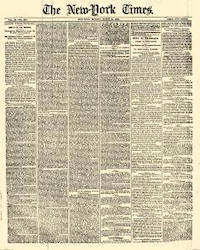
New York Times, May 19, 1860

Special Dispatch to the New-York Times.

CHICAGO, Friday, May 18.

The work of the Convention is ended. The youngster who, with ragged trousers, used barefoot to drive his father’s oxen and spend his days in splitting rails, has risen to high eminence, and ABRAM LINCOLN, of Illinois, is declared its candidate for President by the National Republican Party.

This result was effected by the change of votes in the Pennsylvania, New-Jersey, Vermont, and Massachusetts Delegations.

Mr. SEWARD’s friends assert indignantly, and with a great deal of feeling, that they were grossly deceived and betrayed. The recusants endeavored to mollify New-York by offering her the Vice-Presidency, and agreeing to support any man she might name, but they declined the position, though they remain firm in the ranks, having moved to make LINCOLN’s nomination unanimous. Mr. SEWARD’s friends feel greatly chagrined and disappointed.

Western pride is gratified by this nomination, which plainly indicates the departure of political supremacy from the Atlantic States.

The prominent candidates for Vice-Presidency were Messrs. HICKMAN, BANKS, CLAY and REEDER. Pennsylvania desired HICKMAN. New-York, in order to resent the conduct of Pennsylvania, Massachusetts and Kentucky, favored Mr. HAMLIN, of Maine; and on the second ballet, cast her whole strength for him, and it was owing to this, and the desire to conciliate New-York, that his nomination was so promptly secured.

Immense enthusiasm exists, and everything here would seem to indicate a spirited and successful canvass. The city is alive with processions, meetings, music and noisy demonstrations. One hundred guns were fired this evening.

The Convention was the most enthusiastic ever known in the country, and if one were to judge from appearances here, the ticket will sweep the country.

Great inquiry has been made this afternoon into the history of Mr. LINCOLN. The only evidence that he has a history as yet discovered, is that he had a stump canvass with Mr. DOUGLAS, in which he was beaten. He is not very strong at the West, but it is unassailable in his private character.

Many of the delegates went home this evening by the 9 o’clock train. Others leave in the morning.

A grand excursion is planned to Rock Island and Davenport, and another to Milwaukee and Madison, and still another over the Illinois Central, over the prairies. These will detain a great many of the delegates and the editorial fraternity.

The Wigwam is as full as ever — filled now by thousands of original LINCOLN men, who they “always knew” would be nominated, and who first suggested his name, who are shouting themselves hoarse over the nomination. “What was it WEBSTER said when TAYLOR was nominated?” ask the opponents of LINCOLN. “What was the result of the election?” retort LINCOLN’s friends.

Thirty-three guns were fired from the top of the Tremont House.

The dinner referred to in Tuesday evening’s dispatch was a private one, and I regret that inaccurate reading of it should have misrepresented the position of the delegation as regards Mr. GREELEY. His right to act as he deemed best politically, was not denied, and consequently there was no defence of his career needed.

Massachusetts delegates, with their brass band, are parading the streets, calling at the various headquarters of the other delegations, serenading and bidding them farewell. “Hurrah for LINCOLN and HAMLIN — Illinois and Maine!” is the universal shout, and sympathy for the bottom dog is the all-pervading sentiment.

The “Wide-Awakes,” numbering about two thousand men, accompanied by thousands of citizens, have a grand torch-light procession. The German Republican Club has another. The office of the Press and Tribune is brilliantly illuminated, and has a large transparency over the door, saying, “For President, Honest Old ABE.” A bonfire thirty feet in circumference burns in front of the Tremont House, and illumines the city for miles around. The city is one blaze of illumination. Hotels, stores and private residences, shining with hundreds of patriotic dips. ENOUGH.

HOWARD.

0 comments

0

News of the Day

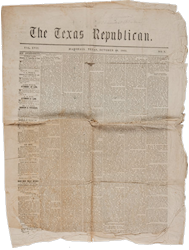
[Marshall] Texas Republican, May 19, 1860

We are requested to state that Miss Myra Rossella, or Prof. Samuel Wilson, will make a balloon ascension in Marshall, on Saturday, May the 26th, at 4 o’clock, P. M., with the largest balloon in the South, being 4 feet in diameter and 65 feet high, and containing six hundred square yards. On the night before the ascension, Prof. Wilson will give a free lecture on aerial Navigation, describing his various ascensions in Mexico, Cuba, California, and other parts of the world. He claims to have made over 200 ascensions. Such a sight has never been witnessed in Marshall, and will consequently attract the attention of the country for many miles. In this connection, we publish the following from the Central Texian, published at Anderson, Grimes county:

“We learn that on Wednesday last Miss Myra Rosella made a successful balloon ascension from the town of Navasota. The fair aeronaut soared to the distance of about a mile, and after satisfying herself and the spectators generally, returned to terra firma but a few hundred yards from her place of departure.”

0 comments

0

New York Times

The New York Times, May 17, 1860

We take from the Augusta Constitutionalist the following letter, or part of a letter, from Mr. STEPHENS, addressed to the editor of that paper. In announcing it, the editor remarks that it was received too late for insertion entire, and will publish the whole on the following day. It was written in reply to one from Several gentlemen in Bibb County, and in it he reviews the exciting questions of the day:

“There is a tendency every where, not only at the North, but at the South, to strife, dissension disorder, and anarchy. It is against this tendency that the sober-minded and reflecting men everywhere should now be called upon to guard.

“My opinion, then, is that delegates ought to be sent to the adjourned Convention at Baltimore. The demand made at Charleston by the seceders ought not to be insisted upon. Harmony being restored on this point, a nomination can doubtless be made of some man whom the party everywhere can support with the same zeal and the same ardor with which they entered and waged the contest in 1856, when the same principles were involved.

“If in this there be a failure, let the responsibility not rest upon us. Let our hands be clear of all blame. Let there be no cause for censure at our door. If in the end the great national Democratic Party — the strong ligament which has so long bound and held the Union together, shaped its policy, and controlled its destinies, and to which we have so often looked with a hope that seldom failed, as the only party North on which to rely in the most trying hours when Constitutional rights were in peril —- let it not be said to us, in the midst of the disasters that may ensue, “You did it!” In every and any event let not the reproach of Punic faith rest upon our name, If everything else has to go down, let our untarnished honor at least survive the wreck.”

0 comments

0

News of the Day
1860s newsprint

[Little Rock] Old-Line Democrat, May 17, 1860

Mr. Editor:–Perhaps there is no little town in Arkansas whose prospects are more flattering than the one that heads this article. We have in our town seven dry good stores, three large groceries and two large drug stores all doing a good business. There are now at this time ten or fifteen new buildings going up. There are also two large church houses, and a fine school house in progress; and an excellent school taught by Mr. Dayton, who is worthy of the patronage of our citizens. There are four or five wood and blacksmith shops and room for several more. We have no boot and shoemaker, but a good one could do a paying business; [illegible] a good saddlery with a good stock could do well. We are a law abiding people, notwithstanding we are blessed with the worst of all evils, five full blooded lawyers, to wit: Shapon [?] & Roach, J. E. Burns, Esq., T. W. Thompson, and the ever ready McDougle. Persons not acquainted with our little town might think that we are a lawing people, but not so, for when I state our lawyers do not live by their profession, but upon the fat of their ribs, I am correct. We are, also, unfortunately, blessed with four physicians, who live principally by fishing and large charges; for it is so seldom that they get a case that the poor fellows have to lay it on to the sovereigns to keep along; so strangers may know that we have a healthy country. The next and worst drag we have is the old bachelors; unfortunately we have six of these old drones to society, known as bachelors, to wit: Shepard, West, Swilling, Thompson, and Burns; these poor old fellows remind us very much of the drone in a bee hive, when the working bees begin to sting them. They are really the only draw back in our community. Poor old stags, I pity you. We have just returned from a visit to the school, taught by Mr. L. T. Dayton, where we heard the students declaim, and from what we have seen in the best schools of our country we are inclined to think Mr. Dayton is doing great honor to himself and the community. I would advise all interested in the education of their children within the bounds of this place to put them under the care of Mr. Dayton. In fact our town and county is fast rising to a high point of wealth and intelligence. There were at the time of holding the election two years ago nine hundred voters, and now there are about twelve hundred. There are in the limits of Pope sufficient pinery to furnish the whole State with limber, and an abundance of fine lands not taken up. There are in the town of Dover three hotels, all of which are making considerably preparations for the convention which meets here the 2nd Monday of May. Felix Grundy, as he is commonly known thro’ this country, is making considerable efforts. The Dover delegates will be well treated, and highly fed, so says Grundy.

I would recommend all who wish a nice and healthy location, to come to our county and town. Yours,

A Citizen.

0 comments

0

New York Times

The New York Times, May 17, 1860

Special Dispatch to the New-York Times.

CHICAGO, Thursday, May 17.

The Convention has made decided progress today. It has acted upon the credentials of members; designated the vote which each State shall have; adopted rules and an order of business, and laid down the platform of the party. The details of all these movements will reach you by telegraph to the Associated Press.

There were symptoms of a storm in the morning. The first signal was Mr. WILMOT’s protest against delegates from Southern States being allowed to vote. There had been a general understanding that most of them would vote for Mr. SEWARD, and Mr. WILMOT’s Movement was regarded as an attempt to diminish Mr. SEWARD’s strength. Several Southern delegates made a warm remonstrance against it, and one or two of them gave Pennsylvania some severe hits.

Mr. ARMOUR, of Maryland, repelled the intimation that Northern money might be used hereafter to influence Southern votes, and saying that the Republicans of Maryland were unpurchased and unpurchasable, and added that Pennsylvania might put that in her pipe and smoke it. Mr. BLAKELY of Kentucky said that he was in the Convention of 1856, and voted for Judge WILMOT, for President, and did not see why Mr. WILMOT now proposed to disfranchise him. After along debate, the report of the Committee was sent back with the assent of the Southern delegates, and during the afternoon a new one was made in which they were allowed a modified vote according to the districts actually represented.

This storm then subsiding, another grew out of a very unfair attempt to impose a two-thirds rule upon the Convention. The Committee reported [continue reading…]

0 comments

Indications of a hot fight.—May 16th, 1860

Through Some Eventful Years by Susan Bradford Eppes
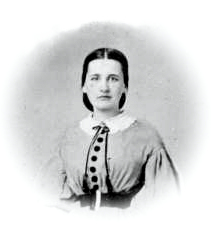
Susa Bradford Eppes

May 16, 1860.—Now that the frolicking is over and there is plenty of time to read the papers, I find much to trouble and alarm. This is a Presidential year and already there are indications of a hot fight. Brother Junius is an Old Line Whig and Father and Buddy are Democrats. They almost quarrel over their different views. Everett and Bell are the Whig candidates, while Breckinridge and Lane are ours. General Lane is our cousin and we feel an interest in his success, but there are others in the race also and nobody can tell how it will be decided.

Lincoln and Hamlin are the Black Republican candidates. This seems to be a new political party and, as near as I can come at it, they have two objects in view, the freeing of the Negroes and the downfall of the South. I am only a child but reading the papers, that is the way it seems to be.

The Convention was held in Charleston, South Carolina, and there was great excitement, the Democrats were not satisfied at putting out a good strong ticket but brought out another, Stephen A. Douglass and Herschel V. Johnston. I cannot remember which name comes first. Father regrets deeply that they should have done this, for, he says, it will weaken the chances of the Democrats.

Mattie is so cute; because her father is a Whig she says she is a Whig too, she shakes her golden curls and turns up her pretty little nose when Cousin Rob and I sing Democratic songs, one especially, sung to the tune of “Benny Havens, Oh:”

“Hark from the tomb a doleful sound,
We hear a mournful yell,
Old fogies shout discordant notes
For Everett and Bell.”

This to Mattie is like shaking a red rag at a bull, isn’t it too funny? I mean to read the papers every day and keep up with the news.

Half an hour later. Just as I was closing my diary Father, who was lying on the couch in the library where I was writing, said: “What is my baby writing? It has brought a real grown-up frown to her face.” I gave him the book to read, he did not say a word for awhile and then he said, “You are getting to be quite a politician. I didn’t know you felt such an interest,” and then he talked to me for some minutes concerning the campaign, which was even now upon us and he told me to come to him whenever there was anything I could not understand. He thought well of the plan of reading the newspapers. He said it was the duty of men and women to keep themselves informed in all matters concerning the welfare of the country.


Susan Bradford is 14 years old when this entry was made.

0 comments

0

Miscellaneous document sources

Washington, D. C, May 16th, 1860.

Dear Stephens, I recd, your letter this morning and I find myself quite surprised that while we so nearly, I may say exactly, agree in principle that we differ so widely in action. I agree with you that [what] we ought to demand is to call upon our Northern allies to stand by their bargain ; but I complain of them that they will not do it. In the first place we [believed?] in non-intervention because we held it to be a fundamental principle of law that slavery existed in the territories without local laws, or to put the case wider that it existed everywhere where not forbidden by law. The Supreme Court have decided this case in our favour; but Mr. Douglas will not stand to it. The Illinois resolutions passed 4th Jany. by his friends expressly declare that it cannot go into the territories without positive legislation. Mr. Douglas under his own hand in his controversy with Black holds the same principle. He says you are out and can not get in except by positive law and nobody but squatters can pass that law. You very truly say we did not take non-intervention on these terms. 2ndly. We did agree to leave the question of the power of the people of the territories to the courts. You admit in your letter, and I agree with that, -it is decided that Congress has not the power to prohibit it itself and could not therefore give it to the people of the territories; but Mr. Douglas denies that and presses upon us, after the decision, for public acceptance the same doctrine and with tenfold the vigour that [he] ever did before the decision. He tenders the issue, he forces it on [continue reading…]

0 comments

0

New York Times

The New York Times, May 16, 1860

Letter from John C. Fremont.

CHICAGO, Wednesday, May 16.

The following letter from JOHN C. FREMONT is in the hands of Judge STAPLES, of California:

DEER VALLEY, Mariposa County, April 12, 1860.

MY DEAR SIR: I have had the satisfaction to receive your thoroughly sincere and friendly letter of the 8th, from San Francisco.

I have to thank you equally for the warmth with which you urge your propositions in my favor, and for the very strong expressions of regret for the position I have taken. Since the campaign of 1856, I have been laboriously occupied with my private affairs, and so exclusively that I have been entirely shut off from the political life of the country. In the beginning of that contest, if I had neither political prestige nor party organization, I had had at least no organized bodies opposed to my nomination. Now the case is wholly different. You will give full faith to what I say when I tell you that I have personally no desire for the Presidency, but I do most earnestly desire to preserve undiminished the great honor which the vote of the North reflected upon me in that campaign. In this respect it would be no benefit to myself, and certainly none to the party, which I wish to serve, if under these circumstances I were brought before the Convention, where I could only be one of the elements of discord. I prefer, on the contrary, to contribute as much as possible to its harmony, and leave it, to this extent more free to make a prompt selection from among the distinguished leaders who have been actively engaged in maintaining and advancing the principles of the party. Letters and other indications had led me to think that my name would be placed before the Convention at Chicago, and wishing to have the certainty in this event that it would be promptly withdrawn, I asked you to do this friendly act for me if it became necessary. I rely confidently upon your assistance that my request will be faithfully observed. The contingency which your very friendly feelings make appear as probable, I look upon as nearly impossible. In such an event the nomination would be accepted, of course, as the choice of the party, and not as the result of a struggle for a nomination. But this, I repeat, I consider impossible.

Renewing my thanks for permitting me to avail myself of your friendship on an occasion of so much importance to me,

I am, very truly, yours,

[Signed.] J.C. FREMONT.

Addressed to Hon. D.C. STAPLES,
Delegate to the Chicago Convention.

0 comments

More Trouble on the Rio Grande

New York Times

The New York Times, May 16, 1860

Special Dispatch to the New-York Times.

WASHINGTON, Tuesday, May 15.

Adjutant-General COOPER has received a dispatch from Col. LEE, Commanding the Department of Texas, in which he says:

“I learned yesterday, through the Mexican authorities, that CORTINAS had returned to the vicinity of the Rio Grande, and had been seen near Ranchero Garsho, below Reynosa, and six miles from the river, with 10 men, though his party is said to consist of about 40. I immediately directed Capt. GEO STONEMAN, 2d Cavalry, with detachment of Companies F. and G., of that regiment, to cross the Rio Grande to-night in time to arrive before day to-morrow where CORTINAS and his followers may be secreted, and endeavor to surprise and disperse them. I also directed Capt. BRACKETT, Second Cavalry, with detachment of Companies I and H to cross the Rio Grande at or near Reynosa this evening, in time to place himself in the rear or on south of the point where CORTINAS may be concealed, and to cooperate with Capt. STONEMAN. It is possible, if the information I have received be correct, that these bandits may be suppressed. It is, however, difficult to make a secret march on the other side of the river. We have to depend upon Mexicans for guides, and the crossing of a rapid stream, swollen as it is at this time by rain, cannot be speedily or quietly effected; but should the attempt fail, it will show them that it is not entirely safe to approach our frontier. The Mexican authorities are heartily cooperating in the efforts to suppress this banditti. The list of prisoners contain eleven names, all Mexicans, it is believed”

Col. LEE notified the Mexican authorities of the orders he had given.

0 comments

0

New York Times

The New York Times, May 15, 1860

From the Associated Press.

CHICAGO, Monday, May 14.

An informal gathering, without any organization whatever, of the German Republicans, from different States, took place to-day, to consult about the manner and how it was best to secure the largest support on the part of foreign-born citizens for the nominee of the Chicago Convention.

The resolution arrived at was to endeavor to obtain from the Republican National Convention a plank in their platform recognizing perfect equality and protection to all citizens, at home and abroad, and declaring against any extension of the present term of naturalization, and against any discrimination between native and adopted citizens as to their qualifications as voters. There was no Convention, and the idea of holding one during the sitting of the National Convention seemed to meet with no favor.

Messrs. CHASE, SEWARD, LINCOLN and WADE were the Presidential preferences of the gentlemen present.

The best feeling prevailed, and all present appeared animated with the desire to do everything to secure a Republican victory in November.

The Committee acting for EDWARD BATES have issued an address today, giving various reasons why that gentleman should be nominated for President. They say Judge BATES, though a theoretical and practical emancipationist, is a native and life-long resident of a slaveholding section of our common country.

His nomination, therefore, would be a signal and final refutation of the charge of sectionalism so unfairly, and yet so effectively urged against the Republican Party, and would render the fire-eating threats of disunion, in case of a Republican triumph, palpably futile and ridiculous. He is the favorite, and candidate of the entire Opposition of Missouri, and will be supported by them, not merely with enthusiasm, but with a confidence of success. We firmly believe Judge BATE’s nomination would nearly dissolve the organization, which has presented to the nation the highest respectable name of JOHN BELL and EDWARD EVERETT, and induce nine-tenths of those hitherto known as Americans, Old-Line Whigs, Union men, &c., to cooperate heartily with us in rescuing the country from the hands into which she has been permitted to fall. We believe now, by a united Opposition, Pennsylvania and New-Jersey will be united, and by the nomination of EDWARD BATES, Indiana, Illinois and Oregon will be carried, and a triumph in November thus placed beyond contingency. In conclusion, we say we entreat you to present the name of EDWARD BATES as the olive branch to the various parties which earnestly desire to overthrow the filibustering, Slavery-extending, sham-Democracy, as a proffer of fraternization and kindly regard. Do this in a generous, magnanimous spirit, and you will have vindicated our cause from the unjust, but damaging, imputation of Sectionalism. The address was signed by F.P. Blair, Horace Greeley, John D. Defrees, John C. Fogel, James B. Eads, Dr. A. Wammer, Commitee.

The excursion trains from Suspension Bridge via Michigan Central, and from Buffalo via Michigan Southern, arrived at 9 1/2 o’clock. It was received here at the depot amid the firing of cannon by an immense concourse of persons, and escorted thence in procession through the principal streets to the “Wigwam,” where speeches were made by Col. CURTIN, of Pennsylvania; T. HOSSARANK, of Ohio; CALEB SMITH, of Indiana, and other distinguished gentlemen. Much disappointment was felt at not hearing TOM CORWIN, who was announced to speak this evening. Every train arriving brings large accessions to the already great number of visitors.

The excursion train on the Michigan Southern road arrived here at 9 1/4 o’clock. That on the Michigan Central road at 9 1/2 o’clock. Both ran the distance between Buffalo and Chicago in from fifteen to fifteen and a half hours, with very heavy trains. On the Southern routes demonstrations were made at stations with bands of music and cannon. On reaching Chicago, the banks of the harbor were lined with Wide Awakes bearing torches, while every building was brilliantly illuminated.

A procession was formed to conduct the delegates to hotels. The streets were thronged, and much enthusiasm was manifested. The principal hotels are already filled to overflowing.

The time of the special Convention train from Buffalo to Chicago to day was as follows: Buffalo to Erie, 88 miles, 2 hours 23 minutes; Erie to Cleveland, 95 miles, 2 hours 28 minutes; Cleveland to Toleoo, 112 miles, 3 hours; Toledo to Chicago, 233 miles, 6 hours 15 minutes.

0 comments

0

New York Times

The New York Times, May 15, 1860

The leading Democratic paper of the Southwest, the Louisville Democrat thus pronounces for Popular Sovereignty and against the Charleston Secessionists:

The action of the recent Convention is the theme of all discussions. Will it result in the dissolution of the Union? We see no cause to anticipate such a result. The party has at once and forever repudiated disunionism. It has refused to strike its colors either at the bid of venal politicians or honest but misguided disunionists. The Convention at Baltimore will be a strong conservative body. Its course will be dictated by wisdom and moderation. The yells of hired, slanderous and venal politicians who have created turmoil and confusion will sink before the strong voice of the multitude counseling wisdom. It was probably right that the Convention should give the seceding States an opportunity to be heard. They were misrepresented by some of their delegates who went to Charleston not to nominate, but to defeat a nomination. The will of the people, their love for the Union, and their nationalism were sacrificed to the lowest shemes, and a rebuke will be given. From every State we will receive delegates for measures, and not some as opposed to one man, and that man the one whose whole life has been one gallant and generous fight for the Democracy. Whoever counsels disunion counsels treason. Whoever glories in secession is an enemy to his country. He would rejoice at her downfall and fatten on her dead body as the sow which eats her farrow. The rebuke to such men must come from public opinion, and those whom they threaten. There are no disunionists in Kentucky, and we rejoice at it.

Of all the parties and factions that have struggled in Kentucky since she became a State, not one has ever dared to whisper such a desire. A speaker counseling disunion would be hissed, if not pelted, from the stand. We hold these secessionists at Charleston, from the Convention, as equally culpable, only a little less honest. The avowed disunionist has some reason for it. He believes the present form of Government injurious to the interests of his section, but these secessionists do not. They throw off the party because it does not assert that Congress should give protection to a specific property, when it cannot and will not; and yet when assembled in this fragmentary Convention, they themselves refuse to demand such laws. They do not declare that Congress must pass laws now to protect Slavery. No, this resolution was voted down. They say that in an emergency, at some future period, Congress must do so. If there ever is to be an emergency, it has arisen. Territories have not only indirectly but directly excluded slavery. No wonder some honest disunionists, slave protectionists, were kicked out of that foul body. It had not even the plea of honesty in opinions to excuse its folly. Its carcass was putrescent at birth, and foul with loathsome corruption. If the Kentucky delegation had been led into this disreputable business, all the water in the Ohio could not have washed them pure enough to make them welcome home. Kentucky holds no terms with these men. She is true to the Union, true to her political principles, and an uncompromising opponent of fraudulent trickery and political chicanery. If she takes a side, it will be open and above board and without reserve.

The Baltimore Convention will nominate DOUGLAS beyond a doubt. The opposition in the South, where it is honest, straightforward disunion, is scarcely a fragment. The political wire-workers, who seceded, are gone, and in their place we will have men fresh from the people. They may prefer another, but they will not sacrifice the party to favoritism. Our party will come forth from the fire purified and strengthened. Many office holders will be laid in limbo. The sweets of private life will be conceded to many political aspirants in the Southern seceding States, and our candidate will sweep the Union like fire in the prairie, and the nation will have a new lease of life.

0 comments

0

New York Times

The New York Times, May 14, 1860

Hon. JOHN BELL, Union candidate for the Presidency, having been serenaded in Philadelphia on Friday evening, responded to numerous calls in the following speech:

FELLOW-CITIZENS: —  It would be contrary to the feelings of our nature, if I did not feel deeply sensible of the compliment which you have paid me to-night, by an assembly on this occasion, a large portion of whom, I flatter myself, have done so in approval of the proceedings of the Baltimore Convention which has just adjourned. (Loud cheers.) I know it is impossible, also, that I can have caused, this large assemblage of exclusive friends of mine, or of the cause in which I have been put forward by an assembly formed, as I am told, of as great, pure, and distinguished individuals, patriots and statesmen as has ever assembled upon any similar occasion in the United States. (Applause.) I know that I cannot have the honor nor the unanimous approval of an assembly like this. Still, I flatter myself that the large majority of them have assembled to-night to signify their approval, and to give their sanction, so far as they can by their manifestations of interest in the cause in which, those of the Convention, as well as myself, are engaged. I do not appear before you, as my distinguished friend did me the justice to state, to make you a regular speech, either upon the topics of the day or upon the issues which have distracted and agitated the country, or for anything else, more than to express my simple acknowledgements for the honor done me by the nomination at Baltimore, and to thank you for this manifestation of your kindness and confidence in me. [Prolonged cheering.] [continue reading…]

0 comments

0

New York Times

The New York Times, May 15, 1860

Special Dispatch to the New-York Times.

CHICAGO, Monday, May 14.

The passengers by the Southern Lake Shore Line left Buffalo this morning, and reached Chicago at 9 o’clock this evening. Great enthusiasm was exhibited all along the route; at every point crowds of people thronged the depots. Bands of music, the booming of cannon, and numberless cheers, testified the great interest felt by the masses touching the objects of the Convention.

At this point an immense procession was formed at the depot. A brass band led off, and the immense concourse escorted the delegates through Lake-street, which was brilliantly illuminated. It is estimated that at least twenty thousand people joined in the welcome.

Among the arrivals by the Southern route are Gen. WEBB and Hon. HENRY RAYMOND, of New-York, Mr. TRASK, of Massachusetts, and many of the Eastern delegations. The New-Yorkers mostly came by the other route. The feeling is strong for Mr. SEWARD, but the main question seems to be who can be elected? Can Mr. SEWARD? If so, then he is the first choice.

The opinion of the Pennsylvania, New-Jersey, Illinois and Indiana Delegations will have great weight in deciding this point.

BANKS has many friends. He has six in the Massachusetts Delegation. Nineteen from that State are for SEWARD, and the other is doubtful.

The Rhode Island Delegation was originally half Republican and half American. Since the Baltimore nomination the Americans have bolted, and some trouble is experienced in filling the vacancies.

Maine and Vermont are openly for FESSENDEN. One-third of the Ohians are for CHASE; the balance incline to WADE. CHASE’s free trade record hurts him.

The hotels are crowded; the streets are alive with enthusiastic shouters, and the spirit of 1840 seems to have revived and broken out afresh.

The Seward men are very confident. The Chase and Wade men work together. The Banks men are quiet, but expect a rally will be made in his favor at an early period. Illinois alone works hard for LINCOLN.

HOWARD.

0 comments

0

New York Times

The New York Times, May 14, 1860

AUGUSTA, Sunday, May 13, 1860.

At a Democratic meeting at Atlanta, on Saturday, the Postmaster defended the Charleston secessionists and denounced DOUGLAS as a traitor to the Democracy and the South. B.C. YANCEY made a lengthy and similar speech. The National Baltimore Democracy was defended by Col. GASKILL. The meeting adjourned for a week.

0 comments

0

New York Times

Edward Everett - Selected as nominee for Vice-President of the United States on May 10, 1860, at the Constitutional Union party convention in Baltimore, Maryland.Edward Everett — Selected as nominee for Vice-President of the United States on May 10, 1860, at the Constitutional Union party convention in Baltimore, Maryland.

Wikipedia:

Edward Everett (April 11, 1794 – January 15, 1865) was an American politician, pastor, educator, diplomat, and orator from Massachusetts. Everett, a Whig, served as U.S. Representative, U.S. Senator, the 15th Governor of Massachusetts, Minister to Great Britain, and United States Secretary of State. He also taught at Harvard University and served as its president.

Everett was one of the great American orators of the antebellum and Civil War eras. He is often remembered today as the featured orator at the dedication ceremony of the Gettysburg National Cemetery in 1863, where he spoke for over two hours—immediately before President Abraham Lincoln delivered his famous two-minute Gettysburg Address.

0 comments

0

New York Times

John Bell, 1860 Constitutional Union Party Candidate for PresidentJohn Bell, two-term U.S. Senator from Tennessee, November 22, 1847 – March 3, 1859, Selected as nominee for President of the United States on May 10, 1860, at the Constitutional Union party convention in Baltimore, Maryland.

From Wikipedia

John Bell (February 18, 1796 – September 10, 1869) was an American politician, attorney, and planter.  One of Tennessee’s most prominent antebellum politicians, he served in the House of Representatives from 1827 to 1841, and in the Senate from 1847 to 1859. He was Speaker of the House for the 23rd Congress (1834–1835), and briefly served as Secretary of War during the administration of William Henry Harrison (1841). In 1860, he ran for president as the candidate for the Constitutional Union Party, a third party which took a neutral stance on the issue of slavery.

Initially an ally of Andrew Jackson, Bell turned against Jackson in the mid-1830s and aligned himself with the Whig Party, a shift which earned him the nickname, “The Great Apostate.” He consistently battled Jackson’s allies, namely James K. Polk, over issues such as the national bank and the election spoils system. Following the death of Hugh Lawson White in 1840, Bell became the acknowledged leader of Tennessee’s Whigs.

Although a slaveholder, Bell was one of the few southern politicians to oppose the expansion of slavery in the 1850s, and campaigned vigorously against secession in the years leading up to the American Civil War. During his 1860 presidential campaign, he argued that secession was unnecessary since the Constitution protected slavery, an argument which resonated with voters in border states, helping him capture the electoral votes of Tennessee, Kentucky, and Virginia. After the Battle of Fort Sumter in April 1861, Bell abandoned the Union cause and supported the Confederacy.

0 comments

0

New York Times

The New York Times, May 12. 1860

BOSTON, Friday, May 11.

Extensive drought throughout New-England is causing great trouble to farmers, who, in some parts of New-Hampshire, drive cattle many miles for water. Fires in the woods are also raging in many localities. At Hyannis, on the Cape, yesterday, a fire spread over 1,000 acres of woodland, and was quite extensive.

0 comments

0

News of the Day

[Little Rock] Arkansas True Democrat, May 12, 1860

Proposals will be received by the undersigned at the Anthony House, Little Rock, or by letter, for the supplying along side of the Memphis & Little Rock Railroad, of Telegraph Poles, of the following character and dimensions; of post oak, sassafras, or black locust, 22 feet long, straight trimmed, and not less than 8 inches at the butt, or 4 inches at the top. The poles to be delivered, singly, at the distance of 260 feet apart, along the line of the Memphis & Little Rock Railroad.

Divisions as follows: Little Rock to Brownsville—Brownsville to Duvall’s Bluff— Madison to Memphis. The divisions will be divided to suit the parties along the line. An inspector will examine the poles when delivered, and the cash paid. Those proposing between Madison and Memphis, will find an Agent at the Railroad Office in Madison. All propositions to be made in writing up to June 1st, and all contractors to commence work by the 4th June.

 Snow & Ketchum.
Little Rock, May 12, 1860.

0 comments

0

News of the Day

[Little Rock] Arkansas True Democrat, May 12, 1860

Visitors to the Hot Springs have commenced early this season. Every stage and steamer adds to the number. About one hundred arrived last week. The Anthony House has been under the necessity of putting up extra cots, even in the parlors. The additions now contemplated to the hotel, will add several more rooms. Another large hotel is much needed.

0 comments

0

Miscellaneous document sources

Washington, D. C, 12th May, 1860.

Dear Stephens, I recd, your letter of the 8th inst. yesterday. It seems from yours that you had not recd, a letter I wrote you some week ago or more inclosing new brief in the Persons and Oliver case and giving you my action and views on the present state of things. When I saw that Douglas’s friends voted to make a platform before electing a candidate, thus playing into the hands of Alabama, I knew his friends look[ed] for and desired secession from the convention; and when their platform appeared refusing even an endorsement of the Dred Scott case, I telegraphed Irwin to show to our delegation to keep the South a unit, get a sound platform and a sound Southern man on it and if they found that was impossible, to bolt. A full view of the facts since the adjournment has satisfied me that my advice was good and I approve the action of the majority of delegates. I fought the campaign of 1848 against the doctrine of territorial intervention against slavery. I am not aware that I ever have by act or deed or thought altered my position on that question. I certainly never intended to do so, and recent events do not at all incline me to modify my hostility. I looked upon it with such contempt that I never made it [a] test, but I certainly would never submit to such a test. Douglas’s Harper article has indoctrinated all of his friends with his folly; and his success without a party disclaimer of his doctrines would compromit us forever. [continue reading…]

0 comments

0

Harper’s Weekly
The Republican Wigwam at Chicago, in which the Republican Convention will be held, May 16, 1860 - Harper's Weekly, Saturday May 12, 1860

The Republican Wigwam at Chicago, in which the Republican Convention will be held, May 16, 1860

Harper’s Weekly, Saturday May 12, 1860

Republican Wigwam at Chicago.

We present herewith a view of the new building yclept the ” Republican Wigwam”—which the Republican clubs of Chicago have built for the National Republican Convention to be held in that city on 16th inst. It reflects credit on the liberality of the Chicago people.

The building stands on the corner of Lake and Market streets, a very suitable location. It is 100 feet by 180; the cornice stands 40 feet from the ground. the ground-floor, inside, is divided between the stage, which will seat 1800 persons; two large commodious committee-rooms, one on either side the stage; and the floor of the hall, which will accommodate, it is said, 8000 persons. The floor rests on an inclined platform, so that persons on the rear seats will have a good view of the stage. For spectator s, a gallery 33 feet wide runs round three sides of the building: a portion of this is set apart exclusively for ladies, and has a separate entrance, The roof of the hall is arched, and in it are five sky-lights, which, with the doors and windows on three sides, will afford ample light and ventilation. At night the whole building will be lit with gas.

The erection of such a building on such short notice, and for such a purpose, shows that the Western people are not so poor as many are fond of asserting.

The architect of the building is Mr. W. W. Boyington.


Wikipedia:

Antebellum custom was to call a political campaign headquarters a Wigwam. Wigwam is also a Native American word for “temporary shelter”.

The Wigwam was a convention center and meeting hall that served as the site of the 1860 Republican National Convention. It was located in Chicago, Illinois at Lake Street and Market (later Wacker Drive) near the Chicago River. This site had previously been the site of the Sauganash Hotel, Chicago’s first hotel. This is where supporters ushered Abraham Lincoln to the party nomination and the eventual U.S. Presidency.

The two-story Wigwam was built by Chicago business leaders to attract the 1860 Convention. It was a temporary structure, built entirely of wood in little more than a month, and it could accommodate 10–12,000 people. The building was used for political and patriotic meetings during the Convention and the American Civil War. It also served as a retail space until its demolition, some time between 1867 and 1871.

0 comments

0

New York Times

The New York Times, May 12. 1860

BOSTON, Friday, May 11.

A Spanish brig, supposed to be a slaver, was brought into Provincetown last evening by Mr. HILL, second mate of the schooner Rienzi, which fell in with her at sea. She had all sail set. No one was on board of her. She was furnished with large quantities of water, rice, peas, beans, bread, fish and beef, and had also a large amount of lumber for a slave deck. She was probably from Havana for Africa. A receipt on board had the words “Brig Don Juan” written on it.

0 comments

0

New York Times

BALTIMORE UNION CONVENTION.; A PLATFORM ADOPTED.

Hon. John Bell, of Tennessee, Nominated for President.

Hon. Edward Everett, of Massachusetts, for Vice-President.

Entire Harmony and Unbounded Enthusiasm.

From the Associated Press.

AFTERNOON SESSION.

The New York Times, May 11, 1860

Special Dispatch to the New-York Times.

BALTIMORE, Thursday, May 10.

Before the Convention assembled this morning circulars and handbills were liberally circulated through the Hall, setting forth the availability of Gen. HOUSTON for the Presidency, with EDWARD EVERETT for Vice-President. Though the current had, during the night, set strongly against HOUSTON, his supporters had been very busy. It was understood that a damaging break had been made against HOUSTON in the New-York delegation, and that BELL would receive ten to fifteen votes from that state.

All the States but Michigan, New-Hampshire, California, Oregon and Wisconsin responded in the Convention this morning at roll-call.

JOSEPH R. INGERSOLL, of Pennsylvania, from the Business Committee, reported the following Platform:

Whereas, Experience has demonstrated that Platforms adopted by the partisan Conventions of the country have had the effect to mislead and deceive the people, and at the same time to widen the political divisions of the country, by the creation and encouragement of geographical and sectional parties’ therefore,

Resolved, That it is both the part of patriotism and of duty to recognize no political principles other than the Constitution of the country, the Union of the States, and the enforcement of the laws; and, as the representatives of the Constitutional Union men of the country, in National Convention assembled, we here pledge ourselves to maintain, protect and defend, separately and unitedly, these great principles of public liberty and national safety, against all enemies at home and abroad; believing thereby that peace may at once be restored to the country, the just rights of the people and of the States be established, and the Government again placed in that condition of justice, fraternity, and equality which, under the example and Constitution of our fathers, has solemnly bound every citizen of the United States to maintain a more perfect union, establish justice, and secure domestic tranquillity; provide for the common defence; promote the general welfare, and secure the blessings of liberty to ourselves and our posterity.

The platform was adopted without dissent, amid great cheering.

After much debate, each State was allowed to cast the number of its electoral vote; every delegate to vote for himself.

The Convention then proceeded to ballot for a Candidate for the Presidency.

The first ballot indicated beyond question that Hon. JOHN BELL was the preference of a majority of the Convention; an indication confirmed by the second ballot when Mr. BELL had 138 votes, Gen. HOUSTON 69, and the remainder scattering. One by one the delegations from various States commenced changing their votes to BELL, and finally, speaking for a large majority of the New-York delegation, Mr. ERASTUS BROOKS proposed that the nomination of Mr. BELL be made unanimous.

The motion was carried with exalted enthusiasm, and Mr. BELL was declared to be the candidate.

The first ballot for Vice-President, resulted in the selection of Hon. EDWARD EVERETT.

The hidden break-down of the Houston interest, and the nomination of BELL, is a sore thing to many of the New York Delegates. Nearly a dozen of them refused to make the choice unanimous. It is believed to be the only sore spot in the Convention. The Southern Delegates generally are much elated, and say that he will carry Tennessee, Maryland and North Carolina any way, and, with two Democrats running, a majority of the Southern States. The Democratic Party in the South is said to be in a more broken condition than in the North. That the election will be carried into the House is confidently predicted. The proceedings attending the nomination of EVERETT were a love feast, which healed all differences. The unmixed Whig character of the ticket does not escape remark. An occasional Democrat suspects that this is little less than a Whig Convention. Nevertheless it is the general belief in and out of the Convention that it is the strongest that could have been made. The Kentucky Delegates express great satisfaction, as do the supporters of Gen. Houston generally, with the election of Mr. EVERETT. A dispatch from New-Orleans, received in the Convention, pledges Louisiana for the ticket.

The New-England delegates are much elated. The Editor of the Boston Courier at once telegraphed to have the ticket run up at the head of its columns.

There is no doubt that, if he would have consented Mr. CRITTENDEN would have been nominated, instead of Mr. BELL.

Gen. HOUSTON will remain the candidate in Texas.

It is believed that there will be no third Electoral Ticket run in New-York, but that the Union men of that State will be left to decide between the Democratic and Republican tickets.

Gov. HUNT, in declining the nomination for Vice-President, stated that he would allow nothing to interfere with his purpose to act independently and effectually in his State. The remark was regarded as significant.

The speeches of Maj. HENRY, of Tennessee, and Mr. HILLARD, of Massachusetts, were efforts of great eloquence.
2 comments

0

Diary and Letters of Rutherford Birchard Hayes
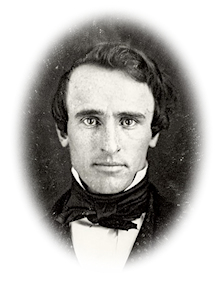
Rutherford B. Hayes (young)
CINCINNATI, May 11, 1860.

DEAR UNCLE – Our delegates have left for Chicago. After Chase, they will prefer Wade, Fremont, or some such candidate—anyone named before Seward.

Sincerely,

R. B. HAYES.

S. BIRCHARD.

0 comments